Final Landing of one of those “Magnificent Men in their Flying Machines”

Farewell to a hero who participated in the greatest adventure for a Jew in 2000 years

By David E. Kaplan

Less than two years ago on the occasion of his 100th birthday, Lay of the Land interviewed Harold ‘Smoky’ Simon, who passed away this week a few months shy of his 102 birthday.

Thumbs Up. At 100, Smoky Simon in 2020 again takes to the skies over Israel in a Tiger Moth he once helped repel the enemy in the War of Independence.

And what did this former South African and Chairman of World Machal (Mahal is the Hebrew acronym for Mitnadvei Hutz La’aretz – volunteers from abroad who came to fight in Israel’s War of Independence) do on that occasion?

Most blokes of a seriously senior age might settle for a thin slice of birthday cake or a “medicinal” scotch; but not Smoky. Donning a helmet and goggles and grinning from ear to ear like a mischievous teenager, the centenarian climbed  into a single propeller Tiger Moth and flew over the very area where in 1948 he and his comrades helped repel the advancing Egyptian attack.

Dubbed the “Flight of the Century”, the video made of the 2020 historical flight went viral on YouTube.

Exhilarating,” was the way he  described to this writer in one word of that flight.

It had truly been a “family Affair” for in separate planes alongside their dad’s aircraft were his two proud sons, Saul and Dan, who after their schooling, followed in their father’s ‘flightpath’ by becoming top pilots and flight instructors in the Israel Air Force (IAF). What a joy for the birthday boy when he alighted  from the plane an hour later to be met by his adoring grandchildren screaming proudly, “Saba,Saba” (“grandfather, grandfather”).

If the experience at 100 felt personally liberating”, the nuance was not lost on Smoky who told this writer:

 “You know, the area I just flew over  – the central Negev – was the very first area to be LIBERATED in the War of Independence.”

While the War of Independence was Israel’s longest war lasting eight months from May 1948 to January 1949, “it was also its costliest with 6,373 military and civilian lives lost out of a population of 650,000,” said Smoky. “What’s more, it was also Israel’s most fateful war for if this war had been lost, the prayers, hopes and dreams of 2000 years would have vanished into thin AIR.”

To ensure that did not happen, it took the likes of this plucky South African aviator, who in 1948,  – took to the AIR to fight for Jewish survival and independence.

Fine Tuning. Final preparations before taking off on his 100th birthday.

LOVE IS IN THE AIR

There are not too many couples who can say  they selected a war to come on honeymoon, but that is what Smoky, and his young bride Myra did in 1948. “When the South African Zionist Federation began recruiting ex-WWII servicemen and it became clear there was going to be an imminent war, we brought our wedding date earlier.

“Howcome?” I asked. 

“Well, when  I said to Myra,  ‘We have got to postpone our wedding,  because I’m going to Palestine,’ she replied, “Not postpone, advance because IF YOU’RE GOING, I’M GOING!” 

Dynamic Duo. Saluting one of the last living heroes of Israel’s fight for independence in 2019, Harold “Smoky” Simon displays his Nefesh B’Nefesh’s Sylvan Adams Bonei Zion Lifetime Achievement Award, together with wife Myra, who had been a meteorologist in the SAAF and  joined the South African Zionist Federation group to volunteer to fight alongside her husband for the emerging Jewish state. (Source: Nefesh B’Nefesh via Facebook Sept. 24, 2019.)

This is how Smoky and Myra were part of the first group of volunteers from South Africa. “We arrived on the 9 May 1948 and the next day we signed on to serve in the new-born Israeli air force, although on that day we did not know yet it was Israel – we spoke of Palestine.” While Myra had served in the SAAF during WWII as a meteorologist  and became the first instructor in meteorology in the IAF, Smoky, who had flown for the Royal Air Force (RAF) over the deserts of western Egypt, Libya and Tunisia and later over Sicily and the rest of Italy, was about to again ‘take off’ into history. “Fighting the Nazis gave us the skills and the experience we needed to fight for Israel,” he said.

And fight they did!

Hearing from a Hero. South African-born accountant Smoky Simon, who became chief of air operations of the nascent Israeli Air Force in May 1948, speaks at Tel Aviv’s Beit Hatfutsot Museum. (PHOTO JUDY LASH BALINT)
 

On the 14 May 1948,  while David Ben-Gurion was declaring the State of Israel in Tel Aviv, Smoky was one of three people who had a clear disturbing view of what was about to befall the new state. The other two were fellow South African, Boris Senior and an Israeli photographer, Shmulik Videlis who were flying in a Bonaza in what was the first reconnaissance flight over enemy territory. Boris was the pilot, Smoky, the navigator.

They observed with sinking hearts; the roads leading from Transjordan and Syria lined with hundreds of vehicles, tanks trucks, half-tracks, and armoured cars, “all moving in for the kill.”

They could see Kfar Etzion “had already been overrun and was on fire,” and would soon learn that some 200 members of Kfar Etzion had been killed in its defense, including South Africans.

Returning to Tel Aviv for their debriefing, they could hardly conceal their anxiety.

We know,” said Yigal Yadin, Head of Operations.

What Smoky did not know but discovered on landing was that while he had been in the air, Ben Gurion had declared independence and the new state had a name – “ISRAEL

I always say,” said Smoky, “that when I left on that reconnaissance mission,  I took off from Tel Aviv Palestine but when I  landed at the same location it was  Tel Aviv Israel! Our world had  changed forever.”

AGAINST ALL ODDS

The anxiety felt by all was understandable. “All we had were a few Tiger Moths, Cessnas and Austers. This made up our ‘Bomber Command’. Egypt had 62 frontline aircraft, including British Spitfires and Italian Macchis and here we were completely exposed without a single combat aircraft or anti-aircraft gun. I keep reminding myself – and I thought of this when flying again for my 100 birthday in the Tiger Moth –  that we are really living in a miracle.”

Planning & Plotting. With Israel’s future ‘up in the air’, standing around the table are (l-r) Aharon Remez (Chief of Israel Air force), Smoky Simon (Mahal – Chief of Operations), Shlomo Lahat (Squadran Commander and latyer Mayor of TYel Aviv) and Chris (Map section of Air Force).
 

The leaders of the Jewish community in Palestine at the time were aware that a declaration of statehood would be met by an immediate invasion by Arab armies.

And the warning was clear in the words of US Secretary of Defense, James Forrestal:

 “There are thirty million Arabs on one side and about six hundred thousand Jews on the other. It is clear that in any contest, the Arabs are going to overwhelm the Jews. Why don’t you face up to the realities? Just look at the numbers!”

Jew could expect no quarter. These words by the first Secretary-General of the Arab League, Abd Al-Rahman Azzam Pasha were chilling:

 “It will be a war of annihilation. It will be a momentous massacre in history that will be talked about like the massacres of the Mongols or the Crusades.”

What was going through Ben Gurion’s mind to proceed with a declaration of independence?  “You know,” says Smoky, “I have asked myself a 1000 times, what sort of inspiration  and courage and determination  he had. Only answer I can find, is  Ein Br’eira – “No Choice

Israel’s position was bleak. It was a David and Goliath scenario of bringing the proverbial staff and sling to a battlefield against five well-equipped armies.

In our few Austers and the few Cessnas brought over from South Africa, we flew off into battle with a pilot, navigator and what we called “bomb-chuckers”. These fellow held the bombs on their laps  – 20 and 50 kilograms –  and at a height of 1500 to 2000 feet,  they would chuck ‘em out and drop them on the  enemy. We would then fly back to base  counting our lucky stars, ‘reload’, and then off again on our next trip.”

Incredulous, I ask:

Wasn’t this very dangerous?”

Well, before opening the aircraft’s door and pitching-out the bombs, we would tie the bomb-chuckers to each other with rope, so that they would not fall out of the plane along with the bombs. Sometimes, for good measure, we also threw out crates of empty bottles which made a terrifying noise scarring the hell out of the population below. If we did not have the goods, we had to pretend!

This is how the IAF in this modest way, developed into this amazing world class air force of today.”

AN OFFICER AND A MENSCH

MODEST” it was, as Smoky attested in this delightful anecdote. On being made Israel’s first Chief of Air Operations in 1948 with the rank of Major or the equivalent of “Squadron Leader”, he needed to display his new rank. However “we didn’t have any.”

Man on a Mission. Air navigator, Smoky Simon, Machal – Chief of Operations in 1948.

So what did you do? “Not me, Myra. She went to a haberdashery shop in Allenby Street and purchased a few pieces of ribbon and sowed it on to my uniform to display my rank.”

To lighten the tension, the night before Smoky’s aerial attack on Damascus on the 10th of June 1948 – the first attack on an enemy Arab city – Smoky said to Myra:

 “Now at least if I get shot down, they will know I am an ‘Officer and a gentleman’!”

Smoky’s plane did six runs over Damascus that night creating the impression “that we were part of a large formation.”

As it was mostly subterfuge causing negligible  damage besides  “a few fires”, the next day, “all the foreigners fled Damascus as they feared our ‘air force’ was about to hammer them.”

MODERN DAY MIRACLE

While Egypt and Jordan were equipped by the British, Syria and Iraq in the early days of the war, Smoky reminded that “Israel had only one friend in the world and that was Czechoslovakia. You know, we owe such a debt to that country. It was Israel’s lifeline and I still keep in touch with guys in Czechoslovakia (Czech Republic) to this day.”

Amplifying on the contribution, Smoky continued:

Firstly, they provided 25 German Messerschmitts,  and what was so remarkable was  – I call it a miracle within the bigger miracle – was that the first four Messerschmitt’s,  which  were brought in parts to Israel and reassembled under the strictest security,  were ready on the 29th of May –  two weeks after the declaration of the State – for an operation that literally saved the war and the State of Israel.

Taking a deep breath, Smoky continued:

“The Egyptians had overrun the kibbutzim in the south and reached Ashdod,  and the next day they would have been in Tel Aviv, where Ben Gurion and the provisional government was located, and the War of Independence would have been lost.”

So who flew these planes to counter the Egyptians?

Two Mahalniks (volunteers from abroad), Lou Lenart an American who led the attack and Eddy Cohen a South African, who was sadly killed in the operation, and two Israelis, Ezer Weitzman, later President of Israel and  Modi Alon.  And I call that day, Israel’s day of survival. It was one of the IAF’s greatest moments.”

War & Remembrance. Mahal heroes (l-r) Migdal Teperson, Smoky Simon, Joe Woolf and Ruth Stern at a Guard of Honour of Mahal volunteers at the Mahal Memorial on Yom Hazikaron 2011

The attack came as a shock to the Egyptian commanders who had believed Israel to be without combat aircraft and suddenly this air attack by the four Messerschmitts halted their advance. Says Smoky, “The Egyptians fell on the defensive and would not be in Tel Aviv in 48 hours as their government-controlled media had boasted. Tel Aviv receded from their grasp! I always think of Churchill’s words of the Battle of Britain, “Never has so much been owed by so many to so few”.”

Amongst that “few” was Smoky, who served until his passing as Chairman of World Machal (Organisation representing the volunteers from overseas in the Israel Defense Forces). In the words of Israel’s founding father and  first prime minister, David Ben Gurion:

The Machal forces were the Diaspora’s most important contribution to the survival of the State of Israel.”

Saviors of the State. Two of the founders of the Israel Air Force, Smoky Simon, Chief of Air Operations (left), Sid Cohen (right) who commanded 101 Squadron and Maurice Ostroff (centre), commander of radar station Gefen seen here in 2005 at a TELFED (SAZF in Israel) event honouring all the MACHAL volunteers, some who attended from overseas.  Click here to listen to a March 2015 Voice of Israel interview with Smoky Simon telling the authentic story about the creation of the State of Israel.

Seventy-two years on from those fateful days, Smoky – at the wonderful age of 100 – was back in the cockpit, revisiting in a similar plane over a familiar terrain and reflecting “what was achieved.”

In his professional life after the war, Smoky would make a huge impact on the insurance industry in Israel eventually selling his agency to one of Israel’s largest insurance companies. However, it was because of people like of Smoky that offered the best INSURANCE for Israel’s survival.  Ensuring that story of survival remains alive for future generations, Smoky dedicated his life to engaging with youngsters in Israel and abroad, including recruits in the IDF, educating them on the vital role of the ‘Machalniks’ in securing a future Jewish state.

Smoky was a man of initiative and action, and what better way to paraphrase that there was:

‘NO SMOKY WITHOUT FIRE’


While the mission of Lay of the Land (LotL) is to provide a wide and diverse perspective of affairs in Israel, the Middle East and the Jewish world, the opinions, beliefs and viewpoints expressed by its various writers are not necessarily ones of the owners and management of LOTL but of the writers themselves.  LotL endeavours to the best of its ability to credit the use of all known photographs to the photographer and/or owner of such photographs (0&EO).

Farewell Arnie

A tribute to a kibbutz icon

By David E. Kaplan

For me as I’m sure for sure for many generations over many years, Arnie Friedman – who passed away  earlier this month on kibbutz Yizre’el in the Jezreel Valley near Afula in north-eastern Israel – was the wide,  warm, welcoming outstretched arms of his beloved community.

You did not need a sign at the entrance that read in Hebrew “Welcome to Yizre’el”, you just needed Arnie standing there to meet you.

I recall as a journalist, my last published article on Arnie. It was two years before corona and his line:

It’s never too late”.

What did he mean by that?

The story that unfolded revealed so much of the character and humour of Arnie, of selfless service to others, his commitment with the capital ‘C” to the Jewish youth movement in South Africa ‘Habonim’, and of finally fulfilling dreams, no matter how long it takes!

“THE GRADUATE”

Special People. Arnie and Peggie Friedman in their garden on kibbutz Yizre’el. (Photo David Kaplan)

In 2018, I wrote that 83-year-old Arnie Friedman would be walking down the aisle. Not the one that comes first to mind – being happily married to Peggie – but another aisle that he missed walking down over sixty years earlier in Cape Town, South Africa. Due to circumstances having denied him the opportunity of enrolling at the University of Cape Town (UCT) in 1950, in 2018 Arnie walked down the aisle at the Max Stern Academic College of Emek Yezreel in Israel to receive his Bachelor of Arts degree.

And Peggie, who stood with Arnie under a Chuppah in 1957, stood beside him again as he was conferred his degree – the fulfilment of a lifelong dream.

It had been a  long time coming.

In his final years at SACS in Cape Town in the late 1940s, “I, like my mates, already started taking preliminary subjects at UCT in preparation. You could do that in those days.”

However, for Arnie, it would lead nowhere!

The family were in dire financial straits and could not afford university tuition fees. Following his father’s return in 1944 from the war in North Africa, he opened a business with an uncle “that struggled,” said Arnie. “Having battled the Nazis, I did not have the heart to pressure my Dad who was now battling financially.”

Studying at university was thus put on hold.

It remained on my to-do list; just a question of – when.”

Arnie took a job with Woolworths, where much of his salary went to help support his family, but when after a few years, it became feasible to enroll at UCT, “Habonim in Cape Town asked me to be Mazkir Klali (Secretary General), which I accepted.”  And then, at the end of 1955, when Arnie again thought that “the time is right” to study, it was not his family that now needed his support, but the State of Israel.

From Cape Town to Cairo! Preparing for the Suez Campaign, Arnie Frieman (standing right) training with his Nahal comrades in 1956.
 

Habonim in South Africa had received a letter from Shimon Peres (later president of Israel) who in the mid-1950s was Director-General of the Ministry of Defense and involved in the planning of the 1956 Suez War, in partnership with France and Britain. “In his letter, which he addressed to Jewish youth movements all over the world,” said Arnie,“he revealed that there was a strong likelihood for war sometime in 1956, and that the State of Israel would welcome young men volunteering to fight.”

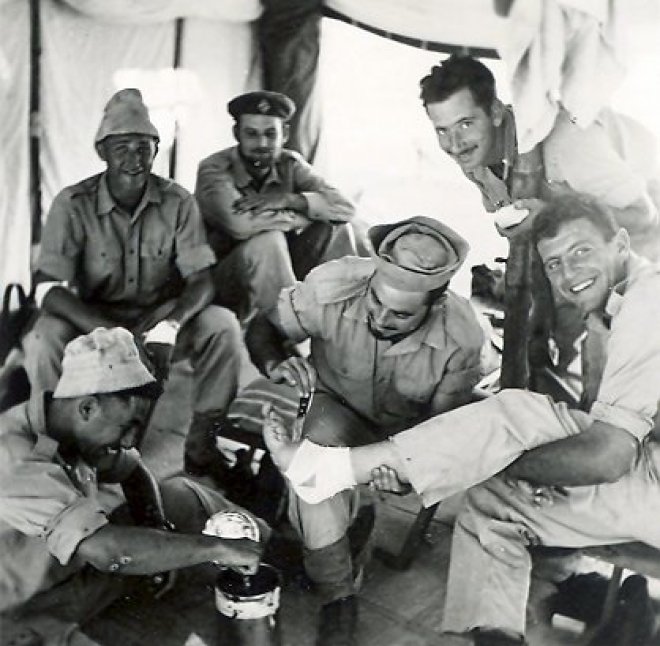
Licking their Wounds. An amused Arnie Friedman (right) having his leg attended to by Harld Kaufman during the 1956 “Suez Campain following the Battle of the Babes in Tel Aviv.

UCT would again have to wait!

A whole gang of us from the Movement – some students, some not – volunteered, and on the third day of arriving in Israel we were drilling in uniform.”

However, “our katzin (“officer”) was less than impressed. He took one look at our overweight and scruffy crowd standing before him and bellowed in broken English, “Why did they not send us money instead to buy arms instead of you useless lot. What are we expected to do with you?” We were really shaken.”

That night, Arnie and his mates met in their barrack, “and we decided to show him. We pulled ourselves together, lost weight, trained seriously” and proudly emerged a formidable fighting unit.

“We were ready for battle,” but their first skirmish however was not against the Egyptians in the ‘Suez Campaign’ but what became known as ‘The ZOA Campaign’.

THE BATTLE OF THE BABES

On the eve of their paratrooper course, the South African Zionist Federation in Israel (Telfed) together with Nahalsplashed out on a party at the Tel Aviv headquarters of the Zionist Organization of America (ZOA) for us.”

After all, this was the first group of Southern African Nahal volunteers.

We arrived washed, combed, boots shinning and clean uniforms,” says Arnie. “To our delight, also invited to the party was a group of girls from some college as our dancing partners. The atmosphere was most convivial – good food, a band, dancing partners, plenty of beer, as well as a bit of the more potent stuff !!!”

Suddenly the party was ‘INVADED’ by a group of tough-looking paratroopers. “Not only did these gatecrashers polish off all our refreshments but without a “by your leave”, butted in and took over as the dancing partners with our girls.”

This was a declaration of war!

Tempers were kept in check until the final notes of Hatikvawhen the first fists started to fly and within seconds, the scene was something out of Western saloon brawl. The Nahal commander and Telfed staff member, Simie Weinstein tried to calm everyone down, but to no avail. He was pushed backwards into a large glass door which shattered into piece. Tables and chairs went flying.

Our officers called for a ‘retreat’ and we were herded into waiting buses.” On the way back to base, first aid was administered to cut cheeks, bleeding noses and hurt pride.

No doubt about it,” says Arnie, “the paratroopers were a far more experienced fighting unit. Nevertheless, our SA Nahal boys acquitted themselves very well.  We carried our bruises with pride. This was our first military battle in Israel.”

However, Arnie had further internal ‘battles’ – either to return to South Africa and university or stay in Israel with his garin (group) that had just been joined by a Habonim garin from Australia on Kibbutz Ginegar near Afula.

Arnie did return to South Africa, not to UCT however, but to marry his beloved Peggie with whom he returned, and together settled with his garin on the young kibbutz of Yizre’el.

Times were tough, and Arnie recalls “we were given a hut without a toilet or shower” and only with their first-born, “were we provided a hut with a bathroom.  But those were the days, and everyone in the country, one way or another, was roughing it. We were young; we did not come to a built-up country but to build the country. We were idealists.”

Studying at a university seemed ever-further away as the days, months and years would turn into decades and Arnie would establish his reputation as kibbutz head of volunteers and young groups studying at Yizre’el’s  ulpan programmes.

Imbued with the ideology of Habonim – “The Builders” – Arnie was living the ‘collective’ dream, but he never ever gave up on his personal dream of studying for a degree.

DREAM FULFILLED

And then, one day some seven years ago, “Now a pensioner”, Arnie saw a poster on a notice board addressed to the “over fifties” who were looking to study for a BA at the local college.

Finally, my time arrived, and with permission granted by the kibbutz, I signed up. Although it was for the over fifties, for most of the four years that I took, I was the oldest student.”

Arnie’s only sorrow was that his sister in Australia, who so supported him studying for this BA and assured that she would attend his graduation, passed away a month earlier at the age of 93. “At least she knew that I had finally fulfilled my dream.”

Noting in 2018 that it was the 120th anniversary of the First Zionist Congress in Basel, Arnie recalled Herzl’s most famous line:

If you will it, it is no dream.”

That summed up the Life of Arnie!

It also reflected the idealism of Arnie and his comrades on Yizre’el when their idealist was really put to their test. I remember Arnie telling  me the story.

The Usual Suspects. Following the Gilboa Walk and lunch as kibbutz Yizre’el in 2007, participants (l-r) Henrietta and David David, Hilary Kaplan, Daniel Klug, Michelle Wolff, Rossie Klug and the writer enjoy the home hospitality of Arnie and Peggie Friedman (right) in their garden. This was a tradition for many years, inspired and organised by Arnie.

SWIMMING AGAINST THE CURRENT

In  2012, after a stormy meeting, Kibbutz Yisrael members turned down a massive offer at the time for a majority stake in the kibbutz’s swimming pool robot cleaning company, Maytronics. It was modeled after the South African Kreepy Krauly, but taken to a whole new level of sophisticated robotics.

It would have made each member of the kibbutz exceeding rich.  But as Arnie explained, what does the word “rich” mean?

Apparently at the meeting that was leaning towards accepting the offer and would have changed the nature and social fabric of the kibbutz,  a South African member got up and asked the question: “If we accept the offer, could the buyer then relocate the business elsewhere, off the kibbutz?”

When the answer came in the affirmative, a debate ensured, which the South African members proved persuasive. As Arnie explained: “Yes, we will be rich, but we will be poor in sacrificing the lifestyle and values we cherish.”

Arnie told me that a member of the kibbutz came up to him afterwards and said:

 “We are indebted to you South Africans. You reminded us  of why we chose to live on a kibbutz and the importance of holding onto its values.”

On a personal level, I remember the close relationship we enjoyed –  in contact daily –  when I chaired the organizing committee of the Habonim 75th anniversary in 2005 on kibbutz Yizre’el, where some 1,700 ‘chevra’ from all over the world descended on this socialist emerald patch in in Jezreel Valley. During the daily grind of organizing, Arnie was that anchor that kept everything on an even keel. He moved mountains with such ease and always with a smile.

The Dream Team. Planning and plotting are Arnie Friedman (sitting centre) at a meeting of the organizing committee of the Habonim 75th Anniversary. Top (l-r) Bennie Segal, David Kaplan, Dave Bloom, Howard Gordon, Mikael Hanan’; (middle) Sean Wasserman; (bottom l-r) Stephen Schulman, Eddie  Solow, Arnie Friedman and Bruce Oppenheimer. ((Photo collection David Kaplan)

THE RIGHT TRACK

It was Arnie that thereafter introduced me to the famous annual Gilboa Walk, where people of all ages and from all over Israel and abroad participate as well as all the youth movements in Israel. It was moving to see all the kids from the youth movements walking in their uniforms and singing songs of idealism. It was poignantly described as a “remnant of Israeli togetherness”.

Each year, Arnie would call me to organize our friends from the south to join the Yizre’el members for the walk, followed by lunch on the kibbutz. It truly was an experience of warm “Israeli togetherness”.

The highlight was always afterwards, tea with Arnie and Peggy in their delightful garden.

Wonderful memories – farewell my friend.

Having a Field Day. Arnie Friedman and Rona Stander  visiting from Sydney, Australia at a rugby match on kibbutz Yizre’el. (Photo David Kaplan)


While the mission of Lay of the Land (LotL) is to provide a wide and diverse perspective of affairs in Israel, the Middle East and the Jewish world, the opinions, beliefs and viewpoints expressed by its various writers are not necessarily ones of the owners and management of LOTL but of the writers themselves.  LotL endeavours to the best of its ability to credit the use of all known photographs to the photographer and/or owner of such photographs (0&EO).

Tefillin against Terror

Jews around the world honour the memory of Eli Kay by doing good deeds in his name

By Michael Kransdorff

Eli Kay was 25 years old. He was deeply committed to Israel and the Jewish people. He made Aliyah from South Africa to Israel as a Lone Soldier. Eli worked as a tour guide at the Western Wall, guiding people through the sacred tunnels.

A few weeks ago, he was gunned down by a Hamas-affiliated terrorist on his way to pray at the Kotel (Western/Wailing Wall) with his Tefillin in his hand.

While this act of terrorism was an unimaginable tragedy for his family and friends, it was also an attack on Klal Yisrael (all of Israel). It was an attempt to deny the Jewish people’s right to pray at our holiest site.

Honouring Eli. A Young visitor to the Eli Kay family during the week of shiva hold up Eli’s Tefillin bag and lay his Tefillin that was recovered after the murderous attack in the Old City, Jerusalem

How would we respond?

Rabbi Ari Shishler, a Chabad Rabbi based in Johannesburg and a close friend of the Kay family, said in an online address after the attack:

 “We are all in shock over the heinous murder of our friend Eli Kay. This was not an attack on an individual. It was an attack on Jews, Judaism and the conscience of all civilised people“. 

We felt this required a response. With the help of Rabbi Ari Shishler, Rabbi Eitan Ash and Josh Maraney, we decided to launch the #TefillinAgainstTerror campaign. We began by calling on people to post selfies of themselves putting on Tefillin with the hashtag #TefillinAgainstTerror in Eli’s memory and as an act of defiance against terror and Antisemitism.

Honouring Eli. A Young visitor to the Eli Kay family during the week of shiva lay his Tefillin that was recovered after the murderous attack in the Old City, Jerusalem.

The response has been phenomenal.

The campaign has gone global. Thousands of people from all over the world including far flung places like Aruba and Mexico have responded on social media platforms, Instagram, Facebook and Twitter. In Israel, people have embraced this call by coming to the Shiva house and asking to put on Tefillin. The family has been overwhelmed by the love and support.

Honouring Eli. A Young visitor to the Eli Kay family during the week of shiva hold up Eli’s Tefillin bag and lay his Tefillin that was recovered after the murderous attack in the Old City, Jerusalem

Women also wanted to do something special to honour Eli’s memory because laying Tefillin is a commandment fulfilled by men.

The campaign was broadened to include candle lighting for the Sabbath in Eli’s memory. The recent festival of Hanukkah provided an opportunity to once against reaffirm our right to freely practice our faith. Just as the Maccabees were able to keep the oil burning in the Temple against all odds, we will not let terrorism deter us now from bringing light into the world.

Honouring Eli. A Young visitor to the Eli Kay family during the week of shiva hold up Eli’s Teillin bag and lay his Tefillin that was recovered after the murderous attack in the Old City, Jerusalem

To date, many around Israel and the world have done acts of kindness to share light against terror. A popular journalist based in Jerusalem and her husband donated sufganiyot (donuts) to soldiers on duty. A group called “Friends of WIZO” who support a WIZO (Women’s International Zionist Organisation) shelter against domestic violence, dedicated a Hanukkah party in his honour.

The most high-profile act of memorial was by popular hard rock band, Disturbed’s front man, David Draiman. Speaking to The Jerusalem Post from his home in Hawaii, Draiman said he wanted to make a statement by coming to Israel after seeing the coverage of the attack.

The coverage was reprehensible in the vast majority of American and European media,” said Draiman. “It’s scandalous how they presented it. Headlines like ‘Palestinian shot dead.’ Well, why was the Palestinian shot dead? Because he was perpetrating a terrorist attack. I love how the context is always flipped around.”

Disturbing News. David Draiman  American singer and songwriter and lead vocalist of the heavy metal band Disturbed, was horrified by the international media coverage of the terrorist murder of Eli Kay, came to Jerusalem and lit a candle at the spot where Eli was brutally gunned down.

Draiman, who noted that he has some 200 relatives living in Israel, said that his candle-lighting ceremony is intended to say that:

 “we will not be intimidated, we’re not going anywhere. People need to learn to live with us [Jews].”

Remember Eli. Young pupils at King David School, Victory Park, Johannesburg lay Tefillin in memory of Eli Kay.

He made good on his word by coming to Jerusalem and lighting a candle at the spot where Eli was brutally gunned down.

The word Hanukkah means “dedication”. Eli was dedicated to his family and friends, Israel and the Jewish people. And many responded in kind by dedicated acts of kindness in his name.

Am Yisrael Chai!


About the writer:

Michael Kransdorff is a Harvard educated financial innovation consultant. In addition to crunching numbers, politics and Jewish history are his passions. He cut his teeth in Jewish activism as one of the SAUJS leaders at the infamous UN Durban Racism Conference and has remained involved in Jewish communal affairs. Michael is chairman of JNF SA, sits on the South African Zionist Federation EOB and also heads up a Litvak heritage research group for the Zarasai (North Eastern) region of Lithuania. 


While the mission of Lay of the Land (LotL) is to provide a wide and diverse perspective of affairs in Israel, the Middle East and the Jewish world, the opinions, beliefs and viewpoints expressed by its various writers are not necessarily ones of the owners and management of LOTL but of the writers themselves.  LotL endeavours to the best of its ability to credit the use of all known photographs to the photographer and/or owner of such photographs (0&EO).
Farewell Eli

His passing reveals the best of a South African family and the worst of its government

By Lay of the Land Co-founders David E. Kaplan, Rolene Marks and Yair Chelouche.

The cruel murder on the 21 November 2021 in the Old City of Jerusalem of Eliyahu (“Eli”) Kay (25), a recent immigrant from South Africa has shocked the nation as it has the ex-pat community in Israel and the Jewish community in South Africa.

Who it has not shocked  – which is shocking – is the political leadership in South Africa!

Future cut Short. Raised in Johannesburg and moving to Israel on his own in 2017,  Eliyahu David Kay was shot while heading to prayer at the Western Wall and died of his wounds in  hospital.

The fact that it took the South African government nearly a week – and only after disappointment and disgust was expressed from the Jewish leadership in press releases as well as letters to the media from dismayed members of the Jewish community – did the government  finally –  and one senses reluctantly – send a letter of condolence addressed to the South African Jewish Board of Deputies (SAJBD) and with a request to pass it on to the Kay family.

This belated response fooled few.

The wording “…we are deeply saddened…” rings rather hollow from a government that is more  receptive and responsive to the opinions and sentiments of Africa4Palestine than the SAJBD.

Formerly known as BDS South Africa, the organisation Africa4Palestine issued a statement following the brutal gunning down in cold blood of the 25-year-old former South African, describing Eli as a “South African mercenary” who was not murdered but “was  killed in gunfire with the indigenous population” and that he “loved Apartheid – a disgrace to our South Africa.”

Yes, there IS a “disgrace to our South Africa”, but that disgrace is the ANC government that lends a warm ear to the disseminators of such vile accusations and lies as Africa4Palestine.

Compare South Africa’s belated reaction to the murder of Eli Kay with its embarrassingly hysterical response to its beauty queen, Lalela Mswane, participating in the 2021 Miss Universe pageant next month in Eilat, Israel.

Only last week, Lay of the Land published an article on the ANC government’s vehement opposition of  South Africa participating in the beauty competition.

While this issue riled up the South African government influenced by the BDS movement, the brutal murder of a South African national on the other hand was met with initial official silence. The common denominator or explanation to both sets of calculated conduct by the ANC government was ISRAEL – the national homeland of the Jewish People.

Eli’s Final Journey.  The young man, Eliyahu David Kay on his way to his final resting place in Jerusalem, the city he loved, studied and worked as a tour guide at the Western Wall.

After 2000 years of exile and persecution, Jews have a name for this – ANTISEMITISM.

Compare the week’s reticence of the South African government with the choice words of the representative of the Israeli government at the funeral of Eli in Jerusalem. Israel’s Minister of Diaspora Affairs, MK Nachman Shai – who in 2017 led a 5-member delegation of the Israeli Knesset (Parliament) to South Africa “to promote dialogue, understanding and cooperation between Israel and South Africa” – spoke of strangers to the Kay family who at the funeral, felt like family:

So many people came today to say goodbye to you. Many  never had the opportunity to meet you, who only learned your name yesterday and decided they wanted to be with you to say goodbye.”

In sad contrast, the only “goodbye” the South African government would truly be happy to say would be as a final farewell to the State of Israel! After all, compare South Africa’s ANC government downgrading its diplomatic relations with Israel – with no ambassador since 2018 – while in 2015, it welcomed to South Africa a Hamas delegation, even hosting it in the South African Parliament in Cape Town. This is the same Hamas that is committed to the destruction of Israel and who only this week was declared a terrorist organization by the UK, joining the US, the EU and other powers.

Laying Eli to Rest. Israelis far and wide, join family and friends attending the funeral at Har HaMenuchot Cemetery in Jerusalem on November 22, 2021of 25-year-old Eliyahu David Kay from South Africa who was murdered in a Palestinian terrorist attack the day before in Jerusalem’s Old City. (Olivier Fitoussi/Flash90)

This is also the same Hamas that praised and took credit for the murder of Eli Kay. Official Hamas media identified the assailant Fadi Abu Shkhaydam as a “leader of the Hamas movement  in East Jerusalem” saying “the operation” was designed to be a warning to Israel, which it said would “pay for the inequities” at the al-Aqsa mosque in Jerusalem.

Writing in the South African national daily, Business Day, Kenneth Mokgatlhe, makes the observation before posing the astute question:

A hysterical SA government withdraws its support for a young woman to participate in the Miss Universe contest in Israel, but doesn’t say a word about a South African Jew killed by terrorists. Surely there is something wrong with this?”

Is this  the direction South Africa is morally heading – associating and identifying with the murderers of Jews?

Clearly concerned at the government’s silence of a  murder of a fellow South African by a Hamas gunman, the South African Zionist Federation released the following statement on the 22 November 2021:

It has been over 24 hours since Eliyahu David Kay, a Jewish South African national who emigrated to Israel, was murdered in an act of terrorism in Jerusalem by a Palestinian gunman affiliated with Hamas. The South African Zionist Federation (SAZF) condemns the deafening silence from the South African Government and the Department of International Relations and Cooperation (DIRCO) on this issue. There has been no message of condolence to the family of the deceased, nor any public condemnation of this attack. DIRCO has in the past issued statements against terrorist attacks in the City of Jerusalem, and it is appropriate for them to do so now in respect of a South African national. 

Hamas is an extremist organisation, as recently confirmed by the United Kingdom which designated Hamas as a terrorist organisation and has outlawed support for the group. This antisemitic and anti-Israel hate group gladly claimed responsibility for the killing of an innocent civilian and injuring others as the gunman opened fire in the Old City of Jerusalem.

We call on the South African Government to publicly condemn this heinous incident and to offer support and assistance to the family of the deceased.”

Finally, the ANC felt the heat and on the 25th November – after five emotionally-charged days following the horrendous murder – sent out its official letter of condolence. The circumstances surrounding South Africa’s response, reveals its antisemitic perspective, namely:

The killing of Jews when carried out by Palestinians is understandable.

Note the carefully selected wording in its belated letter of condolence.

The South African government condemns the actions which led to the death of Mr. Kay…”

What actions?

The implication in this cunningly crafted verbiage is that it could be the behaviour or “actions” of Israel’s Jews that is responsible for the death of Eli Kay. In other words, Israel is responsible for what happened to Eli Kay not the murderer, who will soon be honoured as a victim and martyr in Palestine and within some sectors in South Africa.

The SA government is sending a chilling message to its Jewish community and it’s a message that is being read loud and clear and may explain why in 2021 there will be more Olim (immigrants) to Israel from South Africa than over the past 25 years.

These Olim will be following in the heroic example of Eli Kay and his family, taking a journey that is securing the Jewish state for all eternity.

In the words of Nachman Shai at the funeral:

 “Eli, you died a hero, an example to us all.”


While the mission of Lay of the Land (LotL) is to provide a wide and diverse perspective of affairs in Israel, the Middle East and the Jewish world, the opinions, beliefs and viewpoints expressed by its various writers are not necessarily ones of the owners and management of LOTL but of the writers themselves.  LotL endeavours to the best of its ability to credit the use of all known photographs to the photographer and/or owner of such photographs (0&EO

Up-Start Nation

A pulsating powerhouse, Israel clocks up a Noble Prize Bar Mitzvah bringing her tally to 13 with Joshua Angrist co-winning for economics

By David E. Kaplan

Not bad for such a tiny nation.

And to those eyebrow-raisers kvetching, “Hmnn….. but Angrist lives in the US,” this writer sides with the wife.

Following the announcement that Israeli-American economist Joshua Angrist was awarded together with David Card and Guido Imbens the 2021 Nobel Prize for economics prize, Angrist’s wife, Mira, told Israel’s Channel 12,  she and her husband are Israelis “with every bone in their bodies.”

She explains “We met in the Hebrew University of Jerusalem after he made aliyah… our lives are run between Israel and Boston… We’re very excited right now.”

So are Israelis and justifiably so!

Miniscule Israel has long punched far above its demographic weight when it comes to the Nobel Prize. “There are not many countries who have won so many Nobel prizes,” said the late Shimon Peres, Israel’s President at the time, himself a Nobel laureate who shared the Peace Prize together with then Israeli Prime Minister Yitzchak Rabin and Yasser Arafat in 1994.

Noting Israel’s stunning trajectory, it is little wonder that as of October 2021, NINE of the TEN Israeli Nobel laureates since 2002, have been for either chemistry or economics. Over the same period, vastly larger countries with larger economies failed to outperform the small Jewish State. Israel’s surge as a pulsating powerhouse shows how it belts way above its weight.

Nobel Men. The Royal Swedish Academy of Sciences said the three  – David Card, Joshua Angrist and Guido Imbens  – have completely reshaped empirical work in the economic sciences.

With a souring hi-tech and cyber based economy, Israel is revered today as “The Startup Nation” – the appellation derived from Dan Senor and Saul Singer’s bestseller by the same name – which examines how a young nation with a small population was able to achieve rapid outstanding economic growth. Today, Israel is the envy of many foreign countries and understandably why. Israel has the second-largest number of startup companies in the world after the United States, and the third-largest number of NASDAQ-listed companies after the U.S. and China.. Driven by gumption and grit and abundant ‘chutzpah’, the Start-Up Nation is as much for this writer – amusingly yet profoundly – the  ‘Up-StartNation’ – cherishing its yesterdays but gung-ho about its tomorrows.

It’s only Natural

Covering in their studies the fields of  ‘education’, the ‘labour market’ and ‘immigration’, Angrist and his co-winners were awarded the 2021 Nobel economics prize for pioneering the use of “Natural Experiments”, which are real-life situations that economists study and analyse to determine cause and effect relationships.

It was fascinating to learn – although I assume less pleasing to some US politicians and businesses  –  that Angrist’s colleague and Nobel co-winner, Canadian David Card had successfully in 2019 dispelled some serious erroneous economic beliefs, notably, that an increase in the minimum wage would destroy jobs as it would make it more expensive for companies to do business.

Israeli-American economist wins Nobel Prize. MIT Prof. Joshua Angrist, who taught at Hebrew University in the 1990s, is the 13th Israeli citizen to win the prestigious award.

Together with the late Alan Kruger, they compared the labour markets on both sides of the border between the US states of New Jersey – where the minimum wage had been increased – and Pennsylvania, where it had not. Their research showed that in that context, the minimum wage increase had no downward effect on the number of employees. Their finding went against the prevailing theory that assumed that an increase in the minimum wage would destroy jobs.

Despite endless jokes about economists such as “Economists have predicted six of the last two recessions” or “Economists were invented to make astrologers look good”, they do get plenty right, and since the new millennium, Angrist is the third Israeli to win the Nobel Prize for economics. The other two were Daniel Kahneman in 2002 and Robert Aumann in 2005 and their experiences and insights on the road to Stockholm remain eternally illuminating.

Calculated Risk

Although Israeli Daniel Kahneman received in 2002 the Nobel Prize for Economics he was a  psychologist who had never “taken a single economics course.”  The Tel Aviv-born Kahneman was recognized for changing the way economists grapple with decision-making, particularly during periods of uncertainty.

Kahneman explained the nature of his research to the peculiarity of people who are prepared to risk much more to get back money lost than they are to make the same amount. “For instance, if a gambler is losing steadily, the risks he would take to try to win back his losses and break even, are about twice as great as the risks he would take to gain the same amount of money had he been winning all along.”

Go figure!

Mind over Matter. Nobel Prize laureate Daniel Kahneman received the 2002 Nobel Prize for his groundbreaking work in applying psychological insights to economic theory.

Top Of His ‘Game’

How prescient these words of  Israeli Nobel 2005 for economics Nobel Laurette, Robert Aumann, who also was not an economist but a mathematician:

  “Science is exploration, exploration for the sake of exploration, and for nothing else. We must go where our curiosity leads us; we must go where we want to go. And eventually, it is sure to lead us to the beautiful, the important, and the useful.”

This “exploration’ led Aumann to Stockholm where together with Thomas Schelling, they shared the 2005 Nobel Prize for Economics for their work on conflict and cooperation through game-theory analysis. Professor at the Center for the Study of Rationality at the Hebrew University of Jerusalem, Robert Aumann titled his acceptance speech “War and Peace” honouring Leo Tolstoy who he lamented did not receive a Nobel Prize but “like me, also had a long white beard.” War, unlike the popular view, “is not irrational – it is very rational, and we have to understand that to try preventing it.”

For me, life has been – and still is – one tremendous joyride, one magnificent tapestry.”

Highlighting the “good times”, Aumann cited:

 “The excitement of research, of groping in the dark and then hitting the light. The satisfaction of teaching, of meeting someone at a party who tells you that the course in complex variables that he heard from you twenty-five years ago was the most beautiful that he ever heard. The exhilaration of climbing on an almost vertical rock face; the beauty of a walk in the woods with a four-year-old grandchild, who spots and correctly identifies a tiny wild orchid about which you told him last week; dancing with your wife at your child’s wedding; unraveling an intricate passage in the Talmud with your eighteen-year-old granddaughter; slipping on a ski slope; tumbling two hundred meters down, and then going back and doing the same slope again – this time without slipping, or seeing the flag of Israel fluttering in the wind, right next to that of Sweden, from the roof of the Grand Hotel in Stockholm.”

Game Changer. Prof. Yisrael (Robert J.) Aumann received the Nobel Memorial Prize in Economic Sciences in  2005 for his work on conflict and cooperation through game-theory analysis. He shared the prize with Thomas Schelling.  (Photo personal website)

Well, that blue and while flag will again be “fluttering” in Stockholm, despite some in the Israeli media focusing less on the achievement and more on the issue than Angrist lives mainly today in the USA. What a loss for Israel they write, instead of what a win for all mankind.

Through decades of research, Angrist and his colleagues have demonstrated that many of society’s big economic questions can be answered. Through their methodology of using “natural experiments” – situations arising in real life that resemble randomised experiments – we now have a considerably better understanding of how the labour market operates than we did 30 years ago.

Why is this important?

Because if we are to make good decisions, we must understand the consequences of our choices and this applies to individuals as well as public policy makers. For example, young people who are making educational choices, says Angrist, want to know how these might affect their future income. Choosing to go to “an expensive private college,  does that change your life course in the form of higher earnings?” Also, how much more would people earn if they chose to study longer? Will adding extra years of study improve one’s personal financial situation either through higher salary or  inspiring entrepreneurial ambition?

All this was less important to some in the Israeli media making more of Angrist living in the US. The Jerusalem Post went so far on its front page with an article “A dent in the Aliyah message” The sweet and less sweet in a Noble Prize”, where the writer compares Angrist leaving Israel for greener pastures to the biblical Abraham who makes Aliyah to Israel but leaves shortly afterwards because of a famine.

Big deal. Angrist relocated back to the USA to become an Associate Professor in MIT’s Economics Department and  by his own admission he did so “for more pay”. In other words the economist took a decision for sound economic reasons. The world today is a global village so no big surprise here.

Furthermore, what these articles neglected to consider in their critique, was that Angrist’s return to the US was way back in 1996, long before Israel’s economic miracle and the surge ahead in the hi-tech industry. It is a different Israel today with different opportunities. Even Angrist himself says that the reports on his leaving for financial reasons stemmed from a 2006 Jerusalem Post article on Israel’s brain drain at the time, no longer the situation today. Speaking with Israeli media, Angrist said he was proud to have won the prize as an Israeli and played down reports that he had left Israel because of low wages.

The Times They Are a-Changin. Israel’s reception into a changing Middle East as reflected on this  front page of the UAE’s English daily, Khaleej Times.

“Israel has a very respectable place in science and I am proud to contribute to that,” he told Channel 13 news.

Since Angrist’s relocation back to the States in 1996 for greener pastures, today Israel is the “greener pasture”. How else would you explain that  Israeli tech investment shattered all records in the first half of 2021 with Israel leading the  world in funding growth with a 137% year-over-year increase in the first half of 2021, reaching $10.5 billion.

With this new economic reality, this writer advocates less focus on Abraham leaving because of famine thousands of years ago and more on the 2020 Abraham Accords which has Israel increasingly integrating into the Middle East and Arab world with infinite economic opportunities. Israel today with her Arab partners is leading the way of showing the potential impact of peace on economics.

Now that will be monumental material for a future Nobel Prize, whether for ‘economics’ or ‘peace’.


While the mission of Lay of the Land (LotL) is to provide a wide and diverse perspective of affairs in Israel, the Middle East and the Jewish world, the opinions, beliefs and viewpoints expressed by its various writers are not necessarily ones of the owners and management of LOTL but of the writers themselves.  LotL endeavours to the best of its ability to credit the use of all known photographs to the photographer and/or owner of such photographs (0&EO).

Remembering Shimon Peres

It has been 5 years since the passing of one of Israel’s most beloved leaders – former President, Shimon Peres

By Rolene Marks

He was a pioneer, and a founding father. He was both hawk and dove, warrior and peacemaker. He was an innovator and mediator. He was a Nobel laureate and visionary. He was a leader whose personal and political history was deeply woven with the story of Israel and the Jewish people.

It has been 5 years since the passing of one of Israel’s finest sons – and greatest leaders. We bow our heads in remembrance for our beloved Shimon Peres z”l, who passed away at 93.  He was the last of our original founding fathers and a true icon.

Date with Destiny. Shimon and Sonia Peres when they were dating. (photo credit: Government Press Office)

Shimon Peres, was the eternal optimist, a rare quality in this world. He had transcended a decades long career in politics where he held many of the top portfolios in government including the office of Prime Minister twice. His relationship at times with the Israeli public was very complicated. He had suffered many political losses and at times was deeply unpopular, more so after the signing of the Oslo Accords.  He endured a lot of criticism for his role in the signing of these Accords. Many had held him and Prime Minister Rabin z”l, responsible for the terror that followed in its wake.

Risk Takers. Following a daring raid, Defense Minister Shimon Peres (2nd left)  and Prime Minister Yitzhak Rabin (centre)) greet hostages rescued by Israel from Entebbe in 1976. (photo credit: IDF SPOKESMAN’S OFFICE/URI HERTZL TZHIK/IDF ARCHIVE)

Peres remained ever hopeful that peace is possible in our very volatile region. I cannot help but wonder what he would have thought about the historic signing of the Abraham Accords. Somewhere from on high, he is looking down with immense pride – and satisfaction at the manifestation of the once unbelievable.

But Peres transcended politics and in 1996, founded the Peres Centre for Peace with the intention of furthering his vision of people in the Middle East working together to build peace through socio-economic cooperation and development and people-to-people interaction.

Flight to Freedom. Prime Minister Shimon Peres greets newly released Prisoner of Zion Natan Sharansky at Ben-Gurion Airport where he was flown from Germany after being freed from a Soviet prison, February 11, 1986. (photo credit: GPO)

He was a great unifier and amongst his many accolades, received both a Knighthood from her Majesty, Queen Elizabeth II and honorary title of Sheikh by Bedouin dignitaries in the Negev for his work on behalf of the people of the Middle East.

The Tomorrow Man. Shimon Peres writes on a blackboard with Facebook’s CEO Mark Zuckerberg at the company’s headquarters in Menlo Park, California, March 2012. (photo credit: REUTERS

A true Statesman, he shook the hands of Presidents and Popes, Kings, Queens and movie stars.  Every celebrity who visited, wanted an audience with our ebullient, eloquent and warm elder Statesman. His love for technology was legendary and I sheepishly admit that he was probably more proficient than I am. Who can forget his final message to the world on Facebook– “Buy more Blue and White” or his infamous job hunting clip on YouTube?

I was immensely privileged to meet President Peres when I participated in the Ministry of Foreign Affair’s Young Jewish Diplomats course in 2007. Hearing that young leaders had come to hear him speak, he came over to meet us. He took his time greeting all of us and shaking our hands. When it was my turn he asked in his deeply accented English that had never lost its Polish inflection, “Where are you from?” This was at a time when South African President Mbeki had made such sweeping statements like HIV does not cause AIDS and expressed support for Iran. I responded (trying not to giggle like a teenager at a BTS concert) “South Africa, Mr. President”. After a very short exchange he was on to the next person but left a lasting impression with me who was extremely star struck.

Covering Common Ground. Having both fought for their  country’s freedom after years of colonization and racial persecution, South African President Nelson Mandela exchanges views with Shimon Peres in Cape Town, October 1996. (photo credit: REUTERS)

Israel’s government is once again paying their tributes as Peres continues to unite the most unlikely folk.  There will be many, many more for a man truly deserving of tribute and honour.

Meeting of Minds. After millennia of religious tensions, Pope Francis (left) and Israel’s President Shimon Peres engage in intense discussion at the Vatican. (photo credit: Courtesy)

There will be only one Shimon Peres – and from a grateful nation who bows its head in recognition and remembrance, we say:

 “Thank you Mr. President, for all you gave us, in the good times and bad, in times of strife and peace. May you look down on us one day as we achieve your dream – of a lasting peace.”

May your memory be forever blessed.

Fighters for Freedom.  “The man, the life that we honor tonight is nothing short of extraordinary,” President Obama said honouring Shimon Peres with the Presidential Medal of Freedom at the White House in 2012.  (photo credit: GPO)


While the mission of Lay of the Land (LotL) is to provide a wide and diverse perspective of affairs in Israel, the Middle East and the Jewish world, the opinions, beliefs and viewpoints expressed by its various writers are not necessarily ones of the owners and management of LOTL but of the writers themselves.  LotL endeavours to the best of its ability to credit the use of all known photographs to the photographer and/or owner of such photographs (0&EO).

To the Rescue

Impacting Jewish destiny through education with “Melton” in the vanguard

By Viv Anstey (Melton Cape Town Director) and Lauren Snitcher (Recruitment & Marketing)

Are YOUR grandchildren going to be Jewish?  

We understand only too well, sadly, that there is no guarantee of that. With rising assimilation rates, intermarriage and couples choosing not to have children, the passing on of Judaism to the next generation “le dor va dor” is not a given.

Time and again studies, research and surveys have shown the importance of Jewish education in addressing this problem. The Florence Melton School of Adult Jewish Learning is proud to be part of the solution ensuring Judaism and Jewish values live on through the generations. Melton offers adult learners the opportunity to explore our centuries old tradition through sequential and comprehensive text-based curricula and discover how they relate to us today. It offers a profound understanding of what it means to be Jewish.

The school engages adult learners in a life-long and life-enhancing study of Jewish texts and ideas that nurtures and deepens Jewish community worldwide. Through classes and travel seminars  – both in-person and online (even before the pandemic) – Melton learners are introduced to Jewish texts and ideas and discover how relevant they are to their lives. As students of their Jewish heritage, they find themselves part of a worldwide movement of passionate learners that can then themselves enrich Jewish life at all levels, from within their families to communal organisations to global initiatives.

Melton is the largest non-denominational, inclusive adult Jewish education network in the world, with over 40 Melton communities throughout the United States, Canada, Australia, and South Africa. More than 50,000 learners have experienced Melton’s professionally developed curricula and lively interactive classes.

This creative journey into the world of adult Jewish education began when a remarkable woman who began life in humble beginnings in Philadelphia, USA,  expanded her vision from taking care of millions of tired feet to uplifting people’s minds!

Inventor and activist Florence Zacks Melton (1911-2007) envisioned and endowed The Florence Melton Institute in 1986 as a project of the Melton Centre at The Hebrew University of Jerusalem. She sought to bring to life a comprehensive, relevant, and sophisticated programme of Jewish learning for adults. To this day, Melton attributes its values of accessibility, open-mindedness, integrity, community, and innovation to her enduring vision. Florence Melton saw in her lifetime that for most Jews, their Jewish education ended at Bar/Bat Mitzvah, if they were even lucky enough to have had a Jewish education up to that point. Florence was passionate about creating a programme of study to help adults attain Jewish literacy. She understood that for many, it was their lack of knowledge and familiarity with Jewish learning that seemed to close the doors for further Jewish engagement.

Shoulders, Feet & Minds

Born Florence Spurgeon to Meir and Rebecca Spurgeon in Philadelphia on November 6, 1911, at 19, she married Aaron Zacks, and the couple moved to Columbus, Ohio.

A housewife with an entrepreneurial flair, Florence invented Shoulda-Shams, washable cotton shoulder pads. She later then discovered she could use the material to line slippers which were marketed first as Angel Treads and later as Dearfoams. Florence’s slippers were a huge hit and were immediately successful, selling in their billions.

Firm Footing. From revolutionizing the footwear industry by inventing the world’s first foam-soled, washable slipper, Florence Zacks Melton would later revolutionise adult Jewish education.

Florence’s first husband, Aaron Zacks passed away in 1966 and in 1968, she married industrialist and philanthropist Samuel M. Melton, an Ohio stainless steel fittings tycoon and philanthropist, who served on the boards of many national Jewish charities.

Partners in Pursuit of Jewish Education. Husband of Florence, industrialist Sam Melton served on the Board of Governors of The Hebrew University of Jerusalem, funded the construction of the Samuel Mendel Melton Building for Jewish Education on the Mount Scopus Campus and is credited with having donated more funds in support of Jewish education than any other individual philanthropist

Retiring from business in 1959, Sam Melton turned his attention fully to a range of community and educational philanthropic enterprises, including sponsorship of The Melton Research Center for Jewish Education at the Jewish Theological Seminary in New York, The Melton Center for Jewish Studies in Ohio State University in Columbus, and The Melton Centre for Jewish Education at The Hebrew University of Jerusalem. He served on the Board of Governors of The Hebrew University and funded the construction of the Samuel Mendel Melton Building for Jewish Education on the Mount Scopus campus.

Melton Method. Commitment to the sustainability of Jewish culture and heritage through diverse forms of education.

Sam Melton is credited with having donated more funds in support of Jewish education than any other individual philanthropist.

Florence become an active partner to her husband’s philanthropic projects. Many were sceptical and had concerns about the number of adults that were interested in Jewish study or would even want to view Jewish Study as serious. But Florence, passionate about Judaism and education, perhaps because hers had been interrupted, was determined to empower adult Jews to “Enter The Jewish Conversation”. And so, together with her husband, Sam, in 1986 they created the “Florence Melton Adult Mini-School” – a two-year, non-denominational programme, which operated across North America, Australia and South Africa. To her credit, 35 years later, her school is still growing, stronger than ever. But instead of a 2- year programme, Melton students are still learning decades later.

Always One Step Ahead. From creator of slippers to the inventor and Jewish adult education, entrepreneur Florence Zacks Melton (1911 – 2007) was constantly in the vanguard. (Courtesy of Florence Melton Adult Mini-School)

The fervent passion of its founder, Florence Melton, to bring Jewish education to adult learners lives on to this day in Melton’s leadership, staff, Board, and directors.

Outreach from Jerusalem

Melton’s dual head offices are directed out of Hebrew University in Jerusalem, driven by Rabbi Dr Morey Schwartz, Melton International director, and New York City, led by Rabbi Rachel Bovitz, Melton Executive Director. In true inclusive Melton style, Melton is directed from Jerusalem in the East by a Modern Orthodox male rabbi and New York in the West, by a Conservative female rabbi.

Simply and more affectionately referred to today as “Melton”, the Florence Melton School Of Adult Jewish Learning is enriching the lives of participants across the world who are gaining Jewish literacy through a world class academic curriculum created by scholars and educators at the Hebrew University in Jerusalem.

Melton can be described as an international network of community-based schools that aims to positively impact the destiny of the Jewish people by offering adults the opportunity to acquire Jewish literacy in an open, inclusive, cross-denominational, and intellectually stimulating learning environment.

The Melton Centre at the Hebrew University in Jerusalem has expanded to a large community of eager adults that have a strong commitment to the sustainability of Jewish culture and heritage. As Israel’s first Centre for Jewish Education, the Centre offers a wide variety of research and other resources to accentuate the knowledge of its scholars, including a MA in Jewish Education.

What Makes Melton Unique

Melton learners participate in multi-session courses (ranging from 4 to 30 weeks) that make Jewish texts and ideas accessible, relevant and inspirational. Melton learning is text-based and is designed to be studied within an environment of openness, where questioning and dialogue are encouraged. There are no examinations or tests. The only prerequisite is a commitment to learn. Many of our learners choose to make Jewish learning a way of life.

Network of Learners

Melton learning is powered by an international network of communities. Local offerings (online or in person) are augmented with Melton International’s online learning as well as travel seminars that unite our global community of adult Jewish learners. During 2020 and 2021, due to Covid-19, all our classes moved online, including our first-class travel seminars which have become virtual reality tours, proving almost as good as the real thing, enabling “travel” at a time when physically that has not been possible.

Engaging and Sophisticated Curriculum

Written by talented, insightful scholars and reviewed by experts at the Hebrew University in Jerusalem, our extensive and ever- growing selection of courses engages learners with a variety of interests.

Towers Head and Shoulders. A Shoulda-Shams department store advertisement in August 1947 (source: Google News)
 

Quality Teaching and Learning

Jewish Federations, Jewish Community Centres, Bureaus of Jewish Education, Synagogues, and community coalitions are natural partners with the Melton School. This ensures a community commitment to maintaining the high level of quality expected of each Melton School. To preserve the high standards which are the hallmark of the Melton School, alumni, local faculty members and educators within their communities participate in ongoing professional enrichment offered through Melton itself or The Hebrew University of Jerusalem. Directors attend the yearly International Directors Conference which alternates between America and Israel. In 2020 it was held online with great success.

Israel-Diaspora Partnership

Being a project of the Hebrew University of Jerusalem, being staffed internationally from Israel and America, having travel seminars criss-crossing the land of Israel as well as the Diaspora, alternating the Directors’ conferences between America and Israel and having Melton schools across the Jewish world, the Israel-Diaspora relationship is powerful and symbiotic. Many courses have an Israel component so the links between Israel and the Jewish diaspora are deep and lasting.

Courses On Offer

Our text-based curricula are the hallmark of Melton’s success and keeps Melton students returning for more for close to 40 years. Students come for the learning and stay for the community, creating close friendships with their classmates often extending far beyond the classroom.

From our initial core course which spanned a 2-year curricula, covering the Jewish Calendar and Life Cycle, Jewish Philosophy, Jewish History and Jewish Ethics, Melton now proudly offers approximately 40 more courses.

Examples of Melton courses are:

Shivim Panim– a series covering all 5 books of the Torah; Foundations of Jewish Living – teaching Jewish Values to parents and grandparents of young children; Beyond Borders – The History of the Arab Israeli Conflict; Israeli Literature As a Window to Israeli Society; The Holocaust as Reflected In Diaries and Memoirs; Biblical Women – Emerging From the Margins Through Midrash; Jewish Denominations; The Star and The Crescent – A History of Jewish-Muslim Relations; Jewish Medical Ethics; Jewish Mysticism; Social Justice – The Heart Of Judaism In Theory And Practice and Jews In America – Insiders And Outsiders; Jewish Answers to life’s most challenging questions, Yesod – Jewish Leadership

Inspiring Today and Tomorrow’s Generations. Viv Anstey and Lauren Snitcher at the Melton School of Adult Jewish Education, Cape Town, South Africa.

In  a recent research study two-thirds of those interviewed reported a strengthening or enhancement in different facets of Jewish life.

By offering a robust menu of online courses during these challenging times, Melton has been able to:

  • Increase its reach internationally to individuals in communities otherwise not serviced by Melton
  • Introduce Melton courses to new learners
  • Re-engage former learners with new offerings
  • Develop high quality digital pedagogy
  •  expand its partnerships

Since 2006, we have, under the umbrella of the Midrasha Adult Education Institute enriched lives within and beyond the Cape Town Jewish community to an ever-increasing global student body.

Midrasha offers Melton courses as well as their own home-grown Midrasha courses, with a faculty of talented intellectual and academic experts. It boasts over 3500 graduates inclusive of all sectors of Cape Town Jewry and beyond.

Enriching Education. Adult students at the Melton School in Cape Town, South Africa.

Our latest Midrasha course on SA Jewish History:  Dilemmas & Debates is FULL.  Let us know if you are interested so that we can place you on a waiting list for a repeat of this course in 2022.

To end the year on a high note, we will be running Melton’s “From Sinai to Seinfeld: Jews and Their Jokes”.

For more information on Melton Cape Town contact Lauren Snitcher at lauren@snitcher.org or +27828802257 or visit www.meltoncapetown.org


About the writers:

Viv Anstey is the Director of the Midrasha Adult Education Institute incorporating the Florence Melton School of Adult Jewish Learning and is also currently Director of The Eliot Osrin Leadership Institute. she is founding member of Limmud South Africa, first Director of SA Jewish Museum, co-driver of PJ Library and the Jewish Literary Festival. Viv currently serves on the Cape SA Jewish Board of Deputies as elected committee member and previously on its executive as vice-chair.


Lauren Snitcher graduated as a BA.LLB(UCT) and has worked as an attorney in Cape Town.  She is passionate about Jewish Education and after completing the Melton Course in 2008, she took on the position of recruitment and marketing for Melton Cape Town. As part of her interest in her Jewish Heritage and as a descendant of an Ochberg orphan, she undertook extensive research and travel, resulting in the creation of an Oscar short-listed documentary movie, “Ochberg’s Orphans”.


While the mission of Lay of the Land (LotL) is to provide a wide and diverse perspective of affairs in Israel, the Middle East and the Jewish world, the opinions, beliefs and viewpoints expressed by its various writers are not necessarily ones of the owners and management of LOTL but of the writers themselves.  LotL endeavours to the best of its ability to credit the use of all known photographs to the photographer and/or owner of such photographs (0&EO).

From Battling to Paddling

Injured Israeli army veterans find healing and balance at sea

By David E. Kaplan

I don’t know whether I am a landman or seaman,”  says Israeli injured vet, Eyal Abro, the inspiration and cofounder of SEASU. This happily unsettled question for Eyal is happily helping to settle lives of Israel’s war wounded!

SEASU is a therapeutic and transformative paddling programme for veterans of the Israeli army living in the wake of physical, emotional, and spiritual trauma.

All Smiles At Sea. Eyal Abro, who grew up in Cape Town South Africa and the brainshild and cofounder of SEASU  in Michmoret is never happier than being at sea.

The philosophy is embedded in the name,” explains  brand builder and a cofounder, Michael McDevitt Shai. “SEASU is inspired by the Finnish concept of ‘Sisu and is best understood as extraordinary courage, undying resilience, and resolute purpose when adversity is unthinkable and success unlikely.” 

Every Thursday morning at 6.00am, some 15 vets together with some eight volunteers meet at the SEASU club house on Michmoret beach, nine kilometers north of Netanya.  They come from all walks of life and professions, all highly motivated with the love of the challenge and with one thing in common – they were injured in the military and have sought through a unique paddling programme a way forward.

Soon decked out in their surfski outfits, they take to the sea on their special sleek kayaks imported by Eyal from South Africa, and are beyond the waves and breakers paddling through the rolling high and low swells. There is another feeling out there in the open sea that resonates among the army vets, “that unique spirit of camaraderie,” says Eyal, “of friends who there with you and for you come hell or high water – proverbially speaking.”

One of the oldest in the group is 64-year-old serial entrepreneur Shlomo Nimrodi, who has founded, built, and led a diverse range of global industries, led three IPO’s, several M&A transactions and is at the heart and spirit of the veteran paddlers.

Rearing to Go. Hi-tech entrepreneur and war veteran amputee Shlomo Nimrodi, thrives on challenges whether in business or in sports preferring to paddle without his prosthetic.

A grandfather of five, Shlomo has been with the group for four years. Injured at age 21 while fighting in a special units in the IDF,

Shlomo lost his left leg above the knee as well as suffering “a lot of collateral damage in many parts of my body.” This did not deter this man who thrives on challenges whether in business or in sports.

In the years following his leg amputation, “I skied, did triathlons, and while I lived  in the States for 15 years , I managed to do the NY City triathlon and the Westchester Triathlon, and I guess in one of those ski trips, somebody told me about surfski, and suggested I try it.” Never deterred by a new challenge Shlomo tried, and “I fell in love  at my first try.”  Trying at first to do it with his prosthetic leg,  “I felt at some point this was more of an anchor, so I just left it in the room and started to paddle with one leg.”

This writer found interesting Shlomo’s use of maritime parlance – “anchor”  – to describe that which was holding him back!

Shlomo compares the uncertainty, challenges and the risks at sea as similar to the hi-tech arena where he daily operates. “Every time you go to the ocean its different – different weather, different vision, different feeling, different risks and it’s exciting; it raises the adrenaline.”

Sea’ing is Believing. Amputee paddler Eran Peri injured in the Second Lebanon War, was skeptical at first to surfski but soon became totally passionate about the sport.

Another leg amputee paddler, is Eran Peri, who was injured 15 years ago in the Second Lebanon War. He relates how tough it was to come to terms with his disability.  “I was told there was a guy who I should meet. I was against it; least of all to meet another amputee but when that guy turned out to be Shlomo, who we soon discovered we shared the same birthday, date – it was a sign –  we became instant friends and I started sport again – skiing, cycling and long-distance running.”

The banter between Shlomo and Eran was inspiring.

Hey, Shlomo, how many times we went skiing together?” meaning a lot.

Not enough!” replied Shlomo.

And when Eran observed, “We are not getting any younger,” Shlomo replied:

Are you kidding!”

Magic Moments at Michmoret. Early morning coffee before  grabing their surfskis and taking to the watyer.

Always looking for new challenges, when surfski arrived in Israel through Eyal, Eran was at first skeptical “ But soon fell in love with it. I don’t know if  it’s the combination of  the morning sunrise and the fact that the sea is different every day; overcoming the cold water,  and then the group of people that take care of each other  – whatever it is, it’s a winner!”

Adds Shlomo:

I too at first was skeptical. The group was composed of people with multiple challenges or disabilities.  One guy with PTSD who used to be sea sick after 5 minutes, would throw up and we would have to go back and today, he is one of the best, and like all of us, he loves it.” 

The Art of the Craft

Michael describes the sport’s craft as “long, narrow and lightweight similar to a kayak with an open “sit-on-top” cockpit. Propelled by two-sided paddles and designed to cut through water with incredible efficiently, SurfSkis are built to seat one or two people and can be adapted for individuals missing limbs or using prosthetics to utilize the craft’s pedal and pulley rudder system. We have even created seating platforms for paraplegic individuals.”

Eyal adds that the beauty of the craft is that “it basically puts everyone on a par. So whether someone is amputated or has PTSD issues, on the water, everyone is equal.”
Shlomo adds, “On water it does not matter if you have one leg or half a leg,  you are pretty much the same.”

Technique Time. Decked out in their “WHERE WE BELONG” shirts, SEASU amputees and suffererors of PTSD learning how to use the paddle before going out to sea.

Regarding safety, all paddlers are required to wear a Personal Flotation Devise (PFD) and carry a mobile phone within a waterproof sleeve in case of emergencies.

Eyal laughs:

The most serious catastrophic ‘emergency’ we encounter with these guys is when for some personal reason they are unable on a Thursday to not join us!”

So what inspired Eyal to ‘paddle’ this path forward?

Born to a South African father who met his Israeli mother on kibbutz Nahshon when he volunteered during the 1967 Six Day War, Eyal grew up in Cape Town where he fell in love with the sea and water sports, excelling in water polo. Returning to Israel as age 18, he joined the IDF, where he served deep in Lebanon as a machine gunner close to combat but never experiencing it directly. However, the thoughts of “life and death” experiences he went through, did not leave him unscathed “and although I had light PTSD, even if light, it’s something you need to take care of and I did through the therapy of the sea and combining it professionally by starting my club, SurfSki Israel, in Michmoret that has 160 members and in the last four years, giving back to society through SEASU.”

Setting out to Sea. Last minute instructions outside the SEASU clubhouse in Michmoret before heading out on for an early morning sea adventure .

He adds that “PSTD never really leaves you but today I am thankful to it because it is who I am and has been the inspiration to try heal others through my love and passion for the sea.”

Psychological consultant, Roy Haziza, who brings a career of academic research and applied treatment of military-focused PTSD to serve SEASU’s leadership, volunteers, and post-trauma veterans, explains the transformative therapeutic qualities of the Surfski.

The anticipated journeys of army vets that were derailed by injury or trauma need to be restored or repaired and a new journey is required that is about letting go of the past of imagined futures to make way for a new identity to appear.” The journeyman “must overcome the feeling of often hopelessness and dissabilities to reassert the control of mind over body and develop a sense of health and ability and I believe SEASU paddling offers  just that. The paddlers set out to sea on vigorous paddling adventures, conquering difficulties, fears and aches, pushing their bodies and spirits  to new heights of health and ability. And they also discover a new group that they can identify with on this adventure.”

By paddle skiing, they “find a sense of balance, learn to control their breathing while feeling the water, the wind, the salt, like ancient mariners and all throughout, they have to stay focused, keep up with the group while always concentrating on the technique.  This is why I say that surfski paddling is a medium of  transformation and rebirth.”

Mist over the Med. Early morning mist as the vets paddle out into the Mediterranean.

Shelter from the Storm

By his own admission, SEASU cofounder  Michael McDevitt Shai says he is “the odd man out” being “a native New Yorker who came to Israel 10 years ago” and who has no “military background.”  However, “I have found a real home here in Israel” and it was by sheer chance that “I became involved.”

He says that unlike Eyal, “who was into spearfishing, I was never a sea person; I was more into cycling and marathon running. However, when my wife and I and the kids left Tel Aviv and joined the seaside community of Michmoret, I felt ready for a change – a sea change!

That change came during a storm one winter’s day.

Settled at the Sea. SEASU cofounder and brand specialist Michael McDevitt Shai, a former New Yorker now happily ensconced at Michmoret.

Taking a walk on the beach, “we got caught in a sudden severe rainstorm. Seeking shelter, we ducked under –  and as fate would have it – the awning of Eyal’s surfski club which set off the alarm. A club member came looking, probably afraid someone was trying to break in,  and after chatting, he  kindly offered us a lift home telling me the owner’s name. Shortly thereafter, having dinner with a friend,  in Tel Aviv and telling the story of being caught in the storm and when I mentioned Eyal’s name, he said,  “I served with him in Lebanon.  Great guy!” So I ended up joining the club and fell in love with it.”

Discovering that Michael was a photographer, “Eyal asked me if I could shoot some photos for him  of group of guys who were IDF veterans – amputees and those with PTSD.  I watched these guys on the beach with their surfskis like Shlomo and Eran and another paddler, who suffered both physical injury and PSTD. His story was horrendous. Called to intervene in a terrorist attack in a private home, he was injured by a knife-wielding terrorist and lost his eye by a bullet ricochet meant for the terrorist. Following numerous therapies and medications, he finally found balance in his life through Surfski.

So, armed with his camera, the soon-to-be cofounder of SEASU zoomed in on these battered, bruised but tough guys on the beach who dispensed with their day clothes as they had their disabilities as they prepared to embrace the challenges of the sea. “It was so inspiring, like something out of Greek mythology of mighty men unafraid, embarking on a maritime adventure. I wanted to be part of this adventure and share their story with the world.”

Major Mentor. Current ICF World Surfski Champion, Sean Rice from Cape Town, South Africa is the third cofounder of SEASU offering expertise and experience.  .

So, for the professional brand builder and more recently passionate paddler who through a rainstorm was destined to meet Eyal Abro, and then joined by another South African from Cape Town, Sean Rice, the ICF World Surfski Champion, SEASU was born.

Bearing the scars of the past, a group of heroes vigorously embrace the future.


*For all inquiries, whether looking to join SEASU or those looking to support SEASU to contact Michael McDevitt Shai at: mms@seasu.org

**To see additional photos, check their INSTAGRAM  as well: https://www.instagram.com/seasu_united/


While the mission of Lay of the Land (LotL) is to provide a wide and diverse perspective of affairs in Israel, the Middle East and the Jewish world, the opinions, beliefs and viewpoints expressed by its various writers are not necessarily ones of the owners and management of LOTL but of the writers themselves.  LotL endeavours to the best of its ability to credit the use of all known photographs to the photographer and/or owner of such photographs (0&EO).

Victor in Name and in Life

Remembering Victor Gordon, an award-winning playwright, artist, musician, community leader and strong literary advocate for Israel

By David E. Kaplan

It came as little surprise to hear on Sunday 11 July at the opening of the Zoom memorial service to Victor Gordon of Pretoria, South Africa, to hear his widow, Shirley reveal that she had been phoned that morning by Jonathan Pollard, today a free citizen of the State of Israel.

It had been an emotional yet profound conversation – about ones man’s too soon passing and another’s belated freedom. Their disparate lives were eternally linked by Victor’s  poignant prose.

My Word. Victor Gordon, whose words in the media and on stage,  enthralled , entertained  and challenged. (Photo: Diane Wolfson)

Jonathan Jay Pollard, a former intelligence analyst for the United States government, pleaded guilty in 1987, as part of a plea agreement, to spying for and providing top-secret classified information to Israel. He was sentenced to life in prison making him the ONLY American to receive a life sentence for passing classified information to an ally of the U.S.

Believing that Pollard was the victim of a terrible miscarriage of justice, Victor wrote the play titled “Pollards’ Trial” which was translated into Hebrew opening shortly thereafter in 2011 at the famed Cameri Theatre in Tel Aviv. Not only did it receive a five-star rating from the critics,  but became the only play in the history of Israel to receive an invitation to mount a private performance at the Knesset (Israel’s parliament) before an invited audience of 350, hosted by the former President of Israel, Reuven Rivlin, who was then Speaker of the Knesset. “Since Pollard’s conviction, the Berlin Wall came down but he is still surrounded by the walls of the federal prison,” Rivlin had said. “At first, we thought that if we could act behind the scenes, we could restore trust with the US and bring about a breakthrough that could bring about Pollard’s release. Too slow, we learned that acting quietly wouldn’t help and we needed to act openly to help him become free.”

Victor’s play did just that and ran on-and-off throughout Israel for over two years having a huge impact in galvanizing support for his eventual release.

The issues that Victor drew attention to in his play were troubling.

Set in Pollard’s jail cell, the accused presents his imagined case to the judge – something he was never actually permitted to do when he was sentenced to life. Exposing the American judicial process as ‘twisted’ and ‘double-dealing’ when it came to its treatment of the Jew – Pollard –  it reveals how this accused was deprived of his most basic rights.

Monumental Man. Playwright, artist, activist and communal leader, South African Victor Gordon and wife Shirley. (Photo: Diane Wolfson)

It was hard to believe that anyone at the time who saw this play could remain indifferent to Pollard.  

One man who assuredly was not indifferent was Victor Gordon!

Neither was he on the many fundamental issues effecting the Jewish state. As a member of the South African Zionist Federation Media Team Israel committed to monitoring media bias against Israel and antisemitism, Victor’s articles – well researched and balanced, were a regular feature in the press both in South Africa and abroad. Speaking from Israel at the memorial service on Zoom,  Lay of the Land’s Rolene Marks, who had worked closely with Victor as colleagues on the Media Team Israel since it had been formed 20 years earlier as well as representing Israel’s Truth be Told (TbT) committee, said:

If you are lucky in life, you have the blessing and benefits of truly remarkable mentors. I have been doubly blessed to be able to count Victor as one of mine – both as a friend and as a mentor.”

Words were Victor’s stock-in-trade and Rabbi Gidon Fox, who moderated the Zoom memorial service tearfully wrestled with a conundrum :

 “What words can one say about one of the world’s finest wordsmiths?”

Victor’s passion on spotlighting milestone events impacting the Jewish people  – some forgotten as minor but in truth were monumental –  was the plot of his 2009 play Harry and Ed.

So ordinary sounding – Harry and Ed – yet they were extraordinary men who pulled off the extraordinary.

This play reveals how a hometown friendship between a Jewish boy, Edward “Eddie” Jacobson born in New York’s Lower East Side in 1891 to impoverished Jewish immigrants from Lithuania and  the future US President Harry Truman would shape the destiny of the Jewish People. Following their childhood friendship, they would go into business together – not terribly successfully – from running a canteen to opening a haberdashery but it was the “business” of creating the Jewish State that history would record as a resounding success!

A Friend in Deed. The unique friendship of Harry S. Truman (right) and business partner Edward Jacobson (left) that together influenced the establishment of the Jewish State, captured on stage in Victor Gordon’s illuminating play, “Harry and Ed”.

Irritated by incessant Jewish lobbying for statehood, Truman had issued instructions that he did not want to meet any more intermediaries and so it was left to Ed – the most unlikely of diplomats – to urge the reluctant president to meet one more  –  Chaim Weizmann

As a friend the President could not ignore, and with the weight of a future Jewish state on his aging, tired and stooped shoulders, Ed skillfully beseeched the President:

Your hero is Andrew Jackson. I have a hero too. He’s the greatest Jew alive. I’m talking about Chaim Weizmann. He’s an old man and very sick, and he has traveled thousands of miles to see you. And now you’re putting him off. This isn’t like you, Harry.”

Truman agreed to meet with Weizmann and the rest is history.

The United States became the first nation to grant diplomatic recognition to the new state of Israel on May 14, 1948.

Although Victor did not live in Israel, he  was finely tuned to its peculiar nuances which he explored in his play “You Will Not Play Wagner”. The play examines Israel’s unofficial ban on performing works by “Hitler’s favourite composer” and charts the fictional conflict between a young Israeli composer, Ya’akov, who wants to perform Wagner in the final concert of a prestigious musical competition in Tel Aviv, and an elderly Holocaust survivor, who is the event’s patron.

Sounds of Silence. Poster for Victor Gordon’s thought-provoking play “You Will Not Play Wagner”  that questions the dividing line between politics and art that sets Israeli society on edge.

Set against a backdrop of impassioned protests over the years in Israel to attempts by musicians and composers to defy cultural mores and Shoah sensitivities, Victor expressed in deference to survivors, “I appreciate the fact that there is a place in the world where you won’t hear Wagner.”

Himself an accomplished clarinet and saxophone player, the playwright in Victor struggles to separate the man from his music through his character Ya’akov, who asks:

How can music be antisemitic?”

Victor’s answer was:

You have got one of the greatest composers that ever lived and one of the greatest antisemites that ever lived, and the two meet at the Third Reich. You can’t get worse than that.”

No you can’t.

While I corresponded with Victor on media and Israel related issues, I had never personally met him until 2016 when I was invited as an overseas speaker to the Limmud Conference in Johannesburg.  How fascinating that when I sat down for lunch at the conference,  on my right sat the late anti-Apartheid activist Denis Goldberg, hardly favourably disposed to Israel, although it was to Israel that he left for after his release from prison, and on my left, Victor Gordon, a strong advocate for the Jewish State.  If the next day I was to moderate a debate with four fiery panelists on the then upcoming 2016 US election, this lunch provided some entertaining preparation as I had to deftly ‘moderate’ a riveting discussion on Israel and its policies between these two verbal pugilists holding diametrically opposing views.

It was a lunch that we all left the table with more than the food to chew on.

And in truth, although Victor has left the proverbial ‘table’, he  leaves a lasting legacy and hence shall remain active by inspiring others.


While the mission of Lay of the Land (LotL) is to provide a wide and diverse perspective of affairs in Israel, the Middle East and the Jewish world, the opinions, beliefs and viewpoints expressed by its various writers are not necessarily ones of the owners and management of LOTL but of the writers themselves.  LotL endeavours to the best of its ability to credit the use of all known photographs to the photographer and/or owner of such photographs (0&EO).

Battling for our Boys

From helping English-Speaking lone soldiers to embracing soldiers from the Haredi community, a Jerusalem Rabbi pursues his vision of ensuring Israel’s lone soldiers are never alone

By David E. Kaplan

Rome was not built in a day,” said Rabbi Shalom Myers  of Jerusalem describing a personal journey that began 8 years ago helping English-speaking lone soldiers from abroad to more recently widening the ambit to include Hebrew-speaking Israeli soldiers from the ultra-orthodox Haredi community. However, “we are well on our way,” Shalom affirms enthusiastically of his groundbreaking vision.

There was a particular resonance in the Rabbi’s use of the word “ROME”, which had begun the Jewish exile from the land of Israel 2000 years earlier, and which Rabbi Myers is working to ensure will never happen again as he helps lone soldiers in the Israeli Army protect and preserve the hard-fought Jewish state of Israel.

Home Not Alone. Rabbi Shalom Myers with lone soldiers – all paratroopers in a combat unit –  in a renovated and fully-furnished ‘Emek Lone Soldiers’ apartment in the German Colony Jerusalem

“Never again” means doing not only talking – and Rabbi Shalom Myers exemplifies both. He had just returned with his architect wife Lynne, “my partner” in his Emek Lone Soldiers’ initiative from an Ikea  outlet with a truckload of furnishings “for our apartment in Jerusalem for the Haredi lone soldiers.” The apartment at present houses  six soldiers, “three Israelis and three from abroad, two of whom are from orthodox communities in the USA.” Describing as “our pilot”, Rabbi Myers hopes to have apartments “for 30 plus by the end of 2021” but in the near future to have  a home-away-from-home complex “exclusively for Haredi soldiers.”

A “lone soldier” is a soldier in the IDF with no family in Israel to support them. This could mean a new immigrant, a volunteer from abroad, an orphan or an individual from a broken home. Highly motivated to serve in the Israeli army, most lone soldiers are placed in combat units. At any given time, these soldiers are guarding Israel’s borders by land, air and sea.

Time Out. Rabbi Shalom Myers (centre) enjoying an afternoon  BBQ with active duty lone soldiers near the front lines.

While regular soldiers regularly spend weekends and holidays at home where their parents provide for all of their needs such as food, laundry and a hug, “these basics” are absent for a lone soldier when they leave a base.

There are over 7,000 lone soldiers currently serving in the IDF of which about 45% are new immigrants, coming from Jewish communities all over the world. Another 50% are Israelis who are orphans or that come from low socio-economic backgrounds. And then there are those that come from ultra-orthodox neighbourhoods who are shunned by their families and communities because they decided to go to the army. Of the total, there are up to 1000 English-speaking religious lone soldiers serving annually in various units of the Israel Defense Force. They come from America, England, Canada, Australia and South Africa. Most have no immediate family in Israel and no place to call home.

Securing Israel’s Future. Combined English-speaking and Haredi lone soldiers at an army base with Rabbi Shalom Myers.

This is where the Emek Lone Soldiers – A ‘Home -away- from from home’ framework for religious lone soldiers wanting to maintain their religious lifestyle while serving in the IDF – came in 8 years ago with Rabbi Shalom Myers leading the proverbial charge. The Emek Lone Soldiers is an off-shoot of the flourishing Emek Learning Center in Emek Refaim, the German Colony’s main street, co-founded and headed by Rabbi Myers. So what began years earlier providing for English-speaking lone soldiers has in recent years expanded to embrace the Haredi community. Rabbi Myers  – who has had four sons serve in combat units in the IDF –  explains:

 “they are all our children, all our soldiers – I make no distinction.” It is the Beit Midrash (learning centre), the synagogue  and “our community” that are “our three pillars that we offer to the religious lone soldiers.”

Soft Landing. Far removed from the life they had planned, lone soldiers affixing mezuzot in their new fully furnished Emek Lone Soldiers’ apartment in Jerusalem.

It takes a village to raise a child” reminds Rabbi Myers of the African proverb that means that an entire community of people must provide for and interact positively with children for those children to experience and grow in a safe and healthy environment.

A child himself of Africa, Rabbi Myers is well familiar with the military. Formerly of Cape Town where he was the Reverend of Rondebosch and Parow synagogues, a Chazan at the Claremont shul, he was also a chaplain in the South African army as part of his compulsory military service.

In The Army Now. Rabbi Shalom Myers with lone soldiers at a pre sabbath dinner in the German Colony, Jerusalem organized by  Emek Lone Soldiers.

Shalom recalls when as army chaplain for Western Province Command, the Christian chaplain was suddenly unable to deliver his weekly sermon to the men on parade and “suddenly, I was called upon to fill in”.

I’m the Jewish chaplain,” he answered, “besides I’m unprepared.”

Maak nie saak nie, Myers (“makes no difference” in Afrikaans), proceed,” barked his superior.

Officer Myers looked out at the sea of men standing before him, and the words flowed. Afterwards, the officer congratulated him on the most inspiring sermon he had ever heard and his stature in the military henceforth was rock solid. “The point is,” Shalom asserts, “You need to be prepared not only with knowledge but the confidence to impart that knowledge when you might least be expected to.”

Bonding at the Base. Rabbi Shalom Myers following his shiur (Talmudic study session) to combat lone soldiers at an army base.

Such attributes are serving him well today as he pursues his vision.

Asking what inspired him in this direction, Shalom replies:

“Let me say this. When you get involved in the Rabbanut and you want to teach, influence and help, the Rabbanut is the ultimate Chesed.” And in helping the lone soldiers, “not only are we helping individuals but we are helping the Jewish people.”

I was reminded of the revered Rav Soloveitchik who was very meticulous and stringent in every phase of Hilchot Tefillah, the laws of prayer. However, when once visited by a student serving in the IDF and asked by the soldier in a tank division that involved cleaning and maintaining the tanks whether he needed to change his uniform when covered in oil and grime before davening Mincha, the Rav looked at him in amazement and said out loud:

 “Why would you need to change? You are wearing Bigdei Kodesh – holy clothes!”

Father and Son. A proud Rabbi Shalom Myers with youngest son Moshe at his induction into Sayeret Nachal. 

Rabbi Myers’ pursuit has not come without opposition from within his community. The following exchange is instructive.  He recalls some years ago a well-meaning friend cautioning him:

 “You should choose, either focus on the shul (synagogue) or  the lone soldiers; you cant do both.”

Capable of doing both and much more, Shalom is also a former practicing accountant,  has Smicha from Machon Ariel and taught for 14 years at Ohr Somayach, heading the Mechina program before founding in 2013 the Emek Learning Center.

So while there was no need “to choose”, Rabbi Myers is quick to add that had he had to choose, “I would have chosen the lone soldiers because while the learning centre could be done by others,  what I am offering the lone soldiers particularly now with the Haredi lone soldiers is unique.” Of all the soldiers, the ones “closest to my heart,” says Rabbi Myers are the Haredi Israelis.

Why?

They were not brought up from this; it is not their world and they are giving to their people but at a huge personal price; they have to start their lives all over again. They are the most in need, not only in preparing then for the army and offering them a warm environment during their military service but most important helping them after the army service in guiding them to then study to provide a financially sustainable future. Feeling abandoned, we are like their new parents.”

It’s a long and hard process but it is a fruitful process with huge rewards  not only for individuals but for Israeli society.

The Graduate. Rabbi Shalom Myers (right) at the graduation ceremony of a lone soldier.

Rabbi Myers could not have received a more enriching endorsement for his vision then from the late Chief Rabbi of the Commonwealth, Rabbi Lord Jonathan Sacks, who expressed back in 2018, the following:

One of the core ideas within Judaism is contained in the famous Talmudic phrase: Kol yisrael arevim zeh lazeh, meaning all of Israel are responsible for each other. This is at the heart of the mission and work of the Emek Lone Soldiers Initiative. By caring and looking out for those who have no other support, we are taking responsibility for them in the most Jewish of ways. Linking this work to the writing of a Sefer Torah is a beautiful idea. We know that for a Sefer Torah to be kosher, every letter has to be correct, and no letter, word or phrase is more important than any other. Such is the same with the soldiers who risk their lives in defense of the State of Israel. Each soldier has put himself or herself on the line and as such we, as Am Yisrael, must do everything possible to ensure they are looked after both during and after their service. I wish all at Emek Lone Soldiers, blessings and best wishes for the future.”

Tucking In. Undergoing fitness training in preparation before their draft,  lone soldiers enjoying a meal at the Emek Learning Center in the German Colony, Jerusalem.

Trained for the temporal world with a lifelong passion for the spiritual – “I was born in a shul” – Rabbi Myer’s journey has been one of absorbing and processing experiences along the way that “has served as my GPS” directing him precisely to his present destination  – founding and heading first the Emek Learning Center and now the Emek Lone Soldiers.

May he continue his outstanding service to his community, the state of Israel and today and tomorrow’s lone soldiers.

I am very proud that when I stood under a chuppah 39 years ago, with my bride Hilary, the Rabbi officiating was Shalom Myers!


Having a Ball. Lone soldiers enjoying a game of American football  during a Shabbaton In Herzliya.


While the mission of Lay of the Land (LotL) is to provide a wide and diverse perspective of affairs in Israel, the Middle East and the Jewish world, the opinions, beliefs and viewpoints expressed by its various writers are not necessarily ones of the owners and management of LOTL but of the writers themselves.  LotL endeavours to the best of its ability to credit the use of all known photographs to the photographer and/or owner of such photographs (0&EO).