“WHAT THE WORLD SAYS ABOUT ISRAEL IS UNFAIR, UNTRUE AND UNACCETABLE”

Tribute to the passing of Freda Keet whose inimitable “VOICE OF ISRAEL’ carried from Jerusalem across the globe

By David E. Kaplan

Backtrack to a time when Israel was struggling to survive.

The Jewish state faced multiple enemy states waging war as well as multiple terrorist groups attacking Jews on planes, ships and murderous infiltrations across Israel’s borders. All this, while struggling to establish a viable economy and absorbing Jews from all over the Diaspora. It was in this vulnerable and fragile milieu, that anxious Jews around the world would tune in to listen to the English service of Kol Yisrael – the ‘Voice of Israel’

Radio Royalty. Foreign journalists, diplomats and opinion-makers all tuned in to listen to Freda Keet broadcasting to the world in English on ‘The Voice of Israel’.

Those older enough, may well remember hearing the unmistakable commanding but eloquent voice of Freda Keet – born and bred in the former Rhodesia, today Zimbabwe – who passed away this August in Israel.

As well as an investigative journalist and war correspondent, Freda anchored the English radio news during Israel’s tumultuous years from 1963 -1985. She was one of a handful of journalists granted permission to travel to the Suez Canal during the War of Attrition (1967-1970) and again in 1973 during the Yom Kippur War. Following her retirement from fulltime broadcasting, Freda became deeply concerned about the growing crises with Israel’s public relations, and went on to  lecture widely – at her own expense – across the world, particularly throughout the United States. In 2002, I interviewed Freda for Telfed Magazine on how the media had changed and its implications for Israel.

Look, with radio it was very different. There was no TV in Israel in the early days and everybody used to be glued to their radios for news. We all recall how passengers sat quietly in a bus while the news came on. Radio was king and the English service was well respected – foreign journalists, diplomats and opinion-makers all tuned in. We made a huge impact.”

How familiar her voice was  – even in lands that had been at war with Israel – is revealed in this chance meeting she had following the 1967 Six Day War, when as a war correspondent, she crossed over into the liberated sector of Jerusalem that had been occupied by Jordan and visited the Russian Orthodox Church on the Mount of Olives.

 “It was unbelievable. The Mother Superior, who had never seen my face, knew all about me from my voice on Kol Yisrael. She, and all the nuns, used to listen to the English news. We were truly a bridge to the outside world.”

Broadcast News. Investigate journalist Freda Keet taking notes to later use in her international radio broadcast on Israel’s national news service, Kol Yisrael.

In a talk she presented in 2014 at Beth Protea, the South African retirement home in Herzliya in central Israel, she spoke about her youth growing up in a vibrant Jewish community in Bulawayo:

Looking back, I can see quite clearly that everything I became, or did in my life came from growing up in Bulawayo. My Judaism, my commitment to Israel, my love of theatre – I started acting very young in school productions – so looking back now,  not only was it an amazing life,  it molded the person I am. I grew up in a home full of books; all very left-wing and we grew up on these books. My father had come from Belarus and had actually fought in the Russian Revolution; my mother was from Lithuania. They met in Bulawayo. My Dad had earlier settled in South Africa and rumours spread that  gold had been discovered in Rhodesia, so he rushed up to Rhodesia; he never found gold. Instead he found my mother.”

Freda was the product of that lucky strike!

Most influential said Freda, was belonging to the Jewish youth movement Habonim. “It was my or should I say our lives. I remember the Sunday mornings, the scramble to get dressed and always spending hours,  looking for this thing called a ‘woggle’ – that platted piece of leather that held together your blue and white scarf. I thought about it later…. We used to stand by this little palm tree – simbolising the land of Israel –  that never grew an inch in all the years I knew it,  and which we used to recite the Habonim pledge:

“The upright shall flourish like the palm”.

The palm may never have grown in all those years, said Freda, but she and all those idealistic youngsters did as did Israel.

When later as a roving goodwill ambassador for Israel, Freda carried the symbolism of that palm tree with her. “I travel constantly. I’m on the road morning, noon and night, spending my life at airports and I always wear something like a scarf or a broach that identifies me as an Israeli.”

Maybe a throwback to the impact of the Habonim ‘woggle’ – holding it all symbolically  – like a scarf – together!

Zionism in Africa. All in their youth movement uniform, Southern African Habonim in the 1950s. Note the scarf and woggle on each member fondly referred to by Freda Keet.

Freda, who dedicated her life to Israel outreach, explained in the 2002 interview about the unique Israeli word of ‘Hasbara’ (loosely meaning public relations):

Israel’s obsession with Hasbara is understandable. Foreign to any other nation’s lexicon, the need for Hasbara is tied in with the history of the Jewish people. Being a pariah people reviled and abused for over 2000 years, we finally made it into the ranks of the family of nations. We have paid a price, an appalling price, for this membership.”

Freda stressed three reasons why Hasbara should remain an obsession.

Firstly, for the dignity and honour of the Jewish people.  What the world says about us is unfair, untrue and unacceptable. We are obliged to fight it. Secondly, the war that was once against Israel has become much wider. Today, it’s a war directed at the Jewish people worldwide and we are obliged to fight it on their behalf.”

The third reason, asserts Freda, is:

for our survival. If initially the strategy of the Arab world was to delegitimise the State of Israel, they have now gone way beyond that. We are now defending an attempt to delegitimise the very existence of the Jewish People in their land, in effect, to delegitimise Jewish history. The plan is to eat away at the roots, the very bedrock of this nation. The message is clear. What is taught to Arab children, appearing on Arab websites and TV networks, is that Jews have no historical belonging in this land.”

Freda articulated this point by citing Arafat’s behaviour at the Camp David talks.  “With his back to the wall, Arafat had to come up with a reply to the offer made by Israel. Arafat’s response was, ‘I can’t negotiate with the Jewish people over Jerusalem. There is no historical evidence linking these people to Al Kuds. There is no evidence linking the Jewish people with our land of Palestine.’ True, this diatribe is not new. We’ve heard it all before. But to have said it before the President of the USA and that it hardly solicited a ripple of protest was staggering. If the Arabs can be so brazen in the articulation of these lies eating away at the very legitimacy of the Jewish people to this land, then the whole existence of this country is a fake and a bluff and therefore unacceptable to the family of nations. The disappearance of the State of Israel will become an absolute matter of course. It is for our sheer survival that we have to fight back by whatever means possible.”

CRISS-CROSSING AMERICA

On the lecture circuit, mainly in America where she had become  a familiar figure to thousands of Christians, she was often asked:

Why is the world so obsessed with Israel?” A classic example of this obsession was the case Freda cited at the time of “the UN Geneva Convention of Human Rights, which passed into International Law after WWII. “It has met only once – not to address the massacres that took place in Africa’s Rwanda or Burundi, or in Europe’s backyard of Bosnia and Kosova. The only occasion it saw fit to assemble for Human Rights violations was to condemn Israel.”

Trains Planes and Automobiles. Freda Keet used to crisscross the US addressing audiences on Israel.

Opening today’s papers in August 2022, an Israeli can be justified in asking what has changed since Freda’s observations nearly two decades ago in 2003. The editorial in The Jerusalem Post (29 August 2022) reads:

Despite  the critical refugee problems taking place around the world as a result of the Russian invasion of Ukraine, the Taliban takeover of Afghanistan, and the Ethiopian-Tigray conflict – to give just a few examples – only the Palestinians merit an ongoing UNSC monthly spotlight….”

The obsession with Israel is unrelenting!

In answer to the obvious question of “Why?”, Freda replied:

They attack Israel because it’s easy. Israel is the equivalent of a cheap date. There are no consequences. Attacking Israel exacts no price. You can’t attack any other country because they all belong to geographic blocks and the members protect each other. You cant raise the issue of Tibet because you would offend the Chinese. Zimbabwe is taboo at International Conferences. There was recently a meeting at the UN where Zimbabwe was on the agenda, but South Africa insisted that it be removed. So if you cant discuss Africa because it will annoy the Africans, can’t raise violations in Muslim countries because it will offend Muslims, what are you safely left with? Israel! It will not annoy anyone.”

Bringing Israel to Jews Abroad. Lecturing overseas, Freda Keet addressing a synagogue in the USA.

Freda amusingly reveals how easy it is to misread a situation. “I share a birthday with VE Day, the 8th of May marking the end of the war in Europe. I recall when I was very young the Church bells in Bulawayo ringing on that day and I always thought it was to celebrate my birthday. It was a knock to my pride to discover later it was not.”

Freda did not need church bells to herald her presence. For that she had her unique voice.

The woman who was “The Voice of Israel’ and thereafter for over two decades waged an unrelenting public relations campaign for Israel abroad leaves a lasting legacy. Her eloquence and passion won her a huge Jewish and non-Jewish international following.

If Israel “radio was king” Freda Keet was its queen.


Freda Keet addressing Beth Protea on growing up in the Jewish community of Bulawayo, Rhodesia, today Zimbabwe. This clip was filmed by Dave Bloom as part of his Zimbabwe Jewish Community project started 20 years ago with a website www.zjc.org.il  (currently being rebuilt) and a Facebook group https://www.facebook.com/groups/zimjewishcommunity


While the mission of Lay of the Land (LotL) is to provide a wide and diverse perspective of affairs in Israel, the Middle East and the Jewish world, the opinions, beliefs and viewpoints expressed by its various writers are not necessarily ones of the owners and management of LOTL but of the writers themselves.  LotL endeavours to the best of its ability to credit the use of all known photographs to the photographer and/or owner of such photographs (0&EO).

MY FAVOURITE GENTLEMAN

Remembering a pioneer, a Lay of the Land writer but most of all, a wonderful gentleman and friend, Jonathan Danilowitz.

By Rolene Marks

We make a living by what we get; but we make a life by what we give”. These were iconic words once spoken by Winston Churchill. Jonathan Danilowitz epitomised this. Jonathan lived his life dedicated to helping others; and he leaves behind an extraordinary legacy.

Fought for Change. Jonathan Danilowitz fought to earn partnership benefits for gay and lesbian people in Israel.

I used to tell Jonathan he was my favourite gentleman. And he was. His quiet dignity, integrity and the elegant way that he carried himself was the embodiment of being a gentleman. In the wake of his death, the tributes coming in from all over the world were a testament to the great legacy that he leaves behind – but seldom drew attention to. This was his way of doing things – quietly making an enormous impact without wanting or needing the spotlight on him.

Born in Krugersdorp, South Africa, Jonathan made Aliyah to Israel in 1971.

Jonathan was a pioneer and made his mark in the world with his customary grace and dignity. 

Jonathan’s first job was working for El Al, the national airline as a flight attendant and would later become an in-flight manager. He would make his mark not just through sterling on-board service to his passengers; but would change the landscape for Israel’s LGBTQ+ community.

In one of Israel’s most widely publicized legal cases which made history with the precedent that it set, Jonathan sued the airline in 1989 in the Tel Aviv Regional Labour Court to receive an airline ticket for his longtime partner. For many that may seem a trivial issue to take to court but the reality for same-sex couples was very different.

The suit was filed as a response to El Al’s agreement with the Histadrut labour federation that entitled employees to two free tickets a year, one for the employee and one for his or her “spouse”. At the time this excluded same-sex couples and Jonathan fought for the right to have his same-sex partner recognized as his common-law spouse so that he would enjoy the same civil rights as his colleagues.

Flying High. The man who took Israel’s national airline all the way to the Supreme Court and won – Jonathan Danilowitz.

The case would eventually go to the Supreme Court in 1995.

The Supreme Court agreed with the National Labor Court ruling in 1992 against El Al, saying the national airline’s discrimination against Danilowitz and his partner was illegal and obliged it to grant equal benefits to LGBTQ+ partners. This ruling is considered to be a landmark case in the history of Israel and is featured in the Supreme Court Museum in Jerusalem.

Reflecting on his trailblazing legal victory in his book “Flying Colours”, Jonathan wrote:

 “Deep down inside, I harbour a chip of pride that I played a small role in the way the world views homosexuality. ‘Gay Pride’ – I savour the true meaning of those words.”

Book of Revelations. Writing of his experiences with pathos and humor, Jonathan Danilowitz cracks open the closet and many other doors in his intimate yet revealing book ‘Flying Colours’ that deals with issues ranging from Apartheid to airlines, Israel and the struggle for gay rights.

Jonathan didn’t just fight for what is right in the courtroom but also in the battlefield of public diplomacy. Jonathan, or Jonny as he was known to so many of us was a tireless advocate for Israel and Jewish issues, taking on some of the most preposterous invective with his usual aplomb. He took great pleasure in supporting many of us. I was so honoured to have Jonny in my corner, cheering me on, especially on those days when facing the tsunami of hate just became too much to bear. He would remind me exactly for what I was fighting for and I have no doubt I was not the only one.

I clearly remember attending a protest with him and how he relished being in the trenches.

Along with all of Jonny’s amazing activism, he still worked tirelessly for LGBTQ= rights and served as Chairman of Aguda, Israel’s LGBTQ= task force. In 2020, he was awarded Tel Aviv’s Yakir Ha’ir in 2020 in recognition of his struggle for lesbian, gay, bisexual and transgender rights.

Jonathan was a pioneer, a trailblazer and activist but more than that he was just a wonderful human being who enriched the lives of all of us who knew him.

“He was a life lived to its fullest, a friend to all, a loving and loved being who will be sorely missed” says cousin, Vanessa Fisher.

He will be sorely missed. Rest in peace Jonny, you remain my favourite gentleman.


While the mission of Lay of the Land (LotL) is to provide a wide and diverse perspective of affairs in Israel, the Middle East and the Jewish world, the opinions, beliefs and viewpoints expressed by its various writers are not necessarily ones of the owners and management of LOTL but of the writers themselves.  LotL endeavours to the best of its ability to credit the use of all known photographs to the photographer and/or owner of such photographs (0&EO).

BETWEEN A ROCK AND A HOTEL

Reflecting on a South African ‘dreamer’ and ‘doer’ at Rosh HaNikra – Israel’s rocky border outpost with Lebanon

By David E. Kaplan

I started the week with a visit to Rosh HaNikra, the scenic grotto with a cable car reputed to be one of “the steepest in the world”. It’s the most northern point in Israel’s Mediterranean coastline – next stop lies an historic enemy – Lebanon.

Poetry in Motion. A kaleidoscope of colours and sounds pervades the alluring grotto at Rosh HaNikra.

A turbulent past of thunderous shelling, this day I was happy to absorb the thunderous crash of the waves on the rocks which reminded me of those onomatopoeic lines of  W.H. Auden in his poem ‘On This Island’:

“…Oppose the pluck
And knock of the tide
….”

These words resonated as I listened to the “pluck” of the wave as it receded within the grotto back to sea and then returned with a crashing “knock” against the rocks. It was an endless noisy battle from time immemorial  – much of what transpired only metres above as armies ‘crossing’ from the ancient to the modern world physically crossed here on the coastal road. Among them were the Assyrians, Persians, Greeks, Romans, Arabs, the Crusaders up to and including the British who in the 1940s paved a rail line between Haifa and Tripoli in Lebanon. Bombed by Jewish fighters in June 1946 in the prelude to the War of Independence, it was at this rehabilitated relic of a railway line – today a historic site – that I was looking at when I noticed in the information plaque of the contribution of the South African engineers as part of the South African Engineering Corps. It was then that I remembered that this was the very spot that Norman Lourie, the founder of the South African Habonim youth movement in 1930, had come to cover as a war correspondent attached to a South African engineer unit.

Stopped in its Tracks.  The railway line at Rosh Hanikra from Haifa to Beirut and Tripoli in Lebanon that was inaugurated in 1942 but abandoned only three years later.

Was it fortuitous, I thought, that the Habonim movement reached its 90th in 2020 but due to COVID, will be celebrating this milestone event this coming October 2022 in Israel?

While studying at university in the UK in the late 1920s, Norman Lourie heard a young man like himself, Wellesley Aron, speak about starting a Jewish youth movement in the poor East End of London. So inspired, Norman returned to South Africa with his ‘dream’ and what emerged was to become the largest Jewish youth movement in Southern Africa. Initially modeled on the scout movement, it soon emerged into an ideological powerhouse, whose young bogrim (graduates), would settle in Israel making a superlative impact in every field of human endeavour.

Eye on the Future. Holding his camera, South African visionary Norman Lourie was a poet, war correspondent, pioneer film producer, successful hotelier in Israel and the founder of the Habonim Jewish youth movement in South Africa.

Some  would emerge recipients of the country’s highest civilian award –  the  Israel Prize – for reaching the pinnacle in their field. This year, on Independence Day, Prof. Ruth Berman who was born in Cape Town in 1935, and grew up in Sea Point and attended Habonim – which she says “influenced my decision in 1954 to make Aliyah” – was awarded the Israel Prize for her trailblazing work in linguistics.

In an interview with the SA. Jewish ReportProf. Berman (née Aronson)  expressed that she dedicated the award to her fellow South Africans:

 “who came to Israel in the 1940s and 1950s, who haven’t always received acknowledgement for their tremendous contribution to building Israel. This is especially in regard to those who came from the Zionist youth movements and went on to become leaders in their fields, from medicine to academia to the arts. This award isn’t only mine, but theirs.”

Riveting Ruth. A graduate of the Habonim movement in Sea Point, Cape Town, Ruth Berman is an Israeli linguist, Professor Emerita, Tel Aviv University and the 2022 Israel Prize laureate in linguistics.

One such individual from this early period deserving of recognition is Norman Lourie, whose dream of the youth movement was to influence the lives of so many.

But Norman himself had another dream. While Habonim means ‘the builders’, it was about building in Israel, that Norman’s next dream physically took shape and not too far from where I was standing at Rosh HaNikra.

The seed of that dream germinated during World War II, when Norman, as a war correspondent attached to a South African engineer unit tasked for maintaining the stretch of rail from Haifa to Beirut, found himself on a train that stopped at a sandy station “in the middle of nowhere.

Norman alighted.

Where are we?” he asked.

Shavei Zion,” someone told him. He quickly learnt it was a moshav on the coast started by German immigrants who fled Nazi Germany in 1938. He instantly fell in love with the place and pledged to return.

After the war, he returned and negotiated with two sisters for the purchase of their small hotel that in their advertisement, boasted “running water in each room.”

Norman’s dream was to transform it into a luxury hotel. He formed a syndicate of South African investors and over the next few years built a 5-star hotel, called Dolphin House (Beit Dolphin).

It became the summer home of Israel’s state presidents and a favourite resort for visiting dignitaries and celebrities.

Hollywood in Holy Land. Dolphin House , the meeting place for visiting celebrities to Israel, didn’t just bring Beverly Hills style living to Shavei Zion (Return to Zion), it raised the entire quality of life of the moshav.

Israel’s presidents of the fifties – Chaim Weizmann and Yitzhak Ben Zvi – mixed socially with the likes of Danny Kaye, Sophia Loren, Ralph Richardson, Israeli actress, singer and model Daliah Lavi who was born on Shavei Zion, and many others of the movie industry’s celebrities – most notably, the entire cast of the movie blockbuster – Exodus.

5-Star Hotel for the Stars. The famed Jewish film star Danny Kaye at Dolphin House in the 1950s was a “regular” at the hotel on moshav Shavei Zion.

Dining with the Stars

During the filming of Exodus, another South African fell in love with Shavei Zion and experienced a brush with stardom. In 1960, Ivor Wolf of Ra’anana was in Israel as a volunteer in Nachal. The movie’s director, Otto Preminger, had negotiated with the IDF, to hire some Israeli soldiers to play the part of British soldiers stationed in Acre during the famed breakout scene of the prison, where on May 4, 1947, 28 Irgun and Lehi prisoners were freed. “I was one of those British soldiers and was happy to let the Jews escape,” laughs Ivor. During shooting, Ivor would frequently share meal tables at Dolphin House with the likes of Paul Newman, Eva Marie Saint, Peter Lawford, Lee J. Cobb, Sal Mineo, Hugh Griffith and Ralph Richardson.

All ‘Set’. Staying at Dolphin House, Paul Newman and director Otto Preminger on the set of the film Exodus (1960).

Shavei Zion had also a more direct connection to the movie’s plot. Following the breakout of the Acre prison, all the prisoners killed in the action, were carried by the escapees and buried on the moshav, the first refuge on route following the escape.

Well into the 1960s, Dolphin House was riding a crest of a wave, “actually a metaphor,” says Ivor, “because it still stands next to one of Israel’s finest beaches.” On Sundays, an orchestra used to play on a band-stand and people from all over the north came to enjoy open-air music “in this piece of paradise.”

The movies and the music however did not last. The ‘final curtain call’ on this era came when the property was acquired by Kupat Holim Klalit and turned a 5-star resort into a medical facility. Even this use of ‘Norman’s Dream’ had its time as the property fell into disuse until Ivor again stepped into ‘the picture’, this time not as a ‘walk-on-part’, but as a major actor in the on-going saga of Shavei Zion and Dolphin House.

Shifting Currents. The Prime Minister of Ghana at Dolphin House, the first African country to have diplomatic relations with the State of Israel.

Representing a group of investors, like Norman had done before, “we bought the premises comprising the old, desolate hotel and adjacent buildings and built 22 fully-equipped holiday bungalows called Dolphin Village.”  Norman’s vision was restored – from Dolphin House to Dolphin Village.

Ivor, who had been a leader in the Betar movement in South Africa before making aliyah, is proud of promoting a project that was the brainchild of the founder of Habonim. “After all,” says Ivor, “the bottom line is that our youth movements at the time were all about promoting and building a strong Jewish state. This is what we did, and this is what I feel I am still doing today.”

Shavei Zion is a far cry today from when its founders absorbed the illegal immigrants off the ships evading the British blockade, or when Norman Lurie alighted from a train at a stretch of dirt and saw a property that prided itself on offering “running water”.

‘Sign’ of the Times. Joshua Malka (right) watches as the Prime Minister of Burma (today Myanmar),  one of the first countries in Asia to recognise Israel, signs the guest book at Beit Dolphin (בית דולפין / Dolphin House.)

It is somewhat poignant that  Norman Lourie, who would go on to become as well a prizewinning filmmaker was born in South Africa in 1909 – the same year the first Tel Aviv dwellings were erected on empty Mediterranean sand dunes.  But there is another striking meaningful coincidence. When in 1935, Norman captained a team of South African athletes to the second World Maccabiah Games in Palestine, he met Lord Melchett (Sir Alfred Mond, Bt), a British industrialist and ardent Zionist, who wrote to Norman’s father on his behalf urging him to allow his son to remain in Palestine. Although it would take another decade for Norman to follow his dream and settle permanently in Palestine in 1946, Lord Melchett’s support was never forgotten and when in 2014, a luxury boutique hotel named after Norman Lourie called ‘The Norman’  opened in Tel Aviv, its location was none other than on the corner of –  Melchett Street!

The Norman Conquest. Drink a L’Chaim to Norman Lourie at Tel Aviv’s top boutique hotel ‘The Norman’ named after the visionary who founded the South African Habonim youth movement in 1930.

Tel Aviv today is not short of good bars and pubs but when the former members of South African Habonim  from all over the world gather in Israel this October to celebrate the long-awaited 90th anniversary, they may want to pop into the Champagne and Wine Bar  or the Library Bar at The Norman and toast a L’Chaim to their founder.

EPILOGUE

Staring at the long unused railway line at Rosh HaNikra – a casualty of war –  one can only add to the ‘dreams’ that one day in the not to distant future, that line that Norman came to film will be reopened as Lebanon gets on track in pursuing peace.

But that’s a script that still needs to be written by future dreamers and doers.


While the mission of Lay of the Land (LotL) is to provide a wide and diverse perspective of affairs in Israel, the Middle East and the Jewish world, the opinions, beliefs and viewpoints expressed by its various writers are not necessarily ones of the owners and management of LOTL but of the writers themselves.  LotL endeavours to the best of its ability to credit the use of all known photographs to the photographer and/or owner of such photographs (0&EO).

THE WRITE STUFF

The writer’s message – Jews need to vote not only with their hands but their feet

By David E. Kaplan 


The passing last week of A.B. Yehoshua – described in The New York Times as “a kind of Israeli Faulkner” – brough back memories of my exclusive interview of him in 2010 as editor for Hilton Israel Magazine. That year, the movie of his critically claimed A Woman in Jerusalem was receiving rave reviews and widely expected to be in the running for an Oscar nomination in the Foreign Film category.

On the ‘Write’ Track. Writer A.B. Yehoshua (left) with David E. Kaplan during exclusive interview for Hilton Israel Magazine in 2010 in Haifa.

Sitting down in the lounge of a hotel on the Carmel in Haifa, the writer’s hometown, I quickly discovered how scintillating and physically animated A.B.  – or Aleph Bet as he was commonly called -was in conversation. The more intense he wanted to make a point, the more he enlisted his entire body to join in the discussion!

Having received many prestigious awards for literature both in Israel and abroad, I asked whether he had any aspirations of one day standing on the coveted podium in Oslo?  After all,  The Village Voice – in praising A.B.’s writing -wrote that:

 “Nobel Prizes have been given for less.”

His response:

“I am most proud in the meantime to have made the much shorter journey to Jerusalem to receive the Israel Prize. Let me explain. While for the sciences the Nobel Prize is a true measure of the laureate’s contribution to his or her discipline, this generally has not proved the case with literature. If you look back over the past 110 years or so since the Nobel Prizes were awarded, some fifty percent of the recipients for literature were mediocre writers who have either been forgotten or made little impact beyond the parameters of their national readership. Even more astounding, some of the greatest writers of the 20th century – Virginia Wolfe, Robert Musil, Vladimir Nabokov, Franz Kafka and Leo Tolstoy to name a few – were passed over.

Think of it, Tolstoy, possibly the greatest writer of the 20th century did not receive the Nobel! I am compelled to ask: What are the criteria when minor writers were so honored and the great literary luminaries passed over?”

His face broadening into a wide smile, he concludes:

One would be among no less illustrious company if one did not receive the Nobel than if one did!”

It was said by one critic of your book ‘The Liberated Bride’ that you explore human relationships – husband and wife, parent and child – exposing thoughts that people are often too embarrassed to admit. That you have the ability to reach into people’s minds. Your response?

Relationships are journeys that by their very nature are coloured with clashes and tension. However, it’s not all tempestuous – there is also the beauty of love and friendship. I differ from many writers, who present relationships focusing mainly on the storms, leaving little room for the sunshine to shine through. I, on the other hand, while exploring the interpersonal conflicts, never lose sight of the underlying inter-personal love and friendship that exists between my characters and that is what frequently finally triumphs.”

Totally Animated. A.B. Yehoshua activates much of his body in expressing himself.

To what extent does your fictional writing reflect the realities of life?

I’m a far cry from say the 19th century French novelist and playwright Balzac [Honoré de Balzak 1799-1850 one of the founders of realism in European literature] a wonderful observer of reality who depicted life in his society so precisely in his writing. I on the other hand, while I explore and express reality, I mesh my narrative with allegory, symbolisms and fantasy. As a young writer, I was influenced by Kafka, the abstract writings of Agnon [the Israel writer S.A. Agnon, who received the Nobel Prize for Literature in 1966], Camus, Sartre and Faulkner. Of course, over time and with accumulated experience, ‘the reality’ permeated more into my writings.

While the themes of my book are imbedded into the modern Israeli landscape, its history and its people, my writings are not autobiographical. Many writers like to tell their own story in their writings – this is not the case with me. That is not to say, that life’s experiences have not shaped my writing.”

Riveting Retrospective. In 2012, A.B. Yehoshua won France’s Medicis literature prize – “awarded to a writer whose fame has not yet matched their talent” – for a translated version of his novel “The Retrospective”. (photo Bertrand GUAY )

On this point, did your experiences as a paratrooper in the Israeli army in the mid-1950s impact on your work?

Sure. While my first-hand experience of jumping out a plane gave me the insight to write about a German paratrooper in my book Mr. Mani, it was my military service in the period culminating in the Sinai Campaign of 1956 that gave me credibility when I campaigned later for peace. When I argue for making the necessary comprises to achieve peace, I’m doing so from someone who has experienced war. It is much easier to take a public stand or write on contentious and critically existential issues when you have taken personal risk on the very issues you are espousing on.”

In the mid-1960s you served as Director of WUJS (World Union of Jewish Students) stationed at its world headquarters in Paris? How important was this experience?

Very important. My wife was studying for her doctorate in psychology at the Sorbonne while I was organizing seminars, workshops and conferences for young delegates and participants from Jewish communities from all over world. At the epicenter of global Jewish student life, this experience presented me a window of opportunity to understand Jewish life in the Diaspora.

It was during this period that I began to analyze the phenomena of the Diaspora. Since those early days I have been trying to understand the nature of antisemitism which I set out in an essay in 2008, called, “An Attempt to identify the Root Cause of Antisemitism”.

Jean Paul Sartre who too would have been in Paris at the time you were there, also wrote a piece on antisemitism where he came to the conclusion that antisemitism is an enigma that defies rational comprehension. What conclusion did you arrive at?

I approached the subject from the prism of Jewish identity. And here lies the problem. Jewish identity is unclear, even to Jews. You ask today “Who or what is a Jew?” and you will not hear a definitive answer. What’s more, it’s no clearer today than it was over a thousand years ago. Is Judaism a religion, a nation, a race or people or an amalgam in different proportions of all these elements? Jews do not speak the same language; are scattered around the world and differ in appearance and culture from one place to another. A Jew from Yemen is totally different from a Jew in Russia, as is a New Yorker from a Jew from Kazakhstan or Addis Ababa. Because it is so difficult to determine the nucleus or core component of Jewish identity, antisemites are free to project their own demons and frustrations onto the persona of the Jew and create an identity sustainable for their own designs. Incidentally, the converse is no less true.  Positive perception too may be projected onto the persona of the Jew with different results.”

Fingers doing the Talking. Caricature of A.B. at work.

Nevertheless, you don’t see religion as the core element in your analysis?

The mistake I believe is that people were trying to understand antisemitism mainly through the question of religion; this approach is a cul-de-sac. The antipathy towards Jews has emanated from other religions as it has from secular national ideologies like Nazism. The fact that it precedes Christianity, led me to analyze the subject not through religion but the notion of identity. My conclusion is the abstract nature of the Jewish persona invites others to impose their failings and insecurities upon the Jew’s unclear identity leading to cataclysmic consequences. Ambiguity works against us.”

Of your nine novels, Mr. Mani published in 1990 and adapted for television in a five-part series, has probably received the most critical acclaim. Why is that?

I see this book as my finest achievement.”

How is it different from your other novels?

First of all because of its composition – the structure is original. The book is arranged in the form of five “conversations,” with the speech of only one of the two speakers present on each page. The reader has to imagine what the other would say and therefore is drawn into the narrative, not as a passive observer but as an active participant. Throughout the book, the reader is compelled to remain cerebrally alert.

The dialogue opens in 1982, going back to 1848 tracing dark domestic dramas occurring against the backdrop of historical events. It mirrors pivotal moments in Zionist history with the history of the Mani family where decisions, both national and familial, were made leading to dramatic consequences. Although Mr. Mani is never one of the speakers, the conversations always concerned a Mr. Mani – the father, the grandfather, the great- grandfather and so on going back generationally. 

The speakers include a contemporary Israeli woman, a Nazi soldier stationed in Crete during WW II, a British Jewish soldier in Palestine before the Balfour Declaration, a Jewish doctor in Galicia and a Jewish merchant in Athens.

Threaded throughout this work is one of my fundamental concerns and which brought on the controversy when I addressed Jewish audiences in the USA saying that for all the successes of the Jewish people, we have been a failure.”

Powerful & Poignant. A.B. Yehoshua’s  tour-de-force, ‘MR. MANI –  six generations of the Sephardi Mani family are chronicled in this profound and passionate Mediterranean epic.

What do you mean by failure?

“The Jewish people have journeyed through history blind. The red lights were time and time again flashing, warning Jews, and yet, we ignored these beacons walking into one life-threatening calamity after another. For me the Shoah – the Holocaust – is totally unacceptable in another fundamental way. We lost six million, a third of our people, wiped out for what? For nothing, this is why I say ‘failure’ – not for religion, not for ideology, not for territory – for nothing. How could we as a people, have allowed this to happen because, as always, the signs were there.

The thread in ‘Mr. Mani’ is that the State of Israel could have been established in the 1920s. My ancestors came to Palestine in the middle of the 19th century. If they could come, why not thousands of others – en mass? Can you imagine if a half a million Jews had come – the difference it would have made? The Holocaust if not averted at least Jews would have a place of refuge. Sure there were the Zionist Conferences but we needed greater commitment – Jews to vote not only with their hands but with their feet.”

Explain the controversy that ‘erupted’ with American Jewry was when you addressed a symposium in Washington saying Judaism over the last 100 years has failed and that the future of Jewish people rests on Israeli identity and not on religion?

Yes, they never really understood me in way that those Jews who have come to live in Israel would. As I told them, my identity is Israeli and territory and language – not religion – is what creates my identity. This upset them countering that the Jewish religion, culture, texts and literature have been with us for 3000 years, why should I narrow it down to ‘Israeliness’? My argument is that one’s identity is crafted by one’s environment and the land he lives in. A Jewish Israeli is not the same thing as a Jewish Frenchman; every Jew has an identity linked to the territory he lives in. We, who sit in Israel and daily make the fateful and relevant decisions for the continued existence of the Jews, are the ones ensuring Jewish continuity.

Anyway, if they were angry in the beginning – no more – now they are inviting me to repeat it.”

You are a strong and vocal supporter of the peace movement and attended the 2003 signing of the Geneva Accord. Does your involvement here and thinking on these issues manifest itself in your writing?

My involvement in the Peace Movement is separate and I freely air my political views in essays and interviews. In most my fictional writing, I try to present the humanity of the Arab character, particularly the Israeli Arab through their encounters with Jews in Israel. In this way I try to foster understanding as well as encourage the pursuit of peace.”

Self-Exploration. A.B. Yehoshua, who died this month at the age of 85, was accustomed to rattling the cage like when he claimed that Diaspora Jews are only “partial” Jews, while Israeli Jews are “total” Jews.

While A.B. Yehoshua’s work’s  (much of it published in translation in 28 countries and been adapted for film, television, theatre and opera ) reveal so much about the human condition, this published quote revealed much about this late celebrated writer as a Jew living in Israel:

Diaspora Jews change nationalities like jackets. Once they were Polish and Russian; now they are British and American. One day they could choose to be Chinese or Singaporean..

For me, Avraham Yehoshua, there is no alternative… I cannot keep my identity outside Israel. Being Israeli is my skin, not my jacket.


While the mission of Lay of the Land (LotL) is to provide a wide and diverse perspective of affairs in Israel, the Middle East and the Jewish world, the opinions, beliefs and viewpoints expressed by its various writers are not necessarily ones of the owners and management of LOTL but of the writers themselves.  LotL endeavours to the best of its ability to credit the use of all known photographs to the photographer and/or owner of such photographs (0&EO).


ISRAEL’S FUTURE UNCERTAIN 

Overseas volunteers in 1967 ‘certain’ where they needed to be

Following Lay of the Land’s article ‘SIX DAYS IN JUNE’ by its editor celebrating 55 years since the Six Day War of 1967 that secured the future of the State of Israel,  a lively conversation began with calls and emails of seniors who recalled the days  of their spirited youth when they suddenly put their young lives on hold and volunteered for Israel in its hour of need.

It was a momentous moment in Israel’s history; it was a momentous moment in the personal lives of many who volunteered from abroad. One such is Allan Wolman today from Israel but in 1967 was a young man in Johannesburg, South Africa.

This is his story.

(Editor David E. Kaplan)

RECOLLECTIONS OF A 1967 VOLUNTEER

By Allan Wolman

“On the 5th June 1967, the Six Day War broke out between Israel and her Arab neighbours. Tensions between Israel and Egypt began building up about 4 – 5 weeks prior to the outbreak of war and as these hostilities increased, it seemed that war was inevitable. I had heard that South African volunteers might be accepted to go to Israel and immediately signed up. The South African Zionist Federation (SAZF) occupied a building in downtown Johannesburg and was a hive of activity in those weeks leading up to the war. It was an exciting time with daily visits to the centre to see when we would be sent to Israel. After a selection process and obtaining army and police clearance and a host of other necessary documents, we were ready to leave.

Seeing is Believing. Only a year after the new Knesset building in Jerusalem was dedicated on August 30, 1966 (background) and only days after Jerusalem was reunited and restored to Jewish sovereignty after 2000 years, volunteer Allan Wolman explores Israel’s reunited capital.

When war did break out on the 5thJune, I felt a sense of disappointment as one group had already departed for Israel, and I was not part of it. With ears glued to the radio constantly, as well as almost camping at the Zionist Fed, the  days ticked by until I received the call to be ready to leave that evening!

The excitement was overwhelming. I called my parents and next my Dad arranged $300 – money that he could ill afford at the time – and rushed around to pack and get ready to leave.

Relic of War. Allan Wolman leaning back on a burnt out Jordanian Jeep on a tour of the West Bank shortly after fighting ceased

All the volunteers for that evening  – the second flight out of South Africa – congregated at the office of the Zionist Fed and bussed together to the airport. Parents and friends made their own way to the airport which was bedlam with thousands of people coming to wish our group well. Our SAA plane was a Boeing 707 that took about 250 passengers – all full of volunteers! The excitement at the departure hall was so memorable with proud Dad, tearful Mom and all my ‘envious’ friends who clubbed together and gave me $100 – a fortune in those days!

As SAA in those days was prohibited from overflying African countries, to get to Israel we were forced to fly round West Africa with stops at Luanda, Lisbon and Rome where we were allowed off the aircraft and walked around Rome airport in wonderment  – this was for most of the group their first trip out of South Africa. After Rome, we flew on to Athens where an EL AL aircraft was waiting to take us to Tel Aviv with a fighter jet meeting us en-route to escort us in as the war was not yet over.

My first impression disembarking at then Lod Airport was a bunch of bearded rowdy looking soldiers looking fearsome. After the necessary arrival requirements, our group was bussed to a senior citizen’s home in Herzliya – by that time it was already dark, enhanced by the enforced blackout. I remember those first few hours so vividly – the residents of the home were clapping and cheering us. After an almost 24-hour flight and the excitement of landing in Israel, some of our group walked down to experience a swim in the Mediterranean and then –  even with the war and the “blackout”–  hitch that evening a ride into Tel Aviv.

Sometime before midnight, we arrived at Dizengoff Street – the only place we had heard of – when the cease-fire came into effect and the lights were turned on and the euphoria was simply indescribable. After six days of anxiety, the nation breathed a sigh of relief.

Having a Field Day. Fellow volunteers of the writer (including Raymond Lowenberg and Peter Edel) join a group of  army Nachalniks working on kibbutz Kvutzat Schiller’s cotton plantation.

The following morning all the volunteers were assigned to where they were needed, mostly on various Kibbutzim to assist with agricultural work as most of the men were still in the army. Arriving on kibbutz Kvutzat Schiller  (Gan Shlomo) was like landing on another planet. Following orientation, I was billeted in a room with three other young guys from England, two of which have remained lifelong friends. There were also a few South African chaps in our group, Alan Heitner and one or two others. After some weeks, Peter Edel and Raymond (“Rafi”) Lowenberg joined ‘our’ Kibbutz. Peter, Raymond and I eventually shared a room for some months which were some of the most memorable times spent in Israel. Raymond remained in Israel, married, but was tragically killed on the first day of the Yom Kippur War in 1973. I have hardly ever missed a memorial day in honour of Raymond – a brilliant guy, had his matric before he had a driver’s license and a degree at age nineteen.

Dig This. Sitting on a destroyed Jordanian military earth-mover, are (left-right) volunteers Allan Wolman, Peter Edel and Raymond Lowenberg.

Such incredibly vivid memories of those times in Israel, touring around with those wonderful friends and discovering the country on our own was an adventure in itself. One time we decided to visit the Suez Canal (not too long after the war ended) and witnessed the endless lines of destroyed Egyptian army trucks and tanks. We hiked through Gaza, and Gaza City was a dingy backward town with no building higher than two stories. Also hiked to El Arish, again a pretty backward little town. We never made it to the Canal but pretty close as it was a military security zone. Hiking back to Israel proper, Peter, Raymond, Alan and I were given a ride by an Arab Taxi who en-route back, decided to turn off the road into an Arab refugee camp, which was a pretty hostile areas for Jews to venture in. Anxious and afraid of what lay ahead for us, we discussed in broken Afrikaans to knock the driver unconscious and take over his car to avoid the danger we feared lay ahead. Such bravado, came to nought as the taxi stopped outside a house where his wife and children came out to collect fruit and vegetables he was delivering to his family. We felt ashamed for suspecting the worst. 

What struck me was the coming together of everyone in support of each other. There was such unity. This was so visibly evident when traveling around the country and seeing at every town or settlement, refreshment tables set out by the women of the area preparing sandwiches and refreshments for the soldiers who were either leaving or joining their units as the army remained on full alert.

My time in Israel in the immediate aftermath of the Six Day War was one of the most profound and memorable experiences of my life. Firstly, this was my very first trip overseas and in a country celebrating (with much relief) one of the most astounding military victories in modern warfare, the mood was one of exuberance and happiness after the anxiety leading up to the war. Most of the time was spent working various jobs on the Kibbutz from working in the chicken sheds shovelling chicken ‘sh..t’,  to working in the various orchards and apple packing plant and weeding the cotton fields. You knew you had ‘made it’ – I am talking here serious ‘upward mobility’  – when you were trusted to drive a tractor. This was a status symbol; a far cry from the chicken coup!

Evenings were amazing, a living metaphor of the sixties. We sat around our rooms drinking coffee and socializing with the girls; Raymond would be playing his guitar and we would listen mesmerised to the music and lyrics of the latest Beetles classic –  “Sergeant Peppers Lonely Heart Club Band”.

For sure, we were anything but ‘lonely’; we all felt part of something great happening, so much bigger than ourselves.

Field of Dreams. Having “lots of fun, laughter and discussing girls” says Allan Wolman (left) followed by Peter Edel and Raymond Lowenberg while picking apples in the orchids.

But all good things must come to an end and one morning I came to the realization that if I didn’t get off the Kibbutz, I would remain there for the rest of my life, so I packed and said my goodbyes and left to spend a few weeks with my cousin Cyril Swiel in Tel Aviv which proved a real learning experience seeing the other side of life in Israel. I met up with some friends from South Africa and decided to travel through Europe and “see the world”.

But “seeing the world” was unlike “being in Israel” in 1967

The impact of this experience sowed the seed for eventually, decades later, settling in Israel.


About the writer:

Birds of a feather4

Allan Wolman in 1967 joined 1200 young South Africans to volunteer to work on agricultural settlements in Israel during the Six Day War. After spending a year in Israel, he returned to South Africa where he met and married Jocelyn Lipschitz and would run  one of the oldest travel agencies in Johannesburg – Rosebank Travel. He would also literally ‘run’ three times in the “Comrades”, one of the most grueling marathons in the world as well as participate in the “Argus” (Cape Town’s famed international annual cycling race) an impressive eight times. Allan and Jocelyn immigrated to Israel three years ago.


While the mission of Lay of the Land (LotL) is to provide a wide and diverse perspective of affairs in Israel, the Middle East and the Jewish world, the opinions, beliefs and viewpoints expressed by its various writers are not necessarily ones of the owners and management of LOTL but of the writers themselves.  LotL endeavours to the best of its ability to credit the use of all known photographs to the photographer and/or owner of such photographs (0&EO).

A MAZEL TOV FIT FOR A QUEEN

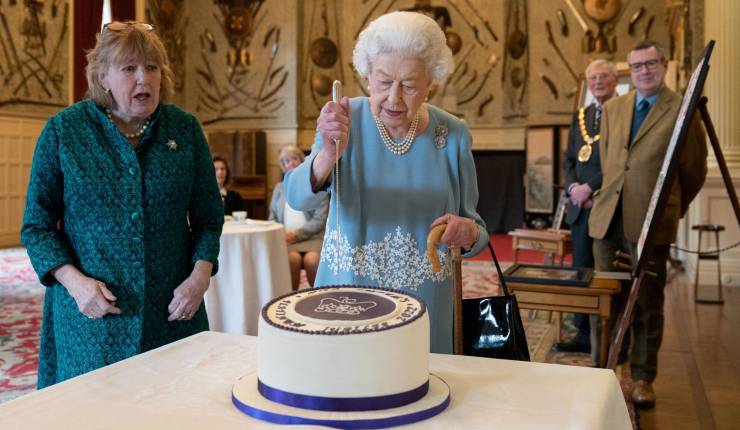
Celebrating the Platinum Jubilee of Her Majesty, Queen Elizabeth 2 as the monarch celebrates 70 years of an extraordinary reign.

By Rolene Marks

“I declare before you all that my whole life whether it be long or short shall be devoted to your service and the service of our great imperial family to which we all belong.”

Princess Elizabeth, South Africa, 1947

We don’t know her thoughts or opinions – a rare feat in in today’s world where everyone is obsessed with sharing everything on social media. She has never given an interview – also a rare feat when most in the public eye are clambering over each other for a few minutes with a camera. We only found out this past weekend what the most famous and respected woman keeps in her chic Launer handbag (besides her lipstick!) and this revelation came courtesy of a beloved fictional bear. When Paddington Bear and her Majesty, Queen Elizabeth II took tea last weekend in a clip for the Platinum Jubilee, we discovered that Her Maj keeps a marmalade sandwich safely tucked in there.

While we may now know this delightful titbit, what many don’t know about is the long and sometimes complicated history that the Royal family have with Jews and Israel.

Many have criticized the Queen for never visiting Israel. What many don’t realise is that foreign trips are made at the request of the British Foreign Office wanting to deploy the soft diplomacy and convening power that royalty has. The Queen cannot send anyone to The Tower (although I think she may have been tempted a few times with her family over the last two years!) but the monarch and her family wield an ambassadorial and convening power that is second to none.

The respected historian, Andrew Roberts, once said that the British government had a de facto ban in place on state visits by Queen Elizabeth II to Israel. “The true reason of course, is that the FO [Foreign Office] has a ban on official royal visits to Israel, which is even more powerful for its being unwritten and unacknowledged. As an act of delegitimization of Israel, this effective boycott is quite as serious as other similar acts, such as the academic boycott, and is the direct fault of the FO Arabists. It is, therefore, no coincidence that although the Queen has made over 250 official overseas visits to 129 different countries during her reign, neither has ever been to Israel on an official visit,” said Roberts, addressing attendees at a gala dinner in London.

The Queen at her coronation.

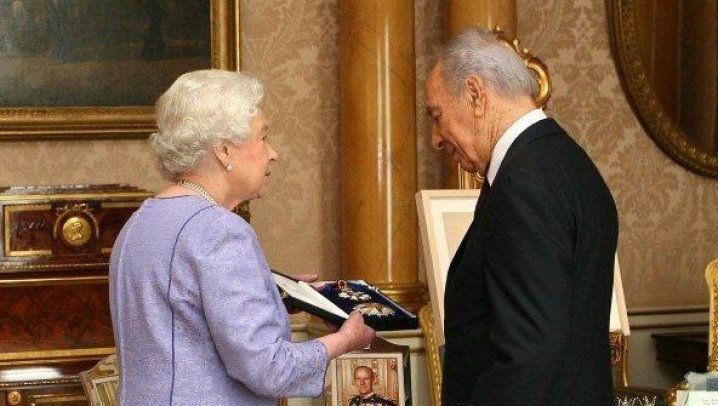
The Queen has received Israeli dignatories including former President Shimon Peres who was awarded an honourary knighthood in 2008. Peres was knighted with the Grand Cross of the order of St Michael and St George.

For 30 minutes, Peres spoke to the Queen about Israel’s history and current situation and gave the Queen two gifts: a letter written by her father, George VI, upon the official recognition by Britain of the state of Israel, and two silver candlesticks in the shape of pomegranates.

The former President described their meeting as:

 “friendly and informal; the Queen asked me a lot of questions on Israel. I was very moved to be the representative who received this honour for the state of Israel. The whole ceremony was not for me as an individual but a mark of respect for the country. I felt I was a shaliach mitzvah (emissary dispatched to do a mitzvah).”

Mr. Peres spoke to the Queen about the suffering of the town of Sderot and said that “the British learnt from the bible and we learnt from the British democracy.”

Arise, Sir Peres. The Queen knights Shimon Peres

Even though the Queen has never visited Israel, she has had strong ties with the Jewish community (even hiring a Jewish mohel to perform a royal circumcision) and has met with Holocaust survivors on many occasions.

One such meeting was at an event marking 60 years of liberation of Bergen Belsen. The late Rabbi Lord Jonathan Sacks z”l who was present, later recounted: “When the time came for her to leave, she stayed. And stayed. One of her attendants said that he had never known her to linger so long after her scheduled departure. She gave each survivor – it was a large group – her focused, unhurried attention. She stood with each until they had finished telling their personal story.”

Rabbi Marvin Hier of the Simon Wiesenthal Centre, spoke of meeting the Queen and Prince Philip in his memoirs and how they took a keen interest in his work and Jewish traditions.

Over the years, members of the Jewish community have been honoured at investitures for their work and contribution in a variety of fields including Holocaust and Jewish education. WIZO’s founding mother, Rebecca Sieff, was awarded an OBE (Order of the British Empire) as has former WIZO UK President, Lorraine Warren and other WIZO Presidents from the United Kingdom and Commonwealth countries.

The late Prince Philip was well known for his politically-incorrect gaffes which some attribute to an attempt to make people laugh and put them at ease. While the foreign office forbid royal visits to Israel, the Duke of Edinburgh visited in a private capacity several times for a very honourable reason. His mother, Princess Alice, who is buried in Jerusalem, has been honoured by Yad Vashem as a Righteous Amongst the Nations for saving the lives of a Jewish family during the Holocaust.

In recent years, two future kings, Prince Charles and Prince William have visited the Jewish state.

Prince Charles represented Her Majesty at the funeral of slain Israeli Prime Minister, Yitzchak Rabin and has supported Jewish causes and visited Israel in recent years.

Prince Charles, once ridiculed for his propensity to prefer conversing with plants than politicians and intellectuals, has said that he prefers to regard himself as the defender of faiths rather than of the faith, that being the Church of England which the monarch heads. To this end, he works hard to promote coexistence between the faiths. The Prince of Wales counted Lord Rabbi Jonathan Sacks as a close friend and lamented his passing. He has also written personal messages in several books including Lily Eberts, “Lily’s Promise”.

The Prince of Wales talks to Holocaust survivor, Lily Ebert.

Prince Charles is patron of World Jewish Relief as well as the Holocaust Memorial Trust, a patronage that once belonged to the Queen but as the monarch hands over more of her patronages to members of her family, the heir to the throne has received this one. He is also patron of the Jewish Museum, JLGB for Jewish youth across Great Britain and numerous others. To coincide with International Holocaust Memorial Day, the Prince commissioned portraits to be painted of several Holocaust survivors accompanied by a documentary on the BBC. The Prince gave a very moving speech the 75th anniversary of the liberation of Auschwitz hosted by Yad Vashem and met privately with survivors, away from the prying eyes of the media. He gave a notable private donation to The Peres Centre for Peace. His wife, the Duchess of Cornwall visited Auschwitz, representing the Queen to mark the 75th anniversary of the Liberation of Auschwitz.

The Duchess of Cornwall (Camilla) lights a candle of remembrance at Auschwitz.

Camilla, the Duchess of Cornwall is also known to enjoy a hora or two. During her visit to Jewish Care’s Brenner Centre in East London to celebrate the organisation’s 80th anniversary, the Duchess danced with delighted residents.

It was a lovely, wonderful experience, I think I’m dreaming,” said Abraham David, who danced with the duchess. “She put her hand out to mine and wanted to dance — I couldn’t believe it. I won’t sleep tonight I’m so excited.”

Having a Swinging Time. The Duchess of Cambridge dances to Hava Nagila at a Jewish Community Center in East London in 2019.

Prince William was the next king in waiting to visit Israel albeit without his lovely wife Catherine (Kate Middleton) who had recently given birth to their third child, disappointing many Israeli fashionstas (okay, me) wanting to catch a glimpse of what she would be wearing but mother duty comes first and we understand. The Prince struck all the right notes visiting the Kotel, Yad Vashem, the grave of his late great-grandmother, met young innovators, took a stroll with Eurovision sensation Neta, and even played volleyball on the beach and football with young Israelis and Arabs – all without breaking a princely sweat.

Prince William plays volleyball in Tel Aviv

The prince also proved that he could navigate some tough political terrain, shuttling between Israeli and Palestinians leaders, without going “there”. Royals are above politics.

Prince William at the Kotel (Western Wall)

On a state visit to Poland, Prince William and his wife, the Duchess of Cambridge visited Stutthof Concentration Camp. It would be a life-changing experience for the Duchess. The Royal couple met Holocaust survivors, Manfred Goldberg and Ziggy Shipper who both came to England after the war as Windermere children.

The Duchess of Cambridge photographs Holocaust survivors.

Since this seminal meeting, the Duchess has dedicated herself to Holocaust education and has taken photographs of survivors for the Imperial War Museum’s exhibition, included them in her book “Hold Still”, engaged with survivors and young educators via Zoom, met with Windermere child survivors, attended Holocaust Memorial Day events and more.

Judge and TV personality, Rob Rinder, who accompanied the Duchess when she met with Windermere survivors tweeted in response to a royal fan “She was – truly – amazing .. Anybody with doubts about the future & purpose of our Monarchy should spend an hour with her. Quite extraordinary.”

Hosting a garden party at Buckingham Palace on behalf of the Queen recently, fascinator firmly fixed, umbrella in hand, the Duchess made a beeline for her good friend Manfred, who along with his wife was a guest. “Manfred,” Catherine said, “It’s so lovely to see you again. How are you?” The two shook hands, whilst Manfred replied: “It’s my pleasure and privilege to see you again.”

The Duchess of Cambridge is delighted to see Manfred Goldberg at Buckingham Palace.

When I saw your name on the guest list I thought ‘yes!’ I am so happy to see you! Are you keeping well?” asked the Duchess. The pictures of the delighted trio were beamed around the world to the happy reaction of many young people who knew exactly who Manfred was and his story of survival. This is the power of royalty. Through their work, generations are learning the stories of the Holocaust because the platform to tell them does not come bigger than the royal family. The Cambridges have spoken publicly about how they are talking to their children about the Holocaust so that it is never forgotten.

The Duchess of Cambridge marks Holocaust Memorial Day

While the history of the royal family, Jews and Israel may have had its awkward moments in  history, it looks like the future seems extremely positive.

The young princess who made that sacred, lifelong vow in South Africa on her 21st birthday has more than delivered and the joyous celebration this past weekend as she marked her Platinum Jubilee is proof of the love and respect she commands through duty and service to her people, Commonwealth and realms.

 The Queen and her heirs at the Platinum Jubilee

We lift a glass of the best kosher champagne and toast to Her Majesty, the Queen on the remarkable achievement of 70 years on the throne. Mazel Tov, Ma’am, the future you have ensured, is in good hands.

MAZEL TOV !!!


While the mission of Lay of the Land (LotL) is to provide a wide and diverse perspective of affairs in Israel, the Middle East and the Jewish world, the opinions, beliefs and viewpoints expressed by its various writers are not necessarily ones of the owners and management of LOTL but of the writers themselves.  LotL endeavours to the best of its ability to credit the use of all known photographs to the photographer and/or owner of such photographs (0&EO).

Farewell to Rodney Mazinter

A tribute to a South African Zionist who fought for his people through word and deed

By David E. Kaplan

Living in Israel, I knew this Cape Town-based writer, poet and published novelist, Rodney Mazinter, mostly by  his pen and what a mighty pen it was.

Rodney Mazinter

Imagining him like the proverbial knight  on his sturdy horse wielding in jousting position a pen as his lance, he pressed forward to do battle for his beloved Israel and the Jewish people. His extensive writings in support of causes close to his heart were warmly embraced by readers beyond South Africa.

In his first novel available through Amazon, the author recreates “the European world of the Jewish people in the first half of the twentieth century – a world of unimaginable hardship and hatred, culminating in the Holocaust.”

We at Lay of the Land in Israel, welcomed his contributions as did our readers across the world, and in paying tribute to this inspiring lover of Israel and community leader (he was a former vice-chair of the South African Zionist Federation, Cape Council), we are proud to publish one of his poems that so poignantly resonates as each stanza shares intimate similarities of his final days.

Having suffered a heart attack and finding himself in an Intensive Care Unit (ICU) in Cape Town, it was a subject that Rodney had previously thought intensely about when he composed this poem set in an ICU not in South Africa but in one of Israel’s premier hospitals – Rambam in Haifa.

The most renowned of the Jewish medieval scholars, Maimonides changed the face of Judaism.

With so many superlative hospitals in Israel, why did Rodney choose Rambam?

Named after and honouring Rabbi Moses Ben-Maimon, called Maimonides or the “Rambam” an acronym of his name in Hebrew, Maimonides was a preeminent medieval Sephardic rabbi, physician, and philosopher and one of the greatest Torah scholars of the Middle Ages. He is credited to  being among the first in Western thinking to propose that the health of the body and soul should be combined, in other words that the body is the home of the soul, and the soul guides the body  revealing the body and the soul as one unit. The Rambam’s medical writings constitute  a significant chapter in the history of medical science.

The setting of Rodney’s poem, Rambam Health Care Campus commonly called Rambam Hospital, is the largest medical center in northern Israel and is named for the 12th century physician-philosopher Rabbi Moshe Ben-Maimon (Maimonides), known as the Rambam.

All this I believe, intuitively, percolated in Rodney’s creative mind as he poetically applied his craft to his subject.

Whether Jew, Muslim or Christian brough to Rambam’s ICU due to illness, accident, war, crime or act or terror, the actions and thoughts of all who busily occupy this space from those seeking salvation to those trying to provide it “Like a team of lifeguards constantly on duty”, the poem moves to the rushed rhythmic beat of a pulsating heart.

Rodney captures it all……

ICU – TRUE HEROES OF RAMBAM

By Rodney Mazinter

A capsule of pain and fear − or an airlock

Waiting for travellers to pass through to a place they’re loath to enter?

Are there those among us who care enough to bring them back?

Jew, Muslim, Christian, some brought low by illness,

Or worse, by bullet, knife or car,

Victims of those weaned on hatred,

Bullied by brutes bereft of − bankrupt of − compassion.

Across the way in a darkened room,

A man struggles to bring his pulse down and his blood pressure up.

A woman whose teary eyes still hold the captured images of visitors,

Lies dying of the illness of old age, an oxygen feed clamped firmly

To her fine Semitic face.

Down the line of serried beds a man cries out incoherently −

It is a high-pitched supplication of dread, pain and pleading. Is he talking to God?

Monitors, the Argus-eyed guardians for the physicians,

Blink codes and messages to those trained to read them.

Through all this, doctors and nursing staff

Meander among the beds performing minor miracles,

Like a team of lifeguards constantly on duty

Ready to pluck a sinking life from the jaws of eternity.

They fight the battle and mostly win,

But there is no triumphant parade with flags waving,

And boastful thumbs stuck in lapels.

There is no time for that − a new patient is wheeled in from ER.

There are lines to set and veins to pierce,

And all focus is on the never-ending stream of humanity

On the road to recovery, if not survival.

Medical personnel wearing protective equipment treat a COVID-19 patient in an intensive care ward at Rambam Hospital, December 15, 2020. (AP Photo/Oded Balilty)

….

Following Rodney’s passing, a close friend  and fellow literati of his from Cape Town, Charlotte Cohen, sent me her poem What is a mensch? republished earlier this month in ‘Jewish Affairs’ a monthly publication issued by the South African Jewish Board of Deputies, in which she asserts “epitomises the person who Rodney Mazinter was.” Who can disagree with her?

In selecting only two lines, I felt drawn to these:

“ A mensch sees the world as ‘we’ not ‘I’

A mensch is always there


Our sincere condolences to his wife Mavis and all the family from Lay of the Land.


While the mission of Lay of the Land (LotL) is to provide a wide and diverse perspective of affairs in Israel, the Middle East and the Jewish world, the opinions, beliefs and viewpoints expressed by its various writers are not necessarily ones of the owners and management of LOTL but of the writers themselves.  LotL endeavours to the best of its ability to credit the use of all known photographs to the photographer and/or owner of such photographs (0&EO).

He Died so that Others may Live

Remembering Christian Arab-Israeli officer Amir Khoury who bravely gave his life to save Jews

By Jonathan Feldstein

Normally, when one goes to express condolences to a family mourning a deceased relative, you know one of the family members, if not the deceased.  At a certain age, one goes to console a friend whose parent died, but with whom you didn’t have a personal relationship, if at all.  It’s rare to show up at the home of someone you don’t know, grieving over the loss of a loved one who you also didn’t know either.  But that’s what I just did.  Here’s why.  

During my last week of nearly a month’s trip throughout the US, there were four terror attacks in Israel. Eleven people were killed, and dozens injured. There have been many more attacks in which, thank God, there were no injuries, and as many as fifteen others reportedly prevented due to good intelligence followed by swift military operations.

With too many Israeli families in mourning and many more suffering injuries and trauma, I took a full day to visit one of them.

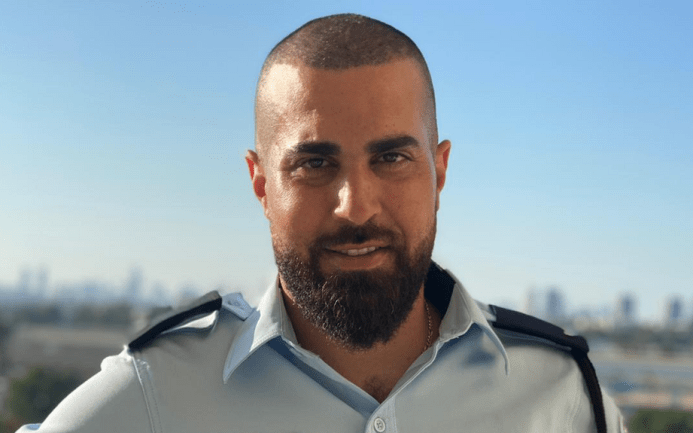
Face of a Hero. Police officer Amir Khoury from Nof Hagalil put himself in the firing line without hesitation in Bnei Brak on March 29, 2022 (Courtesy of the family)

As of this writing, the deadliest recent terror attack took place in Bnei Brak, a city in central Israel with a large ultra-Orthodox population.  Five people were killed including two Jewish Israelis, two Ukrainians, and a Christian Arab Israeli police officer, Amir Khoury. Some may be confused by the idea of a Christian Arab Israeli being a victim, much less a hero as one of the security forces that stopped the terrorist. Amir is credited with racing to the scene of the terror attack, opening fire and neutralizing the terrorist. But he was also mortally wounded in the process.  His partner, who finally killed the gunman, would later eulogize his fallen comrade with these shining words:

My children will grow up and remember your name because you were my flak jacket, dear brother.”

This week, I visited Amir’s family. Hailed as a national hero, this Christian Arab family were receiving visitors from all over the country in tents outside their home adorned with Israeli flags.  Had Amir not acted as decisively as he did, the carnage would have been much worse. 

In Jewish tradition, mourners remain seated on low chairs and visitors approach them.  As soon as I walked into the larger of the two tents, Amir’s father rose and embraced me, speaking to me with warmth, wanting to know who I was, were I came from, and why. As we spoke, we stood together, hands clasped.  He pegged my American accented Hebrew and asked where I was born, when I immigrated to Israel, and about my family. If one didn’t know that he was mourning the murder of his son, one would never imagine that he was not just being a gracious host. As I sat down, I was served strong black coffee.

I spent considerable time speaking with Amir’s father, mother, brother, sister, and brother-in-law.  As we sat together, I couldn’t help but recall the verse from Psalm 133:

 “Behold, how good and pleasant it is when brothers dwell together in unity.”

The original Hebrew says “shevet achim gam yachad” which can be interpreted as dwelling, but also sitting.  There we sat together, mourning a victim of a hate-inspired terrorist who wanted anything but for us – Jew and Arab –  to dwell together in unity.

The terrorist failed.

Visitors came from across the country to pay tribute to this hero – Amir Khouri. There was one person who drove six hours from Eilat, visited for thirty minutes, and then drove back. There were Jews of every background, Arabs, government cabinet members, present and former ambassadors and rabbis. People emerged from the family’s distant past like a former neighbor in Tel Aviv from decades earlier when he was first married.

While I didn’t come from the furthest distance, the family was impressed that I came from Gush Etzion in the Judean mountains south of Jerusalem, because there is a stereotype about “settlers” and Arabs. That’s part of the political baggage with which we live and, like many stereotypes, is built on myths.  We didn’t talk politics at all. It was a wide-ranging visit about Amir, about them, and about our shared society.

They were moved that Bnei Brak, a mostly ultra-Orthodox Jewish city, will be naming a street after their Amir, a Christian Arab. I sensed that all the family wanted was for Amir to be remembered.

He undoubtedly will be and by you reading this, you’re contributing to Amir’s remembrance and ensuring his legacy.

Final Journey. Casket draped with the flag of Israel, Amir Khoury is carried to his burial site by his fellow police officers. (Getty Images)

I didn’t just go visit myself, but brought with me dozens of condolences and prayers from others.  The night before, I posted through my social media and chat groups that I was going to visit the Khoury family. I invited others to send notes. In just a few hours, dozens of people sent their condolences and prayers, along with donations, so we can do something meaningful in Amir’s memory. That so many people sent their condolences in writing was a comfort.  More continue to do so.

A person I spoke to wept while recounting how the family found out about Amir’s death.  They were watching the news with live reports of the terror attack.  They had a bad feeling because calls and text messages to Amir went unanswered.  Each shared how they dealt with this, but that they had each lost it when seeing the police outside their front door a little after 10:00pm, two hours after initial reports of the attack. At that moment, all their fears were realized. As they were recounting, I held back the tears seeing the dark circles under their eyes testifying to their endless tears and lack or sleep. 

Condolence Call. Khoury’s father Jereis (center) and Amir Khouri’s fiancée Shani with Police officers paying a condolence call on March 30, 2022. (Channel 12 screenshot)

While hailed a national hero, the sad tragedy is that by the enemies of peace he is not considered a hero to all! There are those extremists who look at him as a traitor. It’s hardly a public secret that Christian Arabs live under threat from Muslim extremism and another visitor confided in me that Amir’s death was being celebrated amongst some within the Palestinian Authority and among extremists in Israel. There was fear to talk too much about this because with Amir’s heroism being cast into the spotlight, there was a concern that others in the Khouri family might find themselves possible targets.

Sitting with this family of devout Christians, I couldn’t help but think that Amir, like Queen Esther, was put in a situation “for such a time as this.”(Esther 4.14)

I couldn’t bring myself to pose this thought to Amir’s family. Both saved lives and I wondered if like Esther (Esther 4:16), Amir raced to the scene of the terror attack thinking:

If I perish, I perish

One thing for sure is that Amir was an angel for a whole community.  Had it not been for Amir, it’s unthinkable how many more people would have been killed. 

In meeting and speaking with people, I avoided saying “nice to meet you” but rather “it’s an honour to meet you”. I’d have preferred that I never had the occasion to know them, or know of them for it was brought about by personal loss. However, the reality is that tragedy brough us together and in parting, an Amir  family member poignantly expressed:

We not just friends; somehow God ordained it.”

Mourning a Hero. Thousands including ultra-Orthodox residents of Bnei Brak were among the mourners at the funeral of 32-year-old Christian Arab Amir Khoury from Nof Hagalil. “He gave his life for others,” said Yaakov, an ultra-Orthodox Bnei Brak resident interviewed on Channel 13. One of the buses transporting ultra-Orthodox Israelis from Bnei Brak to the funeral. displayed the message: “Amir Khoury, hero of Israel.”

While the formal mourning period has ended, the grief and loss have not and anyone who wishes to send a note to Amir’s family can do so at https://genesis123.co/blessasoldier and send condolences, prayers, and words of comfort which will be delivered to them directly.  A donation of any size will go toward a project in Amir’s memory.  For further information, please be in touch at Gen123Fdn@gmail.com.

Please join us to be a blessing to Amir’s family, honor his memory, and pray that he will be the last victim of hate-inspired terror.


EPILOGUE

I would later learn that on the previous Sunday, Amir Khoury had sat at home with his fiancée Shani Yashar watching the news of a terror attack in Hadera, in which two police officers were killed.

He had said to her “If I see a terrorist in front of my eyes, I’m going to crush him. I’m not going to let anyone get hurt; that’s why I’m a cop.”

Shani recalled pleading with her beloved to “not be a hero”.

He could be nothing else – he lived and died a hero.

  • At the time of publishing this, another attack took place in Tel Aviv and three Israelis were killed.


“Hero of Israel”. Amir Khoury’s grieving comrades at the funeral.  


About the writer:

Jonathan Feldstein ­­­­- President of the US based non-profit Genesis123 Foundation whose mission is to build bridges between Jews and Christians – is a freelance writer whose articles appear in The Jerusalem Post, Times of Israel, Townhall, NorthJersey.com, Algemeiner Jornal, The Jewish Press, major Christian websites and more.


While the mission of Lay of the Land (LotL) is to provide a wide and diverse perspective of affairs in Israel, the Middle East and the Jewish world, the opinions, beliefs and viewpoints expressed by its various writers are not necessarily ones of the owners and management of LOTL but of the writers themselves.  LotL endeavours to the best of its ability to credit the use of all known photographs to the photographer and/or owner of such photographs (0&EO).

Final Landing of one of those “Magnificent Men in their Flying Machines”

Farewell to a hero who participated in the greatest adventure for a Jew in 2000 years

By David E. Kaplan

Less than two years ago on the occasion of his 100th birthday, Lay of the Land interviewed Harold ‘Smoky’ Simon, who passed away this week a few months shy of his 102 birthday.

Thumbs Up. At 100, Smoky Simon in 2020 again takes to the skies over Israel in a Tiger Moth he once helped repel the enemy in the War of Independence.

And what did this former South African and Chairman of World Machal (Mahal is the Hebrew acronym for Mitnadvei Hutz La’aretz – volunteers from abroad who came to fight in Israel’s War of Independence) do on that occasion?

Most blokes of a seriously senior age might settle for a thin slice of birthday cake or a “medicinal” scotch; but not Smoky. Donning a helmet and goggles and grinning from ear to ear like a mischievous teenager, the centenarian climbed  into a single propeller Tiger Moth and flew over the very area where in 1948 he and his comrades helped repel the advancing Egyptian attack.

Dubbed the “Flight of the Century”, the video made of the 2020 historical flight went viral on YouTube.

Exhilarating,” was the way he  described to this writer in one word of that flight.

It had truly been a “family Affair” for in separate planes alongside their dad’s aircraft were his two proud sons, Saul and Dan, who after their schooling, followed in their father’s ‘flightpath’ by becoming top pilots and flight instructors in the Israel Air Force (IAF). What a joy for the birthday boy when he alighted  from the plane an hour later to be met by his adoring grandchildren screaming proudly, “Saba,Saba” (“grandfather, grandfather”).

If the experience at 100 felt personally liberating”, the nuance was not lost on Smoky who told this writer:

 “You know, the area I just flew over  – the central Negev – was the very first area to be LIBERATED in the War of Independence.”

While the War of Independence was Israel’s longest war lasting eight months from May 1948 to January 1949, “it was also its costliest with 6,373 military and civilian lives lost out of a population of 650,000,” said Smoky. “What’s more, it was also Israel’s most fateful war for if this war had been lost, the prayers, hopes and dreams of 2000 years would have vanished into thin AIR.”

To ensure that did not happen, it took the likes of this plucky South African aviator, who in 1948,  – took to the AIR to fight for Jewish survival and independence.

Fine Tuning. Final preparations before taking off on his 100th birthday.

LOVE IS IN THE AIR

There are not too many couples who can say  they selected a war to come on honeymoon, but that is what Smoky, and his young bride Myra did in 1948. “When the South African Zionist Federation began recruiting ex-WWII servicemen and it became clear there was going to be an imminent war, we brought our wedding date earlier.

“Howcome?” I asked. 

“Well, when  I said to Myra,  ‘We have got to postpone our wedding,  because I’m going to Palestine,’ she replied, “Not postpone, advance because IF YOU’RE GOING, I’M GOING!” 

Dynamic Duo. Saluting one of the last living heroes of Israel’s fight for independence in 2019, Harold “Smoky” Simon displays his Nefesh B’Nefesh’s Sylvan Adams Bonei Zion Lifetime Achievement Award, together with wife Myra, who had been a meteorologist in the SAAF and  joined the South African Zionist Federation group to volunteer to fight alongside her husband for the emerging Jewish state. (Source: Nefesh B’Nefesh via Facebook Sept. 24, 2019.)

This is how Smoky and Myra were part of the first group of volunteers from South Africa. “We arrived on the 9 May 1948 and the next day we signed on to serve in the new-born Israeli air force, although on that day we did not know yet it was Israel – we spoke of Palestine.” While Myra had served in the SAAF during WWII as a meteorologist  and became the first instructor in meteorology in the IAF, Smoky, who had flown for the Royal Air Force (RAF) over the deserts of western Egypt, Libya and Tunisia and later over Sicily and the rest of Italy, was about to again ‘take off’ into history. “Fighting the Nazis gave us the skills and the experience we needed to fight for Israel,” he said.

And fight they did!

Hearing from a Hero. South African-born accountant Smoky Simon, who became chief of air operations of the nascent Israeli Air Force in May 1948, speaks at Tel Aviv’s Beit Hatfutsot Museum. (PHOTO JUDY LASH BALINT)
 

On the 14 May 1948,  while David Ben-Gurion was declaring the State of Israel in Tel Aviv, Smoky was one of three people who had a clear disturbing view of what was about to befall the new state. The other two were fellow South African, Boris Senior and an Israeli photographer, Shmulik Videlis who were flying in a Bonaza in what was the first reconnaissance flight over enemy territory. Boris was the pilot, Smoky, the navigator.

They observed with sinking hearts; the roads leading from Transjordan and Syria lined with hundreds of vehicles, tanks trucks, half-tracks, and armoured cars, “all moving in for the kill.”

They could see Kfar Etzion “had already been overrun and was on fire,” and would soon learn that some 200 members of Kfar Etzion had been killed in its defense, including South Africans.

Returning to Tel Aviv for their debriefing, they could hardly conceal their anxiety.

We know,” said Yigal Yadin, Head of Operations.

What Smoky did not know but discovered on landing was that while he had been in the air, Ben Gurion had declared independence and the new state had a name – “ISRAEL

I always say,” said Smoky, “that when I left on that reconnaissance mission,  I took off from Tel Aviv Palestine but when I  landed at the same location it was  Tel Aviv Israel! Our world had  changed forever.”

AGAINST ALL ODDS

The anxiety felt by all was understandable. “All we had were a few Tiger Moths, Cessnas and Austers. This made up our ‘Bomber Command’. Egypt had 62 frontline aircraft, including British Spitfires and Italian Macchis and here we were completely exposed without a single combat aircraft or anti-aircraft gun. I keep reminding myself – and I thought of this when flying again for my 100 birthday in the Tiger Moth –  that we are really living in a miracle.”

Planning & Plotting. With Israel’s future ‘up in the air’, standing around the table are (l-r) Aharon Remez (Chief of Israel Air force), Smoky Simon (Mahal – Chief of Operations), Shlomo Lahat (Squadran Commander and latyer Mayor of TYel Aviv) and Chris (Map section of Air Force).
 

The leaders of the Jewish community in Palestine at the time were aware that a declaration of statehood would be met by an immediate invasion by Arab armies.

And the warning was clear in the words of US Secretary of Defense, James Forrestal:

 “There are thirty million Arabs on one side and about six hundred thousand Jews on the other. It is clear that in any contest, the Arabs are going to overwhelm the Jews. Why don’t you face up to the realities? Just look at the numbers!”

Jew could expect no quarter. These words by the first Secretary-General of the Arab League, Abd Al-Rahman Azzam Pasha were chilling:

 “It will be a war of annihilation. It will be a momentous massacre in history that will be talked about like the massacres of the Mongols or the Crusades.”

What was going through Ben Gurion’s mind to proceed with a declaration of independence?  “You know,” says Smoky, “I have asked myself a 1000 times, what sort of inspiration  and courage and determination  he had. Only answer I can find, is  Ein Br’eira – “No Choice

Israel’s position was bleak. It was a David and Goliath scenario of bringing the proverbial staff and sling to a battlefield against five well-equipped armies.

In our few Austers and the few Cessnas brought over from South Africa, we flew off into battle with a pilot, navigator and what we called “bomb-chuckers”. These fellow held the bombs on their laps  – 20 and 50 kilograms –  and at a height of 1500 to 2000 feet,  they would chuck ‘em out and drop them on the  enemy. We would then fly back to base  counting our lucky stars, ‘reload’, and then off again on our next trip.”

Incredulous, I ask:

Wasn’t this very dangerous?”

Well, before opening the aircraft’s door and pitching-out the bombs, we would tie the bomb-chuckers to each other with rope, so that they would not fall out of the plane along with the bombs. Sometimes, for good measure, we also threw out crates of empty bottles which made a terrifying noise scarring the hell out of the population below. If we did not have the goods, we had to pretend!

This is how the IAF in this modest way, developed into this amazing world class air force of today.”

AN OFFICER AND A MENSCH

MODEST” it was, as Smoky attested in this delightful anecdote. On being made Israel’s first Chief of Air Operations in 1948 with the rank of Major or the equivalent of “Squadron Leader”, he needed to display his new rank. However “we didn’t have any.”

Man on a Mission. Air navigator, Smoky Simon, Machal – Chief of Operations in 1948.

So what did you do? “Not me, Myra. She went to a haberdashery shop in Allenby Street and purchased a few pieces of ribbon and sowed it on to my uniform to display my rank.”

To lighten the tension, the night before Smoky’s aerial attack on Damascus on the 10th of June 1948 – the first attack on an enemy Arab city – Smoky said to Myra:

 “Now at least if I get shot down, they will know I am an ‘Officer and a gentleman’!”

Smoky’s plane did six runs over Damascus that night creating the impression “that we were part of a large formation.”

As it was mostly subterfuge causing negligible  damage besides  “a few fires”, the next day, “all the foreigners fled Damascus as they feared our ‘air force’ was about to hammer them.”

MODERN DAY MIRACLE

While Egypt and Jordan were equipped by the British, Syria and Iraq in the early days of the war, Smoky reminded that “Israel had only one friend in the world and that was Czechoslovakia. You know, we owe such a debt to that country. It was Israel’s lifeline and I still keep in touch with guys in Czechoslovakia (Czech Republic) to this day.”

Amplifying on the contribution, Smoky continued:

Firstly, they provided 25 German Messerschmitts,  and what was so remarkable was  – I call it a miracle within the bigger miracle – was that the first four Messerschmitt’s,  which  were brought in parts to Israel and reassembled under the strictest security,  were ready on the 29th of May –  two weeks after the declaration of the State – for an operation that literally saved the war and the State of Israel.

Taking a deep breath, Smoky continued:

“The Egyptians had overrun the kibbutzim in the south and reached Ashdod,  and the next day they would have been in Tel Aviv, where Ben Gurion and the provisional government was located, and the War of Independence would have been lost.”

So who flew these planes to counter the Egyptians?

Two Mahalniks (volunteers from abroad), Lou Lenart an American who led the attack and Eddy Cohen a South African, who was sadly killed in the operation, and two Israelis, Ezer Weitzman, later President of Israel and  Modi Alon.  And I call that day, Israel’s day of survival. It was one of the IAF’s greatest moments.”

War & Remembrance. Mahal heroes (l-r) Migdal Teperson, Smoky Simon, Joe Woolf and Ruth Stern at a Guard of Honour of Mahal volunteers at the Mahal Memorial on Yom Hazikaron 2011

The attack came as a shock to the Egyptian commanders who had believed Israel to be without combat aircraft and suddenly this air attack by the four Messerschmitts halted their advance. Says Smoky, “The Egyptians fell on the defensive and would not be in Tel Aviv in 48 hours as their government-controlled media had boasted. Tel Aviv receded from their grasp! I always think of Churchill’s words of the Battle of Britain, “Never has so much been owed by so many to so few”.”

Amongst that “few” was Smoky, who served until his passing as Chairman of World Machal (Organisation representing the volunteers from overseas in the Israel Defense Forces). In the words of Israel’s founding father and  first prime minister, David Ben Gurion:

The Machal forces were the Diaspora’s most important contribution to the survival of the State of Israel.”

Saviors of the State. Two of the founders of the Israel Air Force, Smoky Simon, Chief of Air Operations (left), Sid Cohen (right) who commanded 101 Squadron and Maurice Ostroff (centre), commander of radar station Gefen seen here in 2005 at a TELFED (SAZF in Israel) event honouring all the MACHAL volunteers, some who attended from overseas.  Click here to listen to a March 2015 Voice of Israel interview with Smoky Simon telling the authentic story about the creation of the State of Israel.

Seventy-two years on from those fateful days, Smoky – at the wonderful age of 100 – was back in the cockpit, revisiting in a similar plane over a familiar terrain and reflecting “what was achieved.”

In his professional life after the war, Smoky would make a huge impact on the insurance industry in Israel eventually selling his agency to one of Israel’s largest insurance companies. However, it was because of people like of Smoky that offered the best INSURANCE for Israel’s survival.  Ensuring that story of survival remains alive for future generations, Smoky dedicated his life to engaging with youngsters in Israel and abroad, including recruits in the IDF, educating them on the vital role of the ‘Machalniks’ in securing a future Jewish state.

Smoky was a man of initiative and action, and what better way to paraphrase that there was:

‘NO SMOKY WITHOUT FIRE’


While the mission of Lay of the Land (LotL) is to provide a wide and diverse perspective of affairs in Israel, the Middle East and the Jewish world, the opinions, beliefs and viewpoints expressed by its various writers are not necessarily ones of the owners and management of LOTL but of the writers themselves.  LotL endeavours to the best of its ability to credit the use of all known photographs to the photographer and/or owner of such photographs (0&EO).

Farewell Arnie

A tribute to a kibbutz icon

By David E. Kaplan

For me as I’m sure for sure for many generations over many years, Arnie Friedman – who passed away  earlier this month on kibbutz Yizre’el in the Jezreel Valley near Afula in north-eastern Israel – was the wide,  warm, welcoming outstretched arms of his beloved community.

You did not need a sign at the entrance that read in Hebrew “Welcome to Yizre’el”, you just needed Arnie standing there to meet you.

I recall as a journalist, my last published article on Arnie. It was two years before corona and his line:

It’s never too late”.

What did he mean by that?

The story that unfolded revealed so much of the character and humour of Arnie, of selfless service to others, his commitment with the capital ‘C” to the Jewish youth movement in South Africa ‘Habonim’, and of finally fulfilling dreams, no matter how long it takes!

“THE GRADUATE”

Special People. Arnie and Peggie Friedman in their garden on kibbutz Yizre’el. (Photo David Kaplan)

In 2018, I wrote that 83-year-old Arnie Friedman would be walking down the aisle. Not the one that comes first to mind – being happily married to Peggie – but another aisle that he missed walking down over sixty years earlier in Cape Town, South Africa. Due to circumstances having denied him the opportunity of enrolling at the University of Cape Town (UCT) in 1950, in 2018 Arnie walked down the aisle at the Max Stern Academic College of Emek Yezreel in Israel to receive his Bachelor of Arts degree.

And Peggie, who stood with Arnie under a Chuppah in 1957, stood beside him again as he was conferred his degree – the fulfilment of a lifelong dream.

It had been a  long time coming.

In his final years at SACS in Cape Town in the late 1940s, “I, like my mates, already started taking preliminary subjects at UCT in preparation. You could do that in those days.”

However, for Arnie, it would lead nowhere!

The family were in dire financial straits and could not afford university tuition fees. Following his father’s return in 1944 from the war in North Africa, he opened a business with an uncle “that struggled,” said Arnie. “Having battled the Nazis, I did not have the heart to pressure my Dad who was now battling financially.”

Studying at university was thus put on hold.

It remained on my to-do list; just a question of – when.”

Arnie took a job with Woolworths, where much of his salary went to help support his family, but when after a few years, it became feasible to enroll at UCT, “Habonim in Cape Town asked me to be Mazkir Klali (Secretary General), which I accepted.”  And then, at the end of 1955, when Arnie again thought that “the time is right” to study, it was not his family that now needed his support, but the State of Israel.

From Cape Town to Cairo! Preparing for the Suez Campaign, Arnie Frieman (standing right) training with his Nahal comrades in 1956.
 

Habonim in South Africa had received a letter from Shimon Peres (later president of Israel) who in the mid-1950s was Director-General of the Ministry of Defense and involved in the planning of the 1956 Suez War, in partnership with France and Britain. “In his letter, which he addressed to Jewish youth movements all over the world,” said Arnie,“he revealed that there was a strong likelihood for war sometime in 1956, and that the State of Israel would welcome young men volunteering to fight.”

Licking their Wounds. An amused Arnie Friedman (right) having his leg attended to by Harld Kaufman during the 1956 “Suez Campain following the Battle of the Babes in Tel Aviv.

UCT would again have to wait!

A whole gang of us from the Movement – some students, some not – volunteered, and on the third day of arriving in Israel we were drilling in uniform.”

However, “our katzin (“officer”) was less than impressed. He took one look at our overweight and scruffy crowd standing before him and bellowed in broken English, “Why did they not send us money instead to buy arms instead of you useless lot. What are we expected to do with you?” We were really shaken.”

That night, Arnie and his mates met in their barrack, “and we decided to show him. We pulled ourselves together, lost weight, trained seriously” and proudly emerged a formidable fighting unit.

“We were ready for battle,” but their first skirmish however was not against the Egyptians in the ‘Suez Campaign’ but what became known as ‘The ZOA Campaign’.

THE BATTLE OF THE BABES

On the eve of their paratrooper course, the South African Zionist Federation in Israel (Telfed) together with Nahalsplashed out on a party at the Tel Aviv headquarters of the Zionist Organization of America (ZOA) for us.”

After all, this was the first group of Southern African Nahal volunteers.

We arrived washed, combed, boots shinning and clean uniforms,” says Arnie. “To our delight, also invited to the party was a group of girls from some college as our dancing partners. The atmosphere was most convivial – good food, a band, dancing partners, plenty of beer, as well as a bit of the more potent stuff !!!”

Suddenly the party was ‘INVADED’ by a group of tough-looking paratroopers. “Not only did these gatecrashers polish off all our refreshments but without a “by your leave”, butted in and took over as the dancing partners with our girls.”

This was a declaration of war!

Tempers were kept in check until the final notes of Hatikvawhen the first fists started to fly and within seconds, the scene was something out of Western saloon brawl. The Nahal commander and Telfed staff member, Simie Weinstein tried to calm everyone down, but to no avail. He was pushed backwards into a large glass door which shattered into piece. Tables and chairs went flying.

Our officers called for a ‘retreat’ and we were herded into waiting buses.” On the way back to base, first aid was administered to cut cheeks, bleeding noses and hurt pride.

No doubt about it,” says Arnie, “the paratroopers were a far more experienced fighting unit. Nevertheless, our SA Nahal boys acquitted themselves very well.  We carried our bruises with pride. This was our first military battle in Israel.”

However, Arnie had further internal ‘battles’ – either to return to South Africa and university or stay in Israel with his garin (group) that had just been joined by a Habonim garin from Australia on Kibbutz Ginegar near Afula.

Arnie did return to South Africa, not to UCT however, but to marry his beloved Peggie with whom he returned, and together settled with his garin on the young kibbutz of Yizre’el.

Times were tough, and Arnie recalls “we were given a hut without a toilet or shower” and only with their first-born, “were we provided a hut with a bathroom.  But those were the days, and everyone in the country, one way or another, was roughing it. We were young; we did not come to a built-up country but to build the country. We were idealists.”

Studying at a university seemed ever-further away as the days, months and years would turn into decades and Arnie would establish his reputation as kibbutz head of volunteers and young groups studying at Yizre’el’s  ulpan programmes.

Imbued with the ideology of Habonim – “The Builders” – Arnie was living the ‘collective’ dream, but he never ever gave up on his personal dream of studying for a degree.

DREAM FULFILLED

And then, one day some seven years ago, “Now a pensioner”, Arnie saw a poster on a notice board addressed to the “over fifties” who were looking to study for a BA at the local college.

Finally, my time arrived, and with permission granted by the kibbutz, I signed up. Although it was for the over fifties, for most of the four years that I took, I was the oldest student.”

Arnie’s only sorrow was that his sister in Australia, who so supported him studying for this BA and assured that she would attend his graduation, passed away a month earlier at the age of 93. “At least she knew that I had finally fulfilled my dream.”

Noting in 2018 that it was the 120th anniversary of the First Zionist Congress in Basel, Arnie recalled Herzl’s most famous line:

If you will it, it is no dream.”

That summed up the Life of Arnie!

It also reflected the idealism of Arnie and his comrades on Yizre’el when their idealist was really put to their test. I remember Arnie telling  me the story.

The Usual Suspects. Following the Gilboa Walk and lunch as kibbutz Yizre’el in 2007, participants (l-r) Henrietta and David David, Hilary Kaplan, Daniel Klug, Michelle Wolff, Rossie Klug and the writer enjoy the home hospitality of Arnie and Peggie Friedman (right) in their garden. This was a tradition for many years, inspired and organised by Arnie.

SWIMMING AGAINST THE CURRENT

In  2012, after a stormy meeting, Kibbutz Yisrael members turned down a massive offer at the time for a majority stake in the kibbutz’s swimming pool robot cleaning company, Maytronics. It was modeled after the South African Kreepy Krauly, but taken to a whole new level of sophisticated robotics.

It would have made each member of the kibbutz exceeding rich.  But as Arnie explained, what does the word “rich” mean?

Apparently at the meeting that was leaning towards accepting the offer and would have changed the nature and social fabric of the kibbutz,  a South African member got up and asked the question: “If we accept the offer, could the buyer then relocate the business elsewhere, off the kibbutz?”

When the answer came in the affirmative, a debate ensured, which the South African members proved persuasive. As Arnie explained: “Yes, we will be rich, but we will be poor in sacrificing the lifestyle and values we cherish.”

Arnie told me that a member of the kibbutz came up to him afterwards and said:

 “We are indebted to you South Africans. You reminded us  of why we chose to live on a kibbutz and the importance of holding onto its values.”

On a personal level, I remember the close relationship we enjoyed –  in contact daily –  when I chaired the organizing committee of the Habonim 75th anniversary in 2005 on kibbutz Yizre’el, where some 1,700 ‘chevra’ from all over the world descended on this socialist emerald patch in in Jezreel Valley. During the daily grind of organizing, Arnie was that anchor that kept everything on an even keel. He moved mountains with such ease and always with a smile.

The Dream Team. Planning and plotting are Arnie Friedman (sitting centre) at a meeting of the organizing committee of the Habonim 75th Anniversary. Top (l-r) Bennie Segal, David Kaplan, Dave Bloom, Howard Gordon, Mikael Hanan’; (middle) Sean Wasserman; (bottom l-r) Stephen Schulman, Eddie  Solow, Arnie Friedman and Bruce Oppenheimer. ((Photo collection David Kaplan)

THE RIGHT TRACK

It was Arnie that thereafter introduced me to the famous annual Gilboa Walk, where people of all ages and from all over Israel and abroad participate as well as all the youth movements in Israel. It was moving to see all the kids from the youth movements walking in their uniforms and singing songs of idealism. It was poignantly described as a “remnant of Israeli togetherness”.

Each year, Arnie would call me to organize our friends from the south to join the Yizre’el members for the walk, followed by lunch on the kibbutz. It truly was an experience of warm “Israeli togetherness”.

The highlight was always afterwards, tea with Arnie and Peggy in their delightful garden.

Wonderful memories – farewell my friend.

Having a Field Day. Arnie Friedman and Rona Stander  visiting from Sydney, Australia at a rugby match on kibbutz Yizre’el. (Photo David Kaplan)


While the mission of Lay of the Land (LotL) is to provide a wide and diverse perspective of affairs in Israel, the Middle East and the Jewish world, the opinions, beliefs and viewpoints expressed by its various writers are not necessarily ones of the owners and management of LOTL but of the writers themselves.  LotL endeavours to the best of its ability to credit the use of all known photographs to the photographer and/or owner of such photographs (0&EO).