Life in Israel is complicated, its politics even more so
By David E. Kaplan
The Thomas Edison quote “Genius is one percent inspiration and 99 percent perspiration,” could have applied to Israeli politics unfolding in the Knesset on Wednesday the 14th. There was little to inspire coming from the governing – somewhat of a misnomer – coalition’s shenanigans, but it did have much of the country perspiring in anticipation.
It was a day to be attired in togs and towels rather than suits as people from the prime minister down literally looked like they were sweating.
In the early morning’s buildup,everyone knew something big was happening – possibly about to explode – but people were sketchy on the specifics. The next day articles appeared in papers under such headings as the following which appeared in The Jerusalem Post:
THE JUDICIAL SELECTION SAGA EXPLAINED
While it was unfolding in real time, those less au fait with the complex procedural details asked others, who were frequently met with:
“It’s complicated ……”
What was a vote for two positions on a committee had Israelis across the country glued to the news; calling or texting each other for updates or explanations and with half of them ready with their unfurled flags at their front doors ready to take to the streets in protest. Let it be said that the vote was for no ordinary committee but for the all-important Judicial Selection Committee which stood at the core of the protests over the governments assault on democracy with its judicial ‘reform’ – another misnomer – hence the more favoured usage of ‘overhaul’. And with threats coming from all directions if their expectations based on understandings or promises made with the Prime Minister were not met, the stage was set for another societal implosion. That left the PM to skillfully engage in his Machiavellian maneuverings and as the morning passed into afternoon with no announcement of results of the voting, the tension mounted. Maybe the PM was this time losing his touch; less “skillful”.
At midday we heard ‘Road 2’ was blocked, only to learn that it was not to do with protestors but a “suspicious object”.
What was transpiring in the Knesset was far more ‘suspicious’!
If the hallways of the Knesset are characterized by twist and turns, so to were the twists and turns of the drama playing out within this parliamentary labyrinth. It could be described in one word – intrigue!
Begruntled Ben Gvir. “The fact that some Likud members voted against the coalition’s stance is very troubling and raises a big question mark if all Likud members are committed to the judicial reform,” said Ben-Gvir said, Head of the Jewish Power party and Minister of National Security. (Yonatan Sindel/Flash90)
The Great Bard had it right with “All the world is a stage” – as people have roles to play in life just as actors do in the theatre – and there were quite some talked about – others best forgotten -performances. In the starring role was the inimitable prime minister who was juggling egos and agendas of the likes of Levin, Rothman, Ben Gvir and in her first major starring role, Likud MK Tally Gotliv, which turned out disastrous for her and hopefully her future in politics. There were a host of others in cameo roles but that was a side show.
Adding to the plot – which became quite comedic as even newsreaders were speculating after 3 hours of vote counting “How long does it take to count 120 votes?” In fact not even 120, as a few MKS were traveling abroad! Clearly, folk were speculating that they were delaying revealing the results for fear of an unpredictable fallout.
Breaking Rank. Yesh Atid party leader Yair Lapid (left) with party MK Karine Elharrar during a joint press conference at the Knesset in Jerusalem, June 14, 2023. Elharrar was elected 58-56, meaning at least four coalition members broke ranks to vote for her. (Yonatan Sindel/Flash90)
In the nail-biting finale, the result was unexpected. It did not go according to Bibi’s design of a no vote for both candidates – Tally Gotliv and the opposition Yesh Atid candidate, Karine Elharrar which would have resulted automatically with a fresh vote in 30 days allowing Bibi his most precious commodity – time. Time allows him to contort and contrive, but it was not to be because although Gotliv received a paltry 15 votes and was predictably out, the huge surprise was that Elharrar received a whopping 58 votes that meant that 4 members of the Prime Ministers Likud Party deserted and voted for the opposition candidate. There would still be another vote in 30 days but the opposition had won the day and awaiting Israeli flags remained unfurled at front doors – there were to be no protests on the 14th.
Coalition Cohesion Unraveling. Prime Minister Benjamin Netanyahu casts his vote for candidates to the Judicial Selections Committee in the Knesset on June 14, 2023, hoping all his Likud would follow his call to vote ‘no’ for both candidates. Not all did. (AP/Ohad Zwigenberg)
The Likudniks who broke rank was the most talked-about twist and turn sending a strong message to Netanyahu. This follows the earlier major expression of defiance within the coalition of Defense Minister Yoav Gallant‘s public criticism in March, when he warned that the judicial overhaul legislation posed a “clear and present danger” to Israel’s national security. That message now resonated in the inner sanctum of the Likud on Wednesday 14.
Speaking at a conference at Reichman University in Herzliya, Yesh Atid party chief, Yair Lapid said:
“What we saw yesterday in the Knesset vote was the beginning of a new Israeli alliance. From the chaos and mayhem and lies, an alliance has been created that no longer deals with right, left and center — but rather with an attempt to safeguard the State of Israel.”
Best Interests of the State. Speaking at Reichman University in Herzliya on June 15, 2023, the Yesh Atid and Opposition Leader Yair Lapid said that the 4 or more coalition members who mutinied to help elect his party’s Karine Elharrar are unwilling “to be part of plan to destroy Israeli society”.(Avshalom Sassoni/Flash90)
Those coalition MKs who went behind the screen and voted in favour of MK Karine Elharrar “did not switch parties nor receive any promise,” said Lapid. “They did it because they are decent people and are no longer willing to be part of the mechanism destroying Israeli society. I am full of respect for this.”
He added further that:
“We will keep working with them to ensure the well-being of Israeli democracy. Some of them are telling us: ‘Even in an open vote, wewon’t cooperate with anything that damages the State of Israel. We weren’t elected to the Knesset to serve the extremists’.”
Plotting and Plutzing. Members of the coalition during a vote on the Judicial Selection Committee at the Knesset plenum in Jerusalem, June 14, 2023. (Yonatan Sindel/Flash90
Is this a portend for the future. Is Bibi’s support within the Likud for the controversial judicial overhaul severely eroded?
This would appear to be Lipid’s thinking when he added:
“This alliance is the future of the country. A patriotic, liberal, decent, incorrupt majority that acts to boost security, to lower the cost of living, to create a constitution, and most of all — that is determined to ensure that this nation won’t be torn apart.”
Uproar in the House. Political chaos as Benjamin Netanyahu (left) who ordered his coalition to vote against all the committee candidates in a last-minute move suffered a rebellion that has weakened his position of pursuing controversial changes to Israel’s legal infrastructure. (Photo Ronen Zvulun/Reuter)
Can not argue with these aspirations.
Should this take root, Israelis in their thousands across the country could start making alternate plans for their Saturday nights!
While the mission of Lay of the Land (LotL) is to provide a wide and diverse perspective of affairs in Israel, the Middle East and the Jewish world, the opinions, beliefs and viewpoints expressed by its various writers are not necessarily ones of the owners and management of LOTL but of the writers themselves. LotL endeavours to the best of its ability to credit the use of all known photographs to the photographer and/or owner of such photographs (0&EO).
Three Arab writers opining on Middle East issues, address:
– the concern of contemporary education in an age where the “pen is a relic,”
– Florida Governor DeSantis’ candidacy for the White House
– whether Hezbullah is integral for Lebanon’s future political stability.
(*Translation from Arabic by Asaf Zilberfarb)
GUIDANCE AND EDUCATION, NOT INDOCTRINATION
Living in a world of smartphones and laptops require our educators to be tech-savvy and open-minded
By Sa’ad Bin Tefla AlAjmi
Independent Arabia, Saudi Arabia, May 25
Every educational system in the advanced world is currently experiencing a state of emergency. This emergency surrounds emerging digital technologies and artificial intelligence (AI). It is necessary to revise curricula, contemplate shortening the amount of time spent in high school, update textbooks, and rethink the settings and delivery of education. As we move into a digital reality, it is essential to ensure that education evolves to keep pace with this rapidly shifting revolution. Questions posed by educators and politicians in the US Congress recently brought Sam Altman, the CEO of the groundbreaking tech company OpenAI, for an open hearing. The technology, which was released mere months ago, can provide written information in multiple languages within seconds. The purpose of the hearing was to understand in greater detail the warnings that Altman and others have issued about pressing legislation regarding the proper uses of AI before it’s too late.
Those in Congress and academic circles are considering the influence this rapid flow of data will have on studies, education, scientific research, and scholarly publications. Educators are advocating for a change in the traditional approach to education, shifting it away from indoctrination and towards guidance and fostering skills of thought and analysis. We cannot accept a generation indoctrinated with memorized knowledge without being able to reflect, discuss, evaluate, or refute it. The integration of artificial intelligence has brought about an evolution of the teaching-student-place triad, and therefore, calls for the preparedness of modern educators to understand the implications of digital transformation and the use and applications of AI in education. Having been part of the education system for over 40 years – as a student, teacher, teaching assistant, and lecturer – I have witnessed the drastic changes between the generations before and after the digital revolution. We now live in a world of smartphones and laptops that require our educators to be tech-savvy and open-minded. I have witnessed fading human and cognitive engagement with my students. In some lectures, this has led to utter disconnection. I have found myself reiterating lectures repeatedly over the decades in an attempt to keep up with the ever-changing tools. The traditional blackboard has become obsolete, having been replaced by computer technology. Pens have become a relic of the past, and paper and books are in short supply. Such a drastic change is unsettling and reflects the disconnect between modern technology and traditional learning. I stood before a generation fixated on their screens, seemingly unconcerned with discussing, debating, or embracing a topic of discussion. My colleagues and I felt the weight of our responsibility, and we are still committed to proposing a renewal that constantly challenges the status quo, to prevent indoctrination and the obstacles posed by traditional education.
The traditional blackboard is increasingly been replaced by computer technology.
High school graduates arrive at the university without the critical thinking needed to challenge and criticize the opinions and beliefs they hear around them. Consequently, critical analysis and questioning are not encouraged in the minds of students who are programmed to accept and submit to their teachers’ teachings without criticism or review. The traditional teaching of history often mixes religion with facts, which grants a sense of impenetrable sanctity to events and figures from the past. This creates a culture of dependence and intellectual stagnation, passed down to successive generations. For example, we may gain a religious generation; however, this does not prevent them from cheating on exams or plagiarizing scientific research. In fact, many believe that cheating in worldly sciences is permissible with the blessing of religious dogma. In this age of digital information and artificial intelligence, we must ask ourselves:
How can we better impart knowledge to future generations?
Rather than adhering to traditional indoctrination, is there a more effective and ethical educational system that we can turn to in order to better equip our youth for the future?
Sa’ad Bin Tefla AlAjmi
DESANTIS AND THE ROAD TO THE WHITE HOUSE
By Emile Amin
Al Arabiya, Saudi Arabia, May 26
Florida Governor Ron DeSantis announced his intention to run for the US presidential primary race in 2024. The young governor has become a phenomenon in the Republican Party and is perhaps the only competition to former President Donald Trump, who is advancing, despite all hardships, in his bid to again clinch the Republican nomination. It is undeniable that DeSantis has a charismatic persona, a glowing record, and a family unit that almost looks like that of the late President John F. Kennedy. Indeed, Ron DeSantis has all the attributes that have led politicians to enter the White House.
With a doctorate in law from prestigious Harvard University, DeSantis is considered to be a member of the highly educated American intelligentsia. His service in the US Armed Forces, along with the Bronze Star for his bravery, has enabled him to obtain the so-called “green light” from the military. DeSantis’ foray into politics began when he served in the US House of Representatives from 2013 to 2018, before officially becoming the governor of Florida in 2019. Yet where the young governor stands ideologically is still a conundrum to many, especially given the numerous stances DeSantis has expressed over the past year. The darling of the new Republican Party routinely makes the rounds via traditional as well as social media, becoming a leader in the war of ideas that his party has seen fit to wage against a broad range of ideologically diverse politicians, companies, and intellectuals, particularly from the left. Conservatives have helped shape the upcoming presidential contest into one of cultural, ideological, and dogmatic divisions. Gov. DeSantis has taken a hard-line stance on abortion, introducing restrictive laws at six weeks of pregnancy that were even too much for former President Trump to stomach. This raises the question of how deeply his religious convictions really run, and should his Catholicism be an active part of his decisions, or will it be a dormant force as is the case with President Biden, who is Catholic yet openly supports abortion?
Besides abortion, there are further issues that reveal Gov. DeSantis’ rightward leanings. He has ordered schools in Florida to refrain from teaching theories of racial equality and organizing discussions about sexual identity. As more steps are taken to legalize same-sex relationships, and their advocates become more vocal in different states, DeSantis has expressed his rejection of what he calls “fraudulent tolerance” regarding the LGBT community in the United States. This wins over millions of traditional conservatives but also alienates millions of others who see him as being extreme.
Does governor DeSantis have what it takes to shift residence from Florida to Washington DC?
DeSantis appears far removed from circles that favor the casual use of firearms among civilians, yet he did not directly address the matter of the Second Amendment to the US Constitution, which concerns this right. On the other hand, the issue of illegal immigration is one of those issues on which DeSantis takes a firm stance, and has not let up on his claims that the Biden Administration’s lax policies at the border have enabled a massive influx of undocumented immigrants into the country. He continues to emphasize what he views as “the damaging impacts of illegal immigration resulting from the federal government’s careless border policies.” A follower of DeSantis’s ideology might be perplexed, especially since he does not uphold the consensus of the broader Republican Party, as evidenced in his stance on abortion. This begs the question: Who is placing their faith in the Florida governor? Banning abortion is popular among some conservatives in the Republican voting base, yet this has caused many to swing their votes in favor of the Democrats. It is no secret that the Democrats have been a hindrance to many of DeSantis’ initiatives, particularly those spearheaded by the more progressive wing of the party and the Democratic National Committee. Recently, the DNC described DeSantis’ abortion ban as “extreme” and declared that it “disrupts women’s ability to make health care decisions before they even know they are pregnant.” It has been widely speculated that DeSantis could be in the running for the White House in 2024 or 2028, which one can infer from the title of his recent memoir, ‘The Courage to Be Free: Florida’s Blueprint for America’s Revival’. The book offers an understanding of DeSantis’ convictions, although he has shied away from discussing his potential ambitions on the national stage. Nevertheless, it is clear that his administration in Florida is a reflection of his values and views on American politics. The trajectory of DeSantis’ life has demonstrated that he is a paragon of nobility among politicians: one who is able and willing to stand by their conscience, regardless of possible consequences or rewards. This staunchness sets him apart, raising him above engaging in political disputes and entrusting him with the noble aim of improving America and restoring its damaged moral compass.
Could DeSantis be America’s next leader?
Emile Amin
LEBANON’S PATH FORWARD MIGHT BE DEPENDENT ON HEZBOLLAH
By Bechara Charbel
Nidaa Al Watan, Lebanon, June 2
It was far from easy for President Macron to hear from Patriarch Bechara Boutros al-Rahi, the head of Lebanon’s Maronite Church, that most of the country’s Christian population opposed the appointment of a joint candidate with Hezbollah for the presidency. Macron must have been disappointed when his initiative to nominate Suleiman Frangieh, leader of the Marada Movement, fell short of success, yet he was wise enough to encourage the country to press ahead with seeking a consensus. When French interests are set aside, the goal of avoiding an indefinite political impasse is admirable. Moreover, Macron showed no qualms in defending Frangieh as the only viable option who had “passed Hezbullah’s test”. This kind of political realism may work for a superpower like France, but the recent protests in Lebanon have revealed a growing sentiment of desperation amongst citizens to free themselves from a corrupted elite, as well as to no longer be victim to threats and intimidations. Perhaps Macron was justified in his worry about the potential long-term damage caused by an extended vacancy in the premiership, which would only exacerbate Lebanon’s economic woes. Obstruction resulting from Hezbullah ran deep – considerably beyond the two-and-a-half-year wait for Michel Aoun’s inauguration as president – forming crippling delays in the establishment of government and constitutional institutions. However, Macron’s warning to Patriarch Al-Rahi of the dangers of attempting to convene a “founding conference” – driven by Hezbullah with an aim of threatening the security of Christians’ position in the state – appears to be based on a lack of appreciation for the fragility of Lebanese society and politics. It represents an attempt to absolve France of historical responsibility towards Christians in the hope of absolving its sense of guilt. This calls for two things. First, Hezbullah appears to be prioritizing its own influence over the Lebanese political scene with the complicity of Christian officials. Secondly, many Christians are no longer afraid of a potential Hezbullah-organized constituent conference as the current system has failed to protect them and they want a new political framework that grants them security, prevents their children from leaving Lebanon, and ensures their quality of life.
Is Lebanon’s fragile future dependent on Hezbullah? A woman shouts slogans, as she holds a portrait for Hezbollah leader Sayyed Hassan Nasrallah during a rally to mark Jerusalem day, in a southern suburb of Beirut, Lebanon, Friday, April 14, 2023. (AP Photo/Hussein Malla)
Moreover, Hezbullah is achieving domination of the government apparatus without the need to overtly declare that it is furthering Shiite interests. The election of a consensual president in Lebanon may be a welcome surprise for Lebanon. This president may be able to make a serious attempt to reestablish the state by implementing the Taif Agreement and breaking free from the vacuum of the old system. In order to ensure civil peace and preserve the rights of Lebanese citizens, a constituent conference should be held to discuss practical ways to break away from the archaic, centralized political structure of the “old” Lebanon.
Such a move could perhaps provide a clearer path for the future of Lebanon.
Bechara Charbel
While the mission of Lay of the Land (LotL) is to provide a wide and diverse perspective of affairs in Israel, the Middle East and the Jewish world, the opinions, beliefs and viewpoints expressed by its various writers are not necessarily ones of the owners and management of LOTL but of the writers themselves. LotL endeavours to the best of its ability to credit the use of all known photographs to the photographer and/or owner of such photographs (0&EO).
The story of a book, its journey and the people it enlightened
By Stephen Schulman
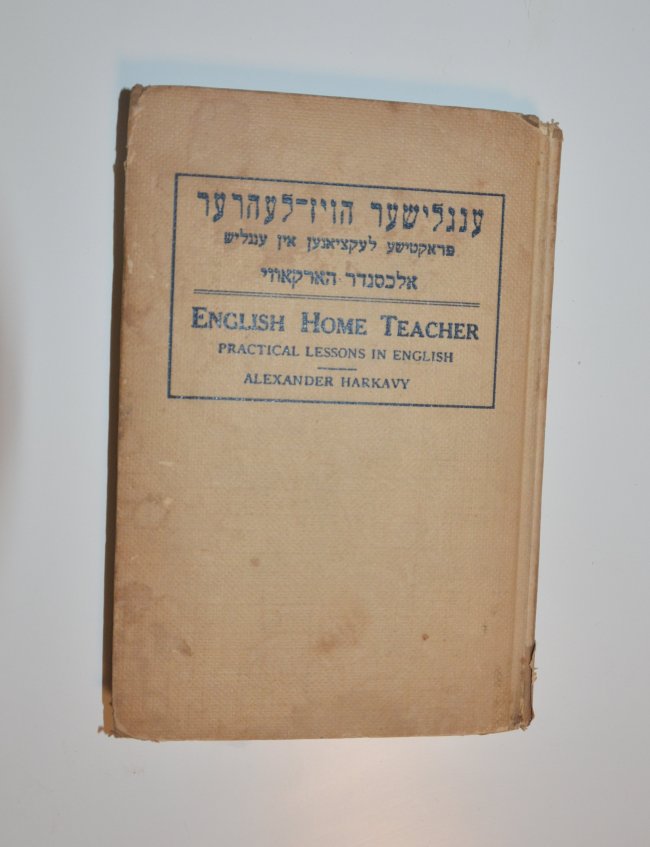
Some time ago, an interesting book came into my possession. English Home Teacher: Practical Lessons in English by Alexander Harkavy had reached me via a circuitous route and with an interesting history. My wife Yona‘s family: her father Meir and mother Tsila together with her mother’s mother and a brother, all Holocaust survivors, had come to Israel in 1949 while the eldest sister remained in Russia. Meir’s entire nuclear family had not survived. A few years later, her uncle and grandmother left for the United States to join her other uncle, also a Holocaust survivor, living there. In 1956, her aunt, Gesia, succeeded in leaving the Soviet Union and spent some years in the States staying with her brothers helping to look after their young children before finally settling in Israel and bringing the book with her.
Man of Words. The Russia-born writer, lexicographer and linguist Alexander Harkevy who after the antisemitic pogroms of 1880 in Russia, joined the Jewish Am Olam (Eternal People) back-to-the-land movement. Unlike Bilu, which directed its activities towards Palestine, Am Olam saw a Jewish future in the United States. In 1882 he emigrated to the US but rather than fulfilling back-to-the-land aspirations, he gravitated to the written word.
Aunt Gesia was fluent in Yiddish, Polish and Russian but the pressing need was to learn English. Caring for her nephews and nieces left little time for formal study. It was then that she acquired the English Home Teacher: Practical Lessons in English. A New Method for Home Instruction: that had been expressly written for Yiddish speakers to learn English.
The book’s author Alexander Harkavy was a most noteworthy gentleman, both talented and industrious. Born in 1863 in Novogrodek, Belorussia, the grandson of the town rabbi, he showed an early interest in languages acquiring knowledge of Hebrew, Russian, Syriac, German and Yiddish. Moving to Vilna at the age of fifteen, he wrote his first work in Yiddish and three years later after the pogroms of 1881, immigrated to the United States.
Beginnings in Belorussia. The town of Nowogródek in Belorussia where Alexander Harkavy was born in 1863. (Photo Shtetl Routes Teatr NN.PL)
Harkavy’s love of Yiddish together with his gift for languages soon crystallized into a vocation. Before making New York his permanent home in 1890, he had led a peripatetic life alternating between Europe and North America helping to found a Yiddish newspaper and a periodical. Once settled in the Big Apple, his literary output was prodigious. With many Jews from Eastern Europe arriving and not having time or opportunity to formally learn the new language, he published Der Englishe Learer (The English Teacher) 1891 and Der Englisher Brivnshteler (The English Letter Writer) 1892 in the “English self taught” genre expressly written for Yiddish speakers and that became immensely popular.
Posing with Peers. Representing the American organization HIAS during a visit to Europe in 1920, Alexander Harkavy (seated, center) posing at a table with fellow representatives from Jewish communal organisations
His talents were not confined to textbooks and in his prolific career, Harkavy translated Don Quixote into Yiddish, revised the King James English Bible, translated it into Yiddish for a dual language version and compiled and contributed to many Yiddish anthologies and publications. Amongst his many other activities, he taught U.S. history and politics for the New York Board of Education and Yiddish literature and grammar at the Teacher’s Seminary in New York. However, his lasting contributions were in lexicography where he compiled Yiddish-English and English-Yiddish dictionaries and the crowning achievement: the Yiddish-English-Hebrew Dictionary (1925) that played an important role in educating East European Jewish immigrants and is in use today.
Yidden Gems. It is partly due to Harkavy’s work that Yiddish today is regarded as a language. His Yiddish dictionaries show that its vocabulary is as ample as that of the average modern language, and that, if lacking in technical terms, it is richer in idiomatic and characteristic expressions.
The English Home Teacher: Practical Lessons in English first published in 1921 and reprinted in 1929 is both a fascinating and enigmatic book. The 272 pages contain 50 lessons each of which commences with a short passage in English, each word accompanied by its translation and a pronunciation guide. It is then followed by a grammatical exposition very often having no connection to the passage itself. Naturally, all the explanations and pronunciations are in Yiddish in Hebrew script.
To put it mildly: didactically, the book is no great shakes. In fact, it would make the eyebrows of a modern and trained English teacher curl! There is no logically graded structure and progression, no revision or reinforcement. In the very first lesson, the neophyte English learner is served a heady brew of past simple active and passive and present perfect tenses plus comparison of adjectives! Moreover, as the pronunciation guide for each English word in the text is written in Yiddish, it would have been interesting to hear someone’s first attempts at enunciation. Nevertheless, it should be borne in mind that this book was written over a century ago when the science of language teaching had barely emerged from its swaddling clothes.
After four decades in the USA, Harkavy was well versed in the contemporary culture, fluent and well read in the vernacular. With his home in New York, he was thoroughly conversant with the current trends of American society. Moreover, he was also on intimate terms with the immigrant experience of his co-religionists and knew full well the basic English required in order to survive and make a living in this new and daunting land.
Well-traveled Book. Expressly written for Yiddish speakers to learn English, Alexander Harkavy’s ‘English Home Teacher’ found its way into the writer’s wife’s family and finally ended up in Israel.
Logic dictates that the English be modern, the passages be relevant and the vocabulary be practical and utilitarian to enable the user to interact and communicate with his/her surroundings. Therefore, it is most puzzling to read the contents of the introductory reading passage in each lesson where the writer has chosen to take the opposite tack. The majority of them are anecdotal, often piquant and pithy with a moral attached whilst others are homiletic. Furthermore, their contents are mainly drawn from early Victorian England with the corresponding vocabulary. It demands a great stretch of the imagination see how archaic terms such as: “a droll fellow, to dine, a duke, an incision, the latter, a witty idler, a tankard, a draught, taken counsel, took lodging, a roguish companion, whereupon” etc. etc. could be put to daily use or even understood in the Bronx.
What were Harkavy’s motives in choosing the texts?
Was he trying to show off and impress his readers with his erudition and grasp of English? This doesn’t seem likely as he was well known and highly regarded in the community and his learned reputation went before him.
Harkavy, having grown up in the world of Talmud studies, was familiar with the tradition of exegesis, wit, pilpulim (hair splitting argumentation and debating) and knew that many new immigrants from Eastern Europe had a similar background. Possibly, he chose the reading passages to appeal to their tastes for most of them are witty, humorous and thought provoking. The introductory passage to the third lesson begins:
A lunatic in an insane asylum was asked how he came there, and he answered: “The world said I was mad, I said the world was mad and they outvoted me.”
Much food for thought!
The English Home Teacher: Practical Lessons in English was first published in 1921, a year that boded ill for the millions of Jews wishing to flee the persecution, pogroms and mass murders of Eastern Europe and the Baltic states and seek a haven on safe shores. There had been a shift in American public opinion and sympathy for all those displaced and stateless had become a fear of being swamped by a wave of impoverished immigrants, feeble in body that would cause the growth of slums, expose workers to cut throat wage competition and endanger American standards of living. That same year, with the passing of the Emergency Quota Act, the United States had declared a moratorium on its immigration policies and had begun to drastically restrict the number of newcomers with Australia, Canada, South Africa and other countries following suit.
Food for Thought. The first lesson in Harkavy’s book – first published in 1921 – is about eating dinner.
With his finger on the pulse, Harkavy was no doubt painfully aware that the Jewish newcomers from Eastern Europe fitted the popular and biased stereotype of the unskilled and indigent immigrant with his/her broken or non-existent English. Maybe he felt that his book offering reading passages on a ‘high level’ would enable its students to acquire a more sophisticated vocabulary with better communication skills to dispel this negative image, ease integration and aid their entry into the work market.
In the archives of ANU (the Museum of the Jewish People) situated on the campus of the Tel Aviv University, there is a film of his visit to Novogrodek in the early 1930’s. The atmosphere was festive for here was a native son who had made good in the Goldene Medina returning as a celebrity to pay his respects to his birthplace. The feted guest was escorted around town and proudly shown the Jewish institutions: the mikveh (ritual bath), the synagogue, the yeshiva and the Talmud Torah with the little children studying diligently at their tables.
Covers a lot of Ground. The cover of Harkavy’s book that must have prepared so many Yiddish speaking immigrants from Eastern Europe to the USA.
The film is bittersweet and very sad and serves as yet another testimony to Jewish presence wiped out during the Holocaust. In 1941, the German army occupied the town and the 10,000 Jewish inhabitants – men, women and children – who comprised half of the town’s population, were ultimately murdered with the assistance of local collaborators. Harkavy was spared the agony of hearing this terrible news.
He had passed away in New York in 1939.
About the writer:
Stephen Schulman is a graduate of the South African Jewish socialist youth movement Habonim, who immigrated to Israel in 1969 and retired in 2012 after over 40 years of English teaching. He was for many years a senior examiner for the English matriculation and co-authored two English textbooks for the upper grades in high school. Now happily retired, he spends his time between his family, his hobbies and reading to try to catch up on his ignorance.
While the mission of Lay of the Land (LotL) is to provide a wide and diverse perspective of affairs in Israel, the Middle East and the Jewish world, the opinions, beliefs and viewpoints expressed by its various writers are not necessarily ones of the owners and management of LOTL but of the writers themselves. LotL endeavours to the best of its ability to credit the use of all known photographs to the photographer and/or owner of such photographs (0&EO).
Unveiling the contours and contrasts of an ever-changing Middle East landscapeReliable reportage and insightful commentary on the Middle East by seasoned journalists from the region and beyond
Also available on YouTube@The Israel Brief – Simply click on the red subscribe button to receive alerts when a new report is posted.
What’s happening in Israel today? See from every Monday – Thursday LOTL’s The Israel Brief broadcasts and on our Facebook page and YouTube by seasoned TV & radio broadcaster, Rolene Marks familiar to Chai FM listeners in South Africaand millions of American listeners to the News/Talk/Sports radio station WINA, broadcasting out of Virginia, USA.
Jewish Canadian philanthropist welcomes demise of present ‘coalition of chaos’ government believing Israel will emerge stronger.
By David E. Kaplan
Then and Now. Birthright cofounder Bronfman identified problems then as he identifies them today.
In 2009, the writer interviewed philanthropist Charles Bronfman on the occasion of the 10th anniversary of the revolutionary programme that the Canadian had co-founded and co-funded. Having diagnosed a decade earlier the fragility of the Jewish diaspora landscape, Taglit-Birthright was the response. Focusing foresight this time to Israeli politics, Bronfman believes the current coalition will fall and Israel will be the stronger for it.
Wounded veterans from the UK and Israel compete in Veterans games in Tel Aviv
By Rolene Marks
War to Tug-of-War. Families of wounded veterans from UK and Israel join a spirited game of tug-of-war.
From the Normandy landings in June ‘44 to the Six Day War of June ‘67, JUNE stands out as the milestone month for Israel to have held the the Veteran Games organized by the Beit Halochem (House of the Warrior) organisation. Families from the UK accompanied their wounded loved ones to Israel in keeping with the organization’s philosophy that all in the family play a crucial role when injured ‘vets’ returns home from war. Read here to learn more.
Perpetual poverty for part of the population should never be government policy
By Neville Berman
Ticking Time Bomb. How will unemployment rates within Haredi community impact Israel’s future?
Israel’s controversial 2023 budget will increase state handouts to religious institutions denying their ever-increasing young members an education to secure employment and provide for their families. This policy will cost taxpayers billions of shekels and result in a growing section of society dependent on government handouts for generations. The writer, an accountant, wrestles with the impact on Israeli society.
LOTL Cofounders David E. Kaplan (Editor), Rolene Marks and Yair Chelouche
To unsubscribe, please reply to layotland@gmail.com
While the mission of Lay of the Land (LotL) is to provide a wide and diverse perspective of affairs in Israel, the Middle East and the Jewish world, the opinions, beliefs and viewpoints expressed by its various writers are not necessarily ones of the owners and management of LOTL but of the writers themselves. LotL endeavours to the best of its ability to credit the use of all known photographs to the photographer and/or owner of such photographs (0&EO).
Wounded veterans from the UK and Israel compete in Veterans games in Tel Aviv
ByRolene Marks
I am writing this article during quite a poignant week. If you are a keen observer of military history, the first days of June are hugely significant. This week, we commemorated 56 years since the start of the Six Day War in 1967 that changed the landscape of the Middle East. The 6th of June marks 41 years since the First Lebanon War “Operation Peace for Galilee” in 1982 and a day that changed the trajectory of the Second Word War as Allied forces troops landed on the Normandy beaches in France in 1944. D-Day. We salute the remarkable men and women of the armed forces.
Why is mentioning famous historical military operations relevant to the veterans games that this article is dedicated to? Because it is a reminder of the fighting and sacrifices made for our freedoms and democracy. We owe these brave soldiers a debt we can never repay. They fight with everything they have – and return bearing the wounds and scars of battle, some carried deep inside the recesses of their souls. We bear reminding of the enormous sacrifices made by our armed forces and whatever generation deployed to battle, they deserve our acknowledgement, respect and support.
Sporting Snapshot. Competing British and Israeli teams pose together at the Veteran Games in Tel Aviv. (Photo Tomer Appelbaum).
Last week, Beit Halochem Centres in Israel played host to the Veteran games, welcoming 60 wounded warriors from the United Kingdom and their families. Beit Halochem (House of the Warrior) is an extraordinary organization. The organization provides unique rehabilitation, sports and recreation centers serving disabled veterans and their families. Beit Halochem provides a place where the wounded undergo the various treatments, which they need for as long as they live. The centre emphasises sport as a rehabilitative tool along with a wide array of social and cultural programmes.
The four Beit Halochem Centres in Israel – including the state-of-the-art complex in Tel Aviv, played host to the warrior athletes and their families as they engaged in friendly competition in events that included swimming, shooting and CrossFit.
War to Tug-of-War. Families of wounded veterans join a spirited game of tug-of-war.
Ex-servicemen and women from across the UK armed forces who have lost limbs in combat and other veterans who are battling crippling post-traumatic stress disorder (PTSD) were selected to compete. PTSD is often endured in silence and sports have a therapeutic effect for many suffering from trauma. What made this competition particularly unique is that competitors did not have to reach a certain sporting standard to qualify. This means that no matter what their sporting level or experience, everyone could compete for medals.
This is the third year that this event took place, and presents a great opportunity not just for veterans to compete, but to bond with each other as well as take in the sights and sounds of Israel.
Grit and Determination. Ashley Hall in competition in the X-fit
The games were organized by Beit Halochem UK and the IDF Disabled Veterans Fund. Beit Halochem UK raises awareness and funds to help support Israel’s wounded veterans. Beit Halochem in Israel helps 51,000 wounded soldiers and victims of terror by offering them support for the rest of their lives.
“Physical activity, camaraderie and the family all play a crucial role in the successful rehabilitation of injured soldiers and the Veteran Games put both front and centre,” said Veteran Games co-founders Andrew Wolfson and Spencer Gelding. “Medals are a great bonus, but our goal is to provide an environment for veterans to challenge themselves in a way that will provide lasting benefits, while building friendships with other heroes and their families with whom they have so much in common.”
Pulling their Weight. Once putting their lives on the line for their countries, wounded vets from the UK and Israel engage in friendly competition in Tel Aviv.
These remarkable warriors are absolutely inspirational.
Ben Roberts, 42 a veteran from Essex who served tours in Iraq and Afghanistan said, “I have Post Traumatic Stress Disorder (PTSD) and in 2010 was diagnosed with Combat Stress Insomnia. I took part in the games last year and they have inspired me, shown me that I have a purpose and I have worth and that there are people out there that are willing to support us and show us British veterans that we can achieve things even with mental health. The games for me personally were a major spiritual level as well and the energy was just amazing here and it has helped me through the year where we are today”.
Cheered on by the Competition. A British athlete is cheered on by Israeli staff and athletes during the third Veterans Games in Tel Aviv on May 29, 2023. (Courtesy Beit HaLohem UK)
Organizers ensured that families were front and centre and they stood on the sidelines and cheered as their loved ones tested their mettle in friendly competition. Family members often struggle when an injured veteran returns back home and the role they play in their loved one’s recovery is crucial. To keep children entertained, a soccer camp is simultaneously held. Nothing builds bonds quite like sports!
Sight to Behold. Craig Lundberg receiving a swimming medal in the visually impaired category
Craig Lundberg 37, was completely blinded after being hit by two rocket-propelled grenades that are usually used for targeting helicopters or armored vehicles while on his second tour of Iraq in 2007. “It feels amazing to have my family along that they can see no matter what life throws at you, you can focus and get around it. I am really honored to be here and I competed in CrossFit and swimming and won a silver medal. It wasn’t expected because there was some great competition. For the lifting of weights and running, my son stood at one end my partner at the other and called to me so I could hear and get from point A to point B so it was a real family event. It is massively important that they are involved. Every day the family live with the sacrifice of living with a blind partner which isn’t the easiest sometimes, so to have them here giving support has been top notch.”
Opening Ceremony. A veteran of Afghanistan, cabinet minister for Veterans Affairs, Johnny Mercer MP addressing the opening ceremony of the Veteran Games.
Accompanying the UK delegation was Minister for Veteran’s Affairs, Johnny Mercer. MP Mercer served in the Royal Artillery and retired in December 2013 with the rank of captain. “We traditionally look at Israel and certainly the certainly the wealth of data you have accumulated over years of experience. I’m trying to make the UK the best country in the world to be a veteran and to do that we need to work with our friends and partners to understand what they’re doing that works really well, so that we can replicate that in the UK.” Mercer added that “it’s amazing to be out here in Israel. There’s nothing quite like an Israeli welcome, seeing the Veteran Games and using the power of sports as a vehicle for recovery. It’s extraordinary.”
Brother-in Arms. From different countries, these veterans share a bond understanding and camaraderie.
The games were timed to coincide with half-term (semester) vacation in the United Kingdom and the group had the chance to visit historical sites in Jerusalem, experience the healing powers of the Dead Sea and enjoy culinary and even graffiti tours in Tel Aviv.
Top Training. Veterans are seen ahead of the Veteran Games in Israel. (photo credit: Courtesy of The Veteran Games)
The bonds forged between these exceptional warriors from the United Kingdom and Israel will last a lifetime.
We could not be more proud to salute them.
While the mission of Lay of the Land (LotL) is to provide a wide and diverse perspective of affairs in Israel, the Middle East and the Jewish world, the opinions, beliefs and viewpoints expressed by its various writers are not necessarily ones of the owners and management of LOTL but of the writers themselves. LotL endeavours to the best of its ability to credit the use of all known photographs to the photographer and/or owner of such photographs (0&EO).
The Israel Brief – 05 June 2023– Update on Egyptian border shooting. Hamas terrorist released. Historic win for Israeli U20 soccer/football. Robbie Williams wows Israel.
The Israel Brief – 06 June 2023– PM Netanyahu speaks to President Sisi. US Secretary of State Blinken heads to Saudi Arabia. Polish delegation in Israel. Guns n Roses rock Israel.
The Israel Brief – 07 June 2023– VP Harris wades into judicial reforms. US official talks Negev Summit. Defense Minister decries criticism of female soldiers. Golda Meir biopic to open film festival.
The Israel Brief – 08 June 2023– Tel Aviv Pride. IDF raze Ramallah house of terrorist. Knesset Ukraine Friendship committee write to President Zelensky. Bruno Mars to rock Israel.
While the mission of Lay of the Land (LotL) is to provide a wide and diverse perspective of affairs in Israel, the Middle East and the Jewish world, the opinions, beliefs and viewpoints expressed by its various writers are not necessarily ones of the owners and management of LOTL but of the writers themselves. LotL endeavours to the best of its ability to credit the use of all known photographs to the photographer and/or owner of such photographs (0&EO).
Jewish Canadian philanthropist welcomes demise of present ‘coalition of chaos’ government believing Israel will emerge stronger.
By David E. Kaplan
It was interesting to read the Ynet newspaper headline that “Charles Bronfman, one of Israel’s most prominent Jewish philanthropists, believes the Israeli government won’t last much longer, as it is only a matter of months before it falls.”
Taglit-Birthright cofounder Charles Bronfman
Whether this Netanyahu coalition does or does not fall – whether within months or longer – it is sobering hearing who is joining the chorus supporting the demise of Bibi’s “coalition of chaos”.
I continued reading Bronfman’s bombshell with increasing interest as it also brought back personal memories of when I interviewed the Canadian billionaire and co-founder of Taglit-Birthright on the occasion of the programme’s 10th anniversary in 2009.
At the time of our telephonic interview, Bronfman was preparing to join a flight with 400 North American Birthright participants, where they would be welcomed on arrival at a special ceremony at Ben Gurion Airport by Israel’s then Prime Minister, none other than its current prime minister – Benjamin Netanyahu. There was then in 2009 much to celebrate. Sponsoring free ten-day heritage trips to Israel for young adults of Jewish heritage, Taglit-Birthright was proving to be the flagship of Israel programmes. Said Bronfman on the Birthright programme in that 2009 exclusive interview:
“It required a massive infusion of funds, a secure structure and a commitment from many disparate parties to make it work. What we were not short of in the beginning were skeptics. Today there are none.”
So yes, there was much to celebrate back then.
If today – because of the threat to Israeli democracy by the coalition’s judicial overhaul – there is less to celebrate, not so for Bronfman who is buoyed by the 2023 protest movement seeing it as a spontaneous expression of democracy.
“This is amazing,” he said referring to the weekly protests now into their twentieth week. “This stopped the legislation and this is also proof that the legislation will not pass. It will not happen, and I believe Israel will come out stronger, the question is in how many days it will take.”
Cry Help – Israel Responds. Taglit-Birthright cofounder Charles Bronfman (left) and the recipient of the 2023 Charles Bronfman Prize Yotam Polizer chief executive officer of IsraAID, the Israel-based non-governmental organization that responds to emergencies all over the world with targeted humanitarian help. (Photo: Meital Pinhas for Phillip Van Nostrand)
Bronfman’s observations and insights were made during a closed conversation at the Charles Bronfman Prize 2023 ceremony in New York, where the $100,000 prize was awarded to Yotam Polizer, chief executive officer of Israel’s international humanitarian aid organization IsraAID.
Often the first to arrive at disaster-struck areas around the world – Sierra Leone, Japan, Greece, Turkey, Nepal, Ukraine, and Sudan to name a few – IsraAID led by Polizer is compared around the world to the International Red Cross.
Bronfman’s posited a personal concern that “in the current political climate in Israel,” it may well become increasingly difficult to convince his grandchildren, who in the future will be leading the family philanthropic endeavours, to contribute to Israel as the family did in the past.
This is a dire warning to Netanyahu. The disturbing direction this government is taking the country will increasingly lose traction with younger generations of Jews. It was already these concerns that inspired Bronfman and his co-partner Michael Steinhardt to initiate the Taglit-Birthright program over two decades ago.
Birthright Visionary. The writer with Charles Bronfman (right) in 2009 at Ben Gurion Airport to cover the arrival of 400 North American Birthright participants marking the 10th anniversary of the Taglit-Birthright program.(Photo D.E. Kaplan)
“Michael and I came at this from different perspectives,” he revealed to me in the interview. “Michael wanted to “plug the dam of assimilation” as he put it. For him this was the number one problem confronting world Jewry and he argued that the program could impact enormously on enriching Jewish life in the Diaspora. While not discounting the importance of stemming the tide of assimilation, I was however more interested in forging a closer relationship between Israelis and Jews in the Diaspora. I believed that together, we could be a real force for good in the world – separately, we might fall apart. It was a case of the age-old saying “United we stand, divided we fall.” I was looking to forge a stronger Jewishworld.”
Time have Changed. Once united collogues in the Likud party, Dan Meridor (right) seen here with PM Netanyahu, now a major opponent of the Prime Minister’s assault on Israel’s internationally respected judiciary.
Is this present Israeli government not a threat to the visions of Taglit-Birthright? Are not the misguided actions of Netanyahu’s coalition more likely to weaken rather than strengthen “to forge a stronger Jewishworld”? The protesters on Israel’s streets every Saturday night know the answer. So does the long-standing Likud member Dan Meridor who was alsopresent at the high profile ceremony at New York’s Historical Society Museum. Concurring with Bronfman in taking a justifiable dig at Israel “coalition of chaos”, Meridor, a former Israeli Minister of Justice and a member of the prize committee, said that “unlike those in the government” leading the controversial judicial overhaul, the people on the stage “care about humanity” and not their positions!
This was quite an indictment from this long-time member of the Likud party who apart from his service as justice minister, had at various times, served as Deputy Prime Minister, Minister of Finance and Minister of Intelligence and Atomic Energy. Back in January 2023, Meridor accused Netanyahu of placing his ambition for power ahead of the country’s best interest by literally “selling out” Israel’s democratic character to win over coalition partners by acceding to their controversial demands.
Voice of Reason. Nachman Shai (2nd left), the IDF’s most trusted voice during the Gulf War was again a trusted voice when he criticized the Netanyahu government’s initiative to overhaul the judiciary at the protest in Kfar-Saba on the 3 June 2023. Seen here with the guest speaker are (l-r) Warren Samuels, the writer, Hilary Kaplan, Janine and Danny Gelley and Jackie Samuels. Liron Samuels, the son of Warren and Jackey was injured by the police at a protest the previous evening and was hospitalized.
Speaking to Ynet, Bronfman said:
“It won’t be a matter of years, it’s a matter of months. This government will fall, I’m sure of that. You read the polls, I read the polls. There are some guys in there that shouldn’t be in any government anywhere. I’m confident that the government will fall in a matter of months, and a year from now we will stand here and we all say Mazal Tov!”
For Bronfman’s prediction to materialize – whether in a few months or longer – the protests must continue.
Which means hundreds of thousands of Israelis know what they will again be doing this Saturday night!
Police Violence. Liron Samuels shows his injuries at the protest in Kfar-Saba that he sustained by the police at a protest the previous night in Caesarea. His account of what happened went viral on the social media.
While the mission of Lay of the Land (LotL) is to provide a wide and diverse perspective of affairs in Israel, the Middle East and the Jewish world, the opinions, beliefs and viewpoints expressed by its various writers are not necessarily ones of the owners and management of LOTL but of the writers themselves. LotL endeavours to the best of its ability to credit the use of all known photographs to the photographer and/or owner of such photographs (0&EO).
Perpetual poverty for part of the population should never be government policy
By Neville Berman
If you give a man a fish, he eats for a day, teach a man to fish, he eats for a lifetime. The origin of this idiom is unknown, but the wisdom of it is self-evident. The latest Knesset budget has turned this idiom on its head. Don’t learn to fish, but eat for life seems to be a new economic theory not practiced anywhere else in the world. Any institution that denies a person the opportunity to become educated in a way that will allow the person to earn a living should not be entitled to receive public funding. The latest two-year budget passed by 64 members of the Knesset does the opposite. It steeply increases government handouts to institutions that deny their members the opportunity to learn English, science and math that will enable them to be gainfully employed. This policy will cost billions of shekels and result in a section of Israeli society dependent on government handouts for generations. This is tragic. Perpetual poverty for part of the population should never be government policy. It is shameful and deceitful.
Budget Blues. Thousands in Jerusalem rallied against the budget and deals for ultra-Orthodox.
How did this come about?
The truth is that the only way that Netanyahu could become Prime Minister was to agree to offer unprecedented amounts of public money to religious political parties that were willing to support him. Blackmail, bribery, corruption and extortion were elevated to new heights. Morality and ethics were abandoned. Netanyahu got what he wanted by offering staggering amounts of public money to those willing to support him if the price was high enough. This is a slippery downward slope that could develop into a chasm that will be incredibly difficult to get out of. The consequences of what happened with the passing of the budget has only just begun. The appointments of some Ministers can be compared to the appointment of a pyromaniac as head of the fire department. It cannot have a happy ending.
Beyond Judicial. Protesters accused the government of looting state coffers to meet demands from Haredi politicians, at demonstration in Jerusalem, Tuesday, May 23, 2023.organized by the same activists behind anti-judicial overhaul campaign.
The real problem is that the small political parties that are part of the coalition have become drunk on the concept that they now control the government and can do whatever they want. What they want is to be able to rule without any oversight by the judiciary. It is called dictatorship.
You have been warned.
A Ticking Time Bomb. How will the unemployment rates within the Haredi community impact Israel’s future.(photo credit: JACK GUEZ/AFP VIA GETTY IMAGES)
About the Author:
AccountantNeville Berman had an illustrious sporting career in South Africa, being twice awarded the South African State Presidents Award for Sport and was a three times winner of the South African Maccabi Sportsman of the Year Award. In 1978 he immigrated to the USA to coach the United States men’s field hockey team, whereafter, in 1981 he immigrated to Israel where he practiced as an accountant and then for 20 years was the Admin Manager at the American International School in Even Yehuda, Israel. He is married with two children and one granddaughter.
While the mission of Lay of the Land (LotL) is to provide a wide and diverse perspective of affairs in Israel, the Middle East and the Jewish world, the opinions, beliefs and viewpoints expressed by its various writers are not necessarily ones of the owners and management of LOTL but of the writers themselves. LotL endeavours to the best of its ability to credit the use of all known photographs to the photographer and/or owner of such photographs (0&EO).
Unveiling the contours and contrasts of an ever-changing Middle East landscapeReliable reportage and insightful commentary on the Middle East by seasoned journalists from the region and beyond
Also available on YouTube@The Israel Brief – Simply click on the red subscribe button to receive alerts when a new report is posted.
What’s happening in Israel today? See from every Monday – Thursday LOTL’s The Israel Brief broadcasts and on our Facebook page and YouTube by seasoned TV & radio broadcaster, Rolene Marks familiar to Chai FM listeners in South Africaand millions of American listeners to the News/Talk/Sports radio station WINA, broadcasting out of Virginia, USA.
Digging up the past releases curses, reveals truths but time for Israelis and Palestinians to maturely move on.
By David E. Kaplan
Hard Rock, Hard Evidence. 3,200-year-old find in Hebrew reveals ‘facts on the ground’ about Jewish life.
Despite finds such as the latest 3,200-year-old folded-lead tablet in Hebrew revealing Jewish life in the land of Israel, Palestinian leaders still reject any Jewish connection. As the saying goes ‘From a Rock to a Hard Place’, the region has to move beyond false narratives to arrive at destination PEACE.
A personal recollection from Israel’s victorious war 56 years ago
By Lennie Lurie
One Jump Ahead! The writer landing safely on his final parachute jump qualifying for “wings” and red beret.
Marking the 56th anniversary of the Six Day War, the writer takes the reader back to those worrying days in 1967 when a younger Jewish state’s future was uncertain. More certain was that young Jews all over the world were prepared to drop everything – put their lives on hold – and volunteer to serve Israel. Here is the story of one young man from Cape Town, South Africa.
ISRAEL HAS FAILED TO FIGHT LATVIA, LITHUANIA’S HOLOCAUST DISTORTION
While three acclaimed films shine spotlight on the Holocaust in the Baltics, Latvia and Lithuania respond with Holocaust distortion
By Dr. Efraim Zuroff
Digging up Dirt. Movie reveals national memorials to murderers feet away from the graves of their victims.
There are dark reasons why new highly acclaimed Holocaust documentaries – James Bulgin’s BBC’s ‘How the Holocaust Began’, Michael Kretzmer’s ‘J’Accuse’ and Eugene Levin’s ‘Baltic Truths’ – are winning awards at film festivals all over the world yet are mostly ignored in the Baltic countries to whom the messages of the films are directed. Allow this writer to reveal why!
LOTL Cofounders David E. Kaplan (Editor), Rolene Marks and Yair Chelouche
To unsubscribe, please reply to layotland@gmail.com
While the mission of Lay of the Land (LotL) is to provide a wide and diverse perspective of affairs in Israel, the Middle East and the Jewish world, the opinions, beliefs and viewpoints expressed by its various writers are not necessarily ones of the owners and management of LOTL but of the writers themselves. LotL endeavours to the best of its ability to credit the use of all known photographs to the photographer and/or owner of such photographs (0&EO).
Digging up the past releases curses, reveals truths but time for Israelis and Palestinians to maturely move on.
By David E. Kaplan
If times today are troubling and the suggestion is that we may have displeased the Almighty, then a recent reading of a 3,200-year-old folded-lead tablet reveals little has changed over the millennia.
The ancient tablet found on Mount Ebal that was recently subjected to special x-ray investigation to reveal what is believed could be the oldest known HEBREW writing ever found in Israel, reads disturbingly:
“You are cursed by the God”
Digging up the Past. The 3,200-year-old “curse tablet” found on Mount Ebal could prove Israelites were literate when they entered the land. (Photo by Jaroslav Valach)
If over three millennia later we are still upsetting the Almighty by our wayward ways – hardly a challenging task – then look how this ancient finding may have upset the leader of the Palestinian Authority, Mahmoud Abbas. It’s not the message that Jews are cursed by God that would rattle him – in this he far outshines the Almighty – but the language in which it is written – HEBREW – the spoken language of the ancient Jewish Kingdoms of Israel and Judah.
If what experts suggest is correct, this would make the tablet the first use of the name of God in the Land of Israel and would prove that Israelites were literate hundreds of years earlier than previously supposed. In other words, Israelites in the Land of Israel speaking Hebrew – albeit an earlier version – as we are doing today. This completely refutes Abbas’ false protestations recently at the United Nations where he challenged historic Jewish ties to Jerusalem.
Can’t the PA leader get over that Jews have been living in this neck of the proverbial woods for thousands of years. But no, in customary theatrics he has to again stand up in the UN as he did on that Israel/Jewish hate-fest, the 75th anniversary of Nakba Day and dismissed with gusto, any Jewish ties to Jerusalem. And this display in folly was happening all the while ancient tablets are unveiled to the world affirming Jewish life here over three thousand years ago. An article in Heritage Science states that the finding:
“…is the oldest Hebrew text found within the borders of ancient Israel … by at least two centuries.”
No wonder Abbas does not approve of any digging around in Jerusalem – the ‘truth’ is the last thing he wants to unearth.
No Ties. A gesticulating Mahmoud Abbas (centre), President of the State of Palestine denies any Jewish ties to the Temple Mount in Jerusalem in his address at the event to commemorate the 75th Anniversary of the Nakba.
‘God’ forbid that anything is revealed that disputes the increasingly popular PA narrative that Jews are a colonial European implant.
Abbas’ unabashed antisemitic protestations are consistent with personal past conduct and of his political peers. In Qatar on Feb. 26, 2012, at an Arab League conference, Abbas refuted any historical Jewish connection to Jerusalem, a diplomatic strategy that began with his predecessor, Yasser Arafat, who questioned whether the Temple even ever existed.
“There is nothing there,” Arafat said at the at the Camp David summit in July 2000. He amplified this two years later in the leading pan-Arab newspaper al-Hayat, Arafat with:
“They found not a single stone proving the Temple was there …”
It goes on and on.
No Attempt at Outreach. Denying Jewish historic connection to Jerusalem during his speech at UN Headquarter in New York, Palestinian Authority President Mahmoud Abbas compared Israeli rhetoric to Nazi propaganda and demanded Israel be suspended from the UN if it does not grant Palestinians a “right of return” for millions of refugees.
A month after Camp David, Abbas himself continued with Arafat’s ideological position on the Temple in an Israeli-Arab weekly, adding:
“… they claim that 2,000 years ago they had a temple. I challenge the claim that this is so.”
Others in the PA “Chorus Line” stuck to this nefarious narrative :
Interviewed in al-Ayyam, the late Nabil Shaath spoke of Jerusalem’s “fictitious temple”
The late Chief Palestinian negotiator, Saeb Erekat asserted that “…. there never was a Temple at al-Quds, “only a “mosque.”
Palestinian politician and a member of the Palestine Liberation Organization’s Executive Committee, Yasser Abd Rabbo, told Le Monde in September 2000 that “There was no archaeological evidence that the Temple ever existed on the Temple Mount.”
Shock and Outrage. Palestinian Authority President Mahmoud Abbas causes shock and outrage when he accuses Israel of perpetrating “50 holocausts” at a press conference alongside German Chancellor Olaf Scholz at a joint press conference at the Chancellery in Berlin, Germany, on August 16, 2022. (Jens Schlueter/AFP)
This can go on and on. No-one benefits and people on all sides die violently. Israelis too have to seriously come to the table and recognise that Palestinians are here to stay and help create a climate that can eventually lead to the elusive “Two-State Solution” that is losing traction but that Netanyahu himself has endorsed. Did the Prime Minister not at Bar Ilan University in 2009 say:
“If we get a guarantee of demilitarization, and if the Palestinians recognize Israel as the Jewish state, we are ready to agree to a real peace agreement, a demilitarized Palestinian state side by side with the Jewish state.”
On German Soil. A headline on the website of Germany’s BILD newspaper expresses shock at PA leader Mahmoud Abbas’s use of the term ‘Holocaust’ to describe past Israeli actions. Instead of apologizing for the terrorist attack on Israeli athletes at the Munich Olympics 1972, Abbas, on German soil, accuses Israel of genocide. (Screenshot)
Even if this was not a fully-throated enthusiastic commitment, Netanyahu did follow it up with “I am willing to make painful compromises to achieve this historical peace,” and later in his speech to the United States Congress:
“I recognize that in a genuine peace we will be required to give up parts of the ancestral Jewish homeland.”
These days few identify Netanyahu with these words but he said them.
STREETSMART
Israelis and Palestinians need to find a way to engage beyond bullets, rockets and false narratives! We owe it ourselves and future generations. If we want safe roads to travel free of terrorism we have to find that road to peace.
Stating Two States. Israeli Prime Minister Benjamin Netanyahu delivers a keynote speech on June 14, 2009, in which he laid out his peace policy at Bar-Ilan University in Ramat Gan, near Tel Aviv, where he endorsed for the first time the creation of a Palestinian state but said it must be demilitarized. ( photo by pool Michael Kramer flash90)
Palestinians would be right to hold Israelis to past promises and Abbas needs to shift his cerebral address from an alternate universe to a reality that Jews have an enriching historical link to the land of Israel and are here to stay. Before being truthful to one’s enemies, all sides need to be truthful to themselves. Palestinians and Israelis need to be prepared for the harsh realities of deep compromises.
In this way, we can fulfill the prophecy of the late Israeli Foreign Minister Abba Eban that:
“Israel’s future will be longer than its past”
While the mission of Lay of the Land (LotL) is to provide a wide and diverse perspective of affairs in Israel, the Middle East and the Jewish world, the opinions, beliefs and viewpoints expressed by its various writers are not necessarily ones of the owners and management of LOTL but of the writers themselves. LotL endeavours to the best of its ability to credit the use of all known photographs to the photographer and/or owner of such photographs (0&EO).