While the mission of Lay of the Land (LotL) is to provide a wide and diverse perspective of affairs in Israel, the Middle East and the Jewish world, the opinions, beliefs and viewpoints expressed by its various writers are not necessarily ones of the owners and management of LOTL but of the writers themselves. LotL endeavours to the best of its ability to credit the use of all known photographs to the photographer and/or owner of such photographs (0&EO).
While taps run dry, public money flows freely, wasted on politically motivated legal battles against Israel.
By Kenneth Mokgatlhe wa Kgwadi
The South African Parliament recently approved a Special Appropriation Bill that allocates R95 million to fund the country’s legal battle against Israel at the International Court of Justice (ICJ). This case, which seeks to hold Israel accountable for its actions towards Palestinians, is not only an ideological pursuit for some members of South Africa’s ruling party; but also an expensive and controversial distraction from the country’s pressing domestic crises. The ANC’s pursuit of this legal warfare under the banner of solidarity with Palestine is both an unwise diplomatic move and a misuse of resources that could be better directed towards solving South Africa’s own socio-economic problems.
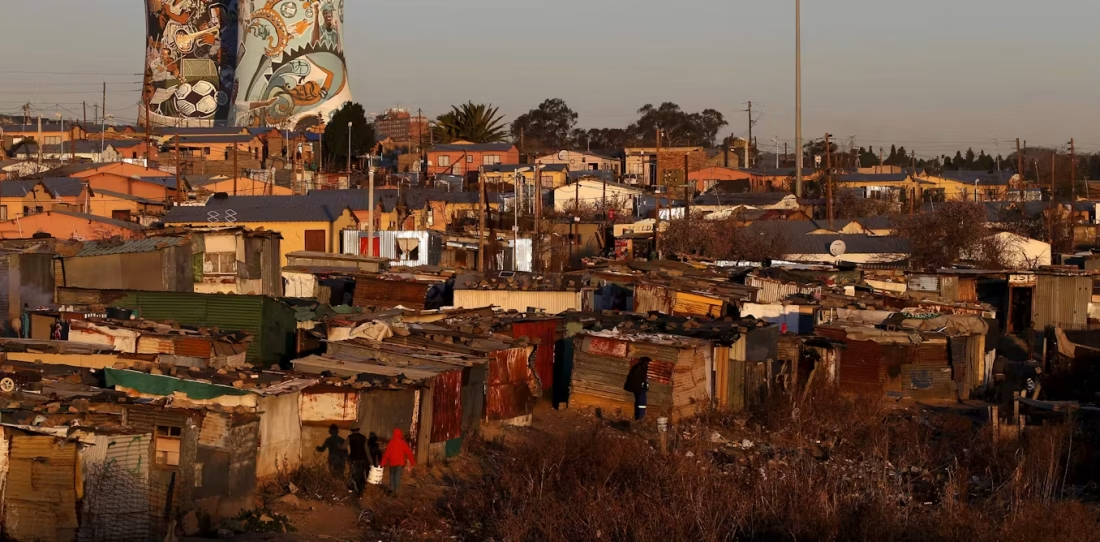
Inequality Street. South African Government misappropriates R95m of taxpayers’ money to pursue political agenda against Israel, while neglecting its own people. Here is a scene in Alexandra township, one of the poorest areas in Gauteng/Johannesburg bordering the wealthy suburb of Sandton, said to be the richest square mile in Africa. (CA Bloem)
This move comes at a time when South Africa is grappling with severe domestic challenges. The government’s mismanagement of resources, coupled with political opportunism, is threatening the country’s long-term stability. South Africa, once heralded as the “Rainbow Nation” after the end of apartheid, now faces staggering inequality, widespread poverty, and the erosion of its democratic institutions. Yet, the ANC leadership seems more focused on using its foreign policy to advance ideological agendas rather than addressing the urgent needs of the South African people.
‘Time’ to Change. South Africa’s goal of building a nation rooted in the “rainbow nation” ideology remains unfulfilled and its people largely “unequal” as visually captured on this cover of TIME magazine, yet expends resources to pursue Israel on fallacious charges of genocide at The Hague.
The Special Appropriation Bill was passed largely due to the support of the Government of National Unity (GNU), an uneasy coalition of various political parties, including the African National Congress (ANC). The ANC, which has long harbored animosity towards Israel, sees the case before the ICJ as an opportunity to further its political agenda – one that resonates with its allies in the Islamic Republic of Iran and other countries hostile to Israel. But the irony is inescapable: as the South African government spends millions of rands fighting Israel, the nation is facing an internal crisis that demands urgent attention.
The government’s alignment with Iran and its proxies, such as Hamas, is also problematic. Iran’s leadership has long supported violent extremism and called for the destruction of Israel. It is well-documented that Hamas, which is backed by Iran, has repeatedly rejected any peace initiative that could bring about a lasting resolution to the Israeli-Palestinian conflict. Instead, Hamas has resorted to violence, perpetuating the cycle of suffering on both sides of the conflict. While Israel has taken significant steps to engage with Arab nations in the pursuit of peace, Hamas remains obstinately opposed to any peace agreement that might end the violence.
This ideological alignment between South Africa’s government and Iran, combined with the recent political rise of Donald Trump in the U.S., has serious implications for South Africa’s foreign relations. The Trump administration, expected to take a more aggressive stance toward the Middle East, is unlikely to tolerate South Africa’s support for Hamas and other terrorist organizations. By continuing down this path, South Africa risks alienating key trade partners and jeopardizing its relations with Western democracies that are vital to its economic future.
While the South African government spends millions on its legal battle against Israel, the country faces a multitude of urgent domestic issues. South Africa is currently one of the most unequal countries in the world, with 10 percent of the population controlling more than 80 percent of the country’s wealth. In contrast, the remaining 90 percent of the population struggles to make ends meet, living in dire poverty. The government’s social welfare programs, while well-intentioned, are inadequate to address the needs of the majority.
Off the Track. Child poverty and inadequate health amenities is widely prevalent throughout South Africa that is being ‘sidetracked’ by foreign issues like the Israel-Palestine conflict.
Unemployment remains at record levels, and the country’s education and healthcare systems are underfunded and dysfunctional. The education system, once one of the most respected in Africa, is now riddled with challenges, from overcrowded classrooms to outdated curricula. The healthcare system, similarly, is overwhelmed and under-resourced, leaving millions of South Africans without access to adequate care. In some areas, basic services such as running water and electricity are unreliable, and crime rates continue to skyrocket, further eroding the quality of life for South Africans.
Instead of diverting R95 million to a foreign legal battle, the government should focus on implementing policies that address these pressing challenges. South Africa’s foreign policy should prioritize economic and diplomatic engagement with Western countries and other key global players to secure investments and promote sustainable growth. The country cannot afford to alienate its trading partners, especially when it is facing such dire internal challenges.
South Africa’s economic growth has stagnated in recent years, with millions of people unemployed and living in poverty. The country’s energy crisis, caused by ongoing power shortages and mismanagement of the state-owned energy company Eskom, is only exacerbating the situation. Load shedding, or scheduled power cuts, is a regular occurrence, crippling businesses and further damaging the economy.
The country’s infrastructure is crumbling, and it is becoming increasingly difficult for ordinary South Africans to access basic services. For example, Johannesburg, South Africa’s largest city, has faced severe water shortages in recent years, with taps running dry in many areas. Rural communities, too, suffer from a lack of access to clean drinking water and basic sanitation. Meanwhile, the government continues to waste resources on foreign disputes that do nothing to address these critical domestic issues.
Rather than engaging in legal battles over the Middle East conflict, South Africa should focus on building stronger trade relations with Western countries and other emerging economies. The country needs to invest in its own infrastructure, improve access to healthcare and education, and create jobs for its growing population. It is also critical that South Africa seeks to address its crime problem, which has reached levels that capture international attention. The government must focus on strengthening its law enforcement agencies and ensuring that justice is served for the victims of violent crime.
Government failing in ‘its’ Job. Looking for a job in South Africa, where the absolute number of unemployed people has doubled in the last 25 years. (Photo: Jeremy Seekings.)
While South Africa’s government continues to pursue legal action against Israel, it is important to recognize the futility of such efforts. The Middle East conflict is a deeply political issue, and no amount of legal wrangling at the ICJ will resolve the complex historical, cultural, and political factors that fuel the conflict. The legal process will not stop Hamas or other terrorist organizations from continuing their attacks on Israel, nor will it bring peace to the region.
The solution to the Israeli-Palestinian conflict lies in political negotiations, not legal proceedings. The United Nations and other international bodies have repeatedly called for dialogue between Israel and Palestine, but Hamas and other radical groups have rejected these efforts. Peace will only come when both parties – Israel and Palestine – are willing to negotiate in good faith and work towards a lasting resolution. In the meantime, South Africa’s role should be one of promoting dialogue, offering humanitarian assistance, and encouraging peaceful solutions, rather than pursuing a legal case that does little to advance the cause of peace.
Misguided and Misdirected. While much preferring the international spotlight by popularly pursuing Israel on false charges of genocide at The Hague, the majority of South Africa’s suffer at home due to government neglect. (Photos: Dursun Aydemir/Anadolu via Getty Images)
The South African government’s decision to allocate R95 million for a wasteful and misguided legal battle against Israel could be better spent addressing local unemployment, poverty, crime, and the country’s crumbling infrastructure. The government’s obsession with Israel and its alignment with Iran’s hostile stance against the Jewish state only serve to alienate key trade partners and undermine South Africa’s long-term interests.
South Africa must shift its focus from ideological foreign policy battles to pragmatic diplomacy that benefits its own citizens. The country needs friends, not foes, and it is essential that the government prioritize economic development, social welfare, and national security over foreign disputes. By doing so, South Africa can begin to build a more prosperous future for its people—one that is based on sustainable growth, peace, and cooperation.
About the writer:
Kenneth Mokgatlhe wa Kgwadi is an independent writer, political analyst and researcher. He is doing his MA in African Studies at the Israeli-based Ben Gurion University of the Negev.
While the mission of Lay of the Land (LotL) is to provide a wide and diverse perspective of affairs in Israel, the Middle East and the Jewish world, the opinions, beliefs and viewpoints expressed by its various writers are not necessarily ones of the owners and management of LOTL but of the writers themselves. LotL endeavours to the best of its ability to credit the use of all known photographs to the photographer and/or owner of such photographs (0&EO).