DAY OF OUT’RAGE

If Palestinians on the West Bank are into their 3rd Intifada, have Israelis in 2023 started their 1st ‘Intifada’?

By David E. Kaplan

Today in Israel is ‘National Disruption Day’. People are taking to the streets en mass – it’s all about direction not of cars but the government! Never seen anything like it before. I have just returned from a huge demonstration at the busiest intersection in my hometown of Kfar Saba, 20 kilometres north of Tel Aviv that began at 8.00am. It did not matter the colour of the traffic lights as the cars, busses and trucks were not going anywhere! It seemed like a metaphor for the country not going anywhere either as if rooted at the no less metaphorical  ‘CROSSROAD’!

They Shalt Not Pass. Buses are blocked from driving through the street as protesters demonstrate against judicial reform in Tel Aviv, March 1, 2023. (credit: AVSHALOM SASSONI/MAARIV)

Posters, flags, blaring over the megaphone and the honking of car horns. At 10.30am the protest  in Kfar Saba officially ended with a rousing singing of the national anthem – Hatikva – the hope. It is a commodity that hangs precariously in the air – hope.

On the way walking home, I receive a text message from my Lay of the Land colleague, Rolene Marks, who was covering the demonstration in her hometown of Modi’in in the centre of the country. A large crowd had assembled outside the residence of the Minister of Justice, Yariv Levin – the architect of the judicial overhaul.  “Protesters were drumming on tambourines, blowing vuvuzelas, and chanting in Hebrew,Yariv Levin you bring shame (“Busha”) to Modi’in,” reported Rolene. While the protests were mostly peaceful “It was very sad to see,” continued Rolene, “to see one religious extremist approach the protestors to spit on them. It was ugly.”

People vs Police. This is where Netanyahu’s government has ‘delivered’ his nation.

I am now back at my computer in my apartment in Kfar Saba and I can still hear motorists expressing their sentiment by honking their hooters. It is so loud you can’t fail to hear, but is the government hearing? Is it even bothering to listen?

The nation-wide protests were scheduled to send a collective message by outraged citizens as Benjamin Netanyahu’s  legislative committee votes to pass the second part of its ‘judicial reform’, a misnomer for its rather ‘injudicious overhaul’. Yes, it began over this issue but is it only over this issue 8 weeks later? There is a collective revulsion of this government whose priorities appear skewed. If the Arabs on the West Bank are engaged in a 3rd Intifada, are Israelis engaged in their 1st Intifada?

As a former student of politics, the atmosphere in Israel reminds me of the protests of France1968, when in the beginning of May of that fateful and turbulent year, a period of civil unrest occurred throughout the French republic, lasting some seven weeks punctuated by protests, general strikes, and the occupation of universities and factories. At the height of those events, the French economy came to a halt. Attempts to quell those strikes by the de Gaulle administration only inflamed the situation further, leading to street battles with the police. And while de Gaul secretly fled to West Germany, it appears our Israeli leadership choses to play the proverbial fiddle, carrying on regardless with its hated legislation, while the country – now literally – burns! The images of revenge settler violence in the Palestinian village of Huwara of burning cars and homes adds to the visual image of a country whose leadership  has lost the plot but worse, lost its soul! 

Torch of Vengeance. This is what the scrapyard in the Palestinian town of Huwara looked like after the settlers had torched it. (AFP/Ronaldo Schemidt)

Adding fuel to the fire, after the riot, chairman of the Knesset’s National Security Committee MK Zvika Fogel of the extreme-right Otzma Yehudit party was unequivocal in his backing for the settler rioters when he said:

 “A closed, burnt Huwara – that’s what I want to see. That’s the only way to achieve deterrence.…… we need burning villages when the IDF doesn’t act.”

Anger Erupts. People rise up on the streets against government going down the wrong road.

We, who know about pogroms, should know better. Just how far low this country’s leadership has sunk, Finance Minister Bezalel Smotrich -who is also the head of the far-right Religious Zionism party and a minister with responsibility for civil affairs in the West Bank within the Defense Ministry – concurred with his equally disgusting coalition collogues at a financial conference that the Palestinian village of Huwara should be “wiped out’, but with one condition.

And what is that condition?

I think the State of Israel should be the one to wipe it out, not, God forbid, private people.” So that is the only transgression the rioters settlers did on their murderous spree – they should instead have left it for the government’s ordered henchmen to do the hit!

Call in the Cavalry. Police deploy horses and stun grenades to disperse Israelis blocking a main road to protest against plans by Prime Minister Benjamin Netanyahu’s new government to overhaul the judicial system, in Tel Aviv, Israel, Wednesday, March 1, 2023. (AP Photo/Oded Balilty)

This man should be in prison not parliament.

While at the demonstrations the common collective chant is ”Bibi Habayta” – “Bibi go home”,  there is an increasing belief, that if in the past people believed Bib always had the solution, now his persona personifies the opposite – dissolution. As the former Minister of Defence Benny Ganz said:

 “The problem isn’t Smotrich, and it’s not Ben Gvir and it’s not Fogel. The problem is Netanyahu. He’s letting the system fall apart. This is all Netanyahu’s responsibility and not his emissaries.”

Crossing Barriers. Ordered to take off the kid gloves, police clash with protestors in Tel Aviv, 1 March, 2023.

The people’s revulsion for the Prime Minister was graphically reflected when only last week, when there are so many existential issues facing a nation of national crisis, the Knesset held a special session to approve state funding on both of Netanyahu’s private residences – one in the seaside luxurious town of Caesarea and the other in Jerusalem. Shouting matches broke out almost immediately as opposition MKs charged the committee for caring more of preserving Netanyahu’s millions than caring about the cost of living crisis faced by millions of Israelis.

The way things are going, today’s Day of Outrage are set to lead to Days of Outrage. Sadly, we’re in for the duration as we have leaders not running but ruining our country.

Worried about Their Future. Despite Prime Minister referring to the protestors as anarchists here are children accompanied by their parents and guardians waving Israeli flags during the demonstration in Tel Aviv on March 1, 2023. (Jack GUEZ / AFP).


While the mission of Lay of the Land (LotL) is to provide a wide and diverse perspective of affairs in Israel, the Middle East and the Jewish world, the opinions, beliefs and viewpoints expressed by its various writers are not necessarily ones of the owners and management of LOTL but of the writers themselves.  LotL endeavours to the best of its ability to credit the use of all known photographs to the photographer and/or owner of such photographs (0&EO).

COALITION PURSUES COLLISION

Creating schisms within Israel and Jewish communities abroad, a government on a warpath with its people

By David E. Kaplan

Opening the papers each morning solicits a groan followed by the moan. It’s crazy but this government is set to undo all the good work built over the years.

The shekel is sliding and money is exiting, and soon people may too! This is a country that traditionally encourages Aliya (immigration); but its new government’s policies may lead to Yerida (emigration) – of both people and purse. As reported in The Times of Israel, bank officials believe  some $4 billion moved out of Israel in recent weeks!

Headlines today in The Jerusalem Post February 22, 2023, reads:

 ‘As shekel slides, PM rejects call for gov’t oversight on interest rates”, and underneath in even bigger font and in bold, a warning that “Judicial change threatens minority rights”.

I could have taken the news headlines any day of the week for the last seven weeks, and all would have been as disquieting. What makes it even more distressing is that it is all of our own making. For a country priding itself on being SMART, this period will go down as STUPID! Does this government want to be responsible for Israel’s proud image of Start-up Nation to turn to Wind-down Nation?

Seemingly oblivious to the warning signs or obvious dangers, Netanyahu’s coalition purposely pursues collision.

Talking Heads. Opposition Yair Lapid (l) has proposed that President Isaac Herzog (r)  set up a commission to examine the matter of judicial reform. (photo OLIVIER FITOUSSI/FLASH90)


And in that it has been worryingly successful:

  • It collided with the country’s State President, Isaac Herzog,  who made a reasoned desperate appeal to take time out and pause the process for dialogue and compromise. The President’s warning of “a powder keg about to explode” solicited from the Justice Minister, “I won’t stop for a minute.”
  • It collided with the BANKERS that have warned Finance Minister Smotrich that judicial shakeup is causing economic fallout. Reported on Channel 12, Uri Levin, the CEO of Israel Discount Bank, is said to have expressed at a meeting that “The shekel is growing weaker, Israel’s risk factor is rising and our stock exchange is doing worse than others around the world.” Levin’s concerns were reportedly supported by other top bankers with another participant reportedly saying that  “money is leaving Israel at a rate ten times higher than usual.” And what was the reaction? Smotrich reportedly dismissed the warnings and accused the bankers of having double standards. This is not normal; this is lunacy.
  • It collided with Israel’s Attorney General, Gali Baharav-Miara, who has ordered the Prime Minister to not get involved in the controversial overhaul of the country’s  judiciary due to a conflict of interest stemming from his ongoing corruption trials. So the PM lets his coalition cohorts bulldozer the process along and he pretends mum because “I can’t get involved.”
  • It collided with Israeli major retailers. Over 50 CEOs of major retail chains and companies in Israel called for a compromise amid concerns over the government’s proposed changes to the judicial system.
  • It collided with over 460 ex-Shin Bet agents urging Likud agriculture minister Avi Dichter warning that the proposed legislation is a ‘coup’ against democracy. Among the signatories were three other past directors of the organization – Carmi Gillon, Ami Ayalon, and Yuval Diskin. They wrote: “We turn to you and ask — do not lend your hand to moves that threaten the foundations of the democratic regime, the unity of the people, and national resilience.”
Overall, Dichter Supports Overhaul. Minister Avi Dichter ignores letter signed by hundreds of former Shin Bet security service agents urging the former chief of the agency to not back the government’s plan for a drastic overhaul of the judiciary, warning it will threaten the foundations of Israel’s democracy.
  • it collided with seven Israeli Nobel laureates who warn that scientific excellence can only thrive in democratic nations with full freedom. “This isn’t a small change,”  expressed Nobel Prize laureate for Economics  Kahneman in an interview. “It’s a huge revolution…. that changes the nature of the country from a working democracy to something that is not a democracy, that is pretending to be a democracy.”
  • it collided with its overseas allies including US President Biden who in a statement to The New York Times, Biden said, “The genius of American democracy and Israeli democracy is that they are both built on strong institutions, on checks and balances, on an independent judiciary.” Building consensus for fundamental changes, he cautioned, is “important to ensure that the people buy into them so they can be sustained.”
  • It collided with one of the most vociferous  supporters of Israel abroad, the eminent jurist, Prof. Alan Dershovitz who says he’s been a student of Israel’s Supreme Court for over half a century and that it is key to the Jewish state’s battle against propagandists claiming it is not a democracy. He warns that the institution “should be kept out of the realm of partisan politics.”
  • It collided with major Diaspora philanthropists who warn that judicial overhaul threatens Israeli democracy. Fifteen leading donors and charities, including Birthright’s Charles Bronfman, say they are “deeply concerned’ by government’s plans and strongly urge dialogue.”
Urging Dialogue. Charles Bronfman seen here speaking at a Taglit-Birthright event is among 15 major donors and charitable foundations, urging PM Netanyahu to enter into a dialogue on the proposed judicial reforms recommended by President Isaac Herzog.
  •  It collided with Jewish leadership in the USA. Departing from the tradition of reticence on Israeli politics, the Jewish Federations of North America  – one of the largest and most prominent Jewish institutions in North America  – warned the Israeli Prime Minister against his government’s plan to legislate an “override clause” that would allow a 61-seat Knesset majority to overrule Supreme Court decisions. “Such a dramatic change to the Israeli system of governance will have far-reaching consequences in North America, both within the Jewish community and in the broader society,” the group said.
  • it collided with  much of the people of Israel who are taking to the streets in ever increasing numbers to protest not because they lost an election but because they fear losing democracy. One marcher’s placard summed up the sentiment:

For Sale: Democracy. Model: 1948. No brakes

Hi-Teck in Hi-Gear against Government. Workers from the tech sector protest against the government’s planned judicial overhaul. The signs say, ‘No freedom, no high tech,’ and ‘Tech workers protest.’ Tel Aviv, February 7,

Although the legislative process is well on its hasty way, it is still not too late to seek dialogue and reach a compromise to prevent an unnecessary and irreparable rapture of Israeli society. As we approach Independence Day in April and are reminded of the value of solidarity and wise leadership over 75 tough and turbulent years, let us be guided by our State President who has suggested not a halt but a pause to find a judicial compromise.

Ridicule rather than Respond. This government unwisely choses to ridicule rather than respond to these mass protests.
 

Is that too much to ask when one considers what is at stake?

I am reminded of the Prime Minister’s superb book ‘A PLACE AMONGST THE NATIONS’, where Israel – against all the odds – stupendously succeeded in this quest.

It would be a shame to lose it in the heart of our people!


Model Behaviour. Displaying their commitment to Zionism and the State of Israel, protestors against the government’s judicial overhaul carry while marching in Tel Aviv, a huge model roll-out of Israel’s 1948 Declaration of Independence. (Photo: Tomer Neuberg, Flash 90)


While the mission of Lay of the Land (LotL) is to provide a wide and diverse perspective of affairs in Israel, the Middle East and the Jewish world, the opinions, beliefs and viewpoints expressed by its various writers are not necessarily ones of the owners and management of LOTL but of the writers themselves.  LotL endeavours to the best of its ability to credit the use of all known photographs to the photographer and/or owner of such photographs (0&EO).

PROUDLY PART OF ‘THE MADDING CROWD’

Israel at critical crossroad after President Herzog addresses nation. Which way will it go?

By David E. Kaplan

“What are you doing this Saturday night?”

For many Israelis today the answer is  simple and obvious.

It’s a long time since so many thousands upon thousands of Israelis collectively know in advance how they are going to spend their Saturday nights. Whether in Tel Aviv, Jerusalem, Beersheba, Haifa or my home city of Kfar Saba, it will not be inside visiting friends or at restaurants or pubs but outside to city crossroads screaming “de-mo-cra-tia” (democracy) and “busha” (shame), while holding aloft Israeli flags.  These ‘crossroads’ are a metaphor of where the country is today – at a crossroad. Anxious about the future character of their country as it threatens to mutate into something dreaded, people of all ages in chilly weather will stand for hours on the soles of their feet for the soul of their country.

Proudly Zionist. To some in the rightwing media that have tried to characterize the protestors as “post-Zionist”, this photo exposes the lie. Proudly holding aloft Israeli flags, these protestors proclaim themselves not “post” but present and passionate Zionists.

I am proud to be one of them!

People ask:

What is the point of protesting?”

What do you hope to achieve?”

They are just going to ignore and proceed anyway. Why bother?”

Well, for one thing, a lot of important folk have joined in “bothering”.

These include judges and jurists, Israeli generals and former security chiefs, bankers and titans in hi-tech, leaders of Israel’s opposition parties joined by world leaders like the presidents of the US and France. All have one thing in common – all have Israel’s interests at heart. They can’t all be “misguided” as I have been called.

Democracy under Threat. The “whole world is watching” says a poster at a protest in Jerusalem against Israel’s planned judicial overhaul. (Leib Abrams/FLASH90)

On the contrary, more and more think the Prime Minister and his government are “misguided” in forcing the country down a dangerous road with a reckless driver behind the wheel. Whether reckless or proverbially carjacked with a gun to the head from coalition partners, the Prime Minister is seemingly disregarding all the warning signs, reminiscent of  one Marie-Antoinette, blinded to the reality outside the palace walls and arrogantly saying:

 “Let them eat cake

We know how that story ended!

And then, a NEWS FLASH – the State President from his residence in Jerusalem is going to address the nation.

When? We learn only hours away, at 8.00 that evening in what his office called “a special address to the nationin fateful days.”

“Fateful days” in Israel is war talk but we are not at war. Or maybe we are – at war with ourselves.

We feel we are in uncharted terrain. The situation must be beyond serious if the President, knowing he did not enjoy the approval of the Prime Minister or any in the coalition to so proceed, was still determined to do so. The state of the nation, Herzog felt, demanded he intervene. This was largely unprecedented in Israeli history for a president to address the nation warning the people not against a foreign danger but a danger from within and from the highest echelons of power – the Prime Minister and his coalition government!

People across Israel sat glued to their TV’s when President Herzog walked solemnly up to the podium.

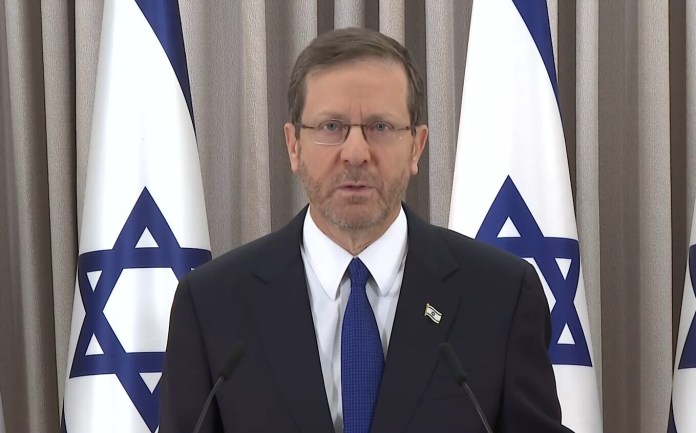
Man of the Moment. Breaking with presidential protocol, a solemn and worried Israeli President, Isaac Herzog, addresses the nation warning of dangers from within.
 

I reflected as he began to speak that this was a far cry when on the 17 March 1949, Chaim Weizmann was sworn in as Israel’s first president. Recognising that his coattails were somewhat clipped by Ben Gurion and that his position was largely ceremonial, he was heard to cynically quip:

 “The only place they will allow me to poke my nose into is my handkerchief.”

Breaking the protocol of the presidency, Isaac Herzog was undaunted to ‘poke his nose’ into current Israel’s affairs of state, On the 12 February 2023, Israel’s State Presidency was as far removed as ‘ceremonial’ as its ever been in its history of 74 years.

In his primetime address to the nation, the President made a passionate appeal to the government less to halt – noting that “change” and “reform” were legitimate pursuits – but more to suspend its hurried legislative process to pave the way for negotiations with the opposition on a broad compromise.

With deepening rifts between right and left, secular and devout, the President cautioned:

I feel, we all feel, that we are a moment before a confrontation, even a violent confrontation…….The powder keg is about to explode, and brothers are about to raise their hands against brothers.”

The President in his heartfelt address brought the full weight of his office in his appeal to a government hellbent on bulldozing its judicial overhaul and imposing it on a highly polarized Israeli society. In urging a pause to the judicial shakeup, the President  proposed a 5-point plan.

The immediate reaction from the government were not encouraging. Justice Minister Yariv Levin – who is the Prime Minister’s point man to driving this judicial overhaul – sounded more like the proverbial Marie-Antoinette when he shrugged off the President’s appeal on Channel 13, saying the legislation would not be halted:

 “even for a minute.”

Herzog reiterated his calls to calm public discourse around his proposal.

Where is this leading?

Well, if the government was ignoring its State President, not so the former  prime minister, Yair Lapid, who called for a ‘Presidential Committee’ on the government’s proposed judicial “reforms” that should begin with a 60-day freeze on all legislation connected with it. Addressing the Knesset, Lapid said:

Sixty days is the blink of an eye in the life of a democracy,” and called for a “proper process” for how such a committee would work. “We waited 74 years. Nothing will happen if it takes another few weeks, during which we will save the nation of Israel from a terrible crisis.”

Also positively responding to the President’s call to save the nation from “a terrible crisis” were 400 ex-senior security officials, including former heads of the police, Shin Bet and Mossad, who signed a letter urging President Isaac Herzog not to agree to any laws that contradict Israel’s core democratic values as part of his efforts to mediate a compromise. The letter reiterated the President’s concern that the proposed legislative steps would “constitute a judicial revolution that will cause damage for generations to come.”

Signatories to the letter of appeal include former Shin Bet chief Nadav Argaman; former Mossad directors Tamir Pardo and Danny Yatom; ex-police commissioner Shlomo Aharonishki and former national security adviser Uzi Arad.

Is this government even ready to listen?

If not, they will probably also ignore the full page  personal appeal  appearing in Israeli newspapers addressed to the President Isaac Herzog by seven Jewish Nobel Laureates – six of whom are Israeli. They are Prof. Aaron Ciechanover(2004 Chemistry), Prof. Avram Hershko (2004 Chemistry), Prof. Daniel Kahnerman (2002 Economics), Prof. Roger Kornberg (2006 Chemistry), Prof Michael Levitt (2013 Chemistry), Prof. Aryeh Warshel  (2013 Chemistry) and Prof. Ada Yonath (2009 Chemistry). Their appeal is based on the negative impact Netanyahu’s government’s proposed legal “reform” will have on scientific research and higher education. They write:

 “We call on the President of the State of Israel to take a clear stance against the proposed changes, on the Prime Minister to return to the positions he himself advocated until recently, and on the members of the Knesset to hear our voice and halt the proposed changes to the legal system.”

How Israel  – “The Startup-Nation” – prides itself on being such a small country with so many Nobel laureates but when the time arises that these same prized laureates warn the country, this government  ignores them because, they believe they “know better.”

City Square Packed in Protest. “We are the only democracy in the Middle East, and we are not going to allow that to change,” said former Minister of Defence Benny Gantz in his address at the demonstration in Kfar-Saba,18 February attended by the writer.

These are troubling times if every Saturday night in the calendar is blocked off to go protest. After 7 consecutive weekends of protest, at the latest demonstration in Kfar Saba  – addressed by the former Deputy Prime Minister and former Minister of Defense Benny Gantz – it was announced that almost a quarter million Israelis were joining in the demonstrations at over 60 sites across Israel. This includes the almost 135,000 people in Tel Aviv who marched from Dizengoff Center to Kaplan Street.

Where to next?

The setting reminds me of two great medieval armies standing ready on a European battlefield, only a brief gallop apart.

To avoid an impeding societal clash, we hope the wise appeal of the President will prevail in time.

Is Israel unraveling? There are enough people who love it to ensure it doesn’t. In the meantime, the protesters will continue and I will be among them as a proud Zionist.


While the mission of Lay of the Land (LotL) is to provide a wide and diverse perspective of affairs in Israel, the Middle East and the Jewish world, the opinions, beliefs and viewpoints expressed by its various writers are not necessarily ones of the owners and management of LOTL but of the writers themselves.  LotL endeavours to the best of its ability to credit the use of all known photographs to the photographer and/or owner of such photographs (0&EO).

PUTTING OUT FIRES

Crazy coalition adds to PM Netanyahu’s woes – and ours!

By David E. Kaplan

When out-of-control wild fires are extinguished by the same crowd that started them, does beg the question:

 “What is going on here?”

It’s crazy, but that is exactly what the Prime Minister of Israel has had to do in his first month of office – put out fires started by his own coalition partners!  

With major threats and issues facing the country – from existential to economic –  look what the PM has had to waste time on:

  • There was first the Religious Zionist Party (RZP) proposed law – championed by the party’s National Missions Minister Orit Strock – to enable businesses and service providers to REFUSE to provide services on the basis of “religious belief” such as a doctor declining to give treatment to a LGBT person. Denounced as discriminatory by politicians from the opposition and members of the medical profession, it was left to the PM to administer the coup de grâce by releasing a written statement and video recording assuring that all persons – irrespective of sexual orientation – would be treated equally.

Doctor No. Contrary to the spirit of the Hippocratic Oath, Religious Zionism lawmaker Orit Strock, proposes bill permitting doctors to refuse treatment to patients on religious grounds. (Yonatan Sindel/Flash90)
  • Next, and literally ‘off the rails’, was United Torah Judaism party chairman, Yitzhak Goldknopf demanding that Transportation Minister, Miri Regev order a halt to construction and maintenance work of Israel’s railways on Saturdays. He claimed that the work is a violation of Shabbat (the Sabbath). Never mind the people who need or want to travel on Saturdays or the vital urgency to complete the national rail electrification project for the betterment of the nation’s economy. In the meantime – although unclear on details – the PM stepped in and an interim compromise was reached that construction was ‘back on track’.
Political Trainwreck. Despite the warning of service delays if maintenance is pushed to weekdays, Haredi Housing and Construction Minister, Yitzhak Goldknopf nevertheless demanded end to Shabbat train work. (Yonatan Sindel/Flash90
  • Then, stepping onto the proverbial pitch was Micky Zohar, the new Culture and Sport Minister who declared  that his ministry would cease funding the previous government’s “Israeli Sabbath” initiative to provide free entrance to a large number of cultural institutions on Saturdays. The only free day in the week for many, it was left again for the Prime Minister to intervene and referee his sport’s minister and assure the public  that “the project would continue.”
Culture Minister gets Bad Review. The decision of Israel’s new culture minister Miki Zohar to cuts funding for events on Shabbat that included free entry to historic sites and subsidies for theatre performances was met with instant opposition. (Photo: Ohad Zwigenberg)
  • Next for the PM to face off was with his ultra-Orthodox United Torah Judaism (UTJ) coalition partner who sought to introduce a bill to separate men and women bathing at springs located in the country’s national parks. Drawing outrage from opposition lawmakers, calling the move a further step towards establishing “a religious state”, the natural spring issue was anything but ‘natural’, and the PM felt compelled to ‘spring’ into action assuring the country that there would be no change in policy.
Coalition to Collision. Antagonising opposition lawmakers was a coalition partner’s bill to gender-segregate natural springs like Ein Lavan Spring in the Jerusalem Mountains. (Yonatan Sindel/Flash90

With the PM having to neutralize the crazy urges of his coalition partners – assuring the nation as well as those observing anxiously from abroad that “I am the pilot; not the co-pilot” which is hardly an edorcement for democracy – is it hardly surprising that people across the country have taken to the streets in protest. These are not disgruntled voters who have not accepted the results of the past election. They accepted the election results because they accept DEMOCRACY. What they have NOT accepted is that the results would lead to a process that dismantles democracy.

Mischief Makers. Religious Zionism party member, Simcha Rothman (l), who has been a key supporter of Justice Minister Yariv Levin (r) to significantly restrict the power of the High Court of Justice, has his sights now set to prevent the Histadrut  – the country’s largest trade union – from joining protests against judicial overhaul. (Yonatan Sindel/Flash90)

One wakes up each day and wonder where or what cherished value or institution is this government going to attack next! Not satisfied with a full-on assault on the Supreme Court – the sole institution that provides an ultimate check and balance on a one-tier legislature (the Knesset) and the prime reason for the protests, next up in the crosshairs is a bill to restrict the striking rights of labour unions. Submitted by far-right Religious Zionism party member, Simcha Rothman, who has been a key player leading the government’s efforts to significantly restrict the power of the High Court of Justice, this bill would prevent the Histadrut  – the country’s largest trade union – from joining protests against judicial overhaul. Super serpentine is Rothman. Because the bill is so designed to strip protections from a labor union that strikes in solidarity with a cause that does not directly impact their line of work, this would prevent the national Histadrut labor federation from joining the nationwide protests against the government’s judicial overhaul plan.

Accepting none of this is Histadrut chairman Arnon Bar-David who issued a statement asserting that the bill would not pass.

Exercising the right to strike is one of the main tools to protect economically vulnerable populations, and I will not allow any party to harm union workers.” Also blasting Rothman’s bill is his immediate predecessor in the Constitution Law and Justice Committee, Labour MK Gilad Kariv, who claimed it is “only phase one of a long-term plan” to place the conservative, right-wing Kohelet Forum think tank in control of the country, “where every man is for himself.”

Quo Vadis. The country braces for “what’s next”  from the Prime Minister (center) and his extreme right-wing coalition partners set on eroding the country’s democratic ethos. (Amir Cohen/Pool via AP)

Every man for himself” is contrary to the ethos of the idea of Israel. As each Saturday night mass protests attests, with the soul of the country at stake, people are relying on the soles of their feet to make their message heard.


While the mission of Lay of the Land (LotL) is to provide a wide and diverse perspective of affairs in Israel, the Middle East and the Jewish world, the opinions, beliefs and viewpoints expressed by its various writers are not necessarily ones of the owners and management of LOTL but of the writers themselves.  LotL endeavours to the best of its ability to credit the use of all known photographs to the photographer and/or owner of such photographs (0&EO).

WHAT DO ISRAEL PRIME MINISTER NETANYAHU AND US REPUBLICAN HOUSE LEADER KEVIN MCCARTHY HAVE IN COMMON?

Both are captives – but so are we

By David E. Kaplan

Americans may well ask just how many deals did House speaker Kevin McCarthy strike with the extreme far-right to finally grab with glee; the prized gavel?

What more could he offer beyond his last pair of socks. House Republican Leader Kevin McCarthy (R-CA) places his hand over his mouth as he stands inside the House Chamber during the voting for a new Speaker of the 118th Congress. (REUTERS/Jonathan Ernst)

The sorry outcome was that while at the same time the USA marked the second anniversary to the January 6 insurrection, on the House floor, Republican lawmakers – who either supported the rioters or helped breathe life into former President Donald Trump’s “big lie” about the 2020 election – were on their nefarious path of not for “We the People” but “We for ourselves”.

Uproar in the House. The voting for the House speaker was tense as right and extreme right of the Repulican Pary battle for supremacy. In the end, ‘deals’ to the extreme faction assured Kevin McCarthy’s ascension to the ‘Hollow Crown”.

Sound familiar?

Israelis can similarly ask:

How many deals did its Prime Minister have to make to hold onto perpetual power?

It is only too evident when we ‘expose’ ourselves to the news, becoming a daily diet of political depravity. Today’s tarnished gem was reading the headline news in The Jerusalem Post that was nothing less than a threat:

Israel will have ‘no government’ if Deri can’t be minister, Shas MK warns

The report goes on to say that Shas MK Ya’acov Margi said he would recommend Shas’s Council of Torah Sages dismantle Israel’s government if Aryeh Deri can’t be a minister.

Deciding Deri’s Fate as Minister. Shas party members sitting in court to hear petitions demanding the annulment of the appointment of Shas leader Arye Deri as a government minister due to his recent conviction on tax offenses at the Supreme Court in Jerusalem, on January 05, 2023. (photo credit: YONATAN SINDEL/FLASH90)

“Dismantle” the Government? For Aryeh Deri? The same Aryeh Deri who in 1999, was convicted of bribery, fraud and breach of trust; and given a three-year jail sentence. In January 2023, Israel’s Supreme Court  ruled that Deri was not allowed to hold a position as a cabinet minister due to his conviction for tax offences, hence the proposed Deri Law which would amount to nothing less than what judiciously-minded MKs are saying is “state-sanctioned corruption”.

While Aryeh Deri as a convicted felon, a fraudster, who should have no right to hold public office or be anywhere within striking range of public funds, now has his salivating pack of supporting party hacks attack the High Court in media interviews, in what appears to be a coordinated threat that the Knesset would respond to a ruling against Deri by curbing the High Court’s powers.

Deri, who is currently serving as Vice Prime Minister, Minister of Health and Minister of the Interior and Periphery, says:

 “I will not resign, no matter what the High Court rules.”

Future Uncertain. Currently serving as the Vice Prime Minister, Minister of Health and Interior, Aryeh Deri has been disqualified from holding office by the High Court that will have implications for the future of Benjamin Netanyahu’s government and the judiciary itself. (Reuters/File Photo)

Are these the characters we should get accustomed to representing us in parliament, never mind holding top positions in government that effect the destiny of the Jewish state and hence the Jewish people?

Is it any wonder that our steadfast guardian – the Supreme Court – is under threat with the proposed legislation conjured by a legal sorcerer by the name of Yariv Levin, who goes by the misnomer of  ‘Minister of Justice’?

As I wrote last week in my article ISRAEL UNDER THREAT FROM  ITSELF, we need to protect and not undermine the Supreme Court because unlike other democracies such as the US and UK that have two tiers of government offering checks and balances, Israel has only one house – the Knesset; and so the Supreme Court is all “We the People” have against an a reckless and unchecked legislature.

We cannot afford its weakening hence the mounting protests with last Saturday nights protest in Tel Aviv attraction over 80,000 people and many more protests to follow. Busses are being arranged from all over the country to bring people to these protests.

And who else is Bibi beholden to? It is all very well our wordsmith PM trying to reassure a sceptic citizenry with  “I did not go to them; they came to me,” when we see what he assembled to form his contrived coalition.

Another of his “came to me” coalition partners is Religious Zionism Party leader MK Bezalel Smotrich, who in a recent recorded conversation is revealed saying to a businessman that he would actively take measures against the LGBTQ+ community and that it would not hurt him politically. Smotrich can be heard saying, “Sephardic, traditional people, you think they care about gay people? Nobody cares. They say that they don’t have a problem with them, ‘you think I care if you [Smotrich] are against them?”

Is this who Bibi has to be in bed with to survive politically? The question is rhetoric – we know the answer – it is emphatically “yes”.

No wonder Yesh Atid party leader MK Yair Lapid says:

 “The Smotrich tapes remind us time and time again how weak Netanyahu is and how dangerous it is that he is held captive by racist extremists.”

The sad truth is that if Netanyahu is a “captive”, so are we to this insane trajectory in our politics. This is not Zionism but the antithesis of Zionism.

Until recently, journalist, commentators and academicians were quick to voice their view that there is no ‘left’ in Israel anymore.  Well, who are the protesters congregating in their thousands to protest against this extreme Likud right-wing government?

Come Hell or High Water. It was both as over 80.000 people braved the intense rain to protest in Tel Aviv against judicial overhaul, viewed as undermining Israel’s democracy.

Actually, they may not be ‘left’ in a political sense, but all that is “left” of a sensible citizenry who see the present regime as a ‘clear and present danger’ to our future.

As I write, I read that the High Court on Wednesday 18 January 2023 has ruled 10-1 in a “Bombshell” decision that Deri cannot be a minister. He cannot retain his positions as Interior and Health minister! With all the threats, how now will Deri and the Prime Minister respond? Members of Deri’s Shas party have warned they may quit Netanyahu government if he is forced out. Clearly, this is not the last round but one of many more to follow.

There is now a war between competing visions for this country. Whose vision will prevail?


While the mission of Lay of the Land (LotL) is to provide a wide and diverse perspective of affairs in Israel, the Middle East and the Jewish world, the opinions, beliefs and viewpoints expressed by its various writers are not necessarily ones of the owners and management of LOTL but of the writers themselves.  LotL endeavours to the best of its ability to credit the use of all known photographs to the photographer and/or owner of such photographs (0&EO).

ISRAEL PARLIAMENTARY SOVEREIGNTY – A CONSTITUTIONAL CRISIS

A cautionary  tale from the South African experience

By former acting Judge, Lawrence Nowosenetz

Is it such a big deal that Knesset can overrule the Israel Supreme Court? That is the plan, it seems, of the new Likud government. The motives are cloaked under the mantle of judicial reform, but this may be a thinly veiled pretext for bringing to heel a judiciary which is an obstacle to the political machinations of the government of the day to protect or give immunity to elected politicians who actually have already crossed the line of the criminal law such as the new Vice Prime Minister and Minister of Health Aryeh  Deri a convicted fraudster  or newly elected Prime Minister Netanyahu who is  currently facing criminal  prosecution.  It remains to be seen whether by the time this is published, the unthinkable  has already have been done.

Courting’ Disaster. Architects of the proposed judicial overall, Justice Minister Yariv Levin (l) and Prime Minister Benjamin Netanyahu.

While some on the Israeli street may think this is not a big deal – indignantly claiming on social media that the legislature reflects the will of the voters and why should unelected judges undermine Knesset  laws – the answer lies of course elsewhere –  in the doctrine of democracy that is not simply based on rule by an elected majority. It is far more complex than simply crass majoritarianism!

Democracy is far more.

It has evolved into a system of checks and balances. This is the idea  which forms the separation of powers of a Government consisting of three elements – the legislature, executive and judiciary. Each has limits and no single part is all powerful or sovereign. This is the model of modern constitutional democracy. Parliament may not exceed its authority. It is bound by the founding laws and values of the State and universal human rights (natural law) . These norms are found in the constitution of the state but are not necessarily written. The US, and many Western states have written constitutions which empower the courts to pronounce on the validity of legislation. A notable exception is England which has an unwritten constitution developed over centuries. Although its parliament is sovereign, it was historically set on course  by the Magna Carta of 1215, which acknowledged the now firmly embedded concept that no man – not even the king – is above the law.

Sending Clear Message. Over 80,000 Israelis protest in Tel Aviv against judicial overhaul. (Jack Guez/AFP)

This evolved over time into the idea of the  rule of law.  England presents a unique example of a constitutional democracy with parliamentary sovereignty which is not abused. Israel has no formal constitution but its founding document – the Declaration of Independence – and the body of basic laws are its constitutional values and norms. This is a grey area which is  in danger of being misused. There is no Bill of Rights which gives courts testing powers over legislative excesses or human rights abuses. The courts should be the guardians of the rule of law and should be independent  of political interference. 

The depravity of parliamentary sovereignty is illustrated by the constitutional crisis which occurred during  the 1950’s in what was then the Union of South Africa. In 1910 the Union of South Africa was formed by the fusion of four provinces, the Cape and Natal being former English colonies with the Orange Free State and the Transvaal being former Boer republics. The Cape Colony was the only province in which a group of non-White people of mixed ancestry called  Coloured  had the franchise. The South Africa Act of 1910, being the constitution, contained a clause guaranteeing  the Coloured right to vote in parliament. This provision was called an entrenched clause. It could only be changed by a 2/3 vote of both houses of Parliament  (a bicameral body consisting of the House of Assembly and the Senate) sitting in a joint session. The National Party, the Apartheid government of the day, viewed the Coloured vote as an obstacle to White rule and pushed through legislation called the Separate Representation of Voters Act which sought to remove Coloured voters in the Cape from the common voter’s role and provide a separate mechanism for the election of four representatives on a separate voters roll. The new law  did not however command a 2/3 majority in a joint sitting of  both houses.  Mr  Harris and a group of aggrieved Coloured voters in the Cape  challenged the validity of this law in court as Parliament had violated its own procedures. The Appellate Division, then the highest court, struck down the overriding legislation as illegal, being not in compliance with the constitution. The government  was most dissatisfied with this decision and then passed the High Court of Parliament  Act to constitute Parliament as a court and with the power to override the courts of law and of course the adverse judicial decision in the Harris case. However, Harris again approached the courts to remedy the  High Court of Parliament law. The Appellate Division again struck out the legislation as a sham as Parliament is not at all a court of law and has no judicial powers. A constitutional deadlock was reached. 

Abuse of Power. Defying rulings of South Africa’s Supreme Court of Appeal (Appellate Division), a predatory parliament in the 1950s pushed through legislation to remove “Coloureds” (mixed race) from the voter’s role.

This stalemate was  overcome by the National Party government  enlarging the Senate with government supporters and also enlarging the Appellate Division with the appointment too, of government supporting judges. The whole sorry saga resulted in the Coloured people being disenfranchised until 1994 when South Africa enacted its democratic interim constitution. The franchise was restored to all South Africans.   

This constitutional gerrymandering  shows the moral depravity of a government armed with untrammelled parliamentary sovereignty, determined to use its powers to maintain power and trample on civil liberties. This approach was already implanted in South Africa by Paul Kruger, prior to the era of union when he  was president of the Boer Republic of the Transvaal. He took a dim view of judicial review, considering it the  work of the Devil introduced to challenge God’s law.  Such an absolutist view harks back to the divine right of kings. This worldview had already been discredited during the Age of Enlightenment in Europe centuries earlier.  

Sign of the Times. Guaranteeing English political liberties, King John signs – under pressure from his rebellious barons – the Magna Carta (“Great Charter”) at Runnymede, a meadow by the River Thames on June 15, 1215.

Democracy has been called a fragile flower. It is easily crushed, particularly by those whose intentions are less than honourable. There has always been a tension between the executive and the judiciary. A delicate balance needs to be maintained. Laws are of general application in most cases whereas a court decision is specific to the parties before it. When legislation is used to favour  an individual, such as a politician, it ceases to be legitimate and is an abuse of power.  In the Harris case, the parliamentary process was used to overturn an unfavourable court judgment. This is a red line which should be guarded against.

Israel is at the tipping point between a constitutional democracy and an unconstitutional pseudo democracy.


About the writer:

Lawrence Nowosenetz is a retired South African advocate at the Johannesburg Bar specialising in labour law; a former senior Commissioner of the CCMA (Commission for Conciliation, Mediation and Arbitration) and  served as an Acting High Court Judge in Gauteng. He has served as Chairman of the Pretoria SA Jewish Board of Deputies and in 2019, he immigrated to Israel where he lives with his wife in Tel Aviv. He retains an interest in international law.


While the mission of Lay of the Land (LotL) is to provide a wide and diverse perspective of affairs in Israel, the Middle East and the Jewish world, the opinions, beliefs and viewpoints expressed by its various writers are not necessarily ones of the owners and management of LOTL but of the writers themselves.  LotL endeavours to the best of its ability to credit the use of all known photographs to the photographer and/or owner of such photographs (0&EO).

ISRAEL UNDER THREAT FROM  ITSELF

A ‘changing of the guard’ is set on changing laws  – a fear for the future

By David E. Kaplan

Israel does not have a Constitution. Nor does it have a two-tier system of government like in the US (a House of Representatives and Senate) that protects “We the People” by providing structural checks and balances.

Israel has just one house – the Knesset – but what it also has – and cherishes – is an internationally respected and sometimes envied Supreme Court that boldly protects ALL its citizens equally.  The Israeli Supreme Court is not merely a magnificent building, it also provides a magnificent service. It is ‘designed’ not only to attract each year multitudes of tourists but to safeguard for all time –  the rule of law.

Under Threat. With Israel’s Supreme Court under attack from the Netanyahu’s hard-right government, will the country’s democratic credentials suffer?

Now however there are ominous forces in play that want not only metaphorically but to literally ‘change the rules’ that will undermine our esteemed Supreme Court posing a threat to civil liberties and minority rights. They are plotting nothing less than an overhaul or more accurately, an overrule by the legislature of the Supreme Court.

Where will the checks be against a – hardly an impossibility these days – reckless legislature without the constraints of the country’s judicial watchdog – a robust Supreme Court?

Yes, Bibi and his new coalition cohorts are on the warpath against the Supreme Court and let us not be fooled by their pretentions of “protecting” democracy. If Israeli democracy needs protecting, it needs protecting from THEM – the Prime Minister and his Justice Minister – Yariv Levin! Under the facile façade of “judicial reform”, the new ultra-right Likud government want the freedom to pursue what could be reckless agendas without any judicial obstacles and to provide as well, protection and immunity to wayward politicians – starting at the top with the Prime Minister himself facing serious criminal charges and then moving down his list of ‘the usual suspects’ in his cabinet. This cabinet includes the Vice Prime Minister serving as well as the Minister of Health and Minister of the Interior and Periphery, Aryeh Deri. Deri has also served time for bribery, fraud and breach of trust, convicted in 1999. Are ‘we the Israeli people’ expected to place our trust and our futures with convicted fraudsters?

Is it any wonder the protests have begun against Prime Minister Netanyahu and Justice Minister, Yariv Levin.

These protests are not a case of the “left having lost an election that they can’t come to terms with it” as rightwing journalists daily jibe but of Israelis who love and respect democracy but now fear losing it.

Wide Awakening. Thousands turn out on a cold wintry Saturday night to protest at Habima Square in Tel Aviv against Prime Minister Netanyahu’s new government, after Justice Minister Yariv Levin unveiled plans earlier in the week to overhaul Israel’s judicial system. (Avshalom Sassoni/Flash90)

The protests on Saturday night the 7 January 2023,  which drew more that 10,000 people to Habima Square in Tel Aviv – “is just one example,” writes the editor of The Jerusalem Report  in his November 9 editorial “of how a large segment of the Israeli public finds these reforms scary and dangerous. People are afraid of the loss of basic civil rights.” The editorial continues, stressing that “Combined with extreme remarks made by some members of the new government about the LGBT community for example, their concerns are not “, as the Prime Minister refutes, “baseless.”

It’s all very well that our smooth-talking Prime Minster is trying to reassure an anxious half of the Israeli population that the claims of his proposed judicial reforms will lead to “the end of democracy” are “baseless”. But are they? After all, he too was once in opposition to the very reforms he now champions.

Demonstrating for Democracy. “We will continue to fight for our democracy,” Merav Michaeli, leader of the Israeli Labour Party, tweeted from the protest in Tel Aviv attended by thousands.  (Avshalom Sassoni/Flash90)

Does Netanyahu – who boasts frequently of how “smart” Israelis are – really believe that Israelis will be duped by the self-interest assertions of a Prime Minister facing criminal charges of bribery, fraud and breach of trust in bed with cabinet ministers who some themselves are convicted felons or hold extreme positions? Noting the caliber of the characters Netanyahu has assembled in his governing coalition, are we really to expect that these reforms will be carried out as he asserts “responsibly” and in a “level-headed manner”?

Who is the Prime Mister kidding? Not any people I know.

And who is Netanyahu listening to? It appears only to himself, while at least one person who he should be listening to is his greatest supporter abroad, emeritus Harvard law professor Alan Dershowitz.

If I were in Israel I would be joining the protests,” Dershowitz told Israel’s Army Radio, referring to the protest attended by thousands in Tel Aviv on Saturday.

Asserting that “It would be a tragedy to see the Supreme Court weakened,” he cautioned that “It will make it much more difficult for people like me who try to defend Israel in the international court of public opinion to defend it effectively [in the future].”

Courting Disaster. Prepared to join the protests, staunch defender of Israel in the court of public opinion, American jurist Alan Dershowitz is troubled by the Prime Minister’s proposed Israel court reforms. (REUTERS/Amir Cohen)

It was a surprise awakening to hear Dershowitz – who has written bestselling books supporting Israeli policies and is close to Netanyahu – to so forcefully oppose the proposed judicial reforms. Dershowitz added he had informed Netanyahu of his “very strong” opposition to the reforms, warning they would also expose Israel to legal challenges by global bodies such as the International Criminal Court.

Even Israel’s president, a position largely ceremonial, has joined in the public outcry to Netanyahu’s judicial reforms. Breaking his silence on Tuesday, President Isaac Herzog  vowed to defend the country’s founding values expressing concern that the proposed reforms by Justice Minister Levin could violate the “moral compass of the country.”

Changes to Israel’s Supreme Court will be ‘supreme’ folly. At the moment the Prime Minister is not listening. It will be up to an awakening public to shout louder.


While the mission of Lay of the Land (LotL) is to provide a wide and diverse perspective of affairs in Israel, the Middle East and the Jewish world, the opinions, beliefs and viewpoints expressed by its various writers are not necessarily ones of the owners and management of LOTL but of the writers themselves.  LotL endeavors to the best of its ability to credit the use of all known photographs to the photographer and/or owner of such photographs (0&EO) .

THE KINGS MISSPEAK

Questioning the claims by the King of Jordan to Protect Christians in the Middle East

By Jonathan Feldstein

I was disappointed to read of Jordanian King Abdullah II warning Israel not to cross “red lines” on Jerusalem during a Christmastime interview on CNN.  Curious as to the nature of King Abdullah’s warning, I decided to watch the interview rather than just comment based on the politicized reports, where the headlines look for click-bait.

By way of full disclosure, I have nothing against King Abdullah.  I think he’s quite a rational, stable, and important leader, for Jordan and for Israel. A close alliance between our countries is important.

Interestingly, Abdullah II’s great grandfather, Abdullah I, moved to the region 100 years ago after he was appointed Emir of Trans-Jordan. He and his brother were rewarded with the territory of what’s today Jordan and Iraq for their loyalty to Britain. As Hashemites, they were moved from their native Mecca where the Saudi dynasty took control of the Arabian peninsula, to these new made-up entities. It was not considered an upgrade at the time, but they took what they could get. This was around the same time my grandparents came home to Israel ending, their and their descendants (my family’s) diaspora.

Twisted Tongue. Jordanian King Abdullah II in an interview with CNN claims to protect Christians in the Middle East. “But does he?” questions the writer. (Photo: Screenshot)

Regarding family, I have a lovely photo of the King’s late father, King Hussein bin Talal, and my father in the early 1990s, just before Israel and Jordan formalized a peace agreement.  My father was overjoyed to meet the King, but also because peace was coming to our counties.  I can see the skyline of Amman from my home, underscoring the geographical proximity and all the historical and modern security issues that go along with that, and I would very much like to meet King Abdullah as my father met his father. However, I must take exception with what he said.

Pursuing Peace. The writer’s father (right) on a UJA mission to Jordan, shakes hands with King Hussein at a reception hosted by the King shortly before the signing of the peace agreement between Jordan and Israel.

Indeed, King Abdullah did issue warnings. He cautioned against Jerusalem being “used by extremists on all sides,” an important comment placing himself in the middle. His criticism of Israel initially took a rare tone when he expressed, “If we continue to use Jerusalem as a soapbox for politics, things can get out of control.” Jerusalem, he continued, is a “tinderbox that if it flashes, we won’t be able to walk away from (in the near future).”

King Abdullah underscored how he wants to be perceived as a centrist, engendering sympathy by “living between Iraq and a hard place.” Yet, he warned from his own soapbox that:

 “if people want to get into a conflict with us, we are quite prepared. I like to…look at the glass half full, but we have red lines.”  

While he was not threatening a third intifada, he did toss that in as a possible consequence of crossing the “red lines”.

The “people” he was referring to were Israelis, and the red lines are related to Israel’s presence in and control of parts of Jerusalem, specifically those in which he sees himself as the ‘custodian’. The Jordan River that separates our counties is often brown and murky. So too, King Abdullah’s words were murky.  He repeated a baseless claim he has made before, that as the Moslem Hashemite leader, he’s custodian of Christian and Moslem holy sites.  In fact, he is not.  Jordan’s custodianship only applies to Islamic sites.

King Abdullah spoke of the shrinking number of Christians in the region, noting that the number of Christians is dropping under “pressure.”  He didn’t say it outright, but the pressure to which he was referring is supposedly from Israel.  That too is false.

While indeed the situation of Christians in the region is dire, around the same time as King Abdullah’s CNN interview, Israel released demographics showing a 2% increase in the Christian population in Israel.  Israel is the only area in the region where the number of Christians is actually growing. In fact, the actual pressure on Christians comes from the wider Islamic society in which they live.

But if the King is concerned about the well-being of Christians in the region, he should start in Jordan itself. Why, when I met a Christian woman visiting Jerusalem recently, she would not be photographed with me, or even in Jerusalem, for fear of herself and her ministry in Jordan being threatened. The same happened with a Christian Palestinian Arab from Bethlehem with whom I had the opportunity to do business recently.  When I suggested taking a picture, he stiffened, and he told me that could be dangerous for him in the Palestinian Authority.

Birthplace of Jesus. Will ‘Silent Night’ one day take on a more literal and ominous meaning of the state of the Christian community in Bethlehem, which has dropped from 86% to 12% in the past 60 years, following a trend across the Middle East, except in Israel, where the Christian population is increasing.

One of the most remarkable comments King Abdullah made was in reference to Islam’s reverence of Jesus as messiah. It might be surprising if the King did not have to walk that back for fear of the charge of heresy. That could prove very dangerous for him and his kingdom where he constantly has to underscore his legitimacy as a Hashemite leader of a country that is predominantly Palestinian Arab. Fortunately for the security cooperation between Israel and Jordan where Israel’s intelligence helps keep the Hashemites on the throne.

Sitting on the east bank of the Jordan River, the King said that it was the third holiest site in Christianity being the location where Jesus was baptized. I asked many Christian friends if this was true, and if so, what the first and second most holy Christian sites were. Without exception, all said that a ranking of such sites is disingenuous, and if it were legitimate, there are other sites that would be in contention for third place, fourth, fifth, and even sixth, ahead of the King’s claimed third place.  Then again, with Islam’s third holiest site being in Jerusalem but never once mentioned in the Koran, perhaps his use of the term is deliberately vague.

Others suggested that he was just pandering, trying to be perceived as the savior (pun intended), of Christians in the Middle East, placing a wedge between Jews and Christians and our shared Biblical understanding of the significance of the Land and people of Israel. His saccharine-sweet words “we are committed to defending the rights, the precious heritage, and historic identity of Christians of our region,” hardly stands up to the reality of the plight and persecution of Christians by Muslims in the Middle East.

The King’s warning about protecting the “status quo” in Jerusalem, undermines the rights of Jews and Christians who, by law, are denied the right to pray on the Temple Mount where Jordan has custodianship. Denying the Jewish right to pray at what’s arguably the most holy place in Jerusalem to Jews must be one of his red lines, and about which he sees no problem enforcing, while “defending the rights” of Christians.

Despite the Jordanian King’s claims to protect Christians and Christian sites, I was left feeling uneasy that his comments were more likely to exacerbate than ease tensions and create divisions between Israel’s Jewish and Christian communities, where there are none.

Disputing King Abdullah’s observations, a spokesperson for Christians United for Israel (CUFI) had it right when he said, “Jerusalem never knew true peace or prosperity until its liberation by Israel.”


About the writer:

Jonathan Feldstein ­­­­- President of the US based non-profit Genesis123 Foundation whose mission is to build bridges between Jews and Christians – is a freelance writer whose articles appear in The Jerusalem Post, Times of Israel, Townhall, NorthJersey.com, Algemeiner Jornal, The Jewish Press, major Christian websites and more.


While the mission of Lay of the Land (LotL) is to provide a wide and diverse perspective of affairs in Israel, the Middle East and the Jewish world, the opinions, beliefs and viewpoints expressed by its various writers are not necessarily ones of the owners and management of LOTL but of the writers themselves.  LotL endeavours to the best of its ability to credit the use of all known photographs to the photographer and/or owner of such photographs (0&EO).

From the ‘United Kingdom’ to the ‘Divided City’

Openly gay UK visitor finds city of Hebron full of surprises 

Written by Lay of the Land UK correspondent

For the purposes of this article, I have kept some of the names of Jewish and Palestinian leaders that work for co-existence in Hebron private. I have done so for their safety, fearing threats of violence and/or imprisonment from the Palestinian Authority (PA) with possible extra-judicial killings from local extremist religious groups.

I had not planned to visit Hebron. Hardly surprising as it’s a city that I, living in the UK, never paid much attention to, considering it far removed both geographically and cerebrally. Even when I did think of Hebron, what came to mind were images of a remote turbulent city with troubled communities – Palestinians beset by internal violence and Jews governed by strict religious laws.  

While I have been in contact with Israeli-Jews and Palestinians from Hebron on social media and personally found the city of very little personal interest, it was by a twist of fate that I would visit it. I had been contacted by an Israeli ‘social media friend’, who lived close to Hebron and works in the city insisting that I visit.

Illuminating Visit. It is important to hear both sides as both local Jews and Arabs have their own stories to tell.

After months of ‘pestering’, I finally agreed while on a holiday on Israel. Although I was anxious about visiting a strictly religious Jewish community as an openly gay man, I was surprised to find the community very accepting of LGBT+ people.

My ‘social media friend’ and contact, Shlomo, picked me up from Tel Aviv. Abandoning my customary caution, I hopped into a car with essentially a stranger and began my visit to a city once described as one of the most dangerous and conflict-ridden cities in the world. The two-hour drive felt like an eternity.  We passed through two easy security points, which where nothing more than a single guard with a toll style security. Checkpoints are often derided and dismissed by anti-Israel protagonists but are critical in providing security.

THE LONG SHADOW OF WAR

The city of Hebron is one of the most historically and religiously important cities to Jews and one of the most important cities, politically, for the PA. It is also a frequent flashpoint in the Israeli-Palestinian conflict.

The first thing that struck me about Shlomo as he gave me a private tour, was that he and his community just wanted to be heard. Giving me a private tour starting at the Cave of the Patriarchs and then moving on to the other local historical sites, I got to ask him as many question as I wanted.

Hebron’s Holly of Hollies. The Cave of the Patriarchs or Tomb of the Patriarchs, known to Jews as the Cave of Machpelah and to Muslims as the Sanctuary of Abraham, is a series of caves in the heart of the Old City of Hebron.

We visited the gravesite of Baruch Goldstein, the infamous Israeli terrorist and mass-murder, where he immediately warned me that the local Israeli authorities closely monitor the site and any public support for Goldstein would be met by an arrest.

I had no desire to stay and while Shlomo reassured me there were no security concerns,  he cautioned me to avoid drawing any attention to myself.

Touring Jewish Hebron, I was able to get a close-up of Palestinian Hebron. An old broken-down chicken wire fence – replete with wide gaps – was the only significant separation between the Palestinian and Jewish Hebron – a rather tenuous ‘barrier’ I thought, considering the tensions I was under the impression, fractured the city.

As I walked through the old quarter of Jewish Hebron, memorials for Jews murdered were common at every corner. They represented a sad reminder of the steep price in lives to choose to live in the second holiest site for Jews after Jerusalem. As I walked around, I saw bullet holes in old walls and doors with l potholes in the ground which I suspected were once caused by explosives.

Writing on the Wall. Hebron graffiti articulates peoples thoughts and dreams.

Shlomo introduced me to a local Jewish community leader and elder called Y, who with the kindness of his wife, invited me to stay at their house for regular vegan meals. Y and his wife were a jolly and inspiring couple with enthralling stories. 

They shared their past in the former Soviet Union being members of the underground and engaging in resistance activities to support persecuted Jews. Other stories from Y, included secretly hosting in Hebron leading LGBT+ Iranian dissidents as well as welcoming Hollywood celebrities.

SILENT PALISTINIAN COEXISTANCE

With Y as our guide, we handed out sweets to the IDF and were joined by two young, religious women. As we walked through the city’s broken pathways, handing out the sweets to the IDF soldiers, I saw many soldiers speaking and some playing football with Palestinian children. I quickly discovered that Y, was well-liked and known around to hand out sweets to the Palestinian children.

Y was extremely proud to show me Palestinian businesses popular with the city’s Jewish residents, notable dentists, pet shops, clothing stores and auto repair shops.

We came upon a cluster of small, very ordinary Palestinian stalls, one of which was owned by a friend of Y – his close contact within Palestinian Hebron.

His friend broke into a wide warm smile when he saw Y but it quickly disappeared when he spotted me. Feeling uncomfortable or suspicious by my appearance, I left the two of them alone to speak as I explored the stalls. I found beautiful, handcrafted items and was fascinated by  the daily co-existence so contrary to the image I had imagined  from the international media.  

Business is Brisk. Despite the tensions, life goes on in Hebron.

Creating their own security network, Y revealed that he and  his friend would secretly pass information to each other about which Jewish or Palestinian children were committing violence against each other in their communities, bypassing the local authorities. They believe that these local Jewish and Palestinian children are best served by being punished by local community leaders rather than subject them to Israeli or Palestinian justice. In this way, it is a far better way to maintain social calm between the two communities.

Y would later tell me on our tour that he believed that 60% of Hebron was supportive of Hamas because of their alleged anti-corruption agenda.  Many are frustrated with the corruption and lack of services from the Palestinian Authority.

The further we travelled around in the areas we were legally allowed to, we passed Palestinian housing estates that were burnt-out – not from clashes with Israelis – but the result of clan-based violence between the Al-Jabari and Awiwi Clans.

ECHOES AMONG THE CHILDREN 

Y openly regaled me with stories of battles that exploded across Hebron on street corners involving sniper, tank, and gun fire – where he was occasionally caught in the middle. Walking around Hebron, I was surrounded by Jewish and Palestinian children going about their daily lives, born after the horrors of the Second Intifada.

It is clear that neither Jews nor Palestinians will be leaving one of the most previously divided and war-torn cities of the conflict. I can only hope that the children that I saw will be able to grow up without the horrors of the past.

It was so reassuring to see children happily playing around, appearing unscarred by street battles that once raged across the city.

I shall carry with me forever the moment I saw a group of young Jewish children skating and rollerblading down a long street, which had once been the site of a fierce firefight.  Where once war characterised this street, the vista that embraced me was of Palestinian children playing football and chatting with IDF soldiers.

Engaging for a better Tomorrow. Jewish visitor from Israel meeting with a young Palestinian girl in Hebron.

What next for Hebron?

It is hard to say what its future will be. I once thought of Hebron of as a remote, impoverished, dull and deary and overly religious city – but I was wrong.

I felt honoured to be so warmly welcomed by everyone I met  and to have been so unexpectedly accepted by the religious Jewish community as gay, was for me, a pleasant surprise!

Having thoroughly enjoyed my visit, I hope to one day revisit and again connect with Hebron’s Jews and Palestinians that are making history and forging a destiny together.


While the mission of Lay of the Land (LotL) is to provide a wide and diverse perspective of affairs in Israel, the Middle East and the Jewish world, the opinions, beliefs and viewpoints expressed by its various writers are not necessarily ones of the owners and management of LOTL but of the writers themselves.  LotL endeavours to the best of its ability to credit the use of all known photographs to the photographer and/or owner of such photographs (0&EO).

Respect for Freedoms

Israel scores high on Freedom House Global Score

By Bev Goldman

“Freedom House works to defend human rights and promote democratic change, with a focus on political rights and civil liberties. We act as a catalyst for freedom through a combination of analysis, advocacy, and action. Our analysis, focused on 13 central issues, is underpinned by our international program work.”

Freedom House is a non-profit NGO that conducts research and advocacy on democracy, political freedom, and human rights in countries across the globe. Founded in October 1941, its first honorary chairpersons were Wendell Willkie, the 1940 Republican nominee for President of the USA, and Eleanor Roosevelt, former and longest-serving first lady of the USA; and it is founded on the core conviction that freedom flourishes in democratic nations where governments are accountable to their people.

A Force for Freedom. A central figure among Freedom House’s early leaders was First Lady Eleanor Roosevelt seen here holding up the United Nations Universal Declaration of Human Rights in November 1949. Eleanor Roosevelt was a strong supporter of Israel from that nation’s founding in 1948 until her death in 1962.

In analysing the countries, Freedom House speaks out against the main threats to democracy while encouraging citizens to exercise their fundamental rights through a unique combination of analysis, advocacy, and offering direct support to frontline defenders of freedom, especially those working in closed authoritarian societies. 

As an independent watchdog organization, its research and analysis focus on the progress and decline of freedom across the globe by empowering human rights defenders and civic activists to advance democratic change.

The 2020 Freedom House Annual Report on Israel is impartial, objective and candid, acknowledging the government’s faults but giving credit wherever it is due, and presenting a picture which to Israel’s enemies would be anathema, but to those who recognise her strengths, it is factual and accurate.

The report begins with an introduction, followed by rigorous analysis of the issues on which they focus: 

“Israel is a multiparty democracy with strong and independent institutes that guarantee political rights and civil liberties for most of the population. Although the judiciary is comparatively active in protecting minority rights, the political leadership and many in society have discriminated against Arab and other ethnic or religious minority populations, resulting in systemic disparities in areas including political representation, criminal justice, education, and economic opportunity.”

The coverage then focuses on the topic of free and fair elections. The report notes that the Central Elections Committee (CEC), which is composed of delegations representing the various political groups in the Knesset and chaired by a Supreme Court judge, guarantees the fairness and integrity of elections, and acknowledges that they are generally peaceful and orderly with results accepted by all parties.

Regarding political pluralism and participation, the reports delineates Israel’s multiparty system as “diverse” and “competitive” but adds that parties or candidates that deny Israel’s Jewish character, oppose democracy, or incite racism are prohibited.  It then includes comments by critics of the 2016 law – which allows the removal of any members who incite racism or support armed struggle against the state of Israel with a three-quarters majority vote – alleging that it is aimed at silencing Arab representatives.

Vibrant Voting. Israel’s “diverse” and “competitive” national elections always attract high turnouts. Seen here are people casting their ballot at a voting station in Jerusalem on March 2, 2020 in an election that at the end of voting, the committee put turnout at 71%. (Olivier Fitoussi/Flash90)

The report illustrates the fact that while women generally enjoy full political rights in law and in practice, they are somewhat underrepresented in leadership positions and can encounter additional obstacles in parties and communities – both Jewish and Arab – that are associated with religious or cultural conservatism.

It discusses further that Arab residents of East Jerusalem have the option of obtaining Israeli citizenship in order to be allowed to vote, though most decline for political reasons. While these non-citizens are entitled to vote in municipal as well as Palestinian Authority (PA) elections, most of them have traditionally boycotted Israeli municipal balloting.

The report observes that Israel’s basic laws are considered equivalent to a constitution (which the country does not have). It adds that in 2018, the Knesset adopted a new “basic law” – the Nation-State Law – which granted only to Jewish people the right to exercise self-determination in the State of Israel. Those opposing it, according to further research done, claimed that it created a framework for the erosion of non-Jewish citizens’ political and civil rights.

This report was released before the election of the current coalition and stated that no Arab party had ever been formally included in a governing coalition, nor did Arabs generally serve in senior positions in government. But the current government under Naftali Bennett is the first to include an independent Arab Israeli party as an official member of the governing coalition. How things change!

History in the Making. An Arab dentist, Mansour Abbas, leader of the Islamist party  Ra’am, emerged as the “Kingmaker” in the 2020 Israel election and made history by ensuring for the first time an Arab party joined a governing coalition.

Israel’s laws, political practices, civil society groups and independent media are recognised as generally ensuring a significant level of governmental transparency, though corruption cases are not infrequent and high-level corruption investigations are regularly held. Israel’s judiciary is especially lauded in the report for its independence and its regular rulings against the government. As an addendum to this, the Supreme Court is verified as having played a crucial role in protecting minority groups and overturning decisions by the government and the parliament when they threaten human rights; and court rulings are almost always adhered to by the State, involving both Israeli citizens and Palestinian residents of the West Bank and Gaza Strip.

Moving forward, the report commends Israel’s media as being among the most vibrant and free of any country. But while criticism of government policy is uninhibited, vociferous, candid, and forthright, the rules differ for print articles on security matters which are routinely subject to a military censor. Security considerations are behind the action of the Government Press Office which withholds press cards from journalists to restrict them from entering Israel. While a law passed in 2017 allows police and prosecutors to obtain court orders to block websites publishing criminal or offensive content, the report acknowledges that freedom of expression advocates are concerned that the same law could suppress legitimate speech if applied indiscriminately.

The report applauds Israel’s commendable respect for total freedom of religion, notwithstanding the fact that the country defines itself as a Jewish state. In matters of marriage, divorce and burial, Christian, Muslim, and Baha’i communities have jurisdiction over their own members, but it mentions that while the Orthodox govern personal status matters among Jews, this power they wield is often objected to by many non-Orthodox and secular Jews. It is also revealed that while the law further protects the religious sites of non-Jewish groups, the latter face discrimination in the allocation of state resources.

Mention is made of the ever-present security concerns in Israel which forced Israeli authorities to set varying limits on access to the Temple Mount/Haram al-Sharif in East Jerusalem in recent years, affecting worshippers across the broader area. However, in 2018 the government lifted restrictions on Jewish lawmakers visiting the site, restrictions that had been in place for nearly three years, a move much approved of by the citizens.

Jitters in Jerusalem. Freedom of worship is guaranteed in Israel but becomes problematic when praying at places held sacred to both religions as seen with Israeli security forces standing guard, as a group of Jews visit the Temple Mount (Al-Aqsa) compound in Jerusalem, on July 18, 2021. (AHMAD GHARABLI / AFP)

With reference to education, all primary and secondary education is national but is divided into multiple public-school systems (state, state-religious, Haredi, and Arabic). A law passed in 2018 bans groups that favour legal action abroad against Israeli soldiers, or that otherwise undermine state educational goals by criticizing the military, from entering Israeli schools or interacting with students.

Israel’s universities are celebrated as being open to all students and have long been vocal centres for argument, protest, and discord; but again, security concerns have resulted in restricted movement and limited access for West Bank and Gaza residents/students. 

Campus Freedom. A clear show of tolerance and freedom, it is no problem for hundreds of Israeli Arab students to demonstrate against Israel on “Nakba Day” at Tel Aviv University.  Arab students registered at Tel Aviv University comprise about 14.5% of the total number of registered students. (Photo: Al Ittihad).

The report refers to the persistent threat of small-scale terrorist attacks in Israel which usually involve stabbings or vehicle onslaughts; and this is combined with ongoing rocket and artillery fire from Syria and the Gaza Strip. While Israeli soldiers are always on alert, trying to obtain the truth from the terrorists, the report adds that while the Supreme Court banned torture in a 1999 ruling, it said that “physical coercion might be permissible during interrogations in cases involving an imminent threat. Human rights organizations accuse the authorities of continuing to use psychological threats and pressure, painful binding, and humiliation.”

Freedom of assembly in Israel permits protests and demonstrations which are typically peaceful. However, some protest activities – such as desecration of the flag of Israel or a friendly country – are seen as criminal acts and draw serious criminal penalties.

Education for All. The number of Arab students in Israeli universities grows 78% in 7 years. Seen here are Arab Israeli students at the campus of Givat Ram at the Hebrew University of Jerusalem. (Miriam Alster/Flash90)
 

Regarding NGOs, particularly those engaged in human rights – and governance-related work, the report observes that a 2016 law states that NGOs that receive more than half of their funding from foreign governments must disclose this fact publicly. The measure mainly affects groups associated with the political left that oppose Israel’s policies toward the Palestinians. But foreign funding for right-leaning groups that support Jewish settlements in the West Bank, for example, more often comes from private sources.

The report deals with additional issues including freedom for labour organisations; due process in criminal and civil cases; freedom of movement; personal and social freedoms; equal treatment of all sectors of society; and equality of opportunity and freedom from economic exploitation among others. However, they were not covered because of space constraints.

True Colours. A clear image of freedom and liberalism is Israel’s annual Pride Parades that attract hundreds of thousands of people from across the world. The parades are the largest in Asia and the Middle East. (photo:Guy Yechiely)

The final summation awarded Israel 73 out of a possible 100 points on the Freedom House Global Score, acknowledging it to be a free state, one of 77 out of 196. Included in those not free, with very low results (some in brackets), are Algeria, China (9), Egypt, Gaza Strip (11), Iran (16), Iraq, Jordan, Lebanon, Liberia, Oman, Qatar, Russia, Saudi Arabia (7), South Sudan (2), Sudan, Syria (1), Turkey, UAE, West Bank and Yemen. All Israel’s enemies.

The results speak for themselves.


About the writer:

Bev Goldman national president of the Union of  Jewish Women South Africa (UJW), worked for many years in education and journalism, and she holds a master’s degree in Feminist Literature. Prior to joining the SA Zionist Federation where she dealt with media and education for 12 years, she was the editor of the ‘Who’s Who’ of Southern Africa; a member of WordWize which taught English language skills to Russian and Polish immigrants in South Africa; an occasional lecturer in English at RAU (now the University of Johannesburg); and Director of Educational Programmes at Allenby In-Home Studies.  Currently, she runs the Media Team Israel for the SA Zionist Federation; she sits on the Board of Governors of the Rabbi Cyril Harris Community Centre (RCHCC); she is an executive member of the International Council of Jewish Women (ICJW); and she edits and proofs Masters and PhD dissertations.


While the mission of Lay of the Land (LotL) is to provide a wide and diverse perspective of affairs in Israel, the Middle East and the Jewish world, the opinions, beliefs and viewpoints expressed by its various writers are not necessarily ones of the owners and management of LOTL but of the writers themselves.  LotL endeavours to the best of its ability to credit the use of all known photographs to the photographer and/or owner of such photographs (0&EO).