WHILE THE WEST’S AWAY, RUSSIA AND IRAN WILL PLAY

Did the West just lose Africa to Russia and Iran?

By Stepan Stepanenko and Catherine Perez-Shakdam

Niger’s military coup, coupled with the new regime’s call for Wagner assistance and apparent negotiations with the Iranian regime, is the beginning of a dangerous realignment in the Sahel region.

If left unaddressed by democratic states, this will see a new stronghold of terror networks on Europe’s borders. Russian and Iranian moves to secure the favor of Niger’s coup leaders show the unity of both in their bid to redress historic balances of power, plunging the country and the region into further turmoil by making democracy and economic development for the region unattainable.

In a historic emergency meeting in Abuja earlier this month, Nigeria and the Economic Community of West African States (ECOWAS) called for the immediate release and reinstatement of Niger’s elected president, Mohamed Bazoum, held by the military since 19 July.

President Ousted. Mohamed Bazoum, Niger’s democratically elected president, was ousted by members of his presidential guard on July 26 and has since been under house arrest with his wife and son in the presidential compound in the capital, Niamey. Facing prosecution for “high treason”, if found guilty, Bazoum could face the death penalty, according to Niger’s penal code. (AP Photo/Michel Euler, File)

ECOWAS issued a stern ultimatum to Niger’s military, giving them one week to comply with their demands or face the consequences, including the potential use of force to restore the nation’s rightful leader. The bloc’s unwavering stance sends a clear message that the international community will not tolerate the disruption of democracy in the Sahel region.

Niger’s coup, orchestrated by General Abdourahamane Tchiani, has further exposed deep-rooted issues within the country. The rise in insecurity and stagnant economic prospects have contributed to the nation’s fragility, leading to disillusionment among the populace – a theme that unfortunately runs throughout much of the region, reminding many that Niger could be only the beginning of a much broader realignment, with efforts by Russia and the Islamic Republic of Iran to exploit chaos to advance their respective agendas.

Taking Charge. Coup leader, General Abdourahmane Tchiani , who was declared as the new head of state of Niger by leaders of a coup, arrives to meet with ministers in Niamey, Niger July 28, 2023. (REUTERS/Balima Boureima) 

Niger’s new leadership is on shaky grounds, coming in at a time when violence and turbulence were decreasing in the country. Coupled with  wider criticism of the presidential guard’s move to detain president Bazoum, the new leadership has no choice but to seek external support from those willing to prey on instability for their personal benefit.

So it comes as no surprise that Evgeniy Prigozhin, head of the infamous Wagner Group, was quick to praise the coup and offer support for the new regime. More worrying is the news that Niger has already asked for assistance from the Russian mercenary group in a visit by the coup’s leader, General Salifou Mody, to Mali – a well-known Wagner outpost.

Offering Order to sow Disorder. Wagner mercenary boss Yevgeny Prigozhin, who remains active despite leading a failed mutiny against the Russian army’s top brass, has hailed Niger’s military coup as  good news and offered his fighters’ services to bring order.

While Russia’s mercenary presence in Africa is well documented, if still largely out of the public eye in the west, a tell-tale sign of the region’s importance to Russia’s future plans in its standoff with the West is Iran’s efforts to assist the coup leaders.

The Sahel has grappled for years with Islamic radicalism, with terrorist groups such as Al Qaeda, ISIS, and Boko Haram vying for control, and the risk that Africa could soon lose territory to the Caliphate 2.0 are too real to be discounted.

Taking into account the recent visit to Niger of Esmail Qaani, the infamous Commander of the Quds Forces – a division primarily responsible for extraterritorial military and clandestine operations – the future of Niger could be grim.

Appointed by Ayatollah Khamenei following the death of General Qassem Soleimani in 2020, Qaani is one of the regime’s most loyal and trusted military operatives and his presence generally signals a desire from Tehran to establish or curate influence.

Niger’s new leadership already announced it is cutting bilateral military ties with France and called back its ambassadors from France, the US, Nigeria, and Togo.

But how did we get here, and more importantly, what does it mean for Western interests and the prospects of peace for the people of Niger and the Sahel?

General Abdourahamane Tchiani’s discontent stems, at least in part, from the presence of foreign forces in Niger. The perception that these forces undermine the military’s authority has fueled dissent and complicated efforts by the United States and France to combat insurgent attacks by Islamic radical groups.

In turn, the coup’s leader’s move to welcome Russia’s assistance clearly indicates that foreign presence is only a pretense.

Flames over Niamey. The headquarters of Niger’s ruling party burns in the background as supporters of the mutinous soldiers demonstrate in Niamey, Niger.

Likewise, in a show of hypocrisy, Mali’s Assimi Goïta, who has made Russia his protector and guarantor, has called for an end to colonialism and the influence of the West on the region, echoing the same lines voiced by Russian diplomats and outlets such as Media Afrique TV, closely linked to Prigozhin’s Association for Free Research and International Cooperation (AFRIC).

The ethnicity and the legitimacy of President Bazoum have also been problematic, fanning old upsets. The predominantly ethnic Arab military have challenged Bazoum’s leadership, despite his majority win in the elections, highlighting the fragility of Niger’s democratic institutions and the difficulties in preserving their integrity.

Niger is only the latest African country to fall prey to violence. Military power seizures in Guinea, Burkina Faso, and Mali most likely paved the way, not to say emboldened, Niger’s military junta.

Before such dynamics, ECOWAS and the African Union have little to no influence. This lack of deterrence has created a troubling environment, encouraging opportunistic military leaders to challenge democratic norms.

The implications of this coup are far-reaching. Niger’s strategic alliances with Western nations in combating insurgency and curbing illegal migration to Europe will be jeopardised. The West could also lose access to vital gold and uranium resources, disrupting markets and broad economic outlooks.

The new military leadership is sure to act as a further facilitator for Russian and Iran to circumvent US and EU and other sanctions placed on their trade.

Undeterred by international moral and legal norms, the impetus of the newly enthroned coup leaders to cling to power will outweigh any restrictions placed on such dealings.

Ultimately, the success of this military takeover could set a dangerous precedent for democracy in the region and Africa as a whole. The formation of a military alliance by the regimes of Guinea, Mali, and Burkina Faso raises concerns about the erosion of democratic values and the need for African leaders to prioritize the interests of their citizens.

Capitalizing on Coup and Chaos. Joining Russia in eyeing Niger as possible inroad against US in Africa, the Iranian Ministry of Foreign Affairs called for stability and calm in Niger, whose President Mohammed Bazoum has been detained and removed in a coup led by members of his presidential guard.

We may also want to consider that Niger’s coup may not be the expression of internal divisions alone but rather the result of a Russian and Iranian bid for control at the heart of Africa to offset Western influence and access.

Taking into account the fragility of the new leader’s power base, the stage is set for the center of Africa to be the new battleground between totalitarianism and democratic forces.


About the writers:

A co-founder and director of UK-based media and consultancy company  ‘Forward Strategy’, Catherine Perez-Shakdam is a frequent contributor to i24NEWS, Al Jazeera, the BBC, The Jerusalem Post, Politico, the Daily Express, and the Daily Mail.

In 2021, Chatherine gained international attention when news broke of her decade-long infiltration of the Iranian regime, during which she was able to gain access to the highest echelons of the regime’s inner circles. Despite the danger following being labeled an ‘enemy of the state’ by Iran, Catherine utilized her extensive knowledge and close-encounter insight to expose a system that had long operated under a shroud of secrecy. Her revelations have provided a unique perspective on Iran’s actions, challenging its narrative and exposing the true nature of its operations.


Dr. Stepan Stepanenko


While the mission of Lay of the Land (LotL) is to provide a wide and diverse perspective of affairs in Israel, the Middle East and the Jewish world, the opinions, beliefs and viewpoints expressed by its various writers are not necessarily ones of the owners and management of LOTL but of the writers themselves.  LotL endeavours to the best of its ability to credit the use of all known photographs to the photographer and/or owner of such photographs (0&EO).

UK, ACT WHILE YOU STILL CAN!

From the intrepid woman who penetrated the inner sanctum of Iran’s leadership and survived, a warning to the UK to outlaw Iran’s IRCG – before it’s too late

By Catherine Perez-Shakdam

(see her revelations in ‘THE MOSSAD AGENT WHO NEVER WAS’)


Leadership expert Simon Sinek once said, “Leadership is not about being in charge. It is about taking care of those in your charge.”

Regrettably, when it comes to the threats posed by Iran and its Islamic Revolutionary Guard Corps (IRGC), the UK’s leadership has fallen short of fulfilling its promise to proscribe the IRGC and hold Tehran accountable.

It is high time for Western capitals, including the UK, to fully assess the dangers such a lack of leadership represents. From Iran’s expansionist agenda to its encroachment on Western institutions through various networks, manipulation of opinions via social media, and the rising threat of sectarian violence, it is crucial to recognize the urgency of addressing these challenges.

She Saw, She Met, She Reveals. Seen here in Tehran is the writer, who like a chameleon, blended into the most dangerous political environment in the world.

Despite acknowledging the threat posed by the Revolutionary Guard to its national security and the safety of citizens, the UK’s leaders have not taken effective measures to proscribe the organization.

Britain’s rulers are more concerned with politicking and avoiding risking the burden of a tactical mistake. But true leadership demands vision and, above all, the courage to stand by one’s beliefs.

Leadership is a call for action, and though wisdom, requires reflection, not chaos. To observe terror tightening its grip on our democratic institutions, threatening not only the integrity of our borders but the very safety of our nationals, is too close to treason for any of us to look away.

The USA designated the IRGC as a terrorist organization in 2019 for:

– its acts of global terror

– violations of the laws of armed conflict

– assassination attempts

– support for regional terrorist groups.

The UK’s delay in following suit raises concerns about the effectiveness of its approach to countering Iran’s malign activities. Iran’s expansionist agenda is a significant concern for global security. The regime’s continual disruption of peace by heightening military tensions in the Middle East and North Africa, along with threats to seize control of the Strait of Hormuz while arguing ‘maritime security,’ are too grave a challenge to our strategic interests – never-mind that of our regional partners – to turn a blind eye in the hope that the Ayatollah might come down from his pulpit long enough to broker a lasting peace.

Global Menace. The IRGC developed itself as a “parallel” or shadow government of Iran, accountable to the supreme leader Ali Khamenei only.
 

Iran’s regime hunger for conquest and ideological domination – one only needs to listen to the words of its ideologues.

The Revolutionary Guard plays a pivotal role in advancing Tehran’s interests beyond its borders, supporting proxy groups and armed militias in the Middle East. To proscribe, it would draw a line in the sand and signal that Britain is no longer prepared to cede ground. That in the face of the advance of terror, our democracies are willing to stand by their beliefs.

If we are what we believe we are, then I must ask, what is the UK today in the face of the single biggest threat to our way of life?

Public Execution. This year alone, more than 350 Iranians have been hanged, according to Norway-based Iran Human Rights. The rights group noted a 36% increase on the same period last year, likely exacerbated by the ongoing uprising since the death in morality police custody of Mahsa Amini and the subsequent unrest sweeping the country.

The UK’s inaction over proscribing the IRGC hampers efforts to address Iran’s regional influence and its potential to destabilize the Middle East further.

It has skillfully infiltrated and established networks within Western countries, including the UK. Its extensive presence in diaspora communities allows it to wield influence, fundraise, and conduct intelligence operations on foreign soil.

The rise of social media has also become a potent tool for the IRGC to manipulate public opinion, both in Iran and abroad. It seeks to shape narratives and sow discord through coordinated disinformation campaigns, undermining Western institutions and public trust. By not holding the IRGC accountable, the UK inadvertently allows this disinformation campaign to persist unchecked.

The IRGC‘s efforts to radicalize certain demographics by fanning negative religious sentiments pose a growing threat to societal stability. The UK’s lack of action in proscribing the IRGC indirectly perpetuates an environment in which sectarian tensions can escalate, contributing to potential violence and undermining social cohesion.

To effectively counter Iran’s expansionist agenda, encroachment on Western institutions, manipulation of social media, and the rising threat of sectarian violence, decisive leadership is imperative.

State Terrorism. EU foreign policy chief said in January that “the bloc won’t label the Islamic Revolutionary Guard Corps a ‘terrorist’ organisation, for now.”  Protesters gathered in front of the European Union headquarters in Brussels to demonstrate against the Iranian government. (Photo: Ohanna Geron/Reuters)

By fully assessing the dangers associated with a lack of action, Western capitals, including the UK, can take the necessary steps to protect their nations and preserve global stability in the face of the IRGC‘s malign activities.

Only through bold and resolute leadership can we hope to address the multifaceted challenges posed by Iran and safeguard our shared values and security interests.

In the words of another leadership expert, Roselinde Torres, “Great leaders are not head down, they see around corners, they are shaping their future not just reacting to it.”

It is high time for the UK leadership to embrace this philosophy and act decisively to confront the IRGC threat, safeguarding the nation and its citizens from potential harm. As we navigate the complex geopolitical landscape, the importance of strong leadership cannot be overstated.

Tiptoeing around Terror. The UK has rejected calls to proscribe Iran’s Islamic Revolutionary Guards (IRGC) as a terrorist group in favour of expanding the criteria by which supporters and companies can be put under sanctions. Members of the Islamic Revolutionary Guard Corps attend a rally marking the annual Quds Day in Tehran on 14 April 2023. (Photo: Wana News Agency/Reuter)


About the writer:

Catherine Perez-Shakdam is  co-founder and director of Forward Strategy, a boutique media and consultancy company based in the UK. She is a prominent expert in the Middle East, particularly in the domains of Iran and Yemen. With a rich background, including consultancy work for the United Nations Security Council in 2012, she has played a crucial role in shaping policy decisions by providing invaluable insights into Yemen’s War Economy, uncovering the intricate web of corruption, trafficking, and money laundering.

Catherine has also established herself as a respected voice in the media landscape. She has been a frequent contributor and commentator for outlets such as the I24, Al Jazeera, the BBC, The Jerusalem Post, Politico, the Daily Express, and the Daily Mail. Her contributions have shed light on critical issues, offering a nuanced understanding of complex situations.

Having previously served as a Research Fellow at the Henry Jackson Society, Catherine has authored compelling policy recommendations and research papers to address the increasing influence of the Islamic Republic of Iran, exposing its activities and providing a deeper understanding of its operations.

In 2021, Catherine gained international attention when news broke of her remarkable decade-long infiltration of the Iranian regime, during which she was able to gain access to the highest echelons of the regime’s inner circles. Unsurprisingly, she was promptly labeled an ‘enemy of the state’ by the regime. Undeterred, Catherine has courageously utilized her extensive knowledge and expertise to denounce the activities of the Islamic Republic, helping to unveil a system that had long operated under a shroud of secrecy. Her revelations have provided a unique perspective on Iran’s actions, challenging its narrative and exposing the true nature of its operations.


While the mission of Lay of the Land (LotL) is to provide a wide and diverse perspective of affairs in Israel, the Middle East and the Jewish world, the opinions, beliefs and viewpoints expressed by its various writers are not necessarily ones of the owners and management of LOTL but of the writers themselves.  LotL endeavours to the best of its ability to credit the use of all known photographs to the photographer and/or owner of such photographs (0&EO).


A KING FOR OUR TIMES

The Eyes of the world on the coronation of King Charles and Queen Camilla

By Rolene Marks

On May the 6th, the eyes of the world will be trained on Westminster Abbey in London as King Charles is crowned the Most High, Most Mighty and Most Excellent Monarch, our Sovereign Lord, Charles III, now, by the Grace of God, of the United Kingdom of Great Britain and Northern Ireland and of His other Realms and Territories King, Head of the Commonwealth, Defender of the Faith, and Sovereign of the Most Noble Order of the Garter.  A long title to be sure – and one that comes with a 1000 year old history and a great sense of responsibility, duty and service.

Britain is a constitutional monarchy and the King is the living embodiment of that contract between constitution, people and sovereign. This was on full splendid display at the accession ceremony following the death of her late Majesty, Queen Elizabeth II.

While the King cannot send anyone to the Tower (although I think he has been tempted to send a few errant members of his family to the great fortress) or has any real power, he is the very symbol of the United Kingdom, the consummate diplomat, deploying that soft diplomacy and convening power only royalty can.

For many of us, this will be the first time we will see a Coronation. It has been 70 years since the last one, when a beautiful 26 Queen Elizabeth, resplendent in her robes and crown, bearing the symbols of power, the scepter and orb, was revealed to the world.

The coronation will be a great moment in history and it is only the British Royal Family that officially crown their monarchs by holding a ceremony like this which will not only have the pageantry and splendor that Britain is renowned for but it also has great spiritual significance. The monarch is the head of the Anglican Church and will take the sacred vow to be “defender of the faith”.  Over 2000 invited guests will gather in the medieval abbey, 7000 military personnel including serving British armed personnel called in from their posts as far as Estonia and Iraq, and others from 40 different countries of the Commonwealth will provide a spectacular parade.

Of course many (like me!) will be glued to the television, eagerly awaiting the carriages and crowns, gowns and tiaras, horses and soldiers and the iconic gathering of Royal family members on the Buckingham Palace balcony.

As King Charles is crowned, we wonder who the man beneath the glittering Crown is.

Heavy is the head who wears the crown and the King has been preparing for decades. King Charles has worked and campaigned tirelessly during his life on causes that have been very close to his heart. As Prince of Wales, he recognized that many young people were falling through the cracks and unable to find employment. Following his discharge from his service in the Royal Navy, he took the salary he received as a naval officer and established The Prince’s Trust. The Prince’s Trust offers courses that help young people aged 11-30 to develop essential life skills, get ready for work and access job opportunities. The Prince’s Trust assists them to find work because having a job or running a business can lead to a more stable, fulfilling life. One of the most famous beneficiaries is the actor, Idris Elba. To date, The Prince’s Trust has helped over a million young people.

King Charles has always been passionate about spirituality and the environment and is known to be somewhat of a workaholic. As he takes the vow to be “defender of the faith”, he is on record as saying that he would like to be the defender of faiths and is often seen at events of different religions. The King danced up a storm with Holocaust survivors during Chanukah and counted the late Rabbi Lord Jonathan Sacks as amongst his close friends.

It is his love of the environment that King Charles is probably the most recognized. Once ridiculed for his fondness for talking to his plants, (he must be doing something right – have you seen the gardens at Highgrove, his estate in Gloucestershire?), the King has followed in the footsteps of his late father, the Duke of Edinburgh; and made saving the environment and being sustainable a priority. Even his Coronation invitation displays his love of all things natural.

The King was years ahead of his time, an early adopter, long before climate was the cause du jour.

Known to be an intellectual, King Charles embraces a broad range of interests but none as loved as his wife and consort, Queen Camilla. Queen Camilla is the love of the King’s life and we are all familiar with the difficult trajectory of their story. This is the juncture when I hope we can let the much-loved late Diana, Princess of Wales rest in peace, as she deserves and wish their Majesties well.

Tabloids have feasted on the foibles on the Royal Family for years and the King and Queen have not been spared (pun very much intended). In recent years, it is the unedifying behaviour of his younger son, Prince Harry and his wife that are the fodder of daily headlines. It is the hope of many that the King and his errant younger son will reconcile in the future.

Many who have met the King and Queen speak of how warm and invested they are in whomever they meet. Queen Camilla who has borne the brunt of some of the most salacious media treatment, has earned the respect and many say even love from Britons as she has kept her head down and focused on the causes close to her heart like domestic violence and the elderly. Her recently launched “The Queen’s Reading Room” has also proven to be a hit. At the end of the day, she is the strong woman behind her husband and keeps him calm and focused.

Some say King Charles will be a “caretaker King” as he prepares his heir, Prince William to be King along with his consort, Catherine. The Princess of Wales is currently the most loved of all the Royal family members. With their three enchanting children, Princes George and Louis and Princess Charlotte, the future of the monarchy is in safe hands. Some of us will be watching Prince Louis to see if the 5-year-old will entertain us as he did during his beloved great-grandmother’s Platinum Jubilee last year, delighting us with his cute expressions.

This weekend, the eyes of the world will focus on the 40th monarch crowned in Westminster Abbey. It will be a moment in time, replete with splendour. The State of Israel will be represented by our President Isaac Herzog and First Lady Michal who will keep with the laws of Shabbat by walking to the Abbey. There they will join Rabbi Mervis, who the King kindly said could stay overnight at his London residence, Clarence House, so that he may observe Shabbat.

This is the kindness of a King who has waited a lifetime for this moment, who has been misunderstood and often mocked but who remains a sovereign devoted to his people, family and role. As we herald in the Carolean Age, we offer our hearty Mazel Tov.

G-d save the King.


While the mission of Lay of the Land (LotL) is to provide a wide and diverse perspective of affairs in Israel, the Middle East and the Jewish world, the opinions, beliefs and viewpoints expressed by its various writers are not necessarily ones of the owners and management of LOTL but of the writers themselves.  LotL endeavours to the best of its ability to credit the use of all known photographs to the photographer and/or owner of such photographs (0&EO).

CELEBRATING A MODERN PERSIAN HEROINE

Reflections during Purim of a latter day heroine, Marzi, a defiant and brave Iranian Christian

By Jonathan Feldstein

Marziyeh  “Marzi” Amirizadeh is not a Persian queen.

Unlike the biblical Jewish queen, Esther, an orphan in Persia expelled from Judea following the Babylonian conquest of Jerusalem and exile of the Jewish people, Marzi is a native of Persia. Today that is Iran. She lives in the United States, her adopted country where, like Esther, she has risen to the occasion “for such a time as this.”  Like Esther who put her life on the line to approach the King, her husband, and to save her people, Marzi also put her life on the line.  She did not go before the modern “King” – the ayatollah – to save her people from imminent death, but rather worked stealthily behind the scenes – against the ayatollahs – to affirm her faith and for the well-being of Iran.

Beauty and the Beasts. Former Iranian prisoners Marziyeh “Marzi” Amirizadeh, (l), and Maryam Rostampour (r)  were sentenced to death in 2009 for spreading the message of Christianity but the regime’s punishment backfired when they evangelized hundreds of fellow prisoners – even prison guards – in the 259 days before they were released following intense international pressure. “God had a purpose for being in that dark place,” says Marzi.

Marzi is an Iranian-born Christian who fled the land of her birth, the land in which she found her faith.  Just doing so put her life at risk. Christians, like Jews are persecuted, as is pretty much anyone who does not fit into the narrowly defined version of extremist Shia Islam that hijacked Iran in 1979.  Sunnis, Kurds, Bahais, and other religious and ethnic minorities are all in the regime’s crosshairs.

Coming to faith as a Christian in Iran is not something to be taken for granted.  While there is the morality police enforcing Islamic dress code, such as ensuring women in the country wear hijabs, simply being a Christian and affirming that in any way publicly can be dangerous, if not life threatening. Marzi knows all too well!

Arrested and thrown into one of the most brutal prisons in the world – the notorious Evin Prison outside Teheran – Marzi was subjected to months of physical and mental hardship, including intense interrogation before being brought to trial, where she was sentenced to death by hanging for the ‘crime’ of “apostacy”.

Behind Bars for Beliefs. The notorious Evin Prison in northwestern Tehran has held during its brutal history, hundreds of peaceful activists, journalists, intellectuals, human rights lawyers and Christians like Marziyeh Amirizadeh and Maryam Rostampour who chose to take the dangerous step of sharing their faith inside the very walls that was meant to silence them.

But like Esther, Marzi is not only brave, she is astute.  In her interrogations and even at her trial, when accused of ‘apostacy’ -the  renunciation of a religious belief – which she did by converting from Islam to Christianity, Marzi simply said:

 “No.” 

Although forced to study Islam, Marzi never considering herself a Muslim, despite that under Islamic law a child born of a Muslim man is Muslim, and that children born as such in Iran are registered as Muslims. Marzi never avowed Islam; never embraced it and so she could never disavow it. Baffling her accusers, they were left without much to challenge her, despite that she and everything about her so enraged the Iranian regime.

Living on the Edge. Marzi was arrested and imprisoned in 2009 for converting from Islam to Christianity, an offense which carries the death penalty. Placed in Evin prison’s notorious Ward 2-A, which is controlled by the Islamic Revolutionary Guards Corps (IRGC), Marzi was denied a lawyer and contact with her family for three months.

But she didn’t stop there. Marzi shared her faith with her accusers, her captors and her interrogators. If Allah was really God, why could she not have a personal relationship with him?  Why could Allah not speak to her directly? There were many “whys” in her search for faith, and then her affirmation of it.

Marzi related that their God is a God who is distant, with whom you cannot have a close relationship, is always ready to punish, even inflict torture for the most minor infractions. She never accepted Allah as the true God.  She was always searching for a personal relationship with God, to find the truth.  Even something as mundane as only praying to God in Arabic, not in Persian or any other language, challenged her and caused her to challenge their theology. If their God was God, he would surely be multi-lingual and receive prayers in all languages?

She understood her accusers were lying, and her eagerness to find God intensified. Eventually, God spoke to Marzi in a dream, revealing the true face of Islam, and God’s love for her and all people. A God of love was comforting, made sense, and upended her accuser’s God of fear. After this, God made Himself present in her life, and became her rock.

In coming to faith in the land whose Islamic leaders brand Israel “the Zionist entity” and “the little Satan”, Marzi also had a spiritual awakening about Israel and the Jewish people, how important they were to her faith and very existence as a Christian. This alone could have earned her another death sentence.  Even in our conversation for the Inspiration from Zion (podcast), she dispassionately notes how that this would assuredly be used by Iranian extremists to demonstrate her “spying” for Israel.  She is aware that should the Iranians arrest her in the future, she will be accused as a spy.

Marzi enraged the judge in whose hands her life precariously lay, by recounting how God spoke to her. This was totally at variance with the judge’s and Islam’s belief that God only speaks to prophets and holy people. Some of her captors even admired the strength of her faith for standing up to the many forms of intimidation and threats of consequences of not renouncing her Christianity, even while challenging fundamental principles of Islam.

But Marzi does not do anything in half measures.  Though Iran is the land of her birth, and the United States is where she’s now a citizen and where she has even run for elected office, Israel is a dream on her radar. Next month she’ll get to fulfill her dream and visit the Land of the Bible, the Land in which her faith was born, where Jesus lived. She wants to see all of Biblical and modern Israel, and be inspired in her own faith.  But she also wants to bring a message of love to Israel that while the Iranian regime hates Israel, average Iranians do not. She knows that just as she was arrested and sentenced to death, and only a miracle saved her, the Iranian threat to Israel is very real, but that God will also protect Israel.

Fate Uncertain. Iranian women prisoners sit at their cell in Tehran’s Evin prison. While allegations of sexual abuse and rape against Iran prison officials have been made by former female political prisoners, information about the alleged number of rapes committed by IRGC officials in Iran’s prisons remains unclear.

2500 years ago, Esther beseeched the Jewish people to pray and fast for her, that she should be able to use her position to save the Jewish people from the death decree forced by Haman.  Today, Marzi represents Esther’s bravery and boldness, and is very much a bridge between Jews and Christians.

Purpose in Prison. In ‘Captive in Iran’, cowriters Marziyeh Amirizadeh and Maryam Rostampour who knew they were putting their lives on the line by sharing their Christian beliefs, recount how God used their 259 days in Evin Prison to shine His light into one of the world’s darkest places, following their arrest in 2009.

We should join her in prayers for Iran, that somehow miraculously the Iranian people can be saved from its evil rulers.


About the writer:

Jonathan Feldstein ­­­­- President of the US based non-profit Genesis123 Foundation whose mission is to build bridges between Jews and Christians – is a freelance writer whose articles appear in The Jerusalem Post, Times of Israel, Townhall, NorthJersey.com, Algemeiner Jornal, The Jewish Press, major Christian websites and more.


While the mission of Lay of the Land (LotL) is to provide a wide and diverse perspective of affairs in Israel, the Middle East and the Jewish world, the opinions, beliefs and viewpoints expressed by its various writers are not necessarily ones of the owners and management of LOTL but of the writers themselves.  LotL endeavours to the best of its ability to credit the use of all known photographs to the photographer and/or owner of such photographs (0&EO).

WHAT DO ISRAEL PRIME MINISTER NETANYAHU AND US REPUBLICAN HOUSE LEADER KEVIN MCCARTHY HAVE IN COMMON?

Both are captives – but so are we

By David E. Kaplan

Americans may well ask just how many deals did House speaker Kevin McCarthy strike with the extreme far-right to finally grab with glee; the prized gavel?

What more could he offer beyond his last pair of socks. House Republican Leader Kevin McCarthy (R-CA) places his hand over his mouth as he stands inside the House Chamber during the voting for a new Speaker of the 118th Congress. (REUTERS/Jonathan Ernst)

The sorry outcome was that while at the same time the USA marked the second anniversary to the January 6 insurrection, on the House floor, Republican lawmakers – who either supported the rioters or helped breathe life into former President Donald Trump’s “big lie” about the 2020 election – were on their nefarious path of not for “We the People” but “We for ourselves”.

Uproar in the House. The voting for the House speaker was tense as right and extreme right of the Repulican Pary battle for supremacy. In the end, ‘deals’ to the extreme faction assured Kevin McCarthy’s ascension to the ‘Hollow Crown”.

Sound familiar?

Israelis can similarly ask:

How many deals did its Prime Minister have to make to hold onto perpetual power?

It is only too evident when we ‘expose’ ourselves to the news, becoming a daily diet of political depravity. Today’s tarnished gem was reading the headline news in The Jerusalem Post that was nothing less than a threat:

Israel will have ‘no government’ if Deri can’t be minister, Shas MK warns

The report goes on to say that Shas MK Ya’acov Margi said he would recommend Shas’s Council of Torah Sages dismantle Israel’s government if Aryeh Deri can’t be a minister.

Deciding Deri’s Fate as Minister. Shas party members sitting in court to hear petitions demanding the annulment of the appointment of Shas leader Arye Deri as a government minister due to his recent conviction on tax offenses at the Supreme Court in Jerusalem, on January 05, 2023. (photo credit: YONATAN SINDEL/FLASH90)

“Dismantle” the Government? For Aryeh Deri? The same Aryeh Deri who in 1999, was convicted of bribery, fraud and breach of trust; and given a three-year jail sentence. In January 2023, Israel’s Supreme Court  ruled that Deri was not allowed to hold a position as a cabinet minister due to his conviction for tax offences, hence the proposed Deri Law which would amount to nothing less than what judiciously-minded MKs are saying is “state-sanctioned corruption”.

While Aryeh Deri as a convicted felon, a fraudster, who should have no right to hold public office or be anywhere within striking range of public funds, now has his salivating pack of supporting party hacks attack the High Court in media interviews, in what appears to be a coordinated threat that the Knesset would respond to a ruling against Deri by curbing the High Court’s powers.

Deri, who is currently serving as Vice Prime Minister, Minister of Health and Minister of the Interior and Periphery, says:

 “I will not resign, no matter what the High Court rules.”

Future Uncertain. Currently serving as the Vice Prime Minister, Minister of Health and Interior, Aryeh Deri has been disqualified from holding office by the High Court that will have implications for the future of Benjamin Netanyahu’s government and the judiciary itself. (Reuters/File Photo)

Are these the characters we should get accustomed to representing us in parliament, never mind holding top positions in government that effect the destiny of the Jewish state and hence the Jewish people?

Is it any wonder that our steadfast guardian – the Supreme Court – is under threat with the proposed legislation conjured by a legal sorcerer by the name of Yariv Levin, who goes by the misnomer of  ‘Minister of Justice’?

As I wrote last week in my article ISRAEL UNDER THREAT FROM  ITSELF, we need to protect and not undermine the Supreme Court because unlike other democracies such as the US and UK that have two tiers of government offering checks and balances, Israel has only one house – the Knesset; and so the Supreme Court is all “We the People” have against an a reckless and unchecked legislature.

We cannot afford its weakening hence the mounting protests with last Saturday nights protest in Tel Aviv attraction over 80,000 people and many more protests to follow. Busses are being arranged from all over the country to bring people to these protests.

And who else is Bibi beholden to? It is all very well our wordsmith PM trying to reassure a sceptic citizenry with  “I did not go to them; they came to me,” when we see what he assembled to form his contrived coalition.

Another of his “came to me” coalition partners is Religious Zionism Party leader MK Bezalel Smotrich, who in a recent recorded conversation is revealed saying to a businessman that he would actively take measures against the LGBTQ+ community and that it would not hurt him politically. Smotrich can be heard saying, “Sephardic, traditional people, you think they care about gay people? Nobody cares. They say that they don’t have a problem with them, ‘you think I care if you [Smotrich] are against them?”

Is this who Bibi has to be in bed with to survive politically? The question is rhetoric – we know the answer – it is emphatically “yes”.

No wonder Yesh Atid party leader MK Yair Lapid says:

 “The Smotrich tapes remind us time and time again how weak Netanyahu is and how dangerous it is that he is held captive by racist extremists.”

The sad truth is that if Netanyahu is a “captive”, so are we to this insane trajectory in our politics. This is not Zionism but the antithesis of Zionism.

Until recently, journalist, commentators and academicians were quick to voice their view that there is no ‘left’ in Israel anymore.  Well, who are the protesters congregating in their thousands to protest against this extreme Likud right-wing government?

Come Hell or High Water. It was both as over 80.000 people braved the intense rain to protest in Tel Aviv against judicial overhaul, viewed as undermining Israel’s democracy.

Actually, they may not be ‘left’ in a political sense, but all that is “left” of a sensible citizenry who see the present regime as a ‘clear and present danger’ to our future.

As I write, I read that the High Court on Wednesday 18 January 2023 has ruled 10-1 in a “Bombshell” decision that Deri cannot be a minister. He cannot retain his positions as Interior and Health minister! With all the threats, how now will Deri and the Prime Minister respond? Members of Deri’s Shas party have warned they may quit Netanyahu government if he is forced out. Clearly, this is not the last round but one of many more to follow.

There is now a war between competing visions for this country. Whose vision will prevail?


While the mission of Lay of the Land (LotL) is to provide a wide and diverse perspective of affairs in Israel, the Middle East and the Jewish world, the opinions, beliefs and viewpoints expressed by its various writers are not necessarily ones of the owners and management of LOTL but of the writers themselves.  LotL endeavours to the best of its ability to credit the use of all known photographs to the photographer and/or owner of such photographs (0&EO).

FOCUS ON FOOTBALL

Watching the US Beat Iran from Jerusalem

By Jonathan Feldstein

I’m not a big soccer fan which has been a challenge living and raising my children in Israel where soccer is so central.  My father was born here, and he loved soccer, but it seems to have skipped a generation.  Nevertheless, I was enthralled watching the US soccer team competing against the Iranian soccer team at the World Cup in Qatar this week. It was symbolic if nothing else, but increased my appreciation for the sport and the players.

Given the history the US has in and with Iran going back to Iran’s Islamic revolution in 1979, followed by the hostage crisis in November that year when the US embassy was stormed and 52 Americans were taken hostage for 444 days, I tend to side against Iran from the get-go.  Since then, Iran dubbed the US the “Great Satan” and Israel the “Little Satan”, and has made no secret of its intent to destroy Israel with a nuclear weapon.  Years of inept US-led negotiations with Iran to try to prevent their drive for a nuclear weapon have not only not been successful, but have left me feeling more jaded about the murderous intent of Iran’s Islamist regime.

How could I not watch the match, pitting the Great Satan vs. the little Evil Empire, the world’s leading state sponsor of terror? It was not going to settle the Iranian nuclear drive; or the evil brand of Islam behind it, but it was compelling. Sitting in the Judean mountains, the original Bible Belt, I had a number of observations as the US beat Iran 1-0.

Before tuning in, I was impressed and inspired by the Iranian team standing silently during the playing of their national anthem before a previous match.  How bold it was on the world stage, for them to join the protests engulfing Iran these past months.  How dangerous for them too. Clearly it was not spontaneous, and clearly the Iranian regime would not tolerate it again.  Word is that the Islamist regime threatened the teams’ family members back at home.  There’s nothing like the threat of imprisonment and torture to ‘motivate’ an athlete, much less a team like theirs, to play hard for their country.

Unfortunately, the Iranian regime’s threats worked, and the team sang its anthem before subsequent matches, including the one against the USA. 

Watching the Israeli broadcast, I was impressed with how much the announcers knew about the Iranian team and its players.  It struck me that as professional as they were in announcing the politically charged match, had it been an Israeli team playing, the game would not have been allowed to be televised in Iran.  Had there been an Israeli team competing against an Iranian team, the Iranians would likely not have allowed their team to compete against Israel – the Little Satan – as they have required of athletes in other sports.

I was entertained by the Israeli announcers’ use of Hebrew phrases as they highlighted the action.  After one missed goal, I thought it funny to hear the announcer say:

 “Oy, oy, oy.” 

One of the announcers was a woman. This struck me as telling as Iran would never allow that. Speaking of women, I sat intrigued watching the cameras span the Iranian fans replete with their faces painted with the Iranian flag, some of them women, and some with their hair uncovered.  It was Iran’s Morality Police – a scary component of Iran’s Law Enforcement Forces (LEF) – that arrested and murdered a young woman whose hair was showing that ignited the current protests engulfing Iran. It is somewhat ironic how female Iranian fans were cheering on their team with their hair uncovered, something that at home would have them arrested, assaulted, and even possibly murdered.

Having a Field Day. Barred from stadiums at home, Iran women support their national team at the World Cup in Qatar with hair uncovered and faces painted.

Then again, that there were women present at all was significant. If I understand correctly, women in Iran are not allowed to attend sporting events. Period. Who’d ever have thought that they’d find relative freedom in “liberal” Qatar that does not allow alcohol to be served, or freedom of religion for non-Muslims.

I reflected that the match took place on November 29, the 75th anniversary of the UN resolution to restore Jewish sovereignty to the Land of Israel. While there were good relations between Iran and Israel before the Islamic revolution of 1978, in 1947 Iran voted against the creation of a Jewish state.

I don’t imagine that it was more than a coincidence but I enjoyed the irony of the American team decked out in blue and the Iranians in white, projecting the blue and white of the Israeli flag. Would some Iranian fanatics have construed this as a Zionist plot?

Blue and White. The writer was amused at the colors of the USA and Iran teams reflecting the colors of the Israeli flag.

Before the match, US team captain Tyler Adams was chided at a press conference by Iranian journalists for mispronouncing Iran, for which he had the class and humility to apologize. Then, he was questioned about how he felt (as a black man) representing a country “that has so much discrimination against black people.”  Regarding American racism, his response was honest that “the US (is) continuing to make progress every single day.” That was classy, a great way to represent the greatness, albeit imperfectness of the United States.

Not ‘On the Ball’. Tense moments for USA’s midfielder and captain Tyler Adams (r) and coach Gregg Berhalter at a press conference as Iranian reporters diverted from usual soccer-related questions and hammered on controversial political issues that have severed the relations between the two countries.
 

Watching the match, the insincerity of the reporter’s question was highlighted as the multi-ethnic American team took to the field.  There were black men and white men, men with dark, blond and even red hair. Their names depicted that some were immigrants and others possibly the descendants of slaves. While not representing the full gamut of American society, they were diverse. As the match went on, it was clear that they played together as a team, as Americans mostly do despite differences.  The Iranian team was far from diverse – all Persian men with dark hair. I don’t know how many were Sunni as compared to the Shiite majority, but I doubt any represented the Azeri, Kurdish, or other minorities. It’s not the first time an Iranian (journalist or otherwise) was insincere, but it was exposed on the field.

As the match drew to a close and it was clear Iran was going to lose – which meant being eliminated from the World Cup – a few thoughts came to mind: 

-Did the team or any of its members not play their best for the symbolism of Iran losing to the US?

– What would happen with the team now? 

– Would they go home and risk arrest, or be shot for not singing their national anthem? 

– Or might they even, while in Doha, race to the US Embassy – note the irony – and seek asylum? 

Singing for Survival. Following Iranian players declining to sing their national anthem before the match against England on November 21, 2022, there were reports of the families of the team being threatened if the players fail to “behave”  – meaning singing the national anthem – ahead of the match against the USA (Photo by FADEL SENNA/AFP via Getty Images).

It was a good, well played match.  I’m glad I watched.  It was filled with symbolism that mirrors much of what’s going on with Iran in the rest of the world. Perhaps by the next World Cup, the Iranians will have successfully dispensed with their tyrannical terrorist leadership, and bring a team to the USA where they can participate freely, and be proud of their country as they have every right to be.


About the writer:

Jonathan Feldstein ­­­­- President of the US based non-profit Genesis123 Foundation whose mission is to build bridges between Jews and Christians – is a freelance writer whose articles appear in The Jerusalem Post, Times of Israel, Townhall, NorthJersey.com, Algemeiner Jornal, The Jewish Press, major Christian websites and more.


While the mission of Lay of the Land (LotL) is to provide a wide and diverse perspective of affairs in Israel, the Middle East and the Jewish world, the opinions, beliefs and viewpoints expressed by its various writers are not necessarily ones of the owners and management of LOTL but of the writers themselves.  LotL endeavours to the best of its ability to credit the use of all known photographs to the photographer and/or owner of such photographs (0&EO).

THE COVER UP

The hijab and the nuanced position of Iranian women

By Hügo Krüger

On 16 September 2022 the 22-year-old Mahsa Amini died in a hospital in Tehran following her arrest by Iran’s Guidance Patrol. Although the details surrounding her death has been disputed, given that she suffered from previous brain injuries (later acknowledged by her family’s lawyer), the event sparked protests and spoke to an underlying anger within Iranian Society.

Death in Custody. Protests following the death in police custody of Mahsa Amini arrested by the ‘Modesty Police” over the  Islamic Republic’s strict dress code. (Photo credit: OZAN KOSE/AFP via Getty Images)

Iranian women started protesting with the Slogan, “Zan, Zendegi, Azadi” – “Women Live, Freedom” and they were joined by the Iranian diaspora in cities like San Francisco, Toronto, Brussels, Berlin, Paris and New York. Much like the Black Lives Matter protests that swept through the United States in the aftermath of the death of George Floyd – the nuanced details of Mahsa Amini’s death no longer mattered, as the movement spoke to systemic issues within the society.

To the protestors, the Hijab symbolizes the status of women in general as Iran still upholds laws and practices like the following that are outright discriminatory.

  • Laws that forbid married women from leaving Iran without their husband’s consent.
  • Legislation that makes it difficult for women to file for a divorce as they risk losing the custody of their children to the father once the children are older than seven.
  • Laws and practices that prevent women from getting married without their father’s permissions.
  • All girls over 7 years old are required to wear a headscarf when going to school, with the practice being mandatory in public from the age of 9
 
Road to Revolution. Thousands of mourners shouting “Woman, life, freedom” and “Death to the dictator” walked along a road, through a field and across a river to bypass roadblocks and reach the graveyard where Amini was buried.

There are however signs of reform within Iranian society as since 2019 Iran abolished a law that prevented Iranian women who marry foreigners to pass citizenship onto their children. A 2018 survey published by Iran’s Parliamentary Research Center (PRC) showed that between 60 to 70% of Iranian women do not follow ” the Islamic dress code” strictly in public”. The report  also noted that positive attitudes to the dress code has been steady falling since 1992 and proposed the repealing of Iran’s hijab as the measure was clearly counterproductive.

The PRC also proposed repealing Iran’s hijab law as one of five approaches the state could adopt to counter waning support of the hijab, arguing that the state’s aim of getting people to embrace it could be achieved in more subtle ways.”

The debate in Iran opened up in recent times with calls for reform that included a former Iranian President, a former Mayor of Tehran, the Grandson of Ayatollah Khomeini, a former brigadier general of the Revolutionary Guard Corps and a senior Islamic Cleric.

Future down the Road. The uncertainty for women in Iran is reflected in this photo of a child covering her face and a young woman riding on a bus in Tehran. (photo © Reuters)

When it comes to women, Iran is a country of contradictions, the above mentioned laws stand in stark contrast against the remarkable achievement that over 70% of Iran’s mathematics and science graduates are women, a higher proportion than in most liberal western democracies. Iranian Mathematician, Maryam Mirzakhani, was the first and only women to date to have won a Field’s Medal in Mathematics and in 2016 Dorsa Derakhshani became Iran’s first female Chess Grandmaster. She obtained the title after the Iranian Federation banned her for refusing to wear a Hijab, and her brother was punished for playing a match against an Israeli Opponent . When it comes to Sports, Iranian Female Athletes compete at an International Level and have won a series of Gold Medals at the Olympic Games. Iran’s fertility rate (usually the best proxy that economists use to measure the advancement of women) has fallen to levels below China’s thanks to rapid urbanization rate that occurred in the period following the collapse of the last Shah’s Rule.

Playing by her own Rules. A defiant 19 -year-old Dorsa Derakhshani was banned in 2017 from Iran’s national chess team for playing without wearing a headscarf during a competition in Gibraltar and accordingly switched allegiances to the US.

So why the contradiction with the hijab and other outdated practices?

Under strict Islamic Rule, the purpose of Hijab is to encourage modesty, both physically and spiritually as stated in [Qur’an 24:31].

“And tell the believing women to reduce of their vision and guard their private parts and not expose their adornment except that which appears thereof and to wrap their headcovers over their chests and not expose their adornment except to their husbands, fathers, sons, husband’s sons, brothers, brother’s son, sister’s sons…”

Despite being mandated religiously, the practice of wearing face veils varies throughout the Muslim World. Media reports often don’t distinguish between the different types of veils like the Hijab, Niqab, Burka, Chador and Dupatta. The adherence to the particular type is often a function of cultural and conservative attitudes that in certain countries, like Iran predate the arrival of Islamic Rule.

Surveys report that the practice of wearing a face veil in one form or another ranges significantly in among Muslim Women Worldwide, from a 90% acceptance rate in Egypt, to less than half in Lebanon. Even in countries with sizable Muslim minorities and strong rights for women, many women actively chose to wear the veil out of their own free will with acceptance ranging from 65% in the United States, 64% in India and more than 50% among South Africa’s university educated Muslim Women. Today only two countries, Afghanistan and Iran mandate the wearing of head scarves in public as since 2018 it is no longer compulsory in Saudi Arabia – although it is still practiced by the majority of the population.

Adherence to the practice changed throughout the last century in Iranian society. From 1936, the Shah Reza Pahlavi implemented a series of “modernisation reforms” like the Kashf-e-Hijab, that gave the police the right to rip the hijab from a women’s face. His aim was to modernise Iran and remove the influence of the Muslim Clerics in the society, but the practice ultimately backfired and emboldened the revolutionary movement.

Despite attempts to celebrate it, the Pahlavi Dynasty was cruel. The Shah ruled Iran with an Iron fist and notably with the SAVAK – a Gestapo like security force that routinely tortured dissidents of the state. In the years prior to the 1979 revolution, Iranians found escape in the Madrassas and Mosques that offered a form of congregation and solitude from the brutality of the Monarchy. The role of the Mosques became a political instrument that was used to mobilise dissident voices against the regime. Women started wearing their head scarves as a symbol of rebellion against the Monarchy.

But in the aftermath of the Iranian revolution the Hijab moved again from the positive to a negative. After adopting the constitution known as the Velayat-e faqih, the Iranian Supreme Leader Ayatollah Khomeini dictated that face covering become mandatory for women in public life to conceal their “nakedness”. His decision sparked the 1979 Women’s Day Protests, the first rebellion against the introduction of the veil. The protest had an initial moderate success, but it only delayed the Hijab’s systemic implementation. In 1980, unveiled women were refused entry into public life and by 1983, women could face corporate punishment for not wearing a headscarf. Then during the Iran Iraq War, the status of the Hijab briefly changed again as Iranian Women wore the headscarf as a symbol to get behind the war effort. It’s also worth recalling that it was ultimately thanks to Israeli Weapons and Military support that Iran could repel Saddam Hussein’s Army as at the time Israeli Intelligence regarded Iraq as a bigger threat to National Security.

Today under Iranian Law, women over the age of 9 are required to wear a veil in public and since 2005, they could be fined by Iran’s Guidance Patrol, known as the ‘Morality Police’ in the West, for not adhering to the country’s dress code. The right to enforce the dress code rule is also exerted by more than one institution that includes the infamous paramilitary Basij – an institution that is less accountable to the public. As soon as the hardliner President Mahmoud Ahmadinejad instituted the Guidance Patrol, tales of police brutality and abuse of power became evident. Powerless and humiliated citizens, who couldn’t take their anger out at the police decided in turn to chastise and attack religious women who wore the veil out of conviction.

Close Inspections Of A ‘Moral’ Kind. Morality police patrols are tasked with ensuring that women are not wearing “bad hijab”.

The behavior of the Guidance Patrols in some cases was so violent and harsh that it led to a popular backlash. But since they were connected with the police force, the ordinary people did not dare respond to them. Rather, they attack religious people who would verbally chastise them for the way they were dressed. On June 13, 2012, it was reported that a 30-year-old woman was abused in Punak, Tehran. After having chastised a woman who, according to her, was improperly wearing the veil, she was attacked by the improperly attired woman who pulled off her veil. The next day, a woman who was accompanied by her 3-year-old child was beaten by two other improperly veiled women in Khaniabad, Tehran. A few days later, a young man was beaten and wounded after chastising another man who, according to witnesses, was dressed very inappropriately.”

My experience in traveling through Iran with my wife has been that the hijab’s enforcement clearly differs from city to city and within family to family. In Iran’s religious capital Qom, it is rare to find a woman without a full chador, yet just South in Isfahan, particularly younger women preferred to wear only a headscarf. In the northern more liberal areas around Rasht and in Tehran, it’s not too uncommon to see women barely respecting the rule in public and often in restaurants or on the Caspian Sea’s beach, they simply don’t care about the Hijab.

As confirmed to me by a former journalist; Fereshteh Sadeghi; the protests in the aftermath of Masha Amini is not as widespread as reported in the western media, they came overwhelmingly from the upper classes and university students. Her observation ties in with a 2018 poll that found that many Iranians agree with the statement that “Women should wear the hijab even if they don’t believe in it”. The poll notes that the attitude and opinion is a function of geography, and therefore clearly even abolishing the law will not entirely remove the practice or eliminate the cultural pressures that exist within Iranian Society.

A Cover Up. On 8 March 1979, more than 100,000 women gathered on the streets of the Iranian capital to protest against the new Islamic government’s compulsory hijab ruling, which meant that women would henceforth be required to wear a headscarf when away from home.

Nuance should be added here as educated Muslim women throughout the world wear a veil out of their own free will. The Iranian government as advised by its own parliament has no reason to fear that the practice will go away, even if the laws that mandate them are removed.

The modernisation of Iran should be encouraged if Iranians and others around the world wish to see constructive constitutional change within the Islamic Republic and its relations to other Middle Eastern countries and notably the hostile relationship with Israel. But I also caution against those who preach the language of revolution. The nature of the Iranian regime is that the security forces act as a shadow of power. They have shown their willingness to squash any attempt that challenges their rule. In the unlikely event that that the government is toppled, the IRCG will quickly exert control over Iran and potentially bring a more devasting order to power as was the case in Egypt in the aftermath of the Arab Spring. The Iranian military is still one of the most respected institutions in the country and despite western media coverage, the majority of Iranians do actually support their government.

Flaming Passions. How long will the flame of revolution burn amongst a rising populace as seen by these demonstrators in Tehran? (Photo: Obtained by AFP via Getty Images)

The upliftment of women in Iran, much like elsewhere in the world often has little to do with the morality and debate taking places within the intellectual silos, but is rather driven by the technology and urbanisation that breaks down traditional and religious authority. The advancement of women is comparable to the abolition of slavery that was only defeated after the widespread use of the steam engine and not due to the moral debates that took place since the time of Aristotle. Telling women what they should and should not wear simple cannot be justified in the modern era and as Iran’s own government admitted in 2018, the society has long past moved the point where the law is enforceable.


About the writer:

Hügo Krüger is a South African born Structural/Nuclear Engineer, writer and YouTube podcaster, commentating on topics relating to Energy and Geopolitical Matters, Hügo is married to an Iranian born Mathematician and Artist; the couple resides in Paris.

THE TIPPING POINT

From Russia to Iran – will the rumble of their people lead to a tumble of their leadership?

By Neville Berman

The French Revolution of 1789 and the Russian Revolution of 1917 have one thing in common. They both resulted in the overthrowing of the ruling class by their own subjects.

Fighting for Freedom. The participants in the French Revolution were ready to do anything to end the monarchy, a sentiment clear in Eugene Delacroix’s Liberty Leading the People, 1830

Fast forward to the post Second World War period, and we see history repeating itself again and again. There is ample evidence of citizens ruled by kings or dictators removing their leaders once a certain tipping point is reached. All the leaders mentioned below were totally in control of their countries when they were suddenly either forced to resign or were killed. Here are six examples in chronological order of their overthrow.

King Farouk reigned over Egypt from 1936-1952. Upon his removal from the throne, he remarked that one day there will only be five kings left, the king of England and the kings of spades, diamonds, clubs, and hearts. King Farouk died in exile in Rome in 1965.   

Mohammed Reza was the last Shah of the Imperial State of Iran. He was crowned in September 1941. He had the largest standing army in the middle east. The army swore allegiance to him personally yet failed to support him when the people rose up against his rule. He was forced into exile in 1979 in the Iranian Revolution.   

People Fired Up. Iranian demonstrators setting light to a rubbish bin in Tehran during a protest in Iran on September 21, 2022 for Mahsa Amini, days after she died in police custody. – | Afp | Getty Images

Ferdinand Marcos ruled the Philippines for 20 years from 1966 – 1986. His authoritarian rule unraveled as a result of public criticism of his corrupt lifestyle. He was removed from office and died in exile.

Nicolae Ceausescu ruled Romania with dictatorial powers for 24 years from 1965 to 1989. When he was overthrown, an elite army unit was requested to provide 10 volunteers to be part of the firing squad. All the members of the unit volunteered. Ceausescu died with 10 bullets in his chest. 

Erich Honecker led East Germany for 18 years from 1971 to shortly before the fall of the Berlin Wall in October 1989. When Gorbachev refused to intervene to protect him, Honecker was forced to resign. He died in exile in Chile.

Muammar Gaddafi ruled Libya for 42 years. After declaring that “all his people loved him” he was forced to flee. When he was found in his hometown of Sirte, he was immediately executed. The date was October 20, 2011. Clearly not all his people loved him.

Message in Moscow. Demonstrators march with a banner that reads “Ukraine—Peace, Russia—Freedom,” in Moscow on February 24, 2022, after Russia’s attack on Ukraine.

It seems plausible that both President Putin and the Iranian regime are both approaching the tipping point from which there is no return. Much in the hands of their people, an anxious global community watches and waits.

The world will be a much safer and better place should their rule end.


About the Author:

Accountant Neville Berman had an illustrious sporting career in South Africa, being twice awarded the South African State Presidents Award for Sport and was a three times winner of the South African Maccabi Sportsman of the Year Award.  In 1978 he immigrated to the USA  to coach the United States men’s field hockey team, whereafter, in 1981 he immigrated to Israel where he practiced as an accountant and then for 20 years was the Admin Manager at the American International School in Even Yehuda, Israel.  He is married with two children and one granddaughter.


While the mission of Lay of the Land (LotL) is to provide a wide and diverse perspective of affairs in Israel, the Middle East and the Jewish world, the opinions, beliefs and viewpoints expressed by its various writers are not necessarily ones of the owners and management of LOTL but of the writers themselves.  LotL endeavours to the best of its ability to credit the use of all known photographs to the photographer and/or owner of such photographs (0&EO).

‘BLOOD’IMIR PUTIN’S WAR

Ditching imperious ambitions to dodge military conscription – a message from the masses

By David E. Kaplan

It’s a war about nothing,” said the Russian father supporting his young son on his shoulders to CNN on the Georgian side of the border with Russia.  He was one among the throng of refugees escaping their “Mother Russia” to avoid conscription. As one gleans in interviews with one fleeing eligible Russian soldier after another, they “hate” this war but feel powerless to stop it.

Protests against President Vladimir Putin’s partial mobilization order are spreading across Russia, including to the far east, as many young men are fleeing the country. CNN correspondent Nick Robertson reports. #CNN #News

Evgeny, a 28-year-old photographer from Moscow, who walked the last 20 kilometres to the Georgia-Russia border crossing at Verkhny Lars to avoid the huge traffic jam of vehicles trying to cross, told CBC News that:

 “People are fleeing under very dire circumstances; many are saving their lives. They do not want to fight in this imperialistic, pointless war.”

Russians on the Run. People walk next to their cars queuing to cross the border into Kazakhstan at the Mariinsky border crossing, about 400 kilometers (250 miles) south of Chelyabinsk, Russia, Tuesday, Sept. 27, 2022. Officials say about 98,000 Russians crossed into Kazakhstan in the week since President Vladimir Putin announced a partial mobilization of reservists to fight in Ukraine. (AP Photo)

For George Vatsadze, who crossed with his brother and his dog carrying only a bag with a few clothes, it was personal. It does not get more personal than family. With a Ukrainian grandmother and cousins living in Ukraine, this marketing professional had “no choice,” he said. “I can’t go there to fight.” 

Aware he was placing himself at risk by speaking to CNN, he nevertheless continued:

I think maybe about half of our population think the war is wrong, but they can’t stand up against it because it’s dangerous.”

As the CNN camara left George crossing into Georgia focusing on his disappearing back  – the ever-diminishing image left the viewer of a man leaving his home for good – never to return!

Putin causes Panic. Cars, walkers and cyclists at a border crossing between Russia’s North Ossetia region and Georgia after Moscow announced a partial military mobilization. (AP Photo)

These tragic unfolding human dramas playing out at Russia’s border crossings with Georgia, Finland and other areas, bear testimony to the hundreds of thousands of men  desperately trying to bolt before being dragged into fighting Vladimir Putin’s war in Ukraine.

This reminded me of the story of my grandfather Menachem Mendel Kaplan from Shadova (Šeduva ) in Lithuania then part of Tzarist Russia who was conscripted into the Russian army in 1904 and sent off on a troop train across Siberia to Vladivostok to fight in the Russo-Japanese War (1904-1905). As a Jew from a small shtetl, Menachem Mendel – later to be known as Max – was hardly interested in risking his life to further Russia’s rival ambitions with the Empire of Japan over Manchuria. So, before the train stopped at Vladivostok, he waited for it to slow, jumped off, ditched his rifle and uniform, walked to the port of Vladivostok and stowed away on an English steamer bound for Southampton. Had he been caught he would have been shot for desertion. For freedom, he was prepared to take the risk. He never reached England. Disembarking instead in Cape Town where he knew he had family, with his first steps in a land foreign in culture and language, began half the story of my family’s journey in South Africa and later in Israel.

Off the Beaten Track. A Trans-Siberian Railway train delivering supplies to Russian troops during the Russo-Japanese war. It would have been such a train that Menachem Mendel (Max) Kaplan jumped from when he deserted the Russian Imperial Army in 1904. (Ullstein Bild/Getty Images)

The Barb was right about ‘Much Ado About Nothing’. If ‘something’ is not done to stop Putin’s war of “nothing”, how many more men will ditch imperious ambitions to dodge conscription?

“MOTHER RUSSIA” TO SMOTHER RUSSIA

For the young father with the child on his shoulder, his thinking – not unlike my grandfather 120 years earlier “This is not my war”. It was Putin’s “pointless war”. With a total area of 17,098,242 Km² (6,601,665 mi²) and a land mass of 16,376,870 Km² (6,323,142 mi²), equivalent to 11% of the total world’s landmass of 148,940,000 Km² (57,510,000 square miles), Russia is the largest country in the world. It does not need Ukraine; rather Putin wants Ukraine, and is prepared that people die en mass in pursuit  of his imperial obsession.

Interestingly, one of Russia’s closest friends today is Iran as evidenced by Vladimir Putin’s recent visit to Tehran. It was the Russian leader’s first trip outside the former area of the former Soviet Union since his military invaded Ukraine. The Russian president’s first-choice visit reflects the importance he places on improving ties with the Islamic Republic, that itself today is facing civil unrest.

Irate Iranians. Despite Iran’s leadership curbing the internet, protests over the death of Mahsa Amini continued for a fifth day on Wednesday, including in the capital, Tehran.

As Russians protest and flee so too, are there protests taking place across Iran that while triggered by a young woman’s death in custody amid anger over religious rules, reflects as much a rejection of a state’s fossilized leadership that is dragging the country down.

No light at the end of the Tunnel. South Africans protest in November 2017 Eskom’s decision to cut electricity during the day by blocking the N6 highway between Aliwal North and Jamestown, Eastern Cape. 2022 the situation is WORSE!

It is little wonder that my former country South Africa supports Iran unequivocally as well as Putin’s aggression against Ukraine. South Africa too is going through its “Dark Ages”– quite literally as it even struggles  to provide daily electricity to its people.

Battling with the Basics. South Africa’s ANC government is unable to provide its citizens basic services.

What Russia, Iran and South Africa now overwhelmingly share in common is the increasing dissatisfaction of its people. Their leaderships are foremost a menace to their own people.

It’s time for regime change in all three failing states.


While the mission of Lay of the Land (LotL) is to provide a wide and diverse perspective of affairs in Israel, the Middle East and the Jewish world, the opinions, beliefs and viewpoints expressed by its various writers are not necessarily ones of the owners and management of LOTL but of the writers themselves.  LotL endeavours to the best of its ability to credit the use of all known photographs to the photographer and/or owner of such photographs (0&EO).

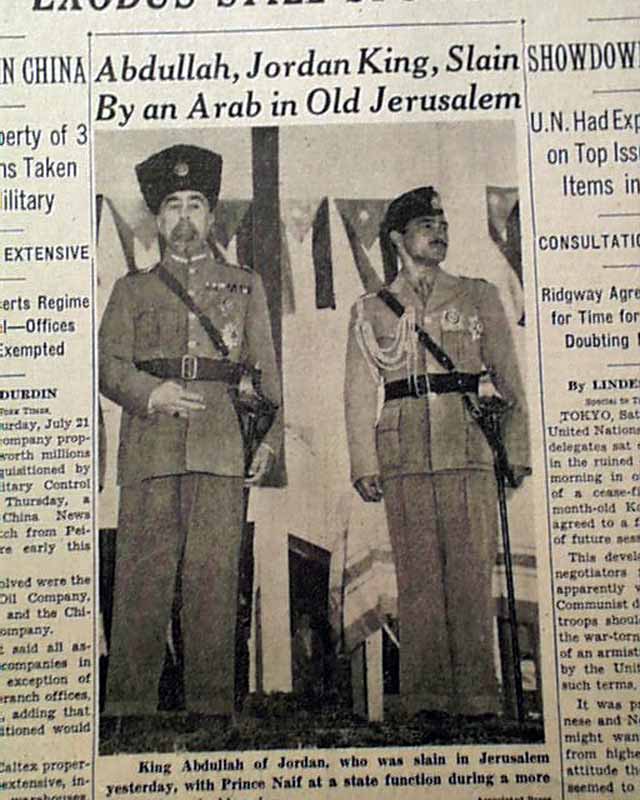
KING ABDULLAH’S LEGACY

By Jonathan Feldstein

On a clear day I can see from my Judean mountain balcony the skyline of Amman.  It’s the only place in the world from where one can see the capital of two countries: Jordan and Israel. I look across the border and am reminded that more than 3500 years ago, the Jewish people stood there waiting to cross into the Land, and two and a half tribes settled on the east bank of the Jordan River: Reuben and Gad, and half of the tribe of Manassah. I think about relations with our modern neighbors often.

King Abdullah I of Jordan

In July 1951, Jordan’s first king, Abdullah I, was assassinated while visiting the Al Aksa Mosque on the Temple Mount.  He was accompanied by his teenage grandson, Hussein, who would become King of Jordan about a year later, and reign until his death in 1999. Hussein is the father of the current King Abdullah II

King Abdullah Assassinated (1951)

I was speaking about Jordan and the Hashemite monarchy with a friend this week, saying that it’s in both Israel’s and Jordan’s interests to have close, peaceful relations, and that Israel should want to be supportive of the Hashemite monarchy which, more or less, has provided stability in the region. 

King Abdullah I was known for his efforts to reach some form of peace or coexistence with Israel, before Israel’s declaration of independence in 1948 and following, although he was assassinated four decades before the formal 1994 peace treaty was finally reached. Unfortunately, while there have been high points of relations between Israeli and Jordanian leaders, the idea of peace with Israel is still not popular on the Jordanian street. There’s often hostility, even among its elected leaders who often make antagonistic, threatening anti-Israel statements.

This is a mistake of the Jordanian (and before that, Egyptian) peace agreements, where there’s been no significant cultural shift or interaction between people. This could be due to lack of vision, or more likely as an outlet to provide a way for the people to vent, against Israel rather than the monarchy.  Consequently, despite the mutual interests to have peace, one rooted in the legacy of King Abdullah I, the relationship even between governments has often been tense, particularly in recent years. 

Abdullah was assassinated by Mustafa Shukri Ashshu, who was associated with the rabidly extremist and antisemitic former Mufti of Jerusalem, Haj Amin al-Husseini. Husseini was known for sparking riots against Jews in British controlled Mandatory Palestine, and was closely allied (and infamously photographed) with Adolf Hitler during World War II. Husseini inspired his followers to oppose the Hashemite kingdom in general, and King Abdullah in particular, largely because Husseini supported the creation of an independent Arab state, which Abdullah’s annexing and occupying the potential territory thereof (the West Bank, or Judea and Samaria) following the 1948-49 War of Independence would prevent.

17.11.1947- Golda Meir meets King Abdullah I of Jordan, in Jordan, a few months before the declaration of independence of the State of Israel

Both preceding and following the 1948 war, King Abdullah met with Reuven Shiloah, the first director of Israel’s Mossad, and Golda Meir (who would become Prime Minister). There are famous stories of Golda dressing in traditional Arab attire to travel to meet the King so as not to be recognized.

King Abdullah I of Jordan (left) with his younger son, Nayef.

It was reported after his death that Abdullah was scheduled to meet with Shiloah and diplomat Moshe Sasson in Jerusalem the day after he was assassinated.  Avi Shalim, an Israeli-British historian, wrote a biography of King Hussein in which he quoted King Abdullah as telling Sasson:

 “I want to make peace with Israel not because I have become a Zionist or care for Israel’s welfare but because it is in the interest of my people. I am convinced that if we do not make peace with you, there will be another war, and another war, and another war, and another war, and we shall lose all these wars. Hence it is the supreme interest of the Arab nation to make peace with you.”

According to Shalim’s biography, Elias Sasson, Moshe’s father, wrote shortly after Abdullah’s assassination:

King Abdullah was the only Arab statesman who showed an understanding for our national renewal, a sincere desire to come to a settlement with us, and a realistic attitude to most of our demands and arguments… We, as well as some of the Arabs and foreigners are going to feel for a long time to come his absence, and to regret more than a little his removal from our midst.”

The state of Arab Israel relations has changed radically since Abdullah’s assassination. Not only were Egypt and Jordan the first two Arab states to make peace with Israel, recognizing that it was in their interests to do so, but four more followed as part of the 2020 Abraham Accords. In three of them, it appears that some of the mistakes of the cold peace of the first two have not been repeated. There’s not just high-level government-to-government contact between Israel and the UAE, Bahrain, and Morocco, but there’s a unique level of interaction between people, and business ties that are all mutually beneficial.

King Abdullah I and his son crown prince Talal

It’s also noteworthy that references to Abdullah’s assassination have had a modern historical whitewash. Immediately following Abdullah’s death, a British publication reported:

The assassin is reported to have been identified as Mustafa Shukri Ashshu, a 21-year-old tailor in the Old City. During the Arab-Jewish war he was a member of the “dynamite squad” attached to the Arab irregular forces which were associated with the ex-Mufti of Jerusalem and became bitter enemies of Abdullah.” 

King Abdullah I of Jordan with Glubb Pasha, the day before he was assassinated by Mustafa Shukri Ashshu, a21-year-old tailor in the Old City. (Photo credit: GLUBB PASHA/WIKIMEDIA COMMONS)

Neither in this segment, nor the whole article, is there a reference to the assassin being a “Palestinian”. It was not a term used in 1951 to describe Arabs. Today however, historical revisionism retroactively brands Mustafa Shukri Ashshu as a “Palestinian”.

History Revealed or Revised? What is revealing about this contemporaneous newspaper report of the assassination of King Abdullahi was the identification of the assassin – as an “Arab” and not as a Palestinian as he is so described today.  

The same Arab/Islamic extremism that was preached by Haj Amin al-Husseini, and which “inspired” King Abdullah’s assassin, is a common enemy of and threat to Israel, Jordan, and the entire Arab Middle East, spilling over around the world. On this anniversary of the assassination of King Abdullah who might have made peace if he had lived, it’s important to revisit his words, that not only is peace important, but where we share common threats, so too it’s important that we unite against these.  

I pray that King Abdullah II will remember and take to heart these words and be guided by the wisdom of his great-grandfather for whom he is named.


The present king of Jordan, Abdullah II, named after his great-grandfather.


About the writer:

Jonathan Feldstein ­­­­- President of the US based non-profit Genesis123 Foundation whose mission is to build bridges between Jews and Christians – is a freelance writer whose articles appear in The Jerusalem Post, Times of Israel, Townhall, NorthJersey.com, Algemeiner Jornal, The Jewish Press, major Christian websites and more.


While the mission of Lay of the Land (LotL) is to provide a wide and diverse perspective of affairs in Israel, the Middle East and the Jewish world, the opinions, beliefs and viewpoints expressed by its various writers are not necessarily ones of the owners and management of LOTL but of the writers themselves.  LotL endeavours to the best of its ability to credit the use of all known photographs to the photographer and/or owner of such photographs (0&EO).