With Israel at war and rampant global antisemitism, what does the future hold with Trump returning as leader of the free world?
By David E. Kaplan
“Jan. 6 made me rule out Trump; Oct. 7 made me vote for him,” writes Ellen Just Braffman, a retired educator and grandmother of 12 who lives in Bala-Cynwyd, Pennsylvania, in the same area as my wife’s sisters and their families. What Braffman unveils throughout her article is the anguish between the two monumental dates – January 6, 2020 and October 7, 2023:
“When October 7th happened; the world changed. October 7th changed everything.”
I understand her cerebral journey perfectly. My wife’s nephew, a life-long Democratic living also in the leafy suburbs of Philadelphia not far from Braffman’s Bala-Cynwyd, emphatically expresses that until October 7 he was,“coasting along,” but now feels “like a born-again Jew.” Like for so many Jews today, October 7, shockingly “changed everything.”
Anger and Anguish. Where to vote was easy. Who to vote was for was less easy.
They were brutally reminded of their identity! More than that; they were reminded of their insecurity because of that identity.
For the equivocating US Jewish voter, it was a reminder that throughout history at moments of hope or choice – It is not so much a case of who will be good for the Jews but who will be less bad.
It was through this prism that anguished Jews viewed the 2024 US presidential election.
How many Jews in the US identified with Braffman when she writes that following January 6, 2021:
“…my anti-democracy, beginning of totalitarianism” radar began to send signals. The horrifying images of the US Capitol mitigating against a peaceful transfer of power horrified me …and Trump’s complicity in this shameful anti-democratic act was clear.”
Yet confounding this narrative were the facts – not words – that contributed to her perplexity that during Trump’s turbulent first term he initiated “the Abraham Accords, amputated Iran’s financial muscle, moved the US embassy to Jerusalem, recognized the strategically critical Golan Heights as part of Israel, and even cut aid to UNWRA, the profound significance of which was not yet widely understood.” Nevertheless, she writes, “Iwas done with President Trump,” who she “considered a highly flawed and dangerous individual.”
And then October 7th happened. “The world changed. October 7th changed everything.”
What also changed was who she was going to vote for!
Existential Concerns. In wake of Oct. 7, some US Jews in swing states rethink longtime support of Democrats seeing Israel’s survival in new light after Hamas attack and amid fears of rising antisemitism.
And you can understand why. What else had also “changed” was a fundamental shift in the Democratic Party that historically stood by Israel from the time of President Truman who despite internal opposition, ensured the US was the first country to recognise the new Jewish state in 1947 and then helped the young state’s development. Instead, in recent years, the Democratic Party welcomed as part of its ‘proud’ progressive shift, the so-called “Squad” with its Middle Eastern agenda undermining the US’s support for Israel at every opportunity. This Squad were at the forefront demanding cease-fires and the blocking of arms to Israel during a time of an existential war and banding slogans in sync with Israel’s worst enemies. They embrace a narrative that Israel was established as a “colonial outpost,” implying that Jews have no right to their own state in their ancestral land! Instead of jettisoning this toxic invasion into its ranks, Democrats were absorbing them and allowing it to reshape the party’s DNA.
House Democrats also undermined their support with Jews when they splintered over a bipartisan resolution condemning antisemitism on college campuses and calling for the presidents of Harvard and MIT to step down. The episode highlighted stark Democratic divisions that had been bubbling up to the surface. Although the resolution passed 303-126, only 84 Democrats voted in favor of it while a whopping 125 voting against it. All Republicans bar one, voted for it.
Where’s the Protection? Impacting an election was the fear of Jews exposing their identity amid rampant antisemitism on US college campuses. (Photo: Brian Snyder/Reuters)
The smell had become a stench and then for Philadelphian Ellan Braffman it became personal. While being “overwhelmed by the scope” of the October 7 massacre, then came “the green tents on College Green on the campus of U of Penn, my alma mater. Then there was the pro-Hamas march through Center City Philadelphia to Goldie’s restaurant, my favorite stop, their faces hidden by kaffiyehs, screaming “from the river to the sea.” My anti-totalitarian radar began sending me nonstop alerts and making clear the importance of a strong USA, a force for good in this world with a clear vision of good and evil.”
So, while challenged on route to the voting booth by the January 6th storming of the Capitol, many perturbed Democratic Jews were now guided by another date, October 7th. There were now two narratives; two diverse mindsets – a pre and a post October 7. The people who might naturally have voted for pre-October 7 suddenly would now vote for the opponent because the prime issue was no longer democracy, the economy, abortion, health care or the border but the future of Jews both in Israel and globally. This was brought home as I write post-US election and see the braking news of violent attacks against Jews two days before the anniversary of Kristallnacht in 1938, of Maccabi Tel Aviv fans in Amsterdam following the match against Ajax.
‘We were ambushed’: At least ten injured, three missing in Amsterdam pogrom” read The Jerusalem Post headline with Israel sending two emergency flights to evacuate Israelis from the city.
Targeting Jews. It was only a question of time that protesting like this pro-Palestinian mob demonstrating against Israel in Amsterdam in October 15, 2023 would morph into violence as what happened on November 7, 2024, when Jewish fans at the Maccabi Tel Aviv game against the Dutch side Ajax were set upon by a mob. (Photo: Reuters/ Piroschka Van de Wouw).
That in this day and age, Israel has to send emergency flights to a European capital because it is unable to protect its Jewish visitors? This comes only a few weeks after reports of Dutch police refusing to guard Jewish sites over “moral dilemmas”. As reported in the media, Marcel de Weerd and Michel Theeboom from the Jewish Police Network, reveal:
“There are colleagues who no longer want to protect Jewish targets or events”.
These same officers later spoke with De Telegraaf, where they said that some members of the police are refusing to be deployed at the Dutch National Holocaust Museum in Amsterdam nor to accept food and drinks from the venue.
In the wake of the antisemitic attacks at the Ajax-Maccabi Tel Aviv football match, the Dutch Organization for Central Jewish Consultation issued an urgent call for immediate, tough measures:
“The terrible scenes we witnessed last night show that there is no time to wait before taking tough measures.”
Menacing Mob. A vicious mob is seen here chasing Israeli soccer fans fleeing for their lives in Amsterdam following a match against Ajax Amsterdam. (Photo: Reuters).
In the Netherlands, much like the rest of the Diaspora, antisemitic incidents significantly increased after Hamas’s October 7 attacks – anincrease ofover 800%, according to the Center for Information and Documentation on Israel.
On October 7, Hamas pulled the trigger but the next day there was a global queue to join its firing squad.
It may seem crazy to some, but maybe we need a little crazy in the White House to face-off crazy in the world!
Israeli football fans attacked by pro-Palestine mob in Amsterdam
While the mission of Lay of the Land (LotL) is to provide a wide and diverse perspective of affairs in Israel, the Middle East and the Jewish world, the opinions, beliefs and viewpoints expressed by its various writers are not necessarily ones of the owners and management of LOTL but of the writers themselves. LotL endeavours to the best of its ability to credit the use of all known photographs to the photographer and/or owner of such photographs (0&EO).
Wherever the Islamic Republic of Iran’s influence extends, human rights diminish, freedom contracts, and women are forced into submission.
By Catherine Perez-Shakdam
The arrest of a female student in Tehran, who courageously stripped down to her underwear in protest against the Islamic Republic of Iran’s oppressive dress codes, is yet another grim illustration of the regime’s endless war against personal freedom. Amnesty International’s urgent call for her immediate release highlights the brutal lengths to which the authorities of the Islamic Republic will go to maintain control over their citizens, especially women. Yet this event is far from an isolated episode within Iran’s borders. The Islamic Republic’s repressive ideology has metastasized far beyond Tehran, extending its reach to every corner of the so-called Shia Crescent, leaving a trail of intimidation, violence, and oppression in its wake.
Iran Exposed. The young woman student stripped in protest after being assaulted for improperly wearing a hijab in violation of Tehran’s strict modesty laws.(Photo credit: SCREENSHOT/X/VIA)
The Islamic Republic’s abuse of its own population is no new phenomenon, and women, in particular, have been subjected to some of its worst excesses. This young student – harassed, humiliated, and assaulted by security forces for defying Iran’s enforced veiling laws – was simply the latest target of an autocratic theocracy that cannot tolerate even the faintest sign of individual autonomy. But to see this as merely a domestic issue is to underestimate both the ambitions and the reach of the Islamic Republic of Iran. This Islamic regime has turned repression into an exportable doctrine, refining it over decades and passing its brutal model on to allies and proxies across the Middle East.
Iranian student arrested after removing clothes at university
Consider Iraq, where militias aligned with the Islamic Republic of Iran terrorise activists, particularly women and minority groups, in a grotesque attempt to recreate the ideological stranglehold seen in Iran. Or Lebanon, where Hezbollah has systematically embedded the Islamic Republic’s worldview into Lebanese society, harnessing anti-Israel sentiment to deflect from the group’s own suffocating grip on the country. In Syria, Iran-backed forces have crushed any glimmer of democratic reform in favour of endless brutality and conformity to Tehran’s model. And in Yemen, the Houthis – armed and ideologically shaped by the Islamic Republic – have left ordinary Yemenis with little freedom and less hope, forcing the same script of obedience and control onto yet another suffering populace.
Women behind Bars. It was not too long ago that Iranian women were banned from entering stadiums as seen here as young girls watch a practice session of Iran’s national soccer team from behind the railings. (Photo: Morteza Nikoubazi/Reuters)
The disturbing consistency here is undeniable: wherever the Islamic Republic of Iran’s influence extends, human rights diminish, freedom contracts, and women, in particular, are forced into submission. But what’s particularly insidious is how the Islamic Republic cloaks this brutality. The regime has long relied on anti-Zionism as a powerful smokescreen, deflecting attention from its own abuses. By positioning itself as the “defender” of the Palestinian cause, the Islamic Republic has managed to rally international support and galvanise its base. Yet this posturing is a fraud. Anti-Zionism serves merely as a tool to distract from the regime’s very real war on freedom within its own borders and across the region.
Defiance. Says Masih Alinejad, an Iranian-American journalist, author, and women’s rights activist who the IRGC attempted to assassinate, commented on X: “In Iran, a student harassed by her university’s morality police over her ‘improper’ hijab didn’t back down. She turned her body into a protest, stripping to her underwear and marching through campus – defying a regime that constantly controls women’s bodies. Her act is a powerful reminder of Iranian women’s fight for freedom. Yes, we use our bodies like weapons to fight back a regime that kills women for showing their hair.”
The Islamic Republic’s calculated embrace of anti-Zionist rhetoric is not about solidarity; it’s about survival. For the regime, casting Israel as the enemy diverts attention from the crimes it commits daily against its own citizens. When people are focused on an external foe, they’re less likely to question the oppression and corruption of their own rulers. But the cost of this tactic is high, and it is borne by countless women, minorities, and dissenters across the Middle East who find themselves as pawns in the Islamic Republic’s grand narrative.
It’s time we look beyond the Islamic Republic of Iran’s self-styled image as a regional “resistance” force. The tragic case of this young student in Tehran, stripped of her dignity and denied her freedom for a simple act of protest, is a stark reminder of the true face of the regime. Her experience mirrors that of women and activists across the territories where the Islamic Republic’s proxies hold sway. This is not a war confined to Iran’s borders; it’s a transnational crusade against individual freedom and autonomy, exported through fear, repression, and force.
Targeting Women. Iranian teenager Nika Shakrami, killed after her arrest during protests in Iran, seen here on a cell phone, October 6, 2022. (Photo: AFP)
For too long, the West has failed to see through the Islamic Republic of Iran’s duplicity. Anti-Zionism may be a convenient political tool for Iran, but it is a mask for a regime that fears freedom, despises dissent, and punishes those who dare to defy it. If we are serious about supporting human rights and democracy, we must confront the Islamic Republic’s oppressive influence head-on, challenging both its domestic abuses and the exported doctrine that has left so many in fear and desperation.
Warpath against Women. Mahsa Amini, the 22-year-old Kurdish-Iranian woman who was arrested for allegedly violating Iran’s mandatory headscarf law died in police custody in 2022, sparked worldwide protests against the country’s conservative Islamic theocracy.
The international community owes it to this young woman – and to every individual in Iran and across the region who still dares to seek freedom – to see through the Islamic Republic’s narrative for what it is: a sham. The Islamic Republic of Iran’s ideological warfare against Israel has never been about justice; it has been a calculated device to sustain a regime that survives by denying others their rights. The Islamic Republic’s war on women, on minorities, and on basic freedoms is not just Iran’s problem. It is a cancer that has spread through its proxies and threatens all who stand for the right to be free.
The time for understanding the Islamic Republic of Iran’s duplicity is over; the time to expose it is now.
Video evidence shows multiple arrests after regime launched draconian campaign against women and girls
About the writer:
A co-founder and director of UK-based media and consultancy company ‘Forward Strategy’, Catherine Perez-Shakdam is a frequent contributor to i24NEWS, Al Jazeera, the BBC, The Jerusalem Post, Politico, the Daily Express, and the Daily Mail. In 2021, Chatherine gained international attention when news broke of her decade-long infiltration of the Iranian regime, during which she was able to gain access to the highest echelons of the regime’s inner circles. Despite the danger following being labeled an ‘enemy of the state’ by Iran, Catherine utilized her extensive knowledge and close-encounter insight to expose a system that had long operated under a shroud of secrecy. Her revelations have provided a unique perspective on Iran’s actions, challenging its narrative and exposing the true nature of its operations.
Feature picture: AI Generate image courtesy of Catherine Perez-Shakdam
While the mission of Lay of the Land (LotL) is to provide a wide and diverse perspective of affairs in Israel, the Middle East and the Jewish world, the opinions, beliefs and viewpoints expressed by its various writers are not necessarily ones of the owners and management of LOTL but of the writers themselves. LotL endeavours to the best of its ability to credit the use of all known photographs to the photographer and/or owner of such photographs (0&EO).
While Sudan slips towards a disaster of historic proportions there is minimal media coverage and global concern!
By Allan Wolman
First published in the Daily Friend, an online newspaper of South Africa’s Institute of Race Relations
The BBC recently featured on both their radio and TV platforms – “Sudan the Forgotten War” – highlighting a conflict that has been raging for over a year.
In April this year, Paris hosted the International Humanitarian Conference for Sudan and neighbouring countries, drawing attention to the ongoing crisis. The conflict in Sudan, rooted in tensions between Arab herders and non-Arab farmers over land, resources, and political power, has led to over 2 million refugees fleeing to neighbouring countries.
How Sudan has become the world’s ‘forgotten war’ | BBC News
The conference condemned the violence, including ethnic attacks, indiscriminate bombings, and gender-based violence, particularly against women and children, describing the situation as the worst child displacement crisis globally, highlighting that the war in Sudan has triggered the world’s most severe humanitarian crisis this year. The head of the United Nations High Commissioner for Refugees(UNHCR) for the region reported shocking accounts of widespread rape and sexual violence.
Competing with Gaza. Sir William Patey, former British Ambassador to Sudan told Sky News there appears to be no end in sight to the conflict. What’s more, he warned that efforts of coming to some kind of resolution with international partners are difficult as attention is focused on Ukraine and Gaza.
UN Women – charged with advocating for the rights of women and girls, and focusing on a number of issues, including violence against women and violence against LGBT people – responded to the Sudanese conflict in stark contrast to their silence on the gender-based and sexual violations faced by Israeli women victims on 7 October. The organisation issued a statement titled “A Year of Suffering for Sudanese Women and Girls,” calling on the international community to ensure that the conflict in Sudan does not become a neglected crisis.
Sudanese women and girls face heightened risks of gender-based violence, with widespread and increasing reports of sexual exploitation, abuse, and trafficking.
Again, UN Women “stands with the people of Sudan during this difficult time” yet remains mum on the plight of Israeli hostages, some of whom may be about to give birth after being raped and sexually assaulted almost nine months ago.
Millions in Sudan face disaster as the Rapid Support Forces (RSF), a paramilitary group that has been fighting the Sudanese Armed Forces (SAF), are accused of using food access as a weapon in the ongoing war. It’s worth noting that within days of accusing Israel of genocide in the International Court of Justice, President Ramaphosa proudly hosted the mass murderer, Mohamed Hamdan Dagalo (aka Hemedti leader of RSF), at his Pretoria residence.
Sudan: The ‘forgotten war’ where mediation efforts have failed’
FICKLE FAMINE FOCUS
Sudan is facing a potential famine worse than any the world witnessed in Ethiopia 40 years ago, according to the UN. Aid deliveries continue to be blocked by the warring armies, though arms supply to both sides flow in.
With much of the world’s attention focused on Gaza, Sudan, already the worst humanitarian crisis globally, is slipping towards a disaster of historic proportions, with minimal media coverage and global concern. A UN humanitarian appeal for the country has received only 16% of the funds it needs.
Save Sudan. Despite a UN humanitarian appeal for the country, it has received only 16% of the funds it needs.
The UNHCR, together with the Egyptian government, estimates that more than 500,000 people have fled from Sudan to Egypt since hostilities began, and are in need of international support.
In response, the UNHCR and other NGOs, in collaboration with the Egyptian government, are working to support those fleeing Sudan. The UNHCR is coordinating a response to address the needs of those crossing into Egypt. Egypt, being a signatory to International Refugee Conventions and Protocols, is fulfilling these obligations and providing life-saving assistance for those fleeing the war on its southern border, as it did by hosting its brother Arab refugees fleeing the carnage of the Syrian civil war.
Concern diverted elsewhere. “All the hallmarks of ethnic cleansing”, but too few care!
The question therefore must be asked why Egypt refuses to extend the same humanitarian relief to its north-eastern neighbours – the Gazans – who share a common language, religion, and culture.
Historically, this territory was part of a larger cultural and political entity under Egyptian influence, yet today, the border is strictly reinforced and sealed, preventing any refugees from crossing into Egypt. Again, this crisis is being ignored by the media.
Egypt’s decision to seal its border with Gaza is largely driven by concerns over Hamas’s strong ties with the Muslim Brotherhood. President Sisi and the military view the Muslim Brotherhood as an Islamist organization with a fundamentally different ideology from their secular nationalist stance.
Gazans Unwelcome. While Egypt welcomes those fleeing Sudan on its southern border, no such hospitality for Gazans on its north-western border and to ensure “no entry”, builds a new miles-wide buffer zone and border wall along its border with Gaza. (satellite image from Maxar Technologies)
They fear that the Brotherhood could gain power and potentially alter the secular nature of the Egyptian state. This fear has led to strict measures, including the closure of the Gaza border, to prevent any potential influence or power consolidation by the Brotherhood.
About the writer:
Allan Wolman in 1967 joined 1200 young South Africans to volunteer to work on agricultural settlements in Israel during the Six Day War. After spending a year in Israel, he returned to South Africa where he met and married Jocelyn Lipschitz and would run one of the oldest travel agencies in Johannesburg – Rosebank Travel. He would also literally ‘run’ three times in the “Comrades”, one of the most grueling marathons in the world as well as participate in the “Argus” (Cape Town’s famed international annual cycling race) an impressive eight times. Allan and Jocelyn immigrated to Israel in 2019.
While the mission of Lay of the Land (LotL) is to provide a wide and diverse perspective of affairs in Israel, the Middle East and the Jewish world, the opinions, beliefs and viewpoints expressed by its various writers are not necessarily ones of the owners and management of LOTL but of the writers themselves. LotL endeavours to the best of its ability to credit the use of all known photographs to the photographer and/or owner of such photographs (0&EO).
Voters are treated as powerless pawns to legitimize a terrorist regime.
By Marziyeh Amirizadeh
This week’s Iran’s presidential election is really a “selection”, controlled by its all-powerful Supreme Leader, Ayatollah Ali Khamenei. Only candidates who are approved, vetted, and qualified by the 12 member Guardian Council are eligible to participate in this three-ring circus. Six Guardian Council members are appointed directly by the Supreme Leader. The other six are selected by Khamenei’s hand-picked judiciary chief. The judiciary chief is appointed not because of his qualifications as a jurist, but because of his loyalty to the Supreme Leader. The Guardian Council members are the singularly most loyal soldiers and servants of the Supreme Leader. They are his clowns to run the country, jumping through hoops as the ringmaster Khamenei wishes.
Iran’s Supreme Puppeteer. Going through the visual pretense of an “election”, Iran’s supreme leader Ayatollah Ali Khamenei votes in Tehran, with the country going to the polls to elect a successor to the late president Ebrahim Raisi, who was killed in a helicopter crash. (Photo: AFP)
After the mysterious death of President Raisi in a helicopter crash last month, the Islamic regime launched its circus presidential “selection”. The Guardian Council (AKA the Supreme Leader) approved six candidates. Five hardliners, and one reformist, Masoud Pezeshkian.
What qualifies the candidates is not their education, political or diplomatic proficiency, or their experience running a country. Their qualification is based exclusively on their subservience to the Supreme Leader, blood on their hands from killing dissidents, and supporting, organizing, and exporting extremist Islamic ideology and terrorism abroad.
The candidates are indeed clowns, puppets of the Supreme Leader. Their resumes echo their servitude, having served as commanders of the IRGC, members of Basij (secret police), parliamentarians, or in different capacities under the Supreme Leader’s direct supervision. Each candidate excels at serving the Supreme Leader through suppression and killing of countless Iranian civilians, or expanding terrorism in the Middle East to organizations like Hamas, Hezbollah, and other proxies, killing Israelis and other innocents.
In the circus of Iranian elections, the Supreme Leader always selects one reformist candidate to deceive people to bring them to the ballot box, ostensibly to legitimize the show. As always, the reformist clown, this time Pezeshkian, plays the part of a candidate on the side of people, seeming to care about their issues.
Contrived Contest. The election is presented as a three-way contest between two hardline candidates, Saeed Jalili and Mohammad Baqer Qalibaf, and reformist candidate Masoud Pezeshkian, but the outcome is all decided before the first vote is cast. (Photo: Reuters)
One issue that reformists always play with is the suppression of women for not wearing a hijab. Publicly, Pezeshkian promises to address this issue and give women their freedom. His campaign motto is “For Iran”. “For” in Farsi is “baraye” which is the name of the song that became the anthem of the “Woman, Life, Freedom” movement after the brutal 2022 murder of Mahsa Amini, an Iranian Kurdish woman who was murdered by the regime for not wearing a hijab. By using this motto “For Iran”, Pezeshkian tries to deceive Iranians that he cares about Iranians and is going to work for them.
In fact, reformists and hardliners are opposite sides of the same coin. Together, they act as oxygen to the regime. In the presidential selection this week, Pezeshkian plays the sympathetic reformist clown of the Supreme Leader to deceive the world that Iranians support the Islamic regime through the electoral circus. Nevertheless, the majority of Iranians know that the president has already been selected, and the circus of an “election” is just a side show for the world to see, to legitimize a terrorist regime in power.
For years, Iranians were deceived by this tactic. In the 2009 presidential selection, millions of Iranians voted for a reformist candidate, but the Supreme Leader selected hardliner Ahmadinejad, teaching Iranians a lesson that in the Islamic regime dictatorship, Iranians have no voice, and their vote counts for nothing. It amplified that reformists only prop up the regime, and are worse than the hardliners.
After the brutal murder of Mahsa Amini, more than 80 million Iranians said “NO” to the Islamic regime. That is the true vote of Iranians that unfortunately the world’s leaders refuse to hear. Iranians chanted in the streets, “Hardliners, reformists, the game is over.”
Killed in Custody. For the writer, this is the true vote of the people of what that they think of their leadership. Iranian demonstrators take to the streets of the capital Tehran during a protest for Mahsa Amini, days after she died in police custody. Protests spread to 15 cities across Iran over her death following her arrest by the country’s morality police. (Photo: AFP via Getty Images)
However, in this presidential selection in order to deceive people to vote for him, Pezeshkian, is using another tactic of the former Foreign Minister Javad Zarif, the master of deceiving Iranians. Zarif, during one of his interviews outside Iran, said that despite all the regime’s suppression, Iranians always support their leaders. In addition to Pezeshkian as candidate, regime-exported reformist agents outside Iran work ceaselessly to extort legitimacy for the regime from western leaders. Zarif was one of the masterminds to plant reformists in key leadership roles outside Iran for this critical time.
While millions of Iranians boycott the presidential selection circus, the Islamic regime is working tirelessly to gather their followers to sham campaign rallies, deceiving people through bribery, and giving them false hope. They bus many of their followers, and Afghan migrants as additional clowns, to create a crowd for their presidential puppets. While Iranians are not familiar with iconic circus leader PT Barnum, the regime subscribes to his truism that there’s “a sucker born every minute.”
Shockingly, reformists outside Iran, with the help of the Biden administration, are also organizing more than 30 polling stations in different states for the regime’s agents who are enjoy freedoms in the United States, to be able to cast their votes for the killers at home. Through this, they use illusions through smoke and mirrors to pretend to Americans that Iran has any democracy.
Election Deception. The reformist candidate Masoud Pezeshkian, who the writer characterizes as little more than a “clown” playing the part of a candidate on the side of people, seeming to care about their issues.
While Iranians have no hope for the future of their country as long as this evil regime is in power, President Biden is giving hope to the ayatollahs to stay in power for his own interests, and in support of his presidential candidacy.
No matter how hard the Biden administration and some western politicians are working behind the scenes to keep the biggest state sponsor of terrorism in power, history has proven that dictators will collapse when 90% of people say enough is enough. The outcome of this week’s “selection” is pre-determined, but Iranians will eventually realize victory and take back their freedom despite all the betrayals.
Shame and treason will be the only legacy of those who stand on the wrongside of the history with the Supreme Leader and ayatollahs.
About the writer:
Marziyeh Amirizadeh is an Iranian American who immigrated to the US after being sentenced to death in Iran for the crime of converting to Christianity. She endured months of mental and physical hardships and intense interrogation. She is author of two books (the latest, ‘A Love Journey with God’), public speaker, and activist for religious freedom. She has shared her inspiring story throughout the United States and around the world, to bring awareness about the ongoing human rights violations and persecution of women and religious minorities in Iran.
While the mission of Lay of the Land (LotL) is to provide a wide and diverse perspective of affairs in Israel, the Middle East and the Jewish world, the opinions, beliefs and viewpoints expressed by its various writers are not necessarily ones of the owners and management of LOTL but of the writers themselves. LotL endeavours to the best of its ability to credit the use of all known photographs to the photographer and/or owner of such photographs (0&EO).
If Africa is inept at solving problems on its doorsteps, how does that make it adept at solving the problems of others a continent away? Go figure!
By Kenneth Mokgatlhe
It has become clearer to me over the years that governments from my African continent display little respect for the lives of their fellow black people. In many of these mismanaged failing states, vast populations across the African continent live in extreme poverty, remain unprotected from diseases, have little to no access to adequate health services as well as hygienic water sources and seem cursed in having uncaring leaderships as defenseless citizens are slaughtered like chickens.
While sickening, it has struck me as particularly strange how some of these incompetent governments would go and meddle in the Israel-Palestine conflict while neglecting the welfare of their own people.
South Africa, which dragged the State of Israel, into the UN’s International Court of Justice (ICJ) is the most unequal country in the world. Around 75 to 85 people are violently murdered daily and most victims are black. South Africa has the highest unemployment rate of 33% in the world, and most of those young people are black. According to the World Bank in 2020, 50.5% of the population lived in poverty while 25 percent (almost 14 million people) was experiencing food poverty.
South Africa has major domestic problems that pose internal national security threats. This is a ticking time-bomb that could explode at any moment. It should be a given that the newly elected incoming government should prioritise the plight of its destitute black people in South Africa before interfering in affairs a continent away that are of no strategic benefit to the larger population of the country.
A country’s foreign policy should be an assertion of its national self-interest to the benefit of its domestic situation. A sober person should ask how many millions the ICJ case cost the South African government, how it served the nation domestically, and what effect the exercise had on bringing an end to the war between Israel and Hamas.
State of Hunger in DCR. Democratic Republic of Congo (DRC) is Africa’s second largest country, with great mineral and natural resources, yet for decades, the country has suffered constant conflict, epidemics, undernutrition, and food insecurity. One in four people in DRC are experiencing a food crisis.
To make matters worse, we have a continental body, the African Union (AU), headquartered in Ethiopia, which has no regard for Africa and its people. We have a bloody war in the Democratic Republic of Congo (DRC), which according to the Council on Foreign Relations has claimed the lives of over six million black people since 1996. Daily, black people continue to kill each other in the eastern DRC, but the AU appears unwilling to make a clarion call to end the bloodshed.
No Peace, No Security.31 African heads of state attended the founding conference of the OAU in May 1963. Sixty years later, its successor organization, the African Union (AU), has repeatedly come under fire for failing to achieve that objective. (Photo: picture-alliance/dpa).
The 2020-2023 war between Eritrea and Ethiopia claimed more than 700,000 lives, and has resulted in continued war crimes in the North of Ethiopia. Here again, the AU (and the UN) has not taken action. Maybe this is because this war did not trend in the mainstream media. The AU should be the ‘voice of the powerless’ on the continent but has emerged as a ‘paper tiger’ and seek to speak on their behalf – however it is becoming irrelevant to many Africans because it does not advance their interests.
‘Famous’ for Failure. Human rights Mozambican activist and chairman of his country’s Center for Democracy and Development, Adriano Nuvunga, expresses his disappointed with the AU for failing to fulfill its chief objective of ensuring peace and security on the continent. (Photo: Sitói Lutxeque/DW)
In the words of Mozambican Human rights activist Adriano Nuvunga:
“Today, the African Union is an organization that primarily represents the interests of the powerful. It is toothless and ineffective, and it repeatedly proves itself incapable of ensuring prosperity, security, and peace for all Africans.”
I am dragging the toothless AU into this discussion because the Chairperson of the AU Commission, former Chad prime minister, Moussa Faki Mahamat, constantly uses all available platforms to condemn Israel.
My question:
When is he going to prioritise the welfare of black people on his own continent?
Mismanagement and Misdirection. Rather that seriously dealing with conflicts in Africa, AU prefers to focus on the conflict between Israel and Gaza following the massacre in Israel on October 7.
However, if he is so passionate about international human rights, why does Mahamat ignore what his horrifying playing out in Haiti where fellow black people (descendants of Africa sharing our heritage) are slaughtering each other? Why is he so obsessed about Israel when many black people are dying in their thousands in the Caribbean? What is extra special about Israel that diverts his attention from any concern to the lives of the descendants of Africa?
Mr. Moussa Faki Mahamat, are African lives so cheap to you?
According to media reports, about 15,000 Sudanese who are also African have been killed while more than 30,000 have been badly injured since the start of the civil war in 2023, but there is absolutely nothing that the AU has done to quell the volatile situation in Sudan. The World Food Programme (WFP) has recently alerted the world that Sudan is now facing unprecedented levels of starvation. We should be asking if “starvation has been used as a weapon of war?”
Struggling to Survive. Sadio Abdi Rahman Ahmed, 50, stands with three of her six children near their tent at a camp in Baidoa, Somalia. (Lynsey Addario/National Geographic)
Africa needs to defend and protect the lives of Africans in the continent. We have enough problems in the mother continent that should be preoccupying our minds rather than finding ourselves trapped in conflicts elsewhere in the world. African countries need to unite and cooperate in combating wars, violent murders, terrorism, poverty, inequalities, water insecurity, human and drug trafficking, and unemployment among the youth and women.
I am reminded of the spirit of awakening across Africa in the early 1960’s, captured in the words of Ghana’s first president, Kwame Nkrumah at the Organization of African Unity founding on May 25, 1963:
“We must now unite or perish”
There is little evidence by the policies presently pursued that we are adhering to that spirit.
About the writer:
Kenneth Mokgatlhe is pursuing a Master of Arts in African Studies, African Sustainable Communities program, at Ben Gurion University of the Negev. He is a political writer, analyst, and researcher.
While the mission of Lay of the Land (LotL) is to provide a wide and diverse perspective of affairs in Israel, the Middle East and the Jewish world, the opinions, beliefs and viewpoints expressed by its various writers are not necessarily ones of the owners and management of LOTL but of the writers themselves. LotL endeavours to the best of its ability to credit the use of all known photographs to the photographer and/or owner of such photographs (0&EO).
From a curse to a blessing – have Argentina and Israel turned a tide in diplomatic relations?
By Jonathan Feldstein
Jerusalem’s Kiryat Hayovel neighborhood has a distinct international flavor. Streets are named Bolivia, Brazil, Costa Rica, Guatemala, Uruguay and more, recognizing Latin American countries that voted to establish a Jewish state in the Land of Israel in 1947. Notably missing from the top of the list is Argentina which abstained during the 1947 UN vote.
A Street Named ‘Guatemala’. With a number of streets in Jerusalem named after South American countries, conspicuous by its absence is Argentina that did not join fellow Latin American states that voted at the UN in 1947 to support the establishment of a Jewish state.
Recently, Argentinian President Javier Milei arrived in Israel to show solidarity at this time of war, and to turn the tide between the stained past of his country’s relationship with Israel. Milei’s visit was significant and historic on many levels. He arrived shortly after being elected in November, signifying the significance he places on Israel and his country’s relationship with Israel, which was a foundation of his campaign. Indeed, it was Milei’s first state visit overseas. Milei’s arrival also made him the first head of state to visit Israel from South America since the inhuman Hamas attack on Israel and massacre, the beginning of a war that’s now well into its fourth month.
Big Move. Announcing plans to move the embassy to Jerusalem, Argentina’s President Javier Milei is seen here on 6 February 2024 praying and in tears at the Western Wall in Jerusalem’s Old City. (photo: Western Wall Heritage Foundation)
As many foreign dignitaries have done, Milei visited communities next to the Gaza border that were overrun by Hamas terrorists, among which some 1200 people were massacred by the terrorists, and from which hundreds were take hostage. Indeed, the significance of President Milei’s visit was amplified by him being accompanied to Israel’s Gaza border by Israel’s President Isaac Herzog.
Presidents Milei and Herzog were accompanied by former hostage Ofelia Roitman, a woman originally from Argentina, who moved to Israel in 1985. This was her first visit back to the farming community from which she was kidnapped.
Walk in the Shadow of Death. Exposed to the massacre that took place on October 7, President Isaac Herzog (left) and Argentinian President Javier Milei visit the destroyed homes on Kibbutz Nir Oz on February 8, 2024. (Maayan Toaf/GPO)
Milei gave unconditional backing to Israel, calling Hamas, the Palestinian Arab Islamists, a “terrorist group” who had committed “a crime against humanity.”Mieli noted:
“The free world can’t remain indifferent in this case, as we see clear examples of terrorism and anti-Semitism and what I would describe as 21st century Nazism. When we hear about the methods that were used this time, it reminds us of the atrocities of the Holocaust.”
Hearing the Horror. During the visit to devastated kibbutz Nir Oz, Argentinian President Javier Milei (left) was joined by former Argentinian, Ofelia Roitman (right) who had been taken hostage and released from Gaza, and was returning to her home for the first time since the massacre. Israeli President Issac Herzog (right) look on.
Milei’s visit was also noteworthy in that he prayed at the Western Wall, danced with Israeli worshippers, and affirmed his intention to move Argentina’s embassy to Jerusalem.
During his visit, some of my Argentinian friends went out of their way to express their pride and joy in seeing their president turning the tide on relations with Israel that have been marred by a history that’s less than positive, and previous leaders whose positions who have been decidedly hostile to Israel, or ambivalent at best. Following the Holocaust, Argentina welcomed and gave refuge to Nazi leaders and war criminals. Then in the 1990s, two massive Islamist terrorist attacks took place in Buenos Aries, targeting in 1992 the Israeli embassy, followed by the Jewish Community Center in1994. Investigations into these and the culpability of its leaders at the time also lead to the mysterious death of a Jewish prosecutor, Alberto Nisman, on the eve of a trial that would have made much of this public.
President Milei’s visit made me think of my friend Diego Freytes and his profound and personal essay in “Israel the Miracle,” published by the Genesis 123 Foundation, featuring 75 essays by Christian leaders from around the world about why Israel is significant to them. Diego not only refers to Argentina’s bitter past in blocking Jewish immigration in the 1930s, harboring Nazi war criminals and terrorists, and covering up its compliance as a base for Iranian terror. He does a deep dive into the meaning of the promise God made to Abraham in verse Genesis 12:3:
“I will bless those who bless you, And I. will curse him who curses you; And in you, all the families of the earth shall be blessed.”
Israel the Miracle. Diego and Carolina Freytes.
More than just a cursory repetition of the Biblical verse, he looks at the root of the Hebrew words and what they mean, noting not just that its an imperative to bless Israel. Diego writes that the root of the word “to bless” is the same as the root of the word “knee”. He explained that it’s not just a concept, but an active duty, as in to bend a knee. Literally, to stand in solidarity. President Milei’s visit clearly did that.
The corollary to actively blessing Israel is cursing Israel. Despising Israel. A simple English or Spanish translation does not reveal the depth of the verse in the original Hebrew. The consequence for cursing, or “looking down on someone” is not simply a non-descript curse. Diego notes the Hebrew for the second part come from the word that means “to destroy completely.”
Reflecting on Argentina’s past, Diego notes the consequence of its actions that have been a curse to Israel, and how that has been a scar on Argentina for decades, leading to multiple examples of a country that once had a glorious past, spiraling downward to near utter destruction in the 80 years since it began cursing Israel. He writes before Milei’s election, as a reflection and seeking forgiveness for Argentina’s past, and as a prayer for its future. “What happened to my nation? Argentina is in a deep economic, political, and social crisis that has lasted more than 80 years. Inflation grows at over 100 percent per year. There is only a memory of that dazzling nation.”
This week, Diego Freyets’ words and President Milei’s visit came together as the beginning of a hint of turning the tide. In the early hours of February 12, the IDF conducted a seamless and bold military operation in the southern Gaza city, Rafah, rescuing two hostages. Rafah remains the last stronghold of Hamas to where its terrorist leaders have fled, and where they have brought the remaining hostages held since October 7.
Of 136 hostages held, it could have been any hostages found and brought home. However, the two rescued were born in Argentina. When President Milei visited the Gaza border area, he knew these Argentines were still in captivity just miles away. Is this a coincidence, or a divine wink that the tide is turning in the right direction, that the blessing is beginning? Only God knows. May He continue to work through President Milei to heal the decades long rift, and may all the remaining hostages be rescued and come home soon.
About the writer:
Jonathan Feldstein - President of the US based non-profit Genesis123 Foundation whose mission is to build bridges between Jews and Christians – is a freelance writer whose articles appear in The Jerusalem Post, Times of Israel, Townhall, NorthJersey.com, Algemeiner Jornal, The Jewish Press, major Christian websites and more.
While the mission of Lay of the Land (LotL) is to provide a wide and diverse perspective of affairs in Israel, the Middle East and the Jewish world, the opinions, beliefs and viewpoints expressed by its various writers are not necessarily ones of the owners and management of LOTL but of the writers themselves. LotL endeavours to the best of its ability to credit the use of all known photographs to the photographer and/or owner of such photographs (0&EO).
By Raymond Wacks Emeritus Professor of Law and Legal Theory
I am driving along a well-remembered highway in Randburg. It is 2005 – the last time I visited South Africa (where I was born and, as they say, bred). Randburg is an anonymous conurbation on the outskirts of Johannesburg. As a student, I had a holiday job here as a cashier in a supermarket.
But is this really Randburg? Formerly a whites-only area, I see only black faces. My supermarket has disappeared. The shopping mall is unrecognisable. I must have taken a wrong turn. Peering at the road sign, I am reassured. This is indeed Hendrik Verwoerd Drive.
Former Prime Minister Hendrik Verwoerd? In post-apartheid South Africa? Surely this architect of evil cannot still be celebrated 15 years after the demise of what he called ‘separate development’? While many towns and public places have been accorded new (or pre-existing) African names, several roads have been reborn to conform to the new ideology. Nelson Mandela features prominently, of course, but there are also streets dedicated to the memory of Che Guevara, Joe Slovo, and other revolutionary heroes.
Perhaps, I thought, policy had simply failed to catch up with principle. Nevertheless, it struck me as astonishing that Verwoerd should continue to be venerated. It was he who famously declared that his government’s role was ‘the preservation of the white man and his state’. Under his premiership, from 1958 until his assassination in 1966, apartheid was not only consolidated, but clothed in philosophical, cultural, and theological validation that drew on the seductive power of Afrikaner nationalism. He had, in fact, presided over the country’s break with Britain and the establishment of a republic. And, under his steely, cerebral leadership, the African National Congress was banned, and Nelson Mandela was sentenced to life imprisonment.
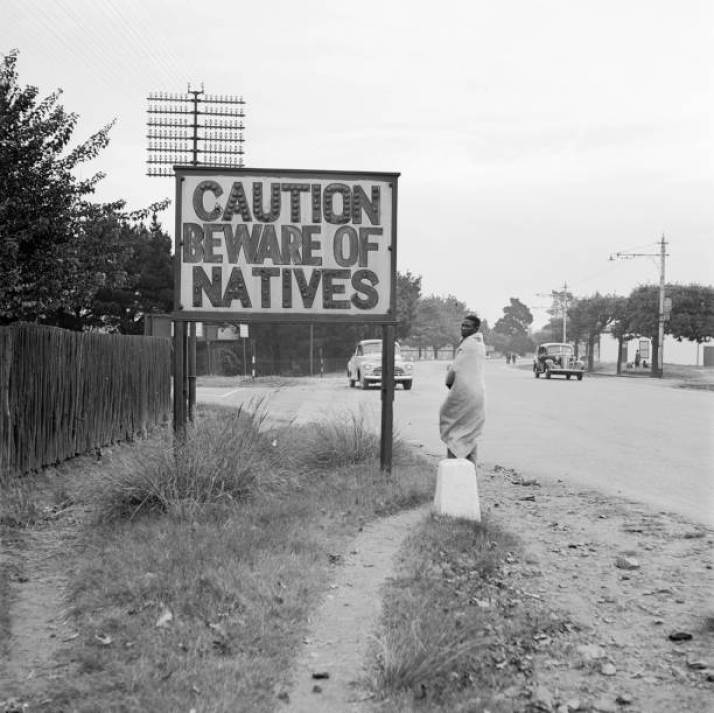
South Africa Out of Step. Under apartheid, blacks were separated by law from whites – including separate stairways.
WHAT IS ‘APARTHEID’?
Apartheid, it is frequently forgotten – or conveniently overlooked – was not merely racial segregation. It was an elaborate, intricate project, sustained by a doctrinaire philosophy applied by an authoritarian regime buttressed by draconian legislation. It relied on an unaccountable security force with sweeping powers, a largely enthusiastic legislature and a mostly pliant judiciary. The legal system was the creation of a white minority; the political system disenfranchised every ‘non-white’ person, and the law discriminated against them in almost every facet of social and economic life: employment, land, housing, education, sex and freedom of movement.
Deaths in detention and torture were systemic. ‘He slipped in the shower’ or ‘he jumped from the interrogation room window’ were the stock explanations offered by the security branch. Surveillance, intimidation, and police brutality were routine. Apartheid South Africa was the archetypal modern police state. The Broederbond, a secret, Calvinist, all-male society fostered Afrikaner interests. Jan Smuts described it as a ‘dangerous, cunning, political fascist organisation’.
The neo-Nazi nature of this totalitarian order was one of its fundamental components. I remember the day that Verwoerd’s successor, John Vorster, was elected. We university students greeted each other with mock Nazi salutes. He was detained in 1942 as a result of his membership of the pro-Nazi Ossewabrandwag, which supported Germany during the Second World War.
RESISTING INJUSTICE
There was, of course, a small minority of whites, including Afrikaners, who opposed the injustice of apartheid. A conspicuous example was the lawyer, Bram Fischer. Despite his impeccable Afrikaner antecedents (his father was judge president of the Orange Free State; his grandfather, a member of the cabinet) he championed the rights of the oppressed, defending Mandela in the notorious Rivonia trial of 1963-4. Enduring considerable personal suffering and sacrifice, he went underground to wage war against the iniquity of apartheid.
In 1966, he was convicted of furthering the aims of communism – a catch-all charge, since communism was defined to include ‘bringing about any political, industrial, social, or economic change… by the promotion of disturbance or disorder’ or ‘encouraging feelings of hostility between the European and the non-European races… the consequences of which are calculated to further… disorder’. The statute empowered the minister of justice to brand as a communist any person he decided fitted the description.
The writer (left) seen here with Nelson Mandela in 1991.
Fischer was sentenced to life imprisonment, during which he developed cancer. As a result of a fall, he fractured his neck and femur. He was partially paralysed and lost the ability to talk. Three months elapsed before the authorities permitted his transfer to hospital. He died soon thereafter. Ruthless inhumanity and petty vindictiveness were among the hallmarks of apartheid.
Nelson Mandela described Fischer as ‘one of the bravest and staunchest friends of the freedom struggle that I have ever known … displaying a level of courage and sacrifice that was in a class by itself’.
Issue was black and white. This area of the sea and beach was strictly reserved for South Africa’s white population.
KILLING OPPONENTS
The generosity of definition of the Suppression of Communism Act of 1950 was equalled by the Terrorism Act of 1967 which defined ‘terrorism’ as including anything that might ‘endanger the maintenance of law and order’. Life sentences in South Africa were exactly that. And the gallows were kept busy: between 1910 and 1989 more than 4,200 executions were carried out. About half of those met their end between 1978 and 1989 when the struggle against apartheid was at its peak.
The overwhelming majority of those put to death were black; many were political prisoners. At the end of July 1989, for example, a total of 283 prisoners were being held on death row at Pretoria Central Prison. Of these, 272 were black; 11 were white. In March 1988, 53 individuals were hanged for politically related crimes.
Sign of the Times. ‘Swart gevaar’ (Afrikaans for “black danger”) was an apartheid term skillfully used to sensitize the whites to fear the majority black African population as a dangerous threat.
APARTHEID STANDS ALONE
It hardly requires stating that injustice in our world is ubiquitous. But the abomination of apartheid was unique. The United Nations sought in 1973 to crystallise its essence by establishing it as a crime. According to the Apartheid Convention, the offence consists of inhuman acts committed for the purpose of maintaining domination by one racial group over any other, and systematically oppressing them.
The authors of the Convention, in pursuit of greater precision, provided a catalogue of the acts embraced by the crime, including murder, torture, inhuman treatment and arbitrary arrest of members of a racial group, legislation that discriminates in the political, social, economic and cultural fields, separate residential areas for racial groups, the prohibition of interracial marriages, and the persecution of opponents of apartheid.
The text captures the quintessential elements of apartheid as applied in South Africa – even though it drains it of much of the system’s malevolence and authoritarianism touched on above. And, despite the demise of apartheid in 1994, the offence lives on. Thus, in 1998, the Rome Statute of the International Criminal Court included apartheid, along with a catalogue of other wrongs such as murder, extermination, enslavement, and torture, as a crime against humanity.
Lawyers – and other pedants – may therefore claim that, notwithstanding the terms of the Apartheid Convention, and its explicit description of the South African situation, apartheid may exist anywhere. This folly has, of course, given rise to the preposterous contention that Israel is an ‘apartheid state’. The Jewish state is far from a paragon of virtue, but stigmatising it in this cavalier manner is itself a grotesque injustice – and an affront to those who endured the long years of torment and persecution in South Africa.
The subjectivity of suffering renders any attempt to calibrate injustice, difficult. It is specious and misconceived, however, to describe Israel as implementing apartheid – even by the standards of international law.
Where are the ‘inhumane acts… of an institutionalised regime of systematic oppression and domination’ by one race over another, as specified in the Rome Statute? Unlike blacks under apartheid, Israeli Arabs may vote, stand for election to parliament, be appointed to the judiciary. They have the freedom to attend any hospital, school, or university. They are not denied access to beaches, cinemas, theatres, libraries, sporting facilities. They may choose who to love. And it is reportedly easier for an Arab citizen of Israel to buy an apartment in Tel Aviv or Jerusalem than in Beirut, Bahrain, Kuwait, or Doha.
Signposted Society. Separate areas allocated for the different races. In this natural setting, Malays left and Europeans, meaning whites, to the right.
FINDING APARTHEID
Even Richard Goldstone, the former South African judge who headed the censorious inquiry into Israel’s ‘Cast Lead’ operation in Gaza, conceded that in Israel, ‘there is no apartheid. Nothing there comes close to the definition of apartheid under the 1998 Rome Statute…’ In an article in the New York Times in October 2011, he declared:
‘I know all too well the cruelty of South Africa’s abhorrent apartheid system, under which human beings characterised as black had no rights to vote, hold political office, use “white” toilets or beaches, marry whites, live in whites-only areas or even be there without a “pass.” Blacks critically injured in car accidents were left to bleed to death if there was no “black” ambulance to rush them to a “black” hospital. “White” hospitals were prohibited from saving their lives.’
Truth be Told. Richard Goldstone, the former South African judge who headed the censorious inquiry into Israel’s ‘Cast Lead’ operation in Gaza, conceded that in Israel, ‘there is no apartheid. Nothing there comes close to the definition of apartheid under the 1998 Rome Statute…’
The plight of those who live in Gaza and the West Bank is plainly different. Combating terrorism and maintaining security inevitably exact a high price. It cannot be denied that many Palestinians encounter hardship, privation, and indignity. But one might ask: Where is the sympathy and compassion for those who live in squalid camps in various Arab countries?
In Lebanon, for example, up to 400,000 Palestinian refugees live in dreadful social and economic conditions, many in overcrowded camps without essential utilities. They are effectively stateless. In 2001, the Lebanese parliament enacted legislation prohibiting Palestinians from owning property. The law also restricts their ability to work in several areas. While a ban on Palestinians holding most clerical and technical positions was terminated – provided they obtained temporary work permits – more than 20 high-level professions are denied to Palestinians. Moreover, Palestinians are not eligible for social security benefits. They are subject also to discrimination in respect of housing, property ownership, inheritance rights, and freedom of movement and residence.
SELECTIVE OUTRAGE
Where is the expression of outrage at these measures? Is Lebanon not an ‘apartheid state’? What about Syrian discrimination against Sunnis and Christians? Or its gulag of extermination camps in which thousands of political opponents are executed and tortured? Why is Israel singled out for censure and boycotts? Even in the case of Gaza and the West Bank it is mendacious and mischievous to describe Israeli policy as apartheid. Is the Israeli government really an ‘institutionalised regime of systematic oppression and domination by one racial group?’
Despite the political challenges, Palestinian West Bankers are carving out a future characterized by enterprise and ingenuity embodied in such projects as Rawabi (Arabic روابي meaning “The Hills”). The first planned city built by Palestinians in the West Bank, Rawabi is hailed as a “Flagship Palestinian enterprise”.
Whatever traction its advocates seek to gain from the South African archetype, the argument actually undermines the Palestinian cause. If there is injustice, let us call it by its name. Simplistic sloganeering is unhelpful. It is no less so than in the increasingly fashionable designation of ‘Holocaust’ to instances of barbarity that, while plainly heinous, fall far short of the depravity of the Third Reich. There are, of course, all too many examples of egregious attempts at genocide around the world but they are usually confined to a single nation and spring from internecine tribal or religious divisions. The ‘final solution’ – the wholesale extermination of the Jews (not merely in one country, but across all of Europe) – stands alone as a paradigm of inhumanity and iniquity. Let it be.
It is no answer to assert that these usages are merely metaphorical. Metaphor often enriches language. But it may also debase. The capricious abuse of ‘apartheid’, along with ‘massacre’, ‘genocide’, and ‘occupation’, has lamentably become commonplace.
Factual and linguistic precision is more likely to generate solutions to intractable political problems. Reckless rhetoric may appeal to the demagogue; it has no place in the quest for peace and justice.
I have just discovered – thanks to Google maps – that Hendrik Verwoerd Drive has been renamed. It is now Bram Fischer Drive.
About the writer:
Raymond Wacks, Emeritus Professor of Law and Legal Theory, graduated from Wits law school in 1969 having served on the Executive of the SRC and as President of the Law Students’ Council. He left South Africa in 1970 to pursue research at Oxford where he spent the next decade. In 1982 he returned to SA to take up the chair in public law at the University of Natal, Durban. Wacks is the author of fifteen books, several of which have been translated into more than a dozen languages on legal philosophy, privacy, and justice. He is also the co-author of five books, and editor of ten. His monograph, The Rule of Law Under Firewas published by Hart in 2021. Oxford University Press published the sixth edition of his Understanding Jurisprudence: An Introduction to Legal Theory in 2021, as well as the third edition of Law: A Very Short Introduction which appeared earlier this year.
While the mission of Lay of the Land (LotL) is to provide a wide and diverse perspective of affairs in Israel, the Middle East and the Jewish world, the opinions, beliefs and viewpoints expressed by its various writers are not necessarily ones of the owners and management of LOTL but of the writers themselves. LotL endeavours to the best of its ability to credit the use of all known photographs to the photographer and/or owner of such photographs (0&EO).
Israelis respond to mobs burning Christian churches and homes in Pakistan after blasphemy allegations
By Jonathan Feldstein
Perhaps you have heard the news. Fires torching hundreds of properties. Entire households burned to the ground. Every personal belonging lost. Thousands of lives destroyed. The devastation has been unprecedented, and it will take years to rebuild that which can be rebuilt. But the personal tragedies and lives lost may never heal.
If you’re in the West, you may have heard about the tremendous loss in Maui, Hawaii. Wildfires have left a trail of death and destruction. As horrible as that is, it is not what I am writing about today.
Christians look at burnt furniture and other things outside their homes vandalized by an angry Muslim mob in Jaranwala in the Faisalabad district, Pakistan, Thursday, Aug. 17, 2023. (AP Photo/K.M. Chaudary)
While Maui was burning in what was an act of God, Christian communities in Pakistan have been burning, torched to the ground, not as an act of God but as an act of evil. Trumped up charges of “blasphemy” by Moslems in Pakistan against two Christian men was the spark that set off a widespread rampage of attacks by Moslems against their Christian neighbors that have lasted nearly a week as of this writing.
In Pakistan, charges of blasphemy can carry a death penalty. Blasphemy can be as simple as “embarrassing” Islam. Sometimes, mobs of people take this Pakistani Islamic justice into their own hands. So much for the religion of peace.
For days, an out-of-control pogrom has been carried out against Christians, with law enforcement turning a blind eye as if there’s any legitimate excuse for that. Dozens of churches have been ransacked, looted, and burned to the ground. Hundreds of Christian homes were also attacked, looted, and burned. Personal belongings that were too big to loot were simply dragged to the street and burned. Countless bibles have been burnt, desecrated, destroyed.
A boy comforts a woman weeping after her home was vandalised by a Muslim mob. (KM Chaudary/AP Photo)
All this, displaced thousands of lives, entire extended families forced to flee their homes, their communities, seeking shelter anywhere they could, even makeshift tents in open areas. Not that this would make them safer from the attacks of their Moslem neighbors. It just made them more vulnerable, marked, open to assault. Just less to burn. They fled with the clothes on their backs, and now have nothing left, and no homes to return to.
Pakistan Muslim Mob Attacks Christian Churches, Property Over Blasphemy Charges
Even if they could return, how will they ever move back, even if their homes are rebuilt? How will they ever feel safe among the Moslem neighbors whose hate was ignited against them and their faith? But they are stuck in Pakistan, with nowhere to go, as second-class citizens, tolerated but not really accepted. The targets of evil hatred whenever there’s an excuse. There’s no recourse.
A few years ago, I posted a video on YouTube of a Christian man in Pakistan being lynched and burned to death. Apparently that – the posting not the lynching and burning – violated their “community standards” against violence. Earlier this year, because of that, YouTube blocked me. When I “appealed”, I got an immediate automated response that my appeal was rejected. I laughed at first, realizing that YouTube houses no shortage of gratuitous violence, but when it comes to posting real crimes to highlight the evil amid which Christians have to exist there, that’s too much for their sensitive community standards. I hesitate to post videos I have seen of the most recent violence, but they are real and horrific.
Unlike Maui, Pakistani Christians have no insurance. No state of federal money to rebuild. Police are not comforting, much less protecting the victims in Pakistan. Pakistani Christians exist in the crosshairs of a society that’s simply unsafe. They are tolerated, sometimes, but not protected. Second class? How about seventh class.
A Christian man emerges from a vandalised home in Jaranwala. (KM Chaudary/AP Photo)
In the past week, many of my Pakistani Christian friends have turned to me, in Israel, for prayers and support. They are heartbroken, devastated, and scared. Yet as much as they fear for themselves and their families, they are trying to help those most in need, as good Christians should for one another. However, for them, simply reaching out to me, an Orthodox Jew in Israel, could trigger more violence, even lynching. As much as they may be “tolerated” in Pakistan, Israel and the Jews are the enemy.
They also know I’ll help, because I care, and because I did a year ago when they were struck by floods of Biblical proportions and Christians suffered because of their status far more than average Moslem Pakistanis. Seventh class.
Christians remove burned furniture and other items from their vandalised homes. [KM Chaudary/AP Photo]
I undertook this effort then on behalf of the Genesis 123 Foundation which exists to build bridges between Jews and Christians and Christians with Israel in ways that are new, unique, and meaningful. This includes looking out for persecuted Christians, specifically in the Middle East. A year ago, after unprecedented flooding across Pakistan, we stepped up to raise funds to support our Pakistani Christian friends who suffered even more of the devastation than the Moslem population. Unprecedented. An organization of Jews and Christians, run by an Orthodox Israeli Jew, reaching out to protect Christians in Pakistan. It was a blessing to do so, and it was our responsibility, to be a blessing to the families of the world.
Church on the outskirts of Faisalabad was burned. [Ghazanfar Majid/AFP]
As entire families in Pakistan have been devastated, we launched a campaign again, urgently, to provide any funding, as generously as possible, so we can help with the rebuilding. Our partners and friends are reliable and have the highest integrity. One is asking for a meagre $20,000. The truth is even $120,000 is not enough. But that’s our goal. We want the impact to be felt as widely as possible because there are and will be needs far beyond the physical and tangible losses.
I pray that Jews and Christians, and anyone of good conscience, will step up and join the efforts. Maui is horrible. My heart is pained for all the loss. But as much as that’s true, there’s no aid for Pakistani Christians. Not until now.
About the writer:
Jonathan Feldstein - President of the US based non-profit Genesis123 Foundation whose mission is to build bridges between Jews and Christians – is a freelance writer whose articles appear in The Jerusalem Post, Times of Israel, Townhall, NorthJersey.com, Algemeiner Jornal, The Jewish Press, major Christian websites and more.
While the mission of Lay of the Land (LotL) is to provide a wide and diverse perspective of affairs in Israel, the Middle East and the Jewish world, the opinions, beliefs and viewpoints expressed by its various writers are not necessarily ones of the owners and management of LOTL but of the writers themselves. LotL endeavours to the best of its ability to credit the use of all known photographs to the photographer and/or owner of such photographs (0&EO).
Niger’s military coup, coupled with the new regime’s call for Wagner assistance and apparent negotiations with the Iranian regime, is the beginning of a dangerous realignment in the Sahel region.
If left unaddressed by democratic states, this will see a new stronghold of terror networks on Europe’s borders. Russian and Iranian moves to secure the favor of Niger’s coup leaders show the unity of both in their bid to redress historic balances of power, plunging the country and the region into further turmoil by making democracy and economic development for the region unattainable.
In a historic emergency meeting in Abuja earlier this month, Nigeria and the Economic Community of West African States (ECOWAS) called for the immediate release and reinstatement of Niger’s elected president, Mohamed Bazoum, held by the military since 19 July.
President Ousted. Mohamed Bazoum, Niger’s democratically elected president, was ousted by members of his presidential guard on July 26 and has since been under house arrest with his wife and son in the presidential compound in the capital, Niamey. Facing prosecution for “high treason”, if found guilty, Bazoum could face the death penalty, according to Niger’s penal code. (AP Photo/Michel Euler, File)
ECOWAS issued a stern ultimatum to Niger’s military, giving them one week to comply with their demands or face the consequences, including the potential use of force to restore the nation’s rightful leader. The bloc’s unwavering stance sends a clear message that the international community will not tolerate the disruption of democracy in the Sahel region.
Niger’s coup, orchestrated by General Abdourahamane Tchiani, has further exposed deep-rooted issues within the country. The rise in insecurity and stagnant economic prospects have contributed to the nation’s fragility, leading to disillusionment among the populace – a theme that unfortunately runs throughout much of the region, reminding many that Niger could be only the beginning of a much broader realignment, with efforts by Russia and the Islamic Republic of Iran to exploit chaos to advance their respective agendas.
Taking Charge. Coup leader, General Abdourahmane Tchiani , who was declared as the new head of state of Niger by leaders of a coup, arrives to meet with ministers in Niamey, Niger July 28, 2023. (REUTERS/Balima Boureima)
Niger’s new leadership is on shaky grounds, coming in at a time when violence and turbulence were decreasing in the country. Coupled with wider criticism of the presidential guard’s move to detain president Bazoum, the new leadership has no choice but to seek external support from those willing to prey on instability for their personal benefit.
So it comes as no surprise that Evgeniy Prigozhin, head of the infamous Wagner Group, was quick to praise the coup and offer support for the new regime. More worrying is the news that Niger has already asked for assistance from the Russian mercenary group in a visit by the coup’s leader, General Salifou Mody, to Mali – a well-known Wagner outpost.
Offering Order to sow Disorder. Wagner mercenary boss Yevgeny Prigozhin, who remains active despite leading a failed mutiny against the Russian army’s top brass, has hailed Niger’s military coup as good news and offered his fighters’ services to bring order.
While Russia’s mercenary presence in Africa is well documented, if still largely out of the public eye in the west, a tell-tale sign of the region’s importance to Russia’s future plans in its standoff with the West is Iran’s efforts to assist the coup leaders.
The Sahel has grappled for years with Islamic radicalism, with terrorist groups such as Al Qaeda, ISIS, and Boko Haram vying for control, and the risk that Africa could soon lose territory to the Caliphate 2.0 are too real to be discounted.
Taking into account the recent visit to Niger of Esmail Qaani, the infamous Commander of the Quds Forces – a division primarily responsible for extraterritorial military and clandestine operations – the future of Niger could be grim.
Appointed by Ayatollah Khamenei following the death of General Qassem Soleimani in 2020, Qaani is one of the regime’s most loyal and trusted military operatives and his presence generally signals a desire from Tehran to establish or curate influence.
Niger’s new leadership already announced it is cutting bilateral military ties with France and called back its ambassadors from France, the US, Nigeria, and Togo.
But how did we get here, and more importantly, what does it mean for Western interests and the prospects of peace for the people of Niger and the Sahel?
General Abdourahamane Tchiani’s discontent stems, at least in part, from the presence of foreign forces in Niger. The perception that these forces undermine the military’s authority has fueled dissent and complicated efforts by the United States and France to combat insurgent attacks by Islamic radical groups.
In turn, the coup’s leader’s move to welcome Russia’s assistance clearly indicates that foreign presence is only a pretense.
Flames over Niamey. The headquarters of Niger’s ruling party burns in the background as supporters of the mutinous soldiers demonstrate in Niamey, Niger.
Likewise, in a show of hypocrisy, Mali’s Assimi Goïta, who has made Russia his protector and guarantor, has called for an end to colonialism and the influence of the West on the region, echoing the same lines voiced by Russian diplomats and outlets such as Media Afrique TV, closely linked to Prigozhin’s Association for Free Research and International Cooperation (AFRIC).
The ethnicity and the legitimacy of President Bazoum have also been problematic, fanning old upsets. The predominantly ethnic Arab military have challenged Bazoum’s leadership, despite his majority win in the elections, highlighting the fragility of Niger’s democratic institutions and the difficulties in preserving their integrity.
Niger is only the latest African country to fall prey to violence. Military power seizures in Guinea, Burkina Faso, and Mali most likely paved the way, not to say emboldened, Niger’s military junta.
Before such dynamics, ECOWAS and the African Union have little to no influence. This lack of deterrence has created a troubling environment, encouraging opportunistic military leaders to challenge democratic norms.
The implications of this coup are far-reaching. Niger’s strategic alliances with Western nations in combating insurgency and curbing illegal migration to Europe will be jeopardised. The West could also lose access to vital gold and uranium resources, disrupting markets and broad economic outlooks.
The new military leadership is sure to act as a further facilitator for Russian and Iran to circumvent US and EU and other sanctions placed on their trade.
Undeterred by international moral and legal norms, the impetus of the newly enthroned coup leaders to cling to power will outweigh any restrictions placed on such dealings.
Ultimately, the success of this military takeover could set a dangerous precedent for democracy in the region and Africa as a whole. The formation of a military alliance by the regimes of Guinea, Mali, and Burkina Faso raises concerns about the erosion of democratic values and the need for African leaders to prioritize the interests of their citizens.
Capitalizing on Coup and Chaos. Joining Russia in eyeing Niger as possible inroad against US in Africa, the Iranian Ministry of Foreign Affairs called for stability and calm in Niger, whose President Mohammed Bazoum has been detained and removed in a coup led by members of his presidential guard.
We may also want to consider that Niger’s coup may not be the expression of internal divisions alone but rather the result of a Russian and Iranian bid for control at the heart of Africa to offset Western influence and access.
Taking into account the fragility of the new leader’s power base, the stage is set for the center of Africa to be the new battleground between totalitarianism and democratic forces.
About the writers:
A co-founder and director of UK-based media and consultancy company ‘Forward Strategy’, Catherine Perez-Shakdam is a frequent contributor to i24NEWS, Al Jazeera, the BBC, The Jerusalem Post, Politico, the Daily Express, and the Daily Mail.
In 2021, Chatherine gained international attention when news broke of her decade-long infiltration of the Iranian regime, during which she was able to gain access to the highest echelons of the regime’s inner circles. Despite the danger following being labeled an ‘enemy of the state’ by Iran, Catherine utilized her extensive knowledge and close-encounter insight to expose a system that had long operated under a shroud of secrecy. Her revelations have provided a unique perspective on Iran’s actions, challenging its narrative and exposing the true nature of its operations.
Dr. Stepan Stepanenko
While the mission of Lay of the Land (LotL) is to provide a wide and diverse perspective of affairs in Israel, the Middle East and the Jewish world, the opinions, beliefs and viewpoints expressed by its various writers are not necessarily ones of the owners and management of LOTL but of the writers themselves. LotL endeavours to the best of its ability to credit the use of all known photographs to the photographer and/or owner of such photographs (0&EO).
From the intrepid woman who penetrated the inner sanctum of Iran’s leadership and survived, a warning to the UK to outlaw Iran’s IRCG – before it’s too late
Leadership expert Simon Sinek once said, “Leadership is not about being in charge. It is about taking care of those in your charge.”
Regrettably, when it comes to the threats posed by Iran and its Islamic Revolutionary Guard Corps (IRGC), the UK’s leadership has fallen short of fulfilling its promise to proscribe the IRGC and hold Tehran accountable.
It is high time for Western capitals, including the UK, to fully assess the dangers such a lack of leadership represents. From Iran’s expansionist agenda to its encroachment on Western institutions through various networks, manipulation of opinions via social media, and the rising threat of sectarian violence, it is crucial to recognize the urgency of addressing these challenges.
She Saw, She Met, She Reveals. Seen here in Tehran is the writer, who like a chameleon, blended into the most dangerous political environment in the world.
Despite acknowledging the threat posed by the Revolutionary Guard to its national security and the safety of citizens, the UK’s leaders have not taken effective measures to proscribe the organization.
Britain’s rulers are more concerned with politicking and avoiding risking the burden of a tactical mistake. But true leadership demands vision and, above all, the courage to stand by one’s beliefs.
Leadership is a call for action, and though wisdom, requires reflection, not chaos. To observe terror tightening its grip on our democratic institutions, threatening not only the integrity of our borders but the very safety of our nationals, is too close to treason for any of us to look away.
The USA designated the IRGC as a terrorist organization in 2019 for:
– its acts of global terror
– violations of the laws of armed conflict
– assassination attempts
– support for regional terrorist groups.
The UK’s delay in following suit raises concerns about the effectiveness of its approach to countering Iran’s malign activities. Iran’s expansionist agenda is a significant concern for global security. The regime’s continual disruption of peace by heightening military tensions in the Middle East and North Africa, along with threats to seize control of the Strait of Hormuz while arguing ‘maritime security,’ are too grave a challenge to our strategic interests – never-mind that of our regional partners – to turn a blind eye in the hope that the Ayatollah might come down from his pulpit long enough to broker a lasting peace.
Global Menace. The IRGC developed itself as a “parallel” or shadow government of Iran, accountable to the supreme leader Ali Khamenei only.
Iran’s regime hunger for conquest and ideological domination – one only needs to listen to the words of its ideologues.
The Revolutionary Guard plays a pivotal role in advancing Tehran’s interests beyond its borders, supporting proxy groups and armed militias in the Middle East. To proscribe, it would draw a line in the sand and signal that Britain is no longer prepared to cede ground. That in the face of the advance of terror, our democracies are willing to stand by their beliefs.
If we are what we believe we are, then I must ask, what is the UK today in the face of the single biggest threat to our way of life?
Public Execution. This year alone, more than 350 Iranians have been hanged, according to Norway-based Iran Human Rights. The rights group noted a 36% increase on the same period last year, likely exacerbated by the ongoing uprising since the death in morality police custody of Mahsa Amini and the subsequent unrest sweeping the country.
The UK’s inaction over proscribing the IRGC hampers efforts to address Iran’s regional influence and its potential to destabilize the Middle East further.
It has skillfully infiltrated and established networks within Western countries, including the UK. Its extensive presence in diaspora communities allows it to wield influence, fundraise, and conduct intelligence operations on foreign soil.
The rise of social media has also become a potent tool for the IRGC to manipulate public opinion, both in Iran and abroad. It seeks to shape narratives and sow discord through coordinated disinformation campaigns, undermining Western institutions and public trust. By not holding the IRGC accountable, the UK inadvertently allows this disinformation campaign to persist unchecked.
The IRGC‘s efforts to radicalize certain demographics by fanning negative religious sentiments pose a growing threat to societal stability. The UK’s lack of action in proscribing the IRGC indirectly perpetuates an environment in which sectarian tensions can escalate, contributing to potential violence and undermining social cohesion.
To effectively counter Iran’s expansionist agenda, encroachment on Western institutions, manipulation of social media, and the rising threat of sectarian violence, decisive leadership is imperative.
State Terrorism. EU foreign policy chief said in January that “the bloc won’t label the Islamic Revolutionary Guard Corps a ‘terrorist’ organisation, for now.” Protesters gathered in front of the European Union headquarters in Brussels to demonstrate against the Iranian government. (Photo: Ohanna Geron/Reuters)
By fully assessing the dangers associated with a lack of action, Western capitals, including the UK, can take the necessary steps to protect their nations and preserve global stability in the face of the IRGC‘s malign activities.
Only through bold and resolute leadership can we hope to address the multifaceted challenges posed by Iran and safeguard our shared values and security interests.
In the words of another leadership expert, Roselinde Torres, “Great leaders are not head down, they see around corners, they are shaping their future not just reacting to it.”
It is high time for the UK leadership to embrace this philosophy and act decisively to confront the IRGC threat, safeguarding the nation and its citizens from potential harm. As we navigate the complex geopolitical landscape, the importance of strong leadership cannot be overstated.
Tiptoeing around Terror. The UK has rejected calls to proscribe Iran’s Islamic Revolutionary Guards (IRGC) as a terrorist group in favour of expanding the criteria by which supporters and companies can be put under sanctions. Members of the Islamic Revolutionary Guard Corps attend a rally marking the annual Quds Day in Tehran on 14 April 2023. (Photo: Wana News Agency/Reuter)
About the writer:
Catherine Perez-Shakdam is co-founder and director of Forward Strategy, a boutique media and consultancy company based in the UK. She is a prominent expert in the Middle East, particularly in the domains of Iran and Yemen. With a rich background, including consultancy work for the United Nations Security Council in 2012, she has played a crucial role in shaping policy decisions by providing invaluable insights into Yemen’s War Economy, uncovering the intricate web of corruption, trafficking, and money laundering.
Catherine has also established herself as a respected voice in the media landscape. She has been a frequent contributor and commentator for outlets such as the I24, Al Jazeera, the BBC, The Jerusalem Post, Politico, the Daily Express, and the Daily Mail. Her contributions have shed light on critical issues, offering a nuanced understanding of complex situations.
Having previously served as a Research Fellow at the Henry Jackson Society, Catherine has authored compelling policy recommendations and research papers to address the increasing influence of the Islamic Republic of Iran, exposing its activities and providing a deeper understanding of its operations.
In 2021, Catherine gained international attention when news broke of her remarkable decade-long infiltration of the Iranian regime, during which she was able to gain access to the highest echelons of the regime’s inner circles. Unsurprisingly, she was promptly labeled an ‘enemy of the state’ by the regime. Undeterred, Catherine has courageously utilized her extensive knowledge and expertise to denounce the activities of the Islamic Republic, helping to unveil a system that had long operated under a shroud of secrecy. Her revelations have provided a unique perspective on Iran’s actions, challenging its narrative and exposing the true nature of its operations.
While the mission of Lay of the Land (LotL) is to provide a wide and diverse perspective of affairs in Israel, the Middle East and the Jewish world, the opinions, beliefs and viewpoints expressed by its various writers are not necessarily ones of the owners and management of LOTL but of the writers themselves. LotL endeavours to the best of its ability to credit the use of all known photographs to the photographer and/or owner of such photographs (0&EO).