BACK IN THE GOOD OLD, BAD OLD DAYS OF APARTHEID

What’s happening under the Netanyahu coalition has former South- Africans in Israel worried.

By Larry Butchins

We are under dire threat. Whether many people are ready to accept and believe or not, we are on the brink of becoming what all our detractors and enemies have claimed for decades – an apartheid state. With laws that call for discrimination against Arab Israelis – yes, when funds are held back from Arab communities, that is discrimination; when law makers on the right talk about “giving job preference” to Jews over Arabs, that is racism; when women are told to “cover up” and sit at the back of the bus, that is prejudice – whether we like it or not, and it doesn’t matter if that is “official policy” or not , it is this government which is enabling that type of thuggish, racist, discriminatory behavior. Empowering those who do believe it, to act it out.

I believe that as a former South African, who grew up and then lived under the apartheid regime all my life until making Aliyah, it is my moral duty to raise a red flag and wave it vigorously, to warn what could happen here. It is my moral duty to caution that while I have fervently defended Israel against those who condemn it as an apartheid state, we are rapidly heading in that direction, to hell in a handbasket, and I am horrified by that possibility.

Shades of Shame. Visual imagery of South Africa past that the writer never wanted to revisit elsewhere.

Allow me to hark back to the days of apartheid in South Africa, as a reminder of what life under doctrinaire and dogmatic rule, was really like back then.

One of my earliest memories of apartheid was when I was probably around 10-years-old. Late one night, my parents insisted I accompany my father to take our black maid Mavis to the central train station in Durban. I had to sit in front of the car and Mavis had to sit in the back seat. When on the drive home, I asked my father why I had to go with him, he replied that he had to have proof (me, his white little boy) that he and Mavis were not contravening the Immorality Act. Had he been stopped by the police, driving alone with a black woman, they both would have been arrested on charges under that “immoral” act. He would have copped a large fine (because he was white), and she would have been thrown in jail (because she was black), processed in the system, and not seen the light of day for weeks, possibly even months. I couldn’t quite internalize the message at that age, but it followed me the rest of my life in SA, always looking over my shoulder to check that the dreaded security service, BOSS (Bureau of State Security) wasn’t following me or checking everything I had written, said or done.

Disturbing Developments. At a change of command ceremony on Wednesday night, outgoing Binyamin Regional Brigade commander Eliav Elbaz, said in reference to increasing settler violence that “It should be said in a loud clear voice, that actions of this type are not ethical, not Jewish, and do not contribute to security.” (photo credit: IDF SPOKESPERSON’S UNIT)

I will quote from a chapter of my book, “Train in the Distance” in which the protagonist, Adam Marks, a reporter on a weekly newspaper in the 1970s – the height of apartheid – laments about his so-called “privileged freedom”.

“Do you think I’m free?

“When I write and publish the word ‘Amandla (Freedom in Zulu)’ under my name in the columns of a widely circulated newspaper, do you believe that I will not be condemned for that? Do you not understand that I am putting my freedom – and the welfare of my family – at risk? I cannot express my opinions freely, I cannot associate with whom I please: if I wish to invite Black friends to my home for dinner, I will be watched and under suspicion. If I meet Black friends for a day at the beach…well, that’s not going to happen, because we can’t even go to the same beach! I cannot even meet them for a picnic in a public park – unless my Black friends are seen to be my servants – haulers of wood and drawers of water for my benefit.

“Do you not understand that I cannot read, or view or listen to what I want? If I wish to read ‘The Communist Manifesto’, or ‘Lolita’, or ‘Lady Chatterley’s Lover’, or hundreds of other banned books, magazines; or see certain films; listen to music by certain musicians – can you believe Maria Callas singing Lucia di Lammermoor fell under the censors obliterating red pencil? Fats Domino, The Beatles, Rodriguez…how many more?

“Radical new ideas, by writers, artists, musicians and committed, passionate people, are influencing and shaping dynamic new thinking throughout the world…and here we sit, under the yolk of an evil system with evil intent, all because of our ‘privilege’.

“I am not free; my ideas are not free; my life is not free – despite all my privileges, I am still a white victim of apartheid. YOU are white victims of apartheid; and I don’t know when or if it is ever going to end…”

Separate entrances in post offices and banks, stairwells in train stations, trains reserved for different races; busses – those which allowed blacks on board in the first place, insisting they sat at the back – the last three rows reserved for blacks; Christian National Education – indoctrination of school children about the “right” of the white man to conquer the land and confine others to “homelands” or “locations”; the imposition of the morals and religious authority over what we could read, or view, or listen to, or even discuss…

Back of the Bus. Some of the hundreds of Israelis demonstrating against the segregation of men and women on buses in certain neighborhoods of Jerusalem, where the women must sit in the back. (Miriam Alster/Flash 90)

I could write volumes on the apartheid regime, its beginnings, middle and end… and how White South Africans enjoyed a multitude of benefits, lifestyle choices and preferential treatment. About how the Afrikaner-led government set itself up as the highest authority in the land – except for the Supreme Court and a group of courageous justices. Despite virulent government opposition, criticism and the possibility of arrest, banning orders, 90- or 180-days imprisonment, they were a light of sanity in a very dark nation.

Under the General Law Amendment Act, the Special Branch was allowed to arrest anyone they suspected of being engaged or involved in any act against the State and to hold them incommunicado for 90 days (and later 180 days) at a time. The Special Branch could interrogate and extract information, and the public was not entitled to any information including even the identity or whereabouts of people being detained. Detainees could literally and effectively “disappear”. If no charges were to be laid, the Special Branch had to release the individual or individuals after 90 (or 180) days. At the time, Prime Minister John Vorster boasted that this was repeatable “until this side of eternity.” A perfect example of the absolute need for an authority higher than the government.[1]

Am I suggesting that bleak Kafkaesque scenario could happen here in Israel? Not exactly, but there are certain resonant and frightening parallels. I do believe that former South Africans, those who came to this beautiful land of ours to flee discrimination and mind control, who came here to a democratic homeland; who came to work for and build a beacon of freedom and enlightenment – albeit somewhat flawed – should now stand up and cry out:

 “We are NOT an apartheid country – and NEVER WILL BE: IT CANNOT HAPPEN.”


[1] South Africa, Overcoming Apartheid, Building Democracy – Detentions Without Trial During the Apartheid Era


About the Writer:

Larry Butchins – I was born in Cape Town, South Africa, and started my journalistic career as a cub reporter on Durban’s morning newspaper, The Natal Mercury, covering fires, accidents, shipping and beach news. I then moved to the Sunday Tribune’s Johannesburg branch office, covering everything from visiting celebrities to political scandals and student anti-apartheid riots. At a protest at Wits University, I was arrested along with student protesters and spent the weekend in a cell in Johannesburg’s notorious John Vorster Square.

Eventually lured into Public Relations, I opened my own PR firm in Durban. On moving to Israel with my family in 1987, I branched from classical PR into Marketing Communication, running a small English-language agency promoting Israeli products abroad, working with Israeli hi-tech enterprises. Five years ago, I self-published my novel Train in the Distance based on my actual experiences as a journalist working under (and often against) apartheid’s rules and regulations.

In addition to professional writing, I write articles and stories, travel blogs – The Offbeat Traveller – and children’s books, two of which have been published in the US and South Africa. I am now entering my third career as a screenwriter and producer for an international TV series based on my novel.

My wife, Marlyn, and I live in Tzur Yitzhak , north of Kfar Saba; have three grown children and four  grandchildren who all live in Mitzpe Ramon.

Contact Details:

Email: larrybtrain@gmail.com


While the mission of Lay of the Land (LotL) is to provide a wide and diverse perspective of affairs in Israel, the Middle East and the Jewish world, the opinions, beliefs and viewpoints expressed by its various writers are not necessarily ones of the owners and management of LOTL but of the writers themselves.  LotL endeavours to the best of its ability to credit the use of all known photographs to the photographer and/or owner of such photographs (0&EO).

BETWEEN THE MOUNTAIN AND THE SCHOOL FALLS THE SHADOW

Top Jewish Day school in South Africa’s “Mother City” targeted by politicians

By David E. Kaplan

The picturesque backdrop to the Cape Town Jewish community’s ‘Jewel in the Crown’ –  Herzlia School – is the  iconic  exquisite Table Mountain. The latest media backdrop to this ‘gem’ is anything but “exquisite”.

High and Low. A member of the EFF in the Western Cape Legislature has called for the deregistration of Herzlia School (entrance seen here) charging that it is a “feeder for South African Zionists joining the IDF”. (Herzlia High/Facebook).
 

How can it be otherwise when antisemitism casts its dark show on the country’s Mother City, resting on a school, a Jewish school!

Shame on the Western Cape Legislature that a member should feel so emboldened to call for the de-registration of a school – for being Jewish!

Whatever such practical implications this would suggest, it sends a familiar message to Jews.

Cape Town to Cairo via Israel. A former member of Knesset, advisor to the late President Shimon Peres and Deputy Ambassador at the Israeli embassy in Cairo, this alumnus of Herzlia School, Cape Town, Ruth Wasserman Lande is currently chairperson of the Women’s Impact Forum at the World Jewish Congress.

Disregarding and disrespecting the School’s excellence and its proud history in being a feeder to the University of Cape Town (UCT), it  ignores a long line of illustrious alumni enriching humanity both in South Africa and across the world. Such notables from judges, poets, artists and leaders in industry and the sciences  include Ephraim Mirvis who is presently the Chief Rabbi of the United Hebrew Congregations of the Commonwealth, Michael Hayden, Professor of Medical Genetics at the University of British Columbia and Canada Research Chair in Human Genetics and Molecular Medicine and best known for his research in Huntington disease and Israeli diplomat, Ruth Wasserman Lande who was a member of the 23 Knesset had served previously at the Israeli Embassy in Egypt as well as serving as an advisor to President Shimon Peres.

Rabbi and the Prince. An alumnus of Herzlia School, Chief Rabbi of the Commonwealth Ephraim Mirvis (left) with then Britain’s Prince Charles, now King Charles III at the Israel Museum in Jerusalem, Jan. 23, 2020 (Menahem Kahana/Pool Photo via AP, file)

Dismissing the phenomenal  achievement of the school enjoying a 100% pass rate, the motivation  behind the call of the member of the third largest political party in South Africa – the EFF (Economic Freedom Fighters) – to de-register the school is its Jewishness embodied in its love for Israel – the national homeland of the Jewish people.

It’s a love that goes back in time to well over a century.

The hate that drives those supporting the deregistration of Herzlia School goes back a lot longer – 2000 years!

The love of Jews in South Africa for a Jewish state preceded its establishment in 1948 by half a century. It even preceded the establishment of the oldest liberation movement in Africa, the ANC  – established in 1912 – when in 1896, the first members of Hibbat ZionHovevei Zion Society was formed in South Africa and a resolution establishing the South African Zionist Federation (SAZF) was passed in 1898. That was one year after the First Zionist Congress in Basel, Switzerland. An enriching offspring of this movement is Cape Town’s Herzlia School established in 1940, that has above its entrance gate, the prophetic words of Theodore Herzl, after whom the school is named:

“If you will it, it is no dream”.

It is a dream that took 2000 since the exile under the Romans to come to fruition and it’s a monumental achievement that some South African politicians in the ruling ANC and the those in the EFF would like to see destroyed. Unable to build themselves, they chose instead to destroy the work of others.

In support for her calling for Herzlia School to be de-registered, EFF MPL Aisha Cassiem said during a debate in the Western Cape Legislature:

“It is insulting for the DA [Democratic Alliance] provincial government to condemn the war in Ukraine but do nothing with regard to this school [Herzliya School ] which is aligned to the apartheid state of Israel and encouraging learners to partake in apartheid.”

Gunning for Jews. Undaunted by the danger to Jews her rhetoric could cause,  MPL Aisha Cassiem called upon Education MEC David Maynier to deregister Herzlia School as he had, according to her, the power to do so.

There may well be not another school in South Africa that its students while at school and thereafter, stood out as vocal opponents of Apartheid.

It may well be true that there is “no need for concern” as expressed by the South African Board of Deputies (SAJBOD) in its press release:

“By now you are aware of an article which has appeared in the Cape Argus calling for the deregistration of Herzlia High School. This article has also been shared on a variety of social media

Rest assured, the school is in no danger of being deregistered. It was tabled for discussion last week Thursday during a Western Cape Legislature meeting where this outrageous proposal was unequivocally rejected.

Obviously these reprehensible claims against the school have no substance and there is no need for concern. The Cape South African Jewish Board of Deputies is in constant communication with Herzlia leadership and will continue to monitor the situation. ”

Adrienne  Jacobson
Chairperson, Cape South African Jewish Board of Deputies
”

Herzlia School’s proud badge

However “outrageous” the proposal so described so as not to cause concern, the public rhetoric of political leaders in South Africa today like Aisha Cassiem is false, dangerous and highly inflammatory that could so easy lead to physical violence on Jews.

Seduced by the parlance of the likes of EFF’s Cassiem, potential perpetrators of violence could so easily believe they would enjoy official approval. This is a familiar plot and script for Jews well versed in their history.

There is more than the electrical outages or loadshedding darkening South Africa today. Contributing  to South Africa’s ‘Dark Ages” are its politicians and when they resort to antisemitism, the writing is on the wall or in this case, on the slopes of Table Mountain!


While the mission of Lay of the Land (LotL) is to provide a wide and diverse perspective of affairs in Israel, the Middle East and the Jewish world, the opinions, beliefs and viewpoints expressed by its various writers are not necessarily ones of the owners and management of LOTL but of the writers themselves.  LotL endeavours to the best of its ability to credit the use of all known photographs to the photographer and/or owner of such photographs (0&EO).

‘QUEEN OF SHEBA’ RETURNS TO ISRAEL

Young South African woman on a mission to Israel

By Jonathan Feldstein

If she were a Biblical character, she would be the Queen of Sheba: an influencer, and a strong and inspiring leader looking to build alliances, to learn, to grow, and to bring better to the world. Coming from the tip of southern Africa, she is a tip of the growing movement across Africa to repair and restore relations with Israel and the Jewish people. She is also a popular media personality and author for whom her Christian faith is interwoven in everything she does.

Major Personality. Media personality and author Major Daughter from South Africa. (courtesy)

A decade ago, Major Daughter was given a vision for the imperative to restore ties with Israel as a pillar of Africa to correct the curse resulting from most of the continent breaking ties with Israel decades earlier.  While she is not a formal educator, she knows that education is the key.  Africans need to be educated to the reality that Israel is, Israel’s long-standing history in Africa, and to break the stereotypes of perpetual misinformation that, at best, is ill-informed.  But in recent decades ‘ill-informed’ has become disinformation, even with malice and lies. 

Much of the lies and disinformation emanates from the country of her birth – South Africa. It is something about which she is passionate about fixing, one by one.  And that’s the nature of the unique trip she is leading to Israel, and her appeal to Israelis to join the movement.

On June 26, dozens of business, civic, academic, and religious leaders along with noted media personalities will be participating in a special event that gives voice to her vision. While coming from around the world, the Leadership Summit and Tour will start in Egypt, the northeastern corner of Africa, symbolically building a bridge between Israel and Africa. It will trace the route of the Exodus of the Jewish people from slavery to freedom, and as a reminder of God’s providence thousands of years ago, demonstrating His might at the time in contrast to that of the then, world superpower. It will culminate in bringing the Jewish people to the Land of Israel.

Now, as part of the 75th anniversary celebration of the restoration of Jewish sovereignty to the Land of Israel with the birth of the State of Israel, she leads a group of Africans and others to learn, grow, be inspired, and to build alliances. Just like the Queen of Sheba.

Many initiatives exist to build relationships between Africa and Israel. While there are several notable holdouts – including Major Daughter’s native South Africa leading a charge against Israel in the expansive continent. In recent decades, many African nations have gone out of their way to forge their own mutually beneficial relations with Israel.  One thing that differentiates this effort is that it is faith based, but not only based on faith leaders. For that reason, Major is looking for Israelis to join the Summit on June 29 for a day of intense conversations, and networking.  She says:

“Israelis should come out (to participate) because Africans are coming to learn, more than just networking, but to form partnerships. Israeli Jews should come out to be part of it, to support this global conversation, and how we can turn the tide.  We want to see what can be done to make progress. Let’s not talk about the darkness of the past, we want to shine a light on the future.”

In a recent conversation on the Inspiration from Zion podcast, Major Daughter affirms that much of Africa is suffering the cumulative consequence of cursing Israel and is eager to change the course.  Part of the “correcting the curse” is exposing Africans to the reality of Israel. Many think that Israel is an endless war zone, impossible to live within safely, much less thrive and prosper. The notion that there are people who don’t understand this, how Israel is truly a shining example for all, is astounding.  She expects that the Leadership Summit and Tour will open their eyes, and then the eyes of many more back at home thereafter.  Many also don’t realize that Israel is also a thriving democracy, for all its citizens. She decries the “Apartheid” label that was disingenuously branded on Israel in her own country, along with the scourge of BDS. Africans know the truth. They will see it first-hand. 

The Summit will take place at Jerusalem’s Ramada hotel.  Israelis are invited to register to attend the full day of programs, meals, coffee breaks, and forge their own relationships among the Summit’s diverse participants for only $50.

BUILDING BRIDGES

Striking another Biblical analogy, Major is clear that supporting Israel and building bridges is neither a one-way street nor exclusive to having positive relations with the Arab and Moslem world. Some think that supporting Israel is mutually exclusive to supporting Arabs, that Arabs and Jews are destined to be enemies, and that you can only support one. 

“The opposite is true,” says Major and avers that because Jews and Arabs are related, “people can and must support both.” 

Hers is a refreshing voice of intelligence, faith, and inspiration, and all participating are in store for something unique and remarkable, and will go a long way in advancing the cause of why she believes visiting Israel is something that everyone has to do.

When King Solomon in ancient times was visited by the Queen of Sheba, she brought gifts of gold, frankincense and spices; this ‘Daughter’ of Africa will bring energy, inspiration and understanding to build bridges and alliances of the future.


________

For information and to register for the Leadership Summit, please visit this site.  


About the writer:

Jonathan Feldstein ­­­­- President of the US based non-profit Genesis123 Foundation whose mission is to build bridges between Jews and Christians – is a freelance writer whose articles appear in The Jerusalem Post, Times of Israel, Townhall, NorthJersey.com, Algemeiner Jornal, The Jewish Press, major Christian websites and more.


While the mission of Lay of the Land (LotL) is to provide a wide and diverse perspective of affairs in Israel, the Middle East and the Jewish world, the opinions, beliefs and viewpoints expressed by its various writers are not necessarily ones of the owners and management of LOTL but of the writers themselves.  LotL endeavours to the best of its ability to credit the use of all known photographs to the photographer and/or owner of such photographs (0&EO).

BEYOND THE NARRATIVE – SOUTH AFRICA-ISRAEL RELATIONS

Can the South African experience be a guiding force? It could and should

By Ostern Tefo

Several anti-Israel activists, including BDS (Boycott Divest Sanctions) and others, boldly assert that Israel is an Apartheid state, when such allegations could not be further from the truth. Misguidedly, this has led to a South African foreign policy exclusively geared to favour one side – Palestine. As a result of erroneous perceptions, this has created a complex and divisive viewpoint.

Ruling oppressively in Gaza, Hamas has no interest in achieving peace in the sense of parties arriving at a mutually agreeable consensus. This not in its DNA. As long as this remains the case, the predicament of the Palestinian community must be regarded as the product of both Hamas’ rule over Palestinians in Gaza as well as the ongoing conflict between Israel and the Palestinians. Conflicts can be resolved if both parties are willing to do so. The latter is well illustrated by the success of the South African liberation struggle which resulted in a successfully negotiated settlement that birthed democracy and above all, “peace and reconciliation”.

Raucous Road. A protest against Israel in South Africa in 2021. Are these the voices that shape South Africa’s foreign policy?
(AP Photo/Nardus Engelbrecht)

Israel has repeatedly attempted to initiate peace negotiations with the Palestinian leadership, but each time has been violently rebuffed. It would be inaccurate to compare the struggle for democracy in South Africa to the Palestinian struggle for independence. They are not remotely comparable. To say that “Israel is an Apartheid state” solely in an effort to delegitimize Israel, ends up delegitimizing the definition of Apartheid. It is an abuse of the word and hence an abuse of the people who suffered under Apartheid.

It is critical for a number of reasons that South Africa not only maintains but strengthens its diplomatic relations with Israel. South Africa is on its knees with:

– its rolling blackouts

– the world’s highest unemployment rate

– poor access to healthcare

– grey listing

– a murder rate that is higher than the death toll in Ukraine at present.

All this, when my country, South Africa, could greatly benefit from Israel’s rapidly expanding entrepreneurial economy with its emphasis on hi-tech innovation. South Africa could profit from a number of Israeli solutions which is presently being used to solve problems in much of African.

So, why not South Africa?

Take the South African healthcare system for starters, which is in tatters and compare it to Israel’s superlative National Healthcare System. There is no comparison!

Cultivated Hate. The venom by some in the South Africa Muslim community against Israel that influences the ANC today began years ago as seen in this protest against the late Israeli Prime Minister Ariel Sharon.

Every resident across Israel, whether in cities or small towns in the countryside is insured for quality healthcare under their National Health Insurance Law. While South African health care accessibility remains poor in rural areas and there are problems retaining physicians in the public system, surely South Africa could learn from the Israeli system.

Then there is Israel’s drip irrigation technology popular in much of Africa. Tailormade for dry terrain or lands plagued by unreliable water resources, the Israeli system allows villages to grow more food with less water, which not only dramatically improves food security but also economic development and financial independence. Israel, a far more desert country than South Africa with much less rainfall, is now water independent. South Africa should welcome the Israelis instead of driving them away!

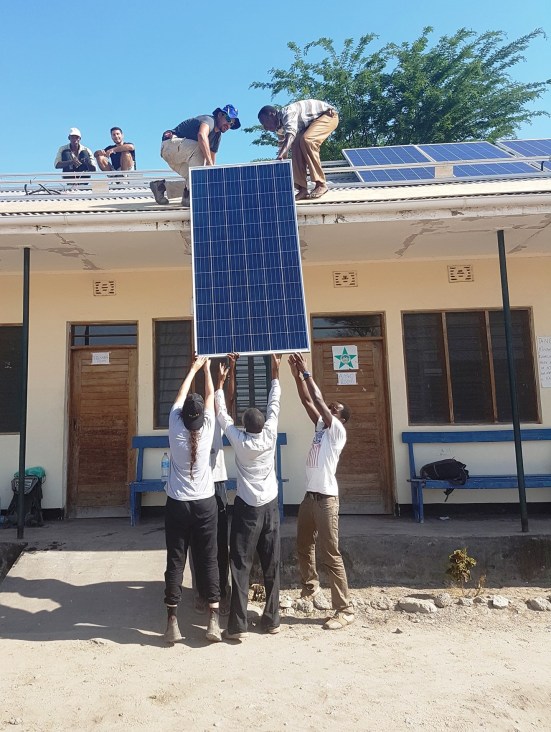
A Light unto the Nations. Israeli engineering students from Tel Aviv University (TAU) bring solar power to a remote Tanzanian medical clinic, as part of their ongoing work in the village. (Photo via Facebook)

In terms of “loadshedding”, our all-consuming national catastrophe  of widespread national blackouts of electricity supply that began in 2007 and is worse today in 2023, why not speak to the Israelis who have revolutionised solar power and energy?

Instead of the South African parliament dumbly voting this March 2023 to downgrade ties with Israel, it should be doing the opposite. It should be strengthening not destroying ties!

Sad ‘State’ of Affairs. At a time when many African and Muslim countries are strengthening and deepening ties with the State of Israel for the benefit of everyone’s common interests, South Africa does the opposite as exhibited in its House of Parliament in Cape Town when it voted to downgrade its ties with the Jewish state.

Ultimately, we have to come to terms with the fact that Israel  cannot be prejudiced for defending its sovereign policies and the interests of its people, and Palestine must take responsibility for the attacks on Israel carried out by Hamas and other extremists. South Africa’s refusal to maintain full diplomatic relations with Israel motivated solely by the conflict, exposes its bias and prejudice because Palestine also commits a fair share of unprovoked aggressions against Israel.

To preserve the true legacy of the South African experience of reconciliation and share it with others that they too can benefit,  South Africa’s foreign policy should be consistent, and above all, its leaders need to display impartiality and non be biased.

‘Tapping’ into Israeli Ingenuity. Israeli Sivan Yaari of INNOVATION:AFRICA opens taps of clean water for the first time in this remote part of Tanzania. Innovation:Africa has completed over 880 solar and water installations, impacting over 4.2 million people (photo credit: INNOVATION:AFRICA)

Since COVID-19 broke out, the South African economy has continued to contract. In contrast, Israel’s economy is still expanding.

We have much to learn and gain by deepening our relations with Israel. South Africa stands to gain far more from a positive and mutually beneficial relationship with Israel than Israel does and yet, we behave abysmally towards Israel.  All to our detriment and suffering of our people.

Switched On Tanzania. An ‘illuminating’ lesson for South Africa – Nkaiti Medical Center is lit up at night for the very first time thanks to Israeli engineering students. (Photo via Facebook)

In essence, one cannot dismantle the fact that the benefits of the association outweigh the costs. Thus, it would be in the best interest of the South African to restore full relations with Israel and encourage partnerships to the mutual benefit of South African and Israelis.


About the writer:

Ostern Tefo has a BA in Political Studies and International relations and is currently studying for his LLB at the University of the Witwatersrand. He serves as a coordinator at ‘Africans for Peace’, a collective of independent students, scholars and activists who bring an African lens to the global debate on peace and stability on the African continent.


While the mission of Lay of the Land (LotL) is to provide a wide and diverse perspective of affairs in Israel, the Middle East and the Jewish world, the opinions, beliefs and viewpoints expressed by its various writers are not necessarily ones of the owners and management of LOTL but of the writers themselves.  LotL endeavours to the best of its ability to credit the use of all known photographs to the photographer and/or owner of such photographs (0&EO).

HOW THE MIGHTY HAVE FALLEN

A reputation of tough and tenacious, SA Rugby loses its spine

By Lennie Lurie

In an unprecedented vote on the 6th November 1962,  uniting nations on both sides of the Iron Curtain, the UN General Assembly passed Resolution 1761, condemning South African Apartheid policies and called for the imposition of economic sanctions on South Africa. While nations such as the United States and the United Kingdom were at first reluctant to impose sanctions, by the late 1980s, both countries and 23 other nations had passed laws placing various trade sanctions on South Africa.

An immediate arms embargo was followed by a trade embargo which played havoc with the burgeoning vehicle production factories in the eastern Cape province. Despite the large numbers of black employees who were dismissed as a result of production cut backs, they heartily approved of the economic sanctions even though their income was grievously affected. Anything which would contribute to the removal of the cruel, wicked and  humiliating racial policies of Apartheid was encouraged and the black workers were prepared to bear the load of the economic boycott as it affected them as well.

When it was realised that the SA Government was not bending under the economic boycott, a cultural boycott was imposed on the Republic. No foreign entertainers and singers visited SA and no South Africans performers would be welcome overseas. The iconic and celebrated SA singer of authentic African music, Miriam Makeba, who gained international fame with her popular “click” song, wholly supported the cultural boycott, which made a strong impression on South African artists and entertainers.

Miriam Makeba – Click Song (Qongqothwane) (Live)

Here again, the resolute and determined SA government remained steadfast in the maintenance and implementation of the Apartheid system.

Finally, it was decided to impose a sport boycott on all South African sportsmen and women preventing the proud ‘Springbok’ teams – notably in rugby and cricket – from competing abroad as well as officially banning any overseas countries and foreign sports team from touring South Africa. And this, dear friends, was the final straw which broke the back of the Apartheid system!

Economic sanctions against South Africa placed a significant pressure on the SA government. The cultural boycott made SA unwelcome overseas and isolated the country from foreign entertainers and performers. The real fear that the Springboks would no longer compete against the sports teams of other countries proved to be a hardship (particularly on the rugby field!) that even the most fervent white nationalist could bear.

In 1990, President Frederik Willem (F.W.) de Klerk recognized the economic unsustainability of the burden of international sanctions and felt the isolation of his country in all aspects of culture and sport. Reluctantly but finally and unreservedly, he released the nationalist leader Nelson Mandela and unbanned the African National Congress (ANC) that Mandela led. De Klerk and Mandela together guided the country to democratic elections in 1994, with Mandela as president. When Mandela was asked if the sanctions, especially the sports boycott, helped to bring an end to the apartheid system, Mandela replied “Oh, there is no doubt!”

Can’t take the Heat. While players from Israeli rugby team ‘Tel Aviv Heat’ are seen here in London celebrating a victory in November 2022, they will not be seen in South Africa this March after their invitation to compete was withdrawn by the SA Rugby Union following pressure from the BDS coalition.

Who can ever forget the emotional scene when Nelson Mandela congratulated the Springbok rugby captain, Francois Pienaar on winning the 1995 World Rugby Cup in Ellis Park. Rugby was as dear to Mandela as any white South African rugger lover – he never forgot the pressure of the international sports boycott on his country and how it contributed in breaking the vile and contemptible Apartheid system.

True Colours. Disinviting Israeli rugby team to participate in South Africa in 2023 is a far cry from the outreach projected by President Nelson Mandela and Springbok captain, Francois Pienaar at the historic 1995 Rugby World Cup.

In light of the above historical review of the sports boycott on South Africa, it is therefore most surprising and deeply disappointing to read that the South African Rugby Union (SARU), had on the 3rd February, 2023, rescinded its invitation, given in August, 2022, to have the Israeli rugby team Tel Aviv Heat compete in the 2023 Mzansi Challenge tournament – also known as the Currie Cup First Division, which is scheduled to start on the 24th March with teams from Kenya, Namibia and Zimbabwe and six SA provinces.     

The Tel Aviv Heat team includes a number of South Africans and its coach, Kevin Musikanth, was born in South Africa.

Happier Days. Launched as Israel’s first professional rugby team in July 2021, Tel Aviv Heat is seen here celebrating a post-match at Loftus Versfeld at the end of a magical South African Tour hosted by the Blue Bulls in 2022.

The SARU President Mark Alexander stated that it had “listened to the opinions of important stakeholder groups” and took the step “to avoid the likelihood of the competition becoming a source of division.” A more accurate and honest reason being that the SARU bowed under pressure and alleged threats from supporters of the South African BDS (Boycott, Disinvestment, Sanction) Coalition.

Shameful Withdrawal. Under pressure, Mark Alexander SA Rugby president rescinds invitation to Israeli team, Tel Aviv Heat.

This cowardly and shameful volte-face decision by the SARU is not only insulting to the Israeli Tel Aviv Heat rugby team but it is a despicable slap-in-the-face to the sporting image of South Africa which knows only too well the historical background of imposing a sports boycott on a fellow sporting nation or team. To comprehend that the all-powerful SARU has cowardly kowtowed to insidious pressures and / or threats of the SA BDS Coalition, an anti-Israeli group of South Africans who are known as talkers, not doers, is all the more pathetic. It is indeed a sad day when South African rugby has lost its independence, objectivity and neutrality in matters relating to sport and becomes a spineless puppet manipulated by an anti-Semitic group, simply pulling on distant strings!

Let SARU bow its head in shame in stooping so low as to callously affront the proud and heroic image of that South African leader, known to all his friends as ‘Madiba’, who had the courage to welcome and support a sport boycott as a means of exerting pressure on a government that oppressed his people under the scourge of Apartheid.

Not long ago, the University of Cape Town, again under pressure from BDS student supporters, decided to impose a boycott on all Israeli universities and colleges. UCT soon realized that it had more to lose than gain by such an ill-advised and self-defeating act and promptly withdrew its boycott threat after it was inundated by letters from former students informing the UCT council that they would discontinue all financial aid should UCT enact the boycott. Frankly, UCT could be in greater need of ground breaking Israeli academic discoveries and inventions than vice versa!

Thumbs Up to Thumbs Down. Israel’s SA-born rugby coach Kevin Musikanth who helped get together Israel and the UAE to play a historic match for the Sons of Abraham trophy got the thumbs down for his Tel Aviv team the ‘Tel Aviv Heat’ to compete in his native South Africa.

Likewise, SARU has already lost face in the eyes of many Israelis and probably Israeli supporters world-wide. Making excuses about “competition becoming a source of division” when it is well-known that the BDS threat was the real reason, places SARU as a pathetic and weak-willed organization, susceptible to the crudest form of verbal pressure.

Even the image of the proud Springbok emblem has been irrevocably tarnished and sullied by the cowardly collapse of SARU.

One can only exclaim: How the mighty have fallen!


About the writer:

A B.Sc. graduate in Economics and Geology from the University of Cape Town (UCT), Lennie may be the only volunteer from abroad who was granted permission to leave his group on kibbutz during the 1967 Six Day War to rejoin his paratroop brigade that he had served with years before following his matriculation in Cape Town. In Israel, Lennie has worked as an Export Manager for some of the country’s major food manufacturers and chemical companies as well as an independent consultant in Export Marketing guiding many small Israeli businesses to sell their products and services in the world-wide market. As a result of a work accident in 1995, Lennie made a career change and became an independent English teacher working mainly with hi-tech companies and associated with universities and colleges in the north of Israel.


While the mission of Lay of the Land (LotL) is to provide a wide and diverse perspective of affairs in Israel, the Middle East and the Jewish world, the opinions, beliefs and viewpoints expressed by its various writers are not necessarily ones of the owners and management of LOTL but of the writers themselves.  LotL endeavours to the best of its ability to credit the use of all known photographs to the photographer and/or owner of such photographs (0&EO).

SOUTH AFRICA’S PATH TO NOWHERE

ANC government repeatedly alienates partners for development in South Africa

By Pamela Ngubane

In a heart-warming series of events, Israel has repeatedly displayed its commitment to continue growing its ties in Africa. This follows the announcement by Chadian President, Mahamat Deby, that his country would open an embassy in Israel.

The Chadian leader travelled to Israel to officiate the inauguration of the embassy in Ramat Gan in early February. Deby cited that Chad and Israel were at a decisive turning point in their relationship, during a meeting with Prime Minister Benjamin Netanyahu in Jerusalem that week. This followed waves of peace talks in the Middle East and Northern Africa, which have resulted in a remarkable increase in economic cooperation between Israel and other states.

Back to Africa. “We believe that our co-operation can help not only advance our relations and our co-operation, but it is also part of Israel’s coming back to Africa and Africa coming back to Israel,” said Chadian President Mahamat Idriss who is seen here meeting with Israel’s State President, Isaac Herzog following the opening of the Chadian Embassy in Ramat Gan, outside Tel Aviv.

Deby was welcomed in Israel with great diplomatic fanfare by President Isaac Herzog and Foreign Minister Eli Cohen for the opening of the Chadian embassy. At the time, Prime Minister Netanyahu reported that this would form part of a tremendously important relationship with a major country in the heart of Africa.

The news of Chad formalising its diplomatic ties to Israel were followed closely by reports that Israel and Sudan would sign a “historic peace agreement” in Washington in a few months’ time, indicating an irrefutable move to promote peace, dialogue and increase economic cooperation between Africa and Israel in 2023.

The Sudanese agreement is particularly noteworthy because it overturns the Khartoum Resolution of 1967, which was issued at the conclusion of the 1967 Arab League summit, convened in Khartoum, the capital of Sudan, in the wake of the Six-Day War. The resolution is infamous for containing what became known as the “Three Nos”:

“no peace with Israel”

“no recognition of Israel”

“no negotiations with it”

This has been comprehensively shattered this year and replaced with three Yes’s for peace.

‘Power’ to the People. Children in Iringa, Uganda, where the Israeli nonprofit organization, Innovation Africa connected a clinic to electricity via solar power, December 21, 2019. (Sue Surke/Times of Israel)
 

Countries in Africa and the Middle East continue to welcome Israeli technology and innovation through these historical peace agreements and talks. This is an unsurprising fact, given that Israeli solar technology now provides a stable water supply to over 3.5 million people in Africa, and to over half a million people in South Africa as well.

One would be forgiven for imagining that these developments would encourage South Africa’s national government to adopt foreign policies which would aim to promote Israel in our country as a partner for our continued development and basic service infrastructure. And yet, here we are, completely disengaged from reality. Our Minister of International Relations, Naledi Pandor, won’t pick sides when it comes to Russia and the war it has waged on innocent civilians in Ukraine! However, when it comes to Israel, it’s always been a hard no. Why? Because Israel offers the ANC government (currently polling below 50%) with the only straw of relevance they have left to the South African electorate. And even then, it is entirely misguided and based on a narrative that has never served Palestinians or Israelis at all.

Impacting Millions. Since its inception in 2008, Israeli company ‘Innovation Africa’ with its solar and water installations, impacts millions across 10 African countries Uganda, Malawi, Tanzania, Zambia, Democratic Republic of Congo, Cameroon, South Africa, eSwatini, Ethiopia and Senegal.

South Africans have been called to categorically reject the appropriation of the suffering of black people under colonisation; and Apartheid by the enemies of Israel as a tool to de-legitimise the Jewish state. This has been communicated on a number of occasions by several stakeholders, including the South African Zionist Federation and the South African Jewish Board of Deputies, as well as Stand With Us.

The Holy Land of Israel remains the ancestral and indigenous homeland of the Jewish people. The return en masse of Jews throughout the world to re-establish their state two thousand years of exile and statelessness, is the legitimate and legal expression of the Jewish people’s struggle for national self-determination.

Israel is the only democracy in the Middle East and is home to a multicultural society where the rights of all religions, minorities, ethnicities and beliefs are protected and promoted. It is the only country in the Middle East where the population of Christians is growing and has a number of holy sites which are critically relevant to Christians and their faith.

Skewed Foreign Policy. While quick to condemn Israel at every opportunity, Minister of International Relations Naledi Pandor has refused to condemn Moscow’s invasion of Ukraine that is claiming thousands of innocent lives. Reinforcing the two country’s friendship, Pandor is seen here welcoming her Russian counterpart Sergei Lavrov for talks in Pretoria. This February 2023, joint “war games” military exercises with Russia and China were held in South Africa.

And yet – the ANC continues to feel threatened by Israel’s growing ties in Africa. So much so, that our national government shamelessly allows the narrative of an “Apartheid state” to consume all conversations about Israel in our country.

South Africa’s foreign policy between Israel and the Palestinians should take a de-hyphenated approach if we are to contribute meaningfully to securing peace for the people living in both territories during our lifetime. This will ensure that South Africans continue to access the best that Israel has to offer, while creating a safe space for the difficult conversations that need to take place to address the senseless violence and suffering that has destroyed families across both borders to date.

At this rate, we need to start asking ourselves, as South Africans, some hard questions. Has the ANC government been captured by the BDS movement? And is BDS dictating our foreign policy to our public representatives?


About the writer:

A Social Science Honours graduate, Pamela Ngubane is a history teacher who was appointed as the Spokesperson of SAFI (South African Friends of Israel)


While the mission of Lay of the Land (LotL) is to provide a wide and diverse perspective of affairs in Israel, the Middle East and the Jewish world, the opinions, beliefs and viewpoints expressed by its various writers are not necessarily ones of the owners and management of LOTL but of the writers themselves.  LotL endeavours to the best of its ability to credit the use of all known photographs to the photographer and/or owner of such photographs (0&EO).

SOUTH AFRICAN RUGBY CAN’T TAKE THE ‘HEAT’

SA Rugby Board withdraws invitation to Israeli team – the Tel Aviv Heat

By Pamela Ngubane

For those who know little about the game of rugby, what’s ‘in play’ here, is less about the sport and more about the principle! The South African Rugby Union (SARU) has withdrawn an invitation to an Israeli rugby team – Tel Aviv Heat – to play in the 2023 Mzansi Challenge tournament in South Africa due to the objections of several “stakeholders”.

Refusing to play Ball. An invitation for Tel Aviv Heat – the Israel-based Super Rugby Cup franchise –  to participate in a provincial tournament in South Africa has been withdrawn by SA Rugby. (Photo by Levan Verdzeuli/Getty Images)

Who are these “stakeholders” and what is their agenda?

While the SARU tried to explain that they had “listened to the opinions of important stakeholder groups”, it failed to consult with either the Tel Aviv Heat or the Israel Rugby Union, or even the Israeli Embassy in South Africa prior to their mean-spirited decision.

It simply failed. It failed both procedurally and morally.

Scheduled to play in the tournament with four other international teams and six teams from South African provinces, Tel Aviv  Heat was informed that the invitation had been withdrawn!

Let me make it clear that despite the publicity surrounding this development, the SARU decision disinviting Tel Aviv Heat from the upcoming Mzansi Challenge, does NOT represent the South Africa people. What it does represent is the shameless bullying of the Jew-hating Boycott, Divestment and Sanctions Movement (BDS) movement resorting to, when they fail to convince anyone of the lie that Israel is a state perpetrating Apartheid.

‘Bokke’ on the Run. Tarnishing the Springbok image, SA Rugby announced that it had withdrawn an invitation to the Tel Aviv Heat to play in the Mzansi Challenge. Photo: SA Rugby website

South Africans across the board are increasingly experiencing the Jewish state as a partner for development and progress, as it consistently shows in its conduct when relating to other nations and peoples.

Just this week, South Africans, along with the rest of the world, have witnessed the work of the Israel Defence Forces (IDF), medics from Israel’s world-renowned Sheba Medical Centre, and countless Jewish and Israeli volunteers, in Turkey and Syria, where thousands need aid in the aftermath of the recent devastating earthquakes. And this is despite that Turkey has had a rocky relationship with Israeli in recent years and that Syria remains technically at war with Israel. That is the nature of Israel – it responds to people in need.

This selflessness brings to mind the words of a young Jewish woman conscript in the IDF (Israel Defence Force)  I interviewed. When I asked her what Israel meant to her, she replied that no matter how people behave towards Israel and the Jews, “my country” will always lend a helping hand anywhere it is needed. She said this altruistic attitude was a part of her Jewish identity and that no amount of the world’s cruelty would change this about her people. This tenacious spirit has won the admiration of the friends and enemies of the Jews over the years.

Heat Wave in Tel Aviv. The Tel Aviv Heat (in blue) has been a success, both on and off the pitch, as it helps reignite the spirit of rugby throughout Israel.(photo credit: TSAHI REIZEL/COURTESY)

As the world seriously begins to seek to overcome the challenges that divide humanity and hamper our progress, Israel and the Jewish people are being recognised as “a light to the nations”. This is not just for their brilliant technological and scientific innovations and breakthroughs, but most importantly because they are willing to share this knowledge with all who are eager to listen and learn.

Africa in particular is embracing Israel as a partner for development who will not only advise but teach us how to recalibrate our thinking so we can ‘tackle’ – using rugby parlance – our problems with the aim to solving them permanently.

Israel’s willingness to get ‘into the ruck’ – again borrowing another rugby stratagem – with us in the fields of agriculture, water management, ICT, medicine, and entrepreneurship is why 44 out of 55 members of the African Union (AU) maintain increasingly strong diplomatic relations with the Jewish state.

Therefore, while the cynical BDS celebrates Tel Aviv Heat’s exclusion from the 2023 Mzansi Challenge, they will not be able to keep South Africans and Africans from seeing the truth about Israel in the long run. While BDS insist on fighting against the moves by African states to normalise relations with the Jewish state, their efforts will grow increasingly futile as Israel’s humanitarian achievements surpass these bigoted efforts to undermine Israel’s right to exist as a Jewish and democratic state.

Joel Joins In. South African rugby legend, Joel Stransky joins in the fray in criticizing the SA Rugby Board decision.
 

As I continue to work in the field of Israel advocacy, I daily draw inspiration from the incredible contribution the nation of Israel has made to humanity since its founding over 3500 years ago.

While the history of this tiny nation is replete with dire experiences of national persecution and despair, there have always been outsiders who have watched in awe as the Jewish people emerged stronger after every trial.

It is my hope that Israel and the Jewish people will see these admiring friends shining brighter and cheering louder than the hateful bigots that try to tear them down.

So while the South African Rugby Union seemed to indicate that its intention behind its decision to withdraw the invitation to Tel Aviv Heat was “to avoid the likelihood of the competition becoming a source of division”, it will only, in the words of the statement from Tel Aviv Heat, “sow further division in South Africa and beyond by bolstering voices dedicated to vilify, demonize, and censor those who do not share their views.”

Let me conclude that when Israel’s friends become more fearless and vocal in her defence, we will see that far more people stand with Israel than against her and the Jewish people across the world.


The Plane Truth. Contrary to the lies South African BDS spreads about the Jewish state, here is the real Israel as it sends search and rescue equipment to Turkey in the wake of the devastating earthquake. What contribution has South Africa made to either Turkey or Syria besides ‘sending’ condolences?


About the writer:

A Social Science Honours graduate, Pamela Ngubane is a history teacher who was recently appointed as the General Manager of SAFI (South African Friends of Israel)


While the mission of Lay of the Land (LotL) is to provide a wide and diverse perspective of affairs in Israel, the Middle East and the Jewish world, the opinions, beliefs and viewpoints expressed by its various writers are not necessarily ones of the owners and management of LOTL but of the writers themselves.  LotL endeavours to the best of its ability to credit the use of all known photographs to the photographer and/or owner of such photographs (0&EO).

SOUTH AFRICA DARING TO DISCRIMINATE

As president of the BRICs bloc (Brazil, Russia, India, China, and South Africa) in 2023, should the ANC government  not exercise moral responsibility and apply foreign policy consistently?

By Rowan Polovin National Chairman, South African Zionist Federation 

(First published in Business Day)


Minister of International Relations and Cooperation, Naledi Pandor, is fundamentally concerned with one international issue over all others, what she calls “the ongoing flagrant abuse of the human rights of Palestinians” which, in her view places “a moral responsibility on South Africa to act.”

It is remarkable that Pandor is able to command such exclusive action from the ANC government over a territory smaller than our beloved Kruger National Park, whilst remaining deafeningly silent to the cries of Ukrainians last year and numerous other serious human rights issues in Africa and around the world. Moreover, she blames Israel for the ongoing conflict with the Palestinians, and absolves all responsibility and agency from Hamas and the Palestinian Authority. 

Dressed to Discriminate. While consistently failing to condemn Russia’s barbaric war of aggression against the Ukrainian people costing the lives of tens of thousands of civilians, South Africa’s Foreign Minister Naledi Pandor – feeling most at home in a Palestinian headscarf – will always rush to virulently denounce the Jewish state following any clashes between Israel and Palestinians.

The Department of International Relations and Cooperation (DIRCO), and the South African public, should hold Minister Pandor accountable for her statement. Indeed our government certainly does have a moral responsibility to act decisively to assist global communities when it comes to the protection of human rights. Especially when they are being abused at a rate that only South Africans could begin to comprehend. 

The United Nations has confirmed that 170 deaths were recorded as a result of the Israeli-Palestinian conflict in 2022. While the loss of innocent lives on any side of a conflict is tragic, the vast majority of those casualties were Palestinian militants. By contrast, according to the Office of the High Commissioner for Human Rights, over 6 900 people were killed as a result of Russia’s invasion of Ukraine in 2022. It is estimated that 408 of these fatalities were children.

 
This is utterly devastating, and we are no strangers to this level of violence in South Africa, where over 7000 citizens were murdered in just the second quarter of the 2022/23 financial year. Tragically, over 550 of those deaths were children, according to the national crime statistics report as released by Minister of Police, Bheki Cele, last year.  

But, of course, it is easier for the government to deflect attention someplace else. 

Rampant Crime, Misguided Ministers. Nonthando Booi holds a picture of her murdered niece, Siphokazi Booi. While more than 7,000 people were murdered over three months (July-September) in 2022 in South Africa, the government prefers to deflect public attention elsewhere, like on the Middle East.  (Photo Kaylynn Palm / Action Society)

South Africa’s foreign policy appears to be singularly limited to Israel-bashing. This position prevents our country from playing any meaningful role in finding a peaceful solution to the Israeli-Palestinian conflict.  The ANC government’s obsession with Israel also precludes us from benefiting from the changing landscape of the Middle East and Africa. The Abraham Accords, where peace and normalisation has been achieved between Israel, the United Arab Emirates and Bahrain, as well as Morocco and Sudan here in Africa, has effectively ended the Arab-Israeli conflict. 

More countries in the Middle East and Africa could follow suit in 2023. The Negev Forum working group recently concluded groundbreaking meetings between these countries, focusing on food security, water technology, clean energy, tourism, health care, education, coexistence and regional security. Does South Africa want to be left out in the cold, and lose out on the advantages of these strategic partnerships?

The Outsider. While initiatives like the Negev Forum Working Groups hosted by the UAE on January 9-10, 2023 in Abu Dhabi with senior officials from the governments of Bahrain, Egypt, Israel, Morocco, the UAE, and the US discussed opportunities to advance initiatives that “encourage regional integration, cooperation, and development, for the benefit of their populations and the wider region that include initiatives to strengthen the Palestinian economy and improve the quality of life of the Palestinian people,” South Africa opts to be left out in the cold and lose out on the advantages of strategic partnerships.

Back home, our foreign policy decisions are irrational. Last week, ANC International Relations Committee Chair, Lindiwe Zulu, confirmed that the ANC had resolved to simply not take sides in the Russia-Ukraine war. She added that it would also be supporting China in its dispute with Taiwan. But the ANC went further. Its January 8th anniversary statement of this year calls on Western governments to end sanctions on global human rights abusers such as Iran, Syria, Zimbabwe and Venezuela. The ANC has a remarkable willingness to be on the wrong side of history just so long as it retains its Cold War friends.

The ANC could be positioned to act as mediators between warring factions, people and states, given its own experience of great pain and suffering at the hands of a political authority that abused South African human rights in ways we are only beginning to come to terms with today. The collective trauma suffered by millions of South Africans should have left us at war with one another for decades – and yet, under the leadership of President Nelson Mandela, the ANC was able to do something fundamentally extraordinary. It shifted people’s perceptions of one another, in a way that enabled us to see beyond any illusion, that we are all South Africans and that this territory is home to everyone residing within its borders. Different religions, traditions and languages were not barriers to our social cohesion – but rather a celebration of our diverse, yet collectively shared humanity.  

South Africa’s political leadership changed the trajectory of the conflict present in our country. And as such, our country is in a strong position to assist other states with doing the same. But when Minister Pandor turns a blind eye to almost all international human rights violations to discriminate over Israel, one cannot help but wonder what has happened to the ANC and its international credibility. 

If the abuse of human rights is the starting point for Pretoria’s commitment to assist foreign states with local causes, where is the South African initiative on Ukraine or many other conflicts closer to home? Will we stand by idly while Russia continues to put hundreds of Ukrainian children in early graves? Why have we not seized the opportunity to become world leaders in changing perceptions and illusions that alienate human beings from one another? 

Blind Sided. While photos like this of death and destruction in Ukraine that will likely lay the groundwork for future charges of war crimes against Russia, South Africa’s ANC government prefers to look the other way, advocating instead “to not take sides” in the Russia-Ukraine war.

Our country should seek to apply its foreign policies with uniformity, and show a degree of courage and leadership at the same time. South Africa holds the Presidency of BRICS in 2023 – will we use this position of leadership to hold Russia and others to account? Or will the ANC government continue to pick and choose its moral responsibilities based on its nostalgic political relevance of yesteryear?


About the writer:

Rowan Polovin National Chairman, South African Zionist Federation 


While the mission of Lay of the Land (LotL) is to provide a wide and diverse perspective of affairs in Israel, the Middle East and the Jewish world, the opinions, beliefs and viewpoints expressed by its various writers are not necessarily ones of the owners and management of LOTL but of the writers themselves.  LotL endeavours to the best of its ability to credit the use of all known photographs to the photographer and/or owner of such photographs (0&EO).

FORGOTTEN HISTORY REMEMBERED

The heroic past shall be ‘unveiled’ at an upcoming ceremony at Johannesburg’s Jewish cemetery illuminating ‘bloodlines’ between South Africa and Israel

By David E. Kaplan

On the 27th November, people of all faiths and races – some wearing medals of battles past – will gather at the South African National Jewish War Memorial at West Park Cemetery in Johannesburg. They will do so to remember those South African soldiers who sacrificed their lives in the world wars of the twentieth century that not only “changed the course of history” but profoundly impacted on the destiny of the Jewish people. The acts of bravery by these soldiers – whether aware at the time or not – contributed to the restoration of Jewish sovereignty in their ancestral homeland in 1948.

Live stream link on Sunday 27/11/22, 10:30 (SA time) – https://www.facebook.com/SAZionistFed/

The drama of three long forgotten and for many never even known events, will be ‘unveiled’ together with the stones embodying their pulsating pasts.

STORY OF A STONE

When only a year ago, students at  UCT ( University of Cape Town) tried to expunge the memory of South Africa’s famed wartime Prime Minister Jan Smuts by defacing and covering his bust with plastic bags and ultimately removing it from the campus as well as renaming the historic men’s residence from Smuts Hall to Upper Campus Residence, the upcoming gathering on the 27 November has a contrary agenda of honouring his memory as it connects with the Jewish people. If UCT students sought to ‘cover’ Smuts’ bust, the South African Zionist Federation (SAZF), JNF (SA), the South African Jewish ex-Service League together with its committee member, Selwyn Rogoff and its former Chairman, Peter Bailey also representing the Isaac Ochberg Heritage Committee in Israel, have sought to uncover Smuts’ less known past, notably his contribution to the State of Israel.

Century of a Stone. The cornerstone originally unveiled by Prime Minister Smuts in 1922 to be again unveiled by his great-grandson Gareth Shackleford on the 27 November 2022 at West Park Cemetery, Johannesburg.

When it was brought to Bailey and Rogoff’s attention that a cornerstone honouring South African Jews who had fought and died in the Great War that had been unveiled by Prime Minister Smuts in November 1922 at the old Jewish Guild War Memorial Building in downtown Johannesburg had after a century of travels to different locations  resurfaced in the garden of a bowling club, they felt a special memorial event marking the centenary should be held. Bailey felt further that it should include two other monumental contributions of South African soldiers who died in the service of that biblical land that would in time emerge as the state of the Jewish people – Israel. Through this writer’s intervention, he contacted Benji Shulman of the SAZF that set in motion the upcoming event that will have Smuts’ great-grandson, Gareth Shackleford, who will unveil again the cornerstone that his grandfather originally unveiled a century earlier reminding the world of the love Smuts had for the Jewish people and his role in the creation of the Jewish state.

Dead at Delville. Included amongst Jewish South African soldiers killed in WWI was the writer’s grandfather’s brother, Victor Kaplan, who volunteered for overseas service and was killed in the Battle of Delville Wood in 1916. (Family photo)

Too few are aware that when Smuts and Chaim Weizmann met in London during the Great War, the two began a close friendship that lasted for the rest of their lives and greatly influenced events in Palestine. In an essay on Smuts and Weizmann, Richard P. Stevens writes:

“perhaps few personal friendships have so influenced the course of political events during the twentieth century as the relationship between General Jan Christiaan Smuts, South Africa’s celebrated prime minister, and Chaim Weizmann, Zionist leader, and Israel’s first president.”

Meeting of Minds. They emerged friends with shared visions – Chaim Weizmann (left) and Jan Smuts, circa 1915 (photo credit: JERUSALEM POST ARCHIVE)

Research reveals that Smuts played a monumental backroom role in the drafting of the Balfour Declaration, providing Weizmann with a direct conduit to the War Cabinet. Another of Smuts’ great-grandsons, Philip Weyers, said of his great-grandfather, who he fondly refers to as “Oubaas” (old boss) that:

“he was the anonymous partner to the Balfour Declaration. The spirit and even some of the wording of the Balfour Declaration came from the Oubaas’ mouth. His thoughts and views carried a lot of weight, and is imbedded in that fateful document.”

It is little wonder that kibbutz Ramat Yohanan – founded in 1932  – was named in honour of Jan Smuts; ‘Yohanan’ being the Hebrew translation for the Afrikaans ‘Jan’ or English ‘John’, in recognition of his unstinting efforts on behalf of the Jewish people.

LETTER TO LEGEND

However, Israel’s ‘Magna Carta’ – the Balfour Declaration of 1917 – would have meant very little beyond a letter or footnote in history had not the actual ‘feet’ of commonwealth soldiers – including the Cape Corps comprising members of South Africa’s Coloured community – fought valiantly to relieve Palestine of the Ottoman Turks. Some 54 Coloureds  – Christians and Muslims – lost their lives in what became known as the Battle of Megiddo, opening the road for General Allenby’s breakthrough to Damascus. Most important from a Jewish perspective, while it “opened the road” for Allenby, it cleared the region of the occupying Turks, paving the way for a British Mandate and ultimately Jewish statehood in 1948.

Jubilation in Jerusalem. One month after the Balfour Declaration, General Edmund Allenby enters the Old City on the 11 December 1917 to accept the surrender of Jerusalem from the Ottoman Turks. Next battle to follow – Megiddo.

A year following the famous battle, Field Marshal Viscount Allenby, GCB, GCMG had this to say about the men of the 1st Cape Corps:

 “I heard you are creating a Roll of Honour containing Cape Corps names. I had the honour of serving with many of the Cape Corps in Palestine and I should like to add my tribute of appreciation. The record of those of the Cape Corps who fought under my command is one that any troops might envy. Especially on September 19 and 20, 1918, they covered themselves with glory, displaying a bravery and determination that has never been surpassed.”

A descendant of this battle, Cmdr. M. Adeel Carelse MMM (Ret.), whose grandfather Cpl. C. H. Carelse fought bravely at Square Hill and Kh Jibeit that were decisive battles within the larger Battle of Megiddo and was awarded the Distinguished Conduct Medal, will unveil on the 27 November a plaque to the Cape Corps. Today in Cape Town’s suburb of Retreat, there is Square Hill School that is named after this famous battle that too few remember or the sacrifices made.  However, these mostly forgotten battles fought in a biblical land, ended Ottoman Turkish rule and led to the eventual establishment of the independent states of Jordan, Syria, Lebanon, Iraq, and ISRAEL!

Valiant Fighters. Men of the 1st. Battalion, Cape Corps(160th Brigade, 53 Welsh Division) in Palestine 1918.

WORKED TOGETHER, DIED TOGETHER

The third stone of history to be unturned at the ceremony, will be to remember and honour the 644 black Southern Africans who went down with 140 Yishuv Jews on the SS Erinpura during WWII.

They had all worked together as volunteers on a British labour project in Palestine for the war effort and were together in a convoy in the Mediterranean in May 1943 . The SS Erinpura was carrying more than 1000 troops, including Basuto and Batswanan members of the African Auxiliary Pioneer Corps and Palestinian Jewish soldiers of 462 Transport Company of the British Army when on the evening of 1 May 1943, German bomber aircraft attacked the convoy 30 nautical miles (56 km) north of Benghazi.

They Made History. On parade but soon to be tested in battle are soldiers of the Cape Corp during WW1 who performed so heroically at the Battle of Megiddo in 1918 against the Ottoman Turks.

In one wave of the attacks, a bomb hit the Erinpura in one of her forward holds, causing her to list to starboard and sink within five minutes. The crew of her 12-pounder anti-aircraft gun continued to return fire until she sank with a loss of life of 800 that included the 633 Sotho, 11 Tswana soldiers and 140 Palestinian Jewish soldiers.

Lives lost at Sea. The ‘SS Erinpura Memorial’ on Mount Herzl, Jerusalem is dedicated to the 139 Jewish soldiers of the British Army  462 Moving Unit in British Mandate of Palestine  that lost their lives on the SS Erinpura  that was sunk in an attack  by the Luftwaffe on 1 May 1943.

The monument on Mount Herzl  to the 140 Jewish soldiers who drowned aboard the SS Erinpura is shaped like a ship  with a pool of water representing the sea where on the bottom appear the names of the fallen. Above the pool is a turret adorned with the Hebrew text of Psalm 68, verse 22:

“The Lord said, I will bring again from Bashan, I will bring my people again from the depths of the sea.”

Ship of Soldiers. The ill-fated SS. Erinpura that went down with South African and Jewish Palestinian soldiers in WWII.

This did in a sense happen with the emergence five years later  with the gathering of Jews and the established of the Jewish state in 1948.

It is only fitting that  Israel’s Ambassador to South Africa, Eliav Belotsercovsky, will unveil a memorial plaque at the West Park Cemetery ceremony to the tragic loss of life of both the Yishuv Jews and black South Africans who lost their lives together in a cause that others may live.

Entrance to West Park Cemetery, Johannesburg

EPILOGUE

The years have rolled by and like packed away old unread books, heroic lives were lost tucked away in forgotten chapters in recedingly remembered conflicts. The upcoming ceremony on the 27 November 2022  in Johannesburg is designed to address this amnesia and all across the world are invited to attend on ZOOM

https://www.facebook.com/SAZionistFed/

Before all these events played out, the instruction of ‘being careful not to forget’ was already present in Deuteronomy 4:7–9:“Only take heed to thyself, and keep thy soul diligently, lest thou forget the things which thine eyes have seen, and lest they depart from thy heart all the days of thy life: but teach them thy sons, and thy son’s sons.


While the mission of Lay of the Land (LotL) is to provide a wide and diverse perspective of affairs in Israel, the Middle East and the Jewish world, the opinions, beliefs and viewpoints expressed by its various writers are not necessarily ones of the owners and management of LOTL but of the writers themselves.  LotL endeavours to the best of its ability to credit the use of all known photographs to the photographer and/or owner of such photographs (0&EO).

TIME TO DO RIGHT, SOUTH-AFRICA

Pandor’s call for Israel to be called an ‘apartheid’ state laughable

By Pamela Ngubane

(Originally published in The Citizen)

At a Palestinian Heads of Missions (HOM) in Africa conference, on 26 July 2022, held in Pretoria, South Africa, South Africa’s Minister of International Relations and Cooperation (DIRCO) Dr Naledi Pandor, told the international community that they ought to consider labelling the only democracy in the Middle East as an apartheid state. What is laughable, is that she expects these nations, which largely value and uphold democracy as the world’s most progressive political system, to take her seriously.

Pandor’s Pulpit. Draped with a Palestinian headscarf, South Africa’s Foreign Minister Naledi Pandor calls for Israel to be declared an ‘apartheid state’ at a conference held in Pretoria on 26 July 2022 of the Palestinian Heads of Mission in Africa.

As usual, nothing was said about the lack of democracy and transparency in the way the Palestinian Authority (PA) governs the West Bank. In the last few days, Palestinian lawyers staged a protest against the authoritarian Palestinian government that Pandor supports. The parliament is defunct and the only “rule of law” are the diktats which emanate from the pronouncements made by Mahmoud Abbas, who has become the de facto Palestinian president-for-life. Yet, according to Minister Pandor, the most unprogressive person on the African continent is the African Union (AU) Commission Chairperson Moussa Faki Mahamat because he granted observer status in the continental body to the State of Israel.

Israel in Africa. In July 2021, under the chairmanship Moussa Faki Mahamat, the African Union granted Israel observer status, a decision that does not sit well with South Africa’s Foreign Minister Naledi Pandor (AP Photo/Ronald Zak)

While Minister Pandor embarked on this political grandstanding, employees of the African National Congress (ANC) picketed outside the ANC’s pre-policy conference gala dinner, demanding they be paid their outstanding salaries. Medical personnel at Chris Hani Baragwanath Hospital are struggling to provide care to patients, using infrastructure built in the previous century. Sixty to seventy per cent of students who leave high school will be unemployed.

When it comes to the ANC, logic is not necessarily the lens through which issues are analysed. A logic-based examination of the situation between Israel and the Palestinians will show that the hallmarks of apartheid are not present in how Israel conducts itself.

Writing on the Wall. While pointing false fingers at Israel, South Africa’s inept and morally bankrupt ANC government is dragging South Africa down as reminded by these very own angry ANC staff picketing outside the party’s national policy conference in Johannesburg over unpaid salaries for June and July 2022. (Picture: Twitter/ @_cosatu)

Israel has shown through the adoption of systematic legislation that it upholds the rights of the Arab citizens of Israel. Not only do they have full voting rights, but the city of Jerusalem has also instituted a programme to provide higher education and employment opportunities in East Jerusalem with the establishment of a “Silicon Valley” in the area. Arab entrepreneurs in the information and communications technology (ICT) sector are receiving mentorship from prestigious Israeli tech organisations.

Work permits are provided daily for Palestinians from the West Bank and Gaza whose only chance at earning a living is to be found in Israel. The incompetence of Palestinian governments in Gaza and the West Bank has created this economic crisis. And it uses the financial donations it receives, due to the goodwill of the international community, to line its pockets and pay terrorists to attack and kill Jews.

While Minister Pandor continues to cherish delusions of the Jewish state being made a pariah, most African states support AU Commission Chairperson Moussa Faki Mahamat’s decision regarding Israel. African states continue to establish institutional mechanisms to fight the ills that have hindered the continent’s progress since the end of colonial rule. Moreover, they see in Israel a shared story of victory over oppression and marginalisation at the hands of the world’s great powers.

Out of thin Air. While South Africa’s ANC government has its head in the clouds, much of Africa is availing itself of Israeli technology such as this revolutionary device by an Israeli company WATERGEN that produces water out of air. (photo credit: Courtesy)

As Israel grows its partnerships with its neighbours through the Abraham Accords, it becomes clear to enlightened African leaders that Israel is a desirable partner to help Africa achieve its Agenda 2063 developmental goals. These include:

– the creation of an integrated and productive continental economy

– maintaining peace and security on the continent unlocking

– the potential of Africa’s people, through better food security, education provision and medical interventions.

A country’s foreign policy must reflect the aspirations of its citizens. It’s time South Africa reoriented its foreign policy in favour of nurturing productive relations with other states, by being an advocate for global peace, a facilitator of regional and international dialogue and doing what is right by its people.


About the Writer:

A Social Science Honours graduate, Pamela Ngubane is a history teacher who was recently appointed as the General Manager of SAFI (South African Friends of Israel)


While the mission of Lay of the Land (LotL) is to provide a wide and diverse perspective of affairs in Israel, the Middle East and the Jewish world, the opinions, beliefs and viewpoints expressed by its various writers are not necessarily ones of the owners and management of LOTL but of the writers themselves.  LotL endeavours to the best of its ability to credit the use of all known photographs to the photographer and/or owner of such photographs (0&EO).