How Western countries can confront the challengers of growing unassimilated immigrant populations.
By Neville Berman
Despite the enormous improvement in the material lifestyle of the 21st century, millions of people have not shared in the abundant wealth created by technology and innovation. Many countries are in reality failed states, unable to provide jobs, sufficient food for their population and repay loans to international aid agencies such as the World Bank. With no foreseeable prospect of a better life in the countries of their birth, millions of people are risking their lives in attempting to immigrate to other parts of the world. The vast majority of these immigrants are economic migrants seeking better opportunities for themselves and their families. They normally have low marketable skills, little or no financial resources, and are unfamiliar with the language, culture or religious practices of the countries that they are desperately trying to reach.
Chancing the Channel. Migrants sit on a dinghy as they wait to cross the English Channel from France. (Photo: Getty/Carl Court)
Most countries in the western world are running on financial deficits that are reaching alarming proportions. Interest payments on debt have become a major issue in the budgets of almost all western countries. Countries are cutting social services to their own population, while at the same time providing new immigrants with free housing, health care, educational assistance, and direct financial aid. The inevitable clash between the local population and the new immigrants is tearing countries apart. Hatred is on the rise. Immigration has become a hot topic that will play an important role in future elections in the western world. There is almost zero immigration going the other way.
Greener Pastures. This photo taken at a Spanish enclave on Morocco’s Mediterranean coast, encapsulates a visual clash of cultures as migrants from North Africa scale a fence to reach Europe while one golfer is in mid-swing, while another gazes in bewilderment as if under surprise attack. (Photo: Jose Palazon/Reuters)
What is happening all over the Western world is that new immigrants usually live in low-income areas just outside major cities. Many of these new immigrants cannot find jobs. The areas that they live in soon take on a different character to what existed before, and end up becoming a no-go area for local police. This scenario is replicating across the Western world.
All Aboard. Uncertain which country in Europe they might eventually end up residing, some 500 passengers on this boat crossing from Libya to Italy. What is ‘certain’ is that Europe is changing as a result. (Photo: Massimo Sestini).
Children born in a country normally enjoy a right of citizenship. While exposed in their home environment to the language of their parents, they then spend their formative years in local schools that inculcate the language, culture, values and heritage of their adopted country into their lifestyle. At the age of 18, they are granted the right to vote in local and national elections. On the other hand, what happens with immigrants is that five years after they are granted the legal right to live in the country, they are granted citizenship. Provided they are over the age of 18, they are entitled to vote. After five years of living in a country, they usually still communicate with their family in the language of their birth, and are probably not fully integrated into the local customs, values and culture of the country. In many cases their religious beliefs are foreign to the accepted religious practices of the majority of the local population.
All Western countries are democracies that hold elections for public office. The increase in the proportion of the immigrant population with the right to vote, can be the determining factor in who gets elected. In the case of France, President Sarkozy banned the right to wear full-face veils known as burqas in public spaces. The result was that over 90% of the Muslims, who made up 8% of the population, voted against him in the 2012 French presidential election. Sarkozy lost the election by a 3.2% margin. Clearly the Muslim vote determined who became President of France. Political parties across Europe took note of what happened in France. They started pandering to the Muslim community in their countries, in order to have a better chance of being elected. The question that arises is what can be done to alleviate the problems described above?
Paris ‘Street Scene’. It’s not artists anymore that tell the story of the “city of Lights”. Taking over public areas, Friday prayers on the pavement in Goutte d’Or,18th arrondissement, Paris. (Photo: William Daniels/Panos Pictures)
The first suggestion that I would like to make is to grant citizenship only to people who have lived in the country for 18 years and not 5 years. After eighteen years of living in the country they will probably be more integrated into the country and more acclimatized to local norms, values and customs than after only 5 years of living in the country. If locally born citizens need to wait 18 years before they get the right to vote, it seems reasonable that foreign immigrants should also need to wait for 18 years before acquiring the right to vote. The second suggestion is that during the 18 years of acclimatization, they will be subject to mandatory deportation if convicted of a crime that involves a prison sentence of more than 2 years. This will act as a deterrent against engaging in criminal activity by the immigrant population. During the 18 years of waiting to be a citizen, a Purple Passport should be issued to all legal immigrants who wish to travel in and out of the country. This passport will not grant any rights of citizenship to the holder of the passport.
Cultural Clash. Standing in the way of integration, Muslims demonstrate in the UK demanding the introduction of Sharia Law.
Almost all countries are increasing the amount allocated in their defense budgets. They are doing this in order to deter and to be better able to defend themselves in the event of an attack by a potential enemy country. They are also increasing their budgets to defend against cyber-attacks that can cripple the smooth running of the country. What they are not taking into account is that one of the main threats facing many countries is not external but internal. There are many factors that lead to dissatisfaction, hatred and anarchy in a country. The right to free speech has become a license for hate speech. A disproportionate amount of hate speech can be attributed to the changing makeup of the country caused by mass immigration of people with different beliefs and values. It is time to think outside the box and adopt new measures that are aimed at preventing the disintegration of Western society from within. Across the Western world, democracy itself is under threat!
They Came, They Saw, They Conquer. Something Britains never thought they would see occur in their territory – dozens of Muslim protesters at a rally in 2014 in the Brick Lane area of London warning retailers that they face up to 40 lashes if they continue to sell alcohol.
INTO EXTRA TIME
While the suggestions expressed above may alleviate more than resolve, they will at least provide additional time for countries to formulate policies and programs that will seriously tackle the internal problems that they face. Like climate change and artificial intelligence that have the potential to lead to job losses and economic hardships for millions of people, so too will mass immigration of unskilled people that will not disappear in the near future. If anything, it is likely to increase.
Planning and managing this process needs to start now.
About the writer:
Accountant Neville Berman had an illustrious sporting career in South Africa, being twice awarded the South African State Presidents Award for Sport and was a three times winner of the South African Maccabi Sportsman of the Year Award. In 1978 he immigrated to the USA to coach the United States men’s field hockey team, whereafter, in 1981 he immigrated to Israel where he practiced as an accountant and then for 20 years was the Admin Manager at the American International School in Even Yehuda, Israel. He is married with two children and one granddaughter.
While the mission of Lay of the Land (LotL) is to provide a wide and diverse perspective of affairs in Israel, the Middle East and the Jewish world, the opinions, beliefs and viewpoints expressed by its various writers are not necessarily ones of the owners and management of LOTL but of the writers themselves. LotL endeavours to the best of its ability to credit the use of all known photographs to the photographer and/or owner of such photographs (0&EO).
Indigenous and Sovereignty are in most cases mutually exclusive.
By Neville Berman
On February 18, the Israeli Foreign Minister, Gideon Saar addressed the UN Security Council on Israel’s right to the biblical land of Israel. He stated that the Jewish people are the indigenous people of the land of Israel. He then asked a question of how is it possible that Jewish presence on its ancestral land is seen as a violation of international law? The delegates were left in stunned silence as the logic of Jewish claims to the land of Israel were clearly articulated. This article is about whether Jews are in fact indigenous to the land between the Jordan River and the Mediterranean Sea, and whether they have the right to sovereignty over the land. It is based on the narrative as described in the Torah.
The Torah is the compilation of the first five books of the Hebrew Bible, namely the books of Genesis, Exodus. Leviticus, Numbers and Deuteronomy. It is the basis of monotheism and western civilization.
According to the Torah, Abram who later became Abraham was born in Mesopotamia in 1,813 BCE. He is described as an Ivri. He married Sarah, who remained childless during a woman’s normal child bearing years. With his wife’s approval Abraham fathered a child with his wife’s maidservant, named Hagar. She was not Jewish and the child was named Ishmael. When Abraham was 70 years old, he received the Covenant from G-d. Five years after this epic event, Abraham moved to Canaan, where in accordance with an important part of the Covenant, he circumcised himself as well as his firstborn son Ishmael, who was then 13 years old. At the age of 90, Sarah miraculously gave birth to her only son called Isaac. G-d promised Abraham that both his sons, Ishmael and Isaac, would be the progenitors of great nations.
Contact Concluded. A 18 century graphic by William Hogarth depicting Abraham buying a field from Ephron the Hittite which included the cave of Machpelah in Hebron to be used as a family tomb.
Using the dates above, we can conclude that monotheism began when Abraham received the Covenant 3,769 years ago. This is the number of years between when Abraham received the Covenant and the current year of 2026. After his marriage to Sarah, they became the first monotheistic Hebrew couple. Sarah had a son with Abraham named Isaac. Isaac married Rebecca, and they had a son named Jacob. Abraham, Isaac and Jacob are considered the three Patriarchs of what would become Judaism. Sarah is considered the first of the four Jewish Matriarchs. After Sarah’s death, Abraham purchased a tomb in Hebron known as the cave of Machpelah, for her burial. The cave was purchased from Ephron the Hittite at an exorbitant price. In the book of Genesis, Abraham confessed that he is:
a stranger and a resident among you.
Heavenly Hebron. The Cave of Machpelah in Hebron is the world’s most ancient Jewish site and the second holiest place for the Jewish people, after the Temple Mount in Jerusalem. The cave and the adjoining field were purchased by Abraham some 3700 years ago and it is where he, Isaac, Jacob, Sarah, Rebecca and Leah are all buried in the same Cave of Machpelah. These are considered the patriarchs and matriarchs of the Jewish people.
The purchase of the site is highly significant. The cave became the burial site of all three Patriarchs and three of the four Matriarchs of the people that became known as Hebrews, then Israelites and finally Jews. The fact that Abraham had to purchase the burial site, indicates that people previously lived there, and were the owners of the property. They were Hittites, who were pagans. Indigenous people do not need to buy land from someone who lived there before they arrived.
Stamp of Sovereignty. “I hold up a jug handle from the Kingdom of Judea, 2700 years ago. It has a stamp of the Jewish king on it,” says Israeli Foreign Minister Gideon Sa’ar in an explosive address on the 19th February 2026 before the UN Security Council session on the Middle East. He strongly argued that “No other nation, in any other place in the world, has a stronger right than our historical and documented right to the land of the Bible”.
Part of the narrative of Judaism is their exodus from Egypt. For hundreds of years Jews lived in bondage in Egypt. After suffering 10 plagues including the last plague of the deaths of all first-born Egyptian males, Pharaoh finally relented, and allowed Moses to lead the Israelites out of Egypt. After the Red Sea miraculously parted to allow the Israelites to escape the advancing Egyptian army, the Israelites journeyed to Mount Sinai, where Moses received the Ten Commandments from G-d. Moses then led the Israelites towards the land that G-d had promised to the seed of Abraham, Isaac and Jacob. Before entering the land Moses sent out 12 spies, one from each tribe of Israel, to spy out the land. After 40 days they returned.
All twelve spies reported that the area was harsh and occupied. Only two of the spies, Joshua and Caleb, reported that with the help of G-d, they would be able to conquer the land. After all the miracles that Moses and the Israelites had personally witnessed, it seems surprising that they were hesitant to enter the land that G-d had promised to the seeds of the Patriarchs. Probably, due to this hesitancy, Moses and the Israelites were then required to wander in the desert for 40 years. Only when the next generation was considered worthy of entering Canaan, were the Israelites allowed to enter Canaan. Moses never entered Canaan and he died in 1,273 BCE.
Tumbling to Trumpets. Well-fortified Jericho is the first city that Joshua’s Israelite forces encounter and according to the Bible, falls in a miraculous manner following the march around the walls with the Ark of the Covenant once a day for six days, and on the seventh day and seventh lap they blow ram’s horn trumpets and shout really loud causing the walls to crumble.
Joshua led the Israelites across the Jordan River into Canaan, and was instructed by G-d to wipe out the Canaanites. The first city Joshua attacked was Jericho. Remnants of pottery found in Jericho have been carbon dated to be over 5,000 years old. From this, it can be concluded that people were living in Jericho for over a thousand years before Joshua conquered the land. The vast majority of the Canaanites were wiped out by Joshua. The Israelites would eventually become known as Jews and Canaan was renamed Judea. It is important to note that indigenous people do not need to conquer land that others inhabit.
To cut a long story short, the Romans conquered Judea, and renamed the area Palaestina. Over the course of time, it became known as Palestine, and finally in 1948, the Jews renamed it the Land of Israel. This name is based on the fact that Jacob was also referred to by the name Israel.
If Indigenous people are defined as the original inhabitants of a region, then from the events mentioned above, it appears that Jews are not indigenous to the land of Israel. The question now arises whether Jews have the right to sovereignty over the land.
The Right of Jews to sovereignty over the land of Israel, is primarily based on G-d’s promise of the land to the seed of Abraham, Isaac and Jacob. This promise is repeated several times in the Torah. This right was never promised to the seed of Ishmael, or anyone else. The claim of sovereignty is supported by over 3,000 years of Jews living in the land, as well as the building of the First Temple that was destroyed by the Babylonians and the Second Temple destroyed by the Romans. Both Temples were built by Jews on Mount Moriah in Jerusalem that is the present site of the Mosque in Jerusalem. The United Nations approval of Resolution 181 in 1947, known as the Partition Plan of Palestine, merely confirmed the right of Jews to sovereignty over a sliver of the biblical land of Israel. The victories in the War of Independence in 1948, and the Six Day War in June 1967, further extended the right of Jewish sovereignty over the land. This is the same right claimed by America, Canada, Australia, New Zealand and many other countries that gained sovereignty by subjugating the land by conquest.
History Unearthed. Excavation of King David’s palace in Jerusalem. According to the Hebrew Bible, the name “City of David” was applied to Jerusalem after its conquest by King David in 1000 BCE.
Sovereignty involves granting citizenship to the people living in the area. Israel cannot remain a Jewish and democratic state with a majority of Palestinian citizens. To avoid this scenario, Israel should not extend sovereignty to areas with large Palestinian populations in Judea and Samaria (West Bank) and Gaza. What it can do, is to place the large Jewish settlement blocks in the West Bank under Israeli sovereignty. These large settlements are all situated in the biblical land of Israel.
The saga of the return of diaspora Jews to their ancestral homeland is a testament to the fulfilment of G-d’s promise of the land to the seeds of Abraham, Isaac and Jacob. The Jews have survived exile after exile, and thousands of years of blood libels, persecution and demonization. They have never abandoned their belief in one G-d and their devotion to Jerusalem. They have miraculously returned to their ancestral land, and have resuscitated Hebrew as a spoken language. They have made the desert bloom. They have established what has been metaphorically described as the villa in the jungle. It is not utopia, and has many serious problems and faults that still need to be resolved in the fullness of time.
Archeological digs in Jerusalem, and many other sites, have confirmed that Jews have lived in the land between the Jordan River and the Mediterranean Sea for thousands of years. From the above, it appears that there is a compelling case for Jewish sovereignty over the land of Israel based on three claims. The first is the promise by G-d of the land to the seed of the Jewish Patriarchs, the second is over 3.000 years of Jews living in the land, and the third is conquest, both ancient and modern. No other sovereign country can claim all three of the above. I will end with the following message from G-d from the book of Genesis:
I will bless those who bless you, and whoever curses you, I will curse.
Unearthing Jewish Life in Ancient Times. The Excavation of King David’s Palace
About the writer:
Accountant Neville Berman had an illustrious sporting career in South Africa, being twice awarded the South African State Presidents Award for Sport and was a three times winner of the South African Maccabi Sportsman of the Year Award. In 1978 he immigrated to the USA to coach the United States men’s field hockey team, whereafter, in 1981 he immigrated to Israel where he practiced as an accountant and then for 20 years was the Admin Manager at the American International School in Even Yehuda, Israel. He is married with two children and one granddaughter.
While the mission of Lay of the Land (LotL) is to provide a wide and diverse perspective of affairs in Israel, the Middle East and the Jewish world, the opinions, beliefs and viewpoints expressed by its various writers are not necessarily ones of the owners and management of LOTL but of the writers themselves. LotL endeavours to the best of its ability to credit the use of all known photographs to the photographer and/or owner of such photographs (0&EO).
Attending the Noval Music Festival on October 7, 2023 – “a cross between Woodstock and Auschwitz” – Yuval survived and then sang for her country.
By Jonathan Feldstein
“Hang up the phone and play dead.” This harrowing advice from Yuval Raphael’s father saved her life on October 7, 2023, and brought her to the spotlight in Basel, Switzerland as Israel’s representative to Eurovision last week.
Most Americans have never heard of Eurovision, and surely not a 24-year-old Israeli, Yuval Raphael.
Dream On. Time has passed but not the antisemitism since Theodor Herzl was photographed on a balcony in Basel in 1901. Seen last week was Nova massacre survivor and Israel’s representative to the 2025 Eurovision in Basel, Yuval Raphael recreating the iconic image on May 16, 2025. (Bettman Archive; Nitzan Livnat/Kan)
On October 7, 2023, Yuval was at the Nova Music Festival in southern Israel along the Gaza border, located in a wooded area with an adjacent lot on which a stage had been set up for all night music and dancing. Thousands of young people camped out all night.
At 6:30 in the morning, when Hamas began firing thousands of rockets at Israel as cover for the invasion that they had planned for months, the Nova festivalgoers became easy targets. The assault included terrorists in improvised propelled hang gliders who were shooting from the air, as countless other terrorists shot, raped, sexually mutilated, tortured, kidnapped, and burned to death as many people as they could. 364 people, out of 1200 that day, were massacred on the site of the music festival, making it a cross between Woodstock and Auschwitz.
Yuval and her friends fled to a crammed fortified concrete bus shelter, about 50 people taking cover in a tiny space meant for a handful of people to take cover for a few minutes from rockets that have plagued southern Israel for more than two decades. These bus shelters were meant to protect from rockets and shrapnel, not from terrorists with AK47s, RPGs, and grenades.
Before her Eurovision fame, Yuval testified at the UN:
“The next thing I remember is that…one girl was just grabbing my hand really hard. She was really scared, and I was like ‘everything’s going to be okay.’” Suddenly a Hamas terrorist stood at the entrance to the shelter shooting wildly to kill anyone and everyone. I turned around to the girl who was holding my hand, and she was no longer with us. She was dead.”
Yuval was terrified. She called her father telling him that many people inside the shelter had been murdered. In a conversation no parent could ever be prepared for, Yuval’s father told her to pretend that she was dead, to hide under the corpses of her friends and others, and not make any noise. Throughout the day, terrorists kept returning to the shelter, spraying the inside with bullets.
Yuval remained inside the shelter for eight hours, suffering a head wound and broken leg. Finally, after hiding underneath corpses, Yuval and ten other survivors were rescued from the shelter. Out of about 50 people inside the bus shelter, four out of five were murdered.
Yuval always loved singing, but after the massacre, both as a way to honor those lost and a means of personal therapy and demonstrating resilience, she entered Israel’s popular Hakochav Haba (“Future Star”) TV reality show; the winner of which represents Israel at Eurovision. Yuval dedicated her singing to “all the angels” murdered at the Nova festival, affirming, “Music is one of the strongest ingredients in my healing process.” Yuval won. Israeli Arab singer, Valerie Hamaty came in second, having performed with another October 7 survivor, demonstrating hope and coexistence.
Yuval arrived in Basel, targeted by terrorist supporters and numerous death threats. It’s astounding that having survived a music festival that brought people together from many nations, she was confronted by the same hatred at the world’s Super Bowl of music festivals. Throughout her time in Basel, Yuval had unprecedented security to protect her and other members of the Israeli team. She received no grace from the haters who simply branded her as evil, because of her nationality, and despite of what she survived.
At Eurovision, Yuval sang “A New Day Will Rise” conveying the message of remembering and honoring the generation of youth, Israel has lost. The song is in English, French, and Hebrew. The Hebrew verse is, appropriately from the Song of Songs (8:7): “Many waters cannot quench love, nor can rivers sweep it away.”
“Staying Alive”. When 24-year-old Yuval Raphael took center stage Saturday night at the Eurovision Song Contest in Basel, Switzerland, she stood there not only as a talented Israeli but a defiant and resilient Israeli. Just 589 days earlier, Yuval was hiding under a pile of dead bodies in a roadside bomb shelter that turned into a death trap for dozens who fled there from the Supernova music festival on October 7. Of some 50 people in the shelter, she was one of only 11 who came out alive. (Photo: REUTERS/DENIS BALIBOUSE)
Despite the protests against Israel that included the support of 70 former Eurovision participants and a man making a threatening gesture of slitting a throat as Yuval and the Israeli delegation walked by as well as a few countries petitioning the Eurovision to disqualify Israel, Yuval’s song gelled perfectly with this year’s Eurovision theme of “Unity Shapes Love.”
Protester threatens slaughter as Yuval Raphael walks Eurovision Song Contest carpet with bodyguard
Explained Yuval:
“It captured exactly the message that I want to share about resilience and unity. The song is strong and powerful, but also soft and loving. When I sing it, I feel secure and open-hearted. All its lines are strong but, ‘Everyone cries, don’t cry alone,’ is beyond powerful. We all go through hard times, and because doing so is a shared experience, supporting and loving each other is crucial.”
Eurovision has a dual system of voting with each participating country selecting its own panel of judges and offering its highest coveted “douze (12) points” to any nation’s representative other than their own. Viewers around the world are also able to vote. Yet to prevent stuffing the ballot box and an unfair advantage of more populous countries, individual voters also cannot vote for their own nation’s representatives.
Yuval was ranked 5th place going into the competition. In the end, she won the popular vote from around the world, moving her up and finishing second only behind Austria’s representative. Israelis are full of pride and hope that despite the world’s high-profile antagonism, maybe this is a sign that the pro-Hamas Israel haters are in reality little more than a loud and unpleasant minority.
Highlighting this axis of hate was at the same time Yuval won the popular vote from the world, the Iranian-backed Houthis fired yet another ballistic missile at Israel from Yemen, sending millions of Israelis to their bomb shelters in the middle of the night.
As a woman who looked death in the eye and survived the October 7 massacre – thanks in part to her father’s haunting advice – Yuval Raphael overcame death threats in Europe and came in second. She’s being celebrated for showing the same resilience and love for life that Israelis have demonstrated since October 7, albeit not without its trauma that we all still are dealing with.
Welcome Home Yuval. Israel’s Yuval Raphael received an emotional welcome at Ben Gurion Airport after winning 2nd place at Eurovision 2025! Capturing hearts across Europe, Yuval is not only a musical talent but also a survivor of the October 7, 2023 Hamas massacre at the Nova music festival.
It is that same genocidal hatred and threats against Jews, exemplified in Basel with that pro-Hamas protester making a gesture toward Yuval that he was going to slit her throat, that nurtured the people and the ideology that gave rise to October 7.
Citizens of the world would be wise to remember this, and celebrate along with Israelis even if they had never heard of Eurovision or Yuval Raphael before.
Jonathan Feldstein - President of the US based non-profit Genesis123 Foundation whose mission is to build bridges between Jews and Christians – is a freelance writer whose articles appear in The Jerusalem Post, Times of Israel, Townhall, NorthJersey.com, Algemeiner Jornal, The Jewish Press, major Christian websites and more.
While the mission of Lay of the Land (LotL) is to provide a wide and diverse perspective of affairs in Israel, the Middle East and the Jewish world, the opinions, beliefs and viewpoints expressed by its various writers are not necessarily ones of the owners and management of LOTL but of the writers themselves. LotL endeavours to the best of its ability to credit the use of all known photographs to the photographer and/or owner of such photographs (0&EO).
A review of Solly Kaplinski’s evocative “Journeys into the Gentle Heart’ revealing the WHY of the WHO.
by David E. Kaplan
Travelling the length and breadth of Israel, you cannot fail to notice when visiting parks and forests, hospitals, water reservoirs, restored antiquities, universities and colleges, museums, kindergartens, special needs schools and other enriching medical, scientific or cultural institutions – the illuminating boards with the names of donors. These boards are an insight into the DNA of a special global Jewish community – a community of individuals who, having succeeded in their personal lives in the lands they live, then want to contribute to the success of the land of their collective dream – the eternal Jewish homeland of Israel.
Alongside the family names on these donor boards invariably appear the cities they hail from. Typically, you’ll see Sydney or Melbourne, Cape Town or Johannesburg, Vancouver, Toronto or Montreal, LA, Miami, Boston, Philadelphia or New York or multiple cities across Europe and the UK to name but a few. Short in wording, these donor boards are long in their message. It tells a story of a collective venture – and for many of them an “adventure” – of like-minded visionaries and of shared family values that transcends global geography, embraces Jewish history and ensures Jewish continuity.
Helping Hand. Over 20 years of working with philanthropists, Solly Kaplinski reaches out to donor families from Jewish communities around the world to learn what inspires or even “ignites” their passion to support causes in their home countries and Israel.
While earlier generations of philanthropists, notably the Rothschild and Montefiore families, contributed during the pioneering period to the creation and establishment of the Jewish state, the baton passed to ensuing generations who continued the legacy contributing to strengthening the state so that in the words of Israel’s illustrious diplomat, Abba Eban, “Israel’s futurewill be longer than its past.”
So, while we gaze at the donor boards and recognise many of the family names, what is less known is the ‘WHY’.
This is the question that fascinated Solly Kaplinski, who has spent much of his working life professionally engaging with “givers”. The result of his enquiry is his latest book ‘JOURNEYS INTO THE GENTLE HEART – The World Is Built With Kindness’, where Solly engages with 50 donor families, “who I know personally and with whom I worked – in some cases over a 20-year period. ”Most of the material “was solicited via a combination of interviews, drafts submitted and finessed, and zoom calls.” It makes fascinating reading and particularly instructive to those engaged in the multifaceted world of fundraising.
Solly has all the attributes to explore the world of Jewish philanthropy. An engaging personality, author, poet and the son of Holocaust survivors – his parents survived the Shoah as a member of the Bielski partisans in the forests of Poland – Solly, before settling in Israel with his family 25 years ago, headed Jewish Day Schools first in Cape Town in his native South Africa and later in Canada. In Israel, he went on to serve as Yad Vashem’s Director of the English Desk and thereafter served as the JDC’s Executive Director of Overseas Joint Ventures. These experiences gave Solly an amplified insight into the global world of Jewish philanthropy and to understand the mindset of donors.
Kaplinski’s‘Journeys into the Gentle Heart’ enables readers to accompany 50 storytellers from all over the world sharing their personal journeys, delving into what fuels their philanthropy. (Graphic design is by Leora Blum of Ra’anana)
An added dimension to his book is that it was written over a period of traumatic transition in the Jewish world covering pre and post the October 7, 2023 massacre. Has something fundamentally changed in the nature and scope of fundraising from pre to post October 7, 2023? Solly recalls in his foreward, a memory of the response of Jewish communities in South Africa and around the world “when confronted with Israel’s existential crises in the days leading up to the 6-Day War in June 1967, when mass graves were being prepared in Israel,” and how huge sums of money were raised with people “even pawning their jewelry and selling other items of value, to rally to the cause.”
Such was the passion and the commitment that has not only persisted but intensified over time. Rallying “to the cause” remains a key thread throughout Solly’s book and clearly reinforced following October 7.
“The massive challenge” in the post October 7 world, Solly writes, “is to focus on Israel’s long-term rehabilitation and reconstruction which will be incalculable.” His guess is that “donors will be faced with how to continue supporting the causes which speak most to them – and how to reconcile that, given the new realities of Israel’s desperate situation and plight, where one may feel obliged and compelled out of necessity, to engage in more Israel-centered philanthropy – a no-choice philanthropy. Of course, it doesn’t have to be an either-or choice: the pie can be expanded and there will be many who will give over and above.” I sense Solly is eluding here to the similarity of the calling today that transpired during the pre and post period of the 6-Day War.
Man on a Mission. Solly Kaplinski (right) on a JDC (American Jewish Joint Distribution Committee) mission visiting local Jewish communities in Estonia, seen here in the capital Tallinn. (Photo: courtesy JDC)
Noting the current “frailty and fragility” of Israel’s current situation and “the horrific rise in antisemitism around the world,” Solly surmises that the current “joint partnership” between Israel and the Diaspora Jewry “may very well need to be refracted through a different prism.”
This intensified concern for Israel is shared by many of the donors Solly interviewed. Canadian philanthropist and corporate lawyer, Gail Asper from Winipeg, expressed that “…when Israel is in crisis as a result, for example, of the devastating and horrific attacks of October 7, 2023, I feel it is our responsibility to make Israel, the only home for the Jewish people, a top, unconditional priority.” President and a trustee of the Asper Foundation, Gail sums up a common sentiment of most donors when she concludes:
“If we all work together, we can ensure the Jewish people will flourish in perpetuity.”
In the same vein, Executive Director of ANKA Property Group, Vera Boyarsky from Sydney Australia believes:
“Without a healthy Israel we can’t hold our heads high and confidant. As my late father said, “Give till it hurts as it’s only money; the people in Israel are giving their lives.”
Set on addressing the needs of Israel’s tomorrows is Sir Mick Davis from London, whose brother Ricky Davis participated in Israel’s heroic Entebbe Raid of 1976. Says Davis:
“When this war is won…philanthropists will need to channel energy and passion into addressing the challenges of Israel’s future strength. For too long we have allowed massive economic, educational, and health disparities to fester in Israeli society, creating divisions that have been too easy for unscrupulous populists to exploit. We must strive to distribute access to the opportunities of Israel’s innovative economy the length and breadth of the country, across every section of the economy.”
Jewish Outreach. Inna Vdovychenko of the American Jewish Joint Distribution Committee meets with a Jewish senior in need in Odesa, Ukraine. (Photo: Courtesy JDC).
Davis sees the role of the philanthropist in “ensuring that Israel is able to maintain its qualitive edge in the years and decades to come,” and “while it is not ours to finish the job, our Jewish souls will not allow us to desist from it.”
In addition to a love of Israel is the aspect of family values, of instilling in the next generation the desire to contribute to the upliftment of those less fortune or in need. Both are best articulated by Jeremy Dunkel from Sydney, Australia:
“Philanthropy is often part of the conversation around our dinner table, as we hope to pass on our love for, and commitment to the global Jewish community to our children. The tragic events of October 7 have only reinforced this, illustrating that we are one people, and are collectively responsible for the welfare of our brothers and sisters in Israel, and throughout the Diaspora.”
Also emphasizing the enormous impact of October 7 is retired Baltimore judge, Ellen M. Heller. Raised in a modest “blue collar” East Baltimore neighborhood after the end of WWII “where we were the only Jewish family. My family, like others, lived modestly. Most of the clothes my sisters and I wore had been passed on by cousins.” For Ellen, October 7 is a date “that will always be in the annals of unthinkable, cruel pogroms against Jews: the slaughter of innocent people – grandparents, parents, children, infants. With this day of devastation, I have realized an important component of my philanthropy: the giving that comes from the emotion, the strong anguish to be of help and to save lives – in this instance Jewish lives, lives of our people. This giving derives from the basic instinct and determination that our people and the existence of our Jewish homeland must survive.”
For some of a particular generation, a strong motivation towards philanthropy has been the impact of the Holocaust. This is the case with Eva Fischl OAM, President of The Joint Australia, who defines herself “as a Holocaust survivor,” and says plainly, “my actions are a product of that definition.” Being a Holocaust survivor, “carries huge baggage around my survival. It depicts pain, anxiety, fear, sorrow, sometimes guilt of surviving with the knowledge that both family and others have died.” For Eva, it propelled a devotion “of 42 years of my life to my fellow Jews – anchored by the belief that the Shoah, the supreme example of rendering people powerless, behoves those that can – to help.”
So too are Lottie and Ervin Vidor from Sydney both Holocaust survivors, “who arrived in Australia with just the clothes on our backs.” Lottie came in 1949 “with my parents, after wandering around Poland for almost four years in the hope of getting a visa to the USA or Australia…”
For the Vidors, “…to support the local community as well as Israel is in our DNA – and makes us feel both humble and grateful.”
Originally from Cape Town South Africa Peter and Elaine Smaller from Sydney, have just celebrated their 50th wedding anniversary and are “enjoying the philanthropic side of our lives.” This would appear to be an important factor in sustaining enthusiasm for constantly giving. Peter says he grew up “in a household where philanthropy was ever present.” Of his parents, “I never heard them say no to anyone asking for help – both Jewish and non-Jewish causes.”
From War to Work. JDC has developed programs to help reservists and disabled veterans transition back to work and fill roles required by Israeli businesses in order to return to full productivity. Pictured here are reservists at a management training initiative. (Photo: Courtesy JDC).
Elaine sees the need “to build a strong Israel. Especially today. That sense of – we are nothing without a strong Israel-has driven my philanthropy. I am eternally grateful for those who live in Israel and face a daily existential threat, so that I can live in peace in the Diaspora.”
There are those that give out of deep religiosity. For Nicole Yoder of Jerusalem, “Giving reminds me that I have nothing that I didn’t receive as a blessing from above. This keeps me grounded. Giving enables me to express my compassion. I like to give where my giving can make a life changing difference to someone.” As Vice President for Aid & Aliyah at the International Christian Embassy in Jerusalem, “…it is a source of joy and fulfilment that the ICEJ has defended and stood with Israel, especially today.”
There are throughout instructive tidbits. For example, one anonymous donor from Washington, USA, expressed that what was especially important for him was “…that the maximum amount of my gift actually reaches the people in need and is not lost in the administration of the organization.” In this respect he refers to a leading authority in the Sanhedrin in the early first century CE, Rabban Gamliel who once said, “Do not give an excess tithe through guesswork.” (Pirkei Avot 1:16).” In other words, “Do your homework!”
Miracle Makers. With entire cities and kibbutzim in Israel evacuated to hotels in the Dead Sea region, the JDC established temporary schools and kindergartens — in partnership with the Ministry of Education for 2,500 evacuated children also connecting these young people with teams of trauma psychologists. “Nothing Short of a Miracle”: Dead Sea Emergency Education …
For Kevin Kalinko of Sydney whose family supports many Israeli charities as well as local and international Jewish causes, one of the questions now being raised as they define their family’s philanthropic strategy is “Do we give more to fewer organizations or less to more organizations?” Wanting to optimize one’s impact, I assume it’s not an uncommon challenge to most philanthropists. An illuminating gem in the Kalinko interview was his recollection from his early 20s while backpacking in Turkey on a very tight budget, “I negotiated to buy yesterday’s bread for half price from the local bakery in Istanbul. One morning, I was sitting on the side of the road in front of the bakery, with yesterdays pide about to eat my breakfast,” when he noticed that the man sitting next to him had a selection of cheeses, olives, vegetables and bread. “He looked at my pide and back at his meal and then offered to share his meal. When I paid more attention to the man…I realized he was homeless. He had little to give but was willing to give that which was important him.” This story reminded me of Solly writing in his foreward of cases of Jews in the Diaspora in response to the 6-Day War of “even pawing their jewellery and selling other items of value, to rally to the cause.”
Solly delightfully likens a fundraiser to a shadchan – a matchmaker. He refers to a lesson he learnt from his teacher Rabbi Edward Abrahamson, “that a shadchan doesn’t just bring a man and a woman together to get married; he or she is giving them the great z’chut to find a partner in life, to raise a family – and to build a Jewish home. And in a similar vein, we as fundraisers, are helping donors to understand – and embrace the power that they have to do good and do what is just, right, honest and moral.”
In what motivates all these donors to so generously support causes “close to Home” – where ‘home’ could be the city where they live or their beloved Israel where their heart lies no less, I will end with Sara and Irwin Tauben of Montreal.
Active in India. Jewish philanthropy is not restrained by geography. Seen here is Solly Kaplinski, JDC’s Executive Director of Overseas Joint Ventures with professional JDC staff in Mumbai, India.
Like many of the donors in Solly’s book – as with Solly himself – the Holocaust casted a giant shadow over Irwin, whose parents were the “sole Shoah survivors of their families” and who came to Montreal “with nothing but love for each other and the will to succeed – and to give their family a better life.” One month after their arrival in Canada, Irwin was born.
Says Irwin who together with Sara, support causes in Canada, worldwide and Israel:
“My father used to tell us: ‘Never look up; always look down.’ This was his way of telling us not to envy those with more, but to be grateful that we can help those in need.”
————————————
The book – useful for those in the field of fundraising and resource development – is available for free and can also be read free online at:www.journeysintothegentleheart.com
While the mission of Lay of the Land (LotL) is to provide a wide and diverse perspective of affairs in Israel, the Middle East and the Jewish world, the opinions, beliefs and viewpoints expressed by its various writers are not necessarily ones of the owners and management of LOTL but of the writers themselves. LotL endeavours to the best of its ability to credit the use of all known photographs to the photographer and/or owner of such photographs (0&EO).
It took more than three decades for any of the five Allied Anglo-Saxon democracies which fought against Nazi Germany in World War II (United States, Canada, Australia, Great Britain and New Zealand), and against all logic, admitted at least hundreds, if not thousands of Nazi criminals as immigrants, to take any legal measures against those persons who had lied to obtain entry. It was only in 1979, that the United States, which admitted the largest number of former Nazis, estimated at 10,000, established the “Office of Special Investigations” to exclusively prosecute former Nazi collaborators who lied on their immigration applications in order to obtain permission to enter the United States and subsequently become American citizens. Three additional countries – Canada in 1986, Australia in 1989, and Great Britain in 1991 – followed suit and passed laws enabling to pursue legal measures against former Nazi collaborators. The only country which refused to prosecute those who lied about their service with the Axis forces, was New Zealand.
Nazi Quarry to Chicago School. The book details how after being promoted to oversee 12 men at the Gross-Rosen facility, Kulle marched prisoners to a quarry (pictured) where the 12-hour shifts were so brutal few lived for more than a month.
This year, now that almost all of the perpetrators are no longer alive, and it appears that there will not be any more Nazi trials, historians, journalists and writers can summarize the results achieved by each of the countries which tried to take legal action against the Holocaust criminals who sought refuge in Anglo-Saxon democracies, and the same is true for Germany. So far, four excellent books have been published this year, about four different countries which summarize their efforts to bring Holocaust perpetrators to justice. Tobias Buck‘s The Final Verdict; The Holocaust on Trial in the 21st Century focuses on the belated trials in Germany, but also gives excellent insights to explain why West Germany made it so difficult to prosecute Nazi criminals, and why so many murderers were spared trials and punishment. Jon Silverman and Robert Sherwood‘s Safe Haven; The United Kingdom’s Investigation Into Nazi Collaborators and the Failure of Justice explains the failures of the British War Crimes Unit, which account for the paltry results achieved (only one perpetrator convicted and punished). Historian Jayne Persian‘s Fascists In Exile; Post-War Displaced Persons in Australia explains the reasons for the even worse results in Australia (no convictions).
In view of such dismal results all over the globe, Michael Soffer‘s Our Nazi; An American Suburb Encounter With Evil is a genuine breath of fresh air for several reasons. First of all, the major focus of the book is a case of a German Nazi who immigrated to the United States, which has the most successful record of all the Anglo-Saxon democracies who faced this problem. For the record: 109 Nazis who immigrated to the U.S. illegally have been punished either by denaturalization and/or deportation for immigration and naturalization violations.
The first book to lay bare the life of a Nazi camp guard who settled in a Chicago suburb and to explore how his community and others responded to discoveries of Nazis in their midst. “Our Nazi; An American Suburb’s Encounter With Evil,” The University of Chicago Press, 2024, 306 pages, $25.00
And what makes this book even more interesting is the particular problems which arose in the case of German Reinhold Kulle, who served as an S.S. guard in the notorious Gross-Rosen concentration camp, and whose diligence and dedication to his job posed some difficult dilemmas for his employers and his neighbors.
Behind the Smiling Façade. Nazi prison camp guard Reinhold Kulle who hid in plain sight in America for nearly three decades, is seen here in the Oak Park and River Forest High School’s 1966 yearbook.
Kulle was considered an outstanding school custodian, beloved and respected by the staff and students of Oak Park and River Forest High School. His work performance was uniquely appreciated, as was his personal conduct and exceptional relations with the students, many of whom found it difficult to believe that Kulle had been an S.S. guard in a Nazi concentration camp.
Hiding in Plain Sight. Reinold Kulle, during his time as a Nazi before he fled to the US and a quiet, Midwestern life. Kulle was one of around 10,000 Nazis who entered the US after the war and, like others, blended into his community, his neighbors oblivious to his past. Throughout World War II, Kulle had not only been a member of the Nazi’s Waffen-SS, but had worked at Gross-Rosen concentration camp where 40,000 Jews died.
To make the story more understandable, Soffer provides an excellent summary of the history of the Office of Special Investigations (OSI), its establishment, and the obstacles that they faced to pursue the cases in the United States. Of particular interest, are his descriptions of the OSI lawyers, such as Bruce Einhorn and Eli Rosenbaum, for whom the Kulle case was his first at OSI, and later for many years became its director.
School for Scandal. The school hired Kulle even though the marriage certificate it had on file for him had his SS rank, the concentration camp where he worked, and a Reichsadler eagle stamp. Top left: Kulle at his Brookfield home in 1983, at the time of his deportation hearing. (Photography: (Kulle) Chicago Tribune; (school) Pioneer Press)
He also described in great detail the local personalities on both sides of the debate about Kulle and how to decide his fate. What was of particular interest was the tireless efforts of some of the Jewish women residents of Oak Park, who never gave up despite the pressure they faced from their colleagues and neighbors. Leah Marcus, Rima LuninSchultz, and Rae Lynne Toporoff, helped make history and achieve justice, and deserve the mention that Michael Soffer gave them.
About the writer:
Dr. Efraim Zuroff is the former director of the Israel office of the Simon Wiesenthal Center dedicated to Holocaust research, the prosecution of Nazi war criminals, and confronting antisemitism. As the world’s last Nazi hunter, Dr. Zuroff co-created the project, “Operation Last Chance” that operated across 14 countries in Europe and South America, offering financial rewards for information which could facilitate the prosecution of Nazi Holocaust perpetrators. Dr. Zuroff is also the author of over five hundred scholarly articles, publications, and books about the Holocaust and related subjects.
While the mission of Lay of the Land (LotL) is to provide a wide and diverse perspective of affairs in Israel, the Middle East and the Jewish world, the opinions, beliefs and viewpoints expressed by its various writers are not necessarily ones of the owners and management of LOTL but of the writers themselves. LotL endeavours to the best of its ability to credit the use of all known photographs to the photographer and/or owner of such photographs (0&EO).
Renewing friendships and strengthening ties, Israel wins more than medals at international stamp exhibition in Romania
By Dr. Les Glassman
(*First appeared in The Jerusalem Post)
It was an honor and a privilege to be appointed Israeli commissioner to the EFIRO 2024 World Specialized Stamp Exhibition in Bucharest, which was hosted in the halls of the National Library of Romania and was held from April 6 to 19. Nine Israeli exhibitors had worked tirelessly on their exhibits and as Commissioner, I had collected their valuable exhibits and prepared the customs and insurance.
At the opening ceremony, Ion Chirescu, president of both the Romanian Philatelic Federation and the Organizing Committee, expressed that:
“Renowned philatelists from 81 countries from all continents, exhibitors, jury, commissioners, experts, journalists, and visitors have arrived in Romania, united by their passion for stamps, these paper jewels that for over 186 years have told fascinating stories and have revolutionized the way people from all parts of the world communicate.”
The exhibition was held under the patronage of the Federation Internationale de Philatelie (FIP) and auspices of the Federation of European Philatelic Associations (FEPA). The year 2024 marks the 150th anniversary of the establishment of the Universal Postal Union, a prestigious international organization of which Romania was a founding member. 2024 also commemorates the 165th anniversary of the union of the Romanian Principalities of Moldova and Wallachia, which led to the Romanian state and its independence.
Stories in Stamps. Histories revealed through stamps at the 2024 exhibition in Bucharest, Romania.
Little did we know that 24 hours prior to our departure, we would be running to bomb shelters when Iran attacked Israel with 300 drone and ballistic missiles. Miraculously, they were intercepted and minimal damage was caused, but this resulted in the closure of Ben-Gurion Airport. We were fortunate to depart in the early hours on Monday morning. By midday, I was already mounting the exhibits in the exhibition hall.
The first commissioner I met happened to be from Iran, with whom I have developed a close friendship for over 10 years. I was pleasantly surprised with the genuine concern from the majority of the commissioners, including from Egypt, the UAE, Saudi Arabia, and Iraq. Our head coverings may be different, but we were united in our love and interest in philately, seeing each other as individuals and appreciating the special friendships.
Romania and Israel stamp bonds
There has always been a very close bond between the Romanian and Israeli Philatelic Federations. Romanian Jews in Israel represent about 10% of the population and have strong relations with Romanian culture. We were delighted and honored when the organizing committee appointed Yigal Nathaniel the FIP consultant and Adv. Eliyahu Weber the prestigious position of president of the jury, together with Eddie Leibu, as a member of the jury. Both of the latter have Romanian roots. It was unprecedented that three Israeli judges would be chosen to serve on the jury.
Left their Stamp on the Exhibition. The Israeli delegation at the World Specialized Stamp Exhibition in Romania (left- right)Eli Weber, Yoram Lubianiker, Eddie Leibu, Yigal Nathaniel, and the writer, Les Glassman.(Photo: Les Glassman)
To cement our ties further, the Romanian Post together with Israel Post issued a joint stamp called HORA. Israel’s most popular and internationally familiar folk dance that is traditionally performed at Jewish weddings around the world where the newlyweds are lifted into the air while their family and friends dance in circles around them, the Hora originated in Romania. The inauguration of this joint issue was held at the iconic and magnificent Choral Temple Synagogue, which was built in 1864, a surviving testament of the Jewish community of Bucharest. The event was held in the presence of the chief rabbi of Romania, the Israeli ambassador, general director of Romfilatelia, and members of the Romanian Parliament.
Hora Dance. On April 17, 2024, Israel and Romania celebrated their 75 years of uninterrupted diplomatic relationship through a joint issue representing the Hora dance – a type of circle dance – originating in Romania and that played a foundational role in modern Israeli Folk Dancing.
Weber was the keynote speaker and delivered his speech in Romanian, which delighted the packed audience. The beautiful joint issue was sold at the exhibition and was appreciated by all.
The Palmares Award Ceremony was held at the lavish Le Chateau Bucuresti Ballroom in the presence of world-renowned Romanian musician Nicolae Voiculet, who surprised the Israeli delegation with his rendition of “Hava Nagila” and “My Yiddishe Mama”. I was very pleased with the results our Israeli exhibitors obtained with Doar Ivri taking both Large Gold in the Philatelic Literature, the first issue of Israel, as well as Gold in the Traditional Philatelic section with a special prize. We received two more medals – Large Vermeil and Silver. The quality of the exhibits shown was very high. There were over 2,550 frames of stamps, letters, postcards, and documents showcasing a colorful history of the world.
Cementing Ties. The inauguration of the joint Israel and Romanian postage stamp HORA was held at the iconic and magnificent Choral Temple Synagogue, built in 1864, a surviving testament of the Jewish community of Bucharest. The event was held in the presence of the chief rabbi of Romania, the Israeli ambassador, general director of Romfilatelia, and members of the Romanian Parliament.
The Israeli Philatelic Federation donated a special prize – A Time of Peace – which was awarded to a Large Vermeil exhibit from Romania. My wife Lucy presented a ‘Model of Jerusalem’ from the Israeli Philatelic Federation as a gift to the president of the Romanian Philatelic Federation in appreciation of the very close ties between our federations and countries.
Attending a stamp exhibition is possibly the finest place to learn about and appreciate cultural and religious diversity.
Joint Romanian Israeli Stamp Inauguration at Choral Synagogue, Eli Webber
About the writer:
Dr. Les Glassman is a Dental Surgeon, an Israeli Philatelic Commissioner, a Wits University Israel Alumni representative and a passionate stamp collector since the age of 6, a love of Philately instilled by his late father. He has for the past 15 years been Israel’s Commissioner travelling to international stamp exhibitions and competitions across the world even to countries thought hostile to Israel. A dedicated recorder of personal histories, Les is passionate about meeting and recording the testimonies of Holocaust survivors, all of which can be found on YouTube and in various Holocaust Museums.
While the mission of Lay of the Land (LotL) is to provide a wide and diverse perspective of affairs in Israel, the Middle East and the Jewish world, the opinions, beliefs and viewpoints expressed by its various writers are not necessarily ones of the owners and management of LOTL but of the writers themselves. LotL endeavours to the best of its ability to credit the use of all known photographs to the photographer and/or owner of such photographs (0&EO).
Stolen from Israel, our precious hostages lie isolated in a hostile dark. Despite their disconnect, millions who knew them not, know them today as family. Such is the sentiment expressed in this poem by Fonda Dubb of Eilat. (David Kaplan Lay of the Land editor)
By Fonda Dubb
We feel your pain We feel your suffering Our souls are connected with yours You are not alone
Your strength is from the Lord Your Creator You are not alone
We grieve with you and grieve for you Your longing to be home You will never be forgotten You are not alone
We cry for you We do not know you You are “people ” some of us have never met Yet my heart sings a song of love and tears Longing for you to come home To be freed from your chains of bondage And united again together with your family and friends
How brave you are!! We simple mortals cannot feel nor see your pain But cry in unison That soon you will be free to roam in our beloved land again While I who do not know you shed tears of sorrow and love To come back again You are not alone
I feel you belong to me I pray that almighty G-d will protect you all And give you strength to live each day in a noble way Knowing You are not Alone
Hashem anoints your head with precious oils And heals you in a calming way With thoughts of coloured butterflies Of white, blue, yellow and red that come gently down to rest upon your shoulders So you can rest at night to give you peace of mind You are not alone
I shed a final tear with hope, love and prayer to restore your mind Knowing You are not alone
We live in a world that cares And cries for you with might We blow you kisses We send you hugs To hold you and secure you tight So you are not alone at night And to feel our tears That are not in vain that splash upon our pillows at night To protect you all the day and night With a gentle smile We send a glow of light to spread our message to tell you Spread out on a golden sheet Our love for will never waver YOU ARE NOT ALONE
Wherever you are in Israel, from the cities to the smallest town, the faces of the hostages stare back, appealing ….. Seen here is a woman looking at a board displaying pictures of hostages, in Tel Aviv, Israel, February 5. (Photo: Reuters/Susana Vera)
About the poet:
Fonda Dubb, a former South African who in her own daring way challenged the apartheid regime by teaching dance and cooking in “Black areas” in the Eastern Cape and Northern Transvaal. Fonda Dubb, today, resides in Eilat, Israel (see article: The Right Moves). Her lifelong concern for others has led to her receiving numerous awards, most notably in 2012 the ‘Woman of the Year Miller Prize’ for volunteerism from the Mayor of Eilat. In recent times, Fonda has taken to writing poetry drawing from her experiences both in South Africa and Israel.
While the mission of Lay of the Land (LotL) is to provide a wide and diverse perspective of affairs in Israel, the Middle East and the Jewish world, the opinions, beliefs and viewpoints expressed by its various writers are not necessarily ones of the owners and management of LOTL but of the writers themselves. LotL endeavours to the best of its ability to credit the use of all known photographs to the photographer and/or owner of such photographs (0&EO).
The story of a book, its journey and the people it enlightened
By Stephen Schulman
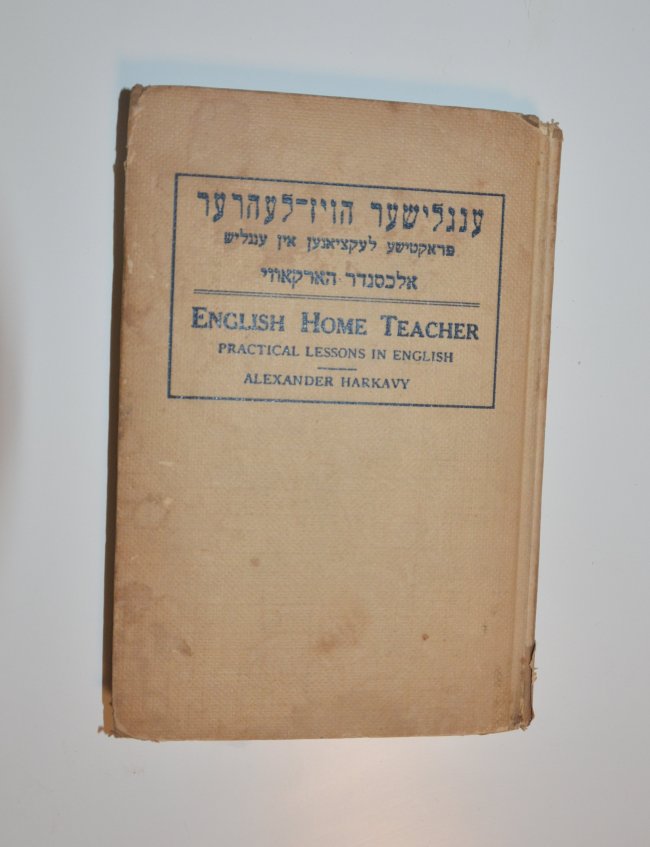
Some time ago, an interesting book came into my possession. English Home Teacher: Practical Lessons in English by Alexander Harkavy had reached me via a circuitous route and with an interesting history. My wife Yona‘s family: her father Meir and mother Tsila together with her mother’s mother and a brother, all Holocaust survivors, had come to Israel in 1949 while the eldest sister remained in Russia. Meir’s entire nuclear family had not survived. A few years later, her uncle and grandmother left for the United States to join her other uncle, also a Holocaust survivor, living there. In 1956, her aunt, Gesia, succeeded in leaving the Soviet Union and spent some years in the States staying with her brothers helping to look after their young children before finally settling in Israel and bringing the book with her.
Man of Words. The Russia-born writer, lexicographer and linguist Alexander Harkevy who after the antisemitic pogroms of 1880 in Russia, joined the Jewish Am Olam (Eternal People) back-to-the-land movement. Unlike Bilu, which directed its activities towards Palestine, Am Olam saw a Jewish future in the United States. In 1882 he emigrated to the US but rather than fulfilling back-to-the-land aspirations, he gravitated to the written word.
Aunt Gesia was fluent in Yiddish, Polish and Russian but the pressing need was to learn English. Caring for her nephews and nieces left little time for formal study. It was then that she acquired the English Home Teacher: Practical Lessons in English. A New Method for Home Instruction: that had been expressly written for Yiddish speakers to learn English.
The book’s author Alexander Harkavy was a most noteworthy gentleman, both talented and industrious. Born in 1863 in Novogrodek, Belorussia, the grandson of the town rabbi, he showed an early interest in languages acquiring knowledge of Hebrew, Russian, Syriac, German and Yiddish. Moving to Vilna at the age of fifteen, he wrote his first work in Yiddish and three years later after the pogroms of 1881, immigrated to the United States.
Beginnings in Belorussia. The town of Nowogródek in Belorussia where Alexander Harkavy was born in 1863. (Photo Shtetl Routes Teatr NN.PL)
Harkavy’s love of Yiddish together with his gift for languages soon crystallized into a vocation. Before making New York his permanent home in 1890, he had led a peripatetic life alternating between Europe and North America helping to found a Yiddish newspaper and a periodical. Once settled in the Big Apple, his literary output was prodigious. With many Jews from Eastern Europe arriving and not having time or opportunity to formally learn the new language, he published Der Englishe Learer (The English Teacher) 1891 and Der Englisher Brivnshteler (The English Letter Writer) 1892 in the “English self taught” genre expressly written for Yiddish speakers and that became immensely popular.
Posing with Peers. Representing the American organization HIAS during a visit to Europe in 1920, Alexander Harkavy (seated, center) posing at a table with fellow representatives from Jewish communal organisations
His talents were not confined to textbooks and in his prolific career, Harkavy translated Don Quixote into Yiddish, revised the King James English Bible, translated it into Yiddish for a dual language version and compiled and contributed to many Yiddish anthologies and publications. Amongst his many other activities, he taught U.S. history and politics for the New York Board of Education and Yiddish literature and grammar at the Teacher’s Seminary in New York. However, his lasting contributions were in lexicography where he compiled Yiddish-English and English-Yiddish dictionaries and the crowning achievement: the Yiddish-English-Hebrew Dictionary (1925) that played an important role in educating East European Jewish immigrants and is in use today.
Yidden Gems. It is partly due to Harkavy’s work that Yiddish today is regarded as a language. His Yiddish dictionaries show that its vocabulary is as ample as that of the average modern language, and that, if lacking in technical terms, it is richer in idiomatic and characteristic expressions.
The English Home Teacher: Practical Lessons in English first published in 1921 and reprinted in 1929 is both a fascinating and enigmatic book. The 272 pages contain 50 lessons each of which commences with a short passage in English, each word accompanied by its translation and a pronunciation guide. It is then followed by a grammatical exposition very often having no connection to the passage itself. Naturally, all the explanations and pronunciations are in Yiddish in Hebrew script.
To put it mildly: didactically, the book is no great shakes. In fact, it would make the eyebrows of a modern and trained English teacher curl! There is no logically graded structure and progression, no revision or reinforcement. In the very first lesson, the neophyte English learner is served a heady brew of past simple active and passive and present perfect tenses plus comparison of adjectives! Moreover, as the pronunciation guide for each English word in the text is written in Yiddish, it would have been interesting to hear someone’s first attempts at enunciation. Nevertheless, it should be borne in mind that this book was written over a century ago when the science of language teaching had barely emerged from its swaddling clothes.
After four decades in the USA, Harkavy was well versed in the contemporary culture, fluent and well read in the vernacular. With his home in New York, he was thoroughly conversant with the current trends of American society. Moreover, he was also on intimate terms with the immigrant experience of his co-religionists and knew full well the basic English required in order to survive and make a living in this new and daunting land.
Well-traveled Book. Expressly written for Yiddish speakers to learn English, Alexander Harkavy’s ‘English Home Teacher’ found its way into the writer’s wife’s family and finally ended up in Israel.
Logic dictates that the English be modern, the passages be relevant and the vocabulary be practical and utilitarian to enable the user to interact and communicate with his/her surroundings. Therefore, it is most puzzling to read the contents of the introductory reading passage in each lesson where the writer has chosen to take the opposite tack. The majority of them are anecdotal, often piquant and pithy with a moral attached whilst others are homiletic. Furthermore, their contents are mainly drawn from early Victorian England with the corresponding vocabulary. It demands a great stretch of the imagination see how archaic terms such as: “a droll fellow, to dine, a duke, an incision, the latter, a witty idler, a tankard, a draught, taken counsel, took lodging, a roguish companion, whereupon” etc. etc. could be put to daily use or even understood in the Bronx.
What were Harkavy’s motives in choosing the texts?
Was he trying to show off and impress his readers with his erudition and grasp of English? This doesn’t seem likely as he was well known and highly regarded in the community and his learned reputation went before him.
Harkavy, having grown up in the world of Talmud studies, was familiar with the tradition of exegesis, wit, pilpulim (hair splitting argumentation and debating) and knew that many new immigrants from Eastern Europe had a similar background. Possibly, he chose the reading passages to appeal to their tastes for most of them are witty, humorous and thought provoking. The introductory passage to the third lesson begins:
A lunatic in an insane asylum was asked how he came there, and he answered: “The world said I was mad, I said the world was mad and they outvoted me.”
Much food for thought!
The English Home Teacher: Practical Lessons in English was first published in 1921, a year that boded ill for the millions of Jews wishing to flee the persecution, pogroms and mass murders of Eastern Europe and the Baltic states and seek a haven on safe shores. There had been a shift in American public opinion and sympathy for all those displaced and stateless had become a fear of being swamped by a wave of impoverished immigrants, feeble in body that would cause the growth of slums, expose workers to cut throat wage competition and endanger American standards of living. That same year, with the passing of the Emergency Quota Act, the United States had declared a moratorium on its immigration policies and had begun to drastically restrict the number of newcomers with Australia, Canada, South Africa and other countries following suit.
Food for Thought. The first lesson in Harkavy’s book – first published in 1921 – is about eating dinner.
With his finger on the pulse, Harkavy was no doubt painfully aware that the Jewish newcomers from Eastern Europe fitted the popular and biased stereotype of the unskilled and indigent immigrant with his/her broken or non-existent English. Maybe he felt that his book offering reading passages on a ‘high level’ would enable its students to acquire a more sophisticated vocabulary with better communication skills to dispel this negative image, ease integration and aid their entry into the work market.
In the archives of ANU (the Museum of the Jewish People) situated on the campus of the Tel Aviv University, there is a film of his visit to Novogrodek in the early 1930’s. The atmosphere was festive for here was a native son who had made good in the Goldene Medina returning as a celebrity to pay his respects to his birthplace. The feted guest was escorted around town and proudly shown the Jewish institutions: the mikveh (ritual bath), the synagogue, the yeshiva and the Talmud Torah with the little children studying diligently at their tables.
Covers a lot of Ground. The cover of Harkavy’s book that must have prepared so many Yiddish speaking immigrants from Eastern Europe to the USA.
The film is bittersweet and very sad and serves as yet another testimony to Jewish presence wiped out during the Holocaust. In 1941, the German army occupied the town and the 10,000 Jewish inhabitants – men, women and children – who comprised half of the town’s population, were ultimately murdered with the assistance of local collaborators. Harkavy was spared the agony of hearing this terrible news.
He had passed away in New York in 1939.
About the writer:
Stephen Schulman is a graduate of the South African Jewish socialist youth movement Habonim, who immigrated to Israel in 1969 and retired in 2012 after over 40 years of English teaching. He was for many years a senior examiner for the English matriculation and co-authored two English textbooks for the upper grades in high school. Now happily retired, he spends his time between his family, his hobbies and reading to try to catch up on his ignorance.
While the mission of Lay of the Land (LotL) is to provide a wide and diverse perspective of affairs in Israel, the Middle East and the Jewish world, the opinions, beliefs and viewpoints expressed by its various writers are not necessarily ones of the owners and management of LOTL but of the writers themselves. LotL endeavours to the best of its ability to credit the use of all known photographs to the photographer and/or owner of such photographs (0&EO).
The Jewish festivity of Shavuot brought back memories of a kibbutz in Israel’s South and its South African connection
By David E. Kaplan
“Where you spending Shavuot?” I asked my physiotherapist as I lay flat in his clinic in Ra’anana while he worked on my recalcitrant right knee. Known as the Jewish “feast of weeks” – although celebrated over one day – Shavuot commemorates the revelation of the Torah on Mt. Sinai to the Jewish people and celebrated with families eating dairy food.
“I’ll be spending it with my family, my parents, where I was born and grew up – on the kibbutz.”
“Which kibbutz?” I ask.
“Revivim. It’s in the south. You ever heard of it?”
If Shavuot is a festivity of revelation, there was more revelation to follow.
Not only had I heard of it, I knew all about it having written years earlier about its South African connection that so few know, in particularly its connection to the small town of Parow, outside of Cape Town, where I grew up until the age of four.
Family Ties. With the old British Mandate police station at Kibbutz Revivim in the background – that in June 1948 a Palmach Brigade took at heavy cost from the Egyptians – pose the descendants of the Cape Town/Parow Berold family with the late Freda Pincus (née Berold) seated in the centre. Freda’s parents from Parow, South Africa, donated the land for Revivim.
The story begins in the 1930s when Jewish aspirations and nationalism were aroused by Zionist leaders touring Jewish communities around the world inspiring the rebirth of Jewish sovereignty in biblical Palestine. They were followed by emissaries of the JNF (Jewish National Fund) encouraging Jews to invest in the future Jewish state by purchasing land in Palestine. One of the communities they focused on was South Africa and history records their efforts were well spent. One such inspired family was Barney and Fanny Berold from Parow, a developing town outside Cape Town. Barney was a successful industrialist who owned and ran Plywoods – Parow’s first factory. My late father, worked at Plywoods who used much of his salary of £12 a month (later raised to £15) to support a fledgling ‘Cape Gate Works’ of which he was a cofounding partner – Parow’s second factory – to survive. Cape Gate was started in 1929 during the Great Depression, and according to my Dad, that in the early months apart from his salary at Plywoods, “our only income came from selling petrol from a manually operated pump.”
“NOTHING THERE”
A few years before the passing of Freda Pinkus in Jaffa, Israel, the then 94-year-old daughter of Barney and Fanny Berold, revealed to me in an interview her parent’s love for the Jewish homeland, “not yet Israel.” At a time when few visited Palestine, could even afford to travel there, “My parents visited Palestine twice in the 1930s, first in 1932 and then 1936 when they met the Zionist activist Avraham G r a n o v s k y. Later he changed his name to Granot and would be a signatory to the Declaration of Independence, a member of the Knesset and chairman of the JNF. However, back in 1936, the JNF were negotiating with an Arab to buy his land in the Negev when this South African group with my parents arrived and Granovsky asked if anyone was interested in buying it.” The British Mandate Authority allowed Jews to purchase land, but not to establish settlements. “The land was totally out of the way, a desolate landscape some 36 kilometres south of Beer Sheva. There was nothing there except a British Mandate police station. During World War II, a large British army base was established, which served as a stopover from Suez to the centre of the country. Anyway, as far as I know, my father was the only one interested and he bought 825 dunams. Of course it did not sound financially attractive, but my father was a Zionist. He was not investing for profit but in the future of the Jewish People.”
Champion of the Desert. To offer encouragement, Chairman of the Provisional Government of Israel, David Ben Gurion (right) visits Revivim in 1943.
A few months later, “he passed away in Parow and my Mom returned to Parow. In 1939 our family received transfer of the property.” This might have been the end of the story until Freda’s brother George Berold, while stationed in Egypt during WWII “took leave to visit Palestine. He went to see Granovsky hoping to see the land and report back to the family in South Africa. Granovsky dissuaded himsaying that there was a war on and there were no roads to reach this area. Probably the only way to reach the area was on camel, which I imagine would not have been too appealing to my brother with only a few days leave! Anyway, Granovsky then asked George if the family would consider donating the land to the JNF for the purpose of establishing a kibbutz.” It was quite a daring idea as it would be the southernmost kibbutz at the time with no access to piped water. It would demand of its members immense grit, determination and vision. It would also require the acquiescence of the Berold family of Cape Town. George said he would discuss with the family who all agreed. “This was the land that the JNF gave for the establishment in 1943 of Kibbutz Revivim.”
However, it was not so simple.
Pulsating Progress. Bringing water to the area meant survival. Revivim reservoir in 1946 with the old fort in the background.
DESTINY IN THE DESERT
While the small group received the Berold parcel of land to fulfill their dream of settling the Negev, they had to be careful as permanent settlements were illegal. To circumvent British Mandate regulations, Revivim was established as an “Agricultural Research Station” and formally named ‘Mitzpe Revivim’ or ‘Revivim Lookout’. Settlers pretended that the antenna they used for radio contact was essential in “testing climate conditions”, and were so convincing that the British bought the story. The radio was hidden in a first-aid kit!
A Golda Moment. Actress Anne Bancroft (right) is shown around Kibbutz Revivim by Golda Meir (left), whom she is to portray in the Broadway production “Golda” – a play by William Gibson based on Mrs. Meir’s “My Life”.
The first settlement began with only three men and as the research station slowly grew, eventually women were allowed to join. One of these brave women was Golda Meir’s daughter. The stars were not only a fascinating desert night sighting. They sometimes appeared to on the ground as it did when Hollywood star, Anne Bancroft was shown around Revivim by Israel’s former premier, Golda Meir.
However, in the 1940s, Revivim was isolated and fraught with danger.
Determined in the Desert. Six years after settling on the land, young Revivim residents at the time of Israel’s independence in 1948.
Battling the elements was tough but soon they would have to confront a new enemy – their fellow man! A portent of what was to come occurred in December 1947 when a Kibbutz Revivim car was ambushed and three members of the kibbutz were killed. Then in 1948, Revivim became the center of Israel’s defense of the Negev during the War of Independence. An airstrip was built to fly in supplies and the caves which were once home to the pioneers became the field hospital and main base. Kibbutz members valiantly withstood heavy Egyptian attacks and 34 soldiers, including one woman, fell in the ensuing fighting, all recorded in a museum there today.
Battling with the Basics. View of Revivim with underground ancient Nabataean caves, pitched tents and fortified building on top of the hill.
Riveting Revivim
After the war, Revivim emerged as a pioneering center for desert agriculture. It played a huge part in the massive success Israel has had in making the desert bloom and the story of its development as revealed in its Mitzpe Revivim Museum popular to tourists, presents a colorful insight of a hard-fought journey won. It mirrors the journey of modern Israel. My physiotherapist regaled me the stories of his youth on Revivim:
“What a wonderful place to grow up. I knew nothing of life outside the kibbutz. The kibbutz was our world. We didn’t watch TV; I had many friends and we played and explored and built things and developed a feeling of camaraderie. Everyone on the kibbutz ate together in the chadar ochel (communal dining room) and where we celebrated together the chagim (festivities). I am proud to say, the kibbutz today is still mostly a collective, adhering to its founding principles. I always look forward to returning. I’m not only visiting my parents but revisiting the values of what I still hold dear.”
Sabras planting Sabras. Planting cacti on TuBishvat on Revivim some years back, are the children of former South African Wendy Cohen- Solal (née Israel from Parow)
PRESENCE OF PAROW
Google Kibbutz Revivim and you will find that it was established in 1943 by a youth movement group from Rishon LeZion that included new immigrants from Austria, Germany and Italy on land given to them by the JNF. You have to deep search to extract from whom the JNF acquired it, that is, the Berold family from Parow.
Even many who live there are unaware of the South African connection to their home. One such was Joyce Friedman (née Kanowitz) from the USA who was born in Pretoria, South Africa in 1943 and when she was 18, immigrated to Israel and moved to Revivim where she became a member. She wrote to me some years ago following the publication of my first article on Revivim:
“When the 1967 war broke out, many groups of volunteers arrived, amongst them South Africans and it was my job to be their madricha [leader]. They did well for themselves and I was proud of them.
After living in Israel for 12 years, l met my husband who is an American, and we got married at Revivim. After two years, we moved to the USA in 1974.
Recently, my nephew in Israel sent me a copy of your article regarding Kibbutz Revivim and the financial link between it and the South African Jewry. It made for very interesting reading as this was the first time l had ever heard about it. Even while being on the kibbutz, no one had ever told me about the funding. Funnily enough my cottage faced the old fort, so l was constantly reminded of the kibbutz’s history.”
Revivim Relic. While today a relic of the past, it was once the kibbutz’s lifeblood bringing in supplies when it was cut off from the rest of the country.
Revivim has another connection to Parow in Wendy Cohen-Solal. born in Parow to Ivan and Raiza Israel and who settled on the kibbutz. In subsequent visits to Revivim during the 1950s, Fanny Berold kept up the connection with the kibbutz her family made possible, by donating money towards a rose garden and a library. During the 1967 Six Day War and the aftermath,” said her daughter Freda, “there were many Southern African volunteers on Revivim; I’m sure some of them, their forebears, could have come from Parow.” Today the kibbutz is held in high regard for its pioneering use of saline and brackish water. One of its members, Yoel de Malach, received the prestigious Israel Prize for his efforts in this field. Despite being a desert kibbutz, Revivim’s dairy farm once won the prize for the largest quantity of milk produced by any farm in Israel. No less surprising it also has a “fish farm” – in the desert!
On the occasion of Revivim’s 75th anniversary some years ago – the Pincus and Berold families were honoured for their family’s enriching history embedded to the kibbutz no less embedded than the Negev’s desert rock. While many Jews donated money to buy land in Israel, “As far as I know,” said Freda, “Revivim is the only case of actual privately-owned Jewish land being donated for this purpose.”
By George! While stationed in Egypt during WWII, George Berold visited Palestine hoping to see the land his parents had bought years before in the Negev and which he was encouraged to impress upon his family back in South Africa to donate for a strategically important kibbutz for an emerging Jewish state.
From Cape Town’s ‘Northern Suburb’ to Israel’s southern desert, South Africans have been fulfilling the prophesy of Isaiah that in “A dry and thirsty land, where there is no water” they shall make the desert bloom.
While Revivim became the heart of the Negev it was the heart of South Africa’s Berold family that made it all happen.
While the mission of Lay of the Land (LotL) is to provide a wide and diverse perspective of affairs in Israel, the Middle East and the Jewish world, the opinions, beliefs and viewpoints expressed by its various writers are not necessarily ones of the owners and management of LOTL but of the writers themselves. LotL endeavours to the best of its ability to credit the use of all known photographs to the photographer and/or owner of such photographs (0&EO).
Still defining who and what it is, Israel at 75 is plugging full steam ahead
By David E. Kaplan
Yom Ha’atzmaut has arrived this year at a time of internal turmoil and uncertainty. If the flags are out every Saturday night in justifiable protest – in my view – they will be out this Independence Day in no less justifiable pride as we celebrate how far we have come despite the challenges. It’s okay if at 75 the country is still trying to work out what it’s going to be when it grows up.
Determining Direction. Israelis take to the streets in weeks of protest to determine the country’s future.
Looking back to 1948, the naysayers and voices of gloom were lining up at the starting block warning that we stood no chance. Just review the choice of words of US Secretary of Defence, James V. Forrestal who was trying to influence President Truman not to support the Jewish state’s quest for independence:
“You fellows over at the White House are just not facing up to the realities in the Middle East. There are thirty million Arabs on one side and about six hundred thousand Jews on the other. It is clear that in any contest, the Arabs are going to overwhelm the Jews. Why don’t you face up to the realities? Just look at the numbers!”
It’s not only about the numbers.
Polly the Pioneer. Polly Resnick kneeling (right) on the refugee boat she took from Italy to Palestine in 1938. Seated on her right is the famous Zionist leader, Menachem Ussishkin.
I thought of some of the early South African pioneers I have interviewed over the years like Polly Resnick (née Salber), ordinary people caught up in doing extraordinary things. Arriving from Cape Town to Haifa in 1938 on a small refugee boat, she boarded a bus to Tel Aviv. Chugging along the old coastal road, “we were not yet halfway to Tel Aviv when the bus driver told us to get quickly under our seats because we were being shot at. Bullets whistled through the windows. So this was my warm welcome to Palestine.” I loved her story, when later married and living in Jerusalem, a British officer came to her door. “It was during the curfew soon after the bombing of the King David Hotel and he asked, “Madam, do you speak English? I wanted to say to him thatI speak a better English then him but instead, I invited him in and seated him on the couch which underneath was hidden five rifles.” Polly had had been a member of the Haganah since her early days living with her aunt in Tel Aviv. Now she thought:
“Oh my God, if he finds these firearms, not only will they be confiscated, I WILL BE CONFISCATED!” My heart was pounding. I offered him a cup of English tea to which he replied, “Oh Madam, I would love it.” We sat and chatted. All I wanted to do was get rid of him, and he asked if he could please have another cup of tea. I was crazy with fear and all the while my neighbours were shouting to me in Hebrew from their balconies, “Don’t worry Polly; It will be alright. You’ll be okay.”
Meanwhile soldiers were swarming the road and randomly searching houses for firearms. “Finally, he finished his second cup of tea and left with a smile. Little did he know he was sitting on the very illegal items he was searching for.”
Well, sometimes you have to look beyond the numbers that Defence Secretary Forrestal alluded to but to the core values and the will of the people at the time. I recall when moderating a debate in 2015 at a WIZO conference at the Hiton Tel Aviv, to my question “How relevant today is Zionism to the lives of Jews both living in Israel and in the Diaspora?” the Deputy Mayor of Jerusalem Rachel Azaria, answered as follows:
“There is a lovely story of two chalutzim (pioneers) on their kibbutz, Afikim, while under siege during the War of Independence. While shells were falling all around them, they spoke of establishing a state, not caring if it lasted one day or more but it had to come into being. That was their task. After the war, every year on Yom Haatzmaut, whenever they walked passed each other on the kibbutz, they would defiantly hold up the number of fingers displaying how old Israel was. As the years wore on, they would run out of fingers and smile. They got the job done and it was now up to the next generation to secure it.” And so it has been, continued Azaria, “that each generation since independence was confronted with “getting the job done’.”
How Wrong Was James. Defence Secretary James V. Forrestal warned the American administration that there no millage in officially supporting a Jewish state as it had little chance of surviving a combined Arab attack.
And while that is still the case today of “getting the job done”, today’s generation – as we pass further from the defining epochs of the Shoah (Holocaust) and the independence – need to figure out who we are, what we stand for and to define our Zionism that will have traction for future generations. In part that is what the national protests are about, which at this Yom Haatzmaut is now into its 17th week.
But where one can look at the ‘numbers’ to see where today’ generation is taking Israel, look no further than today’s news headline:
Israeli high schoolers sweep international math competition
“In a historic first,” the report read in The Jerusalem Post, that “an all-female team of young Israeli mathematics students took home every medal possible at the European Girls’ Mathematical Olympiad (EGMO) in Slovenia. These young Israeli math enthusiasts won the gold, silver, and bronze medals after competing against 214 contestants from 54 countries worldwide.
Number One in Numbers. Israel’s female winning team at the European Mathematics Olympiad for Girls. Since Israel’s involvement in the competitive series began in 2012, Israeli female math enthusiasts have won an impressive 19 medals in the Olympiad. (credit: FUTURE SCIENTISTS CENTER AND MINISTRY OF EDUCATION)
Not only was this an extraordinary achievement for these young students, but one student, in particular, stood out from the crowd. Participant Noga Friedman not only took home the gold medal for her achievements but ranked 1st, competition wide with a “perfect score.”
Its also an extraordinary achievement for Israel.
So yes, we ‘do the math’. Israel at 75, despite the challenges, has the talent and the temerity to continue: “to get the job done”.
While the mission of Lay of the Land (LotL) is to provide a wide and diverse perspective of affairs in Israel, the Middle East and the Jewish world, the opinions, beliefs and viewpoints expressed by its various writers are not necessarily ones of the owners and management of LOTL but of the writers themselves. LotL endeavours to the best of its ability to credit the use of all known photographs to the photographer and/or owner of such photographs (0&EO).