There are words here that will direct you to look away – DON’T! You need to read, process and bear witness.
By Rolene Marks
[Warning: Sensitive Content]
In 2024 I was invited with a small group of journalists and diplomats to view some of the evidence that was found on the terrorists on 7 October and what was subsequently discovered in the Gaza strip. Under close supervision and military intelligence headquarters, we viewed weapons, maps, books and material – and orders in specific detail to commit acts of appalling sexual violence, including instructions for the victims to remove their clothing.
This article will be extremely uncomfortable and difficult for many to read. I appeal to you to please persist – we must bear witness and be the voices of victims and survivors.
Ushered into another room, phones prohibited, we were shown a 20-minute collation of footage from Hamas body-cam, first responders and desperate family members searching for their loved ones. This we were told, would be evidence submitted to the ICJ where South Africa had filed a case accusing Israel of genocide. The images are seared into my conscience – including that of a partially burnt woman, her legs splayed, dress pushed up and naked, intimate parts for the world to see. There was a slice across her one thigh. I recall another image that I see as clear as day. The body of a woman, on top of a pile of corpses, bleeding from her crotch where she had been shot with the deliberate intent to defile her femininity.
A picture taken during a media tour organized by the Israeli military shows food on a table inside a burned house in the kibbutz Nir Oz on October 19, 2023, following the October 7 attack by Hamas. (Photo: Menahem Kahana / AFP)
The evidence of what I saw is undeniable.
These are two specific examples of the horrific crimes of Sexual and Gender based Violence (SGBV) and crimes against humanity committed against Israeli men, women and children on 7 October 2023 and to hostages in captivity.
Despite irrefutable proof noted in reports by UN Women, the Dinah Project and one from the Association of Rape Crisis Centres, denial, downplaying and even justification of the atrocities still continue – including from feminist organisations. It would appear that the voices of victims matter – unless they are Israeli. What message does this send future victims of SGBV?
This week, the Civil Commission – an independent Israeli non-profit organisation led by human rights expert and 2024 Israel Prize laureate Dr Cochav Elkayam-Levy – released their report. “Silenced no more” was meticulously documented and referenced for over two years and is a devastating collation of the crimes against humanity and SGBV committed on that day and to hostages in captivity.
Children were no less a target for Hamas savagery as seen here at a blood-stained kindergarten in Kibbutz Beeri following their bloody barbarous rampage. (Photo: Reuters/ Amir Cohen)
The report is close to 300 pages long and contains documentation of at least 10,000 items including videos, photographs, forensic findings and the testimonies of 430 victims and survivors. Hamas proudly filmed and distributed evidence of their crimes. The hope is that not only will this be documented to fight back against denial – but could lead to further legal action against the perpetrators. Israel’s Knesset has approved the convening of a special tribunal to try the perpetrators of 7 October.
The individual testimonies are absolutely devastating.
In the weeks and months following the atrocities, eye witnesses and forensic experts testified about what they witnessed. Forensic experts spoke about the condition of the bodies that were brought in for identification, saying how they were shot in their eyes, their faces and their breasts, and even targeted in their most intimate parts. Women were stripped, bound, stabbed, shot and burned. Heads were decapitated and pelvic bones shattered. Even after death, sexual assault continued. A Nova survivor testified to a victim being shot in the head while her rapist continued his assault. The intention was clear – to destroy their beauty and femininity. Forensic pathologists spoke of an “obsession with sex organs”. First responders echoed the same sentiment and have addressed numerous NGO’s and global institutions sharing their testimonies to the defilement and horror they saw on the kibbutzim, road 232 and at the Nova festival grounds.
Raz Cohen, a survivor of the Nova Music Festival on October 7 and a key witness to the horrific acts committed by Hamas terrorists provided detailed testimony which included witnessing the rape of a young woman. (Photo: Tomer Shunem Halevi, Hagai Dekel)
“I saw them raping her,” says Raz Cohen, who escaped the Nova Music Festival, “Then they murdered her. And then they raped her again.”
New report details ‘systematic’ rape and sexual violence during Hamas’ Oct 7 attack on Israel. Seen here is an Israeli soldier patrolling the Nova Music Festival sites following the massacre. (Photo: Aris Messinis/AFP/Getty Images)
Eden Wessely, who came to Nova to rescue a friend, found and filmed a naked, burned body. “Her dress was pulled up, and she wasn’t wearing underwear, not because it burned, because there was no trace. . . . Her legs were spread. Her genitals were exposed.” Was it the same image I saw?
“There were horrific scenes, difficult to take in,” said Eden Wessely who saw “hundreds of corpses, and a girl who had been raped and [her body] burned. Things that human eyes have difficulty looking at.”
Former hostages have spoken about the abuse they suffered in captivity. Guy Gilboa-Dalal spoke about how he was touched on his private parts and how his captor “wanted to make a porn movie with him.” Arbel Yehud testified to daily abuse.
Keith Siegel, a 66-year-old grandfather who was taken from Kibbutz Kfar Aza along with his wife Aviva, 65, testified that he was made to undress in front of a terrorist who then shaved his pubic hair and made comments about his penis.
Former hostage Aviva Siegel seen here speaking to CNN’s Wolf Blitzer reveals in the Civil Commission Report how she was nearly executed after she comforted a young girl who was sexually assaulted in captivity.
Aviva Siegel spoke about how she was nearly executed after she comforted a young girl who was sexually assaulted in captivity. Siegel recalled telling young girls to take feminine products with them to the bathroom so that if their captors thought they were on their period, they would not abuse them.
A male says he was gang-raped at the Nova site, providing medical records and a detailed account:
“They laughed, they were really pleased, as if I was their sex doll.”
The Commission also identified thirteen recurring patterns of sexual and gender-based violence repeated across multiple sites. They include a damning list of crimes:
* Rape, gang rape, and other forms of sexual assault.
* Sexual torture, including intentional burning and mutilation.
* Deliberate shooting in the head, face and genital area.
* Killings and executions following or committed during abuse.
* Postmortem sexual abuse, humiliation, and the desecration of bodies, including cutting off body parts.
* Forced nudity and exposure including to family members.
* Handcuffing, binding, and restraint of victims.
* Public displaying and parading of women and children. One such example is the parading of the body of Shani Louk, whose partially undressed and twisted limbs were paraded on a truck in Gaza while men spat at her.
* Abduction of mothers and children.
* Sexual violence in the presence or near vicinity of family members including Kinocide – the deliberate targeting and destruction of families as a weapon of war or terror, recognized as a distinct form of violence against humanity.
The graphic image by freelance AP photojournalist Ali Mahmoud depicts 22-year-old Shani Louk’s half-naked body being taken by Hamas terrorists on October 7. The Jewish Chronicle has blurred her image. (Photo: Ali Mahmoud)
* Filming and digital dissemination by the perpetrators including the use of social media to document, glorify, and amplify the atrocities.
* Threats of forced marriage.
* Rape and other forms of sexual violence against boys and men.
President Herzog released a statement on social media platform X on behalf of his wife, Michal, who said:
“We must continue to amplify around the world the voices of the victims of sexual violence committed by Hamas terrorists on October 7th and thereafter.”
Mrs. Herzog commended the Civil Commission on October 7th Crimes against Women and Children “for their dedicated research and tireless work, resulting in the publication of an important new report that once again gives voice to the victims.”
The victims and survivors of these most evil of crimes will no longer be silenced by those who deny, downplay and justify the atrocities committed by Hamas. Please do not look away. As unbearable as the testimonies are to read and hear, we must bear witness. We have a moral duty to be their voices. Silence is a second violation.
While the mission of Lay of the Land (LotL) is to provide a wide and diverse perspective of affairs in Israel, the Middle East and the Jewish world, the opinions, beliefs and viewpoints expressed by its various writers are not necessarily ones of the owners and management of LOTL but of the writers themselves. LotL endeavours to the best of its ability to credit the use of all known photographs to the photographer and/or owner of such photographs (0&EO).
How do young Brits who display poor understanding of their own history, emerge so ‘knowledgeable’ about Jews – enough to hate them?
By David E. Kaplan
I was stunned! Why?
VE (Victory in Europe) Day falls Friday, 8 May 2026. It commemorates the end of WWII in Europe in 1945, and is marked by community commemorations and events that traditionally include a parade starting at Parliament Square around 12:00 PM and a fly-past over Buckingham Palace at 1:45 PM.
So, on the Tuesday preceding this proud national celebration of the downfall of Nazism in Europe, while watching the British news channels, I sat in disbelief as one young adult after another – the so-called Gen Z – was randomly asked in a national poll in cities across the UK the question:
“What does VE Day represent?”
Most were clueless!
While all polled were well-spoken and seemingly well “educated”, it was nevertheless a question that had most of them stumped.
Many guessed and most wrongly. One confused Gen Z Londoner claimed it was “basically the red poppy day.”
The Day Young Brits Forgot. GB News interviewing Gen-Z Britons on whether they knew what VE Day is.
Even more telling was the way they treated the question as having little to no meaningful relevance in their lives. The sacrifice made by their grandparent’s generation hardly resonated.
Back in the studio, the two news co-anchors at GB News as well as those they had on as panelists – albeit of an older generation than those polled – sat distressed and asked themselves:
“How has our education system failed us?”
Britain’s “Greatest Generation” seemed forgotten by today’s generation.
All this follows a 2026 poll conducted by the Royal British Veterans Enterprise (RBVE) and Opinium, revealing a significant portion of younger generations unaware of what ‘VE Day’ represents. The survey foundthat:
“…two-thirds (66%) of Gen Z adults in the UK do not know that VE Day marks the end of the Second World War in Europe.”
Sad Situation. A survey by the Royal British Veterans Enterprise (RBVE) found that while 63% of UK adults know VE Day marks the end of the Second World War, only 34% of Gen Z do. The poll also showed that although 80% consider VE Day important to British identity, fewer than a quarter believe younger generations truly grasp veterans’ experiences. (Photo: The Independent)
I though as I sat and processed this ignorance, never mind 26-year-old Brits but 6-year-old Israelis know of Yom HaZicharon (Day of Remembrance) commemorating all those killed in defense of the State of Israel or were killed in acts of terror as well as Yom HaShoah, (Holocaust Remembrance Day) commemorating the murder of 6 million Jews during the Nazi Holocaust. Israelis of all ages know their history. They cannot afford the luxury of not knowing.
Cultural Amnesia. After this Gen Z interviewee was corrected thinking VE Day is “an anniversary of the First World War?” she then argued: “I wouldn’t say it’s necessarily the most important lost knowledge, but in terms of being aware of past conflicts in order to prevent future ones is probably a good thing. But how is it celebrated; I don’t know…”
All this begs the question:
With a shallow understanding of their OWN history as revealed in the recent poll, how is it that Britain’s Gen Z seem to feel sufficiently informed on the history of the Middle East to take to the street with such collective aggression against the Jewish state?
Is it feasible to believe that those who are ignorant of what VE Day stands for truly understand the meaning and implications of the banners they hold up, such as “Globalize the Intifada”, “Zionism is Racism”, “Death to the IDF” and “From the River to the sea”.
Other statistics are no less disturbing. This past May, a poll conducted by ‘More in Common’ for the Jewish News found that 40% of British voters surveyed agreed that Britain would be “neither better nor worse off” if Jews left the country.
Clueless. “I don’t know what it is and I’m Gen Z. What is it?” replied this young woman to the question ‘What is VE Day?’
Released in the wake of a string of violent antisemitic attacks, the polling found that only 32% of those surveyed believed Britain would be “much worse off” if Jews left. This concerning metric on the state of antisemitism in the UK should come as no surprise following a March poll conducted by the Union of Jewish Students (UJS) that revealed that one in five (20%) university students in the UK would be reluctant to, or would never, share a house with a Jewish student. The survey, published on March 16, 2026, and conducted by JL Partners, surveyed 1,000 students across 170 institutions between late January and early February 2026 and painted a picture of “normalized” antisemitism on UK campuses.
Revolting Reversal. While their grandparents and great-grandparents might have fought against those that mass murdered Jews, these youngsters today support those who massacre Jews. Protesters outside King’s College London in London on October 7, 2025, the second anniversary of the deadly Hamas-led attack on Israel. (Photo: Justin Tallis/ AFP)
The survey further revealed that nearly one in four respondents (23%) have seen behavior that targets Jewish students for their religion or ethnicity, while almost four in 10 (39%) who “witness regular Israel-Palestine protests” have seen frequent harassment of Jewish students.
In addition, close to half polled heard chants or slogans “glorifying Hamas, Hezbollah or other proscribed groups on campus” (49%) or seen justification of the October 7, 2023, massive massacre of Jews orchestrated by Hamas (47%).
With attack on Jews and their property in the UK reaching “unprecedented” levels, Prime Minister Starmer said in a televised address to the nation:
“People are scared, scared to show who they are in their community, scared to go to synagogue and practice their religion, scared to go to university as a Jew, to send their children to school as a Jew, to tell their colleagues that they are Jewish, even to use our NHS. Nobody should live like that in Britain, but Jews do.”
Is it any wonder in a survey conducted by Campaign Against Antisemitism in late 2025 found that a majority of British Jews (61%) had considered leaving the UK over the previous two years due to rising antisemitism.
Jews in the UK – An Endangered Species. People attend a rally organized by Campaign Against Antisemitism opposite Downing Street in central London on April 30, 2026. (Photo: Carlos Jasso—Getty Images)
As I write, news comes through of a “Stamford hill Antisemitic Incident” where a male suspect onboard a London bus threatened Jewish passengers, shouting “Shame Hitler didn’t kill you” and “You should all go in the gas chambers”, while making threats to kill Jewish children and claiming to have a knife.
As this May 8 on VE Day when millions of Britons will commemorate those who identified and stood against the forces of evil, one wonders what the people of that generation would think of today’s generation when Jews today are still not safe – not from Nazis but from residents of Britain!
While the mission of Lay of the Land (LotL) is to provide a wide and diverse perspective of affairs in Israel, the Middle East and the Jewish world, the opinions, beliefs and viewpoints expressed by its various writers are not necessarily ones of the owners and management of LOTL but of the writers themselves. LotL endeavours to the best of its ability to credit the use of all known photographs to the photographer and/or owner of such photographs (0&EO).
If the West cannot stand with its Jews when they are threatened, blamed and smeared with recycled blood libels, then we are dead as societies.
By Andrew Fox
I am done pulling punches. This will not be an easy read. Do not look away.
Fuck this. I am furious at the antisemitism pouring through the West, confident and shameless, and at those who know it is wrong, yet sit by and let it happen and say or do absolutely nothing.
View at burnt Ambulances in a car park at Golders Green in London, Monday, March 23, 2026, after an apparent arson attack on four vehicles belonging to a Jewish ambulance service, Hatzola Northwest, in London. (Photo: Alberto Pezzali/AP)
In Britain, we have already had Jews and their security guards stabbed to death. Jewish ambulances were set on fire. Now we have had multiple synagogue fire bombings in London. I woke this morning to a WhatsApp message from a Jewish friend I treasure, telling me about the latest atrocity against British Jews. I am sick of this. I am sickened by it, and I do not understand how anyone with any decency is not sickened too. Why are we not angrier?
Jewish people are being forced to answer, again, for every accusation, every fantasy, every blood libel hurled at the State of Israel. A Jewish student in London, Paris, New York or Melbourne is treated as if they sat in the Israeli war cabinet. A synagogue is treated as if it were a military installation. A kosher restaurant becomes a proxy battlefield. A Jewish child in a school uniform is expected to carry the moral weight of a war they did not start, a government they did not elect, and a region most of their accusers could not find on a map without help. It is grotesque. It is ancient hatred with new slogans. I am angry, and you should be too. If you are reading this, why the fuck are you not angrier?
A 45-year-old Muslim man goes on a rampage in Golders Green looking for Jews to stab. Antisemitism is being ‘normalised’ and not taken seriously enough, chief rabbi tells BBC. (Photo: Screen shot from BBC)
Holocaust survivors have told me in person that the atmosphere in Britain today is like 1930s Germany. Why will our leaders, our government, our legal system not listen to them? The Holocaust did not arrive fully formed. It started with demonisation, isolation and undeserved blame.
Wake. The. Fuck. Up.
The blood libels are back. They have just been laundered through the language of activism, human rights and moral urgency. Jews are again cast as uniquely cruel, uniquely conspiratorial, uniquely bloodthirsty. Israel is accused not merely of error, not merely of brutality, not merely of war, but of metaphysical evil. Every casualty is flattened into proof of Jewish depravity. Every complexity is erased. Every Hamas or Hezbollah or Iranian atrocity is contextualised into mist. Jewish grief is interrogated. Jewish fear is mocked. Jewish self-defence is treated as criminal.
The most sickening expression of this is the obscene inversion of the Holocaust in Gaza. Gaza is not the Holocaust. Gaza is not Auschwitz. Gaza is not Treblinka. Gaza is not the industrialised, continent-wide mechanical attempt to exterminate an entire people. Gaza is not the murder of six million people because they were Jews. Gaza is not children selected for gas chambers, families shot into pits, communities erased from Europe, nor names turned to ash. To compare the war in Gaza to the attempted extermination of the Jewish race is an obscene desecration. There is no parallel. None whatsoever.
April 14, 1945 – Pile of ashes and bones found by U.S. soldiers at Buchenwald concentration camp in Germany (Dwight D. Eisenhower Presidential Library)
Civilian suffering in Gaza or Lebanon is simply a feature of war. It can be real without turning Jews into Nazis. War can be horrific without becoming the Shoah. Palestinians can be mourned without stealing the language of Jewish annihilation and weaponising it against Jews. The Holocaust is not a metaphor for anyone’s rhetorical convenience. It was a specific crime, committed against a specific people, at a specific scale, with a specific ideological purpose: the eradication of Jews from the earth. To invert it against Jews now is morally obscene.
Everyone in the West should stand with their Jewish neighbours. They should stand with Jews because Jews are being threatened, harassed, isolated and collectively blamed for the actions of a state. They should stand with Jews because history has already shown us where this road leads when decent people find a thousand elegant reasons to look away.
April 12, 1945 – Bodies of prisoners of Ohrdruf concentration camp stacked like cordwood (Dwight D. Eisenhower Presidential Library)
Silence is permission. When Jewish schools need guards, when students hide Stars of David, when families wonder whether it is safe to walk to synagogue, and when mobs chant slogans that make Jews feel hunted in the cities they call home, when Jewish ambulances and places of worship are being firebombed, the moral test is not complicated. Stand with Jews, or admit that your principles are worth piss in the wind.
The absence of solidarity is a stain. The refusal to name antisemitism because it wears a fashionable political mask is a stain. The cowardice of institutions, politicians, universities and cultural figures who can identify every hatred except this one is a stain.
What the shuddering fuck are we doing, Britain? Why are we not angrier? Why are we not forming human shields around our Jewish community? Our grandparents fought a global war so that this could never happen again. It is literally happening again, and we are standing by and doing absolutely fucking nothing.
I am angry because Jews should not have to beg for support. Jews should not feel they have to thank someone merely for showing solidarity with them. I am raging because “Never Again” has become a slogan people applaud, yet it fails when courage is demanded. I am angry because standing by Jews is the only right option, and too many otherwise good, decent people are choosing silence, disregard or antipathy.
Look: I cannot say this anymore simply. Once they are done with the Jews, they are coming for you, too. Get fucking angry before it is too late, if not for the Jews, then for yourselves and your children.
About the writer:
A veteran of three grueling tours of Afghanistan, Major Andrew Fox holds a Batchelor’s degree in Law & Politics, a Master’s in Military History & War Studies, Msc in Psychology and is currently studying for a PhD in History.
While the mission of Lay of the Land (LotL) is to provide a wide and diverse perspective of affairs in Israel, the Middle East and the Jewish world, the opinions, beliefs and viewpoints expressed by its various writers are not necessarily ones of the owners and management of LOTL but of the writers themselves. LotL endeavours to the best of its ability to credit the use of all known photographs to the photographer and/or owner of such photographs (0&EO).
The tiny mountain pine beetle has the ability to dig into a tree and then mate and quickly multiply. Once this takes place, a slow steady process of hollowing out the tree from within begins. This hollowing out prevents the nutrients derived from the roots of the tree from reaching the branches and leaves of the tree. In time the tree withers and finally dies. These tiny beetles, measuring the size of a grain of rice, are able to infect entire forests. Thousands of acres of healthy forests have been destroyed by these tiny beetles. The above is a metaphor for what is currently taking place in the liberal Western world.
The Killer Within. Its small and does not look like a killer but an invasion of pine beetles can over time devastate forests from within. (Photo: IStock/Getty Images)
The world runs on oil and gas. A staggering amount of over 102 million barrels of oil are consumed daily. Liquified Natural Gas (LNG) is natural gas cooled to minus 162 Celsius. This reduces the volume to a fraction of its original volume. Both oil and LNG can be transported in pipelines and specially constructed ships and tanker trucks across the world. LNG can be used to produce electricity with a lower carbon footprint than using coal. Currently LNG consumption exceeds 4.2 billion cubic meters per year. French President Charles de Gaulle stated that countries do not have friends, countries have interests. The world clearly has important interests in maintaining its relationship with the major oil and gas exporting countries in the Middle East. Common values of democracy, and all the rights and freedoms that are the basis of the liberal Western world are mutually exclusive to interests.
Whether these oil or gas exporting countries are democracies, dictatorships, or autocracies is irrelevant. Whether they practice the rule of law, have human rights, freedom of religion, a free press, women’s rights, gay rights or any other rights that seem so important to the liberal Western world, is immaterial if they export oil and gas. Western liberal principles are simply ignored when vital interests are at stake. The bottom line is that money makes the world go round, and oil and gas are mega money earners.
What is happening is that the major oil exporting countries and the oil traders are colluding to limit the supply of oil in order to raise the price and increase their profits. No other commodity has the huge profit margins of oil and gas. The vast bulk of oil consumed in America is produced in America. The cost of producing oil in America has not risen as a result of the war in Iran. What has risen is the selling price of oil at the pump. America and the world have been hoodwinked by the greed of the oil industry. At the same time that the majority of countries in the world are going into massive debt, the oil and gas exporting countries are rolling in money. According to a report by the World Bank, total government debt in 2025, reached a record $324 trillion. The situation is unsustainable. The question that now arises is what are the incredibly wealthy oil exporting countries in the Middle East doing with their wealth?
Saudi Arabia has been run for over a century by one family. The present King is Salman bin Abdulaziz Al Saud. He is the last surviving son of Abdulaziz who founded the Kingdom of Saudi Arabia. King Salman is over 80 years old and is not well. He has appointed one of his sons, Muhammed bin Salman known as MBS as the de-facto ruler of Saudi Arabia. Saudi Arabia has a Public Investment Fund with nearly a trillion dollars under its management and control. For decades Saudi Arabia has been fully funding the construction and running costs of mega Mosques across the western world. The Imans in these Mosques are hand picked to promote the conservative, fundamentalist form of Sunni Islam that is practiced in Saudi Arabia. Subjugation to sharia law and gender separation has been promoted in the West. The Saudi appointed Imans in these mega Mosques have radicalized tens of thousands of their followers living in the West to oppose western values and culture. They should not be viewed as friends of the West.
Deliberately Designed. A mosque in the Diyanet Center of America outside Washington, D.C. For several decades, Saudi Arabia has extensively funded the construction and operational costs of mosques, Islamic centers, and schools throughout the Western world. Totaling billions of dollars in oil revenue, these investments have been part of a deliberate, long-term policy to promote a conservative form of Islam known as Wahhabism or Salafism globally. (Photo: Shutterstock)
Qatar is a peninsula in the Arabian Gulf with a border in the south with Saudi Arabia. Approximately 320,000 of its 3 million population are Qatari citizens. Since its inception in the 19th century, Qatar has been ruled by one family known as the House of Thani. The current Emir is Sheik Tamin bin Hamad Al Thani who has ruled Qatar since June 25, 2013. Qatar is an absolute monarchy where the Emir is the head of state and commander in chief of the armed forces. Qatar is a major exporter of LNG and is enormously wealthy.
Qatar is playing a double game in pretending to be a friend of the West, while it is actively promoting chaos and the destruction of the West. Qatar is a supporter of the Muslim Brotherhood that aims to subjugate the entire world to Islamic rule and Sharia law. The billionaire leaders of Hamas, who embezzled all their wealth from the people in Gaza, and helped plan the atrocities committed by Hamas, are living a luxury life with their families in Qatar. Hamas is a designated terrorist entity and anyone hosting and protecting their leaders is obviously not promoting peace in the world.
Qatar is fully funding the TV station known as Al-Jazeera. It has over 3,000 employees and reporters. It reports 24/7 to over 430 million viewers around the world in both Arabic and English. Al Jazeera reaches millions of people in the world who are illiterate and soak up the anti-Israel and anti-western rhetorical nature of the reporters. No other TV channel has the resources that Al Jazeera has. It has radicalized millions of its listeners to become active protestors against America and Israel. There is no doubt that Al Jazeera has promoted and spread militant Islam across the world.
Penetration and Propaganda. Al Jazeera, founded in 1996 in Doha, Qatar, has functioned as a powerful but controversial tool designed to project Qatari influence and provide an alternative Arab-centric perspective on global events. Its influence amplifies Muslim political identity and regional resistance movements to a global audience.
Qatar has spent billions of dollars financing Departments of Middle Eastern Studies at almost all the major universities in America. Only people with a proven anti-Israel and anti-Western philosophical world outlook are hired to become professors and lecturers in these departments. The intention of Qatar is to promote an anti-Western mindset in the students who will most likely become future leaders of America. Qatar is buying properties, sports clubs, businesses and making investments that aim at gaining influence amongst the decision makers of the West. With its vast wealth, Qatar has corrupted many of the institutions that are vital to running the world. All of Qatar’s actions are intended to promote the rise of Islamic values in the West and are in direct opposition to liberal Western values.
America maintains approximately 10,000 military personnel at the Al-Udeid Air Base in Qatar. The base serves as the forward headquarters of the United States Central Command known as CENTCOM. In effect Qatar operates under American protection while at the same time it is spending billions of dollars trying to undermine America. One family that controls a country with 320,000 citizens has been able to use its money to undermine and corrupt the entire liberal West. Despite its tiny size, Qatar is a major threat to the Western world.
How Qatar Bought American Higher Education
In the 7th century, the Prophet Mohammad entered into a 10-year ceasefire with the Quraish tribe who controlled Mecca. It was known as a hudna. Two years later. A re-armed Mohammad attacked and took control of Mecca.
The current war with Iran started in 1979 when Iran became an Islamic Republic. “Death to America” and “Death to Israel” became their official policy. The Iranian regime has squandered billions of dollars on trying to eliminate Israel. The Iranian policy is clear. First conquer the Saturday people, then subjugate the Sunday people.
Iran has used its vast wealth to export terrorism across the world. They have used proxies to bring death and destruction wherever they can. They have armed and financed proxy terrorist entities in Iraq, Yemen, Syria, Lebanon, Gaza and have tried to incite the Palestinians to attack Israel. In the last two months, they have attacked the United Arab Emirates, Saudi Arabia, Qatar, Bahrain and Kuwait. They have attacked ships using the international waterway known as the Straits of Hormuz. They and their proxies have fired thousands of missiles at civilian targets. They have killed tens of thousands of their own citizens protesting against their policies. The regime and its proxies have broken international law left, right and center. Other than America and Israel, the world simply ignores their genocidal behavior.
Poison Ivy. The Qatari government sends billions of dollars to Ivy League American colleges yearly, forcing institutions to adapt and allow violent pro-Palestinian protests to thrive across the country. Seen here are U.S. Police at Cornell University following antisemitic incident. Qatar has become the largest foreign donor to U.S. universities, with over $6 billion in funding recorded since the 1980s and billions more in donations between 2001 and 2021. Photo: Getty Images)
For decades Iran has been saying that their nuclear program is only for peaceful purposes. If you believe that, then you are living in Lala land. If Iran’s nuclear program is peaceful, then they do not need to enrich uranium to levels that have no peaceful purposes. Iran is without doubt a serial liar.
Tuition of Terror. Qatari money flows into U.S. universities fueling hate and violence against Jews. Straight out of the Nazi text book was this poster seen at Columbia University depicting all Israelis as skunks reminiscent of the reference to Jews as vermin.
Ever since the end of the Second World War, the concept of “unconditional surrender” has been removed from the lexicon of international affairs. What has happened is that rules of warfare now demand proportional responses. This policy does not end wars. What it does is perpetuate endless conflicts. Professor Alan Dershowitz jokes that America is building special F35 aircrafts for Israel with 3 seats for a pilot, a navigator and a lawyer.
In the last two months, America and Israel have massively reduced the capacity of Iran and its proxy terrorist organizations to wage war. Neither Iran, nor any of its proxies have surrendered or been defeated. Their leadership has been decimated, but they have not changed their intentions. The world is now calling for a ceasefire with Iran. This is the hudna trap.
Exporter of Terror. Iran has long been designated as the world’s leading state sponsor of terrorism, using its vast wealth — primarily from oil and petrochemical exports — to finance, arm, and train a network of proxy militant groups across the Middle East and beyond.
If sanctions on Iran are lifted, and the regime remains in power, then the regime will do exactly what Muhammad did. They will rearm and attack when they are ready.
The attack on America on September 11, 2001, was a pivotal moment in world affairs. The world was instantly divided into those that were horrified by what occurred, and those who celebrated the devastation. In the name of multiculturalism, diversity and equal opportunity the very people that cheered the attackers, have since been invited into the West and have become citizens. They have been financed and radicalized by Saudi Arabia, Qatar, Iran, and other oil rich Arab countries to promote chaos and to destabilize the Western world. They are using free speech and democracy to gain power and to destabilize the countries that they have immigrated to.
Militant Islam is now the greatest threat to the liberal Western way of life. Russia and China do not have tens of millions of supporters living in the West. On the other hand, there are already tens of millions of Islamists living in the west who see themselves as part of the army of Islam. They are well financed and organized and because of their numbers, they are playing a crucial role in democratic elections in the West. Aircraft carriers, nuclear powered submarines, missiles and drones cannot be used against them. In America they are totally protected by the American Constitution. There are elected members of congress who are Muslims who refuse to condemn the policy of “Death to America“. They and their followers are opposed to everything that made America into a superpower. Like the mountain pine beetle, they intend to hollow out America until it withers and dies. It is time for the West to recognize who its enemies are to stop treating them as allies.
About the writer:
Accountant Neville Berman had an illustrious sporting career in South Africa, being twice awarded the South African State Presidents Award for Sport and was a three times winner of the South African Maccabi Sportsman of the Year Award. In 1978 he immigrated to the USA to coach the United States men’s field hockey team, whereafter, in 1981 he immigrated to Israel where he practiced as an accountant and then for 20 years was the Admin Manager at the American International School in Even Yehuda, Israel. He is married with two children and one granddaughter.
While the mission of Lay of the Land (LotL) is to provide a wide and diverse perspective of affairs in Israel, the Middle East and the Jewish world, the opinions, beliefs and viewpoints expressed by its various writers are not necessarily ones of the owners and management of LOTL but of the writers themselves. LotL endeavours to the best of its ability to credit the use of all known photographs to the photographer and/or owner of such photographs (0&EO).
A discourse with the editor reveals failures and fears to take on Islamic fundamentalism.
By Lawrence Nowosenetz
The Daily Friend (DFr) is a publication of the South African Institute of Race Relations, a proud an distinguished organisation established almost 100 years ago which has always stood for promoting democracy, freedom and rule of law. In short, classical liberalism.
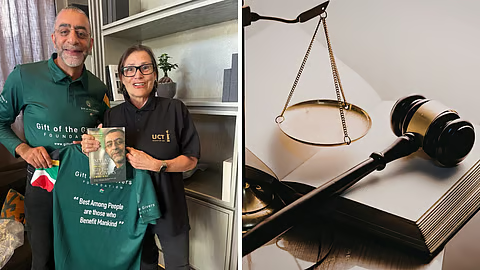
In a recent text conversation with Michael Morris (MM) the editor of DFr I drew his attention to the statement of Dr Imtiaz Sooliman, head of Gift of the Givers who was awarded an honorary doctorate by the University of Cape Town. This subject was the basis of an article by the writer: University of Cape Town’s ultimate degradation – honouring Dr Sooliman (Lay of the Land 31 March 2026).
Dr Sooliman who is widely lauded as a great humanitarian expressed some extreme views which are quite irreconcilable with democracy and freedom. In a public interview on 7 October 2024, being the first anniversary of the worst massacre of Jews since the Holocaust, he said:
“I don’t follow international law or human law. I follow Koranic law. I am a Muslim. I don’t need any permission from anybody in the world to tell me what to do. I break the laws all the time. Breaking the law is laws of the West and people and governments. It’s not Islamic law. I follow Islamic law, and Islamic law overrides any other law. … I don’t have to follow any law. My law is very clear to me. Allah himself has instructed me. I don’t need men to tell me what to do. I don’t follow them.”
Islamic law is quite different to Western law in that whereas democracy separates the state and its legal authority from religion, Koranic law is theocratic and makes no such distinction. The supreme authority is a religious leader whose authority cannot be questioned or challenged by legal restraints. Sharia, the legal framework of Koranic law does not protect individual rights as understood in liberal democracy. It is repressive and authoritarian. Women and homosexuals are oppressed and discriminated against. Apostacy is punishable by death. Historically non-Muslims were given the status of Dhimmi in Muslim countries where they were treated as inferiors, had to pay a special tax and had to dress in a certain way to identify themselves as non-Muslims. This is where the Star of David attached to the clothing of Jews originated. These practices are no longer followed but indicate the fundamentalism of Sharia law. Today Iran and Afghanistan are examples of Islamist repressive authoritarian theocratic rule.
Mr Morris was invited by the writer to express whether this statement of Dr Sooliman was in accordance with democracy and the rule of law in South Africa. He was not in agreement. He was not prepared to say that the statement of Dr Sooliman was a clear expression of rejection of South African law. His opposition to censuring Dr Sooliman for his adherence to a theocratic ideology and rejection of man-made law are worth examining in order to expose the serious flaws. At the outset Mr Morris endorses a dispassionate approach and in a spirit of enquiry, whether he lives up to that desirable standard is in doubt:
MM: “The statement was short and cannot be taken on face value. The true test of what he meant would be to interview Dr Sooliman to obtain clarity or provide further context.”
Michael Morris, editor at the Daily Friend.
There is a profound moral principal involved being that people are accountable for their deeds. Speech is included. More so when the statement is made publicly by a public figure such as Dr Sooliman. It is perfectly proper and widely practised to comment on face value of what prominent people say. Importantly, although he made this statement in 2024, despite countless interviews he has given since then, he has never modified or repudiated a single word. Strangely he has never been asked what he meant. No one seems to have misunderstood his message. His statement was sufficiently comprehensive to confirm that he rejects laws of man. His language is plain and unambiguous. Shorter statements than his such as political slogans have traction and are usually well understood without any embellishment.
MM: “It is unfair to single out the “fervent religiosity” used by Dr Sooliman as it is much like the views by Jewish and Christian fundamentalists who declare they owe fealty only to God and no other. There have been comments to this effect made by readers of the DFr. Are they also subversive of the very values UCT should be safeguarding?”
There is a fundamental difference between the fundamentalist readers of DFr and Dr Sooliman. He is a public figure who received a high honour for his humanitarianism. This is unique and unprecedented. No leader, whether fundamentalist or otherwise has publicly rejected the law of South Africa in the democratic era. The last time that happened was during Apartheid.
Islamism is radically different to any Jewish or Christian “fervent religiosity”. The ideology of the Muslim Brotherhood, political Islam, which Dr Sooliman supports goes much further. It promotes using violence in the form of Jihad to establish domination and power in non-Muslim countries. Dr Sooliman, through Gift of the Givers made donations to Al Aqsa Foundation, an organisation forming part of the Union of Good, a coalition of Islamic charities supporting Hamas’ infrastructure, an organisation on the US State Department list of foreign terrorist organizations. The chairman of Union of Good was Sheik Yusef Al-Qaradawi a high-ranking member of the Muslim Brotherhood. In 2011, Dr Sooliman received an award from Sheik Yusef Al- Qaradawi for his service to Palestine. Al-Qaradawi is known as the key figure in shaping the concept of violent jihad and the one who allowed carrying out terror attacks, including suicide bombing attacks, against Israeli citizens, the US forces in Iraq, and some of the Arab regimes. He was banned from entering some Western and Arab countries. A true humanitarian would have distanced himself from Al-Qaradawi as many Muslim leaders have done.
Proud Lawbreaker Honored. Dr Imtiaz Sooliman who was honored at the University of Cape Town (UCT) by conferring on him an honorary doctorate for his humanitarianism, says ,“I don’t follow international law or human law. I follow Koranic law. I am a Muslim. I don’t need any permission from anybody in the world to tell me what to do. I break the laws all the time.”
Certainly, no religious Jewish or Christian leader in South Africa has publicly defied democratic South African law in the name of religion. If indeed people of any faith have made similar public religious claims to Dr Sooliman, they ought to be wholly and immediately censured. Such statements violate the raison d’etre of democracy: The social contract which has underpinned liberal democracy for centuries. This is worthy of guarding by custodians of freedom such as The Daily Friend .
MM: “Not only the Koran, but the Torah and Bible are not repositories of human rights either”
At best a half truth. Indeed, there are parts of the Jewish and Christian Bible such as acceptance of slavery that are today abhorrent. However, modern political notions of justice and individual liberty owe much to Jewish and Christian teachings, rather than the Koran. The US Constitution is a prime example of the influence of Christianity. Koranic law places submission to Allah as a foundational value whereas the same cannot be said of Judaism and Christianity with regard to the relationship with God. Judaism teaches a holy covenant and Christianity teaches love of God through Jesus Christ. Islamic theocracy is inconsistent with the rule of the law of man.
MM: “Preserving liberty cannot be advanced by curbing liberty. Freedom of speech must be tolerated in order to counter intolerant ideas.”
In principle, yes, subject to Popper below. There is no suggestion of curbing the freedom of speech of Dr Sooliman. His speech is however subject to censure. The DFr should be in the forefront of declaring Dr Sooliman’s statement inappropriate and in clear conflict with Western democracy and liberty. Karl Popper, the renown Austrian-born British philosopher to whom I referred in our conversation, proposed the paradox of tolerance:
“We should therefore claim in the name of tolerance, the right not to tolerate the intolerant. We should claim that any movement preaching intolerance places itself outside the law, and we should consider incitement to intolerance and persecution as criminal, in the same way as we should consider incitement to murder, or to kidnapping, or to the revival of the slave trade, as criminal.” (My emphasis)
The Open Society and its Enemies Vol 1: K.R Popper (Routlege 1966) p 211
Dr Sooliman’s statement has not reached the criminal level but his Islamist theocratic views are clearly on the trajectory of intolerance. To repeat: He should be censured, not prevented from expressing himself freely. The South African Constitution itself recognises limitations to basic rights. Section 36 provides that the Bill of Rights “for limitation to the extent that it is reasonable and justifiable in an open and democratic society based on human dignity equality and freedom …” There is no room for repressive Sharia authority in South African law.
MM: “Confronting him with semi-facts, innuendo, guilt by association and so on, only risks making him seem strong and you seem weak.”
A somewhat vague, personal and unsubstantiated remark unworthy of dispassionate discourse. The confrontation is based on the ipse dixit (exact words) of Dr Sooliman. There is nothing semi factual or innuendo (suggestion). His Islamist Muslim Brotherhood affiliations are on public record and indeed his own biography makes that plain. It is the duty of responsible people to call out dangers to democracy – no contest of strength is involved. Just accurate and reasonable analysis to enlighten and inform.
MM: “The meaning given to Dr Sooliman’s statement by the writer was convenient to his preconceptions.”
This is an ad hominem, personal and unsupported attack on the objectivity and the careful, fact-based assessment by the writer. The ideological background of Dr Sooliman is well documented and this includes beyond any question his adherence to the Muslim Brotherhood teachings as well as his support of Hamas. These are not preconceptions or subjective opinions of the writer but well documented background history on the worldview and political stance of Dr Sooliman. No reasonable person can conclude otherwise.
IN CONCLUSION
On 27 October 2025 Dr Sooliman declared to certain UCT interested parties:
“… to threaten your students and your university because you’re acting on the base of Israel. I think you should be stripped of your citizenship and thrown out of the country.”
An illiberal proposal which raises serious problems not merely because of its injustice and unconstitutionality, but also because it would require man-made law and enforcement to put into effect. The same legal structure Dr Sooliman says he does not need. It also is problematic because it is intrinsically anti- humanitarian and in violation of basic human rights. It does not behove a person who is bestowed with a prestigious honour for his services to society to make such dishonourable remarks.
Fortunately, South Africa has principled leaders prepared to speak out in upholding democracy. Recently convicted and sentenced EFF political leader Julius Malema made threatening and disparaging remarks about the prosecution and judiciary. This too cannot be tolerated.
“At a time when South Africa continues to confront significant challenges within its criminal justice system, it is important that leaders act responsibly and uphold the institutions designed to protect citizens. Accountability must be accepted with dignity, and disagreements must be addressed within the framework of the law. The rule of law is not negotiable. It is the foundation upon which our democracy stands. Undermining it, through reckless and unfounded attacks on the Judiciary, places that foundation at risk, and with it, the rights and freedoms of all South Africans.
Statement issued by Adv. Glynnis Breytenbach MP, DA Spokesperson on Justice and Constitutional Development, 17 April 2026.
It is troubling that an editor should go such lengths to find contrived and disingenuous arguments to evade the pressing and unavoidable reality that Dr Sooliman holds very hostile views on Western democracy and the rule of law which stand uncontradicted. The Daily Friend should protect freedom of expression by publishing the comments made by the writer about the views of Dr Sooliman as they are central to protection of democracy. At the very least, freedom of speech demands a frank and open publication of the concerns raised, no matter how unreasonable or disagreeable these are to Mr Morris. The loser in stifling this crucial examination of Dr Sooliman’s language is the hard fought South African liberal democracy itself.
About the writer:
Born in Pretoria Lawrence Nowosenetz obtained his BA at University of the Witwatersrand and LLB at the University of South Africa. He has been admitted as an Attorney in South Africa and as an advocate in South Africa. He practiced at the Pretoria and Johannesburg Bar and worked as a human rights and labour lawyer at the Legal Resources Centre a public interest law firm. Lawrence was Awarded a Fulbright Scholarship and completed professional internship in the USA. He was a a labour arbitrator and mediator, part time Senior Commissioner at the Commission for Conciliation Mediation and Arbitration (CCMA) as well as a panelist at Tokiso Dispute Settlement. He was a member of the South African Jewish Board of Deputies and Pretoria Chairman. He has also served as an Acting Judge of the Hight Court, South Africa. He now lives in Tel Aviv.
While the mission of Lay of the Land (LotL) is to provide a wide and diverse perspective of affairs in Israel, the Middle East and the Jewish world, the opinions, beliefs and viewpoints expressed by its various writers are not necessarily ones of the owners and management of LOTL but of the writers themselves. LotL endeavours to the best of its ability to credit the use of all known photographs to the photographer and/or owner of such photographs (0&EO).
Concerned directors, who are family members, have taken three fellow directors of the Mauerberger Foundation Fund (MFF) to court for alleged serious breach of fiduciary duty, deliberate deception and mismanagement.
By Marika Sboros
(Courtesy of BizNews where article first appeared)
In the quiet, wood-panelled world of South African philanthropy, the Mauerberger Foundation Fund (MFF) has long stood as a bastion of generational legacy and social justice.
That is set to change with an explosive, urgent filing in the Western Cape High Court on April 13, 2026, against three of the MFF’s five directors, including MFF Board Chair and Managing Director Dianna Yach, granddaughter of the Fund’s industrialist-philanthropist founder Morris Mauerberger.
Devious Directors? Legendary Jewish philanthropist, Morris Mauerberger, established the Mauerberger Foundation Fund in 1936 to support a multitude of causes in Israel, mostly in education. His granddaughter, Dianna Yach, is one of three directors who may be undermining the family legacy, according to court papers.
The applicants are two of the MFF’s directors: Yach’s cousin, Steven Levy, a businessman and the Board’s longest-serving director, and her brother, Dr Derek Yach, a US-based medical doctor, public health specialist and World Health Organisation (WHO) veteran.
The interim relief the applicants seek, pending the final determination of the court proceedings, is Dianna Yach’s immediate suspension from the MFF Board, along with fellow directors Igshaan Higgins and Prof Brian Figaji.
Higgins is an attorney and a director of De Klerk en Van Gend Incorporated. He is also founder-curator-director of the Cape Heritage Museum (also called the Cape Muslim and Slave Heritage Museum) that receives generous MFF funding.
Figaji is an engineer and Chancellor of the Cape Peninsula University of Technology (CPUT), has served on the UNESCO Executive Board and chaired the South African National Commission for UNESCO. He is Chair of the fishing company, I&J, a trustee of the WWF Nedbank Green Trust and Chair of the Abe Bailey Trust.
As CPUT Chancellor, Figaji serves an institution that receives MFF funding for the “Brian Figaji Scholarship for Women in Engineering”.
Crucially, among the final relief sought is for the court to declare Yach, Higgins and Figaji “delinquent directors“.
Under South African law, the declaration can be a professional death sentence. A delinquent director is disqualified from holding a directorship in any company, from being the trustee of a Trust or bearing office in a non-profit organisation (NPO) for at least seven years.
In some cases, the declaration is for life. That legal “nuclear option” is reserved for those found guilty of gross abuse of position, wilful misconduct or a total breach of fiduciary trust. It brands them as a permanent threat to the public interest.
A leading precedent is the Pretoria High Court case of Dudu Myeni, former Chair of the South African Airways Board. She was declared a delinquent director for life in 2020 after a relentless legal challenge by OUTA (Organisation Undoing Tax Abuse), a civil-action NPO dedicated to challenging the abuse of authority and misappropriation of public funds. The order led to Myeni’s personal financial ruin. OUTA successfully pursued punitive legal costs against her personally, moving for sequestration when she failed to pay.
In the present case, Kumesh Moodley, attorney for the applicants, says that an application to have directors declared delinquent under section 162 of the Companies Act is “a step of the most serious consequence.” His clients have not taken this action lightly or prematurely.
“They have taken it now because their evidence before the Court, and the gravity of what is at stake for the MFF and its beneficiaries, dictate that it is not a step open to them to avoid,” Moodley says.
“It is a step they are obliged to take in discharging their fiduciary duties as directors.”
For Figaji, these court proceedings are not the first relating to how he carries out his fiduciary duties. In the 2020 High Court case involving Marib Holdings (the Chapman’s Peak tollgate operator), valid legal grounds were proven for shareholders to sue Figaji and two fellow directors for a potential breach of fiduciary duties. The court record established that the directors bypassed the Companies Act by paying themselves just over R2-million in fees in the 2017 financial year, without the required shareholder approval, leading the judge to rule that their actions must face legal scrutiny. Their attempt to use the Court to block a shareholder’s quest for accountability was unsuccessful.
At the core of their application, Levy and Derek Yach’s extensive court filing of over 1100 pages is a battle for the legacy and soul of the institution that Mauerberger created in the late 1930s.
Seeking Suspension. Global health expert and WHO veteran, Dr. Derek Yach (above), a grandson of Morris Mauerberger, is one of two applicants who have applied to the Western Cape High Court for the immediate suspension from the MFF board of his sister, Dianna Yach, and fellow directors Igshaan Higgins and Prof Brian Figaji.
The MFF has funded community-based and academic institutions in South Africa, Israel and the West Bank in education, health and alleviation of poverty for more than 80 years.
The applicants claim that Dianna Yach has effectively seized control of and laid “siege” to the MFF, turning it into a personal “fiefdom”. They say it is one where compliance, procedure and corporate governance have been rendered relics of the past.
No fewer than nine formal complaints have been made against her, Higgins and Figaji for breaches of the Companies Act and conduct inconsistent with the overriding duty to act in the MFF’s best interests.
Levy and Derek Yach allege a deliberate, systematic “governance collapse” and “methodology of financial misrepresentation” behind more than 11 years of constitutional non-compliance with the MFF MOI (Memorandum of Incorporation).
The MOI records Mauerberger’s express wishes. It imposes a mandatory distribution regime requiring 50% of annual, distributable income to be allocated to Israeli entities, 25% to South African Jewish entities and 25% to South African non-Jewish entities.
Despite this prerequisite, from 2014 the Israeli allocations were skewed, declining as low as 4% in 2017; 6% in 2021; 7% in 2022 and 5% in 2023. In 2024, Israeli beneficiaries made up 10% of total donations, which were just under R15- million.
The applicants argue that the MFF lost its primary “moderating influence” in a matter of days when two experienced directors walked away in early 2025.
The papers reveal that brother Jonathan Yach resigned as a director with immediate effect on December 25, 2024, after 23 years of service. He stated that “recent events” had fundamentally challenged his perspective on how to best serve the MFF.
Resignation challenges. Court papers reveal that Jonathan Yach, brother of Dianna Yach, resigned as an MFF director in 2024, after 23 years of service citing challenging “recent events”. Jonathan is seen above as at an award ceremony at the Technion in Haifa in June 2019, as a trustee of the MFF Research Award for Transformative Technologies for Africa. The MFF prize aims to strengthen academic ties and the exchange of ideas between researchers in Israel and Africa to “harness new technologies for the benefit of humanity.” (Photo: Technion Spokesperson)
On January 3, 2025, independent director Adv Joe van Dorsten, a renowned author and tax law and Companies Act expert, resigned in direct response to Dianna Yach’s “personal criticism” and declaration that she had “lost trust” in him after he raised reasoned governance concerns about boardroom transparency.
The applicants allege that the resignations were not just administrative exits. They were the first documented casualties of a clear pattern where independent directors who dare to challenge the Chair are not heard but are instead driven out.
With these two directors out, Higgins, who sits on the UCT Law Clinic Advisory Board with Yach, was appointed to the Board.
In this way, court papers say that Yach formed a majority “voting bloc” with Higgins and Figaji that marginalised dissenting voices and insulated her conduct from any form of meaningful oversight.
The MFF’s departure far from the MOI’s legacy path and non-compliance deepened, the applicants claim.
They note that Figaji conceded in August 2025 that funding allocations were non-compliant with the MOI. He proposed returning the MFF to compliant status by 2028. Yach and Higgins promptly supported and accepted the proposal.
The applicants refer to this roadmap of “deliberate deviation” as a “programme of continued non-compliance, dressed in the language of gradualism.” In contrast, Levy had proposed “a path to immediate restoration of the Founder’s wishes”.
They claim further that Yach has routinely ignored MOI’s mandates through “creative accounting” designed to provide a false appearance of constitutional compliance.
One example is the “intentional” miscategorisation of a controversial R1-million MFF donation in September 2025 to Gift of the Givers charity as an allocation to an Israeli beneficiary.
Perhaps the single most explosive evidence in the filings is what the applicants call the “Ghost Email” fabrication. It marked the transition from a messy boardroom brawl to an alleged scandal of documented instances of fabrication, fraud and fundamental dishonesty.
It was set off, according to court papers, by a relatively large R600,000 MFF grant allocated in the 2025/2026 budget to Higgins’s Cape Heritage Museum.
The applicants see this funding as a suspicious 500% increase in just five years, starting from R100,000 in 2021. Similarly, they see Higgins voting on his own 2025/2026 grants for his museum without disclosing his personal interest as breaching the Companies Act.
When Levy tried to act as a proper fiduciary by requesting a “Verification Register” to assess whether the grant was properly considered and to assess compliance and risk indicators, he says Yach responded dismissively. She apparently contended that non-executive directors are not entitled to that information and went so far as to invite Levy to resign and Higgins backed her up.
The message to directors appeared clear, say the applicants:
Stop asking questions or resign; either way, you are not getting the information you seek.
Court papers present a digital forensics analysis showing that Higgins drafted a Board letter to block Levy’s attempted oversight of his own museum and sent it to Yach only, allowing her to pass it off on March 6, 2026, as her independent decision.
This effectively exposed the “Ghost Email” ruse, the applicants say, when she dispatched the complex document after a physically “improbable” 16-minute window.
Perhaps most damning was Yach’s apparently simple oversight: in the rush, she failed to delete remnants of Higgins’s professional law-firm signature before firing the email off to the full Board.
It became a digital “smoking gun”.
By adopting the grantee’s objection as her executive decision, the applicants say Yach transformed “from the guardian of the grantor’s interests into the protector of the grantee’s interests.”
They see this as a pattern of “betrayal of office of the most extreme and gravest form.”
They raised a separate event on March 31, 2026, supported by metadata establishing that Figaji used his personal computer to draft a resolution to appoint himself as MFF Vice-Chairperson. Yach then circulated it as her own proposal and later dismisses this misrepresentation as “procedural minutiae”.
Metadata show that this document was created just 55 seconds apart from a retaliatory disciplinary resolution against Levy. The applicants say this aimed to obstruct Levy’s attempts to access grantee funding information.
They say that Figaji officially recorded his vote in favour of his own appointment on April 1, 2026, without disclosing his authorship to the Board. On April 8, Yach announced Figaji’s “election” as Vice Chair of the MFF Board.
The applicants contend that this appointment is invalid and carries no authority as the resolution behind it was “clandestinely” engineered by the very person who stood to benefit from it.
They see this as a “self-serving” breach of fiduciary duty designed to ensure that a “sympathetic successor” remained in power should the High Court suspend Yach as Chair.
Levy and Derek Yach say these events involve different directors and dates but are linked by a single “modus operandi of concealment”. They say Figaji’s actions reinforced the bloc’s “retaliatory and self-serving character,” mimicking the “covert collaboration” that the “Ghost Email” exposed.
Under the grandfather’s glare. With Morris Mauerberger’s bust looking on, his granddaughter, MFF chairperson Dianna Yach, presents a R1-million donation to Gift of the Givers CEO Dr Imtiaz Sooliman, who allegedly aligns with extremist Islamist jihadist forces that seek Israel’s destruction.
Evidence of multiple attempts by both applicants to gain access to information on funding decisions over the years supports their contention of an incriminating “wall of silence”, which the respondents constructed.
They argue that “where three directors of a charitable foundation collectively refuse to engage with questions about the application of that foundation’s funds, the inference is that engagement would expose what silence is designed to conceal.”
Court papers note Dianna Yach’s unilateral suspension of the MFF’s decades-long commitment to funding Telfed, South African Zionist Federation (Israel) in March 2021.
Telfed has long served as “a bridge between the Southern African Jewish diaspora and Israel, supporting immigrants (olim) and fostering the educational, cultural, and communal ties that bind (Jewish) communities across continents,” CEO Dorron Kline writes in a letter to MFF directors in March 2026.
When Kline engaged her at a donor gathering in Cape Town in March 2025 and raised the possibility of resuming Telfed’s relationship with the MFF, he recalls her conveying the following sentiment:
“Israel’s reaction to the Hamas 7th October (2023) atrocity is outrageously disproportionate. Israel is clearly committing genocide. Therefore, Israel has lost its right to call itself a nation amongst other nations. There is no reason for Telfed to approach the Mauerberger Foundation for funding until the Israeli government ceases to kill innocents and agrees to the establishment of a Palestinian State.”
The applicants see this as Yach’s pattern of holding the MFF hostage to her personal political beliefs with impunity.
Initial court filings create an overwhelming impression of the respondents transforming the MFF Board into a virtuoso performance of “musical hats“. It is brimming with conflicts of interest, allowing them to rotate seamlessly at will into donors, recipients and “independent” auditors of their own self-advancement.
Yach’s dual role as both MFF Chair and MD makes her the Foundation’s only paid employee. This allows her to control oversight of her own executive conduct, the applicants note.
This structural conflict is mirrored in her senior governance roles at the University of Cape Town (UCT), where she sits on its Council as one of two representatives elected by donors, and chairs the HR and other committees.
Court papers show that UCT has become a primary beneficiary of “over-allocations” while Israeli funding has been systematically slashed. In 2023, for example, UCT received R3.8-million from the MFF, while the mandatory Israeli allocation was a mere R600,000.
Critically, Yach voted in favour of academic boycotts against Israeli institutions at UCT as part of the “Gaza resolutions”. She then deposed to a sworn affidavit in the ongoing Mendelsohn lawsuit against the university, explicitly using her title as “Chair of the Mauerberger Foundation Fund” to support this political stance without Board authorisation or notification, the applicants allege.
In this intricate web of entanglements, the applicants say that Yach has advocated for boycotting the very beneficiaries MFF is constitutionally mandated to fund, while her colleagues moonlight as clandestine ghostwriters of their own grants and vice-chair appointments.
As the matter heads to the High Court on May 4, 2026, the question remains:
Can a foundation survive when its “proper channels” are “actively barricaded by the very individuals who would later insist, with indignation, that those channels should have been used”?
The applicants are family but their filing is clearly not the fruits of a family squabble. They see it as their duty as fiduciaries to ensure that their grandfather’s legacy is preserved and that its beneficiaries’ work in South Africa and Israel continues to thrive with MFF support.
If the court finds that Dianna Yach, Higgins and Figaji have used “ghost” channels to govern and wilfully breach their fiduciary duties, the MFF may finally be forced to course-correct.
*Dianna Yach, Brian Figaji and Igshaan Higgins were emailed for comment.
Yach replied by return email:
“I will not respond to any of the averments that you make at this time. I will request my lawyers to respond to you in due course, and only once the matter that you have referred to has been called in open court on 4 May 2026.”
Figaji and Higgins did not reply.
All have since filed a notice of intention to oppose the application. They have until April 30, 2026 to submit answering affidavits.
About the writer:
Marika Sboros is a South African freelance investigative journalist with decades of experience writing fulltime for the country’s top media titles on a wide range of topics. She started her career as a hard-news reporter in the newsroom of the now defunct Rand Daily Mail, a campaigning anti-government newspaper during the worst excesses of the apartheid era. She commutes between South Africa and the UK.
While the mission of Lay of the Land (LotL) is to provide a wide and diverse perspective of affairs in Israel, the Middle East and the Jewish world, the opinions, beliefs and viewpoints expressed by its various writers are not necessarily ones of the owners and management of LOTL but of the writers themselves. LotL endeavours to the best of its ability to credit the use of all known photographs to the photographer and/or owner of such photographs (0&EO).
The Nation that roars like lions is powered by Zionism
By Rolene Marks
“And who is like your people Israel, the one nation on earth that God went out to redeem and be a people for himself, and to make a name for himself, and doing for them great and awesome things for your land, before your people whom you redeemed to yourself from Egypt, from the nations and their gods?” Samuel 7:23
Maligned, demonized, misunderstood, bastardised and used as a pejorative, the word Zionism has become another “ism”. Simply put, Zionism is the Jewish right to self-determination in our ancient homeland, Israel and the right of the modern state to exist. You don’t have to be Jewish to be a Zionist and as antizionism, the latest iteration of the ancient hatred of antisemitism soars, I want to take a moment to celebrate the country that we have built. A nation is built by people and Israel’s people are nothing less than extraordinary. These past two years have been a lesson in heroism.
This is the house that Zionism built. The ordinary people who have become the heroes of story.
Holding-Off Hamas. South African born Cpt. Daniel Perez, 22, (left) a platoon commander in the 7th Armored Brigade’s 77th Battalion and his tank crew fought for hours against the Hamas invasion of the Nahal Oz IDF outpost until Daniel was killed alongside Sgt. Tomer Leibovitz and Staff Sgt. Itay Chen. Daniel’s weapon (right) was found in a booby-trapped compound in the northern Gaza Strip. (Photo: IDF Spokesman’s Unit)
I watched former hostage, Matan Angrest, pale faced and frail, stand before the grieving family of his late commander, Cpt. Daniel Perez (z”l), and deliver a eulogy, stating his intention to walk beside them for the rest of his life. Angrest spoke of his willingness to go back into Gaza and retrieve the remains of Itay Chen (z”l), his fellow soldier from “Team Perez”. Chen’s remains were returned for burial in November 2025. I watched this slight young man, barely 48 hours out of captivity, having difficulty standing but a superhuman strength to honour his captain. I was captivated by the integrity and sheer inner strength of this young man.
I have watched the coverage of the funerals of soldiers and hostages laid to rest and the hundreds and sometimes thousands who line the routes and filled the cemeteries for someone they did not know personally, but knew and loved with their soul. I have also been to these funerals – and the pain of burying our finest sons and daughters cut down in their prime while defending our safety is a sorrow that cuts to the very core. Soldiers in Israel are the sum of us and when we refer to them as our sons and daughters, we mean it in the purest form.
I think of the almost superhero strength of hostage families who moved heaven and earth in every corner of the globe, to make sure that the world heard about and never forgot that their loved one in captivity was more than a picture on a poster – they were a universe. Some families got their loved ones back alive and can accompany them on their road to healing and recovery – but many, far too many, received their beloved to lay to rest. They are bound in the holy place reserved for the martyrs of our history.
Heroic Homecoming. First morning of freedom after returning from two years in Hamas captivity (seen here stepping out from the helicopter holding the Israeli flag), Matan Angrest said, “‘If it were up to me, I’d return to IDF service.”’ (Photo: IDF)
The women of this country are remarkable. They are every kind of wonder woman you could image. They are the ones who serve on the frontline and the ones who hold down the home front, who volunteer in every imaginable way. They are the wives, girlfriends, partners of soldiers, offering strength and support while our warriors defend and protect. The weight of responsibility that they carry on their shoulders is enormous and yet they are the unbreakable spine of our country. I think of women like Tali Hadad, a kindergarten teacher from Ofakim who rescued her wounded son and other victims amidst intense gunfire on 7 October or Rachel Goldberg-Polin, who in her fight to free her son, Hersh, from captivity inspired the world with her strength and humanity. Hersh was murdered along with 5 other hostages and the world, in turn, hold Rachel in her grief with love. These are just two examples of the many, many heroines.
A Mother’s Might. Anderson Cooper and Rachel Goldberg-Polin (CNN’s 60 Minutes) in her murdered son Hersh’s room, which she has kept as he left it. To Anderson’s statement that “you did more than anybody could possibly do,” Rachel replied “… And sometimes, 100% is not enough.”
Our women defending us in the skies flew missions to Iran as pilots and navigators to strike at the heart of the despotic regime that has persecuted their own women and girls. There is something magnificently poetic about that.
It takes herculean strength and courage for victims of sexual violence to speak about it – let alone publicly. On 7 October, Hamas committed the crime against humanity of sexual violence against women, girls and men. Most of the victims were murdered, their testimonies silenced forever. Summoning their extraordinary strength following captivity, at least 11 hostages, male and female have spoken publicly about the horrific sexual abuse they routinely endured in captivity. They are a living testament to the horrors that happened and an answer to deniers.
Prior to 7 October, many feared that should war break out, our young generation would be too engrossed in their devices to respond. Boy, did we get it wrong! They have more than risen to the challenge – I would go as far to say they are our finest generation. On 7 October, they did not wait for the call – as Hamas committed a trail of atrocity in their wake, our young warriors came home to defend our country. Those that were here did not wait – they grabbed what weapons they had, many paying the ultimate price.
Many of them rest in eternal peace in graveyards across the country, testament to lives gone far, far too soon.
The former hostages that held on to their faith in the depths of hell. The stories of what they endured are devastating – but they all held on to their faith, taking pride in their identity as Jews, all the while knowing that is why they were targeted. Their faith was their rebellion against torture and constant attempts to convert them to Islam. In the pits of the terror tunnels like their ancestors who held on to faith in the death camps during the Holocaust – and those that found secret ways to continue observance in Inquisition Spain or Soviet Russia. They welcomed in Shabbat, tried to observe the laws of Kashrut, said the Shema and all they could to sustain their faith. Their steadfast faith has inspired the same in so many around the world as antisemitism spreads in a deadly blaze of hate.
The house that Zionism built was created by pioneers, stoic in the face of extreme challenges. Pioneers on many fronts like former hostage Gadi Moses. The octogenarian has vowed to rebuild his beloved kibbutz Nir Oz that was decimated on 7 October or Brig. Gen. Daniel Gold, the brains behind the Iron Dome or the countless others in the fields of science, medicine, agriculture, AI, culture and entertainment and many, many other fields.
Resilience and Renewal. “I sung Hatikvah as a hostage in Gaza to keep my hopes of being free alive,” said Gadi Moses (age 80) a farmer and peace activist kidnapped from Kibbutz Nir Oz on October 7, 2023 and returned after 482 days in Gaza captivity, vowing to rebuild his community. (Photo: Ori Ben Hakoon)
The house that Zionism built has tikkun olam (repairing the world) as a pillar of its foundation. Herzl’s vision for the Jewish state was one that helped communities in Africa and around the world. Today, wherever disaster strikes or where help is needed, Israel answers the call – even in those places where we have no diplomatic relations or official recognition.
We are a nation of dreamers – for peace, to blaze a trail in the unknown – but we are also a nation of warriors. A nation that almost stands as a global anomaly because we know the price of not having our home and are proud of who we are and the values that we defend. Yes, there are divisions and internal disputes that threaten to rock the stability of our home – and we cannot allow hubris and disunity to find a permanent place. Our robust, democratic nature must be protected at all costs.
The House of Zionism is built on a solid foundation of strength, heroism, sacrifice, courage, love and an unshakeable millennia old love and connection. The house of Zionism has weathered storm after storm and despite the constant attacks and lies, will remain strong.
We are Aner Shapira and Hannah Szenesh, Eli Sharabi and Ahsan Daxa, we are Rachel Goldberg Polinand Ibrahim Kharuba. We are Yuval Raphael and Golda Meir. Shimon Peres and Artem Dolgopyat. We are King David and Devorah. We are Ben Gurion and Judah Maccabee. We are the sum of all of us throughout our noble history and have built this home, brick by brick.
For over two years, Israelis have lived with compounded trauma – but walking hand in hand with that, is this fierce resolve to live and to win. We are stubborn like that. On 7 October, we were hit as hard as we could be – and kicked repeatedly. Since then, we have fought back. We have fought on multiple fronts as Iran sought to surround us in a ring of fire. The pressure has been immense – but so has our stoic fortitude. Our ability to feel joy and treasure life has learnt to walk hand in hand with our grief. Both are ever present.
Israeli Grit. Israel Air Force Commander Major General Tomer Bar speaking on April 21, 2026 at the memorial ceremony for the force’s fallen soldiers at Pilots’ Hill, said “We took off on October 7 and won’t land until we complete the mission.”
Every slur, every accusation even though they hurt has also woken something up in us. It has galvanized us a fierce resolve to protect and defend our home. We do not need to be loved or pitied – but we do need to live.
We are the house that Zionism built. We are the bricks and mortar, the very foundation. There are times when the house comes under attack – but the foundations remain strong, rooted and defiant. We have been through a baptism of fire and are surviving the inferno. We bear the bruises – but also the triumphs. We are writing our own story, determining our own future, with resolute determination.
We are the house that Zionism built.
*Feature photo:Nation Roars. Statue of a roaring lion – “The Roar of the Lion”.
While the mission of Lay of the Land (LotL) is to provide a wide and diverse perspective of affairs in Israel, the Middle East and the Jewish world, the opinions, beliefs and viewpoints expressed by its various writers are not necessarily ones of the owners and management of LOTL but of the writers themselves. LotL endeavours to the best of its ability to credit the use of all known photographs to the photographer and/or owner of such photographs (0&EO).
Daily life in Israel when missiles are striking across Israel.
By Peter Bailey
Israel’s many wars, the first of which started before the rebirth of the State of Israel on 14 May 1948, has resulted in an extremely efficient and effective system of everything possible being done to ensure the safety of the civilian population at all times. There is a well-worn comment that while Israel’s enemies have spent fortunes on developing armies and weapons with which to attack Israel, Israel has spent the bulk of its defense spend on defensive capabilities and citizen safety. The evolution of how wars are waged has seen the use of offensive weapons such as rockets, missiles and drones becoming the weapons of choice with which to attack Israel. The country has thus been developing increasingly sophisticated anti rocket and missile defenses, while also concentrating on the erection and maintenance of communal and private residential safe areas of various types.
I regularly found myself searching for shelter during the course of my daily travels as a result of the nature of my work for Beth Protea, a South African founded retirement home for seniors situated in Herzliya. I work with the Protea Home Care (PHC) division, which provides services to the elderly who reside independently in their own homes, but require assistance in managing various aspects of their lives. One of the services offered by PHC is the daily (Sunday to Thursday) delivery of well-prepared nutritious meals to clients, who, for various reasons are unable to prepare their own meals. These clients reside in an area which includes the cities of Herzliya, Raanana, Hod Hasharon, Kfar Saba, Tel Aviv, Ramat HaSharon and as far afield as Holon. The reality is that despite the emergency situation and missile attacks, meals have to be delivered and I am on the road four mornings a week. Recalling my experiences, might provide readers outside of Israel an idea of life governed by alerts announced on one’s cell phone, followed by the siren anywhere from one and a half to ten minutes later. Of course, if you are living in the north of the country, there may be no pre-siren alert and you may have less than 15 seconds to find safety before a missile strikes. Seeking safety quickly becomes the name of the game.
There are communal or public bomb shelters available in well-advertised and sign posted areas of almost all civilian population areas, office blocks and many of the older apartment buildings. Referred to in Hebrew as a miklat (plural miklatim), which is a communal or public bomb shelter or safe area, with many underground parking areas beneath malls, other public buildings, railway and bus stations also being used for public safety purposes. The disadvantage of the miklatim is that many of them are situated in basements, with many accidents resulting from people having to rush down stairs to the safe area. Since 1951, Israel has been passing increasingly more effective laws regarding the construction and availability of safe areas. The word miklat comes from the biblically ordained cities of refuge (ערי מקלט), so the word miklat translates as a place of refuge.
Making the most of a dire situation, Israelis do yoga at an underground garage, used as a public shelter, in Tel Aviv during the Israel-US war with Iran. March 17. 2026. (Photo: Miriam Alster/Flash90)
We then have the mamad, acronym for merchav mugan dirati, which means home safe area, with mamadim found in many apartments and free-standing homes. Legislation was passed in 1993, making it mandatory by law for all new homes, free standing or in apartment blocks, to have a mamad (safe room). This legislation was prompted by the 1991 Iraqi Scud missile attacks during the 1st Gulf War, Operation Desert Storm. The threat of chemicals or gas being released into the atmosphere by the exploding missiles resulted in the 1993 legislation, which also made provision for the proper sealing of all safe rooms.
The third category of safe room is the mamak, acronym for merchav mugan komati, which means the safe area on each floor of an apartment or office complex. The building in which I reside has a mamak, which means that it’s a short, safe and convenient walk down the passage to safety. Many older and disabled people residing in older buildings with a basement miklat, rather than a mamak or mamad, often resort to sitting in the lobby area outside their apartments as they are unable to get to the safe area in time and in safety. This is not ideal, but offers a small degree of safety, as long as there are no windows, which can shatter and cause injuries in the event of a nearby blast or explosion.
A chair for an elderly or disabled person in the lift lobby is a common sight . (Photo: Peter Bailey)
Finally, there is the migunit, which is a portable free standing safe area which can be placed in areas where there is no miklat. One of the reasons for this innovation is that business premises such as shops and restaurants are not allowed to be open for business during an emergency period, unless there is a nearby safe area for customers in the event of a missile alert. Necessity being the mother of invention, an answer to the problem was found.
A migunit or portable bomb shelter outside a supermarket. (Photo: Peter Bailey)
The most satisfying feature of my experiences seeking safety during my travels has been the friendly and helpful attitude of people wherever and whenever I have been in need of a safe area. My first experience of this camaraderie and unconditional helpfulness was following a warning alert that the siren would be sounding in the next few minutes was in the Tel Aviv suburb of Bavli. Immediately after receiving the alert, I looked for a safe place to stop my car, and as I did so, a young lady knocked on the window and asked if I was in need of shelter, and if so to follow her, which I did. A few metres down the road was the entrance to a school, and I soon discovered that many schools in Tel Aviv, closed because of the emergency situation, had opened their miklatim to the public. I followed the crowd down into the basement where despite my protestations, somebody insisted I take their chair, which I did with gratitude. Total strangers were chatting with each and with my Hebrew not too wonderful, a few people spoke to me in English and I was really part of a wonderful socialising event. When the all clear sounded, off we all went, going our own way.
Another learning experience was just after leaving a residential building in Herzliya where I had delivered a meal when the alert sounded on my cell phone. I retraced my steps into the building and followed the signs to the basement miklat, where I joined a small group of adults and about 20 young children. I knew that the building had recently been renovated, which meant that each apartment had its own mamad, so I was somewhat taken aback at seeing so many kids and so few adults. I soon had the answer. The war situation meant that children were not at nursery schools or kindergartens as these were all closed, which meant that parents had to take time off work to care for their children. The very practical solution in this building was for two sets of parents to be with the youngsters while other parents were free to go to work, with the ‘duty parents’ changing every two hours.
Duty parents with children in a miklat in an apartment building in Herzliya. (Photo: Peter Bailey)
Later that same day, I found myself in the Ramat Aviv suburb of Tel Aviv, when the alert sounded. It was already the fourth time that day. I saw a curbside parking bay available and parked the delivery van, and as I stood on the pavement looking around, a man standing at the entrance to a school beckoned to me. I went over to him and he invited me to join them in the school miklat, where I saw that there were mattresses along two walls of the safe area, but this time several adults were resting on the mattresses. My curiosity once again got the better of me and I asked the man who had originally beckoned me for more detail. It turned out he was the school principal, but with no pupils, he had opened the miklat to the public. The school was adjacent to a very old quarter of Ramat Aviv, with many of the nearby buildings lacking any form of safety for the residents, so they had been invited to sleep in the school miklat in case there were siren alerts during the night. I was offered coffee and a chair, while I marvelled at the resourcefulness of the school principal and unsolicited care and kindness shown to one and all while the sirens wailed.
SIREN IN THE SUPERMARKET
While shopping with my wife during Pesach (Passover) at the local hypermarket, we had just finished paying for our trolley, when the alert sounded on our cell phones. I pushed the full trolley to the area designated as the safe area, and while somewhat concerned, was instructed to leave the trolley outside, together with many other trolleys. We were shepherded through a door only to discover that this led to a stairwell, which was full of people as the miklat was already overcrowded. So, there we stood for the next 20 minutes, waiting for the ‘all clear’. Probably one of my less enjoyable miklat stays, although I was delighted to find my trolley intact with all our paid for shopping just as we’d left it. So good to experience honesty of the highest degree in adversity.
Not the saftest place nor recommended with an incoming ballistic missile from Iran, nevertheless a packed stairwell of a building following a siren.
EXPECT THE UNEXPECTED
While on a delivery call in an area known as the Old North of Tel Aviv, not far from Hamedina Square (Kikar Hamedina), where there are many older buildings with no protection, the siren sounded. Where would I find safety here? While most residential building entrance doors in this area are usually locked with a code, I found that many doors were wide open with signs in Hebrew advising that a miklat was available. This was once again a wonderful example of the caring and sharing attitude of most Israelis. Although I’ve had many experiences seeking safety during this war, one particular miklat stay stands out. I was travelling on the highway near Hod HaSharon, having heard the alert warning that missiles from Iran were on their way and that the siren would be sounding in the next few minutes. I took the first off ramp and found myself outside the Sokolov Train Station, illegally parked in the no stopping zone right outside the station and jumped out the car as the siren went off. I was cutting it fine. The normally officious barrier guards who usually take no nonsense from anybody, were now holding the barriers open and ushering all and sundry into the station building. I was shepherded into a crowded small miklat behind the ticket office, which looked more like a staff coffee area than a miklat, but it had a proper bomb proof security door. I was touched at the total personality change of the security personnel, but it was nothing more than typical Israeli caring during times of adversity.
People find refuge in the miklat in Sokolov Railway Station. (Photo: Peter Bailey)
The last miklat I want to talk about is really a case of saving the best for last. While doing a delivery in Ra’anana the siren went off and I immediately sought refuge in the miklat of the building I was in. I’d walked into the gold standard of miklatim. What a pleasant surprise to find a carpeted floor, very comfortable chairs including a few armchairs, and to top it all, a ping pong table. That one must take the prize for the best appointed miklat I’ve been in. While living through a war with missiles dropping extremely dangerous cluster munitions on civilian areas, injuring some 8,000 people and killing 20, the residents of this building decided that if they had to spend many hours in the miklat, home comforts were important.
A more ‘up-market’ miklat with carpeted floor, television set, artwork, armchairs and ping pong table in Ra’anana. (Photo: Peter Bailey)
To bring home the danger and how daily life in Israel under fire reminds me of Russian roulette, a friend of mine was on her way to pay a shiva call (condolence visit) in Ramat Gan, an area she was unfamiliar with, when she received an alert on her phone. With the clock ticking until the siren went, she ran into a nearby apartment complex and followed others down into the building’s miklat. She was lucky – some were not. The building she had randomly selected took a direct hit from one from one of the thirty or forty cluster bombs released by an Iranian ballistic missile, and Yaron and Ilana Moshe, a disabled couple in their seventies, were unable to reach safety in time and were killed.
The damage to the building was immense.
A neighbor later recounted how after hearing the powerful blast, he exited his safe room to find his own apartment severely damaged. Rushing to check on his neighbor’s apartment, he discovered their front door destroyed and a large hole in the ceiling with another resident, they tried to clear debris at the entrance, fearing the couple were trapped inside. He later expressed to the media some relief that the victims’ grandchildren were not present at the time.
Such is daily life in Israel during this war with Iran.
Images of apartment hit by Iranian attack in which two Israelis were killed in Ramat Gan and which the writer’s friend took refuge in the building’s underground bomb shelter (miklat).
Feature photo: Packed tight, people take cover as siren warns of incoming missiles fired from Iran, at a public bomb shelter in Jerusalem, June 15, 2025. (Photo: Noam Revkin Fenton/Flash90)
About the writer:
Peter Bailey made Aliyah from South Africa with his wife Jeanne in 2013 in order to join their three sons and families who were already in Israel. He spent 35 years in the glass industry in South Africa while also being active in military veterans affairs, being National Chairman of The South African Jewish Ex Service League prior to making Aliyah. He completed his compulsory military training in South Africa in 1964 and was commissioned as an officer in 1965, retiring with the rank of major, after 19 years service in the SADF Citizen Force. While on active service on the Namibian Angolan border in 1976 he commanded 101 Task Force’s Counter Insurgency Operations Training Centre. He has enjoyed a lifelong interest in military history and has conducted intensive research into the Jewish contribution to South Africa’s military history, writing many papers on the subject and giving relevant lectures across South Africa. He is the author of two published books, Street Names in Israel and Men of Valor, Israel’s Latter Day Heroes.
While the mission of Lay of the Land (LotL) is to provide a wide and diverse perspective of affairs in Israel, the Middle East and the Jewish world, the opinions, beliefs and viewpoints expressed by its various writers are not necessarily ones of the owners and management of LOTL but of the writers themselves. LotL endeavours to the best of its ability to credit the use of all known photographs to the photographer and/or owner of such photographs (0&EO).
If possible, Tucker would happily platform Hitler on his podcast.
By Jonathan Feldstein
April 14, is Yom HaShoah, Holocaust Memorial Day. In Israel this will be observed with local memorial ceremonies, and ones broadcast on national TV. Interviews, documentaries, and feature films related to the Holocaust will be aired across all TV and radio channels, with entertainment channels suspending broadcasting. An air raid siren (different from that which we have spent the last several weeks dreading and sending us to our bomb shelters) will be sounded, stopping traffic and bringing people across the nation to stand in silent prayer and reflection.
Nation Mourns. People stand still in Jerusalem, as a two-minute siren is sounded across Israel to mark Holocaust Remembrance Day. (Photo: Yonatan Sindel/Flash90)
This year, there are an estimated 196,000 Holocaust survivors remaining. It’s a drop of 20-25% from five years ago (240,000-250,000), an even bigger decrease from approximately 300,000 just a decade ago. As many die and the remainder age, their medical and other needs increase. Since 2023, other challenges have also increased, with many suffering poverty and, in Israel, living through the Hamas massacre of October 7, 2023, and the war that followed. Many are reliving the memory of traumas of their early lives in their final days.
With fewer survivors branded with Nazi concentration camp tattoos among us, it’s jarring to see the increase in the permissiveness of antisemitism on so many levels, all over the world. We’re witnessing an increase in the outright denial that the Holocaust ever happened, or the distortion of the realities.
While there are no outright quotes (yet) of Tucker Carlson overtly denying the Holocaust happened, among the most jarring and public instances of legitimizing antisemitism and Holocaust denial, are his platforming overt antisemites and, in doing so, not only not challenging their evil thoughts, but in fact giving them legitimacy. Tucker himself has also crossed the line many times, mainstreaming antisemitism in a way that would make the Nazis proud.
Plain and Simple. No, platforming Holocaust revisionists, neo-Nazis, and other extremists isn’t merely “asking questions”, it is antisemitism.
Over and above the hateful and historically inaccurate ideas of people he has platformed, Tucker has put a big wind in the sail of such deniers and antisemites in a way that’s nuanced and sneaky, deceiving the world by reviving antisemitic tropes that have been historically disproven.
There are more than a few instances where this is the case, showing a deliberate, calculated, and possibly even scripted plot. One example is Tucker referring to “Jews” and following that with the statement/question “whatever that means/is.” Doing so he set up the more recent lies by questioning the historic and biblical reality and lineage of the Jewish people.
Having sown the soil with this toxic fertilizer, he started planting his deadly seeds. Tucker has overtly embraced a fringe and disproven claim that Ashkenazi Jews are not really descendants from Abraham (and therefore not part of God’s covenant and thus foreign occupiers in Israel), known as “Khazar theory.” Through this discredited allegation, today’s Jews of European descent are actually descendants of a tribe of medieval Turkic Khazar converts to Judaism.
Forget that there are ample Biblical examples of gentiles converting and becoming part of the People of Israel (including the “mixed multitudes” who left slavery in Egypt with the Jewish people, Jethro, Ruth, and others), and who are every bit as much part of the Jewish people then as converts are today. Tucker willingly, deliberately distorts historical truth, specifically calling out Prime Minister Netanyahu and making up statements that there’s “no evidence they ever lived” in the Land of Israel.
“Khazar theory” has been as debunked as the notion that the world is flat. Antisemitic flat-earthers like Tucker don’t care about truth. The theory has been rejected by geneticists, historians, and archaeologists. Yet Tucker calls for Jews to do DNA tests, despite evidence showing substantial Biblical ancestry alongside European admixture, consistent with our 2000-year diaspora history.
“Khazar theory” has long been weaponized by antisemites (from Soviet propagandists, white nationalists, Holocaust deniers, Tucker, and other modern pundits) precisely to delegitimize Jewish identity, claims to Israel, or the reality of the Holocaust.
While Tucker hasn’t said it himself (yet), one could see him platforming Adolph Hitler today (as he has with modern tyrants like Russia’s Putin, Iran’s Pezeshkian, and others), defending doing so as his “duty” as a “journalist,” to preserve Americans’ “constitutional right and the God given right to all the information about matters that affect them.”
You can almost hear him saying it:
“Mr. Hitler, many people despise your views but Americans want to know the truth about how you’re really not antisemitic, because the Jews – whatever that means – that you allegedly killed were not really Jews, isn’t that right? I think you even wrote about it in your “Kampf” book, that those people identified as Ashkenazi Jews aren’t really descendants of Abraham, and so all you’ve tried to do is eliminate a foreign occupier from among pure Europeans, setting up a network of transit camps to help them get back to their indigenous land, Turkey.”
By this ‘logic’ if the Nazi’s victims weren’t really Jews, then there was no holocaust against the Jews, and no genocide: Holocaust denial by denying that the victims were not Jews to begin with.
Maybe Tucker’s interview with Hitler would be a debate, with Hitler defending the Nazi definition of Jewishness as racial, classifying people as Jewish based on ancestry, religious practice, or having one Jewish grandparent. Or maybe he’d have hit Tucker’s softball question out of the park, denying he’s an antisemite as Tucker does, saying some of his best friends are Jews. Maybe he’d even praise Anne Frank and Elie Wiesel as his favorite Jewish authors.
Would there be a Hitler-Carlson dispute, or a love-fest? Who knows?! But Hitler and millions of European antisemites sure believed that Ashkenazi Jews murdered in the Holocaust were Jews by every definition: history, self-identification, community, culture, religion, and the Nazis’ own criteria. Their descendants today – me and my family as well as the Prime Minster and his – remain part of the continuous Jewish people with documented ties to ancient Israel and an unbreakable bond to modern Israel.
Platforming Holocaust Denier. Tucker Carlson (right) discusses ‘these Zionist Jews’ with avowed antisemite Nick Fuentes on October 28, 2025. Asked who in the conservative movement needed to be taken down, Fuentes replies, “These Zionist Jews.” (Screenshot via JTA)
By full disclosure, I did something lazy starting this article. I asked AI to write it for me. It’s interesting that in this case, artificial intelligence is indeed more intelligent and has more integrity than Tucker Carlson. The response I got was, “I am committed to truth-seeking and will not produce content that revives discredited tropes, or distorts the documented genocide of 6 million Jews to fit a narrative.” If only Tucker were half as honest, or intelligent.
Stand with truth and righteousness. Don’t let Tucker get away with his twisted “logic” that as absurd as it is, can make this exact case I just did.
*Feature photo: Tucker Carlson speaks during AmericaFest in Phoenix, Arizona, US December 18, 2025.(Photo: Cheney Orr/Reuters).
About the writer:
Jonathan Feldstein - President of the US based non-profit Genesis123 Foundation whose mission is to build bridges between Jews and Christians – is a freelance writer whose articles appear in The Jerusalem Post, Times of Israel, Townhall, NorthJersey.com, Algemeiner Journal, The Jewish Press, major Christian websites and more.
While the mission of Lay of the Land (LotL) is to provide a wide and diverse perspective of affairs in Israel, the Middle East and the Jewish world, the opinions, beliefs and viewpoints expressed by its various writers are not necessarily ones of the owners and management of LOTL but of the writers themselves. LotL endeavours to the best of its ability to credit the use of all known photographs to the photographer and/or owner of such photographs (0&EO).
UCT’s Gaza resolutions have sparked a court battle, donor exodus and fresh scrutiny of council governance, funding losses and reputational damage.
By Marika Sboros
(Courtesy of BizNews where article first appeared)
There was a time not that long ago when becoming a member of the University of Cape Town (UCT) Council was considered a privilege.
The position carried prestige as a pinnacle of civic duty.
These days, membership of UCT’s supreme governing body looks more like a masterclass in incinerating millions, potentially billions, of endowment Rands while whistling a catchy political tune.
That’s after allegations of serious breaches of fiduciary duties and perjury by some Council members in their impugned decision-making – decisions which caused not just major financial loss but a haemorrhage of funding from high-profile, philanthropic foundations and international government agencies.
The litany of allegedly dodgy dealings preceding that haemorrhage is documented in an ongoing lawsuit against UCT Council in the Western Cape High Court.
It was launched in August 2024 by one of UCT’s own – head of historical studies Prof Adam Mendelsohn – after Council voted to adopt the Senate’s proposed “Gaza Resolutions” in June 2024.
Stakes are High. When Professor Adam Mendelsohn, then head of UCT’s history department and director of the Kaplan Centre for Jewish Studies took the University of Cape Town to court over two resolutions it adopted in June 2024 relating to Gaza, he did so out of a deep concern for the institution, its students, staff, and ordinary South Africans, made clear in the arguments of his legal team led by Advocate Eduard Fagan SC.
The court hearing concluded on October 30, 2025, before a three-judge bench with the promise of a ruling “early in the new year”.
A quarter into 2026, no ruling is in sight.
The resolutions enforce an academic boycott of Israeli academics and reject the International Holocaust Remembrance Alliance (IHRA) definition of antisemitism in favour of the Jerusalem Declaration on Antisemitism (JDA).
The JDA lends itself more easily to political boycott.
The IHRA is a gold standard adopted by more than 47 national governments, including the US, Canada, the UK, Switzerland,26 of the 27 EU countries and over 13000 organisations and institutions.
Future Uncertain. Supporters for Prof. Adam Mendelsohn outside the court in a case which is important not only for the future of South Africa’s premier university but the future of Jewry in South Africa.
Top global universities that have adopted the IHRA definition include Harvard and Columbia in the US, and Oxford and Cambridge in the UK.
The JDA has been adopted by UCT and a few universities with a dual approach.
In a twist of institutional irony, by adopting the JDA, UCT breached a clause specifying IHRA compliance in a funding agreement with its major philanthropic donor, the Donald Gordon Foundation (DGF) that it had itself drafted.
Tragic Trajectory. 2023 herald the exciting news that ‘The Donald Gordon Foundation’ was making a landmark donation of R200 million to UCT’s Neuroscience Institute (see Atrium above), which would later be withdrawn in the largest, single donor loss as a consequent of reckless decision-making by UCT’s management.
That makes Council’s rejection of the IHRA definition look less like a principled stand and more like a messy divorce from its own legal handiwork.
Court documents on public record paint a combustible portrait of some Council members who wouldn’t recognise a conflict of interest if it slapped them in the face with a 150-page answering affidavit.
Leading this modern-day bonfire of the vanities are Adv Norman Arendse SC, Chair of Council’s executive committee (Exco), and Dianna Yach, Exco member in June 2024.
Mendelsohn claims that their governance skills and behaviour were so legally and financially inflammable that he is seeking costs against both personally, and similarly against Exco members Reeza Isaacs (Deputy Chair) and Malcolm Campbell.
The move, known in legal terms as “punitive costs”, is not unusual. After all, if you play revolutionary activist with someone else’s hundreds of millions of Rands, you should be prepared to cover part of the legal fees when the revolution turns out to be an unlawful mess.
Mendelsohn’s lawsuit cites UCT Council as the first of 32 respondents, Arendse as the second, Campbell as the 6th, Isaacs as the 9th, and Yach as the 31st. He claims that all wilfully withheld from Council crucial information signalling clear and present warnings from high-profile donors.
In particular, they appear to have ignored DGF’s loudly “barking dogs” warning of significant financial and reputational damage if the resolutions were adopted.
When Council adopted the resolutions and the financial fallout happened precisely as DGF trustees had predicted, it was devastating.
The largest single, overnight loss was the DGF’s withdrawal of its R200-million gift for UCT’s Neuroscience Institute. This became the “canary” for UCT’s donor gold mine.
The DGF permanently withdrew from negotiations for a future landmark project – a new teaching hospital valued at between R400-million and R500-million. The project is now earmarked for Stellenbosch University.
The DGF also demanded a refund of the first R20-million tranche paid towards the R200-million donation for the Neuroscience Institute.
In November 2024, the Michael and Susan Dell Foundation suspended its annual funding of R6.5 to R7 million per annum to UCT. The foundation’s final donation in 2024 was in support of 259 undergraduate and 29 postgraduate disadvantaged UCT students on its Dell Young Leaders Programme.
There are no new Dell Young Leaders at UCT in 2026.
The Harry Crossley Foundation, funder of student bursaries and research projects in 2024 to the value of R9.375-million, has stopped new funding from 2025. Their reasons? Concerns around “cancel culture” and the increase of antisemitism at UCT.
UCT Council appeared oblivious of the fact that ideology does not pay tuition fees, as one critic put it.
Other donors followed suit.
UCT had already alienated the university’s biggest international funding agency even before the resolutions were adopted.
The US State Department had adopted the IHRA definition of antisemitism as far back as 2010. It began cooling its financial relationship with South Africa in early 2024.
In a direct counter-move, the UCT Senate proposed, and the Council later adopted the JDA, explicitly rejecting the IHRA standard. This placed UCT’s June 2024 resolutions in direct conflict with US policy guidelines.
The friction culminated in a February 2025 Executive Order that halted federal aid, immediately terminating grants from USAID (US Agency for International Development), amounting to roughly R31 million.
Since the freeze began, R172-million has been explicitly halted via “’stop-work” orders on 22 active projects. An additional R265-million remains stalled due to unissued renewals. That left a R1.67-billion portfolio of National Institutes of Health (NIH) funding in an indefinite limbo.
In response, in May 2025 the UCT Black Alumni Association urged the university to “prioritise partnerships with Global South nations, BRICS allies and progressive global institutions that share its values.”
By early 2026, the projected risk had solidified into a structural deficit. It has forced UCT into a strategic shift away from American partnerships in favour of survival attempts through European and philanthropic lifelines.
Facing the potential decimation of its landmark research into HIV/AIDs and TB, UCT is now trying to bridge this deficit by petitioning the South African National Treasury for emergency relief and turning toward European donors to secure its clinical trials.
In lengthy responding affidavits, Arendse and Yach have vigorously denied any and all wrongdoing. In his answering affidavits, Arendse continued to downplay the negative impact of the extensive loss of donor funding after adoption of the resolutions.
Yet for an SC who has built his career on the precision of memory and law, Arendse appears to have developed a selective case of legal Alzheimer’s.
Luckily, the information age has an infallible memory.
Court papers in Mendelsohn’s case highlight Arendse’s apparently severe bouts of memory dysfunction. In particular, he claimed to be unaware of any certainty that the DGF would withdraw funding.
He appears not to have understood the contents of a lengthy letter that he and UCT interim VC at the time, Prof “Daya” Reddy, received from a DGF executive trustee on April 30, 2024.
Arendse and Reddy were signatories of UCT’s funding contract with the foundation in September 2023.
The letter makes clear precisely what had provoked the DGF’s “barking dogs”. As the trustee wrote simply: UCT had “not upheld its side of the contractual agreement” to have a “zero tolerance attitude to antisemitism as defined by the IHRA.”
With surgical linguistic precision, the trustee proceeded to eviscerate the Senate’s resolution rejecting the IHRA as “tendentious, mendacious” and riddled with “untruths” about Israel and Jews.
He made the DGF’s position legal clear: UCT was in breach of contract. This was not a vague threat. It did not require legal expertise to understand it.
It was a formal notification that the DGF found itself “impaled on the horns of a dilemma.” It had “lost faith” in UCT, the trustee said, but believed in the Neuroscience Institute’s work and wanted to “find a way forward.” He also said that Arendse and Reddy had “opportunity to remedy” the breach of contract.
The trustee relayed that sentiment to Reddy in a follow-up email requesting an urgent meeting.
In his letter, he even helpfully suggested a way forward for UCT to fulfil its contract with the DGF. That required the university to “actively demonstrate its seriousness in tackling antisemitism head on through the adoption of guidelines, the design and implementation of training programmes and educational campaigns for staff and students and the creation of reporting mechanism and metrics to measure impact.”
All that Arendse had to do in the interim, therefore, was his legal duty: to put all relevant facts, including the DGF trustee’s letter, before Council.
This letter was not put before Council, as Council member and High Court advocate Kessler Perumalsamy confirmed in a remarkably frank “affidavit of candour” in May 2025.
In his legal filing, Perumalsamy bravely broke ranks with the Council’s official leadership to provide what he described as the “correct facts“. These flatly contradicted Arendse’s version of events.
In response to the ensuing exchange of court papers, the DGF trustee addressed a further lengthy letter on May 22, 2025, addressed to UCT’s Vice Chancellor, its Interim Registrar, Arendse and all Council members.
His language was as clear and direct in intent. He carefully rebutted claims Arendse had made under oath. In particular, he rejected Arendse’s allegation of any “uncertainty” about the DGF’s intentions should UCT’s rejection of the IHRA definition become institutional “law”.
The trustee pointed out that the DGF’s contractual agreement with UCT was “deliberately concise,” made “no excessive demands” and did not insist on the “extensive list of conditions typically associated with contracts of this kind.”
Therefore, Arendse’s claim of “uncertainty” about DGF’s position was, to the trustee, demonstrably false.
This precipitated lengthy debate during oral arguments in court during Mendelsohn’s lawsuit. It sparked questions and quizzical reflections from the three-judge Bench, over whether or not the donors actually did warn Council of terminal breaches of funding agreements, and the seriousness of perjury claims against a senior counsel of the High Court.
Yach appears similarly affected by selective memory recall in her responding affidavits. That’s likely the result of the myriad of conflicts of interest below the many different hats she wears.
Yach is one of two representatives elected by donors to Council and Chair of UCT’s HR and Remuneration Committee. She claims to be a donor in her private capacity as Chair of the Mauerberger Foundation Fund (MFF). Her grandfather, Morris Mauerberger, set up the foundation in the late 1930s.
Yach has faced a barrage of criticism over the direction MFF has taken recently. Many see these as straying from the path set by her grandfather’s legacy.
At UCT, her job ostensibly has been to nurture and safeguard relationships that keep its academic lights on. Instead, she presided over a “Great Trek” of philanthropy that ended UCT’s relationship with at least two of the country’s most high-profile donor assets.
That relationship was strained further when Gift of the Givers founder-CEO Dr Imtiaz Sooliman made a public call on a UCT-hosted platform on October 27, 2025, blatantly directed at UCT donors:
“The second most important point is, which worries me, when people withdraw their money from a South African university, being South African, saying that you take a tax benefit to benefit the students of your country, but now you’re withdrawing your money because you’re an agent for a foreign government, that makes it a big problem for me. And to me, if you do that, to threaten your students and your university because you’re acting on the base of Israel, I think you should be stripped of your citizenship and thrown out of the country.”
In his Own Words. Dr Imtiaz Sooliman who was conferred with an honorary doctorate at UCT on March 30, 2026, is seen here speaking at UCT in October 2025, calling himself ‘5000% antisemitic.’
Yach was seen cosying up to Sooliman in multiple social media posts between this rhetoric and UCT Council’s consideration of Sooliman for an honorary doctorate in December 2025.
UCT conferred the honorary doctorate on Sooliman on March 30, 2026, marking a definitive rupture in the university’s relationship with its historical benefactors.
For Yach, who serves simultaneously as the UCT Council donor-elected representative, as a member of the UCT Alumni and Development Board and as a major philanthropist, this institutional endorsement creates a paradox.
It signals that her donor representative’s role has transitioned from a fiduciary bridge to a symbolic observer of a Council that now views traditional philanthropy as a form of “ransom” to be broken.
In the face of UCT’s honouring Sooliman’s rhetoric, it would be understandable for all those donors who have withdrawn funding since the June 2024 resolutions to feel ostracised.
UCT presents as loudly celebrating its divorce from legacy patronage in favour of a new, politically aligned identity.
In his lawsuit, Mendelsohn alleges that Yach and Arendse actively disparaged donors to Council colleagues.
Arendse is accused in court papers of effectively calling donors “hostage takers”. He claims he only reflected on what a “sad day” it would be if UCT were “sort of held hostage or to ransom” by donors.
Court papers highlight minutes of Council Exco meetings referencing “donor power”, “donor privilege” and “manipulation by funders (with) a pro-Israel stance”.
Yach is alleged to have used language reminiscent of a mob boss to threaten Mendelsohn and his family to persuade him to drop the lawsuit. She claims she spoke solely out of concern for his professional prospects.
Conduct outside the Court. Outside court, anti-Israel protestors hurled abuse at supporters of Mendelsohn’s concern for UCT with Professor Usuf Chikte, the coordinator of the Palestine Solidarity blaring “Look at these disgusting Zios,” and telling the media that “the Zionists are prioritising Jewish supremacy over everybody else”. While Mendelsohn’s supporters held signs saying, “Let ideas compete, not identities,” and “Universities should teach, not preach,” Mendelsohn protestors were yelling “One Zionist, one bullet,” and “There is only one solution: intifada resolution.”
Collectively, UCT Council Exco members have appeared content not just to bite some donor hands that have fed the university, but to gnaw donor arms down to the bones.
Mendelsohn’s argument remains compelling that some Council members held extraordinarily jaundiced views of UCT’s major donors whose perceived ideological views differed from theirs.
He claims that they effectively “tricked” Council colleagues into voting for “symbolic” resolutions to further their own personal political agendas.
More proof may lie in a synchronised move Arendse and Yach made on July 15, 2025. It may have inadvertently revealed their true intention: to rewrite the narrative on the financial fallout long after the canary had stopped singing.
Both tried to access UCT’s private donor lists but were unable to do so due to legal privacy constraints. Undeterred, Arendse later presented letters from donors as retroactive “bouquets of moral approval” of the resolutions, as Mendelsohn described it in court papers.
And when UCT’s Executive instituted an independent investigation into this creative “donor stewarding“, Arendse took to an unusual high road: he declined to “be complicit in or condone an unauthorised/unlawful investigation which is contrary to the UCT statutes.”
In other words, Arendse refused to cooperate with the inquiry into his conduct because he had not authorised it.
Yach claimed that her “sole reason” for requesting the donor lists was to “encourage” donor support. That newfound zeal for outreach contrasted sharply with her response to 290-plus emails of concern from high-profile alumni and donors that she received between April and May 2025.
Yach has reportedly dismissed them as “unsolicited” approaches to her private email.
Since then, the digital world sheds further light on the darkness of UCT’s governance circus at the highest levels.
Critics have noted that Isaacs was appointed CEO of The Spar Group as of March 2026, with the ghost of the David Jones debacle during his decade-long tenure as Woolworths FD by his side. It was a R21-billion Australian misadventure that vaporised shareholder value with the efficiency of a controlled demolition.
Criticism of Woolworths Holdings following its acquisition of David Jones was generally directed at its executive leadership under CEO Ian Moir. Isaacs, as finance director at the time, would have formed part of the broader leadership cohort associated with the transaction.
That can look like a questionable background for someone holding the keys to UCT’s University Finance Committee.
Spar’s Board has declared full confidence in its CEO.
A question hanging in the ether is why Arendse and Yach are still on Council, not even suspended pending the court’s ruling, given the serious allegations against them? After all, UCT found the energy to act swiftly against Mendelsohn and to suspend him on spurious grounds.
Hostile Environment. SAJBD National Director Wendy Kahn said the SAJBD joined the case to demonstrate “the hostile environment in which these resolutions were adopted, and their impact on Jewish students and academics at UCT.”
UCT leadership appears impervious to criticism, unburdened by tedious constraints of good governance, financial reality and unimpeachable integrity.
Its standard for Council members appears to be “not yet convicted of anything,” while critics say that it should be “above any suspicion at all.”
The most telling thing hovering “above” some UCT Council members is the level of arrogance required to burn down the house and then complain about the fire damage.
UCT was approached for comment. Spokesperson Elijah Moholola replied:
“UCT notes that this query relates to litigation concerning the Gaza resolutions. The matter was heard in the Western Cape High Court in October 2025, and UCT is currently awaiting judgment. Given that judgement is pending, it is inappropriate for UCT to comment on the matter.”
About the writer:
Marika Sboros is a South African freelance investigative journalist with decades of experience writing fulltime for the country’s top media titles on a wide range of topics. She started her career as a hard-news reporter in the newsroom of the now defunct Rand Daily Mail, a campaigning anti-government newspaper during the worst excesses of the apartheid era. She commutes between South Africa and the UK.
While the mission of Lay of the Land (LotL) is to provide a wide and diverse perspective of affairs in Israel, the Middle East and the Jewish world, the opinions, beliefs and viewpoints expressed by its various writers are not necessarily ones of the owners and management of LOTL but of the writers themselves. LotL endeavours to the best of its ability to credit the use of all known photographs to the photographer and/or owner of such photographs (0&EO).