SOUTH AFRICA DARING TO DISCRIMINATE

As president of the BRICs bloc (Brazil, Russia, India, China, and South Africa) in 2023, should the ANC government  not exercise moral responsibility and apply foreign policy consistently?

By Rowan Polovin National Chairman, South African Zionist Federation 

(First published in Business Day)


Minister of International Relations and Cooperation, Naledi Pandor, is fundamentally concerned with one international issue over all others, what she calls “the ongoing flagrant abuse of the human rights of Palestinians” which, in her view places “a moral responsibility on South Africa to act.”

It is remarkable that Pandor is able to command such exclusive action from the ANC government over a territory smaller than our beloved Kruger National Park, whilst remaining deafeningly silent to the cries of Ukrainians last year and numerous other serious human rights issues in Africa and around the world. Moreover, she blames Israel for the ongoing conflict with the Palestinians, and absolves all responsibility and agency from Hamas and the Palestinian Authority. 

Dressed to Discriminate. While consistently failing to condemn Russia’s barbaric war of aggression against the Ukrainian people costing the lives of tens of thousands of civilians, South Africa’s Foreign Minister Naledi Pandor – feeling most at home in a Palestinian headscarf – will always rush to virulently denounce the Jewish state following any clashes between Israel and Palestinians.

The Department of International Relations and Cooperation (DIRCO), and the South African public, should hold Minister Pandor accountable for her statement. Indeed our government certainly does have a moral responsibility to act decisively to assist global communities when it comes to the protection of human rights. Especially when they are being abused at a rate that only South Africans could begin to comprehend. 

The United Nations has confirmed that 170 deaths were recorded as a result of the Israeli-Palestinian conflict in 2022. While the loss of innocent lives on any side of a conflict is tragic, the vast majority of those casualties were Palestinian militants. By contrast, according to the Office of the High Commissioner for Human Rights, over 6 900 people were killed as a result of Russia’s invasion of Ukraine in 2022. It is estimated that 408 of these fatalities were children.

 
This is utterly devastating, and we are no strangers to this level of violence in South Africa, where over 7000 citizens were murdered in just the second quarter of the 2022/23 financial year. Tragically, over 550 of those deaths were children, according to the national crime statistics report as released by Minister of Police, Bheki Cele, last year.  

But, of course, it is easier for the government to deflect attention someplace else. 

Rampant Crime, Misguided Ministers. Nonthando Booi holds a picture of her murdered niece, Siphokazi Booi. While more than 7,000 people were murdered over three months (July-September) in 2022 in South Africa, the government prefers to deflect public attention elsewhere, like on the Middle East.  (Photo Kaylynn Palm / Action Society)

South Africa’s foreign policy appears to be singularly limited to Israel-bashing. This position prevents our country from playing any meaningful role in finding a peaceful solution to the Israeli-Palestinian conflict.  The ANC government’s obsession with Israel also precludes us from benefiting from the changing landscape of the Middle East and Africa. The Abraham Accords, where peace and normalisation has been achieved between Israel, the United Arab Emirates and Bahrain, as well as Morocco and Sudan here in Africa, has effectively ended the Arab-Israeli conflict. 

More countries in the Middle East and Africa could follow suit in 2023. The Negev Forum working group recently concluded groundbreaking meetings between these countries, focusing on food security, water technology, clean energy, tourism, health care, education, coexistence and regional security. Does South Africa want to be left out in the cold, and lose out on the advantages of these strategic partnerships?

The Outsider. While initiatives like the Negev Forum Working Groups hosted by the UAE on January 9-10, 2023 in Abu Dhabi with senior officials from the governments of Bahrain, Egypt, Israel, Morocco, the UAE, and the US discussed opportunities to advance initiatives that “encourage regional integration, cooperation, and development, for the benefit of their populations and the wider region that include initiatives to strengthen the Palestinian economy and improve the quality of life of the Palestinian people,” South Africa opts to be left out in the cold and lose out on the advantages of strategic partnerships.

Back home, our foreign policy decisions are irrational. Last week, ANC International Relations Committee Chair, Lindiwe Zulu, confirmed that the ANC had resolved to simply not take sides in the Russia-Ukraine war. She added that it would also be supporting China in its dispute with Taiwan. But the ANC went further. Its January 8th anniversary statement of this year calls on Western governments to end sanctions on global human rights abusers such as Iran, Syria, Zimbabwe and Venezuela. The ANC has a remarkable willingness to be on the wrong side of history just so long as it retains its Cold War friends.

The ANC could be positioned to act as mediators between warring factions, people and states, given its own experience of great pain and suffering at the hands of a political authority that abused South African human rights in ways we are only beginning to come to terms with today. The collective trauma suffered by millions of South Africans should have left us at war with one another for decades – and yet, under the leadership of President Nelson Mandela, the ANC was able to do something fundamentally extraordinary. It shifted people’s perceptions of one another, in a way that enabled us to see beyond any illusion, that we are all South Africans and that this territory is home to everyone residing within its borders. Different religions, traditions and languages were not barriers to our social cohesion – but rather a celebration of our diverse, yet collectively shared humanity.  

South Africa’s political leadership changed the trajectory of the conflict present in our country. And as such, our country is in a strong position to assist other states with doing the same. But when Minister Pandor turns a blind eye to almost all international human rights violations to discriminate over Israel, one cannot help but wonder what has happened to the ANC and its international credibility. 

If the abuse of human rights is the starting point for Pretoria’s commitment to assist foreign states with local causes, where is the South African initiative on Ukraine or many other conflicts closer to home? Will we stand by idly while Russia continues to put hundreds of Ukrainian children in early graves? Why have we not seized the opportunity to become world leaders in changing perceptions and illusions that alienate human beings from one another? 

Blind Sided. While photos like this of death and destruction in Ukraine that will likely lay the groundwork for future charges of war crimes against Russia, South Africa’s ANC government prefers to look the other way, advocating instead “to not take sides” in the Russia-Ukraine war.

Our country should seek to apply its foreign policies with uniformity, and show a degree of courage and leadership at the same time. South Africa holds the Presidency of BRICS in 2023 – will we use this position of leadership to hold Russia and others to account? Or will the ANC government continue to pick and choose its moral responsibilities based on its nostalgic political relevance of yesteryear?


About the writer:

Rowan Polovin National Chairman, South African Zionist Federation 


While the mission of Lay of the Land (LotL) is to provide a wide and diverse perspective of affairs in Israel, the Middle East and the Jewish world, the opinions, beliefs and viewpoints expressed by its various writers are not necessarily ones of the owners and management of LOTL but of the writers themselves.  LotL endeavours to the best of its ability to credit the use of all known photographs to the photographer and/or owner of such photographs (0&EO).

ISRAEL PARLIAMENTARY SOVEREIGNTY – A CONSTITUTIONAL CRISIS

A cautionary  tale from the South African experience

By former acting Judge, Lawrence Nowosenetz

Is it such a big deal that Knesset can overrule the Israel Supreme Court? That is the plan, it seems, of the new Likud government. The motives are cloaked under the mantle of judicial reform, but this may be a thinly veiled pretext for bringing to heel a judiciary which is an obstacle to the political machinations of the government of the day to protect or give immunity to elected politicians who actually have already crossed the line of the criminal law such as the new Vice Prime Minister and Minister of Health Aryeh  Deri a convicted fraudster  or newly elected Prime Minister Netanyahu who is  currently facing criminal  prosecution.  It remains to be seen whether by the time this is published, the unthinkable  has already have been done.

Courting’ Disaster. Architects of the proposed judicial overall, Justice Minister Yariv Levin (l) and Prime Minister Benjamin Netanyahu.

While some on the Israeli street may think this is not a big deal – indignantly claiming on social media that the legislature reflects the will of the voters and why should unelected judges undermine Knesset  laws – the answer lies of course elsewhere –  in the doctrine of democracy that is not simply based on rule by an elected majority. It is far more complex than simply crass majoritarianism!

Democracy is far more.

It has evolved into a system of checks and balances. This is the idea  which forms the separation of powers of a Government consisting of three elements – the legislature, executive and judiciary. Each has limits and no single part is all powerful or sovereign. This is the model of modern constitutional democracy. Parliament may not exceed its authority. It is bound by the founding laws and values of the State and universal human rights (natural law) . These norms are found in the constitution of the state but are not necessarily written. The US, and many Western states have written constitutions which empower the courts to pronounce on the validity of legislation. A notable exception is England which has an unwritten constitution developed over centuries. Although its parliament is sovereign, it was historically set on course  by the Magna Carta of 1215, which acknowledged the now firmly embedded concept that no man – not even the king – is above the law.

Sending Clear Message. Over 80,000 Israelis protest in Tel Aviv against judicial overhaul. (Jack Guez/AFP)

This evolved over time into the idea of the  rule of law.  England presents a unique example of a constitutional democracy with parliamentary sovereignty which is not abused. Israel has no formal constitution but its founding document – the Declaration of Independence – and the body of basic laws are its constitutional values and norms. This is a grey area which is  in danger of being misused. There is no Bill of Rights which gives courts testing powers over legislative excesses or human rights abuses. The courts should be the guardians of the rule of law and should be independent  of political interference. 

The depravity of parliamentary sovereignty is illustrated by the constitutional crisis which occurred during  the 1950’s in what was then the Union of South Africa. In 1910 the Union of South Africa was formed by the fusion of four provinces, the Cape and Natal being former English colonies with the Orange Free State and the Transvaal being former Boer republics. The Cape Colony was the only province in which a group of non-White people of mixed ancestry called  Coloured  had the franchise. The South Africa Act of 1910, being the constitution, contained a clause guaranteeing  the Coloured right to vote in parliament. This provision was called an entrenched clause. It could only be changed by a 2/3 vote of both houses of Parliament  (a bicameral body consisting of the House of Assembly and the Senate) sitting in a joint session. The National Party, the Apartheid government of the day, viewed the Coloured vote as an obstacle to White rule and pushed through legislation called the Separate Representation of Voters Act which sought to remove Coloured voters in the Cape from the common voter’s role and provide a separate mechanism for the election of four representatives on a separate voters roll. The new law  did not however command a 2/3 majority in a joint sitting of  both houses.  Mr  Harris and a group of aggrieved Coloured voters in the Cape  challenged the validity of this law in court as Parliament had violated its own procedures. The Appellate Division, then the highest court, struck down the overriding legislation as illegal, being not in compliance with the constitution. The government  was most dissatisfied with this decision and then passed the High Court of Parliament  Act to constitute Parliament as a court and with the power to override the courts of law and of course the adverse judicial decision in the Harris case. However, Harris again approached the courts to remedy the  High Court of Parliament law. The Appellate Division again struck out the legislation as a sham as Parliament is not at all a court of law and has no judicial powers. A constitutional deadlock was reached. 

Abuse of Power. Defying rulings of South Africa’s Supreme Court of Appeal (Appellate Division), a predatory parliament in the 1950s pushed through legislation to remove “Coloureds” (mixed race) from the voter’s role.

This stalemate was  overcome by the National Party government  enlarging the Senate with government supporters and also enlarging the Appellate Division with the appointment too, of government supporting judges. The whole sorry saga resulted in the Coloured people being disenfranchised until 1994 when South Africa enacted its democratic interim constitution. The franchise was restored to all South Africans.   

This constitutional gerrymandering  shows the moral depravity of a government armed with untrammelled parliamentary sovereignty, determined to use its powers to maintain power and trample on civil liberties. This approach was already implanted in South Africa by Paul Kruger, prior to the era of union when he  was president of the Boer Republic of the Transvaal. He took a dim view of judicial review, considering it the  work of the Devil introduced to challenge God’s law.  Such an absolutist view harks back to the divine right of kings. This worldview had already been discredited during the Age of Enlightenment in Europe centuries earlier.  

Sign of the Times. Guaranteeing English political liberties, King John signs – under pressure from his rebellious barons – the Magna Carta (“Great Charter”) at Runnymede, a meadow by the River Thames on June 15, 1215.

Democracy has been called a fragile flower. It is easily crushed, particularly by those whose intentions are less than honourable. There has always been a tension between the executive and the judiciary. A delicate balance needs to be maintained. Laws are of general application in most cases whereas a court decision is specific to the parties before it. When legislation is used to favour  an individual, such as a politician, it ceases to be legitimate and is an abuse of power.  In the Harris case, the parliamentary process was used to overturn an unfavourable court judgment. This is a red line which should be guarded against.

Israel is at the tipping point between a constitutional democracy and an unconstitutional pseudo democracy.


About the writer:

Lawrence Nowosenetz is a retired South African advocate at the Johannesburg Bar specialising in labour law; a former senior Commissioner of the CCMA (Commission for Conciliation, Mediation and Arbitration) and  served as an Acting High Court Judge in Gauteng. He has served as Chairman of the Pretoria SA Jewish Board of Deputies and in 2019, he immigrated to Israel where he lives with his wife in Tel Aviv. He retains an interest in international law.


While the mission of Lay of the Land (LotL) is to provide a wide and diverse perspective of affairs in Israel, the Middle East and the Jewish world, the opinions, beliefs and viewpoints expressed by its various writers are not necessarily ones of the owners and management of LOTL but of the writers themselves.  LotL endeavours to the best of its ability to credit the use of all known photographs to the photographer and/or owner of such photographs (0&EO).

Lay of the Land Weekly Newsletter- 12 January 2023

Unveiling the contours and contrasts of an ever-changing Middle East landscape Reliable reportage and insightful commentary on the Middle East by seasoned journalists from the region and beyond

Home

Like this content? Please share and tweet it to your friends and followers.

To subscribe via email please send a mail noting your request to: layotland@gmail.com 

Please visit/ join/follow our social media platforms:

 Facebook page: http://www.facebook.com/LotLSite/

Twitter: Lay Of The Land – @layoftheland5

Also available on YouTube @The Israel Brief  – Simply click on the red subscribe button to receive alerts when a new report is posted.


What’s happening in Israel today? See from every Monday – Thursday LOTL’s The Israel Brief broadcasts and on our Facebook page and YouTube by seasoned TV & radio broadcaster, Rolene Marks familiar to Chai FM listeners in South Africa and millions of American listeners to the News/Talk/Sports radio station  WINA, broadcasting out of Virginia, USA.

The Israel Brief

(Click on the blue title)


Articles

(1)

ISRAEL UNDER THREAT FROM  ITSELF

A ‘changing of the guard’ is set on changing laws  – a fear for the future

By David E. Kaplan

Under Threat. With Israel’s Supreme Court under attack, will the country’s democratic credentials suffer?

“HANDS OFF” is the message on the street from an ever-increasing number of protestors who fear the proposed “reform” of the judicial system will deform Israeli democracy. Interfering with the Supreme Court – asserts the writer – is ‘supreme’ folly.

ISRAEL UNDER THREAT FROM  ITSELF

(Click on the blue title)


(2)

THE KINGS MISSPEAK

Questioning the claims by the King of Jordan to Protect Christians in the Middle East

By Jonathan Feldstein

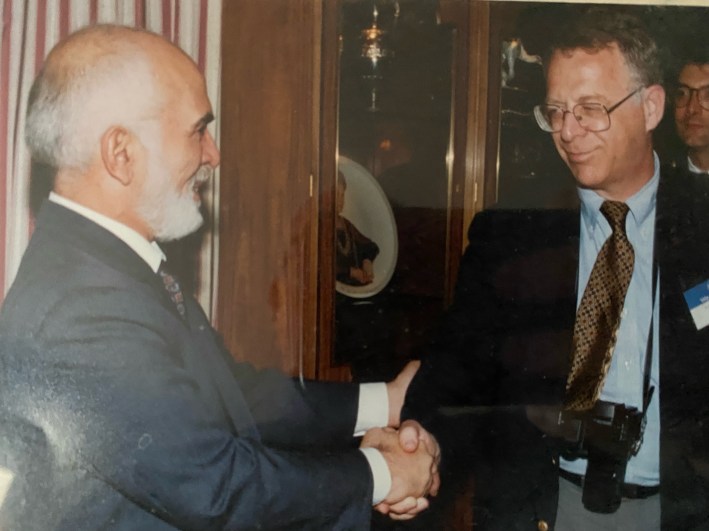
Pursuing Peace. The writer’s father (r) and King Hussein (l) at reception before signing peace agreement.

While the writer’s father was “overjoyed to meet the King” mostly “because peace was coming” to Jordan and Israel, some thirty years later, the writer is saddened by the King’s son warning of “red lines” and directing blame exclusively on the Jewish state.

THE KINGS MISSPEAK

(Click on the blue title)


(3)

IT’S A QUESTION OF HABIT

Some key ingredients to building lasting habits

By Justine Friedman

The Right Stuff. Implement lasting patterns and behaviours that will positively impact your life.

You are feeling “unfit, unhealthy, overweight or disorganised in your life” then you are not alone with most the population anywhere. Let the writer – who has over 20 years’ experience as a clinical dietician and a mindset mentor – guide you in pursuing practical and sustainable goals.

IT’S A QUESTION OF HABIT

(Click on the blue title)


LOTL Cofounders David E. Kaplan (Editor), Rolene Marks and Yair Chelouche

To unsubscribe, please reply to layotland@gmail.com


While the mission of Lay of the Land (LotL) is to provide a wide and diverse perspective of affairs in Israel, the Middle East and the Jewish world, the opinions, beliefs and viewpoints expressed by its various writers are not necessarily ones of the owners and management of LOTL but of the writers themselves.  LotL endeavours to the best of its ability to credit the use of all known photographs to the photographer and/or owner of such photographs (0&EO).

The Israel Brief- 09-12 January 2023

The Israel Brief – 09 January 2023 US Secretary of State to visit Israel. Supreme Court overhaul. Negev Summit underway. Harvard University denies Ken Roth a fellowship due to anti-Israel bias.


The Israel Brief – 10 January 2023 Ben Gvir gives directives on protestors. Concern as Minister of Communications wants to shut down public broadcaster. Concerns as Israel sanctions PA. Mural in support of Iranian women unveiled in Jerusalem.


The Israel Brief – 11 January 2023 Ben Gvir says no arrest for opposition leaders. Pres Herzog appeals for calm. Judicial reform protesters meet with police chief. Oh Harry!


The Israel Brief – 12 January 2023 AG’s, States Attorney’s write unprecedented letter. Energy cost of living plan. Smotrich and Gallant discuss shared responsibilities. Azerbaijan appoint first ambassador to Israel.


Rolene Marks sits down with HonestReporting’s Editorial Director, Simon Plosker as he names “Dishonest Reporter of the year”

Editorial Director, Simon Plosker, speaking live on Modiin – and Beyond with Rolene Marks.


Rolene Marks speaks to Newzroom Afrika about the Taliban’s alarming rollback of women’s rights.

US plans to hold Taliban government accountable


While the mission of Lay of the Land (LotL) is to provide a wide and diverse perspective of affairs in Israel, the Middle East and the Jewish world, the opinions, beliefs and viewpoints expressed by its various writers are not necessarily ones of the owners and management of LOTL but of the writers themselves.  LotL endeavours to the best of its ability to credit the use of all known photographs to the photographer and/or owner of such photographs (0&EO).

ISRAEL UNDER THREAT FROM  ITSELF

A ‘changing of the guard’ is set on changing laws  – a fear for the future

By David E. Kaplan

Israel does not have a Constitution. Nor does it have a two-tier system of government like in the US (a House of Representatives and Senate) that protects “We the People” by providing structural checks and balances.

Israel has just one house – the Knesset – but what it also has – and cherishes – is an internationally respected and sometimes envied Supreme Court that boldly protects ALL its citizens equally.  The Israeli Supreme Court is not merely a magnificent building, it also provides a magnificent service. It is ‘designed’ not only to attract each year multitudes of tourists but to safeguard for all time –  the rule of law.

Under Threat. With Israel’s Supreme Court under attack from the Netanyahu’s hard-right government, will the country’s democratic credentials suffer?

Now however there are ominous forces in play that want not only metaphorically but to literally ‘change the rules’ that will undermine our esteemed Supreme Court posing a threat to civil liberties and minority rights. They are plotting nothing less than an overhaul or more accurately, an overrule by the legislature of the Supreme Court.

Where will the checks be against a – hardly an impossibility these days – reckless legislature without the constraints of the country’s judicial watchdog – a robust Supreme Court?

Yes, Bibi and his new coalition cohorts are on the warpath against the Supreme Court and let us not be fooled by their pretentions of “protecting” democracy. If Israeli democracy needs protecting, it needs protecting from THEM – the Prime Minister and his Justice Minister – Yariv Levin! Under the facile façade of “judicial reform”, the new ultra-right Likud government want the freedom to pursue what could be reckless agendas without any judicial obstacles and to provide as well, protection and immunity to wayward politicians – starting at the top with the Prime Minister himself facing serious criminal charges and then moving down his list of ‘the usual suspects’ in his cabinet. This cabinet includes the Vice Prime Minister serving as well as the Minister of Health and Minister of the Interior and Periphery, Aryeh Deri. Deri has also served time for bribery, fraud and breach of trust, convicted in 1999. Are ‘we the Israeli people’ expected to place our trust and our futures with convicted fraudsters?

Is it any wonder the protests have begun against Prime Minister Netanyahu and Justice Minister, Yariv Levin.

These protests are not a case of the “left having lost an election that they can’t come to terms with it” as rightwing journalists daily jibe but of Israelis who love and respect democracy but now fear losing it.

Wide Awakening. Thousands turn out on a cold wintry Saturday night to protest at Habima Square in Tel Aviv against Prime Minister Netanyahu’s new government, after Justice Minister Yariv Levin unveiled plans earlier in the week to overhaul Israel’s judicial system. (Avshalom Sassoni/Flash90)

The protests on Saturday night the 7 January 2023,  which drew more that 10,000 people to Habima Square in Tel Aviv – “is just one example,” writes the editor of The Jerusalem Report  in his November 9 editorial “of how a large segment of the Israeli public finds these reforms scary and dangerous. People are afraid of the loss of basic civil rights.” The editorial continues, stressing that “Combined with extreme remarks made by some members of the new government about the LGBT community for example, their concerns are not “, as the Prime Minister refutes, “baseless.”

It’s all very well that our smooth-talking Prime Minster is trying to reassure an anxious half of the Israeli population that the claims of his proposed judicial reforms will lead to “the end of democracy” are “baseless”. But are they? After all, he too was once in opposition to the very reforms he now champions.

Demonstrating for Democracy. “We will continue to fight for our democracy,” Merav Michaeli, leader of the Israeli Labour Party, tweeted from the protest in Tel Aviv attended by thousands.  (Avshalom Sassoni/Flash90)

Does Netanyahu – who boasts frequently of how “smart” Israelis are – really believe that Israelis will be duped by the self-interest assertions of a Prime Minister facing criminal charges of bribery, fraud and breach of trust in bed with cabinet ministers who some themselves are convicted felons or hold extreme positions? Noting the caliber of the characters Netanyahu has assembled in his governing coalition, are we really to expect that these reforms will be carried out as he asserts “responsibly” and in a “level-headed manner”?

Who is the Prime Mister kidding? Not any people I know.

And who is Netanyahu listening to? It appears only to himself, while at least one person who he should be listening to is his greatest supporter abroad, emeritus Harvard law professor Alan Dershowitz.

If I were in Israel I would be joining the protests,” Dershowitz told Israel’s Army Radio, referring to the protest attended by thousands in Tel Aviv on Saturday.

Asserting that “It would be a tragedy to see the Supreme Court weakened,” he cautioned that “It will make it much more difficult for people like me who try to defend Israel in the international court of public opinion to defend it effectively [in the future].”

Courting Disaster. Prepared to join the protests, staunch defender of Israel in the court of public opinion, American jurist Alan Dershowitz is troubled by the Prime Minister’s proposed Israel court reforms. (REUTERS/Amir Cohen)

It was a surprise awakening to hear Dershowitz – who has written bestselling books supporting Israeli policies and is close to Netanyahu – to so forcefully oppose the proposed judicial reforms. Dershowitz added he had informed Netanyahu of his “very strong” opposition to the reforms, warning they would also expose Israel to legal challenges by global bodies such as the International Criminal Court.

Even Israel’s president, a position largely ceremonial, has joined in the public outcry to Netanyahu’s judicial reforms. Breaking his silence on Tuesday, President Isaac Herzog  vowed to defend the country’s founding values expressing concern that the proposed reforms by Justice Minister Levin could violate the “moral compass of the country.”

Changes to Israel’s Supreme Court will be ‘supreme’ folly. At the moment the Prime Minister is not listening. It will be up to an awakening public to shout louder.


While the mission of Lay of the Land (LotL) is to provide a wide and diverse perspective of affairs in Israel, the Middle East and the Jewish world, the opinions, beliefs and viewpoints expressed by its various writers are not necessarily ones of the owners and management of LOTL but of the writers themselves.  LotL endeavors to the best of its ability to credit the use of all known photographs to the photographer and/or owner of such photographs (0&EO) .

IT’S A QUESTION OF HABIT

Some key ingredients to building lasting habits

By Justine Friedman

That’s it! You’ve made a decision. You reach a point where you have had enough of feeling unfit or unhealthy or overweight and uncomfortable or disorganised in your life. You are finally going to be happy and have the relationships you have always wanted. It’s now time to start to make changes so that you can finally succeed in the area you’ve been desperate to succeed for so long. This time it’s going to be different! This time you are not going to break the diet or stop until you get to your goal!

Can you relate to these sentiments? Have you been in a position or are you currently feeling this way? That spark of motivation and inspiration can be so powerful. It is the driving force behind every persons push to finally start to improve the quality of their lives.

So, the question is how do we go about making positive changes and implementing habits that will allow us to reach our health and wellness goals? These can be food or lifestyle related (improving relationships with self and others). In fact, any habit that will improve day-to-day life falls into this category. When we decide to achieve a specific goal and we are very “psyched” about it, it is easy to feel motivated and positive. Unfortunately, the reason so many people find themselves giving up too soon may arise due to not setting realistic or achievable outcomes. It is so human to feel overwhelmed and fall off the wagon if you’re trying to do too much all at once. 

In over-reaching and attempting to take on too much and too soon, as well as expecting perfection from oneself, we set ourselves up to fail. Can you relate to the feeling when you try to do everything all at once and then you miss a step of the process? The sense of disappointment and failure can make you think:

 “This is impossible, I just can’t do this, so why should I even bother?”

When we try to use our willpower to resist temptation and impulses, we can end up exhausting ourselves, particularly when we are trying to change too much all at once. In fact, we each have a limited amount of willpower that we use each and every day. If we are finding that we have other challenges to face, our newer habits that we are so desperate to implement, fall by the wayside as we use any energy towards addressing these situations. It is so common for people to find themselves, even after a few weeks of managing to build a new habit to be faced with a trigger that causes any old and more entrenched habit to take over. This can lead one to feel frustrated, despondent, and annoyed at one’s inability to just do what they set out to do.

A great example that is often used is trying to run a marathon. You wouldn’t go out and try to run 42km in one day. You would need to slowly build distance over time, pushing yourself a little more each day, and setting yourself realistic goals. 

Working towards a new goal is the same. Even though it may not seem like you are doing a lot by taking baby steps each day, when you manage to do things in bite-size amounts, that’s where the greatest power lies. Changing and implementing lifetime habits are best achieved by taking small, manageable steps so you don’t fall over at the first hurdle and fail or give up. 

So, what are habits? They are behaviours that are influenced by cues, routine, and rewards. When we consistently repeat the same behaviour over time it becomes a habit. Our habits can be so layered and enmeshed in our lives. Each habit is built on another. It can feel like peeling an onion. Each layer that is removed reveals another underneath until you get to the core. There is always a lot discussed about how long it takes to either break or create a new habit. In general, most people settle on 21 days as the accepted average. I feel that it takes far longer (not to put you off!) for with each new behaviour there are many components to it, just like the many layers of the onion, and if we wish to ensure that the new habits that we are forming over time are there to stay, then each element of the old behaviour needs to be addressed and each aspect of the new behaviour needs to be consistently practiced. It is very human to desire something greatly and then revert to a comfort zone in old habits and behaviours the minute we feel uncomfortable or experience emotions that trigger us.

So how do we go about ensuring our success? One of the first steps is putting perfection on notice. When we expect perfection, and we can’t sustain it we will give up very easily.

The next step is identifying what it is that you wish to improve or change. Without judging or criticising the behaviour that you would like to shift, become curious about why you practice it and when you are most likely to do it. For example, if you find yourself snacking or grazing from 3pm in the afternoon all the way until dinner time, you can become curious about what you are eating and drinking at the beginning of your day until 3pm. Are you trying to be too strict? Are you so busy that you ignore your hunger signals? Are you out and you haven’t taken any food with you so that by the time you get home you are over-hungry? Does this lead you to making poor choices or desperate to fill what feels like a bottomless pit? There are many different situations that can either set you up for success or trip you up along the way.

Once you have identified potential hurdles then you can work to avoid them. You can ensure that you take a break during the day to eat more regular meals and snacks, ensuring you keep your energy and blood sugar levels balanced. If necessary, you can set an alarm on your phone to remind you, particularly if you get too busy. You can make realistic choices about what you will eat at different times of day and pay attention to whether you are drinking sufficient water. Planning ahead of time is always more likely to lead to success. The key is to be able to be flexible if it doesn’t pan out exactly as you anticipated.

This is where one of the most crucial elements comes in. The element of forgiveness. It is the opposite of perfection as it allows us to feel compassion for when we simply can’t follow through or when we find ourselves in front of a hurdle. If we expect perfection in this moment the hurdle may act to block our path. However, if we are more forgiving of how we feel in the situation we become open to reassessing where we are and more likely to find a different way to deal with the obstacle. There are always many ways to reach the same destination and it may not always be the shortest or most anticipated path that gets us there. If we are to truly succeed on this journey, allowing ourselves to experience the steps and “scenery” along the way will make it more meaningful. Not only will reaching our destination seem more victorious but we will have stretched ourselves and grown as the process unfolds.

Does this all sound like too much? Would you rather stay in your safe and comfortable zone, wishing you weren’t? Change is always possible! With the right support you can implement lasting patterns and behaviours that will positively impact your life. Each person and situation is unique and the path to success is too. If you truly desire to reach your destination setting yourself up for success will get you there.

So many wait for January 1st to make new year resolutions. And while these are generally well meaning, the long term success of them are rather short lived. If you truly wish to see positive change in your life, start small and start now, building lasting habits is within your grasp, you just need to take the first step.


About the writer:

Justine Friedman works as a clinical dietician and a mindset mentor. She has over 20 years experience in supporting clients to make sustainable and practical lifestyle adjustments. Her focus is empowering women over 40 to make the necessary changes to feel confident with their food choices and at peace with food, while at the same time managing their weight without restriction or guilt. She works with women both 1:1 as well as in her online signature group program, “The Wellness Upgrade”. For more information visit her website on www.justinefriedman.com


While the mission of Lay of the Land (LotL) is to provide a wide and diverse perspective of affairs in Israel, the Middle East and the Jewish world, the opinions, beliefs and viewpoints expressed by its various writers are not necessarily ones of the owners and management of LOTL but of the writers themselves.  LotL endeavors to the best of its ability to credit the use of all known photographs to the photographer and/or owner of such photographs (0&EO) .

THE KINGS MISSPEAK

Questioning the claims by the King of Jordan to Protect Christians in the Middle East

By Jonathan Feldstein

I was disappointed to read of Jordanian King Abdullah II warning Israel not to cross “red lines” on Jerusalem during a Christmastime interview on CNN.  Curious as to the nature of King Abdullah’s warning, I decided to watch the interview rather than just comment based on the politicized reports, where the headlines look for click-bait.

By way of full disclosure, I have nothing against King Abdullah.  I think he’s quite a rational, stable, and important leader, for Jordan and for Israel. A close alliance between our countries is important.

Interestingly, Abdullah II’s great grandfather, Abdullah I, moved to the region 100 years ago after he was appointed Emir of Trans-Jordan. He and his brother were rewarded with the territory of what’s today Jordan and Iraq for their loyalty to Britain. As Hashemites, they were moved from their native Mecca where the Saudi dynasty took control of the Arabian peninsula, to these new made-up entities. It was not considered an upgrade at the time, but they took what they could get. This was around the same time my grandparents came home to Israel ending, their and their descendants (my family’s) diaspora.

Twisted Tongue. Jordanian King Abdullah II in an interview with CNN claims to protect Christians in the Middle East. “But does he?” questions the writer. (Photo: Screenshot)

Regarding family, I have a lovely photo of the King’s late father, King Hussein bin Talal, and my father in the early 1990s, just before Israel and Jordan formalized a peace agreement.  My father was overjoyed to meet the King, but also because peace was coming to our counties.  I can see the skyline of Amman from my home, underscoring the geographical proximity and all the historical and modern security issues that go along with that, and I would very much like to meet King Abdullah as my father met his father. However, I must take exception with what he said.

Pursuing Peace. The writer’s father (right) on a UJA mission to Jordan, shakes hands with King Hussein at a reception hosted by the King shortly before the signing of the peace agreement between Jordan and Israel.

Indeed, King Abdullah did issue warnings. He cautioned against Jerusalem being “used by extremists on all sides,” an important comment placing himself in the middle. His criticism of Israel initially took a rare tone when he expressed, “If we continue to use Jerusalem as a soapbox for politics, things can get out of control.” Jerusalem, he continued, is a “tinderbox that if it flashes, we won’t be able to walk away from (in the near future).”

King Abdullah underscored how he wants to be perceived as a centrist, engendering sympathy by “living between Iraq and a hard place.” Yet, he warned from his own soapbox that:

 “if people want to get into a conflict with us, we are quite prepared. I like to…look at the glass half full, but we have red lines.”  

While he was not threatening a third intifada, he did toss that in as a possible consequence of crossing the “red lines”.

The “people” he was referring to were Israelis, and the red lines are related to Israel’s presence in and control of parts of Jerusalem, specifically those in which he sees himself as the ‘custodian’. The Jordan River that separates our counties is often brown and murky. So too, King Abdullah’s words were murky.  He repeated a baseless claim he has made before, that as the Moslem Hashemite leader, he’s custodian of Christian and Moslem holy sites.  In fact, he is not.  Jordan’s custodianship only applies to Islamic sites.

King Abdullah spoke of the shrinking number of Christians in the region, noting that the number of Christians is dropping under “pressure.”  He didn’t say it outright, but the pressure to which he was referring is supposedly from Israel.  That too is false.

While indeed the situation of Christians in the region is dire, around the same time as King Abdullah’s CNN interview, Israel released demographics showing a 2% increase in the Christian population in Israel.  Israel is the only area in the region where the number of Christians is actually growing. In fact, the actual pressure on Christians comes from the wider Islamic society in which they live.

But if the King is concerned about the well-being of Christians in the region, he should start in Jordan itself. Why, when I met a Christian woman visiting Jerusalem recently, she would not be photographed with me, or even in Jerusalem, for fear of herself and her ministry in Jordan being threatened. The same happened with a Christian Palestinian Arab from Bethlehem with whom I had the opportunity to do business recently.  When I suggested taking a picture, he stiffened, and he told me that could be dangerous for him in the Palestinian Authority.

Birthplace of Jesus. Will ‘Silent Night’ one day take on a more literal and ominous meaning of the state of the Christian community in Bethlehem, which has dropped from 86% to 12% in the past 60 years, following a trend across the Middle East, except in Israel, where the Christian population is increasing.

One of the most remarkable comments King Abdullah made was in reference to Islam’s reverence of Jesus as messiah. It might be surprising if the King did not have to walk that back for fear of the charge of heresy. That could prove very dangerous for him and his kingdom where he constantly has to underscore his legitimacy as a Hashemite leader of a country that is predominantly Palestinian Arab. Fortunately for the security cooperation between Israel and Jordan where Israel’s intelligence helps keep the Hashemites on the throne.

Sitting on the east bank of the Jordan River, the King said that it was the third holiest site in Christianity being the location where Jesus was baptized. I asked many Christian friends if this was true, and if so, what the first and second most holy Christian sites were. Without exception, all said that a ranking of such sites is disingenuous, and if it were legitimate, there are other sites that would be in contention for third place, fourth, fifth, and even sixth, ahead of the King’s claimed third place.  Then again, with Islam’s third holiest site being in Jerusalem but never once mentioned in the Koran, perhaps his use of the term is deliberately vague.

Others suggested that he was just pandering, trying to be perceived as the savior (pun intended), of Christians in the Middle East, placing a wedge between Jews and Christians and our shared Biblical understanding of the significance of the Land and people of Israel. His saccharine-sweet words “we are committed to defending the rights, the precious heritage, and historic identity of Christians of our region,” hardly stands up to the reality of the plight and persecution of Christians by Muslims in the Middle East.

The King’s warning about protecting the “status quo” in Jerusalem, undermines the rights of Jews and Christians who, by law, are denied the right to pray on the Temple Mount where Jordan has custodianship. Denying the Jewish right to pray at what’s arguably the most holy place in Jerusalem to Jews must be one of his red lines, and about which he sees no problem enforcing, while “defending the rights” of Christians.

Despite the Jordanian King’s claims to protect Christians and Christian sites, I was left feeling uneasy that his comments were more likely to exacerbate than ease tensions and create divisions between Israel’s Jewish and Christian communities, where there are none.

Disputing King Abdullah’s observations, a spokesperson for Christians United for Israel (CUFI) had it right when he said, “Jerusalem never knew true peace or prosperity until its liberation by Israel.”


About the writer:

Jonathan Feldstein ­­­­- President of the US based non-profit Genesis123 Foundation whose mission is to build bridges between Jews and Christians – is a freelance writer whose articles appear in The Jerusalem Post, Times of Israel, Townhall, NorthJersey.com, Algemeiner Jornal, The Jewish Press, major Christian websites and more.


While the mission of Lay of the Land (LotL) is to provide a wide and diverse perspective of affairs in Israel, the Middle East and the Jewish world, the opinions, beliefs and viewpoints expressed by its various writers are not necessarily ones of the owners and management of LOTL but of the writers themselves.  LotL endeavours to the best of its ability to credit the use of all known photographs to the photographer and/or owner of such photographs (0&EO).