Unveiling the contours and contrasts of an ever-changing Middle East landscapeReliable reportage and insightful commentary on the Middle East by seasoned journalists from the region and beyond
Also available on YouTube @The Israel Brief – Simply click on the red subscribe button to receive alerts when a new report is posted.
What’s happening in Israel today? See from every Monday – Thursday LOTL’s The Israel Brief broadcasts and on our Facebook page andYouTubeby seasoned TV & radio broadcaster, Rolene Marks familiar to Chai FM listeners in South Africa and millions of American listeners to the News/Talk/Sports radio station WINA, broadcasting out of Virginia, USA.
Lay of the Land welcomes the 10,000 athletes from 80 countries and visitors from abroadto the to the 21st Maccabiah – the 2022 “Jewish Olympics”
Keeping the ball and the Jewish people “in touch” (photo. D.E. Kaplan) Lay of the Land reporting from a packed Wingate at the opening rugby match between South Africa and Israel, which SA won 40-8 on Friday 15 July. Entry to watch all events is free.
Reflecting on a South African ‘dreamer’ and ‘doer’ at Rosh HaNikra – Israel’s rocky border outpost with Lebanon
By David E. Kaplan
Rock Solid. Not just a ‘pretty place’, Israel’s scenic outpost reveals as mush about the place as the people that passed through it.
A surprise visit to Rosh Hanikra revealed surprising history jarring the writer to recollect the role of the visionary Norman Lourie, who transformed landscapes and impacted lives both in South Africa where he was born and in Israel where he settled.
Debate rages on social media platform discussing if Anne Frank had “White privilege”
By Rolene Marks
Picture Imperfect. If teenager Anne Frank was not safe in Nazi occupied Holland, her memory and image remains unsafe today.
Where is the “privilege” in being singled out for extermination? A convoluted race-based perverted logic is preying on social media today dehumanising Anna Frank and the 1.5 million Jewish children murdered in the Holocaust as if they had it coming being “White”! If understandably dumbfounded, the writer breaks it down.
Miroslaw Tryczyk’s startling exposé of Polish participation in the mass murder of Jews
Book review by Nazi-hunter Dr. Efraim Zuroff
(First published in The Jerusalem Report)
Revelation to Revulsion. ‘THE TOWNS OF DEATH’ illuminates the mass murder of Jews by their Polish neighbours.
“There are very few books which influence the rewriting of history, but this book should be one of them,” asserts Nazi hunter Dr. Zuroff. It details from witness testimony, the murder Jewish residents of fifteen towns and villages in eastern Poland NOT by the Nazis but by their Polish neighbours! Despite false government narratives to cover up the past, brave writers are illuminating the terrible truth.
LOTL Cofounders David E. Kaplan (Editor), Rolene Marks and Yair Chelouche
To unsubscribe, please reply to layotland@kenmar11
While the mission of Lay of the Land (LotL) is to provide a wide and diverse perspective of affairs in Israel, the Middle East and the Jewish world, the opinions, beliefs and viewpoints expressed by its various writers are not necessarily ones of the owners and management of LOTL but of the writers themselves. LotL endeavours to the best of its ability to credit the use of all known photographs to the photographer and/or owner of such photographs (0&EO).
Reflecting on a South African ‘dreamer’ and ‘doer’ at Rosh HaNikra – Israel’s rocky border outpost with Lebanon
By David E. Kaplan
Istarted the week with a visit to Rosh HaNikra, the scenic grotto with a cable car reputed to be one of “the steepest in the world”. It’s the most northern point in Israel’s Mediterranean coastline – next stop lies an historic enemy – Lebanon.
Poetry in Motion. A kaleidoscope of colours and sounds pervades the alluring grotto at Rosh HaNikra.
A turbulent past of thunderous shelling, this day I was happy to absorb the thunderous crash of the waves on the rocks which reminded me of those onomatopoeic lines of W.H. Auden in his poem ‘On This Island’:
“…Oppose the pluck And knock of the tide….”
These words resonated as I listened to the “pluck” of the wave as it receded within the grotto back to sea and then returned with a crashing “knock” against the rocks. It was an endless noisy battle from time immemorial – much of what transpired only metres above as armies ‘crossing’ from the ancient to the modern world physically crossed here on the coastal road. Among them were the Assyrians, Persians, Greeks, Romans, Arabs, the Crusaders up to and including the British who in the 1940s paved a rail line between Haifa and Tripoli in Lebanon. Bombed by Jewish fighters in June 1946 in the prelude to the War of Independence, it was at this rehabilitated relic of a railway line – today a historic site – that I was looking at when I noticed in the information plaque of the contribution of the South African engineers as part of the South African Engineering Corps. It was then that I remembered that this was the very spot that Norman Lourie, the founder of the South African Habonim youth movement in 1930, had come to cover as a war correspondent attached to a South African engineer unit.
Stopped in its Tracks. The railway line at Rosh Hanikra from Haifa to Beirut and Tripoli in Lebanon that was inaugurated in 1942 but abandoned only three years later.
Was it fortuitous, I thought, that the Habonim movement reached its 90th in 2020 but due to COVID, will be celebrating this milestone event this coming October 2022 in Israel?
While studying at university in the UK in the late 1920s, Norman Lourie heard a young man like himself, Wellesley Aron, speak about starting a Jewish youth movement in the poor East End of London. So inspired, Norman returned to South Africa with his ‘dream’ and what emerged was to become the largest Jewish youth movement in Southern Africa. Initially modeled on the scout movement, it soon emerged into an ideological powerhouse, whose young bogrim (graduates), would settle in Israel making a superlative impact in every field of human endeavour.
Eye on the Future. Holding his camera, South African visionary Norman Lourie was a poet, war correspondent, pioneer film producer, successful hotelier in Israel and the founder of the Habonim Jewish youth movement in South Africa.
Some would emerge recipients of the country’s highest civilian award – the Israel Prize – for reaching the pinnacle in their field. This year, on Independence Day, Prof.Ruth Berman who was born in Cape Town in 1935, and grew up in Sea Point and attended Habonim – which she says “influenced my decision in 1954 to make Aliyah” – was awarded the Israel Prize for her trailblazing work in linguistics.
In an interview with the SA. Jewish Report, Prof. Berman (née Aronson) expressed that she dedicated the award to her fellow South Africans:
“who came to Israel in the 1940s and 1950s, who haven’t always received acknowledgement for their tremendous contribution to building Israel. This is especially in regard to those who came from the Zionist youth movements and went on to become leaders in their fields, from medicine to academia to the arts. This award isn’t only mine, but theirs.”
Riveting Ruth. A graduate of the Habonim movement in Sea Point, Cape Town, Ruth Berman is an Israeli linguist, Professor Emerita, Tel Aviv University and the 2022 Israel Prize laureate in linguistics.
One such individual from this early period deserving of recognition is Norman Lourie, whose dream of the youth movement was to influence the lives of so many.
But Norman himself had another dream. While Habonim means ‘the builders’, it was about building in Israel, that Norman’s next dream physically took shape and not too far from where I was standing at Rosh HaNikra.
The seed of that dream germinated during World War II, when Norman, as a war correspondent attached to a South African engineer unit tasked for maintaining the stretch of rail from Haifa to Beirut, found himself on a train that stopped at a sandy station “in the middle of nowhere.”
Norman alighted.
“Where are we?” he asked.
“Shavei Zion,” someone told him. He quickly learnt it was a moshav on the coast started by German immigrants who fled Nazi Germany in 1938. He instantly fell in love with the place and pledged to return.
After the war, he returned and negotiated with two sisters for the purchase of their small hotel that in their advertisement, boasted “running water in each room.”
Norman’s dream was to transform it into a luxury hotel. He formed a syndicate of South African investors and over the next few years built a 5-star hotel, called Dolphin House (Beit Dolphin).
It became the summer home of Israel’s state presidents and a favourite resort for visiting dignitaries and celebrities.
Hollywood in Holy Land. Dolphin House , the meeting place for visiting celebrities to Israel, didn’t just bring Beverly Hills style living to Shavei Zion (Return to Zion), it raised the entire quality of life of the moshav.
Israel’s presidents of the fifties – Chaim Weizmann and Yitzhak Ben Zvi – mixed socially with the likes of Danny Kaye, Sophia Loren, Ralph Richardson, Israeli actress, singer and model Daliah Lavi who was born on Shavei Zion, and many others of the movie industry’s celebrities – most notably, the entire cast of the movie blockbuster – Exodus.
5-Star Hotel for the Stars. The famed Jewish film star Danny Kaye at Dolphin House in the 1950s was a “regular” at the hotel on moshav Shavei Zion.
Dining with the Stars
During the filming of Exodus, another South African fell in love with Shavei Zion and experienced a brush with stardom. In 1960, Ivor Wolf of Ra’anana was in Israel as a volunteer in Nachal. The movie’s director, Otto Preminger, had negotiated with the IDF, to hire some Israeli soldiers to play the part of British soldiers stationed in Acre during the famed breakout scene of the prison, where on May 4, 1947, 28 Irgun and Lehi prisoners were freed. “I was one of those British soldiers and was happy to let the Jews escape,” laughs Ivor. During shooting, Ivor would frequently share meal tables at Dolphin House with the likes of Paul Newman, Eva Marie Saint, Peter Lawford, Lee J. Cobb, Sal Mineo, Hugh Griffith and Ralph Richardson.
All ‘Set’. Staying at Dolphin House, Paul Newman and director Otto Preminger on the set of the film Exodus (1960).
Shavei Zion had also a more direct connection to the movie’s plot. Following the breakout of the Acre prison, all the prisoners killed in the action, were carried by the escapees and buried on the moshav, the first refuge on route following the escape.
Well into the 1960s, Dolphin House was riding a crest of a wave, “actually a metaphor,” says Ivor, “because it still stands next to one of Israel’s finest beaches.” On Sundays, an orchestra used to play on a band-stand and people from all over the north came to enjoy open-air music “in this piece of paradise.”
The movies and the music however did not last. The ‘final curtain call’ on this era came when the property was acquired by Kupat Holim Klalit and turned a 5-star resort into a medical facility. Even this use of ‘Norman’s Dream’ had its time as the property fell into disuse until Ivor again stepped into ‘the picture’, this time not as a ‘walk-on-part’, but as a major actor in the on-going saga of Shavei Zion and Dolphin House.
Shifting Currents. The Prime Minister of Ghana at Dolphin House, the first African country to have diplomatic relations with the State of Israel.
Representing a group of investors, like Norman had done before, “we bought the premises comprising the old, desolate hotel and adjacent buildings and built 22 fully-equipped holiday bungalows called Dolphin Village.” Norman’s vision was restored – from Dolphin House to Dolphin Village.
Ivor, who had been a leader in the Betar movement in South Africa before making aliyah, is proud of promoting a project that was the brainchild of the founder of Habonim. “After all,” says Ivor, “the bottom line is that our youth movements at the time were all about promoting and building a strong Jewish state. This is what we did, and this is what I feel I am still doing today.”
Shavei Zion is a far cry today from when its founders absorbed the illegal immigrants off the ships evading the British blockade, or when Norman Lurie alighted from a train at a stretch of dirt and saw a property that prided itself on offering “running water”.
‘Sign’ of the Times. Joshua Malka (right) watches as the Prime Minister of Burma (today Myanmar), one of the first countries in Asia to recognise Israel, signs the guest book at Beit Dolphin (בית דולפין / Dolphin House.)
It is somewhat poignant that Norman Lourie, who would go on to become as well a prizewinning filmmaker was born in South Africa in 1909 – the same year the first Tel Aviv dwellings were erected on empty Mediterranean sand dunes. But there is another striking meaningful coincidence. When in 1935, Norman captained a team of South African athletes to the second World Maccabiah Games in Palestine, he met Lord Melchett (Sir Alfred Mond, Bt), a British industrialist and ardent Zionist, who wrote to Norman’s father on his behalf urging him to allow his son to remain in Palestine. Although it would take another decade for Norman to follow his dream and settle permanently in Palestine in 1946, Lord Melchett’s support was never forgotten and when in 2014, a luxury boutique hotel named after Norman Lourie called ‘The Norman’ opened in Tel Aviv, its location was none other than on the corner of – Melchett Street!
The Norman Conquest. Drink a L’Chaim to Norman Lourie at Tel Aviv’s top boutique hotel ‘The Norman’ named after the visionary who founded the South African Habonim youth movement in 1930.
Tel Aviv today is not short of good bars and pubs but when the former members of South African Habonim from all over the world gather in Israel this October to celebrate the long-awaited 90th anniversary, they may want to pop into the Champagne and Wine Bar or the Library Bar at The Norman and toast a L’Chaim to their founder.
EPILOGUE
Staring at the long unused railway line at Rosh HaNikra – a casualty of war – one can only add to the ‘dreams’ that one day in the not to distant future, that line that Norman came to film will be reopened as Lebanon gets on track in pursuing peace.
But that’s a script that still needs to be written by future dreamers and doers.
While the mission of Lay of the Land (LotL) is to provide a wide and diverse perspective of affairs in Israel, the Middle East and the Jewish world, the opinions, beliefs and viewpoints expressed by its various writers are not necessarily ones of the owners and management of LOTL but of the writers themselves. LotL endeavours to the best of its ability to credit the use of all known photographs to the photographer and/or owner of such photographs (0&EO).
The Israel Brief – 11 July 2022 – Israeli tributes to Shinzo Abe. Preparing for Pres. Biden’s visit. Pres Herzog to visit Czech republic. Gantz and Saar merge parties.
The Israel Brief – 12 July 2022 –USA to release damning dossier on Russia. Amnesty UK peddling hate merch? Israel dispatches defensive aid to Ukraine. It’s the Maccabiah!
The Israel Brief – 13 July 2022 –Pres. Biden in Israel. UN says Israel should be on report blacklist. Israeli ambassador to Poland presents credentials. Was Anne Frank privileged?
The Israel Brief – 14 July 2022 –Pres. Biden in Israel day 2. Saudi Arabia approves overflights. IDF’s first female border commander. Opening of Maccabi Games.
While the mission of Lay of the Land (LotL) is to provide a wide and diverse perspective of affairs in Israel, the Middle East and the Jewish world, the opinions, beliefs and viewpoints expressed by its various writers are not necessarily ones of the owners and management of LOTL but of the writers themselves. LotL endeavours to the best of its ability to credit the use of all known photographs to the photographer and/or owner of such photographs (0&EO).
Debate rages on social media platform discussing if Anne Frank had “White privilege”
By Rolene Marks
I cannot believe that I have to write this article in 2022 when we assume that with the body of knowledge and evidence that exists about the Holocaust. But here we are. Along with many outraged activists on JTwitter (Jewish Twitter), I added my voice to a chorus that had to take to the internet platform to say “No, Anne Frank is NOT an example of white privilege”.
Yup. You read that right.
What started off this tsunami of ire was the tweet below:
Nothing says “white privilege” like a whole group of people, i.e. Jews, singled out for extermination because not only were we seen as an inferior race by the Nazis; but we were not even seen as human.
This is not the first time that the teen who put a name and a face to the one and a half million Jewish children who were murdered during the Holocaust has seen her image, memory and experience appropriated by those seeking to politicise a point.
The millions of people all around the world, in many different languages, who have read her story have shared in her daily frustrations, the precocious personality of a typical teenager experiencing the changes and her heartbreaks as well as the very real fear and hurt of being targeted for death for the crime of being a Jew. Anne Frank put a name and a face to the
1, 500, 000 children murdered in the Nazi genocide of the Jewish people. For many people, Anne Frank put a human face to a catastrophe many viewed in the abstract.
Anne and her sister Margot were sent to Bergen Belsen after the secret annex where her family and several other Jews were carefully hidden from the Nazi death machine, was discovered. They died of typhus and their bodies thrown into a mass grave. Their father Otto Frank, survived them.
Over the last few days, Anne Frank became a victim again. She was “othered” by someone who like many, see everything through a prism of race. The person who tweeted the offensive tweet was not the only one accusing her of amongst many things, “white Privilege”, “Jewish privilege” and “colonization”. In “woke’ 2022, it is not unusual to see offence frackers accuse those who they don’t agree with or in this case, whose history they know nothing about; use terminology like “colonisation” or “privilege” – something very easy to do when you are living in suburbia with unfettered access to the internet….
Esteemed author and intellectual, David Baddiel who wrote the best-selling book, “Jews don’t Count” opined that there is a type of Schrodinger’s law on whites, particularly in reference to Jews. Schrodinger’s law originally referred to the physicist Erwin Schrodinger who explained how a cat in a box could be in an ambiguous predicament in the world’s most successful thought experiment. Until the box was opened and the cat’s condition weighed, the strange laws of quantum theory indicated that it could be both dead and alive.
Baddiel’s theory when applied to antisemitism is a kind of “Schrodinger’s whites”. Simply put, Jews are both white and not white, and too many are not seen as underprivileged or marginalised. Jews are often thought of as rich capitalists and don’t fit the fashionable parameters that get social justice warriors all heated up. Jews are also “too white” for campaigners and of no interest of social justice activists who see racism as a class construct, one in which you need to be economically or socially disadvantaged. “For progressives, he writes, “no victory is claimed by championing their experience, and this leads to a subtle — and unconscious — exclusion.” The mission of fighting racism has been repurposed to suit the other political causes of campaigners rather than the needs of its victims.” Anyone else have a headache?
To this point, Baddiel brings up the concept of “Schrodinger’s Whites”. Jews are both white and not white. To those trotting out the accusations of privilege, most Jews pass for Caucasian and are “rich”, so therefore they enjoy “white privilege”. Shades of Whoopi Goldberg arguing that the “Holocaust was not about race, just some white people fighting each other” springs to mind. In that sentence, Goldberg erased the unique and painful Jewish experience which is why her comments were so obscenely offensive.
Baddiel was asked for his comments about Goldberg and he said:
“One of the principal things going on here is the resistance that antisemitism is racism. What a lot of people think it is religious intolerance.”
He pointed out that, despite him being an atheist, he would have been persecuted due to his Jewish heritage:
“My great-uncle who died in the Warsaw Ghetto was not an observant Jew. The whiteness of Jews is a very complex thing.”
Baddiel explains that“Far-right groups… have seen Jews as not part of the white race. But meanwhile, the far-left, the association of Jews… with power and privilege makes them super white.”
Author and comedian David Baddiel and his bestseller, ‘Jews Don’t Count.’ (Courtesy)
Jews are not a homogenous people – we are different races and ethnicities that come from all corners of the globe, are both affluent and not – but the one thing we all have in common irrespective of race, ethnicity and success is that the only “privilege” we all seem to have is enduring millennia of discrimination, persecution, hatred, exclusion and genocide.
This brings me back to Anne Frank.
Anne Frank once said, “In spite of everything, I still believe that people are really good at heart”. If only the hope expressed through this remarkable young woman – whose story resonates through the generations in the hope that it would educate people and remind them that we were not just numbers but had names, lives and experiences – would be realized. We have to do better by Anne.
Perhaps we can start by ensuring that she continues to be a voice and a human face for the millions of Jews throughout our history who have suffered the unfathomable. We have a duty to protect Anne and everything she represents.
While the mission of Lay of the Land (LotL) is to provide a wide and diverse perspective of affairs in Israel, the Middle East and the Jewish world, the opinions, beliefs and viewpoints expressed by its various writers are not necessarily ones of the owners and management of LOTL but of the writers themselves. LotL endeavours to the best of its ability to credit the use of all known photographs to the photographer and/or owner of such photographs (0&EO).
There are very few books which influence the rewriting of history, but this book should be one of them. It is the history of the fate of the Jewish communities in fifteen towns and villages in eastern Poland in the Bialystok region, in which the Jews were murdered beginning in summer 1941 not by the Nazis, but by their Polish neighbors. The communities which met this fate were :
Paint the Town ‘Red’. The mass murder of Jews in their hometowns by their neighbors is authentically revealed by witness reports from survivors, bystanders and the murderers themselves found in court testimonies.
The common denominator among them for more than half a century, was the false narrative that their Jewish residents had been murdered by the Nazis, a “fact” inscribed on the various monuments to commemorate their memory. In 2001, however, Polish historian Jan Gross, who for many years had been teaching at Princeton, shocked Polish society by publishing Neighbors, a historically accurate narrative of the mass murder of almost all the 1,600 Jews of Jedwabne, many of whom were burned alive by their neighbors in the barn of a Polish resident of the town.
Poles Apart. Antonina Wyrzykowska and her husband were beaten by fellow Poles for saving Jews in Jedwabne, and were later recognized as Righteous Among the Nations
Neighbors shocked Polish society and sparked intense internal controversy. Needless to say, it was totally rejected by ultranationalists and nationalists, and was considered an unprecedented attack on the accepted historical narrative of Poland during World War II. As the author explains in his concluding chapter, the Communists who ruled Poland in the aftermath of World War II completely denied the participation of Poles in Holocaust crimes. According to their version of the events, the Germans were the exclusive perpetrators of the crimes of the Holocaust and many Poles were Righteous Among the Nations. The facts revealed in Neighbors, however, cast serious doubt on that narrative, and created widespread public interest in the issue. which led to a forensic murder investigation of the events in Jedwabne by the Polish Institute of National Memory, which confirmed that the perpetrators were indeed ethnic Poles. In 2001, Polish President Aleksander Kwasniewski publicly apologized for the crime, as did President Bronislaw Komorowski in 2011.
Unholy Alliance. The author demonstrates the pivotal role of the Catholic clergy and individual priests, the intellectual classes, and political circles in perpetuating anti-Semitism leading to the mass murder of Polish Jews.
Following the rise to power of the ultranationalist Law and Justice party, however, President Andrzej Duda publicly criticized Komorowski’s apology, leaving the crimes in Jedwabne an open wound in Polish society. This bitter ongoing controversy, is what makes this book incredibly important, because it conclusively proves that the murders of the Jews of Jedwabne was not by any means an isolated incident, but rather a crime which was repeated by ethnic Poles in fourteen other communities in the same geographic area during the same time period. Tryczyk’s research is impeccable and is primarily based on court documents from over 700 cases conducted in Poland under the decree of August 31, 1944 on the punishment of “Fascist-Nazi Criminals Guilty of Murder and Torture of Civilians and Prisoners and of the Traitors of the Polish Nation,” supplemented by additional relevant sources such as Jewish memoirs by survivors, and the documentation of the proceedings of the Main Commission for the Investigation of Nazi Crimes in Poland, and many others.
Gag Order! “Poland is trying to ‘gag’ history,” says Polish-American sociologist and historian and Professor of History, emeritus at Princeton University Jan Gross who has been a catalyst for historical debates about Polish behavior during the Holocaust ( Photo: AP Photo/Czarek Sokolowski)
Besides presenting much descriptive evidence on the crimes in each of the communities and their incredible cruelty (Jews were burned alive and murdered by iron-clad stakes, knives, axes, saws, pitchforks and hammers, but very rarely by firearms), Tryczyk attempts quite successfully to explain the reasons for the pogroms, and the four stages of the process which transformed the Jewish residents from neighbors to defenseless sub-humans. The first stage was the intensive prewar antisemitic incitement against the Jews by the National Democrats political party and by many local Catholic priests. The second stage was the power vacuum left by the fall of the Polish state in 1939, and the subsequent flight of the Soviets in spring 1941, which was filled by the creation of a local Polish administration with its own militia, which took drastic measures against people accused of supporting the Soviets. The third stage was characterized by attacks on wealthy Jews, plunder of their property, rape of Jewish women, and beatings and humiliations of Jews. The Nazis arrive in the fourth stage and give their approval for a pogrom. In some cases they leave the murders to the local perpetrators, in others they cooperate with the killers.
Buying its Pastto Bullying its Scholars. Before being overturned by an appellate court in Poland, Barbara Engelking (l) and Jan Grabowski (r) had been ordered in 2021 to apologize for their research on Poles who collaborated with Nazis (Yad Vashem via AP / courtesy)
Given the controversial “history policy” of the Law and Justice party and their determination to hide the Holocaust crimes committed by ethnic Poles, as per the notorious law of 2018 which made attributing Holocaust crimes to the Polish state a punishable offence, and the attempt to punish outstanding Holocaust scholars Jan Grabowski and Barbara Engelking for revealing Polish participation in the Shoah, Tryczyk’s book has become even more important.
It is not an easy book to read, but it is required reading for anyone interested in the Holocaust history of Polish Jewry.
About the writer:
Dr. Efraim Zuroff is the chief Nazi-hunter of the Simon Wiesenthal Center and Director of the Center’s Israel Office and Eastern European Affairs.
While the mission of Lay of the Land (LotL) is to provide a wide and diverse perspective of affairs in Israel, the Middle East and the Jewish world, the opinions, beliefs and viewpoints expressed by its various writers are not necessarily ones of the owners and management of LOTL but of the writers themselves. LotL endeavours to the best of its ability to credit the use of all known photographs to the photographer and/or owner of such photographs (0&EO).
Unveiling the contours and contrasts of an ever-changing Middle East landscapeReliable reportage and insightful commentary on the Middle East by seasoned journalists from the region and beyond
Also available on YouTube @The Israel Brief – Simply click on the red subscribe button to receive alerts when a new report is posted.
What’s happening in Israel today? See from every Monday – Thursday LOTL’s The Israel Brief broadcasts and on our Facebook page andYouTubeby seasoned TV & radio broadcaster, Rolene Marks familiar to Chai FM listeners in South Africaand millions of American listeners to the News/Talk/Sports radio station WINA, broadcasting out of Virginia, USA.
A personal account marking the 40th anniversary of the First Lebanon War in 1982
By David E. Kaplan
Leaving Lebanon Behind. Forty years later, David carries with him memories in his mind and shrapnel in his hand.
Having graduated from Israel’s prestigious Technion in Haifa, war for 27-year-old David David was the farthest thing on his mind. Surfing off Tel Aviv beach in the morning, hours later he would find himself on a journey that would take him to a city forbidden to Israelis – Beirut! It was the ‘Summer of ‘82’.
From focusing on issues of social justice, Human Rights organisations are funded today to push particular agendas.
By Rolene Marks
An About Face. Human rights organisations that morphed into advocates for hate against Israel.
How did respected human rights organisations like Human Rights Watch and Amnesty International fall foul of its mandate to the point where its Jewish founders became its anxious critics? While these organisations are mindful as to financial disclosure, they are more reticent when it comes to disclosing who exactly are writing the big cheques. The writer breaks it all down.
On the Ball. From escaping the lows of the Nazis to reaching the dizzying heights on the courts of American basketball.
The life of Ernie Grunfeld, who would go on to win an Olympic gold medal and reach previously unimaginable heights as a top Jewish NBA player and executive could have been so different. From escaping as a child the Nazi nightmare to pursuing the American dream as an adult, this improbable journey of a multi-generational Jewish familyunveils layers of bravely, perseverance and love.
LOTL Cofounders David E. Kaplan (Editor), Rolene Marks and Yair Chelouche
To unsubscribe, please reply to layotland@kenmar11
While the mission of Lay of the Land (LotL) is to provide a wide and diverse perspective of affairs in Israel, the Middle East and the Jewish world, the opinions, beliefs and viewpoints expressed by its various writers are not necessarily ones of the owners and management of LOTL but of the writers themselves. LotL endeavours to the best of its ability to credit the use of all known photographs to the photographer and/or owner of such photographs (0&EO).
A personal account marking the 40th anniversary of the First Lebanon War in 1982
By David E. Kaplan
When Israel launched 40 years ago on June 6, 1982, Operation Peace for Galilee (‘Shlom HaGalil’) also known as the First Lebanon War against Palestinian terrorists based in southern Lebanon, 27-year-old David David was back living with his parents in Holon following his graduation in engineering at the prestigious Technion in Haifa. An army reservist, who had “long forgotten what it was like to be in uniform”, war was “the furthest thingfrom my mind.” Yes, like everybody in Israel, he was up on the news following the attempted assassination in London of the Israeli Ambassador to the UK by one of the terrorist groups operating out of Lebanon. Only a year before on July 10, 1981, the PLO based in Lebanon began shelling the north of Israel with Katyusha rockets and 130 mm artillery shells. Periods followed when civilians in the north had to live in shelters or as many did, move southward to escape the terror.
All this however was not on the young engineering graduate’s mind. Rather than catching up on the news, he was instead catching waves, surfing off Tel Aviv beach.
It was mid-summer, which meant time for fun.
Reality hit home – literally and figuratively – when returning from the beach his distraught mother came to him with papers in her hand:
“You have been called up”.
Both David’s father and mother had survived the ‘Farhud’ – the violent pogrom carried out against the Jewish population of Baghdad, Iraq, on June 1–2 in 1941. Leaving everything behind, their lives and livelihood, they escaped to the new State of Israel – a place of salvation for Jews. However, wherever there are Jews, it is never entirely safe and their son David was off to war.
HAIR-RAISING EXPERIENCE
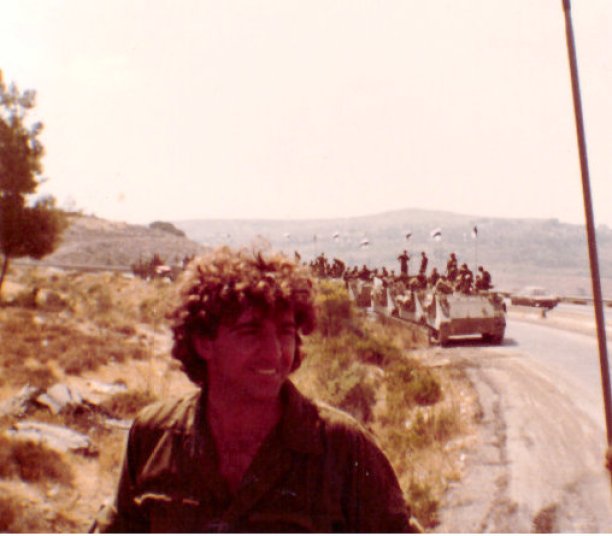
“It was funny; the expected thing do when called up as a reservist was get your hair cut. Not me; I was suspicious about trimming my locks before going to war; maybe it was the Samson syndrome, so I went off to Lebanon in uniform but with a black slightly afro-hippy hairstyle,” relates David whose parents were so proud of their biblical surname felt it deserved repetition – hence David David!
On the road to Beirut, “a CNN correspondent tried to interview me. He remarked he found it strange how in the Israeli army some with no hair and you have plenty. I explained that I was a reserve soldier and had come from the beach. The main thing I told him was “that I am here’ hair or no hair.”
Refusing to cut his long hair, David David in Lebenon in 1982.
While war is ugly David is proud of how he and his comrades conducted themselves. He cites examples:
“Our food truck on the way to Beirut was bombed and there we were, 30 of us with no food and we arrive at a supermarket. All I wanted was milk and a chocolate. Loudly, we were collectively working out the exchange rate as we only had Israeli currency. Meanwhile, the shop owner was terrified; all these soldiers with firearms, speaking loudly in Hebrew; he suspected the worst. He was overwhelmed when the accountant in our group went up to him with all the money we collected and said in Arabic, “We do not have any of your currency but this is the equivalent in ours that you can exchange”. He could not believe it. He broke into a smile he was so relieved. I doubt any soldiers of previous invading armies over the millennia have ever so conducted themselves.”
On another occasion, David was in his amoured vehicle driving through a Palestinian refugee camp. This was during a later reserve duty in Lebanon and in Winter. “We always made a point when we saw children, to stop and offer them food if we had any. On one occasion as we came across a kindergarten it suddenly started raining hard. All the kids were rushed inside both because of the downpour but also because they saw us soldiers and in the tumult, one little girl was left alone crying outside in the rain. Although dangerous to stop so exposed in an unprotected area, we did, and I said, “keep alert; I’m going to take that girl inside”. I got out, took the little hand of the shivering and frightened girl and knocked on the door of the kindergarten. The teacher partially opened, looking terrified and then revealing surprise as she saw me – a soldier holding the girl’s hand. She grabbed the kid and shut the door as if trying simultaneously to shut out the complexity of war. I often think, of that little girl who would today be about 44-years- of-age, herself a mother and possibly a grandmother. Would she even remember the incident and if she did, what would her thoughts be?”
During the war in Lebanon, David David (centre) with his fellow comrades.
Asking what impact the war had, David replies that every year on Yom Ha’atzmaut (Independence Day), during the celebratory fireworks, “I always think about Lebanon. The BOOM BOOM of the fireworks reminds of the noise of shells falling around me. This year I did not experience it and then I realized the fireworks were silent this year in consideration for dogs who become traumatized.”
David David and a comrade on top of their armored vehicle in Lebanon.
David has reason to believe in a guardian angel watching over him. In the second week of the war, he obtained a brief leave of absence to attend a family wedding.
No sooner had David climbed aboard the Egged bus seconded to the military, he was told by the driver “to get off”. Only authorized to carry a maximum of 25 passengers, David was number 26. “I tried to argue; offered to sit on the floor, but the driver refused.” David got off the bus and upset that he might miss the wedding, he then noticed a military truck that was about to leave for Rosh Hanikra, the most northern Israeli town on the Israeli-Lebanese border. It had large tires on the back “I begged the driver for a lift to which he replied if I didn’t mind curling up with the tires.”
It possibly saved David’s life!
“We started to drive and at about 500 metres, two missiles struck the bus I would have been on, causing multiple casualties. The tires shielded me from most of the blast with pieces of shrapnel piercing my face and finger. I still have a piece lodged in the finger and every time there is pain it reminds me of the war.”
David did manage to still attend the wedding and returned a day later on aboard an IDF military helicopter. “Once we entered Lebanese airspace we were pounded by enemy fire and missiles but the crew took all the necessary evasive actions to redirect the incoming missiles and we landed safely. It was very scary. That was one hell of a wedding to attend – both getting there and getting back!”
ROAD TO DAMASCAS
There were moments for David on this road but hardly what one can describe akin to biblical revelations. David can honestly claim to have captured 25 Syrian soldiers without firing a bullet or injuring anyone. In charge of an important machsom (military roadblock) at Bhamdoun, east of Beirut, “Anyone going to Syria had to pass through me. I examined all identification papers and travel documents and my good grasp of Arabic, having studied it at school, would serve me well. One day, a group of 25 men arrived at the roadblock and each presented me with their papers. They explained they had been in Lebanon and were now returning to Syria. I noticed in each of their ID papers, the same word جندي (“jundi”), which I knew meant ‘soldier’. I quickly deduced this was a Syrian Commando unit that had fallen behind our Israeli lines and were trying to return to their area. They had obviously ditched their weapons and uniforms and found civilian clothes. Without raising any alarm, I casually over the radio called for the Shabak (security service) who quickly arrived and took the group away as captured Syrian prisoners.”
On the road leading to Damascus, David David with a convoy behind.
When not engaging the enemy, Bhamdoun proved full of surprises. “We had no access to showers but came across an abandoned villa with a natural hot spring swimming pool. It was a real treat.”
Also abandoned was “a synagogue we discovered. It was once used by Jews visiting this resort town. We honoured its past by some of us praying outside its walls.”
On a lighter note, “a IDF military bulldozer had just completed digging a trench near our checkpoint when the driver looked up at a nearby hill, saw some soldiers and said I’m finished here; I’m going there. I said to him jokingly, ‘maybe you will come back; maybe you won’t’. He asked, ‘What are you talking about?’ I said those are the Syrians. ‘WHAT?’ he bellowed. He never realized how close he was to the frontline, He said “I’m outta here. He turned his bulldozer around and headed back in the direction of Beirut.”
David David (2nd left) and his fellow soldiers discover an abandoned synagogue in Bhamdoun, east of Beirut.
Pressing David as to what helped him get through the war he replies:
“It was humour-often very black humour. Look, we had no proper food;, nowhere to shower; to sleep properly but what we did have was very high moral and humour .We were always telling jokes and funny stories and laughing loud at everything. This is how we got through this war. Also, sharing stories about our lives.”
Having no access to showers, David David and his comrades found an abandoned villa with a private swimming pool.
Merging the two, David explains that whenever a person received a parcel from a loved one, it was “a big occasion shared by all. It was opened in front of everyone. One day, one of us received a parcel from his girlfriend. We were sitting in a cherry orchard; the whole of Lebanon seemed to be one big cherry orchard – they were everywhere. Anyway, he opened this parcel from his beloved and inside was none other than a box of cherries with a note “Because I’m so sweet, I know this will remind you of me.” We could not stop laughing; even the Syrians must have heard us.”
Missing loved ones was alleviated on one occasion when out of the blue an IDF mobile phone truck arrived at David’s base and “we had access to it for the day to phone our families, friends and girlfriends. Cut off as we were, it was wonderful and we did not want the truck to leave. And then a miracle happened. At the end of the day, the truck could not leave, there was a problem with the engine but of course, no problem with the phones. For three days we used the phones. To this day, I am convinced that it was no ‘miracle’ but some talented soldier in our unit who had craftily disabled the truck’s engine. After all, we’re Israelis!”
“The morale was so high,” says David David seen here relaxing with his comrades somewhere in Lebanon.
EPILOGUE
Forty years later, there is still no peace for Israel with Lebanon. It was once falsely believed that Lebanon would be “the second country to make peace with Israel”. It has proved not to be. Under the grip of Hezbollah and Iran, it may prove to be the last.
However for my good friend David David living with his South African-born wife Henrietta (née Wolffe) from Cape Town in Rishon LeZion, to the question of whether there will be peace one day, he replies:
“I hope so; and when there is, the first thing I am going to do is take my family there and see all the places where I was. The place is beautiful – trees, water, mountains. It is breathtaking. That is the paradox that there is also war with the beauty. Not only with Israel but more with itself. When the war is all over, I will return.”
Operation Peace for Galilee (‘Shlom HaGalil’) emblem (1982)
While the mission of Lay of the Land (LotL) is to provide a wide and diverse perspective of affairs in Israel, the Middle East and the Jewish world, the opinions, beliefs and viewpoints expressed by its various writers are not necessarily ones of the owners and management of LOTL but of the writers themselves. LotL endeavours to the best of its ability to credit the use of all known photographs to the photographer and/or owner of such photographs (0&EO).
The Israel Brief – 04 July 2022 –PM Lapid’s first speech. Ballistics examination on fatal Abu Akle bullet. Poland and Israel improve ties. Remembering Entebbe.
The Israel Brief – 05 July 2022 –Ballistics report results released. Is tension growing between Israel and Russia. PM Lapid in France. 50 Cent arrives in Israel.
The Israel Brief – 06 July 2022 –Ben and Jerry’s sue Unilever. US State Dept wants “accountability” in killing of Abu Akleh. More from meeting between PM Lapid and Pres. Macron. Abbas and Haniyeh come face to face.
The Israel Brief – 07 July 2022 –Saudis mulling inviting Israeli official? UNRWA still have not removed incitement from textbooks. Turkey and Israel sign aviation agreement. Rocking Israeli summer.
While the mission of Lay of the Land (LotL) is to provide a wide and diverse perspective of affairs in Israel, the Middle East and the Jewish world, the opinions, beliefs and viewpoints expressed by its various writers are not necessarily ones of the owners and management of LOTL but of the writers themselves. LotL endeavours to the best of its ability to credit the use of all known photographs to the photographer and/or owner of such photographs (0&EO).
Human Rights organisations are no longer just focuses on social justice issues but very heavily funded, many times to push particular agendas.
By Rolene Marks
The human rights industry is worth billions of dollars. This is serious wonga! According to recent statistics reported by the Business Research Company, the global human rights organizations market size was expected to grow from $16.60 billion in 2021 to $17.47 billion in 2022 at a compound annual growth rate. That is a lot of lucre.
One could see why people are drawn to working for human rights organisations – after all who wouldn’t want to work for what they perceive is a noble and just cause? The two most notable organisations are Human Rights Watch and Amnesty International. There are notable parallels between these organisations. Both of these once venerated NGO’s were founded by Jews. Both enjoy extremely high profiles and trust. Both are seen as the litmus test for evaluating human rights transgressions. Both have a clear obsession with the State of Israel. Both have seen their original founders publicly distance themselves from the organisations for fear they were headed down a dangerous, agenda driven road.
When an organization, no matter how noble their mandate is, starts to veer off course and head down a very dubious path it often raises question “who is funding them?”
For the purposes of this article, we will take a look at Human Rights Watch and Amnesty International.
Human Rights Watch
Human Rights Watch (HRW) describe itself as “an independent, nongovernmental organization, supported by contributions from private individuals and foundations worldwide. Human Rights Watch does not solicit or accept donations by governments, directly or indirectly. This includes governments, government foundations, and government officials. Indirect donations include those that are, or appear to be, made on behalf of a government or government official through an immediate family member, another intermediary, or a foundation.” In other words, this is who funds us; but don’t expect us to tell you exactly who they are. This is a procedure followed by Amnesty International as well and is no indication of untoward practice but when these organisations take a stroll down dangerous lanes, it does beg the question – who is doling out the dough?
Robert L. Bernstein, the founder of Human Rights Watch eventually turned against the organization that he started with noble intentions.
“As the founder of Human Rights Watch, its active chairman for 20 years and now founding chairman emeritus, I must do something that I never anticipated: I must publicly join the group’s critics. Human Rights Watch had as its original mission to pry open closed societies, advocate basic freedoms and supportdissenters. But recently it has been issuing reports on the Israeli-Arab conflict that are helping those who wish to turn Israel into a pariah state.”
This has become more and more apparent as HRW turn its focus away from the many human rights atrocities and points a damning finger at Israel. HRW’s former Director Ken Roth who retires next month, has devoted the majority of his online social media presence to singling out Israel – but what else can you expect from someone who once tweeted about “being invited for coffee with Hezbollah” or that Hamas’ use of tunnels to potentially kidnap Israeli soldiers, did not necessarily contravene international law.
Human Rights Watch has lost critical perspective on a conflict in which Israel has been repeatedly attacked by Hamas and Hezbollah, organizations that go after Israeli citizens and use their own people as human shields. These groups are supported by the government of Iran, which has openly declared its intention not just to destroy Israel but to murder Jews everywhere. This incitement to genocide is a violation of the Convention on the Prevention and Punishment of the Crime of Genocide.
But Roth has not stopped there. It has become a daily activity amongst Israel advocates and our allies to call Roth out on his obsessive tweeting about Israel while staying silent on gross human rights violations across the world. He could tweet about the Palestinian Authority crackdown on journalists and critics or the million + Uyghur Muslims in concentration camps in China, or the Biafran people in Nigeria, or the genocide of Christians in that country. There are sadly, countless other conflicts or oppressed people that could do with a smidgeon of Ken’s attention.
Instead he turns his attention to Israel, accusations of Apartheid, excoriating Israel’s leadership – all with a generous serving of Ben & Jerry’s boycott endorsements.
It is no coincidence that Roth is focusing so much attention on the overpriced ice-cream manufacturers boycott, after all it was his colleague, Omar Shakir, who advised the Ben & Jerry’s board.
Remember when ice-cream didn’t have an opinion?
Omar Shakir, the Director of HRW Israel-Palestine, was booted out of the country in 2019 for BDS activities that contravened Israel’s laws. He has now dedicated his energy and time to publishing reports accusing the Jewish State of war crimes during the May 2021 conflagration and a separate one accusing the country of practices of Apartheid – while scarcely a mention about any transgressions from Hamas or the Palestinian Authority. Shakir even went so far as to totally redefine the term Apartheid to push his agenda – a strategy Amnesty International also followed in their recent report.
Can HRW, an organization that practices such flagrant bias and whose Directors are routinely accused of antisemitism not just by Jews but by notable politicians and other high profile people, still be taken seriously or even considered a human rights organisation?
What is extraordinary are the huge salaries received by Roth and his ilk as evidenced in the most recent report featured below.
The cost of hate creation (Courtesy of UN Watch)
While the organization is careful to disclose its financials, it will not disclose which countries, governments, associates etc. write the big cheques.
When a respected human rights organization falls foul of its mandate to the point where its founders raise the alarm bells, one has to ask who is forking out the finance?
Amnesty International
The other “big hitter” in the human rights world is Amnesty International. Founded in 1961 by Peter Benenson, a British lawyer. It was originally his intention to launch an appeal in Britain with the aim of obtaining an amnesty for prisoners of conscience all over the world. Before his passing in 2005, Benenson denounced Amnesty International for its fixation of the State of Israel.
Amnesty International (AI) has a well-documented history of anti-Israel and antisemitic activity and this has been exposed by organisations such as NGO Monitor. A huge portion of its budget seems to focus on nefarious ways to undermining and delegitimizing Israel – including its recent report accusing the Jewish state of “crimes against humanity and practicing apartheid”. They managed to magically redefine what Apartheid was in order to push its agenda.
Antisemitism, hatred and incitement conveyed in a seemingly subtle way with intentional misuse of the term Apartheid (AI)
Examples include its 2015 rejection of a “Campaign against anti-Semitism in the UK” – the only proposed resolution at its Annual General Meeting that was not adopted; comments by its current Secretary General that Israel is a “government that is rogue” and the head of its Finland branch that Israel is a “scum state”; and the fact that no other country in a conflict zone is the focus of similar Amnesty-led boycotts. Amnesty International have routinely hired staff who have posted antisemitic content on social media including Kristyan Benedict, Amnesty UK’s “crisis response manager” who tweeted on November 19, 2012, during Operation Pillar of Defense, “Louise Ellman, Robert Halfon & Luciana Berger walk into a bar….each orders a round of B52s (inspired by @KarlreMarks Bar quips) #Gaza.” The three people he characterized as war-mongers are British Members of Parliament, all of whom are Jewish.
The organisation refused requests to investigate rising antisemitism in the United Kingdom and have routinely embarked on campaigns to promote boycotts, divestment and sanctions on the Jewish state.
Their above mentioned report released in February this was the bitter cherry on the cake and has been dismissed by countries including France, the USA, the UK, the Netherlands and many more as it is seen as a clear breach of the widely recognised International Holocaust Remembrance Association (IHRA) definition of antisemitism. The code adopted by the UK government and other authorities’ worldwide states that it is antisemitic to deny Jews their right to self-determination “by claiming that the existence of a State of Israel is a racist endeavour”. There is genuine concern that this report could add fuel to the already flaming fires of antisemitism.
But Amnesty International have also come under fire. Legal figures and MPs in the UK have called for the UK Charity Commission to consider Amnesty’s status because publishing such a report from its UK office could be a contravention of the clearly stated criteria of the Charity Commission.
Just last month, an independent inquiry into AI’s secretariat found that the human rights organisation has a culture of white privilege with incidents of overt racism. Ouch! (Click and read the full report here).
Some of the accusations include:
Senior staff using the N-word and P-word, with colleagues labelled over-sensitive if they complained.
Systemic bias including the capability of black staff being questioned consistently and without justification, and minority ethnic staff feeling disempowered and sidelined on projects. Micro-aggressive behaviour such as the touching of black colleagues’ hair.
A lack of awareness or sensitivity to religious practices resulting in problematic comments and behaviour, including mocking Ramadan.
Aggressive and dismissive behaviour, particularly over email and often directed towards staff in offices in the global south.
Kieran Aldred, who worked for AIUK as an advocacy officer for three years until 2018 said:
““Working for AIUK destroyed my self-confidence, my belief in my capabilities. I didn’t think I was skilled enough to do my job, that any organisation would ever hire me, let alone promote me, and I suffered from ongoing depression and anxiety.”
Sacha Deshmukh, Amnesty International UK’s Chief Executive, said:
“It is critical in the change that we need to make at Amnesty UK that we acknowledge that his report makes abundantly clear the scale of the transformation we must make to change lots about Amnesty UK as a place to work.”
This is the same organization that spends a fair chunk of cash writing reports, trotting out “experts” like notorious anti-Israel activist, Miko Peled, running seminars and putting up posters and billboards accusing Israel of Apartheid.
These two organisations are not the only heavily funded, agenda rife NGO’s. There are many others. This is not to say all human rights organisations have flung out their mandates in favour of disproportionate focus on the Jewish state.
As Russia’s assault on Ukraine rages on and with it a trail of human rights abuse and China continues to imprison Uyghur Muslims in concentration camps, Christians murdered in Nigeria, Iran hangs dissidents and members of the LGBTQI+ community and many other crimes against humanity continue, perhaps the megabucks poured into the human rights industry is best spent focusing on their plight and not on rallying up hate against the Jewish state.
While the mission of Lay of the Land (LotL) is to provide a wide and diverse perspective of affairs in Israel, the Middle East and the Jewish world, the opinions, beliefs and viewpoints expressed by its various writers are not necessarily ones of the owners and management of LOTL but of the writers themselves. LotL endeavours to the best of its ability to credit the use of all known photographs to the photographer and/or owner of such photographs (0&EO).
By all accounts, Dan Grunfeld is a young man with a very bright future ahead of him. Born in 1984 to a highly successful couple, his father a basketball star who parlayed his athletic success into a job as a top NBA executive, his mother was the daughter of a founding partner of one of the largest law firms in Wisconsin, his future looked quite rosy. Add the facts that Dan is highly intelligent, an extremely talented writer, a hard worker and an individual with empathy and the right sensitivities regarding life and its various challenges, his journey into adulthood should have been a case of very smooth sailing from childhood all the way to the present. A book about his life, however, would most probably have been incredibly boring and not worth the read.
Surviving to Thriving. Says the author: “It’s a happy, hopeful story of basketball, perseverance, inspiration. Yes, I discovered tears, but I discovered a lot of love and laughs.”
Yet Dan’s life and career became much more challenging than he ever could have imagined, because of his family’s Jewish origin, the trials and tribulations and horrific losses of parents and siblings experienced by his Hungarian Holocaust survivor grandparents, and the unique basketball career in America of his father Ernie, who achieved incredible success on and off the court, following his immigration from Communist Romania to the United States at the age of nine. Rather than purposely ignoring or conveniently forgetting these painful aspects of his family history, Dan embraced them all, and they became highly significant factors, which motivated him to try and emulate his father’s athletic achievements, even though his natural athletic abilities did not measure up to those of his Dad. It also made him determined to share his grandparents’ Holocaust and postwar travails in great detail to highlight their incredible resilience and fortitude. In fact, to the best of my knowledge, this is the first book about American college and pro basketball, whose real heroes are an elderly couple of Holocaust survivors.
Eye on the Ball. Ernie Grunfeld hugs his children, Rebecca, 12, and the author, Danny, 9, at a news conference in Harrison, New York, July 21, 1993. (AP Photo/Mark Lennihan
The story of the Grunfeld family begins in the village of Micula, in rural Transylvania, then part of Romania, on the border with Hungary. As Dan describes it:
“there was natural beauty, but no running water, electricity or cars…Toilets were holes in the ground with makeshift wooden seats.”
Anyu, Dan’s grandmother was one of ten children, five boys and five girls. The family was modern Orthodox and relatively well-off, and appeared to be living an almost idyllic, if technologically primitive, life. The problems began in 1940 when Northern Transylvania was transferred from Romania to Hungary, in the framework of the Second Vienna Award. Within a year, the Hungarians began drafting Jewish males of military age to serve in the labor battalions, many of which were sent to accompany the Hungarian soldiers serving on the Eastern front. Their conditions were absolutely terrible, and Anyu’s oldest brother Ernie was purposely poisoned to death by a sadistic antisemitic commander in a labor camp in Ukraine.
Tragedy to Trophies. Ernie Grunfeld with his mother Anyu (Lily) Grunfeld in front of his trophy case. Ernie was named after his mother’s oldest brother who was purposely poisoned to death by a sadistic anti-Semitic commander in a labor camp in Ukraine. (Courtesy)
These problems paled, however, to the horrific situation following the Nazi invasion of Hungary on March 19, 1944. Within two months, the Nazis began rounding up all the Jews living outside Budapest, and deporting them to be murdered in Auschwitz. In Dan’s detailed description of Anyu’s survival in the Hungarian capital, his grandmother showed incredible resourcefulness, not only in saving herself and her sisters, but assisting other Jews by obtaining for them the Schutz-Passe documents issued by Swedish diplomat Raul Wallenberg, which spared their bearers from deportation.
Swedish Savior. When Dan and his grandmother Anyu visit the Holocaust Museum, the first place they go is the corner honoring Swedish diplomat Raoul Wallenberg, who saved Anyu’s life twice as she evaded the Nazis in the Budapest ghetto. “My grandmother still talks about him to this day.”
After the Russians liberated Budapest, Anyu headed home with one of her siblings, only to realize that most of her family had been murdered and almost every single one of their possessions had been robbed by their non-Jewish neighbors. She married a fellow survivor and tried to rebuild her life, but they realized that Communist Romania was not an ideal place to raise a Jewish family, and so after about a decade, they were able to emigrate to the United States and start all over again in Forest Hills, Queens. There the same values of hard work and resourcefulness served them well, and even the tragic loss of one of their two sons to leukemia did not break their spirits. It was in New York City, that their son Ernie achieved the American dream, starring in basketball at Forest Hills High, a success he replicated at University of Tennessee, which paved the way for his NBA career on and off the court, and set Dan on his path to try and match his father’s successes.
In a League of his Own. Ernie Grunfeld, star of the New York Knicks in October 22, 1982 is the only son of Holocaust survivors known to play in the National Basketball Association — or any other major American sports league. (AP Photo/Joe Giza)
As someone who grew up in New York City fantasizing of achieving basketball history as the first Orthodox Jew to play in the NBA, despite totally lacking the skills required, I very much identified with Dan Grunfeld‘s quest to duplicate his father’s basketball career.
Aiming High. Ernie Grunfeld lifting Dan as a young boy who would emerge himself as a pro basketball player in Israel, Europe and the United States, and the tournament MVP for the gold-medal-winning Team USA in the 2009 Maccabi Games. (Courtesy)
His quest was noble, albeit somewhat obsessive, but he did make it to the pros, at least in Europe. But as Dan himself will admit, and as the readers of his book will learn, basketball is not the most important thing in life. The fact that he was able to beautifully convey his family history and remain loyal to his Jewish heritage, is the most valuable lesson from his journey.
By the Grace of the Game: The Holocaust, A Basketball Legacy, and an Unprecedented American Dream
About the writer:
Dr. Efraim Zuroff is the chief Nazi-hunter of the Simon Wiesenthal Center and the director of the Center’s Israel Office and Eastern European Affairs.
While the mission of Lay of the Land (LotL) is to provide a wide and diverse perspective of affairs in Israel, the Middle East and the Jewish world, the opinions, beliefs and viewpoints expressed by its various writers are not necessarily ones of the owners and management of LOTL but of the writers themselves. LotL endeavours to the best of its ability to credit the use of all known photographs to the photographer and/or owner of such photographs (0&EO).