Little did we think when we watched a year ago the final season of ‘Game of Thrones’ and joked that “Winter is Coming” that the show’s most memorable marketing metaphor of impending doom descending on the landscape would step out of our TVs into our very lives.
Portend Poster. Advertisement of the ‘Game of Thrones’ final season – ‘Winter is Coming’.
Corona affected everyone everywhere. And like in the award-winning mythical saga of demons, dragons and the demented, in our wonky world of 2020, people perished, much of our commerce suspended or died, and a powerful leader of the most powerful nation on earth – confounded by the science, fell – to the dismay of his mega-million followers.
“Winter” came with a vengeance and we wonder if our lives will ever be the same again.
No doubt when folk turn on their TVs to watch the countdown to midnight on the 31st December and observe the fireworks first in Sydney; and then illuminate across cities circumnavigating the globe, they will be praying for some semblance of “life as we knew it.”
Diminished social intimacy and wearing masks for fear of ‘the next virus’ is not something we want in our proverbial luggage as we travel into the future!
Still, we do have to marvel.
Colouring the Future. Fireworks in Sydney, usually the first country people watch on television heralding the New Year.
With all the pain and discomfort, we have to tip our hats to those brave souls who day in and day out returned to the terrifying trenches, helping the inflicted and preventing those from being inflicted at great risk to themselves and their families.
The death toll from Covid-19 has surpassed the number of Americans killed in World War I and the Vietnam War combined. And this December 2020, the number of daily Covid-19 deaths in the US now surpasses the number of people who died on 9/11. How sadly ironic that so many of the first responders in 9/11 are falling victim to Covid-19!
New York’s Finest. Retired New York Fire Marshal John Knox in 2017 is among dozens of first responders who answered the call during of 9/11 only to die of Covid-19.
First, it was the horror of that tragic day as first responders ran into the fire as debris rained down. Then followed months of grueling work to remove the bodies and clear the pile as toxic dust inevitably filled their lungs. Then came the illnesses – asthma, cancers and COPD.
And in 2020, nearly two decades later, the coronavirus pandemic – which, in so many cases, feeds off the underlying conditions like the ones 9/11 survivors developed – has finally taken their toll and in many cases, their lives. For those with already weakened lungs and immune systems, this latest challenge has been too great to endure. Beset by Corona, the list of 9/11 victims continues to grow.
And as with the 9/11 first responders, so too have been the healthcare workers on the front lines of the global effort to care for patients with COVID-19 putting themselves at risk for infection. Thousands from a multitude of countries, professions, and specialties have died, and we honour them all.
Signs of Exhaustion. Overworked medical staff catch some sleep between shifts at Chinese hospital. (Image credits: Astroboys2019)
See the Light
As in the story of Hanukkah, which Jews around the world are presently celebrating where we are reminded of miracles – a small quantity of oil to light the Temple’s menorah miraculously lasted eight days – even today’s cynics and skeptics have to marvel as to how humanity has miraculously responded to this pandemic with rapid resourcefulness.
Questions were raised as to how we might achieve the impossible.
It was said that “it usually takes 10 years to develop a vaccine”.
I recall endless opinions and comments in the news media along the lines of from “The grim truth is that a vaccine probably won’t arrive any time soon” to “Our record for developing an entirely new vaccine is at least four years — more time than the public or the economy can tolerate social-distancing orders”.
Breaking News. The first batch of Pfizer vaccines arrive at Ben Gurion International Airport with the Prime Minister reassuring the Israeli public that he would be the first to take the vaccine.
And yet, as we in Israel saw Prime Minister Benjamin Netanyahu and Health Minister Yuli Edelstein attend the arrival of a DHL freight plane transporting the first batch of Pfizer vaccines at Ben Gurion Airport on December 9, 2020, we had to marvel how this vaccine has gone from the drawing board to imminent distribution in such a short period of time.
Hands On. Light at the end of the tunnel, Israeli Prime Minister Benjamin Netanyahu places his hand on the first batch of Pfizer coronavirus vaccines at Ben Gurion International Airport on Dec. 9, 2020. (Marc Israel Sellem/JINI via Xinhua)
No, it did not take years but months as people in Israel will start receiving their doses from the 27th December, four days before New Year 2020. Coronavirus czar, Nachman Ash, said he hopes Israelis will be able to celebrate Passover 2021 in an almost restriction-free manner.
“I assume that in March-April we’ll already return to significant activity. My hope is that we can celebrate Passover in an almost free manner.”
Tides Turned. Israel signs agreement with Moderna for 6 million coronavirus vaccine doses.
How we in Israel recall that it was during Passover 2020 – falling during the initial outbreak of the pandemic – that the government ordered an overnight curfew, confining Israelis to their homes for the first night of the holiday.
A festivity all about celebrating FREEDOM, Passover 2021 may be the momentous milestone when we all return to FREEDOM.
Now that’s something to cheer about – “L’chaim!” (Hebrew “to life”)
Israeli Foresight. “Israel was one of the first countries that believed in us,” said Chief Medical Officer at Moderna Therapeutics, Dr. Tal Zaks, a graduate of Ben Gurion University of the Negev. Speaking to Globes, Zaks revealed, that it was thanks to the advance agreement signed with Moderna that Israel will be among the first countries to receive doses of the company’s vaccine against Covid-19. The advance that Israel paid, said Zaks, “helped to build the company’s production lines.”
*Feature pictute credit: Illustration by Joseph McDermott
While the mission of Lay of the Land (LotL) is to provide a wide and diverse perspective of affairs in Israel, the Middle East and the Jewish world, the opinions, beliefs and viewpoints expressed by its various writers are not necessarily ones of the owners and management of LOTL but of the writers themselves. LotL endeavours to the best of its ability to credit the use of all known photographs to the photographer and/or owner of such photographs (O&EO).
also available on YouTube @The Israel Brief – Simply click on the red subscribe button to receive alerts when a new report is posted.
Happy Hanukkah
What’s happening in Israel today? See this week’s daily ‘The Israel Brief’ broadcasts on LOTL YouTubeby seasoned TV & radio broadcaster, Rolene Marks familiar to Chai FM listeners in South Africa and millions of American listeners to the News/Talk/Sports radio station WINA broadcasting out of Charlottesville, Virginia. You can subscribe to LOTL news from Israel and enjoy at a time of your convenience.
Seeing the Light. A guide showing how the sage was Moses’ likely inspiration for the Menorah
From the goals of the ancient Maccabees in defying Hellenistic influence on Jewish life to a reset in goals of a wayward football club in Jerusalem, the writer explores this rich history on the very terrain in central Israel seeking illumination during this ‘Festival of Lights’.
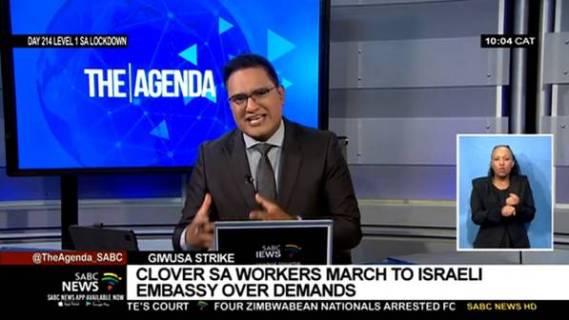
Wrong Way. Disgruntled strikers march against Israel instead of their company ‘Clover’!
In the midst of a labour dispute, employees of South Africa’s major dairy and beverage producer ‘Clover’ have had their cause hijacked by local anti-Israel lobbies redirecting their grievances and their wrath on Israel instead of their bosses.
Arab writers opine on issues pertaining to the Middle East from the impact for the region of an incoming Biden administration to the significance of the late Diego Maradona beyond his magic on the playing field.
While the mission of Lay of the Land (LotL) is to provide a wide and diverse perspective of affairs in Israel, the Middle East and the Jewish world, the opinions, beliefs and viewpoints expressed by its various writers are not necessarily ones of the owners and management of LOTL but of the writers themselves. LotL endeavours to the best of its ability to credit the use of all known photographs to the photographer and/or owner of such photographs (O&EO).
Follow in the ancient footsteps that gave birth to the Jewish “Festival of Lights” to this Hanukkah’s surprise at Jerusalem’s premium football club
By David E. Kaplan
Celebrating the start of Hanukkah today, I am watching my two grandchildren, Ariel and Yali enjoying their sufganiot (doughnuts). They may not know the history or understand the significance of this “festival of lights” but these two and three year-olds are enjoying the fun of Hanukkah roaring with laughter as they play with their spinning tops, known as dreidels (‘sevivon’ in Hebrew). One legend had it that during the time of the Hanukkah story, Jews would grab a dreidel and start to play if Syrian soldiers entered the house while ‘illegally’ praying or studying Torah study. In the Diaspora, the four-sided dreidel displayed four Hebrew letters – ‘nun’, ‘gimel’, ‘hey’ and ‘shin’ representing the words ‘ne’s ‘gadol’ ‘hayah’and ‘sham’, meaning “a great miracle happened there.”
In Israel, the last letter is changed to a ‘peh’, representing the word ‘po’, “here,” with the resulting declaration:
“a great miracle happened here.”
And it sure has as modern day Israel – the Start-Up Nation testifies too. So what happened back then?
In around 168 BCE, Antiochus Epiphanes IV, the Hellenistic King of the Seleucid Empire stepped up his campaign to quash Judaism, so that they would share the same culture and worship the same gods.
Marching into Jerusalem, he vandalized the Temple and decreed that studying Torah , observing the Sabbath, and circumcising Jewish boys were punishable by death. To ensure his policies were carried out, he sent Syrian overseers and soldiers to villages throughout Judea to viciously enforce his edicts.
Entrance to Hasmonain Village.
When these soldiers reached Modiin, northwest of the capital, they demanded that the local leader, Mattathias the Kohein (a member of the priestly class), be an example to his people by sacrificing a pig on a portable pagan altar. He refused killing the King’s representative and with the rallying cry “Whoever is for God, follow me”, Mattathias and his five sons (Jonathan, Simon, Judah, Eleazar, and Yohanan) fled to the hills and caves of the wooded Judean wilderness and founded the Hasmonean dynasty, which ruled from 164 BCE to 63 BCE. They reasserted the Jewish religion and reduced the influence of Hellenism on the indigenous Jewish population.
It is to this beautiful area I visited during a Hanukkah before Corona in the center of Israel. It lies amidst historical heritage sites and the national forest of Ben Shemen, all home to the ancient Maccabees and present day Israelis mostly living in the modern day city of Modi’in, halfway between Tel Aviv and Jerusalem. Past and present merge in a colourful kaleidoscope of nature and history.
Welcome back to the Past. The brainchild of Zohar Baram and his late wife Naomi, Zohar explains Hasmonian Village as a reconstruction of life in ancient times. (photo D.E. Kaplan)
Genesis
To get a taste of “authentic Israel” where the ancient Maccabees once lived and worked, I visited the reconstructed Hasmonian Village in Shilat and met its founder and Director, Zohar Baram.
He explains how it came about.
“After a tough day of fighting in the Sinai during the Yom Kipur War in 1973, we were sitting around our tanks and armoured cars and turned on the radio when we heard the famous British actor, Peter Ustinov say that it had been “a mistake to create the State of Israel” and that “the Jews have no historical connection to the land – it’s a myth!” I was shocked.”
Voice in the Wilderness. The English actor, Peter Ustinov, whose tirade against Israel heard in the Sinai, spurned Hasmonain Village.
Only the year before he met and got to know the British actor when Ustinov stayed in Eilat for the filming in the Negev desert of a British-Israel film Big Truck and Sister Clare. Baram was taken on as Ustinov’s official guide, ‘So you can imagine we spent a lot of time together and we got to know each other quite well”.
Well, not quite!
A tank commander and fearless in battle, Zohar was brought to tears. “Hearing his tirade in that unmistakable voice, I made an instant decision. It was not enough to defend the land; I needed to defend our history. I realized in the sand dunes of Sinai, where Moses received the Ten Commandments that I had to dedicate my life to the education of future generations of the historical connection of Jews to the Land of Israel.”
The result of this ‘revelation’ is today Hasmonaim Village which Zohar Baram established with his late wife, Naomi. “I love working with the youth and it is so important to show and explain to Israeli children who live in apartments what the homes of their ancestors over 2000 years ago looked like. How did they dress; what furniture they had; what decorated their walls and how they made a living.” The village which has a main road and homes on either side “is typical of the size of a village at the time.”
Back to the Grind. Zohar Baram showing the writer how people during the period of the Maccabe ground wheat with an ancient stone grinder. (photo D.E. Kaplan)
He passed me some wheat, placed it in an ancient stone grinder and then left it to me to produce grain that I placed in a plastic bag to take home. We then walked to the village mint, where Zohar hammered three coins “for your children” with motifs from ancient Judea. “The children love this and get the feel what life was like here two thousand years ago,” said Zohar.
Home Truths. At the time of the Hanukkah story, a sense of inside a home showing the furnishings and clothing worn at the time.
Leaving the village, I noticed the words taken from the Bible and inscribed in Hebrew, which translated reads:
“When you see it, your heart will be happy”.
I left the village with a ‘happy heart’ and could well understand why filmmakers – mainly American – use it as a location for movies and documentaries. The most celebrated filmmaker that Zohar has worked with is the American Ken Burns noted for such documentaries as The Civil War and The Roosevelts. “When I work with such celebrated artists, I too enjoy a “happy heart’ when thinking back to that British actor in 1973 whose venomous words directed me on my life’s mission.”
Coining it. Activities include minting coins the ancient way. Zohar Baram passes me a newly minted ‘ancient’ coin. (photo D.E.Kaplan)
Field of Dreams
No visit to this area is complete without a visit to the Biblical Nature Reserve called Neot Kedumim, which in Hebrew means “pleasant pastures (or habitations) of old.” Covering an area of 2,500 dunams (2.5 km2; 0.97 sq mi), Neot Kedumim is a recreation of a biblical landscape.
A Visual Visit of the Bible. The Biblical landscape of Neot Kedumim near Modi’in, midway between Jerusalem and Tel Aviv.
In 1964, land was allocated for the project with the help of Prime Minister David Ben-Gurion and today comprises: the ‘Forest of Milk and Honey’, the ‘Dale of the Song of Songs’, ‘Isaiah‘s Vineyard’ and the ‘Fields of the Seven Species’. Signs are posted throughout the garden quoting relevant Jewish texts in Hebrew and English.
On arrival, my tour guide explained that when Ephraim and Hannah Hareuveni immigrated to Palestine in the 1920s, they dreamed of developing a biblical landscape reserve that “embodied the panorama and power of the landscapes that both shaped the values of the Bible and provided a rich vocabulary for expressing them.”
Their son, Nogah Hareuveni, a physicist, dedicated his life to implementing his parents’ dream. To build the park, thousands of tons of soil were trucked in, reservoirs were built to catch runoff rain water, ancient terraces, wine presses and ritual baths were restored, and hundreds of varieties of plants were cultivated.
“It started in 1964 with Nogah and we teach,” continued the guide, “what he taught us. Working with the Bible in one hand and a spade in the other – he made the connection between the scriptures and nature.”
Noting how Jewish festivities have to do with a certain time of the year and a particular type of fruit, “he planted only those trees and plants that were indigenous in biblical times. He wanted visitors to understand the text of the Bible better by using their senses – seeing, smelling, touching, hearing and tasting.”
He reasoned that because the Bible conveys abstract ideas through parables using images from everyday life thousands of years ago, it had less traction in the 20th century, where people are more attuned to the imagery of consumerism. The idea of Neot Kedumim is to ‘experience’ the Bible in the context of an authentic Biblical landscape. Nogah wanted Neot Kedumim “To be the photo album of the bible.”
Tapping into the Past. Extracting water the ancient way at Neot Kedumim. (Photo by Reut Shai Dror)
It was not surprising that in1994, Neot Kedumim and Nogah Hareuveni, were joint recipients of the ‘Israel Prize’ – Israel’s most prestigious civilian award.
“I always tell my groups that while Israel today is known for its innovative start-up companies, it emanates from our past. To survive in this harsh land one had to come up with ideas; so, the tour will stop at the cistern and see how water was stored; different types of oil lamps and how someone had to think of the idea that one could extract oil from the olive to fuel the lamp, and the type of plant that provided the wick. Here at Neot Kedumim we see how ideas were nurtured in nature and how the ancient Israelites survived and thrived. Here is the beginning of Israel’s status as the Start-Up Nation.”
Seeing the Light. A guide explaining how the sage was the inspiration for the Menorah
Walking along the path feasting my eyes on the exquisite scenery, my guide suddenly raises his hand to stop a tractor coming towards us. Its driver Zachariah Ben Moshe stops, climbs off with a jump and introduces himself as being in charge of tree planting. Explaining that I will be writing an article, he quickly points to the branches on a sage tree.
Holy Moses! Is this what Moses saw? The image of the Menorah is unmistakable in this flowering sage. (photo by Noga HaReuveny)
“What does this remind you of?” he asks.
It stared at me in the face – it was so obvious.
“The Menorah,” I answered. Described in the Bible as the seven-lamp ancient Hebrew lampstand made of pure gold, the Menorah was used in the portable sanctuary set up by Moses in the wilderness and later in the Temple in Jerusalem. Fresh olive oil was burned daily to light its lamps.
“Exactly,” replies Ben Moshe. “The Menorah was taken from the sage. We read how God instructed Moses on how to build a Menorah who said: “Go out to the mountain and see its image.” Clearly, it was the sage he saw and as we say , the rest is history.”
Scoring a Goal for Normalisation
After endless enmity and divisions on the land, “history” was surely made before this Hanukkah with the announcement that the UAE royal family bought half of a top-tier Israeli soccer team – but not just any team. It was Beitar Jerusalem Football Club – an Israeli soccer team with an anti-Arab reputation amongst its fan-base!
Cowers for an Enlightened Future. Sheikh Hamad bin Khalifa al-Nahyan, a member of the Abu Dhabi ruling family (left) and Beitar Jerusalem F.C. owner Moshe Hovav pose for a photo in Dubai.
This barrier-shattering deal is among the fruits of Israel’s nearly three-month-old normalisation agreement with the Emirates and sends a strong symbolic message – that “winds of change” are blowing across the Middle East. The deal puts a Muslim Sheikh at the helm of Beitar Jerusalem, the only Israeli team that has never fielded an Arab player.
So no Arab player, but now an Arab co-owner.
Times are changing – the will and optimism is there.
Says Beitar Jerusalem’s owner, Moshe Hogeg about the deal:
“On the eve of Hanukkah, Beitar’s menorah is lit in a new and exciting light. Together, we will march the club to new days of coexistence, achievements, and brotherhood for the sake of our club, community and Israeli sports.”
With the belief of influencing hearts and minds, UAE’s Sheikh Bin Khalifa, a first cousin of the de facto Emirati ruler, Crown Prince Mohammed bin Zayed, proudly asserted that his investment represented:
“the fruits of peace and brotherhood between the nations”.
When asked in a live video-linked interview about the reputation of the fan-base of the club he had invested, Sheikh Bin Khalifa replied in the spirit of Hanukkah:
“They are mostly young, in their twenties. We should extend them the hand and show them the light.”
Setting New Goals. Israeli Arab midfielder Diaa Sabia (right) with a club official during his presentation at Dubai’s Al-Nasr club.
The new Emirati co-owner added that the Israeli soccer club was open to recruiting Arab players. Already an Israeli Arab midfielder, Diaa Sabia has signed for a Dubai club.
There is this Hanukkah, a movement, momentum and message in ‘play’ – shining LIGHT on a path ahead towards greater understanding and outreach.
While the mission of Lay of the Land (LotL) is to provide a wide and diverse perspective of affairs in Israel, the Middle East and the Jewish world, the opinions, beliefs and viewpoints expressed by its various writers are not necessarily ones of the owners and management of LOTL but of the writers themselves. LotL endeavours to the best of its ability to credit the use of all known photographs to the photographer and/or owner of such photographs (O&EO).
The Israel Brief – 07 December 2020 –Clashes at Qalandiya injures troops. Israel headed into third wave and lockdown? Budget balagan.
The Israel Brief – 08 December 2020 –Covid Chanukah Curfew. Iranians thank Mossad? Israel humanitarian aid in Honduras.
The Israel Brief – 09 December 2020 –The vaccines have landed. Sa’ar breaks from Likud to form new party. Why would a Sheik buy 50% of Beitar Jerusalem?
The Israel Brief – 10 December 2020 –Vaccination Nation – plans to roll out vaccine. Norway cuts aid to Palestinians over antisemitism and hate incitement in educational material. Netanyahu to visit Egypt.
While the mission of Lay of the Land (LotL) is to provide a wide and diverse perspective of affairs in Israel, the Middle East and the Jewish world, the opinions, beliefs and viewpoints expressed by its various writers are not necessarily ones of the owners and management of LOTL but of the writers themselves. LotL endeavours to the best of its ability to credit the use of all known photographs to the photographer and/or owner of such photographs (0&EO)
Clover Workers have been in the midst of an employment dispute with Clover for some time and have had their cause hijacked by the anti-Israel Lobby. A march focusing on an international embassy instead of to their employers was led by The General Industries Workers Association and The Workers and Socialist Party.
GIWUSA uses Clover Workers to Attack Israel
On Monday 26th October 2020, General Industries Workers Union South Africa (These workers have been on strike since 13 October 2020 and GIWUSA claim that they have “long opposed” the selling of Clover SA to Israeli Milco, which was approved by The Competition Tribunal in September 2019.
They state, “CLOVER’s bosses continue to view workers’ demands for a living wage and against labour broking with absolute contempt and disdain.”
They connected their view of Clover administration to Israel by stating:
“This arrogant attitude is consistent with the attitude of the imperialist Israeli regime which continues to commit atrocities against Palestinian people in the occupied territories.”
GIWUSA then stated that they are marching on the Israeli Embassy to hand over a letter of demand.
Letter By General Workers Union South Africa:
Why do we have to speak out?
I feel like this is something that I, as a Zionist and a person that supports fair employment, have to comment on as the anti-Israel movements hijack innocent people from their plight and misdirects them with false promises and a free meal.
Misdirecting the Misery. The gripe is with a company Clover not a country Israel.
It is intriguing how the sale of Clover was approved over a year ago and only now do “The Clover Workers” march on an Israeli entity, when they should be marching at Clover. They claim that this march is due to their “long opposed” sale of Clover to an Israeli company, yet they only “chose” to act 13 months later, which just so happens to be days after our fellow African state, Sudan, announces normalization of ties with Israel.
This timing cannot be a coincidence!
This is clearly a local dispute with nothing to do with the Israeli Government. The description of “The Clover Workers” is designed to make us feel like Clover’s collective employment force – which includes over 1,255 factory workers – are striking, while in the video it looks like 40 people.
Sadly, the Coronavirus pandemic has caused over 1 Million South Africans to lose their jobs this year and is sad and understandable how 3% of Clover’s staff are no longer under employ. Their statement about how their “bosses continue.. with absolute contempt and disdain” highlight how this is a long-term problem/dispute between these workers and their management from 2019 which predates the sale.
Nothing about “The Clover Workers” is discussed or addressed while all the focus is drawn towards the Israeli Government and the plight of the people of Palestine.
If the focus of the letter surrounds “The Clover Workers” who are striking, then why is a stance being taken against a nation and not their employer?
This was a march that is the total opposite of uBuntu where the GIWUSA have hijacked a group of people to service their own agenda and have done nothing to help the workers with their situation with Clover. In a time where Muslim nations such as Bahrain, Egypt, Sudan, Jordan, United Arab Emirates and every one of our BRICS partners(excluding South Africa) as well as multiple African Nations are either normalizing ties/partnering on projects with Israel, this feels like an attempt to show the public that our public do not support ties with Israel while nearly 80% of the citizens in Saudi Arabia do support it.
I call on the GIWUSA and The Workers and Socialist Party to free “The Clover Workers” from their control and to support them in finding their hopeful resolution with Clover and to avoid using anti-Israel sentiments to misdirect people who are already distraught.
About the Writer:
Yossi Malherbe is a South African historian that specializes in African and Middle east politics. He has researched in multiple global archives with a focus on “the tipping point” where foe becomes friend and regime changes come into affect.
While the mission of Lay of the Land (LotL) is to provide a wide and diverse perspective of affairs in Israel, the Middle East and the Jewish world, the opinions, beliefs and viewpoints expressed by its various writers are not necessarily ones of the owners and management of LOTL but of the writers themselves. LotL endeavours to the best of its ability to credit the use of all known photographs to the photographer and/or owner of such photographs (O&EO).
Arab writers opine on issues pertaining to the Middle East from the impact of an incoming Biden administration for the region to the significance of the late Diego Maradona beyond his magic on the playing field.
(1)
Iran’s Bells and Whistles
By Muhammad Al-Sheikh
Al-Jazirah, Saudi Arabia, November 28
The missile fired by the Houthi militias at an oil tanker docked outside the Port of Jeddah had no military value, but rather an informational one. It was done purely for propaganda.
The event took place on the direct orders of Iran, and the weapons used in the attack were likely shipped directly from Tehran. But the goal was to divert attention away from the exceptional success made by Saudi Arabia at the recent G20 summit, which gave the kingdom a significant economic boost while tightening its relationship with the European Union and the United States. The mullahs see and understand the kingdom’s growing role both in the Gulf region and on the global arena. They worry about this development. In response, they seek to destabilize the region with whatever means they have at their disposal, including through their proxies in Lebanon and in Yemen. Iran has no choice but to negotiate with the West and sign a new nuclear agreement that would lift the economic blockade reimposed upon it by the Trump Administration. Otherwise, it will most surely face political and economic collapse.
Heating Up. An official source at the Saudi Ministry of Energy said that the fire that broke out at the Jeddah fuel tank in a distribution terminal of petroleum products was caused by a terrorist attack pointing to the Iran-backed Houthi militia.
Therefore, it can be said that the tanker attack was in fact a message aimed at the new American president, Joe Biden, as well as at the Europeans, reminding them that Iran is still harmful. However, what the mullahs are failing to consider is the fact that the countries of the region are much stronger today than they were when President Obama signed the Joint Comprehensive Plan of Action (JCPOA). The normalization of ties with Israel changed the political equation and created a new united regional front against Iran. No matter how much Iran tries to bully its neighbors, it is in a very weak position, both economically and militarily. Furthermore, the world has grown tired of Iran’s support of armed militias in the Middle East, and has placed many of these groups, including Hezbollah, on the terror watch list. The fanfare that Iran’s militias create — whether in Yemen, Syria, Lebanon or Iraq — is nothing more than bells and whistles. It will not strengthen Iran’s negotiation power or enable it to evade international sanctions. Obama’s vision for the Middle East proved to be disastrous. Thankfully, geopolitical changes that took place in the region over the course of the past four years ensured that Iran doesn’t have the upper hand even as Biden steps into office.
– Muhammad Al-Sheikh
(2)
Gulf Security During the Biden Era
By Dr. Abdul Aziz Hamad Al-Oweishek, assistant secretary general for Political Affairs and Negotiations, Gulf Cooperation Council Al-Sharq
Al-Awsat, London, November 29
When US President-elect Joe Biden takes office on January 20, Gulf security will be among the most important issues that his administration will have to deal with. Biden is no stranger to this issue. He was involved in it during the era of former President Barack Obama. Prior to that, Biden spent 35 years in the Senate, during which he served as a prominent member and occasional chair of the Foreign Relations Committee, one of the most important committees in the Senate, in which Gulf security has occupied an important position over the past decades. Biden’s election marks a return to the traditional course of US policy, in terms and style, after the term of President Donald Trump, who came from outside the traditional establishment that dominates Washington. Biden represents stability and has good relations with leaders of both the Democratic and Republican parties. There is bipartisan consensus among American policymakers that the security of the Gulf is paramount to US national security. Despite the unusual personal style of President Trump, his administration relied heavily on the Gulf security architecture that was devised well before he took office in January 2017. Since the Iranian Revolution of 1979, a security framework has been developed based on the need to secure international shipping routes and American strategic interests in the Arab Gulf. This security framework confirms the central role played by the Gulf Cooperation Council in maintaining regional security. This framework has not changed much throughout the years, and Biden is not expected to change it either — unless Iran’s behavior changes drastically. Gulf countries and the United States maintained close ties ever since the establishment of the Gulf Cooperation Council in May 1981. During the war to liberate Kuwait, America relied heavily on the Cooperation Council, which played a pivotal role in the Gulf War. Amid the events of the Arab Spring and the tumultuous turmoil that led to the growing Iranian interference in the region, the two sides agreed to establish a Strategic Cooperation Forum that would facilitate even closer cooperation between the GCC and the US. In March 2012, the founding meeting of the forum was held at the headquarters of the Cooperation Council in Riyadh, headed by the late Prince Saud al-Faisal and US Secretary of State Hillary Clinton. It was attended by foreign ministers and senior officials from the GCC countries and, on the American side, by a large delegation of administration officials. Several working groups were formed and direct lines of communication were established between the two sides, through the General Secretariat of the Cooperation Council, the US State Department and the National Security Council at the White House.
Securing Security. U.S. Marines on a removable Trident Pier leading to an American ship docked near an Emirati military base in al-Hamra, UAE, on March 23, 2020 (AP Photo Jon Gambrell)
The forum paved the way for the first summit between the Cooperation Council and the United States, which was held in Camp David in May 2015. The second summit was held in Riyadh in April 2016, during the last year of the Obama presidency. At the time, it was agreed to expand the scope of cooperation to include issues such as economic diversification and youth empowerment. In May 2017, the third Gulf-American summit was held under President Donald Trump, affirming the strong commitment to the Camp David Accords, while greatly expanding the scope of cooperation. Therefore, there is an agreement among all political parties in the United States regarding the importance of the Gulf-American partnership. This does not mean that the American political system is rigid and that changes in policy don’t happen. However, the fundamentals of the GCC-US partnership are based on a deeply-rooted alliance that has only grown stronger each year. Both parties understand that the Gulf’s security provides stability of energy markets, strengthened trade and investment, and a calmer Middle East. Therefore, the American policy toward the Gulf will not change under Biden’s leadership.
–Dr. Abdul Aziz Hamad Al-Oweishek
(3)
Maradona: The Golden Boy of Football
By Ali Hussein
Al-Mada, Iraq, November 27
When Uruguayan writer Eduardo Galeano published his famous book, “Football in Sun and Shadow”, the phrase he insisted on putting on the cover read:
“Football is the mirror of the world, revealing a thousand stories on glory, exploitation, love, and misery…it represents the struggle between freedom and fear.”
“The Magician”. Regarded as one of the greatest players of all time, Argentine professional football player Diego Armando Maradona displaying his magic on the field.
To Galeano, football was a choreographed war in which “11 men in shorts are the sword of the neighborhood, the city, or the nation” and wherein “old hatreds and old loves passed from father to son enter into combat.” Thanks to players like Maradona, and before him Pele and dozens of others, football has become a mirror to everything happening in the modern world: It provides people with a sense of identity and belonging; it allows people to fight over competing ideologies; and it has even been shaped by businesses, multinational corporations, and dirty money. What Maradona did for his country of Argentina not even a thousand Argentinian diplomats or policymakers could do. He brought Argentina to the homes of millions of viewers around the world, who watched him use his exceptional skills to manipulate and overtake his rivals on the field.
Magician of Delusion. Scoring self-goals, then Prime Minister Nouri Al-Maliki lashing out at foreign criticisms of his policies. (File photo)
Despite our preoccupation with the matches taking place inside the halls of the Iraqi parliament, we, in Iraq, also follow football. But at a time when the world is grieving the loss of legend Diego Maradona, who was nothing short of a magician in the world of football, we are unfortunately dealing with another “magician,” Nouri Al-Maliki, seeking to delude us that the political failures taking place during his eight years of service have been the fault of everyone but himself. If it weren’t for the international conspiracy against him, Al-Maliki claims, Baghdad would have been competing with Singapore, Tokyo and Berlin. And Al-Maliki isn’t alone; it seems like many of our politicians are suffering from amnesia that prevents them from remembering that our country is suffering from bankruptcy and corruption carried out under the delusion of progress and development. Maradona led his country, Argentina, to victory over most of the countries of the world. He scored hundreds of goals against his opponents on the field. Unfortunately, it seems as if our esteemed parliamentarians are seeking to score goals against their own people by serving their own interests instead of ours and introducing laws that further restrict our freedoms and liberties.
–Ali Hussein
*Translated by Asaf Zilberfarb
While the mission of Lay of the Land (LotL) is to provide a wide and diverse perspective of affairs in Israel, the Middle East and the Jewish world, the opinions, beliefs and viewpoints expressed by its various writers are not necessarily ones of the owners and management of LOTL but of the writers themselves. LotL endeavours to the best of its ability to credit the use of all known photographs to the photographer and/or owner of such photographs (O&EO).
Also available on YouTube @The Israel Brief – Simply click on the red subscribe button to receive alerts when a new report is posted.
What’s happening in Israel today? See this week’s daily ‘The Israel Brief’ broadcasts on LOTL YouTubeby seasoned TV & radio broadcaster, Rolene Marks familiar to Chai FM listeners in South Africaand millions of American listeners to the News/Talk/Sports radio station WINA broadcasting out of Charlottesville, Virginia. You can subscribe to LOTL news from Israel and enjoy at a time of your convenience.
Thumb Up. Celebrating his 100 years, Smoky Simon signals ready for takeoff in the central Negev.
Seventy-two years after taking off to do battle from the sky to secure the future of the nascent Jewish state in the War of Independence, Smoky Simon celebrates his 100 birthday by again taking to the sky in a one-propellor Tiger Moth and ruminates of those daring days when Israel’s future lay in the balance.
Cry Freedom. Jews in Yemen fleeing across the desert to rescue camp near Aden on route to Israel.
While concern for the descendants of Palestinian refugees who fled during Israel’s 1948 War of Independence still dominates the global media, the writer asks what about the plight of the over 850,000 Jews forced to flee from Arab countries leaving behind homes, possessions and a way of life they enjoyed for over 2000 years?
Cape Town to London. Born Ronald Horwitz, the celebrated scriptwriter revisited his “Litvak” roots.
The passing of South African-born British author, playwright and screenwriter, Sir Ronald Harwood best known his screenplays The Dresser and The Pianist, for which he won an Academy Award, Harwood‘s roots trace back to the Lithuanian Shtetl of Plungė (Plungyan).
While the mission of Lay of the Land (LotL) is to provide a wide and diverse perspective of affairs in Israel, the Middle East and the Jewish world, the opinions, beliefs and viewpoints expressed by its various writers are not necessarily ones of the owners and management of LOTL but of the writers themselves. LotL endeavours to the best of its ability to credit the use of all known photographs to the photographer and/or owner of such photographs
Smoky Simon takes to the sky for his 100th birthday
By David E. Kaplan
“Exhilarating,” was the way Smoky Simon described in one word his flight in a small plane over the central Negev near Beersheba at age 100. Dubbed “Flight of the Century” in a local video made of the historical flight, it has understandably gone viral on YouTube. Most blokes – at any age – might settle for a slice of birthday cake or if of a senior age a “medicinal” scotch but not Smoky. Donning a helmet and goggles and grinning from ear to ear like a mischievous teenager, Smoky, who turned 100 in May 2020 climbed into a single propeller Tiger Moth in September and flew over the very area where in 1948 he and his comrades helped repel the advancing Egyptian attack.
Reach for the Sky. Smoky flying at age 100 in September 2020.
It was truly a “family Affair” for in separate planes alongside their dad’s aircraft were his two sons, Saul and Dan, who after school, followed in their father’s ‘flightpath’ by becoming top pilots and flight instructors in the Israel Air Force. What a joy for the birthday boy when he alighted from the plane an hour later to be met by his adoring grandchildren screaming proudly, “Saba, Saba” (“grandfather”).
If the experience also felt “liberating”, Smoky would later say, “You know, the area I just flew over – the central Negev – was the very first area to be LIBERATED in the War of Independence.”
Flying High. Smoky and Myra Simon (sitting) with sons Saul (second left) and Dan (right) following the ‘Flight of the Century’.
Sitting down with Smoky for an exclusive interview with Lay of The Land, Smoky had many more words beyond “Exhilarating” to say of that experience and those daring days during Israel’s War of Independence.
While the War of Independence was Israel’s longest war lasting eight months from May 1948 to January 1949, “it was also its costliest with 6,373 military and civilian lives lost out of a population of 650,000,” says Smoky. “What’s more, it was also Israel’s most fateful war for if this war had been lost, the prayers, hopes and dreams of 2000 years would have vanished into thin AIR.”
To ensure that did not happen, it took the likes of this plucky South African aviator who in 1948 – took to the AIR to fight for Jewish survival and independence.
A Call to Arms
There are not too many couples who can say they selected a war to come on honeymoon, but that is what Smoky, and his young bride Myra did in 1948. “When the South African Zionist Federation began recruiting ex-WWII servicemen and it became clear there was going to be an imminent war, we brought our wedding earlier. Why? Well, when I said to Myra, “We have got to postpone our wedding, because I’m going to Palestine,” she replied, “Not postpone, advance because IF YOU’RE GOING, I’M GOING!”
Plotting Israel’s Survival. Harold ‘Smoky’ Simon (second left) goes over plans with then-Israel Air Force commander Aharon Remez (left) and two unidentified serviceman during the War of Independence. (photo credit: Courtesy)
This is how Smoky and Myra were part of the first group of volunteers from South Africa. “We arrived on the 9 May 1948 and the next day we signed on to serve in the new-born Israeli air force, although on that day we did not know yet it was Israel – we spoke of Palestine.” While Myra had served in the SAAF during WWII as a meteorologist and became the first instructor in meteorology in the IAF, Smoky, who had flown for the Royal Air Force over the deserts of western Egypt, Libya and Tunisia and later over Sicily and the rest of Italy, was about to again ‘take off’ into history.
On the 14 May 1948, while David Ben-Gurion was declaring the State of Israel in Tel Aviv, Smoky was one of three people who had a clear, disturbing view of what was about to befall the new state. The other two were fellow South African Boris Senior and an Israeli photographer Shmulik Videlis who were flying in a Bonaza in what was the first reconnaissance flight over enemy territory. Boris was the pilot, Smoky, the navigator.
They observed with sinking hearts the roads leading from Transjordan and Syria lined with hundreds of vehicles, tanks trucks, half-tracks, and armoured cars, “all moving in for the kill.”
They could see Kfar Etzion “had already been overrun and was on fire,” and would soon learn that some 200 members of Kfar Etzion had been killed in its defense, including South Africans.
Returning to Tel Aviv for their debriefing, they could hardly conceal their anxiety.
“We know,” said Yigal Yadin, Head of Operations.
What Smoky did not know but discovered on landing was that Ben Gurion had declared the State of Israel.
“I always say that when I left on that reconnaissance mission, I took from Tel Aviv Palestine but when landed later at the same location it was Tel Aviv Israel!”
The Jewish world as had Smokys’, changed forever.
‘Tiger Moth’ to ‘do the Math’
The anxiety felt by all was natural. “All we had were a few Tiger Moths, Cessnas and Austers. This made up our ‘Bomber Command’. Egypt had 62 frontline aircraft, including British Spitfires and Italian Macchis and here we were completely exposed without a single combat aircraft or anti-aircraft gun. I keep reminding myself – and I thought of this when flying again for my 100 birthday in the Tiger Moth – that we are really living in a miracle.”
The leaders of the Jewish community in Palestine at the time were aware that the result of declaration of a State of Israel would be an immediate invasion by the surrounding Arab nations.
And the warning was clear in the words of US Secretary of Defence, James Forrestal:
“There are thirty million Arabs on one side and about six hundred thousand Jews on the other. It is clear that in any contest, the Arabs are going to overwhelm the Jews. Why don’t you face up to the realities? Just look at the numbers!”
No Jew could expect any quarter. These words by the first Secretary-General of the Arab League, Abd Al-Rahman Azzam Pasha were chilling:
“It will be a war of annihilation. It will be a momentous massacre in history that will be talked about like the massacres of the Mongols or the Crusades.”
What was going through Ben Gurion’s mind to proceed with the declaration? “You know,” says Smoky, “I have asked myself a 1000 times, what sort of inspiration and courage and determination he had. Only answer I can find, is Ein Beira – “No Choice”
Israel’s position was bleak. It was a David and Goliath scenario of bringing the proverbial staff and sling to a battlefield against five well equipped armies.
‘Plane’ Truth. Smoky and Myra Simon display on the 24 September 2019 Smoky’s Nefesh B’Nefesh’s Sylvan Adams Bonei Zion Lifetime Achievement Award for his key role in the founding of the Israeli Air Force. (Source: Nefesh B’Nefesh via Facebook)
“In our few Austers and the few Cessnas brought over from South Africa we flew off into battle with a pilot, navigator and what we called” bomb chuckers”. These fellow carried the bombs on their laps – 20 and 50 kilograms – and at a height of 1500 to 2000 feet, they would chuck ‘em out and drop them on the enemy. We would then fly back to base counting our lucky stars, ‘reload’, and then off again on our next trip.”
Incredulous, I ask, “Wasn’t this very dangerous?”
“Well, before opening the aircraft’s door and pitching-out the bombs, we would secure the bomb-chuckers with rope, so that they would not fall out of the plane along with the bombs. Sometimes, for good measure we also threw out crates of empty bottles which made a terrifying noise scaring the hell out of the population below. If we did not have the goods, we had to pretend!
This is how the IAF in this modest way, developed into this amazing world class air force of today.”
An Officer and a Gentleman
“MODEST” it was, as Smoky will attest in this delightful anecdote. On being made Israel’s first Chief of Air Operations in 1948 with the rank of Major or the equivalent of “Squadron Leader”, he needed to display his new rank, “but we didn’t even have any so what did we do? Myra went to a haberdashery shop in Allenby Street and purchased a few pieces of ribbon and sowed it on to my uniform.”
At Ease. A relaxed Chief of Air Operations Smoky Simon and Derek Bowden, a paratrooper from the UK.
Making fun to lighten the tension, the night before Smoky’s participation in an aerial attack on Damascus on the 10th of June 1948 – the first attack on an enemy Arab city – Smoky said to Myra “Now at least if I get shot down, they will know I am an ‘Officer and a gentleman’!”
Smoky’s plane did six runs over Damascus that night creating the impression “that we were part of a large formation.”
Although the damage caused was probably negligible – “a few fires” – the next day, “all the foreigners fled Damascus as they feared our ‘air force’ was about to hammer them.”
Man on a Mission. Major Smoky Simon in uniform, first Chief of Operations in the Israel Air Force.
Age of Miracles
Smoky reminds that in those early days of the war that while Egypt and Jordan were equipped by the British, Syria and Iraq by the French “Israel had only one friend in the world and that was Czechoslovakia. You know, we have such a debt to that country. It was Israel’s lifeline and I still keep in touch with guys in Czechoslovakia to this day.”
“How significant was that contribution? I ask.
“Firstly, they provided 25 German Messerschmitts, and what was so remarkable was – I call it a miracle within the bigger miracle – was that the first four Messerschmitt’s, which were brought in parts to Israel and reassembled under the strictest security, were ready on the 29th of May – two weeks after the declaration of the State – for an operation that literally saved the war and the State of Israel.
Flight of The Century –Smoky Simon celebrates his 100th birthday by returning to the cockpit of a Tiger Moth after 72 years since he was Chief of Air Operation in the IAF during Israel’s War of Independence.
“The Egyptians had overrun the kibbutzim in the south and reached Ashdod, and the next day they would have been in Tel Aviv, where Ben Gurion and the provisional government was located, and the War of Independence would have been lost.”
So who flew these planes to counter the Egyptians?
“Two Mahalniks (volunteers from abroad), Lou Lenart an American who led the attack and Eddy Cohen a South African, who was sadly killed in the operation, and two Israelis, Ezer Weitzman, later President of Israel and Modi Alon. And I call that day, Israel’s day of survival. It was one of the IAF’s greatest moments.”
The attack came as a shock to the Egyptian commanders who had believed Israel to be without combat aircraft and suddenly this air attack by the four Messerschmitts halted their advance. Says Smoky, “The Egyptians fell on the defensive and would not be in Tel Aviv in 48 hours as their government-controlled media had boasted. Tel Aviv receded from their grasp! I always think of Churchill’s words of the Battle of Britain, “Never has so much been owed by so many to so few.”
Special Breed. Seen at Telfed’s Tribute to Machal held at Beth Protea, Herzliya, two of the founders of the Israel Air Force, Smoky Simon, deputy Chief of Air Operations (left) and the late Sid Cohen who commanded 101 Squadron ( right) and the late Maurice Ostroff, (centre) commander of radar station Gefen. (Photo by D.E. Kaplan)
Amongst that “few” is Smoky, today Chairman of World Machal (Organisation representing the volunteers from overseas in the Israel Defense Forces). In the words of Israel’s Founding Father and first Prime Minister, David Ben Gurion:
“The Machal forces were the Diaspora’s most important contribution to the survival of the State of Israel.”
Seventy-two years on from those fateful days, Smoky – at the wonderful age of 100 – was back in the cockpit, revisiting in a similar plane over a familiar terrain and reflecting “what was achieved.”
All the people on the ground below can ‘tip their proverbial wings’ and shout “BRAVO”!
Family Roots. Smoky and Myra Simon and extended family at a special dedication woodland rehabilitation event near the memorial for fallen Machal (overseas volunteers) soldiers.
While the mission of Lay of the Land (LotL) is to provide a wide and diverse perspective of affairs in Israel, the Middle East and the Jewish world, the opinions, beliefs and viewpoints expressed by its various writers are not necessarily ones of the owners and management of LOTL but of the writers themselves. LotL endeavours to the best of its ability to credit the use of all known photographs to the photographer and/or owner of such photographs
The Israel Brief – 30 November 2020 – Iranian chief nuke scientist assassinated. Kushner jets to Saudi Arabia. Remembering the Jewish refugees from MENA countries.
The Israel Brief – 01 December 2020 – Is Israel headed to elections? BAHRAINI official headed to Israel to increase trade. Slovenia recognizes Hezbollah as terror organisation.
The Israel Brief – 02 December 2020 –Biden to re-enter Iranian nuke deal? Curfews for Chanukah? BAHRAIN and Israel sign agreements to increase trade and tourism.
The Israel Brief – 03 December 2020 –It is a good news edition of The Israel Brief!
While the mission of Lay of the Land (LotL) is to provide a wide and diverse perspective of affairs in Israel, the Middle East and the Jewish world, the opinions, beliefs and viewpoints expressed by its various writers are not necessarily ones of the owners and management of LOTL but of the writers themselves. LotL endeavours to the best of its ability to credit the use of all known photographs to the photographer and/or owner of such photographs
This week, two momentous dates in history were remembered. Not with much fanfare but with the odd tweet or posting on social media platforms; but these were dates and events that altered the course of history and the profound effects are felt to this day. The first was the partition vote at the United Nations in 1947 that would pave the way for the creation of the Jewish State, the other was the commemoration of the expulsion of Jews from Middle Eastern and North African countries.
On the 29th of November 1947, the United Nations voted to divide what was then British Mandate Palestine into two – land for the Jews and for the Arabs. The Jews accepted, and the modern state of Israel was on its way to being born. The Arabs refused and would soon declare war on the fledgling Jewish State. The State of Israel would be formally declared by David Ben Gurion, the first Prime Minister, on the 14th of May 1948. The Arab response would take place on the night of 14-15 May, when the forces of Jordan, Egypt, Syria and Lebanon invaded. The Egyptian Foreign Minister informed the United Nations Security Council that “Egyptian armed forces have started to enter Palestine to establish law and order” (his cable to the Security Council, S/743, 15 May 1948). Arab leaders at the time encouraged their citizens to leave until they had “driven the Jews into the sea”. Israel would mobilise as many of its able citizens as possible and the Haganah and Palmach (part of Haganah) forces would combine to form the Israel Defense Forces. By the end of the war, Israel was victorious and had made significant territorial gains. Many of the Arab citizens declined to return, despite the invitation by Ben Gurion in the Declaration of Independence to be equal citizens and help build the new state.
2014
What is a seldom discussed story (at least until recent years) has been the experience of Jews living in MENA (Middle Eastern and North African) countries during this time. For centuries and even millennia in some, Jews thrived in these countries. At the time of the Muslim conquests of the 7th century, ancient Jewish communities had existed in many parts of the Middle East and North Africa. Jews under Islamic rule were given the status of dhimmi (second-class citizenship), often subjected to a special dhimmi tax, along with certain other pre-Islamic religious groups. These groups were accorded certain rights as “People of the Book”. In medieval times, many Jews found refuge in Muslim lands; but there were other times when Jews fled persecution in Muslim lands and found refuge in Christian lands. Jews expelled from the Iberian Peninsula were invited to settle in various parts of the Ottoman Empire, where they would often form a prosperous model minority of merchants acting as intermediaries for their Muslim rulers.
Jews would live there for centuries, speaking the same language and observing many of the same customs and integrating well with their fellow citizens. This would change dramatically in 1948.
By 1948 Jewish communities in MENA countries, were flourishing in their numbers. In Morocco the community numbered 265 000, Iran 100 000, Algeria 140 000, Egypt 75 000 and in substantial numbers in other countries.
With the birth of the State of Israel, the reaction from the Arab world was hostile. Some Jews started to leave these countries but were forced to leave their belongings behind; for the majority, their fate was more terrifying. Here are some accounts of what happened to these communities:
Iraq:
In Iraq, where a large community of Jews lived for 2,600 years, violent riots known as the Farhud erupted in June 1941. These riots targeted the Jewish population, mainly in Baghdad. Soldiers who attempted a failed coup took advantage of the power vacuum left by a lack of leadership; and swarmed into Jewish communities together with a bloodthirsty mob, killing 179 innocent people, injuring more than 2,100, and leaving 242 children orphans. This act of violence was celebrated across the Arab world and in Nazi Germany.
Death to Jews. On 1 June 1941, a Nazi-inspired pogrom erupted in Baghdad, bringing to an end more than two millennia of peaceful existence for the city’s Jewish minority.
In 1948, as a response to UNGA Resolution 181 (“the Partition Plan”) and Israel’s independence, laws were passed making Zionism a criminal and even a capital offense, allowing the police to raid and search thousands of Jewish homes for any evidence of Zionism. Between May 1950 and August 1951, the Jewish Agency and the Israeli government succeeded in airlifting approximately 110,000 Jews to Israel in Operations Ezra and Nehemiah. At the same time, 20,000 Jews were smuggled out of Iraq through Iran. A year later, the property of Jews who emigrated from Iraq was frozen, and economic restrictions were placed on Jews who remained in the country.
Morocco
Prior to World War II, the Jewish population of Morocco was approximately 265,000, and though they were not deported by the Nazis, they still suffered great humiliation under the Vichy French government. Following the war, the situation deteriorated.
In June 1948, bloody riots in Oujda and Djerada killed 44 Jews and wounded many more. That same year, an unofficial economic boycott was instigated and by 1959, Zionist activities were declared illegal. In 1963, at least 100,000 Moroccan Jews were forced out from their homes and approximately 150,000 Jews sought refuge in Israel, France and the Americas.
Last Man Standing. Most the Jews in Morocco today are dead and buried. In this 2018 photograph, Joseph Sebag is the last Jewish man in the seaside Moroccan town of Essaouira.
In 1965, Moroccan writer Said Ghallab described the attitude of Moroccan Muslims toward their Jewish neighbours:
“The worst insult that a Moroccan could possibly offer was to treat someone as a Jew. The massacres of the Jews by Hitler are exalted ecstatically. It is even credited that Hitler is not dead, but alive and well, and his arrival is awaited to deliver the Arabs from Israel.”
Egypt
In the 1940s, hostility against the Egyptian Jewish community, which numbered around 80,000, increased. Laws were passed limiting the employment of Egyptians of Jewish descent, as well as requiring majority shareholders of companies to be Egyptian nationals. Since Jews were denied citizenship as a rule, many Jews lost their jobs and businesses.
During the 1948 War of Independence, thousands of Egyptian Jews were put into internment camps, forced out of their jobs, and arrested for supposed collaboration with an enemy state. Synagogues, homes, and businesses were bombed, and many Jews were killed and wounded. More than 14,000 Jews immigrated to Israel during this time seeking safety. Between 1948 and 1958, more than 35,000 Jews fled Egypt.
End of an Era. Jews forced to leave, a former Jewish school, Abbasyia, Cairo.
Between 1956 and 1968 another 38,000 Jews fled Egypt, many to Israel, to escape systematic persecution such as government expropriation of their homes and businesses and arbitrary arrests.
Yemen
The Yemeni Jews endured some of the worst persecution. At the end of November 1947, the Arab population of Aden held a 3-day strike in protest against UNGA Resolution 181 (the Partition Plan). The protest quickly turned violent. Over 80 Yemeni Jews were slaughtered, more than 100 Jewish-owned businesses were looted, and homes, schools, and synagogues were burnt to the ground. This was one of the most violent attacks on any Jewish population in the Arab world.
Fleeing for their Lives. A Yemenite family walking through the desert to a reception rescue camp near Aden.
The Israeli government embarked on a unique plan to save the persecuted Yemeni Jews. From 1949 to 1950, “Operation Magic Carpet” (known in Hebrew as “On the Wings of Eagles”) went into effect. US and British aircraft were used, flying o Aden and airlifting the Jews from Yemen and bringing them to Israel. By the end of the operation, over 47,000 Yemeni Jews were rescued.
Libya
Jews lived and thrived in Libya for more than 2,300 years, with a population of over 37,000. During World War II, the Libyan government implemented their own Nazi-inspired policies; and more than 2,000 Jews were transported to desert concentration camps where hundreds died. In post-war Libya, Arab nationalism grew in popularity, resulting in violent attacks against the Jewish community.
Thriving Jewish Life. City Jews of Tripoli, Libya, 1925. (Photo by G. Casserly/Royal Geographical Society via Getty Images)
In 1945, in the city of Tripoli, more than 140 Jews were killed in a violent antisemitic riot, and a few years later in 1948, violent attacks resulted in 12 dead and the destruction of over 280 Jewish homes. In the three years between 1948 and 1951, 30,972 Jews fled to Israel due to hostile government policies.
Inside Story. Interior of a former Jewish Home in Libya. Jews had lived in Libya for over two millennia.
Syria
By 1943, the Jewish community of Syria numbered approximately 30,000. After Syrian independence from France, the new Arab government prohibited Jewish immigration to Palestine, severely restricted the teaching of Hebrew in Jewish schools and called for boycotts against Jewish businesses. Attacks against Jews escalated with no intervention. In 1945, in an attempt to thwart international efforts to establish a Jewish homeland in Palestine, the Syrian government fully restricted Jewish emigration, burned, looted and confiscated Jewish property, and froze Jewish bank accounts.
When the UN partition was declared in 1947, Arab mobs in Aleppo devastated the 2,500-year-old Jewish community and left it in ruins. Many Jews were killed, and more than 200 homes, shops and synagogues were destroyed. Thousands of Jews illegally fled as refugees, 10,000 going to the United States and 5,000 to Israel. Their remaining property was taken by the local Muslims.
Road from Damascus. A Jewish family in Aleppo, Syria, circa 1910.(Library of Congress)
Syrian Jews that remained were in effect hostages of a hostile regime as the government intensified its persecution. Jews were stripped of their citizenship and experienced employment discrimination. Assets were frozen and property confiscated. The community lived under constant surveillance by the secret police and the freedom of movement was also severely restricted. Any Jew who attempted to flee faced either the death penalty or imprisonment at hard labour camps. Jews could not acquire telephones or driver’s licenses and were barred from buying property. The road to the airport was constructed over the Jewish cemetery in Damascus and schools were closed and handed over to Muslims.
The story of the Jews from MENA countries is a very important part of modern history that has gained traction in recent years. Concerted efforts have been made by the government to remember and commemorate this and the 30th of November has been declared an official day of commemoration of Jewish Refugees.
Today, the majority of Israelis are descendants from those who had to flee MENA countries with an estimated 1 million who can trace their roots back to Morocco. It is incumbent on us to bear witness and tell their stories.
Theirs cannot be the story seldom told.
While the mission of Lay of the Land (LotL) is to provide a wide and diverse perspective of affairs in Israel, the Middle East and the Jewish world, the opinions, beliefs and viewpoints expressed by its various writers are not necessarily ones of the owners and management of LOTL but of the writers themselves. LotL endeavours to the best of its ability to credit the use of all known photographs to the photographer and/or owner of such photographs