THE KINGS MISSPEAK

Questioning the claims by the King of Jordan to Protect Christians in the Middle East

By Jonathan Feldstein

I was disappointed to read of Jordanian King Abdullah II warning Israel not to cross “red lines” on Jerusalem during a Christmastime interview on CNN.  Curious as to the nature of King Abdullah’s warning, I decided to watch the interview rather than just comment based on the politicized reports, where the headlines look for click-bait.

By way of full disclosure, I have nothing against King Abdullah.  I think he’s quite a rational, stable, and important leader, for Jordan and for Israel. A close alliance between our countries is important.

Interestingly, Abdullah II’s great grandfather, Abdullah I, moved to the region 100 years ago after he was appointed Emir of Trans-Jordan. He and his brother were rewarded with the territory of what’s today Jordan and Iraq for their loyalty to Britain. As Hashemites, they were moved from their native Mecca where the Saudi dynasty took control of the Arabian peninsula, to these new made-up entities. It was not considered an upgrade at the time, but they took what they could get. This was around the same time my grandparents came home to Israel ending, their and their descendants (my family’s) diaspora.

Twisted Tongue. Jordanian King Abdullah II in an interview with CNN claims to protect Christians in the Middle East. “But does he?” questions the writer. (Photo: Screenshot)

Regarding family, I have a lovely photo of the King’s late father, King Hussein bin Talal, and my father in the early 1990s, just before Israel and Jordan formalized a peace agreement.  My father was overjoyed to meet the King, but also because peace was coming to our counties.  I can see the skyline of Amman from my home, underscoring the geographical proximity and all the historical and modern security issues that go along with that, and I would very much like to meet King Abdullah as my father met his father. However, I must take exception with what he said.
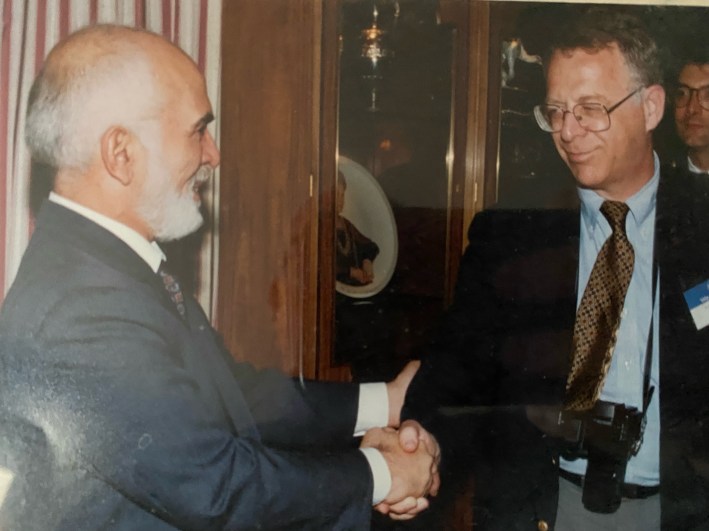
Pursuing Peace. The writer’s father (right) on a UJA mission to Jordan, shakes hands with King Hussein at a reception hosted by the King shortly before the signing of the peace agreement between Jordan and Israel.

Indeed, King Abdullah did issue warnings. He cautioned against Jerusalem being “used by extremists on all sides,” an important comment placing himself in the middle. His criticism of Israel initially took a rare tone when he expressed, “If we continue to use Jerusalem as a soapbox for politics, things can get out of control.” Jerusalem, he continued, is a “tinderbox that if it flashes, we won’t be able to walk away from (in the near future).”

King Abdullah underscored how he wants to be perceived as a centrist, engendering sympathy by “living between Iraq and a hard place.” Yet, he warned from his own soapbox that:

 “if people want to get into a conflict with us, we are quite prepared. I like to…look at the glass half full, but we have red lines.”  

While he was not threatening a third intifada, he did toss that in as a possible consequence of crossing the “red lines”.

The “people” he was referring to were Israelis, and the red lines are related to Israel’s presence in and control of parts of Jerusalem, specifically those in which he sees himself as the ‘custodian’. The Jordan River that separates our counties is often brown and murky. So too, King Abdullah’s words were murky.  He repeated a baseless claim he has made before, that as the Moslem Hashemite leader, he’s custodian of Christian and Moslem holy sites.  In fact, he is not.  Jordan’s custodianship only applies to Islamic sites.

King Abdullah spoke of the shrinking number of Christians in the region, noting that the number of Christians is dropping under “pressure.”  He didn’t say it outright, but the pressure to which he was referring is supposedly from Israel.  That too is false.

While indeed the situation of Christians in the region is dire, around the same time as King Abdullah’s CNN interview, Israel released demographics showing a 2% increase in the Christian population in Israel.  Israel is the only area in the region where the number of Christians is actually growing. In fact, the actual pressure on Christians comes from the wider Islamic society in which they live.

But if the King is concerned about the well-being of Christians in the region, he should start in Jordan itself. Why, when I met a Christian woman visiting Jerusalem recently, she would not be photographed with me, or even in Jerusalem, for fear of herself and her ministry in Jordan being threatened. The same happened with a Christian Palestinian Arab from Bethlehem with whom I had the opportunity to do business recently.  When I suggested taking a picture, he stiffened, and he told me that could be dangerous for him in the Palestinian Authority.

Birthplace of Jesus. Will ‘Silent Night’ one day take on a more literal and ominous meaning of the state of the Christian community in Bethlehem, which has dropped from 86% to 12% in the past 60 years, following a trend across the Middle East, except in Israel, where the Christian population is increasing.

One of the most remarkable comments King Abdullah made was in reference to Islam’s reverence of Jesus as messiah. It might be surprising if the King did not have to walk that back for fear of the charge of heresy. That could prove very dangerous for him and his kingdom where he constantly has to underscore his legitimacy as a Hashemite leader of a country that is predominantly Palestinian Arab. Fortunately for the security cooperation between Israel and Jordan where Israel’s intelligence helps keep the Hashemites on the throne.

Sitting on the east bank of the Jordan River, the King said that it was the third holiest site in Christianity being the location where Jesus was baptized. I asked many Christian friends if this was true, and if so, what the first and second most holy Christian sites were. Without exception, all said that a ranking of such sites is disingenuous, and if it were legitimate, there are other sites that would be in contention for third place, fourth, fifth, and even sixth, ahead of the King’s claimed third place.  Then again, with Islam’s third holiest site being in Jerusalem but never once mentioned in the Koran, perhaps his use of the term is deliberately vague.

Others suggested that he was just pandering, trying to be perceived as the savior (pun intended), of Christians in the Middle East, placing a wedge between Jews and Christians and our shared Biblical understanding of the significance of the Land and people of Israel. His saccharine-sweet words “we are committed to defending the rights, the precious heritage, and historic identity of Christians of our region,” hardly stands up to the reality of the plight and persecution of Christians by Muslims in the Middle East.

The King’s warning about protecting the “status quo” in Jerusalem, undermines the rights of Jews and Christians who, by law, are denied the right to pray on the Temple Mount where Jordan has custodianship. Denying the Jewish right to pray at what’s arguably the most holy place in Jerusalem to Jews must be one of his red lines, and about which he sees no problem enforcing, while “defending the rights” of Christians.

Despite the Jordanian King’s claims to protect Christians and Christian sites, I was left feeling uneasy that his comments were more likely to exacerbate than ease tensions and create divisions between Israel’s Jewish and Christian communities, where there are none.

Disputing King Abdullah’s observations, a spokesperson for Christians United for Israel (CUFI) had it right when he said, “Jerusalem never knew true peace or prosperity until its liberation by Israel.”


About the writer:

Jonathan Feldstein ­­­­- President of the US based non-profit Genesis123 Foundation whose mission is to build bridges between Jews and Christians – is a freelance writer whose articles appear in The Jerusalem Post, Times of Israel, Townhall, NorthJersey.com, Algemeiner Jornal, The Jewish Press, major Christian websites and more.


While the mission of Lay of the Land (LotL) is to provide a wide and diverse perspective of affairs in Israel, the Middle East and the Jewish world, the opinions, beliefs and viewpoints expressed by its various writers are not necessarily ones of the owners and management of LOTL but of the writers themselves.  LotL endeavours to the best of its ability to credit the use of all known photographs to the photographer and/or owner of such photographs (0&EO).

FOCUS ON FOOTBALL

Watching the US Beat Iran from Jerusalem

By Jonathan Feldstein

I’m not a big soccer fan which has been a challenge living and raising my children in Israel where soccer is so central.  My father was born here, and he loved soccer, but it seems to have skipped a generation.  Nevertheless, I was enthralled watching the US soccer team competing against the Iranian soccer team at the World Cup in Qatar this week. It was symbolic if nothing else, but increased my appreciation for the sport and the players.

Given the history the US has in and with Iran going back to Iran’s Islamic revolution in 1979, followed by the hostage crisis in November that year when the US embassy was stormed and 52 Americans were taken hostage for 444 days, I tend to side against Iran from the get-go.  Since then, Iran dubbed the US the “Great Satan” and Israel the “Little Satan”, and has made no secret of its intent to destroy Israel with a nuclear weapon.  Years of inept US-led negotiations with Iran to try to prevent their drive for a nuclear weapon have not only not been successful, but have left me feeling more jaded about the murderous intent of Iran’s Islamist regime.

How could I not watch the match, pitting the Great Satan vs. the little Evil Empire, the world’s leading state sponsor of terror? It was not going to settle the Iranian nuclear drive; or the evil brand of Islam behind it, but it was compelling. Sitting in the Judean mountains, the original Bible Belt, I had a number of observations as the US beat Iran 1-0.

Before tuning in, I was impressed and inspired by the Iranian team standing silently during the playing of their national anthem before a previous match.  How bold it was on the world stage, for them to join the protests engulfing Iran these past months.  How dangerous for them too. Clearly it was not spontaneous, and clearly the Iranian regime would not tolerate it again.  Word is that the Islamist regime threatened the teams’ family members back at home.  There’s nothing like the threat of imprisonment and torture to ‘motivate’ an athlete, much less a team like theirs, to play hard for their country.

Unfortunately, the Iranian regime’s threats worked, and the team sang its anthem before subsequent matches, including the one against the USA. 

Watching the Israeli broadcast, I was impressed with how much the announcers knew about the Iranian team and its players.  It struck me that as professional as they were in announcing the politically charged match, had it been an Israeli team playing, the game would not have been allowed to be televised in Iran.  Had there been an Israeli team competing against an Iranian team, the Iranians would likely not have allowed their team to compete against Israel – the Little Satan – as they have required of athletes in other sports.

I was entertained by the Israeli announcers’ use of Hebrew phrases as they highlighted the action.  After one missed goal, I thought it funny to hear the announcer say:

 “Oy, oy, oy.” 

One of the announcers was a woman. This struck me as telling as Iran would never allow that. Speaking of women, I sat intrigued watching the cameras span the Iranian fans replete with their faces painted with the Iranian flag, some of them women, and some with their hair uncovered.  It was Iran’s Morality Police – a scary component of Iran’s Law Enforcement Forces (LEF) – that arrested and murdered a young woman whose hair was showing that ignited the current protests engulfing Iran. It is somewhat ironic how female Iranian fans were cheering on their team with their hair uncovered, something that at home would have them arrested, assaulted, and even possibly murdered.

Having a Field Day. Barred from stadiums at home, Iran women support their national team at the World Cup in Qatar with hair uncovered and faces painted.

Then again, that there were women present at all was significant. If I understand correctly, women in Iran are not allowed to attend sporting events. Period. Who’d ever have thought that they’d find relative freedom in “liberal” Qatar that does not allow alcohol to be served, or freedom of religion for non-Muslims.

I reflected that the match took place on November 29, the 75th anniversary of the UN resolution to restore Jewish sovereignty to the Land of Israel. While there were good relations between Iran and Israel before the Islamic revolution of 1978, in 1947 Iran voted against the creation of a Jewish state.

I don’t imagine that it was more than a coincidence but I enjoyed the irony of the American team decked out in blue and the Iranians in white, projecting the blue and white of the Israeli flag. Would some Iranian fanatics have construed this as a Zionist plot?

Blue and White. The writer was amused at the colors of the USA and Iran teams reflecting the colors of the Israeli flag.

Before the match, US team captain Tyler Adams was chided at a press conference by Iranian journalists for mispronouncing Iran, for which he had the class and humility to apologize. Then, he was questioned about how he felt (as a black man) representing a country “that has so much discrimination against black people.”  Regarding American racism, his response was honest that “the US (is) continuing to make progress every single day.” That was classy, a great way to represent the greatness, albeit imperfectness of the United States.

Not ‘On the Ball’. Tense moments for USA’s midfielder and captain Tyler Adams (r) and coach Gregg Berhalter at a press conference as Iranian reporters diverted from usual soccer-related questions and hammered on controversial political issues that have severed the relations between the two countries.
 

Watching the match, the insincerity of the reporter’s question was highlighted as the multi-ethnic American team took to the field.  There were black men and white men, men with dark, blond and even red hair. Their names depicted that some were immigrants and others possibly the descendants of slaves. While not representing the full gamut of American society, they were diverse. As the match went on, it was clear that they played together as a team, as Americans mostly do despite differences.  The Iranian team was far from diverse – all Persian men with dark hair. I don’t know how many were Sunni as compared to the Shiite majority, but I doubt any represented the Azeri, Kurdish, or other minorities. It’s not the first time an Iranian (journalist or otherwise) was insincere, but it was exposed on the field.

As the match drew to a close and it was clear Iran was going to lose – which meant being eliminated from the World Cup – a few thoughts came to mind: 

-Did the team or any of its members not play their best for the symbolism of Iran losing to the US?

– What would happen with the team now? 

– Would they go home and risk arrest, or be shot for not singing their national anthem? 

– Or might they even, while in Doha, race to the US Embassy – note the irony – and seek asylum? 

Singing for Survival. Following Iranian players declining to sing their national anthem before the match against England on November 21, 2022, there were reports of the families of the team being threatened if the players fail to “behave”  – meaning singing the national anthem – ahead of the match against the USA (Photo by FADEL SENNA/AFP via Getty Images).

It was a good, well played match.  I’m glad I watched.  It was filled with symbolism that mirrors much of what’s going on with Iran in the rest of the world. Perhaps by the next World Cup, the Iranians will have successfully dispensed with their tyrannical terrorist leadership, and bring a team to the USA where they can participate freely, and be proud of their country as they have every right to be.


About the writer:

Jonathan Feldstein ­­­­- President of the US based non-profit Genesis123 Foundation whose mission is to build bridges between Jews and Christians – is a freelance writer whose articles appear in The Jerusalem Post, Times of Israel, Townhall, NorthJersey.com, Algemeiner Jornal, The Jewish Press, major Christian websites and more.


While the mission of Lay of the Land (LotL) is to provide a wide and diverse perspective of affairs in Israel, the Middle East and the Jewish world, the opinions, beliefs and viewpoints expressed by its various writers are not necessarily ones of the owners and management of LOTL but of the writers themselves.  LotL endeavours to the best of its ability to credit the use of all known photographs to the photographer and/or owner of such photographs (0&EO).

THE COVER UP

The hijab and the nuanced position of Iranian women

By Hügo Krüger

On 16 September 2022 the 22-year-old Mahsa Amini died in a hospital in Tehran following her arrest by Iran’s Guidance Patrol. Although the details surrounding her death has been disputed, given that she suffered from previous brain injuries (later acknowledged by her family’s lawyer), the event sparked protests and spoke to an underlying anger within Iranian Society.

Death in Custody. Protests following the death in police custody of Mahsa Amini arrested by the ‘Modesty Police” over the  Islamic Republic’s strict dress code. (Photo credit: OZAN KOSE/AFP via Getty Images)

Iranian women started protesting with the Slogan, “Zan, Zendegi, Azadi” – “Women Live, Freedom” and they were joined by the Iranian diaspora in cities like San Francisco, Toronto, Brussels, Berlin, Paris and New York. Much like the Black Lives Matter protests that swept through the United States in the aftermath of the death of George Floyd – the nuanced details of Mahsa Amini’s death no longer mattered, as the movement spoke to systemic issues within the society.

To the protestors, the Hijab symbolizes the status of women in general as Iran still upholds laws and practices like the following that are outright discriminatory.

  • Laws that forbid married women from leaving Iran without their husband’s consent.
  • Legislation that makes it difficult for women to file for a divorce as they risk losing the custody of their children to the father once the children are older than seven.
  • Laws and practices that prevent women from getting married without their father’s permissions.
  • All girls over 7 years old are required to wear a headscarf when going to school, with the practice being mandatory in public from the age of 9
 
Road to Revolution. Thousands of mourners shouting “Woman, life, freedom” and “Death to the dictator” walked along a road, through a field and across a river to bypass roadblocks and reach the graveyard where Amini was buried.

There are however signs of reform within Iranian society as since 2019 Iran abolished a law that prevented Iranian women who marry foreigners to pass citizenship onto their children. A 2018 survey published by Iran’s Parliamentary Research Center (PRC) showed that between 60 to 70% of Iranian women do not follow ” the Islamic dress code” strictly in public”. The report  also noted that positive attitudes to the dress code has been steady falling since 1992 and proposed the repealing of Iran’s hijab as the measure was clearly counterproductive.

The PRC also proposed repealing Iran’s hijab law as one of five approaches the state could adopt to counter waning support of the hijab, arguing that the state’s aim of getting people to embrace it could be achieved in more subtle ways.”

The debate in Iran opened up in recent times with calls for reform that included a former Iranian President, a former Mayor of Tehran, the Grandson of Ayatollah Khomeini, a former brigadier general of the Revolutionary Guard Corps and a senior Islamic Cleric.

Future down the Road. The uncertainty for women in Iran is reflected in this photo of a child covering her face and a young woman riding on a bus in Tehran. (photo © Reuters)

When it comes to women, Iran is a country of contradictions, the above mentioned laws stand in stark contrast against the remarkable achievement that over 70% of Iran’s mathematics and science graduates are women, a higher proportion than in most liberal western democracies. Iranian Mathematician, Maryam Mirzakhani, was the first and only women to date to have won a Field’s Medal in Mathematics and in 2016 Dorsa Derakhshani became Iran’s first female Chess Grandmaster. She obtained the title after the Iranian Federation banned her for refusing to wear a Hijab, and her brother was punished for playing a match against an Israeli Opponent . When it comes to Sports, Iranian Female Athletes compete at an International Level and have won a series of Gold Medals at the Olympic Games. Iran’s fertility rate (usually the best proxy that economists use to measure the advancement of women) has fallen to levels below China’s thanks to rapid urbanization rate that occurred in the period following the collapse of the last Shah’s Rule.

Playing by her own Rules. A defiant 19 -year-old Dorsa Derakhshani was banned in 2017 from Iran’s national chess team for playing without wearing a headscarf during a competition in Gibraltar and accordingly switched allegiances to the US.

So why the contradiction with the hijab and other outdated practices?

Under strict Islamic Rule, the purpose of Hijab is to encourage modesty, both physically and spiritually as stated in [Qur’an 24:31].

“And tell the believing women to reduce of their vision and guard their private parts and not expose their adornment except that which appears thereof and to wrap their headcovers over their chests and not expose their adornment except to their husbands, fathers, sons, husband’s sons, brothers, brother’s son, sister’s sons…”

Despite being mandated religiously, the practice of wearing face veils varies throughout the Muslim World. Media reports often don’t distinguish between the different types of veils like the Hijab, Niqab, Burka, Chador and Dupatta. The adherence to the particular type is often a function of cultural and conservative attitudes that in certain countries, like Iran predate the arrival of Islamic Rule.

Surveys report that the practice of wearing a face veil in one form or another ranges significantly in among Muslim Women Worldwide, from a 90% acceptance rate in Egypt, to less than half in Lebanon. Even in countries with sizable Muslim minorities and strong rights for women, many women actively chose to wear the veil out of their own free will with acceptance ranging from 65% in the United States, 64% in India and more than 50% among South Africa’s university educated Muslim Women. Today only two countries, Afghanistan and Iran mandate the wearing of head scarves in public as since 2018 it is no longer compulsory in Saudi Arabia – although it is still practiced by the majority of the population.

Adherence to the practice changed throughout the last century in Iranian society. From 1936, the Shah Reza Pahlavi implemented a series of “modernisation reforms” like the Kashf-e-Hijab, that gave the police the right to rip the hijab from a women’s face. His aim was to modernise Iran and remove the influence of the Muslim Clerics in the society, but the practice ultimately backfired and emboldened the revolutionary movement.

Despite attempts to celebrate it, the Pahlavi Dynasty was cruel. The Shah ruled Iran with an Iron fist and notably with the SAVAK – a Gestapo like security force that routinely tortured dissidents of the state. In the years prior to the 1979 revolution, Iranians found escape in the Madrassas and Mosques that offered a form of congregation and solitude from the brutality of the Monarchy. The role of the Mosques became a political instrument that was used to mobilise dissident voices against the regime. Women started wearing their head scarves as a symbol of rebellion against the Monarchy.

But in the aftermath of the Iranian revolution the Hijab moved again from the positive to a negative. After adopting the constitution known as the Velayat-e faqih, the Iranian Supreme Leader Ayatollah Khomeini dictated that face covering become mandatory for women in public life to conceal their “nakedness”. His decision sparked the 1979 Women’s Day Protests, the first rebellion against the introduction of the veil. The protest had an initial moderate success, but it only delayed the Hijab’s systemic implementation. In 1980, unveiled women were refused entry into public life and by 1983, women could face corporate punishment for not wearing a headscarf. Then during the Iran Iraq War, the status of the Hijab briefly changed again as Iranian Women wore the headscarf as a symbol to get behind the war effort. It’s also worth recalling that it was ultimately thanks to Israeli Weapons and Military support that Iran could repel Saddam Hussein’s Army as at the time Israeli Intelligence regarded Iraq as a bigger threat to National Security.

Today under Iranian Law, women over the age of 9 are required to wear a veil in public and since 2005, they could be fined by Iran’s Guidance Patrol, known as the ‘Morality Police’ in the West, for not adhering to the country’s dress code. The right to enforce the dress code rule is also exerted by more than one institution that includes the infamous paramilitary Basij – an institution that is less accountable to the public. As soon as the hardliner President Mahmoud Ahmadinejad instituted the Guidance Patrol, tales of police brutality and abuse of power became evident. Powerless and humiliated citizens, who couldn’t take their anger out at the police decided in turn to chastise and attack religious women who wore the veil out of conviction.

Close Inspections Of A ‘Moral’ Kind. Morality police patrols are tasked with ensuring that women are not wearing “bad hijab”.

The behavior of the Guidance Patrols in some cases was so violent and harsh that it led to a popular backlash. But since they were connected with the police force, the ordinary people did not dare respond to them. Rather, they attack religious people who would verbally chastise them for the way they were dressed. On June 13, 2012, it was reported that a 30-year-old woman was abused in Punak, Tehran. After having chastised a woman who, according to her, was improperly wearing the veil, she was attacked by the improperly attired woman who pulled off her veil. The next day, a woman who was accompanied by her 3-year-old child was beaten by two other improperly veiled women in Khaniabad, Tehran. A few days later, a young man was beaten and wounded after chastising another man who, according to witnesses, was dressed very inappropriately.”

My experience in traveling through Iran with my wife has been that the hijab’s enforcement clearly differs from city to city and within family to family. In Iran’s religious capital Qom, it is rare to find a woman without a full chador, yet just South in Isfahan, particularly younger women preferred to wear only a headscarf. In the northern more liberal areas around Rasht and in Tehran, it’s not too uncommon to see women barely respecting the rule in public and often in restaurants or on the Caspian Sea’s beach, they simply don’t care about the Hijab.

As confirmed to me by a former journalist; Fereshteh Sadeghi; the protests in the aftermath of Masha Amini is not as widespread as reported in the western media, they came overwhelmingly from the upper classes and university students. Her observation ties in with a 2018 poll that found that many Iranians agree with the statement that “Women should wear the hijab even if they don’t believe in it”. The poll notes that the attitude and opinion is a function of geography, and therefore clearly even abolishing the law will not entirely remove the practice or eliminate the cultural pressures that exist within Iranian Society.

A Cover Up. On 8 March 1979, more than 100,000 women gathered on the streets of the Iranian capital to protest against the new Islamic government’s compulsory hijab ruling, which meant that women would henceforth be required to wear a headscarf when away from home.

Nuance should be added here as educated Muslim women throughout the world wear a veil out of their own free will. The Iranian government as advised by its own parliament has no reason to fear that the practice will go away, even if the laws that mandate them are removed.

The modernisation of Iran should be encouraged if Iranians and others around the world wish to see constructive constitutional change within the Islamic Republic and its relations to other Middle Eastern countries and notably the hostile relationship with Israel. But I also caution against those who preach the language of revolution. The nature of the Iranian regime is that the security forces act as a shadow of power. They have shown their willingness to squash any attempt that challenges their rule. In the unlikely event that that the government is toppled, the IRCG will quickly exert control over Iran and potentially bring a more devasting order to power as was the case in Egypt in the aftermath of the Arab Spring. The Iranian military is still one of the most respected institutions in the country and despite western media coverage, the majority of Iranians do actually support their government.

Flaming Passions. How long will the flame of revolution burn amongst a rising populace as seen by these demonstrators in Tehran? (Photo: Obtained by AFP via Getty Images)

The upliftment of women in Iran, much like elsewhere in the world often has little to do with the morality and debate taking places within the intellectual silos, but is rather driven by the technology and urbanisation that breaks down traditional and religious authority. The advancement of women is comparable to the abolition of slavery that was only defeated after the widespread use of the steam engine and not due to the moral debates that took place since the time of Aristotle. Telling women what they should and should not wear simple cannot be justified in the modern era and as Iran’s own government admitted in 2018, the society has long past moved the point where the law is enforceable.


About the writer:

Hügo Krüger is a South African born Structural/Nuclear Engineer, writer and YouTube podcaster, commentating on topics relating to Energy and Geopolitical Matters, Hügo is married to an Iranian born Mathematician and Artist; the couple resides in Paris.

THE TIPPING POINT

From Russia to Iran – will the rumble of their people lead to a tumble of their leadership?

By Neville Berman

The French Revolution of 1789 and the Russian Revolution of 1917 have one thing in common. They both resulted in the overthrowing of the ruling class by their own subjects.

Fighting for Freedom. The participants in the French Revolution were ready to do anything to end the monarchy, a sentiment clear in Eugene Delacroix’s Liberty Leading the People, 1830

Fast forward to the post Second World War period, and we see history repeating itself again and again. There is ample evidence of citizens ruled by kings or dictators removing their leaders once a certain tipping point is reached. All the leaders mentioned below were totally in control of their countries when they were suddenly either forced to resign or were killed. Here are six examples in chronological order of their overthrow.

King Farouk reigned over Egypt from 1936-1952. Upon his removal from the throne, he remarked that one day there will only be five kings left, the king of England and the kings of spades, diamonds, clubs, and hearts. King Farouk died in exile in Rome in 1965.   

Mohammed Reza was the last Shah of the Imperial State of Iran. He was crowned in September 1941. He had the largest standing army in the middle east. The army swore allegiance to him personally yet failed to support him when the people rose up against his rule. He was forced into exile in 1979 in the Iranian Revolution.   

People Fired Up. Iranian demonstrators setting light to a rubbish bin in Tehran during a protest in Iran on September 21, 2022 for Mahsa Amini, days after she died in police custody. – | Afp | Getty Images

Ferdinand Marcos ruled the Philippines for 20 years from 1966 – 1986. His authoritarian rule unraveled as a result of public criticism of his corrupt lifestyle. He was removed from office and died in exile.

Nicolae Ceausescu ruled Romania with dictatorial powers for 24 years from 1965 to 1989. When he was overthrown, an elite army unit was requested to provide 10 volunteers to be part of the firing squad. All the members of the unit volunteered. Ceausescu died with 10 bullets in his chest. 

Erich Honecker led East Germany for 18 years from 1971 to shortly before the fall of the Berlin Wall in October 1989. When Gorbachev refused to intervene to protect him, Honecker was forced to resign. He died in exile in Chile.

Muammar Gaddafi ruled Libya for 42 years. After declaring that “all his people loved him” he was forced to flee. When he was found in his hometown of Sirte, he was immediately executed. The date was October 20, 2011. Clearly not all his people loved him.

Message in Moscow. Demonstrators march with a banner that reads “Ukraine—Peace, Russia—Freedom,” in Moscow on February 24, 2022, after Russia’s attack on Ukraine.

It seems plausible that both President Putin and the Iranian regime are both approaching the tipping point from which there is no return. Much in the hands of their people, an anxious global community watches and waits.

The world will be a much safer and better place should their rule end.


About the Author:

Accountant Neville Berman had an illustrious sporting career in South Africa, being twice awarded the South African State Presidents Award for Sport and was a three times winner of the South African Maccabi Sportsman of the Year Award.  In 1978 he immigrated to the USA  to coach the United States men’s field hockey team, whereafter, in 1981 he immigrated to Israel where he practiced as an accountant and then for 20 years was the Admin Manager at the American International School in Even Yehuda, Israel.  He is married with two children and one granddaughter.


While the mission of Lay of the Land (LotL) is to provide a wide and diverse perspective of affairs in Israel, the Middle East and the Jewish world, the opinions, beliefs and viewpoints expressed by its various writers are not necessarily ones of the owners and management of LOTL but of the writers themselves.  LotL endeavours to the best of its ability to credit the use of all known photographs to the photographer and/or owner of such photographs (0&EO).

‘BLOOD’IMIR PUTIN’S WAR

Ditching imperious ambitions to dodge military conscription – a message from the masses

By David E. Kaplan

It’s a war about nothing,” said the Russian father supporting his young son on his shoulders to CNN on the Georgian side of the border with Russia.  He was one among the throng of refugees escaping their “Mother Russia” to avoid conscription. As one gleans in interviews with one fleeing eligible Russian soldier after another, they “hate” this war but feel powerless to stop it.

Protests against President Vladimir Putin’s partial mobilization order are spreading across Russia, including to the far east, as many young men are fleeing the country. CNN correspondent Nick Robertson reports. #CNN #News

Evgeny, a 28-year-old photographer from Moscow, who walked the last 20 kilometres to the Georgia-Russia border crossing at Verkhny Lars to avoid the huge traffic jam of vehicles trying to cross, told CBC News that:

 “People are fleeing under very dire circumstances; many are saving their lives. They do not want to fight in this imperialistic, pointless war.”

Russians on the Run. People walk next to their cars queuing to cross the border into Kazakhstan at the Mariinsky border crossing, about 400 kilometers (250 miles) south of Chelyabinsk, Russia, Tuesday, Sept. 27, 2022. Officials say about 98,000 Russians crossed into Kazakhstan in the week since President Vladimir Putin announced a partial mobilization of reservists to fight in Ukraine. (AP Photo)

For George Vatsadze, who crossed with his brother and his dog carrying only a bag with a few clothes, it was personal. It does not get more personal than family. With a Ukrainian grandmother and cousins living in Ukraine, this marketing professional had “no choice,” he said. “I can’t go there to fight.” 

Aware he was placing himself at risk by speaking to CNN, he nevertheless continued:

I think maybe about half of our population think the war is wrong, but they can’t stand up against it because it’s dangerous.”

As the CNN camara left George crossing into Georgia focusing on his disappearing back  – the ever-diminishing image left the viewer of a man leaving his home for good – never to return!

Putin causes Panic. Cars, walkers and cyclists at a border crossing between Russia’s North Ossetia region and Georgia after Moscow announced a partial military mobilization. (AP Photo)

These tragic unfolding human dramas playing out at Russia’s border crossings with Georgia, Finland and other areas, bear testimony to the hundreds of thousands of men  desperately trying to bolt before being dragged into fighting Vladimir Putin’s war in Ukraine.

This reminded me of the story of my grandfather Menachem Mendel Kaplan from Shadova (Šeduva ) in Lithuania then part of Tzarist Russia who was conscripted into the Russian army in 1904 and sent off on a troop train across Siberia to Vladivostok to fight in the Russo-Japanese War (1904-1905). As a Jew from a small shtetl, Menachem Mendel – later to be known as Max – was hardly interested in risking his life to further Russia’s rival ambitions with the Empire of Japan over Manchuria. So, before the train stopped at Vladivostok, he waited for it to slow, jumped off, ditched his rifle and uniform, walked to the port of Vladivostok and stowed away on an English steamer bound for Southampton. Had he been caught he would have been shot for desertion. For freedom, he was prepared to take the risk. He never reached England. Disembarking instead in Cape Town where he knew he had family, with his first steps in a land foreign in culture and language, began half the story of my family’s journey in South Africa and later in Israel.

Off the Beaten Track. A Trans-Siberian Railway train delivering supplies to Russian troops during the Russo-Japanese war. It would have been such a train that Menachem Mendel (Max) Kaplan jumped from when he deserted the Russian Imperial Army in 1904. (Ullstein Bild/Getty Images)

The Barb was right about ‘Much Ado About Nothing’. If ‘something’ is not done to stop Putin’s war of “nothing”, how many more men will ditch imperious ambitions to dodge conscription?

“MOTHER RUSSIA” TO SMOTHER RUSSIA

For the young father with the child on his shoulder, his thinking – not unlike my grandfather 120 years earlier “This is not my war”. It was Putin’s “pointless war”. With a total area of 17,098,242 Km² (6,601,665 mi²) and a land mass of 16,376,870 Km² (6,323,142 mi²), equivalent to 11% of the total world’s landmass of 148,940,000 Km² (57,510,000 square miles), Russia is the largest country in the world. It does not need Ukraine; rather Putin wants Ukraine, and is prepared that people die en mass in pursuit  of his imperial obsession.

Interestingly, one of Russia’s closest friends today is Iran as evidenced by Vladimir Putin’s recent visit to Tehran. It was the Russian leader’s first trip outside the former area of the former Soviet Union since his military invaded Ukraine. The Russian president’s first-choice visit reflects the importance he places on improving ties with the Islamic Republic, that itself today is facing civil unrest.

Irate Iranians. Despite Iran’s leadership curbing the internet, protests over the death of Mahsa Amini continued for a fifth day on Wednesday, including in the capital, Tehran.

As Russians protest and flee so too, are there protests taking place across Iran that while triggered by a young woman’s death in custody amid anger over religious rules, reflects as much a rejection of a state’s fossilized leadership that is dragging the country down.

No light at the end of the Tunnel. South Africans protest in November 2017 Eskom’s decision to cut electricity during the day by blocking the N6 highway between Aliwal North and Jamestown, Eastern Cape. 2022 the situation is WORSE!

It is little wonder that my former country South Africa supports Iran unequivocally as well as Putin’s aggression against Ukraine. South Africa too is going through its “Dark Ages”– quite literally as it even struggles  to provide daily electricity to its people.

Battling with the Basics. South Africa’s ANC government is unable to provide its citizens basic services.

What Russia, Iran and South Africa now overwhelmingly share in common is the increasing dissatisfaction of its people. Their leaderships are foremost a menace to their own people.

It’s time for regime change in all three failing states.


While the mission of Lay of the Land (LotL) is to provide a wide and diverse perspective of affairs in Israel, the Middle East and the Jewish world, the opinions, beliefs and viewpoints expressed by its various writers are not necessarily ones of the owners and management of LOTL but of the writers themselves.  LotL endeavours to the best of its ability to credit the use of all known photographs to the photographer and/or owner of such photographs (0&EO).

KING ABDULLAH’S LEGACY

By Jonathan Feldstein

On a clear day I can see from my Judean mountain balcony the skyline of Amman.  It’s the only place in the world from where one can see the capital of two countries: Jordan and Israel. I look across the border and am reminded that more than 3500 years ago, the Jewish people stood there waiting to cross into the Land, and two and a half tribes settled on the east bank of the Jordan River: Reuben and Gad, and half of the tribe of Manassah. I think about relations with our modern neighbors often.

King Abdullah I of Jordan

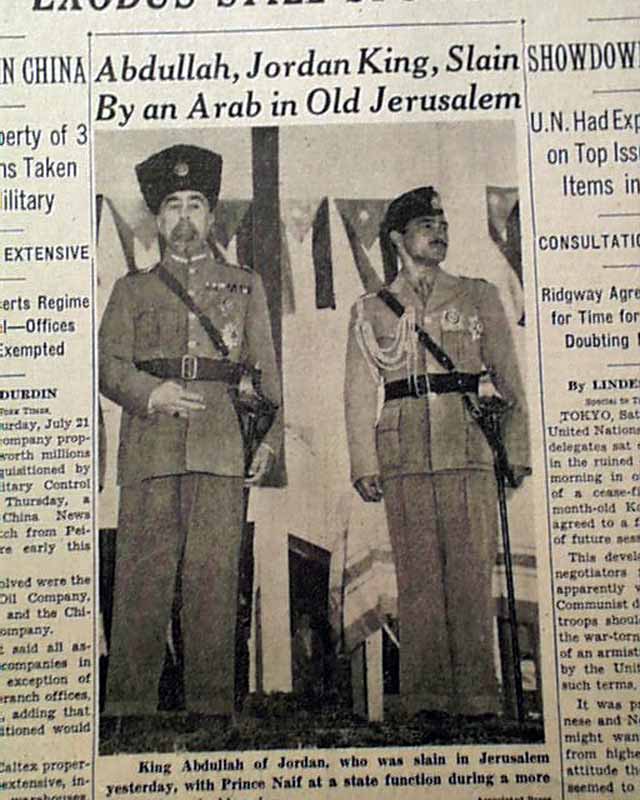
In July 1951, Jordan’s first king, Abdullah I, was assassinated while visiting the Al Aksa Mosque on the Temple Mount.  He was accompanied by his teenage grandson, Hussein, who would become King of Jordan about a year later, and reign until his death in 1999. Hussein is the father of the current King Abdullah II

King Abdullah Assassinated (1951)

I was speaking about Jordan and the Hashemite monarchy with a friend this week, saying that it’s in both Israel’s and Jordan’s interests to have close, peaceful relations, and that Israel should want to be supportive of the Hashemite monarchy which, more or less, has provided stability in the region. 

King Abdullah I was known for his efforts to reach some form of peace or coexistence with Israel, before Israel’s declaration of independence in 1948 and following, although he was assassinated four decades before the formal 1994 peace treaty was finally reached. Unfortunately, while there have been high points of relations between Israeli and Jordanian leaders, the idea of peace with Israel is still not popular on the Jordanian street. There’s often hostility, even among its elected leaders who often make antagonistic, threatening anti-Israel statements.

This is a mistake of the Jordanian (and before that, Egyptian) peace agreements, where there’s been no significant cultural shift or interaction between people. This could be due to lack of vision, or more likely as an outlet to provide a way for the people to vent, against Israel rather than the monarchy.  Consequently, despite the mutual interests to have peace, one rooted in the legacy of King Abdullah I, the relationship even between governments has often been tense, particularly in recent years. 

Abdullah was assassinated by Mustafa Shukri Ashshu, who was associated with the rabidly extremist and antisemitic former Mufti of Jerusalem, Haj Amin al-Husseini. Husseini was known for sparking riots against Jews in British controlled Mandatory Palestine, and was closely allied (and infamously photographed) with Adolf Hitler during World War II. Husseini inspired his followers to oppose the Hashemite kingdom in general, and King Abdullah in particular, largely because Husseini supported the creation of an independent Arab state, which Abdullah’s annexing and occupying the potential territory thereof (the West Bank, or Judea and Samaria) following the 1948-49 War of Independence would prevent.

17.11.1947- Golda Meir meets King Abdullah I of Jordan, in Jordan, a few months before the declaration of independence of the State of Israel

Both preceding and following the 1948 war, King Abdullah met with Reuven Shiloah, the first director of Israel’s Mossad, and Golda Meir (who would become Prime Minister). There are famous stories of Golda dressing in traditional Arab attire to travel to meet the King so as not to be recognized.

King Abdullah I of Jordan (left) with his younger son, Nayef.

It was reported after his death that Abdullah was scheduled to meet with Shiloah and diplomat Moshe Sasson in Jerusalem the day after he was assassinated.  Avi Shalim, an Israeli-British historian, wrote a biography of King Hussein in which he quoted King Abdullah as telling Sasson:

 “I want to make peace with Israel not because I have become a Zionist or care for Israel’s welfare but because it is in the interest of my people. I am convinced that if we do not make peace with you, there will be another war, and another war, and another war, and another war, and we shall lose all these wars. Hence it is the supreme interest of the Arab nation to make peace with you.”

According to Shalim’s biography, Elias Sasson, Moshe’s father, wrote shortly after Abdullah’s assassination:

King Abdullah was the only Arab statesman who showed an understanding for our national renewal, a sincere desire to come to a settlement with us, and a realistic attitude to most of our demands and arguments… We, as well as some of the Arabs and foreigners are going to feel for a long time to come his absence, and to regret more than a little his removal from our midst.”

The state of Arab Israel relations has changed radically since Abdullah’s assassination. Not only were Egypt and Jordan the first two Arab states to make peace with Israel, recognizing that it was in their interests to do so, but four more followed as part of the 2020 Abraham Accords. In three of them, it appears that some of the mistakes of the cold peace of the first two have not been repeated. There’s not just high-level government-to-government contact between Israel and the UAE, Bahrain, and Morocco, but there’s a unique level of interaction between people, and business ties that are all mutually beneficial.

King Abdullah I and his son crown prince Talal

It’s also noteworthy that references to Abdullah’s assassination have had a modern historical whitewash. Immediately following Abdullah’s death, a British publication reported:

The assassin is reported to have been identified as Mustafa Shukri Ashshu, a 21-year-old tailor in the Old City. During the Arab-Jewish war he was a member of the “dynamite squad” attached to the Arab irregular forces which were associated with the ex-Mufti of Jerusalem and became bitter enemies of Abdullah.” 

King Abdullah I of Jordan with Glubb Pasha, the day before he was assassinated by Mustafa Shukri Ashshu, a21-year-old tailor in the Old City. (Photo credit: GLUBB PASHA/WIKIMEDIA COMMONS)

Neither in this segment, nor the whole article, is there a reference to the assassin being a “Palestinian”. It was not a term used in 1951 to describe Arabs. Today however, historical revisionism retroactively brands Mustafa Shukri Ashshu as a “Palestinian”.

History Revealed or Revised? What is revealing about this contemporaneous newspaper report of the assassination of King Abdullahi was the identification of the assassin – as an “Arab” and not as a Palestinian as he is so described today.  

The same Arab/Islamic extremism that was preached by Haj Amin al-Husseini, and which “inspired” King Abdullah’s assassin, is a common enemy of and threat to Israel, Jordan, and the entire Arab Middle East, spilling over around the world. On this anniversary of the assassination of King Abdullah who might have made peace if he had lived, it’s important to revisit his words, that not only is peace important, but where we share common threats, so too it’s important that we unite against these.  

I pray that King Abdullah II will remember and take to heart these words and be guided by the wisdom of his great-grandfather for whom he is named.


The present king of Jordan, Abdullah II, named after his great-grandfather.


About the writer:

Jonathan Feldstein ­­­­- President of the US based non-profit Genesis123 Foundation whose mission is to build bridges between Jews and Christians – is a freelance writer whose articles appear in The Jerusalem Post, Times of Israel, Townhall, NorthJersey.com, Algemeiner Jornal, The Jewish Press, major Christian websites and more.


While the mission of Lay of the Land (LotL) is to provide a wide and diverse perspective of affairs in Israel, the Middle East and the Jewish world, the opinions, beliefs and viewpoints expressed by its various writers are not necessarily ones of the owners and management of LOTL but of the writers themselves.  LotL endeavours to the best of its ability to credit the use of all known photographs to the photographer and/or owner of such photographs (0&EO).

Warm Embrace

Latino community drawing closer to Israel

By Jonathan Feldstein

I was driving in Jerusalem last month and saw a colourful flag flying. The horizontal bars of yellow, blue, and red had a coat of arms in the middle, but I was not familiar with which country it represented.  What I did know is that there was a visiting head of state in town, and flying that country’s flag was a way to show honour and respect.

A few days later, I read that Ecuadorian President Guillermo Lasso was visiting, and had announced the opening of an official innovation office in Jerusalem, and he undertook to maintain a more balanced approach toward Israel at the United Nations.  Both are welcome announcements, particularly given that in the past, Ecuador had been part of a group of countries that frequently voted against Israel at the UN.  President Lasso’s visit marked the first time an Ecuadorian President came to Israel since the countries established diplomatic relations in 1949.

Sister States. Hailing new era in Israel-Ecuador ties, Israel’s President, Isaac Herzog hosts dinner for Ecuadorian President Guillermo Lasso who says countries are “sister state”. (photo Twitter/ Isaac Herzog May 2022)

Celebratory statements and tweets came from both Israeli and Ecuadorian leaders. When I read that the new office will be located in the trade office Colombia that opened in Jerusalem last year, I realized that something big and good was afoot between Israel and Latin America, and the Hispanic community in general.

A week later I read about Israel’s embassy in Mexico opening the Israel-Mexico tech acceleration program, designed to connect innovative enterprises in Israel and Mexico for high-level high-tech collaboration.  The Israeli and Mexican announcement is part of the countries celebrating 70 years of diplomatic relations in July.

High Gear. Amid the 70th anniversary of the establishment of diplomatic relations between Israel and Mexico, the Israeli Embassy of Mexico inaugurates Israel-Mexico tech acceleration program. (photo credit: EMBASSY OF ISRAEL IN MEXICO)

As the 15th-largest economy in the world, this program will connect Mexican and Israeli entrepreneurs working on solutions to respective local challenges and needs including health, communication, and the very important issue of water management.

This comes in the wake of two other central American countries, Guatemala and Honduras, being among those to move their embassies to Jerusalem, and is an important way to increase cooperation and build regional ties.

Given these news items and my growing relationships among the latin community, it’s clear I made a mistake studying French in high school. In these cases however, entrepreneurship is a common language, which will overcome linguistic barriers and build warm, ongoing, and mutually beneficial relationships.

When I think about recent developments, I am pleased but not surprised. The truth is that they all are part of a trend in Many countries understand that close relations with Israel bring many benefits and blessings to the table.  Individually, with strong roots in Christianity, latin communities all over the world look at Israel as the fulfillment of Biblical prophecy. Biblical principles such as blessing Israel, praying for the peace of Jerusalem, being watchmen on the wall, and more are not mere words but God’s playbook.

On High Ground. A woman enters the new Honduran Embassy in Jerusalem, June 23,2021, the fourth country to relocate its embassy from Tel Aviv to the Israeli capital following the US, Kosovo and Guatemala.
| Photo: EPA / Atef Safadi

This was why Guatemala and Honduras quickly followed the United States to recognize Jerusalem as Israel’s capital and to move their embassies there.  As these diplomatic pillars strengthen, it’s no surprise that last year six Central American countries took part in establishing the Central American Forum for Israel.  Doing so, Guatemala, Panama, Honduras, El Salvador, the Dominican Republic, and Nicaragua signed a declaration of support for the Jewish people and the State of Israel.

Close Ties. Guatemalan activists wave Israeli flags near the “Plaza of Israel” in the country’s capital, 2015 reflecting the friendship ties between Israel and Guatemala that go back to 1947 when the UN voted for the resolution that led to the establishment of the modern State of Israel.(photo credit: REUTERS)

Part of this initiative highlighted their commitment to educate future generations about the Holocaust and fight antisemitism. Together, they adopted the International Holocaust Remembrance Alliance (IHRA) definition of antisemitism, declaring:

 “We stand against antisemitism and hatred of all kinds. We support the IHRA as countries and institutions around the world do to simplify law enforcement and deal with the consequences of antisemitism in a correct and just way.”

All this activity is especially noteworthy not just in the strengthening of diplomatic and trade relations with Israel, but as a way to take the war on terror to another front.  Iran has long sought to increase its reach to and presence in Latin America, and indeed has established itself in places like Cuba, Venezuela, and others.  These are not as threatening as Iran’s presence in Argentina where it was responsible for two major terror attacks on the Israeli embassy (March 17, 1992, killing 29 and injuring more than 250) and on the Jewish community center (July 18, 1994, killing 85 and injuring more than 300).

Iran’s terrorist reach is not limited to major bombings. On January 18, 2015, Argentinian prosecutor Alberto Nisman was found dead in his Buenos Aires apartment. “Coincidentally”, days earlier, he had filed a report implicating former President Cristina Fernández de Kirchner and other officials of covering up Iran’s involvement in the 1994 Jewish community center bombing. More recently, a Venezuelan cargo plane with “car parts” and previously owned by Iran, arrived in Argentina, rousing suspicion. It had had a far larger than necessary crew, including several Iranians!

The growing relations between Israel and a number of Latin American countries is important and embodies the Biblical model of Israel being a blessing to the families of the world.  But more than on a national basis, religious support for Israel among latinos worldwide is a cornerstone of support within their nations. This of course includes Latin America, but also throughout the US.  While Christian support for Israel is wide and growing in general, it feels much wider on a per capita basis among Hispanics.

New Directions. ‘Thirsty’ for Israeli innovation,  Colombia in 2015 signed with Israel an agreement on cooperation in industrial R&D. The agreement enabled companies from both countries to receive government funding for joint projects in industrial projects focused on adapting products to the Colombian market. (Photo by Shutterstock.com)

There are many ways in which this is expressed, but one of the most unique, dynamic, and impressive was when I visited Nashville this year and had the privilege of attending services and speaking at Casa de Dios. I am accustomed to an Israeli flag flying in a church parking lot of a number of ministries.  However, Casa de Dios raises the bar: before each of their services every Sunday, they sing Israel’s national anthem, Hatikvah. I was moved beyond words.

The Spanish Connection. The Ralli Museums located in a 40,000 square meter park in Caesarea, Israel exhibiting mainly Latin American and Spanish paintings and sculptures reflects strong historic bonds with the eye to the future.

Something big is happening among latinos relating to Israel.  Exploring this, I hosted two back-to-back conversations discussing a range of reasons why that’s happening and the significance of how Hispanics are awakening to their deep Jewish roots as well. I pray it will continue and be a mutual blessing to us all. If nothing else, I am hoping that Central American pineapples will begin to flood the Israeli market, bringing down the price and bringing up the quality.

As we are seeing, this is a relationship that bears fruit!


About the writer:

Jonathan Feldstein ­­­­- President of the US based non-profit Genesis123 Foundation whose mission is to build bridges between Jews and Christians – is a freelance writer whose articles appear in The Jerusalem Post, Times of Israel, Townhall, NorthJersey.com, Algemeiner Jornal, The Jewish Press, major Christian websites and more.


While the mission of Lay of the Land (LotL) is to provide a wide and diverse perspective of affairs in Israel, the Middle East and the Jewish world, the opinions, beliefs and viewpoints expressed by its various writers are not necessarily ones of the owners and management of LOTL but of the writers themselves.  LotL endeavours to the best of its ability to credit the use of all known photographs to the photographer and/or owner of such photographs (0&EO).

GOOD vs EVIL

President Zelensky  is leaving his mark not only on Ukrainian but world history inspiring all across this fragile planet that sometimes to survive and sustain your humanity, one needs to unify, defy and fight.

It means many will die.

Little wonder the Ukrainian leader has made the 2022 TIME list of 100 most influential people. With relentless determination, Zelensky has galvanized the tailor, the truck driver, the housewife, the schoolteacher, the engineer, hi-tech entrepreneur and greengrocer to become soldiers as they fight for their homes and freedom.

Verbally voyaging into the more intimate battle of wits and values between the two adversaries  – Zelensky and Putin – award-winning South African short story writer, essayist and poet, Charlotte Cohen peels off the layers to reveal the WORD – the word that is a NAME.

(Lay of the Land editor, David E. Kaplan)


A WORD – A NAME

By Charlotte Cohen

A single word imprints perception and relativity  

The difference between honour and horror

Between freedom and captivity

Humanity and brutality  


Often deserving of the hatred and anger

Stemming from extortionate cruelty and danger  

Even offering justification for the killing of an abuser

One still earns the egregious classification of  ‘murderer’


But those who brutally and remorselessly

Kill anyone at random – including themselves 

Caused by inveterate irrationality and hatred

With which they have been indoctrinated

– Or even for a gratuity or family security

Are described by what almost gives legitimacy

To fanatical iniquity:  That word is ‘terrorist’

Now often ascribed with a sense of normality


Yet one single person   

Living and languishing in luxury

Never getting his own hands dirty

With no indoctrinated hatred – but rather fixated

On self-love, land acquisition and addictive power 

Can decree the destruction of a country

And order massacre and mass murder

With one word:    

‘War’.


Names also leave an unchanging word image:

And just as Adolf Hitler epitomises evil     

To the diabolic list of heartless and vicious

Persecutors, oppressors , tyrants and villains 

We can now add that of Vladimir Putin.

And to leaders who gained worldwide respect and fame 

Abraham Lincoln, Winston Churchill, Nelson Mandela ….

`            We can also now attach another name:


Out of Ukraine devastated by Putin

Arose a man of extraordinary talent and diversity

Suddenly thrust with the horrific responsibility

Of a not-sought-for war forced upon him

And though he did not expect it

He never neglected to meet it                                                        

A man of intelligence, conscience, spirit and heart 

Of principle, resolution and tenacity –

He never gave in or gave up

Or abrogated his duty

Volodymyr Zelensky’s name will remain in history

Making commitment and courage his own story

So as a word-name reflects a representation

Of how a mental image will be retained:   

           ‘Putin’– who mistook the word ‘sin’ for ‘win’

 a cruel pitiless despot,  a tyrannical dictator

   ‘Zelensky’ –  a hero, an inspiration

a champion, a protector,  a warrior, a victor


About the Poet:

Charlotte Cohen is an award-winning short story writer, essayist and poet, whose work has appeared in a wide variety of South African publications since the early 1970’s.


While the mission of Lay of the Land (LotL) is to provide a wide and diverse perspective of affairs in Israel, the Middle East and the Jewish world, the opinions, beliefs and viewpoints expressed by its various writers are not necessarily ones of the owners and management of LOTL but of the writers themselves.  LotL endeavours to the best of its ability to credit the use of all known photographs to the photographer and/or owner of such photographs (0&EO).

LET DEAD TERRORIST GROUPS LIE

Enlisting support against delisting terrorists

By Jonathan Feldstein

[Ed note: At the time of publication of this article, Politico  media reports that President Biden has “finalized his decision to keep Iran’s Islamic Revolutionary Guard Corps on U.S. notorious terrorist blacklist.”]

There have been recent reports that the Biden administration is planning to remove five groups from the US’ foreign terrorist blacklist. Each of these groups is now considered defunct. But it’s strange that if they are defunct anyway, why anyone would worry about delisting them. It’s better to let dead terror groups lie.

The groups include Basque Fatherland and Liberty, Aum Shinrikyo, a Japanese cult; Kach, an Israeli/nationalist Jewish group, and two Islamic groups: the Mujahideen Shura Council in the environs of Jerusalem, and Gama’a al-Islamiyya.

When I read the reports, I asked myself why, and why now?  A Christian friend reached out to me to get an understanding from an Israeli perspective, and whether it was something for which she needs to pray. I explained to my friend that it seems the delisting of these groups is connected with ongoing reports that the Biden administration is considering removing Iran’s Islamic Revolutionary Guard Corps (IRGC) from the US terror blacklist as part of wooing Iran to renew the Obama-era nuclear deal.

Just to be clear, the IRGC is directly responsible for the killing of some 600 U.S. military and is far from defunct. A group of 46 retired U.S. generals and a growing number of Democrats and Republicans are on record urging the Biden administration not to remove the IRGC from the terrorist blacklist.

In this context, I explained to my friend that not only does it not make sense to delist defunct terror groups but doing so is deliberately dangerous. Typically, when members of a board, alumni of an institution, or other notables pass away, they are not removed but are identified by a note that they are now deceased. Why not just leave the list of terror groups as is, and make a note that they are defunct? Listing those that are no longer active actually shows success in the war on terror.

To Delist or not to Delist? Supreme Leader Ali Khamenei meeting with leaders of the IRGC last January. Will the Biden administration remove Iran’s IRGC from terror blacklist? (Photo: Handout via Getty)

I told my friend that delisting the defunct organizations is a smoke screen for plans to delist the very active IRGC. Anyone who cares about the threats of Islamic terror in general, and to Israel in particular, will be uncomfortable with the delisting of two Islamic terror groups.  However, the Biden administration’s machinations appears expedient – like the tossing a bone to placate some in Congress – by the inclusion of the Jewish/nationalist group Kach, creating the pseudo impression that the administration is being equitable.  There’s no reason to delist any of these – including Kach. It’s also offensive to those who were the victims of these and other terror groups.

My friend is a Hispanic pastor. She revealed how the removal at the end of 2021 of Columbia’s FARC off the US list of terrorist organizations proved traumatic for Hispanics who had suffered under the ruthless terrorist and drug trafficking group that raped and destroyed and kidnapped poor Colombians for decades.

FARC Fiends. On May 15, 2000 the Colombian FARC put an explosive collar around the neck of a woman, killing her and a man who tried to neutralize the device. (Photo of FARC soldiers: Pablo de Tarso Luz Meneghel Sparco)

The similarities are astounding. It was reported that the Biden administration’s delisting of the ‘now defunct’ Revolutionary Armed Forces of Colombia (FARC) rebel group as a “foreign terrorist” organization was to support a tenuous peace agreement in Colombia. As a rule, wooing terrorists with promises of turning a blind eye rather than confronting and defeating them is not good policy.

This applies to FARC in Colombia, and IRGC in Iran.

Clearly what’s behind this is to bring Iran to sign a new or revised nuclear agreement which has become a pilar of US foreign policy.  Seeing the Biden administration’s eagerness to renew an agreement at any cost, the Iranians have used this as a make-or-break negotiating tactic.

The IRGC is on the terrorist list as a central part of Iran’s military. However, it operates far beyond a typical military unit simply preparing for combat. Since the 1979 Iranian revolution, the IRGC has become a quasi-governmental institution, with vast independent power and actual oversight and control over key elements of Iran’s economy, industry, and energy sectors. It regularly calls for Israel’s destruction, and materially supports other terrorist groups around the world with money, training, and equipment.

Bad Boys. There is overwhelming evidence that the IRGC is the largest and most powerful sponsor of global terrorism, writes Navid Mohebbi in Al Arabiya News. (Stock photo)

While Biden has made a new Iran deal a key pillar of his foreign policy even before coming into office, reports to mitigate the looming disaster of delisting the IRGC, suggest Biden is personally resistant to such delisting. These conflicting agendas suggest a combination of schizophrenia, deliberate disinformation and possible incompetence which I discuss in the interview . Delisting the IRGC might help achieve his key foreign policy goal of an Iranian agreement, but looks weak regarding international terrorism, something that he and other Democrats don’t need as another foreign policy failure.  With the mid-term election in just six months, that’s part of the reason that even some moderate Democrats – already resistant to rejoining a nuclear deal that goes too easy on Iran – are urging Biden to stand firm on keeping the IRGC on the terrorist list.

Right is Might. General Mark Milley, chairman of the Joint Chiefs of Staff said before the Senate Armed Services Committee (SASC) that in his personal opinion, he does not support the delisting of Iran’s Islamic Revolutionary Guard Corps (IRGC) as a foreign terrorist organization.

These issues will no doubt be top on the agenda when Biden is expected to visit Israel at the end of June, particularly in light of recent reports that Iran may be days away from enough material for one nuclear bomb. With his coalition shaky at best, Israel’s Prime Minister Naftali Bennett cannot afford to appear weak or allow anything to undermine his leadership in protecting Israel from the Iranian threat.

Towering Rage. The IRGC was found liable in 2018 for the 1996 Khobar Towers bombing in Dhahran, Saudi Arabia, which killed 19 Americans and injured 260. (© AFP/Getty Images)

Is this a good cop, bad cop quasi negotiating tactic with Iran, or just a dress rehearsal for another Biden administration foreign policy failure? The implications of delisting these terror groups now, along with FARC, opens old wounds of their victims, brings Jews, Hispanics and all people of conscience closer together, and makes us all less safe.


About the writer:

Jonathan Feldstein ­­­­- President of the US based non-profit Genesis123 Foundation whose mission is to build bridges between Jews and Christians – is a freelance writer whose articles appear in The Jerusalem Post, Times of Israel, Townhall, NorthJersey.com, Algemeiner Jornal, The Jewish Press, major Christian websites and more.


While the mission of Lay of the Land (LotL) is to provide a wide and diverse perspective of affairs in Israel, the Middle East and the Jewish world, the opinions, beliefs and viewpoints expressed by its various writers are not necessarily ones of the owners and management of LOTL but of the writers themselves.  LotL endeavours to the best of its ability to credit the use of all known photographs to the photographer and/or owner of such photographs (0&EO).

Killing President Sadat Again

By Jonathan Feldstein

With turmoil in the Middle East, and specifically threats from Iran and its proxies in Syria, Lebanon, Yemen, and Gaza, last month’s  anniversary of the signing of the Camp David peace treaty between Israel and Egypt on the 26th of March 1979  is something to look back on and celebrate. It would have been unimaginable before that to see Israel opening regular flights to Sinai as it will be doing this month, and Israel’s Prime Minister Bennett flying to Sinai for his second historic meeting with Egyptian President al-Sisi within a period of six months.

Last month’s meeting in Sharm El-Sheikh, Egypt, also joined by Emerati Crown Prince Mohammed bin Zayed (MBZ), was less about celebrating the peace, and more about their resolve against a common enemy. In 1979, who’d have ever imagined that.  Or even in 2019. But with Egypt breaking the ice in 1979, Jordan following in 1994, and then the UAE, Bahrain, Morocco, and Sudan all following suit in 2020, the milestone of Camp David is ever present.

Meeting of Like Minds. (l-r) Crown Prince of Abu Dhabi Mohammed bin Zayed, Egyptian President Abdel Fattah al-Sisi  and Prime Minister Naftali Bennett, held a joint meeting in Sharm El-Sheikh
(photo credit: PMO)

Peace with Egypt was momentous on many levels. Israel was able to breathe a little easier having the largest and one of the most powerful Arab countries as well as sharing one of its longest borders, at peace. Egyptian President Anwar Sadat understood Israel was not going anywhere; that after several bloody wars which it lost, more war was not the answer, and it was in Egyptian interests to make peace.

Largely brokered by US President Jimmy Carter, Camp David was one of if not the single most significant achievements, possibly domestically but surely internationally, during Carter’s one term presidency.  Surely, as a self-avowed Christian, Carter celebrated as he recalled Jesus’ words:

 “Blessed are the peacemakers.”

Indeed, Sadat and Israeli Prime Minister Menachem Begin jointly won the 1978 Nobel Peace Prize. 

Hopes of peace breaking out were dashed as Egypt was expelled from the Arab League. Two and a half years later, Sadat would be dead, a victim of his bold statesmanship. The irony of Carter’s single greatest foreign policy success was foiled by his greatest foreign policy failure: the abandonment of the Shah of Iran, the Islamic revolution and rise of the Islamic Republic of Iran, and the 444-day hostage crisis that was just a foreshadowing of the evil to come.

The Three Peacemakers. Today’s Egyptians and Israelis continue to reap the benefits of “No more war” – the cornerstone of the 1979 Egypt-Israel Peace Treaty.(l-r) Egyptian President Anwar Sadat, President Jimmy Carter and Israeli Prime Minister Menachem Begin at the U.S. presidential retreat, Camp David, in rural Maryland.

Four decades later, there are now six Arab countries that have made peace with Israel, and more talking and coordinating with Israel openly. As Sadat understood, Israel is not going anywhere, peace is much more to their advantage than war, and active open alliance with Israel is in their interests. That was clear in Sinai this past March, not as a celebration of Camp David per se, but very much part of its legacy.

What brought Bennett, al-Sisi and MBZ together was discussion of their common enemy and the threats they face.  Indeed, it was Islamists inspired by the Iranian revolution who murdered Sadat in October 1981. Today, a deeper entrenched and more hardline extremist Iran threatens Israel and the rest of the Arab world.  Iran’s nefarious reach today from Lebanon, Syria, Iraq and Yemen, as a southern front along with an outpost in Gaza is extremely startling. Israel is not the only target. This week, Iranian missiles were launched at Jeddah in Saudi Arabia.

Parading Power. This handout photo provided by Iran’s Revolutionary Guard Corps (IRGC) official website via SEPAH News on February 7, 2019 showed the “Dezful” missile during its inauguration ceremony at an undisclosed location. (photo credit: SEPAH NEWS/IRAN’S REVOLUTIONARY GUARDS WEBSITE/AFP)

As much as President Sadat broke the ice making peace, and paid with his life, now more than ever, the moderate Sunni Arab world recognises Iran as being a real threat and present danger.  That’s why we saw the Israeli, Egyptian and Emirati leaders together in Egypt last month. The Saudis and others were not present in person, but there was no question that they were represented.

Missile attacks like that which took place in Saudi Arabia recently are not new. Israel has been dealing with this threat in Syria and Lebanon for years, and of course is monitoring (and disrupting) the Iranian drive to obtain nuclear weapons. What is new, and one of the likely triggers for the surprise meeting in Sinai, is the US and other world powers seemingly running to reach a new deal with Iran, ostensibly to satiate their nuclear ambitions.  The 2015 (JCPOA) Iran nuclear agreement didn’t stop the Iranian ambition or ability.  It paid the Iranians billions, and paved a path to their ability to achieve a nuclear weapon. The Biden Administration seems to want to reach a new agreement at all costs, preferring to see the world as how they want it to be, rather than how it is. 

Reports about the new agreement are that it will be a bad remake of the poor 2015 original.  An element rumoured to be part of the new agreement’s terms is the delisting of the Iranian Revolutionary Guard as a terrorist group. The idea is so absurd, and dangerous, that President Biden could truly look at himself in the mirror and say, “Come on, man.”   

Israel and the moderate Sunni Arab states know better and look at the world how it is, not how they want it to be.  Three successive US presidents have now pushed Israel and former Arab adversaries together.  One brokered an unprecedented four peace treaties. Two so disenfranchised the Arabs so much that their only course of action and self-interest was to ally with Israel against a common enemy. 

Preparing for the Worst. Where will Biden’s reviving of the Iran nuclear deal lead? Israel and most the Arab countries in the Middle East are stupefied.

Carter didn’t pull the trigger that killed Sadat. But by empowering Iran, he provided the ammunition. As Biden and other world leaders’ run to revive the disastrous 2015 agreement, further emboldening a terrorist state, it’s as if they’re reloading the Iranians with ammunition. They can’t kill Sadat again physically, but the Iranians have many targets in their crosshairs, and someone is likely to pay the price.

Israel, Egypt, the UAE, Bahrain and even Saudi Arabia know this.  That’s why the March meeting took place in Sinai. But one can rest assured that the legacy of Camp David generated new alliances, and the Iranian threat created the resolve of like-minded countries in the Middle East to stand firm in defense against this existential barbarism.

“Blessed are the peacemakers”. Amen. 

But sometimes enemies posing existential threats need to be defeated.


About the writer:

Jonathan Feldstein ­­­­- President of the US based non-profit Genesis123 Foundation whose mission is to build bridges between Jews and Christians – is a freelance writer whose articles appear in The Jerusalem Post, Times of Israel, Townhall, NorthJersey.com, Algemeiner Jornal, The Jewish Press, major Christian websites and more.


While the mission of Lay of the Land (LotL) is to provide a wide and diverse perspective of affairs in Israel, the Middle East and the Jewish world, the opinions, beliefs and viewpoints expressed by its various writers are not necessarily ones of the owners and management of LOTL but of the writers themselves.  LotL endeavours to the best of its ability to credit the use of all known photographs to the photographer and/or owner of such photographs (0&EO).