PURIM – Averting Catastrophe

As Israel celebrates this week the joyous holiday of Purim which tells of the near-destruction of the Jewish people as plotted by ‘Haman’, the conniving evil adviser to the Persian King Ahasuerus, and as salvation today is sought from the ongoing mass slaughter in Ukraine at the hands of the evil Putin, it is illuminating to return to the Purim of 1953  as told by Dr. Yosef Begun and Larry Pfeffer. Their incisive perspectives first appeared in The Jerusalem Post in 2014. It was a time when after 1948 – the year of Israel’s independence –  that the USSR under Joseph Stalin was getting increasingly antisemitic, when it became clear that Israel would not be turning “red”.

Purim 1953

By Dr. Yosef Begun and Larry Pfeffer

Yosef Begun’s memories from Moscow

Two years after the end of World War II in 1945, I was 15 and started my studies in a technical high-school of the aviation industry. I was lucky since a year later, in 1948, “the years of late Stalinism” began with all kind of discrimination and persecution of Jews. Jewish students were not accepted at our school. 1948 began tragically. I remember well a cold day in January. I was coming home late frozen, looking forward to a hot supper. Right away I see that Mamma is very upset: she is silent with her hands resting in her lap.

What has happened?” I ask.

Mikhoels is dead. It was an automobile accident.” she replied.

I must confess that at that time I didn’t feel anything special. People were perishing every day. During that period I didn’t know who was this famous Yiddish actor and director of the State Jewish Theater and the chairman of the Jewish Anti-Fascist Committee, which was very helpful in the fight against Hitler. In my youth there was no place either for the Yiddish theater or for its great actor Solomon Mikhoels. I was very assimilated, like many others of my generation whom the Soviet regime deprived of Jewish education and Jewish identity. Mamma and some relatives went for the last farewell to the great Jewish actor and director of Yiddish Theater. Before the Bolshevik Revolution, Mamma had a “classical” Jewish girl’s education in the cheder of her shtetl and respected everything Jewish. I was brought up as a Soviet citizen who studied to be an aviation engineer and literally did not know the “difference between Mordechai and Haman”. As a 15-year boy, I had something “more important” to do that day… Till now I feel ashamed for this.

Portrait of a Monster. To the great relief of many, Joseph Stalin  died of a massive heart attack on March 5, 1953. Revered as the man who helped save his nation from Nazi domination, he is no less remembered as the mass murderer of the century, having overseen the deaths of between 8 million and 20 million of his own people.

At the time, we still could not imagine what difficult times were only beginning for us. Soon rumors began to circulate, each more terrifying than the one before. For example, at the great automobile factory Zavod imeni Stalina (Plant of Stalin’s name). in Moscow, they said that “a group of saboteurs” was uncovered, consisting of top engineers, all of whom were Jews. The newspapers wrote about “cosmopolitans” who did not love the Soviet homeland and Russian people and were “kowtowing” before the West. Almost all of the names of such people were Jewish. There were rumors about closing down the Yiddish Theater… At that time we knew nothing about the arrests, torture, trials and execution of Jewish cultural and public figures. There were hints, rumors and much uncertainty which contributed to our sense of fear of what was to come.

Then came January 1953, when there were announcements about the “murderers in white coats”. Once again the Jews. Antisemitic articles appeared in the central newspapers Pravda, Izvestiya, Komsomolskaya Pravda. Therewere caricatures in Krokodil, with exaggerated Jewish noses and sinister faces… The newspapers printed letters from workers demanding that the “Zionist agents” should be rooted out and punished. No one knew who these “Zionist agents” were, but the papers explained that American Jewish organizations were recruiting Soviet Jews in order to harm Soviet people. Every Jew was, therefore, suspect… Many Jewish specialists were fired and rumors also circulated about the imminent deportation of Jews from Moscow. It was said that Jews themselves asked to be sent to distant regions to be saved from the “people’s anger”. Like many others, I thought that the newspapers could not lie… I hated those “Zionists” who were planning to harm our country. Because of them it would be bad for all Jews… Only one hope remained. Our great leader, Comrade Stalin, wouldn’t allow this! He saved us from the fascists and he knows that we love this country. He would determine who were the enemies and saboteurs. And our enemies, not just the Jewish ones, always got what they deserved.

Power of Purim. Bottom left shows Stalin on the bedroom floor of his dacha outside Moscow following his collapse. Beria, secret police chief, is not hiding his joy. The tombstone (bottom right) reveals the Jewish victims of Stalin era state led antisemitism. The gate over the rail tracks is taken from the Vorkuta Gulag camp entrance in the 1930s and says: “Labor in the USSR is a matter of Honor and Glory”. The physicians in front of the Communist hammer and sickle icon are the accused in the infamous Soviet “Doctors’ Plot”. The men with the rifles depict the execution of leading Jewish cultural and political figures in the USSR and Czechoslovakia. The train, the nearby crowd and skull allude to Stalin’s rumored plans to deport Soviet Jewry and the likelihood of large number of potential victims if Stalin had not collapsed on Purim 1953.

Fear was a constant companion of every Jewish family in the Soviet Union. The mass propaganda affected everyone. In January 1953, I was on holiday at a small rest home near Moscow. Those who relaxed there were mostly simple, uneducated, hard workers, who spent their time playing dominoes. However, everyone showed up at a lecture on “the international situation of the USSR.” In fact the hall was full and people were turned away. After the lecturer from the city committee of the Party sounded off about the machinations of “western world reactionaries” and the Soviet struggle for peace, he was peppered with questions about the main topic at the time: “What will we do with those doctors – the murderers in white coats?” Waiving his right arm, the lecturer stated with pathos: “The criminals have confessed. There will be a trial!”

Four days after Purim, when Stalin’s death was announced on March 5, I was already 20 but was terrified. I thought that now, finally, “they” would come after us; there was no longer anyone to protect us… One of the closest men to Stalin and fellow Georgian, Lavrentiy Beria, became Minister of Internal Affairs and on April 4 it was announced that the “case against the doctors” had been fabricated by members of the State Security service, including its Deputy Minister Mikhael Ryumin. All of them had been arrested and quickly executed. Beria himself was arrested, secretly tried and shot.

The Soviet “Haman” and a Pharaoh of our time, who had planned soon after the Holocaust another major program against Jews, collapsed on March 1, 1953. In a symbolic and miraculous way that day coincided with a joyous Jewish holiday and entered Jewish history as “Purim 1953”. 3,000,000 Jews of the Soviet Union and its colonies were saved from the great disaster. One can only surmise what would have happened if Stalin didn’t die just then. The possibilities included mass deportation of the Jews – following the model of Stalin’s murderous wartime deportations of the Chechens and Crimean Tatars. Disagreements among historians about what Stalin had planned continue to this day.

The truth about antisemitic Soviet actions was hidden from the public for many years until the Soviet regime collapsed at the beginning of the 1990-s. Only then did Soviet citizens, including I, become aware of the following.

 In 1948 and 1949, a group of Russian Jewish writers were arrested, among them the most prominent were Peretz Markish, David Hofstein, David Bergelson, Itzik Fefer, Leib Kvitko. Famous actor Benjamin Zuskin, who played leading roles in Mikhoels’ theater, was also arrested. All of them and some other Jewish cultural figures were members of the Jewish Anti-Fascist Committee (JAC) during the war. Together with them, some prominent public figures were arrested: Solomon Lozovsky, the former Deputy Foreign Minister, Boris Shimeliovich, the chief doctor of the big Moscow clinic, academic Lina Stern, a specialist of physiology. Altogether there were 14 Jews, defendants in the “JAC trial”. All the accusations were invented – as for example that the leaders of JAC were going to give up the Crimean peninsula to America. The real “crime” of Jewish writers was their activity in Jewish culture.

Savage Stalin. Jewish cultural icons executed – David Bergelson (left), Peretz Markish (centre left), Izi Kharik (centre right – Yiddish poet killed in 1937 during The Great Purge), and Solomon Mikhoels (right).
 

By preserving Yiddishkeit , even at a very low intensity, they were an obstacle to Stalin’s plan to accomplish the Soviet “final solution of Jewish question” by total assimilation of Jews. After three years of interrogations and tortures, all the Jewish defenders – with the exception of academic Lina Stern then 73 – were sentenced to death. On August 12, 1952, they were shot in the Lubyanka KGB dungeon. Many other Jews, mostly Jewish cultural and leading public figures, were arrested and sent for long terms to forced labor camps. Some of these people died under interrogation. In 1949 famous Yiddish writer, Der Nister, was arrested and died in the Gulag in 1950. Yitzhak Nusinov died in prison. Shmuel Persov and Miriam Zheleznov were shot. Solomon Bregman, the deputy minister died in prison in January 1953.

The Night of the Murdered Poets” – Aug 12 1952. The flower of Yiddish literary culture in the Soviet Union, Stalin’s victims- David Bergelson, Peretz Markish, Leib Kvitko, and Solomon Lozovsky. 
Joel Sprayregen, a Chicago attorney and activist, later wrote. “Stalin believed he could crush the Jews of Russia with one stroke of mass murder by destroying their culture and language in the darkness of one Moscow night.

Larry Pfeffer’s memories from Budapest

I was ten-years-old in Budapest when Stalin collapsed and died. I only recall the pervasive sense of mourning in the city. Black flags and black drapes were hanging from the buildings. The newspapers’ front page had a picture of Stalin within a thick black frame. As far as I recall on the eve of Purim 1953, I acted in a Purimshpiel in the Orthodox community complex auditorium. Sundays and afternoons, I attended cheder in that complex since age six. Probably this was one of the few operating cheders left in the Communist empire. Periodically, I saw the principal, Shlomo Grossberg – in fact, like others students, attended his wedding in the Orthodox complex courtyard where the chupah was. Suddenly there were rumors in the “Kazincy” central Orthodox synagogue that Shlomo was arrested by the Hungarian secret police. Grownups didn’t discuss such matters with children. Perhaps they also didn’t know what really happened. I recall Shlomo returning to his position maybe eight to ten months later and his face showed that he went through very difficult times. I recently met him in Israel and learned that he was arrested on Purim 1953 for  a “Zionist” show trial. I didn’t want to ask him how he was treated, because I didn’t want to bring back painful memories.

Even as a child I often heard typical Communist propaganda about “Titoist traitors”, the “imperialists and their lackeys”, and “capitalist warmongers” – especially during the Korean war. In Hungary I was not aware of the scale of the Stalin’s terror against Jews and that it was not limited to the USSR: anti-Jewish and anti-Zionist trials were organized also in the Kremlin’s colonies. Only long after I escaped from Hungary in late 1956, did I become aware of the following events.

State Murder. It was among the most notorious show trials of the 20th century, the prosecution and sentencing to death of  the Jew Rudolf Slánský, Czechoslovakia’s leading communist, who had been arrested in a brutal purge ordered by Stalin and said to have been tortured into a confession. (Photograph: BBC)

On November 20, 1952, Rudolf Slánský, the second most powerful in Czechoslovakia, and thirteen other leading Czechoslovak communists, were arrested and tortured. Two received life sentence and the rest, including Slánský, were shot. Slánský and ten more of the arrested were Jews. The trumped up accusation was being “Titoists” and “spying” for the “Western capitalists and imperialists” – typical of Moscow directed show trials of that time.

Raoul Wallenberg, who did so much for humanity, fell into the hands of the Russians on January 17, 1945 – a day before the Russians drove out the Germans and occupied the Pest side of the city. Wallenberg disappeared into the Russian dungeons and the Gulag. His fate is still unknown. Reliable and highly respected investigators, such as Professor Irwin Cotler (former Canadian Minister of Justice), clearly stated that Wallenberg was probably alive for decades after his abduction.

In 1952/53 a Moscow directed “Wallenberg” and “Zionist” show trial was in preparation in Budapest. Leaders of Hungary’s Jewry: Lajos Stöckler, Miklós Domonkos and Dr. László Benedek were arrested – along with two non-Jews who worked with Wallenberg: Pál Szalai and Károly Szabó. They were tortured to force them to “confess” the “crimes” invented by the “script”, according to which in 1945 they “murdered” Wallenberg in Budapest. (Szalai and Szabó rescued many Jews during the Holocaust. At Wallenberg’s request, Szalai met with German general August Schmidthuber and prevented the murder of Budapest ghetto’s 70,000 inhabitants.) Other Jewish leaders were arrested and accused of “Zionist crimes” and “spying for the “capitalists and imperialists.”

Stalin’s Show Trials.  The purges through the courts came to an end with Stalin’s demise following Purim 1953.

The antisemitic “Doctors’ Plot” and Budapest show trials stopped and the danger to Jews in the Soviet Union and its colonies was prevented by Stalin’s sudden – possibly assisted – collapse on March 1, 1953, which was Purim, and his subsequent death a few days later.

The accused doctors, the accused in Budapest, and probably large number of Jews and others living in Soviet Union and its empire were saved when Stalin collapsed on Purim 1953.


While the mission of Lay of the Land (LotL) is to provide a wide and diverse perspective of affairs in Israel, the Middle East and the Jewish world, the opinions, beliefs and viewpoints expressed by its various writers are not necessarily ones of the owners and management of LOTL but of the writers themselves.  LotL endeavours to the best of its ability to credit the use of all known photographs to the photographer and/or owner of such photographs (0&EO).

Soul of Salonica

Violent endings and new beginnings are the weave in this tormented tapestry of three great faiths and peoples inhabiting this bewilderingly exotic city

By Alex Rose

Thessaloniki  – also known as Salonica – is today the second largest city in Greece. Once the second largest city in the Byzantine Empire and later the second busiest port in the Ottoman Empire, I was fascinated to read in Lay of the Land,When Jews Thrive, the World Thrives”, that Israel’s 2022 Genesis Price recipient, Dr. Albert Bourla, the CEO of Pfizer, was born and educated in this ageless cultural crossroad.

“The Jerusalem of the Balkans”. According to the 1913 census, the city’s population was 157,889, comprising 61,439 Jews, 39,956 Orthodox Greeks, 45,867 Turks, 6,263 Bulgarians and 4,364 “foreigners.”

For me, it is of particular interest in that my maternal grandmother and a cousin were the only family members to find their way from Salonica to Jerusalem shortly prior to the commencement of WWII.

So they too were spared the horrors that befell the Jewish community there under the Nazis.

Out in Time. The writer’s maternal grandmother Reina Calderone, who left Salonica for Jerusalem shortly before the outbreak of WWII.(Courtesy Alex Rose)

Salonica City of Ghosts: Christians, Muslims and Jews 1430-1950” by historian  Mark Mazower is described by  the Guardian’s Jan Morris as “A tremendous book about a city unique not just in Europe, but in the entire history of humanity.” The 509 page book consisting of of 23 chapters and includes a number of historical photographs, provides a history of a fascinating, turbulent city and a brilliant guide to Salonica’s rich past.   It unearths the buried past and recounts the haunting story of how the three great faiths – Islam, Christianity and Judaism  – that shared the city were driven apart.

Europe meet the Orient. The history of a bewilderingly exotic city of clashing cultures and peoples, from the glories of Suleiman the Magnificent to its nadir under Nazi occupation.
Salonica is the point where the wonders and horrors of the Orient and Europe have met over the centuries.

Salonika’s  initial character was Byzantine – a synthesis of imperial Rome, the Greek language and Orthodox  Christian faith. Subsequently, the big upheaval was the advance of the Ottoman Turks into the Balkans from Anatolia in the 14th century.

Lost Legacy. Little remains from the 2,000-year presence of Thessaloniki’s Jewish community, though its contribution has been pivotal to the city’s culture, society and economy.

Under the rule of the Ottoman Sultans, one of the most extraordinary and diverse societies in Europe, lived for five centuries amid its minarets and cypresses on the shore of the Aegean, alongside its Roman ruins and Byzantine monasteries. Egyptian merchants and Ukrainian slaves, Spanish-speaking rabbis – refugees from the Iberian Inquisition – and Turkish pashas rubbed shoulders with Orthodox shopkeepers, Sufi dervishes and Albanian brigands.

Thriving Jewish Life. A Jewish family from Thessaloniki, Greece seen in 1917. (Wikimedia Commons)

In essence, it was generally inhabited by people of the three faiths who for the most part lived peacefully.

Flames over Salonica. In 1917, a massive fire roared through the Mediterranean port city of Salonica, Greece, then home to the largest and most dynamic Ladino-speaking Sephardi Jewish community in the world is depicted in this “Study for 1917 Fire —Salonika” (2016) by Harry I. Naar (Courtesy of Naar via JTA)

Mazower describes in Chapter  16 ‘The Great Fire’ of 1917, as “one of the seminal issues.”  He quotes the British journalist and author Collinson Owens:

“……the wailing families, the crash of falling houses as the flames tore along, swept by the wind; and in the narrow streets, a slow moving mass  of pack-donkeys, loaded carts, camels carrying enormous loads; Greek boy scouts [doing excellent work]; soldiers of all nations as yet unorganized to do anything  definite; ancient wooden fire-engines that creaked pathetically as they spat out ineffectual trickles of water; and people carrying beds [hundreds of flock and feather beds], wardrobes, mirrors, pots and pans, sewing  machines [every family made a desperate endeavor to save its sewing machine] and a general collection of rubbish.”

The damage was  almost incomprehensible.

No less than three quarters of the old city had been destroyed, according to an official report. Close to ten thousand buildings were destroyed and over 70,000 people had lost their homes. The Jewish community was worse effected, for the fire had consumed its historic quarters; most of its thirty-seven synagogues were gone, its libraries , schools, club buildings and offices.

Surviving Synagogues. The Yad Lezikaron Synagogue in Thessaloniki commemorating the victims of the Holocaust which the writer’s wife  Renee visited in 2015. Out of 40 synagogues before WWII, only left are the  Monastir and Yad  lazikaron, the last working synagogue, which includes the ‘remains’ from the destroyed synagogues. (Photo Alex Rose)

In Salonica, fires were such a regular occurrence that prayers against them formed part of the local Yom Kippur (holiest day of the year in Judaism) service. This fire dwarfed all previous fires suffered by Salonica as it destroyed the essence of the Ottoman town, and its Jewish core. Out of the ashes, an entirely new town began to emerge, one molded  in the image of the Greek state and its society.

The Shoah

In Chapter 22, Mazower addresses, “Genocide”. On 6 April 1941, German troops  attacked Greece from the north and three days later entered Salonica. The country was partitioned, while Salonica and its region were among  the strategically vital areas which remained  under the control of the German army.  As the resultant death toll rose, fear of famine gripped the population. Emaciated adults were collapsing on the pavements. The wife of the Swiss consul  upon arriving home at the end of 1941, reported:

 “The specter of a contrived  extermination of a whole population cannot be dismissed as a hallucination conjured up by starved stomachs, but rather viewed as a logical appraisal of German  behavior in Greece since the invasion of Russia.”

Around this time, Hitler’s ideological commissar, Alfred Rosenberg was setting up a research center in Frankfurt for the study of world Jewry. When Greece fell , he immediately sent a team to Salonica – “one of the main Jewish centers, as you yourself know”, he told Martin Bormann. In October 1941, Heinrich Himmler warned Hitler that the city’s large Jewish population posed a threat to German security.

Alfred the Monster. Nazi theorist and ideologue Alfred Rosenberg  who played a decisive role in shaping Nazi philosophy and ideology, sent a ‘team” to Salonica.

It came as a shock when on July 8, 1942, the local Wehrmacht commander in Salonica instructed all male Jews aged between 18 and 45 to present themselves for registration. From eight o’clock in the morning, the following Saturday, 9,000 Jewish men stood in lines in Plateia Eleftherias while their names were taken down. The round-up on July 11 helps one to realize how the Final Solution unfolded: not only through instructions from Berlin, but also through the voluntary participation and initiatives of local  authorities.

Something less than 5% of Salonika’s Jewish population escaped deportation compared with perhaps 50% in the Greek capital a year later.

Lost World

In Chapter 3, “The Arrival of the Sephardim”, we read and lament of so much of the Jewish character of the city that was lost.

By1668, the Jews were such an integral part of Salonica that it seemed impossible to imagine they had not always been there.  And indeed there had been Jews in the city before there were any Christians. At the conclusion in the paragraph prior to Chapter 23 – “Aftermath” – we find according to German records, approximately  45,000 people reached Auschwitz  from Salonica and within a few hours of arrival, most of them had been murdered  in the gas chambers.

Hell on Wheels. A railway officer walks in front of a train that was used by the Nazis to carry Jews from Thessaloniki  (Salonica) to Auschwitz during the WWII. (AP Photo/Giannis Papanikos)

The tragedy of this transition is captured in Devin E. Naar’s 18 August 2017 article in Times of Israel, ‘A century ago, Jewish Salonica burned’, which he describes in his sad subhead:

“The home to the largest and most dynamic Ladino-speaking Sephardi Jewish community in the world was rebuilt, only to be destroyed anew”

Salonica had suffered from a series of fires in its history, but during the four centuries under the benign rule of the Ottoman Empire, the city’s residents were permitted to rebuild without much state interference. Not so after ‘The Great Thessaloniki Fire of 1917’. The Greek government, which had only recently annexed Salonica during the Balkan Wars (1912-13), saw in the fire an opportunity to transform once and for all Jewish and Ottoman Salonica into Greek Thessaloniki.

They Came, They Conquered, They Murdered. Invasion of German army into Greece spelled disaster for most the Jews of Salonica.. (photo credit: YAD VASHEM)

As much as Salonika’s Jewish community rebounded from the fire of 1917, the destruction wrought by the German occupation was insurmountable. Beyond the dispossession, deportation and murder of almost all of Salonika’s Jews by the Nazis, the entire character of the city was irrevocably transformed. Several dozen synagogues, with the exception of one or two, were destroyed by the Nazis and their collaborators; visual traces of the Jewish presence in the built environment were gone.  

A journalist further lamented:

The most important thing that the fire destroyed was the Jewish soul of Salonica. It is a terrible story.”


About the Writer:

Alex Rose was born in South Africa in 1935 and lived there until emigrating to the USA in 1977 where he spent 26 years as an engineering consultant, much of it at Westinghouse. He was also formerly on the Executive of Americans for a Safe Israel and a founding member of CAMERA, New York ( Committee for Accuracy in the Middle East Reporting in America and today one of the largest media monitoring organizations concerned with accuracy and balanced reporting on Israel). In 2003 he and his wife made Aliyah to Israel and presently reside in Ashkelon. His writings appear frequently in Times of Israel – The Blog.


While the mission of Lay of the Land (LotL) is to provide a wide and diverse perspective of affairs in Israel, the Middle East and the Jewish world, the opinions, beliefs and viewpoints expressed by its various writers are not necessarily ones of the owners and management of LOTL but of the writers themselves.  LotL endeavours to the best of its ability to credit the use of all known photographs to the photographer and/or owner of such photographs (0&EO).

The Importance of Memory

By Karen Pollock CBE, Chief Executive, Holocaust Educational Trust

Today we mark Holocaust Memorial Day on the 77th anniversary of the liberation of Auschwitz-Birkenau, the infamous Nazi concentration and death camp.

On Holocaust Memorial Day, we remember the 6 million Jewish men, women and children who were murdered by the Nazis and their collaborators. We remember them as the people they were before they were victims – as members of families and communities, as teachers or doctors, people who dreamed of travelling, or playing football for their favourite team. Ordinary people with lives ahead of them

Jewish life before the Holocaust

And we can’t help but remember what happened to them – how they were marked out and identified as Jewish, how they were stripped of their property and their rights, how they were stripped of their citizenship and forced out of their homes. How they were forced into ghettos, and starved and beaten and tortured. And how, eventually, they were taken to ravines and fields and purpose-built death camps across Europe and murdered, in their millions, simply because they were Jewish.

For decades after the war, the human stories of the Holocaust were missing from the public discourse. People knew about the Nazis, they knew about Hitler, they knew that there had been gas chambers. But they didn’t know the human face of those whose lives ended in those gas chambers. The victims were alien, abstract, a homogenous group of 6 million. And they certainly didn’t know the stories of the survivors.

Smiling faces of Jewish kids before the horror was to befall them.

There were lots of reasons – survivors were rebuilding their lives; they did not want to keep reopening their deepest and darkest wounds. And even when survivors did speak, they were met with disbelief, or simply with disinterest. Across the world, countries were rebuilding and trying to move on from the war, and stories of the atrocities faced by survivors were a painful reminder of a past that everyone wanted to forget.

Two of the five girls in this photograph—taken in Humenné, Slovakia, around 1936—are known to have been sent to Auschwitz, Poland, on March 25, 1942, as part of the first official transport of Jews to the death camp. Neither Anna Herskovic (second from left) nor Lea Friedman (fourth from left) survived. (Photo courtesy the Grossman and Gross families)

How times have changed.

There is a lot that paved the way for the change we now see – the televised trial of Eichmann, Schindler’s List in cinemas around the world, survivors gathering in Israel for the first time – and the passage of time. But today, looking back, what I see is the tenacity of survivors who, in their retirement especially, were determined that the world would know what happened to them. In the years since they have been tireless in their efforts to affect change, and to ensure that the horrors of the past would never be forgotten.

Two young Jewish women wearing the yellow star in Paris. Wearing of the star was made compulsory in occupied France in 1942. (PHOTO: KEYSTONE-FRANCE/GAMMA-KEYSTONE VIA GETTY IMAGES)

Today, around the world, communities of all faiths and none, of all backgrounds, in countries who were once occupied by the Nazis and those who were not, will pause for a moment to remember the Holocaust. They will remember the horrors of the past, and they will commit to ensuring its legacy continues. Holocaust Memorial Day has become internationally recognised and integrated into calendars across the globe.

And today those survivors who were not heard for so many years are in the spotlight. Their stories are being told, their voices are being heard, and their legacy is being cemented.

That is not to say that our work is done. Antisemitism continues to be an issue globally. Holocaust distortion continues to grow more prevalent, whether in the rhetoric surrounding the pandemic, in social media ‘jokes’, or in the comparisons of Gaza to the Warsaw Ghetto. There is a huge amount of work to be done to ensure that the hatred that led to the Holocaust is understood and addressed, and that the integrity and truth of the past is preserved.

Elie Wiesel once said that to forget the dead is akin to killing them a second time. Today on Holocaust Memorial Day, they are not forgotten.


About the writer:

Karen Pollock CBE, Chief Executive, Holocaust Educational Trust. She started her professional life working for the Parliamentary Committee Against Antisemitism (PCAA), where she became Director. She joined the Holocaust Educational Trust as Communications Director in 1998 and became the Trust’s Chief Executive in 2000. She was a founding Trustee of the Holocaust Memorial Day Trust and is a member of the Council of the International Center for Education about Auschwitz and the Holocaust Council at the Auschwitz-Birkenau State Museum. She is a Vice President of the Jewish Leadership Council, a trustee of the Community Security Trust and an Advisor to the UK Holocaust Memorial Foundation. In 2012 Karen was awarded an MBE for her services to education in the UK. In 2020, she was awarded a CBE for services to Holocaust education.


While the mission of Lay of the Land (LotL) is to provide a wide and diverse perspective of affairs in Israel, the Middle East and the Jewish world, the opinions, beliefs and viewpoints expressed by its various writers are not necessarily ones of the owners and management of LOTL but of the writers themselves.  LotL endeavours to the best of its ability to credit the use of all known photographs to the photographer and/or owner of such photographs (0&EO).

Bnei and Bnot Mitzvah and the Quest for Meaning

By Richelle Budd Caplan

Yad Vashem

As a mother, I know first-hand about the special bond between siblings. Although they are ultimately individuals with different personalities, they remain linked in a meaningful way that is often difficult to describe in words – especially when they have developed their own form of communication that others in their orbit are not privy to comprehend.

(Courtesy of Yad Vashem)

Developing meaningful links, whether between siblings or friends, is an important part of childhood and maturation. Over the years, a number of international barmitzvah programs have been initiated in an effort to cultivate meaningful connections among Jewish people. For instance, the well-known Jewish social action project in the 1970s and 1980s to bar/bat mitzvah with your “twin” in the Former Soviet Union. These twinning ceremonies at the time acknowledged that not all Jewish children were free to celebrate their coming of age and raised awareness about the “Jewish refuseniks” behind the Iron Curtain. Some of these Jewish youngsters even wore bracelets engraved with the names of the refuseniks who were in Soviet jails, such as Ida Nudel; Yuli Edelstein; Anatoly Sharansky (who we know as Natan Sharansky) and others. Following the massive exodus of Soviet Jewry approximately thirty years ago, breaking these bracelets had special meaning for those who had bonded with them on their respective wrists.

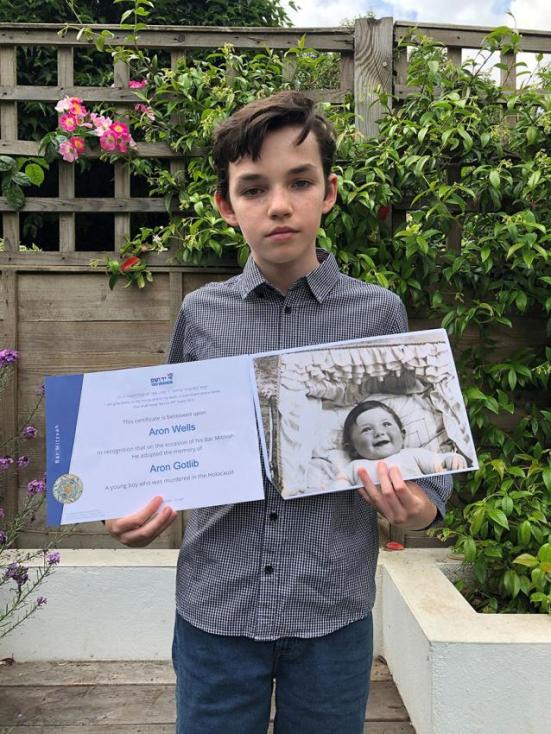
Yad Vashem has launched a unique twinning bar/bat mitzvah program that has been successful in providing scores of young people with a memorable experience by connecting with Jewish children who were unable to have a bar/bat mitzvah during the Holocaust. Although this twinning program has been successfully undertaken, some families have concerns.

Jalen Schlosberg receives a certificate from Cynthia Wroclawski, Manager of the Shoah Victims’ Names Recovery Project, during his Bar Mitzvah celebration, at the Synagogue in Yad Vashem Jerusalem (Courtesy of Yad Vashem)

Recently a Hebrew school teacher who attended a professional development seminar in Yad Vashem related that one of her pupils who was enrolled in this twinning program wanted to discontinue his participation because his parents were concerned that it was too depressing. In the eyes of his parents, their child’s time would be better spent playing sports. This example is not unique, unfortunately.

On the basis of recent surveys, a significant number of millennials and Gen Z are unable to name a single German Nazi concentration camp or ghetto. This lack of knowledge severs yet another bond between the Jewish people and the younger generations. Yet, despite this concern, and perhaps because of it, some Jewish parents still want their children around bar/bat mitzvah age to learn about the Holocaust.

So how can we convince families that the study of the Holocaust will not traumatize or depress their children? How do we encourage young adults that this subject matter can imbue their lives with meaning, especially by learning about the many stories of courage and sacrifice made by “their people” during the Holocaust?

(Courtesy of Yad Vashem)

Every generation has often modified celebrations of rites of passage in Jewish tradition depending on the circumstances of the given place and time – especially in periods of danger and persecution. Emphasizing how Jewish families sought to celebrate and observe Jewish rituals and holidays, despite great risk, can encourage young people to connect with their history. After all, many Jewish youngsters who lost their families and communities struggled to maintain traditional customs and never had a bar/bat mitzvah ceremony during the Holocaust. In the words of Itzhak Reznik, “My parents were religious, but by the time I turned thirteen, I didn’t know I was supposed to be celebrating. All I wanted to do was survive.”  The lack of food, religious articles, and places of worship made it extremely difficult to celebrate festivals and ceremonies.

(Courtesy of Yad Vashem)

For example, Tomi Reichental was born in 1935 in Piestany, Slovakia. He and his family were sent to the Bergen-Belsen concentration camp in 1944. On 18 December  1944, it was Tomi’s brother’s thirteenth birthday. Tomi remembers that “the small stove in the corner of the room had wood burning in it. Mysteriously, several potatoes appeared which were sliced and put on the stove to bake.” He recalls that a family friend entered the room, carrying a piece of black bread that had been cut in slices, spread with margarine and layered to resemble a cream cake. According to Tomi, their friend saved her rations for at least two days which meant that she went hungry to give some happiness to his family. He states that, “The gloom lifted and celebratory humor ensued with mazel tov wishes, embraces, kisses and well-wishing from friends. This is how my brother crossed from childhood to adulthood.” Tomi, along with his mother, aunt and brother, survived the Holocaust, and moved to Ireland after the war.

A Survivor’s Testimony. Tomi Reichental addressing students about the Holocaust.

Bilha Shefer was born in Germany in 1932, and after Kristallnacht or the Night of Broken Glass in 1938, escaped with her family to the Netherlands, where they were eventually deported to the Westerbork transit camp. From Westerbork, they were sent to Bergen-Belsen and eventually released via a one-time prisoner exchange in which Jews were exchanged for German Templers. 

Upon arriving in Bergen-Belsen, Bilha remembers that her mother gathered the family and pulled out a jar of strawberry jam that she liked. According to Bilha, everyone was surprised by this rare treasure. Bilha’s mother proudly proclaimed: “Mazal Tov – it’s your bat mitzvah, your birthday.”  Bilha’s mother had hidden the jar in her bag throughout their journey in order to celebrate Bilha’s bat mitzvah.

Yosef “Tommy” Lapid‘s bar mitzvah took place during the height of the Nazi occupation of Budapest.

Tommy recalls how a perfume bottle was broken to mark his bar mitzvah, thrown to the ground by his mother in an act of resistance, to preserve the integrity of her family: harkening back to a more refined past and to hold fast to the humanity that had been stripped away from them. Surviving the Shoah with his mother, Tommy would later, following a successful career in journalism, serve as Israel’s Minister of Justice and Deputy Prime Minister. His son, Yair Lapid is today Alternate Prime Minister of Israel and Minister of Foreign Affairs.

Tommy Lapid reporting from the trial of Adolph  Eichmann in Jerusalem in 1961

Ultimately, most teenage Holocaust victims never had an opportunity to celebrate their bar/bat mitzvah. Some Holocaust survivors have had special bar mitzvah ceremonies in their golden years at the Western Wall or in neighborhood synagogues as part of their need to find closure and celebrate this rite of passage as part of their Jewish identity.

For example, Yaacov Wexler, a member of Yad Vashem’s staff, had his bar mitzvah in Yad Vashem’s synagogue. Wexler, a baby at the time that he was rescued by Polish Catholic parents, decided to return to the Jewish people over a decade ago and live in Israel. Wexler’s bar mitzvah was celebrated in the presence of another young Polish-Jewish boy who survived the Holocaust – Rabbi Israel Meir Lau, Chairman of the Yad Vashem Council. Bar/bat mitzvah children may be encouraged to learn about the story of Yaacov Wexler, a Holocaust survivor who decided to reconnect to his Jewish roots.

(Courtesy of Yad Vashem)

Robert Powell‘s mother escaped Nazi persecution in Europe, keeping her Jewish identity a secret to her US-born children. At the age of sixty-five, Robert decided to have a bar mitzvah ceremony after he discovered his family roots.  In Robert’s words, my ancestors had a “determination to keep alive our Jewish heritage. Our legacy. Our Jewishness. It only remains for me to honor them by living fully and openly…”

Bar/bat mitzvah programs can provide an opportunity to embark on a personal, meaningful journey. For instance, a few years ago, a Jewish family in the New York area turned to Yad Vashem to mark their daughter’s bat mitzvah by twinning with a Holocaust victim. The bat mitzvah girl requested to know more about her twin’s family. After examining the Pages of Testimony, the family asked Yad Vashem to connect them with the twin’s surviving relatives in Israel. As a result, the two families became close. Since the Israeli family had a son studying in the United States, the bat mitzvah girl invited him to attend her celebration. He did. Entering the event hall, he saw a beautifully framed certificate featuring his aunt’s name. In her speech, the bat mitzvah girl told her guests the story of her adopted twin, and how this Page of Testimony enhanced her bat mitzvah preparations. Through Yad Vashem’s twinning program, this Jewish American family not only fostered a connection with a Holocaust victim but also developed a direct relationship with an Israeli family.

(Courtesy of Yad Vashem)

Yad Vashem hopes that its twinning program will further encourage bar/bat mitzvah aged youths to learn more about the vibrant tapestry of Jewish life before the Holocaust and become inspired by Holocaust survivors’ stories of resilience. This educational process can have a positive impact on bar/bat mitzvah children who are building their “Jewish bedrock”, committing themselves to Jewish continuity and embarking on a life-long quest for meaning.


About the writer:

Richelle Budd Caplan

Living in Israel since 1993, Richelle Budd Caplan is Director of International Relations and Projects of the International School for Holocaust Studies of Yad Vashem. A graduate of Brandeis University and the Hebrew University of Jerusalem with many articles on Holocaust education widely published, Caplan is an active member of the Israeli delegation to the International Holocaust Remembrance Alliance (IHRA), and has developed Holocaust-related projects with numerous international organizations and institutions.


While the mission of Lay of the Land (LotL) is to provide a wide and diverse perspective of affairs in Israel, the Middle East and the Jewish world, the opinions, beliefs and viewpoints expressed by its various writers are not necessarily ones of the owners and management of LOTL but of the writers themselves.  LotL endeavours to the best of its ability to credit the use of all known photographs to the photographer and/or owner of such photographs (0&EO).

Education is Eternal – Netzach Yisrael

Improving the education system for Israel’s Haredi community will help to improve their economic situation – and the country’s

By Rolene Marks

Rabbi Menachem Bombach is a man with a mission. The charismatic Rabbi, raised in the ultra-religious neighbourhood of Jerusalem known as Mea Shearim and who did not speak Hebrew until the age of 20, has a plan to bring about significant change to the Haredi approach to education.

The statistics speak for themselves.

According to the Israeli central Bureau of Statistics, the Haredi community makes up about 12% of the population, with an estimated size of roughly 1 million people – and is amongst the most poor, with 50% living below the poverty line. The Haredi community is also the fastest growing community.

The employment rate of Haredi men is at 51% compared to secular men at 87%. The rate for Haredi women in the workplace is 76% but many are forced to take low paying jobs as a result of their lack of skills.

Even though there is a larger percentage of Haredi women who are employed in the work force, it does not necessarily ensure an improvement in living conditions and the economic situation for the community.

It is clear that this cannot continue – if it does, the effects will be catastrophic.

Enter Rabbi Bombach.

Rabbi Bombach has identified a crucial element to ensuring that this alarming trend is corrected. The Rabbi believes that the key to fixing this growing problem which perpetuates the cycle of poverty, is reforming the Haredi education system. The more members of the community who are educated and receive a matriculation certificate, with skills in significant subjects like maths, English and even Hebrew, the more they will be able to enter into the workplace – and get better jobs. He believes that the current economic situation would not continue if members of the Haredi community were more integrated and productive in society.

Inspired by this, Rabbi Bombach started “Netzach Yisrael”. Established in 2017, Netzach is an ultra-Orthodox (Haredi) network of educational institutions (elementary through to post-high school) whose mission it is to provide its students with an outstanding education and in parallel, work towards a bagrut (matriculation) certificate, which is a prerequisite for higher education in Israel. These studies include mathematics, English, the sciences and civics for both elementary and high school students.

Rabbi Bombach has always been drawn to education. When he was just 12-years-old, he would often lead his peers in Shabbat afternoon prayers. He knew that education would be part of his future.

The Rabbi would go on to study after he finished his schooling and met other students from different communities and societies, including Arabs, secular Jews and others. It was eye-opening. Integrating with other people went a long way to breaking down pre-conceived stereotypes and prejudices and opened his eyes to the ability to stay Haredi – while meeting other people.

Bombach believes in the philosophy that “Jews need to radiate light to each other”.

And so Netzach Yisrael was started. At first, many in the community were skeptical and did not want to send their children to school, but slowly it started to grow and now there are over 1000 students at 11 different educational facilities, with at least 3 700 students attending virtually.

Time for Change. Through a new yeshiva system that he founded in  in Israel, Rabbi Menachem Bombach is determined on reducing poverty in the Haredi community through education, preparing them to attend college and enter the workforce.

There have been several notable success stories. One young student is excelling as an activist talking about climate change, a topic that one would not expect members of the Haredi community to be vocal about. At least 95% of the students who have come through the Netzach Yisrael programme are fully integrated and have gone on to university. This aligns with the focus of having modern, pragmatic Haredim and will improve the economic situation of the community.

Netzach Yisrael’s vision is that the academic programme empowers graduates to create a strong, financially viable future for themselves, their future families, and the Israeli economy, while remaining strongly connected to their core values of Torah observance.

The ethos and values of the Netzach Yisrael programme are very clear – Torah and the worship of G-d by instilling the foundations of faith, worshiping G-d, and the study of Torah as a way of life, Education furthering Derech Eretz, truth, virtue and love of Israel, imparting knowledge, life, social and learning skills and striving for excellence and cultivating personal and social responsibility that is reflected in working for the common good and involvement in the community.

Bombach in Action. This Hasidic Educator is changing the face of Haredi education in Israel

Over seventy years ago, when the State of Israel was formed, the only choice for Haredim was to study Torah,” says Rabbi Bombach. “This was not good for the majority. We can combine religious and secular studies, while maintaining the connection with the community,” he says.

Bucking Tradition. Despite being vilified by his co-religionists, Rabbi Bombach teaches secular subjects to boys.

Today, the proof of success is in the growing statistics of students who have thrived in the Netzach Yisrael programme and continue to excel in tertiary education and beyond. The once skeptical parents are writing glowing testimonials and there is no doubt that Israel will benefit. This truly is proof that a great education, combined with dedications and knowledge of your roots and community – is eternal.

For more information visit: https://netzach.org.il/en/home/


While the mission of Lay of the Land (LotL) is to provide a wide and diverse perspective of affairs in Israel, the Middle East and the Jewish world, the opinions, beliefs and viewpoints expressed by its various writers are not necessarily ones of the owners and management of LOTL but of the writers themselves.  LotL endeavours to the best of its ability to credit the use of all known photographs to the photographer and/or owner of such photographs (0&EO).

Ruth’s Roots Revealed

By Adv. Craig Snoyman

In September 2016 a solitary, single, slightly tired woman arrived in Johannesburg, South Africa. She did  not find the streets  paved with gold, nor were the people particularly friendly. With no family or friends, or even acquaintances, she has arrived in xenophobic South Africa with little fanfare and no more than a suitcase, a small amount of money and bucket-loads of grit and determination.

She made her way to the room that she had found on the internet and rented.  This too, did not match what had been advertised. The room formed part of a larger house that was sub-let to  other tenants as well.  A small , grubby dingy room with a communal toilet and kitchen, substantially misrepresented by the photos that appeared on the website, was to be her new home for the  immediate future. Not even having unpacked, she took a walk to the corner cafe,  bought some cleaning detergent and got down to work, scrubbing down her room and the toilet. She was determined to make the best of whatever hurdles confronted her.

She was different from the other Zimbabweans. She was not an economic migrant. She was here for a higher purpose. She was here to convert to Judaism. For someone who knew nothing about Johannesburg, the area  in which she had  selected to live was slightly out of the more heavily populated Jewish suburbs, but it was within easy  walking distance of  an orthodox shul. This had been her priority.

 Ruth (not her real name) had been in contact with the Union of Orthodox Synagogues  of South Africa. She had been told that there were inadequate facilities in Zimbabwe for her to convert. If she wanted to convert, she would have to do this in South Africa. So she gave up her comfortable life in an affluent area of Harare  and came to stay in the heart  of  the unknown, dangerous Johannesburg.

It was about two weeks after she arrived that I first met Ruth. It was on a Friday night, when walking back from shul. By coincidence, I had gone to that shul to make a minyon (required quorum of ten Jewish male adults). She was a new face in the congregation.  The congregation is small and even with a mechitzah (participation separating men and women), you couldn’t really miss her.  It is a very small congregation, usually all male,  Ashkenazi and (to be politically incorrect) all white.

Ruth, the only woman present, was none of the above.

After the service, she was walking home with the head of security and headed in the same direction as me. The Security head asked me to walk her home as she lived only a few houses away from me, in the same street. With little further ado, she came to our Shabbas table and revealed to us the amazing story behind her desire to convert. 

Ruth had grown up in one of the leafy green suburbs in Harare,  part of a close-knit family. She had cared for her grandmother during her illness, but it was only on her deathbed, that her mother told Ruth that her grandfather was Jewish. Ruth was stunned!

And so began the investigation. Ruth’s aunt (her mother’s sister) had also been aware of the secret but had been sworn to secrecy. She told Ruth what she knew. Her grandfather was a well-known Jewish merchant who lived in a small town in the southern part  of Rhodesia. She knew his name and she knew the name of the shop that he owned. Ruth went to  the town to see what she could find out.  However, this small outpost no longer had a Jewish community,  and the trail ran cold.  She had made various inquiries over the past ten years, including approaching Africa’s travelling rabbi, Rabbi Moshe Silverhaft, but had come no closer to discovering the truth.

Rabbi Moshe Silverhaft

What remained unsaid, but what all of us realised, was that we were talking about colonial Rhodesia and love across the colour line was absolutely taboo at the time. Had anyone been aware of what had happened it would have resulted in a scandal that might well have ruined this man’s  reputation and certainly his livelihood.

Rhodesia, today Zimbabwe in the early 1900s.

Her interest in Judaism had been sparked  and she embarked on a course of discovery to learn more about Judaism and to discover more about her Jewish roots. The course of this road led to a trip to Israel, accompanied by her daughter.  She had done some studying in Israel but wasn’t really ready to proceed further. She returned to Zimbabwe and resumed her life. Her daughter remained in Israel, converted, married, and is living in Israel.

Some years had passed, she was now more settled and had decided to  proceed on her journey. It was now time for her to convert.

It was a  coincidence that she had chosen to come to South Africa to convert. It was a coincidence that she had chosen to rent accommodation in the same street in which we live. It was a coincidence  that I had gone to that shul that night. It was a coincidence that Ruth had accepted our Shabbas meal invitation. By a further  coincidence,  the only Zimbabwean that we knew, just happened to be Jewish. Coincidently, he also just happened to have grown up in that very town where her grandfather had lived. He  just happened to be the son of the reverend who conducted the religious services in the small town, where everybody knew everybody. As the son of the “makulu-baas” (the big boss) of the Jewish community in the town, if anybody had any information about that time, it would be him.  Further coincidently, he and his family just happened to be living around the corner from us. Again, just by coincidence, he had not severed his relationship with Zimbabwe when he emigrated, regularly returning  to Zimbabwe  on business.

And so Ruth was introduced to Boaz, who after hearing two sentences from Ruth, completed the description of the shop, the shops next to her grandfather’s shop as well as a general description of the town. He also  knew who presently owned  the shop.  More importantly, he remembered  her grandfather!

Opening a book entitled “Famous Jews of Rhodesia”, Boaz directed Ruth’s attention to a potted biography of her grandfather, together with  a picture of him.  After ten years of dead-ends, it took only  two weeks in South Africa for her grandfather to be revealed to her.

Rhodesia and Nyasaland (Zambia, Zimbabwe, Malawi) – Jewish Community exploring project

A few weeks after Ruth’s initial shock, Boaz  went on a business trip to Zimbabwe and took Ruth to visit the gravesite of her grandfather.

Arriving as a stranger in a strange land, Ruth has now learned of her past, formed a durable support base and having spent five tough years following the long, winding, and difficult road to an Orthodox conversion. This morning she went  to the mikveh  and participated in small socially distanced  se’udah (festive meal). In a touching gesture, when she announced her new Hebrew name, she had also adopted her grandfather’s surname. Her long  road continues to wind its way, leading to Jerusalem.

In her process of conversion, Ruth would follow in a 3,500 year tradition of observant Jewish women immersing themselves in a ritual purification bath (mikveh).

The unspoken,  but  equally incredible part of the story is about her grandfather. He was by all accounts a very prominent member of the Jewish community. He held national congregational  office and was married to his wife for many years. He and his wife never had children. In Ruth’s own small way, the stone that was rejected has become the cornerstone. She is now a proud Jewess; she has a son that has converted recently at his yeshiva in Israel and soon to be married. She also has a wonderful Kibutznik daughter and son-in-law with two beautiful grandchildren. Her family is  a shoot that   has  grown  from the stump of Zimbabwean Jewry, it is  a branch that has borne new fruit.    

 “Isn’t it wonderful,” says Ruth, “how Hashem reveals the jigsaw pieces and lets us put them together, for us to create our own puzzle.”


About the writer:

Craig Snoyman is a practising advocate in South Africa.


While the mission of Lay of the Land (LotL) is to provide a wide and diverse perspective of affairs in Israel, the Middle East and the Jewish world, the opinions, beliefs and viewpoints expressed by its various writers are not necessarily ones of the owners and management of LOTL but of the writers themselves.  LotL endeavours to the best of its ability to credit the use of all known photographs to the photographer and/or owner of such photographs (0&EO).

A Rabbi and a Self-Hating Jew walk into court with a Newspaper

By Adv. Craig Snoyman

South African Jewry is resilient. They know that their government is vociferously anti-Israel and that when an incident flares up in the Middle East between the Israel and its neighbours, they know to keep their heads down and try and weather the storm.  This time, the captain of the ship was on the starboard, plotting a course to safety and became a target.

Two weeks ago, a three-quarter page article appeared in South Africa’s most widely read national newspaper, the Sunday Times. The headlines blazed:

 “A chief rabbi who is a disgrace to his faith and to human decency.

This prominently placed article was written by a former politician, who is now well past his sell-by date. Once a cabinet minister in the Thabo Mbeki cabinet, his star has faded, but he tries his best to appear news-worthy whenever he can. His sure-safe recipe is knocking Israel or the Jews.  He can do this because he was born a Jew and it’s therefore “acceptable”. It always makes for great conversation when a Jew publicly attacks another Jew, even if the first “Jew” has not an iota of Jewishness, save for the accident of his birth.  This was the situation with our self-hating “Jew”, Ronnie Kasrils. His target was the Chief Rabbi of South Africa, Rabbi Warren Goldstein, and he could hardly fail!

The Rabbi vs the Rebel. Ronnie Kasrils’ article in the Sunday Times attacking South Africa’s Chief Rabbi, Warren Goldstein.

Kasrils, who has very publicly renounced his Jewishness, has pooh-poohed the idea that the Jews were chosen by God. He has declared that Jewishness is merely a charade for Jews to hide their racism and their Zionist exclusivity. His article, which he called an open letter to the President, was much of the same.  Many didn’t read past the headline.  It was a sickening headline. In fact it is exceedingly difficult to find a more disturbing headline than this, in any mainstream newspaper anywhere in the free world. It was incredible that a newspaper was prepared to print it. How does one react to big, bold in-your- face print that says – “A chief rabbi who is a disgrace to his faith and to human decency”.

The article itself was filled with the normal vitriol about Israel and the Jews, but it also made an unjustified and unheard-of attack on Rabbi Goldstein. In fact, the last time that I can remember a chief rabbi of South Africa being so viciously attacked was when Rabbi Rabinowitz attacked the Nationalist government for its policy of Apartheid.  It was an uncalled for, ad-hominem attack on the Chief Rabbi  and a rant against many things Israeli or Zionist.  It was an article that had no place in any respectable publication. Kasrils started off his letter by referring to “the illegal occupation by Israel of Palestinian land” which was “the greatest moral issue of our time”. It only got worse from there.  He referred to the anger at the pain and humiliation inflicted on the Palestinian people, to which was an offence South Africa’s core values of equality, justice and human rights. Clearly, Rabbi Goldstein had no justice or compassion of the hundreds of innocent Palestinians who perished in Israel’s “so-called precision bombing” The Chief Rabbi’s version of “the truth” about Sheikh Jarrah was the same as Apartheid’s eviction policy. Similarly the Chief’s statement that there had been many attempts to create a Palestinian state, was “sheer sophistry”. This was because Israel had colonised Palestine in 1948 and had thereafter engaged in expansion, land theft and ethnic cleansing.  It was the Israeli government that had refused to be a partner for peace, while the Palestinians, even Hamas, “had gone out of their way to consider a two-state solution”. It was the Israelis that had rejected proposals, instead insisting on a Bantustan solution. The Chief Rabbi was “obfuscating” if he suggested otherwise. As for Israel’s right to defend itself against Hamas’ rockets, “Goldstein [had] callously ignored the rain of death poured into the world’s most densely populated concentration camp where two million inhabitants have no place to hide.” How can he support a “people that smash a small densely populated territory to smithereens because they sustained 12 deaths?” Kasrils did not forget to refer to the dubious quote of Richard Falk that “Palestinian resistance to occupation is a legally protected right” and that Israel was violating international law. He also scoffed at the Chief Rabbi’s reliance on “a property-dealing God who presented another peoples land to the so-called chosen” which was in stark contrast to the belief of Palestinian Christians and Muslims. He concluded by holding that “numerous devout Jews interpret the Hebrew bible very differently to Goldstein and his ilk. His views are not representative of Jews in general” and that “Goldstein’s utterances contradict the golden rule of all religions to treat others as you wish them to treat you”.

Up to his Neck. No, Ronnie Kasrils is not wearring a tallit (prayer shawl worn by Jews) but a Palestinian keffiyeh.

With the Jewish community in shell-shock, the response came in last week’s Sunday Times. Entitled “Kasrils breached acceptable boundaries of civilised discourse” virtually every leading organisation within the Jewish establishment attached its name to this public rebuke.  A small photo-replica of the original article with the offensive heading was attached to the Jewish establishment’s response (just in case it could have been forgotten).  In defending the Chief, Kasrils was accused of breaching acceptable boundaries, demonising and defaming the state of Israel and vilifying and crassly impugning “the integrity of the chief rabbi, Dr Warren Goldstein, the public face of the Jewish faith community in South Africa” and inflaming race relations in South Africa. Notably, the Chief Rabbi was not a signatory to the article.

Like any Jew, I know some things and I have an opinion on some things. They don’t always overlap. I have an opinion on Kasrils’ conduct (which might not be fit to publish) and I know something about the law of defamation in South Africa. My opinion based on my knowledge of defamation is that he has opened himself up to a massive lawsuit. Kasrils, who has been on the winning side of a defamation case previously, must also be acutely aware of this as well.

The law of defamation in South Africa balances the existence of various conflicting constitutional rights such as the right to privacy and dignity against the right to freedom of expression and political rights. In principle, to succeed in a defamation case one needs to prove the following: 

(1) there is a statement

(2) it has been published 

(3) it concerns that person

(4) it is defamatory

(5) it has injured that person in his reputation.

The test to be applied to decide whether a statement is defamatory is whether the words complained of, are reasonably capable of conveying to the reasonable reader a meaning defamatory of that person. One does not need to prove falsity. The quantification of damages is dependent on reputation and character, standing in the community and the extent of the publication.

The party being sued has a variety of defences at his disposal. The most common defence is that while the statement appears on the face of it (prima facie) defamatory, the words were used in a non-defamatory sense and special circumstances are set out.  Other defences might include (a) the absence of intention to cause harm (this defence is not available to the media) or (b) that it was made in jest or (c) that the words were spoken in sudden anger as a result of provocation (referred to as “Rixa”) or (d) lack of knowledge of wrongfulness or (e) denial of wrongfulness i.e., that the defamation was not wrongful. 

There are also defences that would apply where the statement was made in the discharge of an official duty such as (f) qualified privilege or where it was made in parliament being (g) absolute privilege. For statements appearing in the media, there are two   defences that are invariably raised, viz. (h) truth and public interest and (i) fair comment. 

When one looks at the requirements that the Chief Rabbi would have to prove, then elements (1)-(3) are self-evident. The crux of the case would be – the reasonable person test.  If this is successful then element (5) falls into place. I regard myself as a reasonable person. On a simple reading of the article, I find it to be unacceptably egregious. On a deeper reading of the article, I find it to be irredeemably and grievously reprehensible and having no redeeming merit. Thus, on the Chief Rabbi’s version, I believe that he cannot but succeed.  As the Chief Rabbi is the pre-eminent Jew in South Africa, I believe that he should qualify for the largest sum of damages ever awarded for defamation in South Africa.

Heading to Court. The man Kasrils has accused of as “a disgrace to human decency”, South Africa’s Chief Rabbi Warren Goldstein speaking at Nelson Mandela’s memorial ceremony on December 10, 2013. (Sky News, YouTube)

Strategically and tactically the response was brilliant. Whether intentionally or by chance (or should I say by fate, as Rabbis don’t believe in chance), with the stroke of a pen, the people of the book  vindicated the Chief Rabbi. The entire upper echelons of the Jewish Community, unquestionably comprising of reasonable people, found the article to be, not only defamatory, but as exceeding the bounds of civil discourse and both vilifying and crassly impugning the chief rabbi’s integrity.  One can’t get a much stronger condemnation of Kasrils’ statement than that. No doubt the Chief has a superior legal team advising him. His father, Ezra Goldstein was one of the sharpest judges on the South African bench and certainly one of the most compassionate.  But the Chief Rabbi, no doubt, has a Greater Hand guiding him. I think the whole Jewish community would derive immense satisfaction in seeing him nail this ###%##   BIG TIME, through the agency of this Greater Hand.

Kasrils, on the other is not without his defences. He has revelled in his article, has not denied a single word of it and his only complaint is that it was not published in its totality. Various defences are immediately ruled out. Having called the Chief Rabbi an obfuscating sophist whose views, and that of his ilk, are not representative of Jews in general, he can hardly be seen to raise a defence of absence of intention to cause insult, or that they were not intended to defame the Chief Rabbi.  The defence of lack of knowledge of unlawfulness is moot. Many of our jurists hold that it is an element of intention. Whether unlawful forms part of intention or not, Kasril’s   statement falls within this larger category.  So Kasrils is left with a choice of two defences: truth and public interest or fair comment. To succeed in the defence of truth and public interest requires proof that both (1) the statement was true and (2) that its publication was to the benefit of the public. Just on a summary of his statement as set out, it is unlikely that he can prove either. Which leaves Kasrils with one defence, that of fair comment. The elements required to be proven for this defence are (1) that it was a comment and not a statement of fact; and (2) that the comment was “fair” (in that it does not exceed certain limits); and (3) the facts commented on were truly stated and (4) the matter was in the public interest. With several facts indisputably incorrect as well as a response from the entire Jewish establishment that Kasrils’ comment breached acceptable boundaries of civilised discourse, it will be difficult for a judge to hold that this defence has any merit either.

Last but not least, the law also provides the Chief Rabbi with a further useful line of attack. Even if Kasrils were able to show circumstances providing a justification for his statement, such a defence should fail, if it can be shown that he intended to injure the Chief Rabbi in his reputation. As my maths teacher used to say: Quod Erat Demonstratum! (Roughly translated: this which has been proved)

In defamation cases like this, not only is the writer of the article sued, but the publisher is as well. There have been cases where even the distributor and the printer of the newspaper have been sued as well. In this case, it would probably be adequate to sue Kasrils and the owners/ publishers of the Sunday Times.

Like all juicy court cases, there is invariably a twist in the tale.  This one is no different. Following this notorious article, Kasrils was interviewed on a Muslim television channel.  He went on record as stating that he was not responsible for the headlines that appeared above his article, that was done by the newspaper itself. It is almost inconceivable that the largest national newspaper, with top-class legal advisors on tap, could have created such a stupefyingly defamatory headline. Our Supreme Court of Appeal has made it abundantly clear that the public media cannot rely on the absence of animus injuriandi to escape liability, (although it may rely on absence of negligence.) If Kasrils is to be believed, not only would it appear that the Sunday Times had been negligent, but it would seem that a case might be made for malevolent premeditation and malice in choosing the headline.  That the Sunday Times first published and then republished the headlines a week later, when the response was published, places it in a very invidious position. Not only has the headline been published twice in hard copy, but these headlines appear around the world in soft copy and remain on record.

No place to hide!

The newspaper’s legal team are going to have their work cut out for them, in the event of defamation litigation being instituted.

I am one of those South Africans who keeps my head down. I am not part of the Jewish establishment. I don’t know what the Chief Rabbi will do. In response to the article, I have bought a Jewish National Fund Certificate so that a tree will be planted in Israel in the name of Ronnie Kasrils.  I really hope that the Chief Rabbi will sue and get the biggest defamation award ever issued in South Africa and then donates it to a Zionist cause in the name of Kasrils. ….and it all has to published in the Sunday Times!


About the author:

Craig Snoyman is a practising advocate in South Africa.


While the mission of Lay of the Land (LotL) is to provide a wide and diverse perspective of affairs in Israel, the Middle East and the Jewish world, the opinions, beliefs and viewpoints expressed by its various writers are not necessarily ones of the owners and management of LOTL but of the writers themselves.  LotL endeavours to the best of its ability to credit the use of all known photographs to the photographer and/or owner of such photographs (0&EO) .

Cadena – Bringing Dignity Back to Young Women

Breaking taboos, Jewish non-profit on a mission to repair the world

By Rolene Marks

There is an old and wise African proverb that says:

Educate a woman and you educate a village.”

Access to a good education saves and improves the lives of girls and women the world over, ultimately leading to more equitable development, stronger families, better services and better health for children. Educating young girls has a wide-ranging impact as well as long term benefits. It is often said that the future is women – and who can forget such extraordinary young women like Malala Yousafzai who literally risked her life for the right to be educated and the countless others, who dream of what so many take for granted?

The simple act of going to school every day is one that many of us don’t give a second thought to; but what of the millions of young girls living in poverty around the world who miss out on a week of school every month because of their menstrual cycle? During this time, young girls who live in areas that are either rural or poverty stricken do not go to school because of a lack of access to safe, hygienic sanitary products, and/or who are unable to manage their periods with dignity, sometimes due to community stigmas. Many of these young girls are made to feel ashamed of their bodies and that they are dirty.

There is a connection between the confidence of women who are able to take care of their bodies and their ability to be able to take care of their education and their communities. At a time when we are having important conversations around issues of body positivity and breaking the stigma about menstruation which is a natural function, we need to draw attention to the many suffering from period poverty, that is – the lack of access to sanitary products, menstrual hygiene education, toilets, hand washing facilities, and waste management.

Young women deserve the basic human right to menstruate with dignity. Diminished capacity, even for just a week, creates barriers to opportunities. It does not just affect the ability of young girls to go to school but women to go to work.

Proud to Help. Young volunteers from the Jewish non-profit Cadena helping a  community in South Africa to replace unsafe and unsanitary pit latrines.

It also impacts on physical health. Lack of access to the right feminine hygiene products may lead to greater risk of infection. In some cases, women and girls do not have access to menstrual products at all. They may resort to rags, leaves, newspaper or other makeshift items to absorb or collect menstrual blood. They may also be prone to leaks, contributing to shame or embarrassment.

Humanitarian organization, Cadena has found a solution to these issues.  Cadena was formed in Mexico in 2004 with the intention of assisting with victims of natural disasters. Since then, Cadena which now has a global presence in many countries around the world, has expanded its focus to include education, the launching of rescue missions, community rebuilding programmes and many, many more important projects. Cadena also firmly believes in a philosophy of “hand to hand”, preferring direct contact with the people that they are helping. The organization became more and more concerned hearing about the situation for young women in poverty stricken areas of South Africa where a decision between buying a loaf of bread or sanitary protection for girls is a heartbreaking but common occurrence. At least 50% of young women in South Africa have seen their education disrupted during their menstrual cycle!

Project Preparation. Volunteers planning and preparing to  replace and upgrade latrines in rural community.

What could Cadena do to help alleviate the situation and ensure that the education of these young women and girls is not interrupted?

The first order of the day was to break the taboos. Cadena had to educate these young girls and women that there was nothing “dirty” or horrible about a process that is a very natural part of being a woman. Sadly today, taboos around this subject are not just in struggling communities but worldwide which is why an article like this can help a lot with breaking down stigmas and taboos.

Team Work. Cadena volunteers help communities with solutions to replace deadly pit latrines and help host workshops to help alleviate period poverty.

Cadena is determined that young girls and women get their dignity back and are committed to equipping them with the tools and material necessary!

Cadena is launching workshops in the townships where women will not only be taught about health and hygiene but will also be supplied with fabric and materials to help them make their own ecological, washable and reusable menstrual pads. This not only helps to empower the women attending the workshops but helps them to share the same skills with their families and communities. These workshops have been held with great success in South America.

Helping communities also creates opportunities for other volunteers to be involved. Students from Johannesburg’s Jewish day school have been eager to help. Cadena is primarily a volunteer organization. While they cannot take anyone under the age of 18 into the field, students were really keen to help as much as possible by packing materials, helping with content creation for distribution and helping to raise awareness. After all, who better to help than their peers of the same age! It also proved a great opportunity for them to learn about the situation for many in their own country who don’t enjoy the same comforts and privileges that they do.

Making a Difference. Braving heat and dust for three weeks in a row, CADENA volunteers in South Africa went from house to house in Plot 89 to deliver PitFix by Enzyme Genie that has made such a difference in a short amount of time.

Cadena has also been instrumental in making sure that rural communities have safe, hygienic latrines following a tragic accident where a 5-year-old little boy drowned. CADENA South Africa will be using PitFix, a locally produced product by the company Enzyme-Genie that removes wastes, breaks down organic solids resulting in a dramatic reduction in smell and the presence of flies in both traditional pit latrines and septic tanks.

This Should Not Happen! The mother of a five-year-old South African boy who died after falling into a pit latrine at school breaks down in court as she described finding his body.

Every person deserves to live a life of dignity and for the truly vulnerable, including women and girls, Cadena is playing a vital role in ensuring that that their personal health is protected and that they never have to miss out on receiving their education.

The future is clearly women!


For more information about how you can help by donating or becoming a volunteer, please visit: https://cadena.ngo/en/southafrica/


While the mission of Lay of the Land (LotL) is to provide a wide and diverse perspective of affairs in Israel, the Middle East and the Jewish world, the opinions, beliefs and viewpoints expressed by its various writers are not necessarily ones of the owners and management of LOTL but of the writers themselves.  LotL endeavours to the best of its ability to credit the use of all known photographs to the photographer and/or owner of such photographs (0&EO)

Sarah Halimi : une déroute judiciaire programmée

Par Dr. Gad Amar

Les faits:

Dans la nuit du 3 au 4 avril 2017, dans un quartier populaire de Paris, Sarah Halimi, 65 ans, médecin de formation et directrice d’une crèche juive à la retraite, est attaquée par son voisin, Kobili Traoré, qui s’introduit chez elle par le balcon et la roue de coups pendant 35 à 40 minutes aux cris d’Allah Akbar, récitant des sourates du Coran et la traitant de « Sheitan » (Satan), avant de la jeter vivante par la fenêtre du 3eme étage. Elle meurt sur le trottoir de ses multiples traumatismes.  

Mère de famille, médecin et directrice de crèche à la retraite, Sarah Halimi a été battue,torturée et assassinée – mais la justice française a fermé les yeux

La veille, Traoré se rend à 5 reprises à la mosquée Omar, une mosquée salafiste voisine. Il la quitte à 22 heures, dîne au restaurant et va dormir chez un ami, dans l’immeuble mitoyen de celui où il réside chez ses parents et où vit aussi Sarah Halimi.

Il se lève à quatre heures du matin, monte pieds nus au 3° étage avec son tapis de prières, sonne chez des amis de sa famille, les Diarra, qui le laissent entrer, ferme la porte à clé, met les clés dans sa poche et crie « ça va être la mort, ça va être la mort ». Le matin, il avait dit à ses parents « J’ai tout raté dans ma vie, ce soir tout sera terminé ». Devant son état d’excitation, les Diarra s’enferment dans une pièce de leur appartement et appellent la police, comme le feront d’autres voisins réveillés par les cris. Traoré fait ses ablutions à la cuisine, récite quelques prières et va sur le balcon dont il enjambe la balustrade pour entrer chez Sarah Halimi qui dort dans son lit. Il prétendra être devenu fou en découvrant chez elle un chandelier à sept branches (les menorot en ont 9…) et des livres de judaïsme.

Les policiers arrivent rapidement, ils sont neuf, ils sont armés, mais n’interviennent pas.

L’assassin, âgé de 27 ans, d’origine malienne, est un toxicomane baraqué d’1m90 qui deale dans le quartier depuis des années. Il a déjà été condamné à 22 reprises pour trafic et usage de stupéfiants, outrage et rébellion. Il a à son actif une cinquantaine de gardes à vue et a fait 2 ans de prison en tout par périodes de 3 et 6 mois (selon William Attal, frère de Sarah Halimi, qui rapporte des éléments du dossier).

Après son forfait le meurtrier retourne chez ses amis maliens. Il est calme et récite son Coran. Il est interpellé à 5heures35 par la police. Arrivé au commissariat, il se rebelle contre les policiers (au moment de la prise de sang ?) et il faudra huit hommes pour le maîtriser. Il en blesse deux. Le médecin juge son état psychiatrique incompatible avec la garde à vue et le fait interner en hôpital psychiatrique sans qu’il ait été entendu une seule fois par la police.

La France incapable de protéger ses juifs, mais aussi ses prêtres, ses policiers, ses enseignants…à cause d’une immigration incontrôlée. Sarah Halimi a été massacrée puis jetée du haut du balcon de son appartement, rue de Vaucouleurs à Paris

Pendant des jours, seuls les médias communautaires font état de l’assassinat de Sarah Halimi. On n’en parle pas dans les medias français. La France est en pleine campagne présidentielle ; François Hollande est le Président (socialiste) sortant jusqu’au 14 mai 2017, Jean-Jacques Urvoas son ministre de la Justice jusqu’au 10 mai 2017. Une médiatisation de ce nouvel assassinat par un islamiste fanatisé risquerait-elle d’apporter des voix à l’extrême droite ?

Le 7 avril le Procureur de la République François Molins déclare qu’en l’état de l’enquête, il n’apparaît pas qu’il s’agisse d’un acte antisémite, mais que cette hypothèse reste à examiner.

Les expertises :

La juge instructrice Anne Ihuellou demandera trois expertises psychiatriques, fondées sur des éléments glanés auprès du criminel, de sa famille et de la famille Diarra. L’enquête ne sera pas élargie à l’entourage moins proche de l’accusé, malgré les demandes des avocats. 

La première expertise, confiée au Dr Zagury (psychiatre d’origine juive) conclut à une bouffée délirante aigue, mais sans abolition du discernement. Le parquet demande à la juge de requalifier le meurtre en acte antisémite.

La seconde, demandée à un collège de trois experts (dont le Dr Bensussan, d’origine juive) conclut à une bouffée délirante avec abolition du discernement : cela implique l’irresponsabilité pénale du criminel.

Face à ces deux expertises contradictoires, les avocats de la victime demandent une troisième expertise, dont les conclusions extrêmement nuancées laissent planer le doute sur l’origine de l’abolition du discernement : « la bouffée délirante aigue (en l’occurrence exotoxique) et la motivation délirante de l’acte sont deux critères qui font discuter l’abolition du discernement, dans la mesure où l’on considère que cet état émerge en dehors de toute volonté du sujet » (arrêt du 19 décembre 2019).

En d’autres termes, cette troisième expertise pose deux questions : si l’abolition du discernement est une conséquence de la bouffée délirante provoquée par une consommation volontaire de cannabis, peut-on la considérer comme un état pathologique indépendant du sujet ? La motivation antisémite, cultivée par Traoré et qui déjà faisait trembler Sarah Halimi à chaque fois qu’elle le croisait, n’est-elle pas une volonté réfléchie du sujet qui trouve dans le crime son aboutissement ?

Le 17 juillet 2019, le Parquet de Paris demande le renvoi aux assises du meurtrier pour crime antisémite. Les juges d’instruction au contraire disent qu’il faut retenir l’irresponsabilité pénale. 

Le 27 novembre 2019, le débat est ouvert en audience publique devant la chambre d’instruction sur la responsabilité pénale du meurtrier.

Meurtrier défoncé, la justice s’enfonce. Kobili Traoré s ‘acharne sur une femme juive de 65 ans et la jette par la fenêtre en criant Allah Akhbar mais pour les tribunaux il n’est pas responsable: défoncé au cannabis au moment des faits, il ne sera jamais jugé.

Les jugements :

Le 19 décembre 2019, la Cour d’Appel de Paris reconnaît la circonstance aggravante du crime antisémite commis par Traoré, mais conclut à l’irresponsabilité pénale du meurtrier, au motif qu’« aucun élément du dossier d’information n’indique que la consommation de cannabis par l’intéressé ait été effectuée avec la conscience que cet usage de stupéfiants puisse entraîner une bouffée délirante aigue »

Le 14 avril 2021, la Cour de Cassation confirme ce premier jugement. Tout en reconnaissant le caractère antisémite du crime, elle confirme l’irresponsabilité pénale du meurtrier.

Les protestations des avocats et de la famille

Les insuffisances de l’enquête sont soulignées par les avocats : pas de reconstitution des faits sur les lieux du crime, pas d’examen du portable de l’assassin qui aurait pu révéler son antisémitisme ou la préméditation, aucune confrontation. Les policiers présents pendant le drame et qui ne sont pas intervenus n’ont pas été auditionnés. Et il n’y a eu ni auditions ni perquisition dans la mosquée salafiste fréquentée assidûment par le criminel.

Sur son compte Facebook, Traoré s’est choisi le nom de « Boubaker Fofana ». Fofana, c’est le nom du meurtrier d’Ilan Halimi en 2006. Un deuxième Fofana annonce-t-il le massacre une deuxième Halimi ?

La barbarie en France. Ilan Halimi, 23 ans, a subi des semaines de torture avant d’être poignardé et incendié par le chef du «gang des barbares», Youssouf Fofana, qui a siégé au tribunal en souriant avec défi et en déclarant: «Allah sera victorieux».

Le meurtrier, qui séjourne depuis 4 ans en psychiatrie, ne suit plus de traitement depuis 18 mois et attend sa libération d’un feu vert du préfet. Pourtant, le second collège d’experts avait affirmé que le meurtrier entamait une schizophrénie. Elle n’a pas été confirmée depuis. Le cas aurait dû être réexaminé de sorte à écarter la maladie et ainsi pouvoir retenir uniquement la bouffée délirante secondaire à la prise de cannabis et au fanatisme islamiste.

La justice française en question et l’inquiétude des juifs de France. Manifestation Place du Trocadéro à Paris dimanche 25.4.2021.

Les conclusions contradictoires des psychiatres sur l’abolition du discernement du criminel permettaient aux juges d’exercer leur liberté d’appréciation pour prononcer leur jugement. Ils ne l’ont pas fait.

Pour éclairer toutes ces zones d’ombre, la magistrate en retraite Danielle Khayat suggérait il y a plus d’un an la création d’une enquête parlementaire (Mabatim, 13.1.2020). Sa proposition n’a pas encore été retenue.  

Les réactions de l’opinion publique :

Nombreuses ont été les réactions indignées de la population juive de France, de ses représentants, de plusieurs hommes politiques dont le Président français Emmanuel Macron, de journalistes, penseurs et hommes de lettres. La consommation de drogue, considérée jusqu’ici par la loi comme un facteur aggravant, devient tout d’un coup une échappatoire. Le Président Macron demande à réécrire la loi sur laquelle les juges se sont fondés qui permet au meurtrier d’éviter le procès devant une cour d’assises et de ressortir libre dès que les esprits se seront calmés. Libre surtout de récidiver grâce à cette nouvelle jurisprudence « cannabis » et sans que justice ne soit rendue à la victime.

Une nouvelle loi « Sarah Halimi »? Le Président Emmanuel Macron souhaite un changement de loi. Il déclare au Figaro: «Décider de prendre des stupéfiants et devenir alors « comme fou » ne devrait pas à mes yeux supprimer votre responsabilité pénale.Sur ce sujet, je souhaite que le Garde des Sceaux (Éric Dupond-Moretti) présente au plus vite un changement de loi ».

Dans le Journal LA CROIX (21 avril 2021), Dominique Durand, Président de l’Amitié Judéo-chrétienne de France, écrit : « L’antisémitisme est une bouffée délirante aigue qui dure depuis des siècles et qui n’a jamais cessé de se renouveler au cours du temps ».

Effectivement, en France, l’irresponsabilité pénale est reconnue dans 15% des cas lorsque la victime est juive, dans 1% lorsqu’elle ne l’est pas (Maître Marc Sztulman dans La Règle du Jeu, 22 avril 2021).

Le dimanche 25 avril 2012, des manifestations de protestation ont réuni 26000 personnes à Paris, Bordeaux, Lille, Lyon, Marseille, Nice, Strasbourg et Toulouse.  Et à Tel-Aviv, New-York, Los-Angeles, Miami, Londres, Rome, les manifestants se sont rassemblés pour réclamer justice pour Sarah Halimi. La maire de Paris a annoncé vouloir donner le nom d’une rue à Sarah Halimi.

20 000 personnes rassemblées au Trocadéro le 25 avril 2021 pour réclamer justice pour Sarah Halimi

Une déroute judiciaire

1. L’instruction de l’affaire souffre de nombreuses lacunes. La préméditation a été écartée d’emblée, qui aurait orienté l’affaire, y compris les expertises, dans une tout autre direction.

L’antisémitisme de Traoré, de sa famille et de ses fréquentations a été sous-estimé. Ce n’est pas le cannabis qui est antisémite et lui attribuer l’origine du crime antisémite commis est une duperie, voire un déni. Pour avoir été des millions de fois assassinés par des antisémites, les Juifs savent que la haine antisémite tue. Au vu des insuffisances de l’instruction il appartenait à la Cour de demander un complément d’enquête pour que soit établie la préméditation. 

2. Sur les trois expertises, l’une penchait pour l’abolition du discernement, l’autre pour la non abolition et la troisième laissait planer le doute. La Cour d’Appel de Paris puis la Cour de Cassation ont retenu l’abolition du discernement. Manifestement, on a préféré enterrer l’affaire.

3. La Cour de Cassation admet les motivations antisémites du crime, mais considère que la bouffée délirante, seule en cause d’après elle, a pu être favorisée par la prise de cannabis.

En France, la loi dit pourtant que la possession ou la consommation de cannabis est strictement interdite. Le jugement qui exonère Traoré de tout procès fait ainsi de ce délit une circonstance exonérante, alors que dans toute autre situation, elle serait aggravante.

4. Mais disent les juges, rien ne prouve que le meurtrier ait su que la prise de cannabis le mettrait dans l’état où son discernement serait aboli. Le procureur Molins réagissant au choc dans l’opinion du jugement de la Cour de Cassation, s’insurge : « Toute personne qui consomme de l’alcool ou du cannabis n’a pas une bouffée délirante et ne voit pas son discernement aboli » (Le Figaro, 24.4.2021).

En effet, le déroulé de la nuit du crime semble refléter au contraire toute la logique, la réflexion, l’organisation et la détermination de l’assassin pour massacrer une voisine qu’il détestait parce qu’elle était juive. Un antisémitisme cultivé au sein de sa famille et nourri par sa proximité avec une mosquée salafiste.

Tel-Aviv dans la rue Forte participation de la communauté française à la manifestation devant l’ambassade de France à Tel-Aviv pour demander justice pour Sarah Halimi, assassinée par un voisin dans son appartement à Paris

La notion d’« abolition du discernement » doit aussi être discutée : un chauffard qui écrase un enfant après avoir consommé du cannabis est jugé responsable avec circonstance aggravante, un assassin drogué qui massacre  une vieille dame ne l’est pas ?

5. Les juges se réfèrent à l’article 122-1 du code pénal français qui ne distingue pas selon leur origine les troubles psychiques conduisant à l’abolition du discernement. A l’émoi suscité par l’affaire Sarah Halimi autant que par celle de Viry-le-Chatillon où des policiers avaient été brûlés par des « jeunes », le Conseil Supérieur de la Magistrature (25.4.2021) vient au secours des juges, rappelant « que le juge a pour mission d’appliquer la loi, et se doit, en matière pénale, de l’interpréter strictement ».

La loi considérerait que l’abolition du discernement, quelle qu’en soit la cause, maladie subie ou consommation choisie de stupéfiants, exonère de la faute ? Elle ne le précise pas et laisse ainsi la porte ouverte à l’interprétation.

A ce propos, un des avocats de la famille Halimi, Maître Gilles-William Goldnagel (le Figaro, 26.4.2021) rappelle que dans une affaire similaire à celle de Sarah Halimi – le coupable avait poignardé sa compagne sous l’emprise de la drogue, trois expertises avaient été ordonnées dont deux concluaient à l’abolition du discernement et il était reconnu souffrant d’« une fragilité psychique dans le registre de la persécution », le meurtrier avait aussi plaidé son irresponsabilité pénale au titre de l’article 122-1. La Cour considéra que la prise de drogue était « une circonstance aggravante », nonobstant l’article 122-1 (arrêt devant la Cour d’Appel de Versailles du 13 février 2018) et renvoya le prévenu devant la Cour d’Assises.

Ainsi, contrairement à ce qu’affirme le Conseil Supérieur de la Magistrature, « la Cour Suprême a bien plus de latitude qu’elle ne le prétend » dans l’affaire de Sarah Halimi.

 (Paule Gonzalès, Le Figaro, 26.4.2021). 

6. Le refus de la justice française d’interpréter la loi en lui donnant un sens rationnel rappelle la rigidité des tribunaux islamistes qui appliquent la charia, à la différence près que les juges islamistes appliquent une loi qu’ils croient divine. Les juges français n’ont pas cette excuse.

7. En se rangeant à une lecture littérale de l’article 122-1, les juges ont manqué de courage. Un nouveau projet de loi sera bientôt déposé par le Garde des Sceaux, qui évitera dorénavant de tels égarements. Il s’appellera peut-être loi Sarah Halimi. Cette loi rappellera à tous que les juges de l’affaire Sarah Halimi ont absout d’avance un criminel fanatique et raciste.

Sarah Halimi. Que sa mémoire soit une bénédiction.


A propos de l’auteur:

Dr. Gad Amar, Chirurgien retraité, hébraïsant et arabisant, auteur d’études juives en hébreu et en français .


Alors que la mission de Lay of the Land (LotL) est de fournir une perspective large et diversifiée des affaires en Israël, au Moyen-Orient et dans le monde juif, les opinions, les croyances et les points de vue exprimés par ses différents écrivains ne sont pas nécessairement ceux des propriétaires. et la gestion de LOTL mais des écrivains eux-mêmes. LotL s’efforce au mieux de sa capacité de créditer l’utilisation de toutes les photographies connues au photographe et / ou au propriétaire de ces photographies (0 & EO)

Sarah Halimi Murdered but no Trial for Murderer – Why?

A French Jew’s insights of the events surrounding her killer’s “escape from justice”

By Dr. Gad Amar, retired French surgeon and writer in Jewish and Arab studies (translated from French)

On the night of April 3/4, 2017, in a popular district of Paris, Sarah Halimi, 65, a doctor by training and retired director of a Jewish crèche, was attacked by her neighbour, Kobili Traoré. Traoré broke into her home via the balcony and beat her up for 35 to 40 minutes to the shouts of Allah Akbar while reciting suras (chapters) from the Quran and calling her “Sheitan” (Satan), before throwing her from the 3rd floor window. She died on the sidewalk from her multiple injuries.

Blind to Jewish Suffering. Jewish mother, retired doctor and head of a kindergarten in Paris, Sarah Halimi  was beaten, tortured and killed — yet France turned a blind eye.

The day before, Traoré went to the Omar Mosque, a neighbouring Salafist mosque five times. He left the Mosque at 10 p.m., dined at a restaurant and slept over at a friend in the apartment building next to the one where he lived with his parents and where Sarah Halimi also lived.

He arose at 04:00am, went barefoot to the 3rd floor with his prayer rug, rang the bell at his family’s friends, the Diarra’s, who let him in, locked the door, put the keys in his pocket and shouted:

 “It’s going to be death! It’s going to be death“.

In the morning, he had said to his parents “I missed everything in my life, tonight it will be all over.” Reacting to his disturbing state of agitation, the Diarra’s locked themselves in a room in their apartment and called the police, as did other neighbours who were awakened by his screaming. Traoré carried out his ablutions in the kitchen, recited a few prayers and went to the balcony where he steped over the balustrade to enter Sarah Halimi’s apartment. She was asleep in her bed. He will later claim to going crazy when he comes across the Jewish seven-branched candelabra and books on Judaism.

The police arrive quickly. They are new to the force and they are armed, but fail to intervene.

France cannot Protect its Jews. Sarah Halimi was thrown from the balcony of her flat in Vaucoloeurs Street (Le Parisien).

The 27-year-old Traoré an African immigrant from Mali, is a six foot tall drug addict who has been dealing in the neighbourhood for years. He had already been convicted 22 times for drug-related offences and resisting arrest. He had to his credit, been held in police custody more than fifty times and served two years in prison in periods of three and six months, according to William Attal, the brother of Sarah Halimi.

After perpetrating the murder, Traoré returned to his friends. He was calm and recited from the Koran. Arrested at 5:35 am, he was brought to the police station where he behaved aggressively and would take eight policemen to subdue him. He injured two. The doctor considered his psychiatric condition and committed him to a psychiatric hospital without hearing testimony from the police.

Accused High, French Justice Low. While Kobili Traoré beat a 65- year-old Jewish woman and threw her out of a window while screaming “Allahu Akhbar”, the courts found he was not responsible for his actions because he was high on marijuana.

For days, it was only the Jewish community media that reported the murder of Sarah Halimi. The French media did not mention it at all. France was in the middle of a presidential campaign.  François Hollande was the outgoing (socialist) President until May 14, 2017, Jean-Jacques Urvoas was his Minister of Justice until May 10, 2017. Possibly factoring in: Would media coverage of this new murder by a fanatic Islamist risk creating support for  the far right Marine le Pen  who was also a candidate in the elections?

On April 7, the Public Prosecutor, François Molins, declared that at that stage of the investigation, it did not appear to be an anti-Semitic act, but remained to be further investigated.

The investigating Judge, Anne Ihuellou, asked for two psychiatric – later three – evaluations, based on elements gleaned from the criminal, his family and the Diarra family. The investigation was not extended to those less close to the accused, despite requests from lawyers.

The first expert, Dr Zagury concluded his analysis. The prosecution asked the judge to reclassify the murder as an anti-Semitic act.

The second, after engaging with further colleagues in the profession, concluded that the accused bore no criminal responsibility.

Faced with these two contradictory testimonies, the victim’s lawyers requested for a third expert opinion.

Underlying the enquiry was the prevailing legal view that if the accused at the time of the commission of the act was in the grip of a drug-induced “delusional fit”, he was not in control of his actions and hence not criminally responsible.

The third expert asked two questions:

Firstly, in the execution of the ‘delusional’ act that culminated in the murder of Sarah Halimi, did the accused’s voluntary consumption of cannabis undermine his ability to formulate criminal intent?

Secondly, should not past conduct of the accused such as causing fear to the deceased every time she met him, be considered to show a pattern of anti-Semitic behaviour explaining the motivation of the crime?

On July 17, 2019, the Paris Public Prosecutor’s Office requested that Traoré be charged for an anti-Semitic crime.  However, the examining magistrate ruled that Traoré was not criminally responsible because his heavy cannabis use had put him in a state of temporary psychosis known in France as Bouffée délirante. 

France on Trial. With France showing a traditional indifference to Jewish suffering, protesters hold placards as people demand justice for Sarah Halimi in Trocadero Plaza in Paris on Sunday. (Photo: AFP)

This was affirmed at the end of 2019 by the Paris Court of Appeal and in 2021 by the Court of Cassation, which is the final court of appeal in France. Lawyers for Halimi’s family subsequently announced their intention to take the case to the European Court of Human Rights.

The shortcomings of the investigation have been exposed by lawyers. There was no reconstruction of the facts at the scene of the crime and no examination of the killer’s cell phone, which might have revealed evidence in conversation of his anti-Semitism or indicators of premeditation. The police officers present during the commission of the crime and who did not intervene, were not interviewed. And there was no investigation of the Salafi mosque frequented by the Traoré.

On his Facebook account, Traoré took the name “Boubaker Fofana”. Fofana is the surname of a gang leader who in 2006, kidnapped, tortured and murdered a young Jewish man, Ilan Halimi.

What is to be deduced from this?

Does not taking the surname of the previous murderer and then killing a Jew with the exact same surname indicate a thoughtful pattern of intentional murderious behaviour rather than a “delusional” act brought about by drug taking?

Barbarism in France. Twenty-three year-old Ilan Halimi suffered weeks of torture before he was stabbed and set alight by ‘Gang of Barbarians’ leader Youssouf Fofana, who sat in court smiling defiantly and declaring: “Allah will be victorious”.

The murderer, who had previously been in therapy for four years, had been out of treatment for eighteen months. However, the second panel of experts had claimed that he was developing signs of schizophrenia. This diagnosis was never confirmed. The case should have been reopened to dismiss this unsubstantiated claim, and to proceed only on the facts that included the accused’s Islamist fanaticism.

The judges should have exercised discretion in pronouncing their judgement. This they failed to do.

To shed light on all these gray – if not dark – areas, retired magistrate, Danielle Khayat, suggested more than a year ago that a  parliamentary inquiry be conducted (Mabatim, 13 January 2020). The magistrate’s proposal was never considered.

Public Reaction

Most of the justifiably aggrieved reactions came from the Jewish community of France and its representatives, as well as from several politicians including French President Emmanuel Macron, journalists, intellectuals and those who wrote letters to the media. Drug use, considered by law to be an aggravating factor, suddenly became a loophole.

France Unmasked. Following Jewish groups reacting with outrage to the decision by France’s highest court  that Kobili Traoré was not criminally responsible for the murder in 2017 of Sarah Halim, French President Macron told the newspaper, “Le Figaro”,  “I would like Justice Minister (Eric Dupond-Moretti) to present a change in the law as soon as possible.” (© Christian Hartmann, Pool/AFP)

In a rare critique of France’s justice system, President Macron said that taking drugs and “going crazy” should not take away criminal responsibility and has called for a change to laws to prevent such a case from happening again.

Exposing the different treatment when victims are Jewish, Dominique Durand, President of the Amitié Judeo-Chrétienne de France, writes in Journal LA CROIX (21 April 2021) that “in France, when victims are Jewish, the accused is failed to be held accountable  in 15% of cases compared with 1% when they are not Jewish.” (Maître Marc Sztulman in La Règle du Jeu, April 22, 2021)

On Sunday April 25, 2012, protests brought together 26,000 people in the French cities of Paris, Bordeaux, Lille, Lyon, Marseille, Nice, Strasbourg and Toulouse, while in Tel Aviv, New York City, Los Angeles, Miami, London, Rome and Brussels, protesters gathered too to demand justice for Sarah Halimi. The Mayor of Paris announced that she proposed to name a street after Sarah Halimi.

Paris is Burning. A mass of protesters at the Trocadero Plaza near the Eiffel Tower in Paris, April 25, 2021 horrified at the message of French justice  – ‘Snort cannabis to kill a Jew!’. (AP Photo/Michel Euler)

The Judicial Route

The investigation of the case suffers from numerous shortcomings. Premeditation was ruled out from the outset, which would have steered the case, including the expert reports, in a completely different direction.

The anti-Semitism expressed by Traoré, his family and his associates was completely ignored. Cannabis is not anti-Semitic and attributing the drug as the cause of the murder while ignoring the anti-Semitic nature of the crime was a deception, even a denial of the truth. After thousands of years of violent persecution, Jews recognise anti-Semitism and its lethal implications. In view of the shameful inadequacies of the investigation, it was up to the Court to request a further investigation in order to establish premeditation.

Indeed, the course of events during the night of the crime shows a determination of the killer to end the life of a neighbour whom he hated – simply because she was Jewish. His anti-Semitism was cultivated within his family and nourished by his association with a local Salafist mosque.

Tel Aviv Reacts. Heavy turnout of the French community at the protest outside the French Embassy in Tel Aviv to ask justice for late Sarah Halimi who was murdered by her neighbour in her apartment in Paris, seen on April 25, 2021. (Avshalom Sassoni/Flash90)

The notion of the accused’s “diminished responsibility” following the use of cannabis should also have been vigorously re-examined. After all,  why should a driver of a motor vehicle who knocks down and kills a child after consuming cannabis be found responsible for his actions with aggravating circumstances, while a drugged out murderer who slaughters a JEWISH old lady is not?

In this regard, one of the lawyers of the Halimi family, Maître Gilles-William Goldnagel (le Figaro, 26 April 2021) referred to a case similar to that of Sarah Halimi, where the accused had stabbed his companion under the influence of drugs, and the Court found that the taking of drugs was “an aggravating circumstance”.

Not only did  the judges in the Sarah Halimi murder case lack courage to pursue the truth, but it was also obvious that:

France preferred to bury the matter!


Sarah Halimi. May her memory be a blessing.


About the writer:

Dr. Gad Amar, Retired surgeon, Hebrew and Arab scholar, author of Jewish studies in Hebrew and French who has published the Sefer ha-Malkhouth in Hebrew by Rabbi David Halévy, the great Kabbalist who took refuge from Spain in Morocco.


While the mission of Lay of the Land (LotL) is to provide a wide and diverse perspective of affairs in Israel, the Middle East and the Jewish world, the opinions, beliefs and viewpoints expressed by its various writers are not necessarily ones of the owners and management of LOTL but of the writers themselves.  LotL endeavours to the best of its ability to credit the use of all known photographs to the photographer and/or owner of such photographs (0&EO)