Renaming a street after a terrorist is taking South Africa down the wrong road.
By Nkanyezi Ndlovu
South Africa has long aimed to play a mediatory role in the Middle East peace process, a diplomatic stance underscored by its historical position of hosting both the Israeli and Palestinian embassies. Recently, however, we have witnessed a concerning increase in anti-Israel initiatives within the country, which appears to compromise South Africa’s once-neutral stance. A notable example is the City of Johannesburg’s recent plan to rename Sandton Drive to Leila Khaled Drive, ostensibly to honor her purported role in the so-called Palestinian resistance.
While altering street names is a common practice, it is crucial to pause and critically assess who Leila Khaled is. Khaled rose to prominence not as a figure of legitimate resistance, but rather for her notorious role in the 1969 hijacking of TWA Flight 840, as well as her involvement in one of the four simultaneous hijackings in Dawson’s Field the following year, both part of the violent and deadly Black September campaign in Jordan. According to Pluto Press, Khaled is viewed by some as a symbol of Palestinian militancy; however, this perspective conveniently glosses over her involvement in severe acts of terrorism.
Not in our Name. South Africa’s protesting against the renaming of Sandton Drive outside Johannesburg Council Chambers against the renaming of street after Palestinian terrorist and plane hijacker. (Photo: Gallo Images / Luba Lesolle)
In pro-Palestinian circles, Khaled may be glorified as a fierce icon of resistance, but the stark reality is that she has become infamous for orchestrating hijackings of civilian aircraft under the banner of pursuing freedom. Her involvement in the hijackings have tragically resulted in the death of numerous civilians, a cowardly act that undeniably qualifies as terrorism. Terrorism, as defined by the Oxford Dictionary, is “the use of violence against non-combatants to achieve political or ideological aims.” Given this definition, it is irrefutable that Leila Khaled is a terrorist. Thus, for South Africa to honor such an individual signifies a deeply troubling misunderstanding of diplomatic protocols and humanitarian principles.
Historically, fighting for freedom has indeed been viewed as a noble cause, with many nations, including Palestine, having valiantly struggled for independence. However, when that fight involves the cruel victimization of innocent civilians, it ceases to be a cause for celebration and becomes an abhorrent act of terrorism. Such atrocities, steeped in violence and hatred, should never be honored or celebrated in the modern world.
Cyril Ramaphosa has often described his government as advocates of diplomatic and peaceful negotiations and mediation. However, by moving forward with plans to honour Khaled, Johannesburg risks undermining South Africa’s capacity to play a constructive role in promoting genuine peace and understanding. This reckless decision would portray South Africa as a supporter of Hamas and other extremist Palestinian factions engaged in terrorism. Furthermore, the recent International Court of Justice (ICJ) case against Israel, spearheaded by the South African government, suggests a troubling shift away from South Africa’s traditional foreign policy towards an overtly pro-Palestinian agenda, lacking a comprehensive and balanced grasp of the broader conflict. Honoring Khaled is thus a glaring step backward in the delicate peace mediation process.
A honours Hijacker. Khaled gained notoriety for her role in the TWA Flight 840 hijacking in 1969 and one of the four simultaneous Dawson’s Field hijackings (see above) the following year. Three aircraft were forced to land at Dawson’s Field, a remote desert airstrip in Jordan, which then became PFLP’s “Revolutionary Airport”. After being imprisoned, Khaled was released in a prisoner exchange for civilian hostages kidnapped by other PFLP member.
In the shadow of such misguided choices, South Africa currently faces pressing domestic challenges, including water problems, femicide, crime and soaring unemployment. In this critical context, prioritizing the renaming of streets risks sending a dangerously misguided message to the public, implying that such symbolic gestures concerning terrorism take precedence over more pressing national concerns. South Africa must navigate its future carefully, ensuring that it upholds values of peace, mutual respect, and humane treatment for all, rather than glorifying the violent actions of a notorious terrorist.
About the writer:
Nkanyezi Ndlovu is a Zimbabwean Human rights activist engaged in the issues of human rights, migration, community development and climate change.
While the mission of Lay of the Land (LotL) is to provide a wide and diverse perspective of affairs in Israel, the Middle East and the Jewish world, the opinions, beliefs and viewpoints expressed by its various writers are not necessarily ones of the owners and management of LOTL but of the writers themselves. LotL endeavours to the best of its ability to credit the use of all known photographs to the photographer and/or owner of such photographs (0&EO).
Can we talk peace, whilst still in the midst of war?
Hamas is decimated, reduced to a disparate ragtag insurgency in Gaza, Hezbollah has been neutered, the myth of Shiite power in Lebanon has been exposed, Syria has collapsed, with the Butcher of Damascus, Bashar al-Assad, having fled to Moscow, Syria’s military is today a scrapheap of metal, Iran has been humiliated, its air defenses destroyed, its missile and nuclear facilities crippled and the Shiite crescent that once encircled and threatened Israel, has effectively been dismantled.
Destruction and Despair. A man carries a Hezbollah flag as he walks past his destroyed apartment in Lebanon following an Israeli airstrike on November 1 , 2024.
Finding peace however, is much harder than waging war. The American invasion of Afghanistan following the 9/11 attacks resulted in the deaths of hundreds of thousands of people. When American forces withdrew from Kabul in 2021, they handed the country and much of their military infrastructure back to the Taliban, the very group that the Allied commanders had attempted to oust.
Similarly, the American lead invasion of Iraq in 2003, ostensibly to search for non-existent weapons of mass destruction, resulted in the death of hundreds of thousands of Iraqis, leaving the Americans with nothing to show for it. Iraq descended into tribal and religious chaos, becoming a vassal state of Iran. The 2011 NATO, attacks on Libya to support rebel forces and oust Colonel Muammar Gaddafi, as part of the Arab Spring, resulted in even greater chaos and instability in the region.
Since the carnage of 7 October, Israel has won a number of decisive victories on the battlefield emerging triumphant and increasingly powerful.
With victory comes opportunity.
Today, on the cusp of victory, Israel must not allow an opportunity for potential peace to slip from its grasp. Concessions after the devastation of 7 October and in the wake of victory are difficult, but peace is made between enemies not friends, and now more than ever, a genuine moonshot for peace must be made.
76 years since the birth of the modern state of Isreal has taught us lessons of what has failed, but we are yet to find a formula for peace that works. I believe there are 10 lessons that can guide our thinking.
LESSON 1
Attempting to destroy Israel and massacre Jews doesn’t end well for Palestinians. In 1948, seven Arab armies invaded Israel in an attempt to destroy the emerging Jewish state and commit genocide on the Jewish population. Their intentions were clear. The Secretary General of the Arab League described the attack, “this will be a momentous massacre (of Jews) which will be spoken of like the Tartar massacre.” For the Arabs, “from the river to the sea”, Palestine would be free of Jews. Their invasion failed resulting in the “Nakba”, the refugee problem that has dogged the region ever since. Subsequent attempts to invade Israel have all failed. The events of 7 October 2023 were merely a continuation on the same theme. Israel is there to stay; it cannot be defeated and each attempt to invade the country results in repeated and ongoing humiliation and destruction for those who try.
Menacing Message. There could be no misunderstanding of intent by the words of Abdul Rahman Hassan Azzam, Secretary-General of the Arab League (1945-1952) who declared in 1947 that, were a war to take place with the proposed establishment of a Jewish state, it would lead to “a war of extermination and momentous massacre which will be spoken of like the Mongolian massacre and the Crusades.”
LESSON 2
The West Bank and Gaza cannot be legitimately annexed by another country. The war of 1948 left the West Bank of the Jordan river – which was supposed to form the fulcrum for an Arab state created by the United Nations partition plan of 1947 – under the control of Jordan, and the Gaza strip under the control of Egypt. In 1950, Jordan annexed the West Bank – an annexation recognized by only Britain, Iraq and Pakistan but no one else. The idea that the West Bank and Gaza could form part of neighbouring countries or be annexed by another country hit a major roadblock.
LESSON 3
The Palestinians are here and not going anywhere. In 1964, an Egyptian engineer in the pay of the Soviet KGB, with the support of the Arab League, established the PLO, not to liberate the occupied West Bank and Gaza (from Jordan and Egypt), but to destroy the state of Israel. Edward Said, the late renown Palestinian academic and professor at Columbia University, lectured my class in International Conflict Resolution at Harvard. He explained that no attempt had been made to establish a Palestinian state while under Jordanian and Egyptian control because Arab society was largely built around family and clan. The notion of Palestinian national identity was only born after the 1967 Six Day War, where a genocidal war by Syria, Egypt and Jordan was thwarted by a pre-emptive Israeli attack which resulted in Israeli control of the Golan Heights, the West Bank, the Gaza Strip and the Sinai Desert. But since then, Palestinian national Identity has been ingrained into the psyche of the world.
Land and dignity are keys to peace. While on a trip to Egypt, I visited the National Military Museum in Cairo. I was amazed to see an exhibition on the great Egyptian military victory of the Yom Kippur War, a war where Egypt was wholly defeated and where Israel had surrounded the entire Egyptian 3rd Army in the Sinai and would have completely obliterated it, if not for the intervention of Henry Kissinger who taught the famous lesson of Sun Tzu, do not surround an army on all sides. The 1973 Yom Kippur War led to the 1978 Camp David Peace Agreements between Israel and Egypt, breaking the taboo of Arab Peace with Israel and setting the precedence that Israel was willing to return land in return for peace.
Syrian Surrender. Blunting the Arab vision of forever destroying the Jewish state, Syrian soldiers raise their hands in surrender on Oct. 10, 1973, in the Golan Heights, five days into the Yom Kippur War. (Photo: Getty Image)
LESSON 5
You make peace with your enemies not your friends. To the surprise of the world, in 1993, Israel under the leadership of Prime Minister Yitzchak Rabin and Foreign Minister Shimon Peres were engaged in the unthinkable. They were secretly negotiating with the PLO, aimed at achieving a peaceful resolution to the conflict. The Oslo Accords marked the first time both parties formally recognized each other and outlined a framework for future negotiations. As a consequence, a year later in 1994, Isael and Jordan signed the Wadi Araba Treaty, ending hostiles between the countries, suddenly peace was possible not just an isolated event.
LESSON 6
A complex deal is possible but both parties have to be ready for peace. In the waning days of Bill Clinton‘s Presidency, his priority turned to solving the Israeli/Palestinian conflict. Under the guidance of American diplomat Dennis Ross, Israel, represented by Yossi Beilin and the Palestinians represented by Mahmoud Abbas (the current President of the Palestinian Authority), negotiated a deal that would see Bill Clinton walk away from the White House with a Nobel Prize. The final touches were to be sealed by Clinton together with Arafat and Israeli Prime Minister Ehud Barak at the Presidential retreat of Camp David. The deal was done, borders were decided, Jerusalem would be expanded, the west side would be the capital of the Jewish state the east side would be the capital of a Palestinian one. Gaza and 96% of the West Bank would be given to the Palestinians as a state together with an additional 4% of Israel. On the day of signing, Yasser Arafat balked and refused to sign the deal that his team had agreed and negotiated.
Mixed Signals. Yasser Arafat defined the Palestinian struggle to destroy the Jewish state rather than freedom for his people.
I once asked Dennis Ross, over breakfast, what had gone wrong. He believed that at the final moment, Arafat was unwilling to give up on the Palestinian dream of achieving everything and destroying Israel.
Barak had risked everything for a deal that evaporated before him. On the flight home, his team honed the message that there was “no partner for peace on the Palestinian side.” The Israeli peace movement collapsed in the face of Arafat’s actions and Barak would lose the upcoming elections. The Palestinians had just blown their greatest chance for peace. As Israeli Prime Minister Golda Meir once famously said, “The Arabs never miss an opportunity to miss an opportunity“.
Symbolic Shake. Israeli prime minister Ehud Barak and Palestinian leader Yasser Arafat shake hands – but in the end little else – at the White House in Washington.
LESSON 7
Never judge a book by its cover. The election after the collapse of the Camp David Summit was fierce. The hardline Israeli general standing for election, Ariel Sharon, would visit the Temple Mount and spark what became known as The Second Intifada which claimed the lives of over 1000 Israelis. Israel was no longer in a mood for peace and Sharon was a hawk. But Sharon was a pragmatist and against all predictions he was soon making moves for Israeli withdrawals from Gaza.
Lesson 8
Unilateral actions don’t work. Prime Minister Sharon saw an occupation of Gaza that could not be justified on moral, political, economic or military grounds. Thousands of troops were deployed to protect 8000 Jewish settlers. Sharon decided to unilaterally withdraw from Gaza in 2005. The disengagement involved the removal of 21 Israeli settlements and the withdrawal of the IDF from the Strip.
In 2006, Gaza went to the polls and elected the Islamic Hamas. Hamas seized control, massacring Fatah (PLO) supporters, throwing officials from buildings, torturing and murdering its opponents. Hamas turned Gaza into a military arsenal, causing Israel to impose a blockade on Gaza. Hamas fired more than 11 000 missiles at Israel and invaded Israel on 7 October 2023, massacring more than 1200 people, mainly civilians and taking 251 hostages. The Sharon plan had failed.
Road to October 7. Hamas routed Fatah (PLO) in intense fighting in Gaza in June 2007 that included throwing Fatah officials from buildings and has since governed the Palestinian territory.
LESSON 9
Without trust you go nowhere. In 2006 Ariel Sharon would suffer a massive debilitating stroke. He would be succeeded as prime minister by Ehud Olmert who, despite being a hardliner, began what became known as the “napkin negotiations“. Olmert and Abbas held a series of negotiations in 2008, where a deal similar to the Camp David Summit proposal previously agreed by Abbas was presented. Olmert showed Abbas maps but refused to provide copies to him for fear that they would be leaked and used against him. Abbas drew copies of the maps on a napkin. The two leaders didn’t trust each other enough to exchange formal proposals and the negotiations collapsed. Olmert was facing corruption charges and would later be sentenced to 6 years in jail for the Holyland real estate scandal.
LESSON 10
Doing nothing is not an answer. Benjamin Netanyahu followed Olmert for his second stint as Prime Minister in 2009. Netanyahu watched the collapse of all the peace efforts and decided to do nothing. His objective was to provide economic prosperity to the Palestinians rather than political rights. He colluded with the Qatari government to pump significant amount of money into the Gaza Strip hoping that this newfound wealth would dissuade the Palestinians away from attacks on Israel or demands for a Palestinian State. Netanyahu focussed on curbing Iran and making peace with the Sunni powers of the Middle East, signing the Abraham accords with Bahrain, UAE, Morocco and Sudan. But October 7 proved Netanyahu’s strategy a failure.
Can we get back on Track? Derailed by the October 7 massacre, the 2020 Abraham Accords remains a major stride towards a future in which people of all faiths and backgrounds live together in peace and prosperity.
Frustratingly I have all of the questions but none of the answers. But I do know that doing nothing and not seizing the new opportunities that arise from an Israeli victory on the battlefield will not serve our interests in the long run.
As we close out 2024 and reflect on the past year, may our thoughts be obsessed on how we bring peace to Israel and the world.
About the writer:
Howard Sackstein is Chairperson of the SA Jewish Report but writes in his personal capacity. He has a BA in International Relations and an MA in political advocacy and international conflict resolution. He has been involved in numerous attempts to facilitate negotiations between Israelis and Palestinians.
While the mission of Lay of the Land (LotL) is to provide a wide and diverse perspective of affairs in Israel, the Middle East and the Jewish world, the opinions, beliefs and viewpoints expressed by its various writers are not necessarily ones of the owners and management of LOTL but of the writers themselves. LotL endeavours to the best of its ability to credit the use of all known photographs to the photographer and/or owner of such photographs (0&EO).
While taps run dry, public money flows freely, wasted on politically motivated legal battles against Israel.
By Kenneth Mokgatlhe wa Kgwadi
The South African Parliament recently approved a Special Appropriation Bill that allocates R95 million to fund the country’s legal battle against Israel at the International Court of Justice (ICJ). This case, which seeks to hold Israel accountable for its actions towards Palestinians, is not only an ideological pursuit for some members of South Africa’s ruling party; but also an expensive and controversial distraction from the country’s pressing domestic crises. The ANC’s pursuit of this legal warfare under the banner of solidarity with Palestine is both an unwise diplomatic move and a misuse of resources that could be better directed towards solving South Africa’s own socio-economic problems.
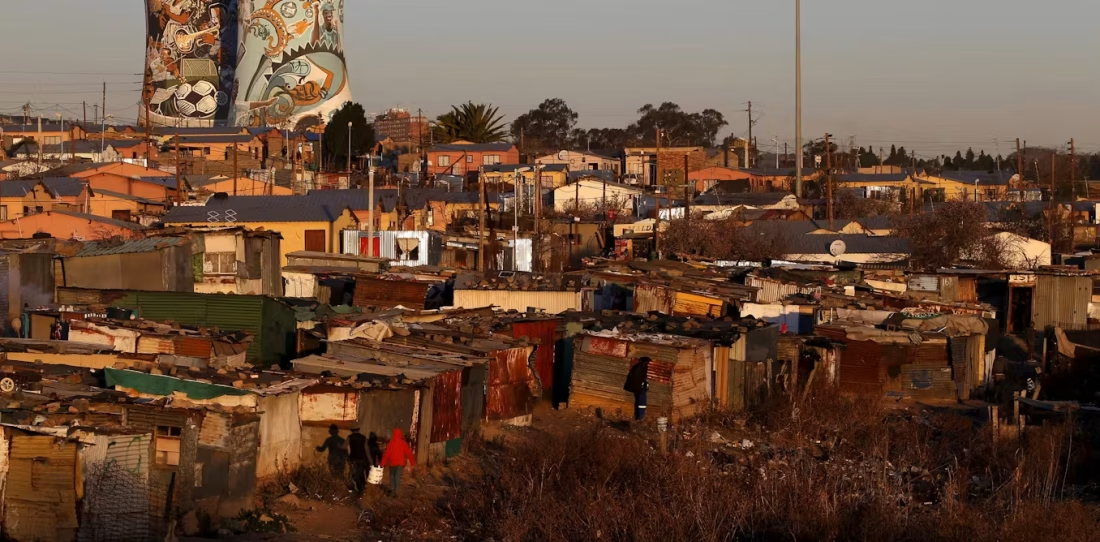
Inequality Street. South African Government misappropriates R95m of taxpayers’ money to pursue political agenda against Israel, while neglecting its own people. Here is a scene in Alexandra township, one of the poorest areas in Gauteng/Johannesburg bordering the wealthy suburb of Sandton, said to be the richest square mile in Africa. (CA Bloem)
This move comes at a time when South Africa is grappling with severe domestic challenges. The government’s mismanagement of resources, coupled with political opportunism, is threatening the country’s long-term stability. South Africa, once heralded as the “Rainbow Nation” after the end of apartheid, now faces staggering inequality, widespread poverty, and the erosion of its democratic institutions. Yet, the ANC leadership seems more focused on using its foreign policy to advance ideological agendas rather than addressing the urgent needs of the South African people.
‘Time’ to Change. South Africa’s goal of building a nation rooted in the “rainbow nation” ideology remains unfulfilled and its people largely “unequal” as visually captured on this cover of TIME magazine, yet expends resources to pursue Israel on fallacious charges of genocide at The Hague.
The Special Appropriation Bill was passed largely due to the support of the Government of National Unity (GNU), an uneasy coalition of various political parties, including the African National Congress (ANC). The ANC, which has long harbored animosity towards Israel, sees the case before the ICJ as an opportunity to further its political agenda – one that resonates with its allies in the Islamic Republic of Iran and other countries hostile to Israel. But the irony is inescapable: as the South African government spends millions of rands fighting Israel, the nation is facing an internal crisis that demands urgent attention.
The government’s alignment with Iran and its proxies, such as Hamas, is also problematic. Iran’s leadership has long supported violent extremism and called for the destruction of Israel. It is well-documented that Hamas, which is backed by Iran, has repeatedly rejected any peace initiative that could bring about a lasting resolution to the Israeli-Palestinian conflict. Instead, Hamas has resorted to violence, perpetuating the cycle of suffering on both sides of the conflict. While Israel has taken significant steps to engage with Arab nations in the pursuit of peace, Hamas remains obstinately opposed to any peace agreement that might end the violence.
This ideological alignment between South Africa’s government and Iran, combined with the recent political rise of Donald Trump in the U.S., has serious implications for South Africa’s foreign relations. The Trump administration, expected to take a more aggressive stance toward the Middle East, is unlikely to tolerate South Africa’s support for Hamas and other terrorist organizations. By continuing down this path, South Africa risks alienating key trade partners and jeopardizing its relations with Western democracies that are vital to its economic future.
While the South African government spends millions on its legal battle against Israel, the country faces a multitude of urgent domestic issues. South Africa is currently one of the most unequal countries in the world, with 10 percent of the population controlling more than 80 percent of the country’s wealth. In contrast, the remaining 90 percent of the population struggles to make ends meet, living in dire poverty. The government’s social welfare programs, while well-intentioned, are inadequate to address the needs of the majority.
Off the Track. Child poverty and inadequate health amenities is widely prevalent throughout South Africa that is being ‘sidetracked’ by foreign issues like the Israel-Palestine conflict.
Unemployment remains at record levels, and the country’s education and healthcare systems are underfunded and dysfunctional. The education system, once one of the most respected in Africa, is now riddled with challenges, from overcrowded classrooms to outdated curricula. The healthcare system, similarly, is overwhelmed and under-resourced, leaving millions of South Africans without access to adequate care. In some areas, basic services such as running water and electricity are unreliable, and crime rates continue to skyrocket, further eroding the quality of life for South Africans.
Instead of diverting R95 million to a foreign legal battle, the government should focus on implementing policies that address these pressing challenges. South Africa’s foreign policy should prioritize economic and diplomatic engagement with Western countries and other key global players to secure investments and promote sustainable growth. The country cannot afford to alienate its trading partners, especially when it is facing such dire internal challenges.
South Africa’s economic growth has stagnated in recent years, with millions of people unemployed and living in poverty. The country’s energy crisis, caused by ongoing power shortages and mismanagement of the state-owned energy company Eskom, is only exacerbating the situation. Load shedding, or scheduled power cuts, is a regular occurrence, crippling businesses and further damaging the economy.
The country’s infrastructure is crumbling, and it is becoming increasingly difficult for ordinary South Africans to access basic services. For example, Johannesburg, South Africa’s largest city, has faced severe water shortages in recent years, with taps running dry in many areas. Rural communities, too, suffer from a lack of access to clean drinking water and basic sanitation. Meanwhile, the government continues to waste resources on foreign disputes that do nothing to address these critical domestic issues.
Rather than engaging in legal battles over the Middle East conflict, South Africa should focus on building stronger trade relations with Western countries and other emerging economies. The country needs to invest in its own infrastructure, improve access to healthcare and education, and create jobs for its growing population. It is also critical that South Africa seeks to address its crime problem, which has reached levels that capture international attention. The government must focus on strengthening its law enforcement agencies and ensuring that justice is served for the victims of violent crime.
Government failing in ‘its’ Job. Looking for a job in South Africa, where the absolute number of unemployed people has doubled in the last 25 years. (Photo: Jeremy Seekings.)
While South Africa’s government continues to pursue legal action against Israel, it is important to recognize the futility of such efforts. The Middle East conflict is a deeply political issue, and no amount of legal wrangling at the ICJ will resolve the complex historical, cultural, and political factors that fuel the conflict. The legal process will not stop Hamas or other terrorist organizations from continuing their attacks on Israel, nor will it bring peace to the region.
The solution to the Israeli-Palestinian conflict lies in political negotiations, not legal proceedings. The United Nations and other international bodies have repeatedly called for dialogue between Israel and Palestine, but Hamas and other radical groups have rejected these efforts. Peace will only come when both parties – Israel and Palestine – are willing to negotiate in good faith and work towards a lasting resolution. In the meantime, South Africa’s role should be one of promoting dialogue, offering humanitarian assistance, and encouraging peaceful solutions, rather than pursuing a legal case that does little to advance the cause of peace.
Misguided and Misdirected. While much preferring the international spotlight by popularly pursuing Israel on false charges of genocide at The Hague, the majority of South Africa’s suffer at home due to government neglect. (Photos: Dursun Aydemir/Anadolu via Getty Images)
The South African government’s decision to allocate R95 million for a wasteful and misguided legal battle against Israel could be better spent addressing local unemployment, poverty, crime, and the country’s crumbling infrastructure. The government’s obsession with Israel and its alignment with Iran’s hostile stance against the Jewish state only serve to alienate key trade partners and undermine South Africa’s long-term interests.
South Africa must shift its focus from ideological foreign policy battles to pragmatic diplomacy that benefits its own citizens. The country needs friends, not foes, and it is essential that the government prioritize economic development, social welfare, and national security over foreign disputes. By doing so, South Africa can begin to build a more prosperous future for its people—one that is based on sustainable growth, peace, and cooperation.
About the writer:
Kenneth Mokgatlhe wa Kgwadi is an independent writer, political analyst and researcher. He is doing his MA in African Studies at the Israeli-based Ben Gurion University of the Negev.
While the mission of Lay of the Land (LotL) is to provide a wide and diverse perspective of affairs in Israel, the Middle East and the Jewish world, the opinions, beliefs and viewpoints expressed by its various writers are not necessarily ones of the owners and management of LOTL but of the writers themselves. LotL endeavours to the best of its ability to credit the use of all known photographs to the photographer and/or owner of such photographs (0&EO).
Under what is known as the Oslo Accords, Israel left Gaza in 2005 and handed the entire territory over to the newly created Palestinian Authority led by Yasser Arafat. Two years later Hamas overthrew the Palestinian Authority and forcefully took control of Gaza. Since then, Hamas has fired over 27,000 rockets at southern Israel. On October 7, 2023 Hamas attacked Israel and killed 1,200 people and took over 250 hostages. They proudly filmed themselves committing rapes, murdering families, beheading and burning babies and other atrocities. Every one of these actions are without any doubt crimes against humanity. To this day the United Nations has refused to pass a single resolution condemning Hamas for the crimes it has committed.
Instead of commending the State of Israel for defending itself after the atrocities committed by Hamas, the International Criminal Court (ICC) decided to issue international arrest warrants for Bibi Netanyahu and Yoav Gallant, the Prime Minister and former Defense Minister of Israel. Amongst many accusations, they are being charged with committing crimes against humanity, including the crime of starvation against the Palestinians in Gaza. The warrants are a grotesque inversion of what international law and justice should be.
Court of Injustice. Seeking warrants of arrest of Israel’s leaders at the ICC was less the expectation of actual arrest and more the demonizing of Israel as evident by posters such as this appearing in Birmingham, UK,
Immediately after the arrest warrants were issued, Josep Borrell, the High Representative of Foreign Affairs of the European Union, announced that all 120 countries that are members of the ICC are obligated to arrest those charged, if they enter any member county. As there are 193 countries that are members of the United Nations, the remaining 73 countries that are not members of the ICC have no such obligation. The United States of America is one of those 73 countries. Emmanuel Macron, the French President, has already announced that France will not arrest the Israeli leaders if they visit France. France is a member of the ICC, and this really shows that the antisemitic pronouncements by the ICC and Josep Borrell are beyond the pale. To make matters even more ridiculous the ICC has attempted to show its evenhandedness by issuing a farcical arrest warrant for one Hamas leader who is no longer alive.
Topsy- turvy Tehran. Following shameful rulings by the ICJ and ICC, even the world’s biggest sponsor of global terrorism, Iran, feels free to hypocritically display huge banners in Tehran depicting Israel’s leaders as war criminals. (Photo:Fatemeh Bahrami – Anadolu Agency)
According to its own website the ICC has a budget for 2024 of over 187 million Euros. It employs approximately 900 people who are supposed to gather evidence and investigate serious crimes against humanity. Since its inception in 2002, the ICC has issued 59 arrest warrants, 21 people have actually been detained, and 11 convictions have been issued. What this means is that just over a third of those charged actually end up standing trial, and nearly half of those are found not guilty, and that on average the ICC has actually achieved one conviction every two years. These facts are quite amazing when one considers that in the 22 years of the existence of the ICC, millions of people have been killed in wars, and millions more have become refugees. Clearly the ICC is a political farce.
Israel has been singled out by the ICC for defending itself in a war initiated by sworn enemies that have demonstrated their absolute determination to eradicate the State of Israel. Every government has the obligation to defend its country. The singling out of Israel by the ICC is a decision that will, to borrow a phrase by President Roosevelt, “live in infamy.” It is most unlikely that Bibi Netanyahu and Yoav Gallant will ever stand in the dock of the ICC in the Hague. The question that now arises is why is the ICC issuing arrest warrants against the leaders of Israel?
Blood on his Colar. The ICC’s devious issuing of warrants deliberately fuels global antisemitism painting the picture of Israel’s wartime leader as a Mafia-type mass murder as reflected in this ‘WANTED’ poster during a demonstration in Lisbon, Nov. 30, 2024. (Photo: Armando Franca / AP)
The answer is clear. The ICC is deliberately promoting the demonization of Jews and Israel. This demonization is not something new. The church has been demonizing Jews for over 2,000 years. The United Nations and the liberal press have been demonizing Israel ever since its inception in 1948. Major Arab oil exporting countries are using their wealth to promote Islam all across the world and to undermine Israel and the West. Qatar has financed the establishment of Middle Eastern Study departments at many major American universities.
Qatar on Campus. Qatar has become the largest foreign donor to American academia in the two decades since 9/11 resulting in US campuses become incubators for Doha’s interests. This ‘Stop the Genocide’ anti-Israel demonstration at Harvard University should rather read ‘Stop Antisemitism’. (Photo: Joseph Prezioso / AFP)
They have used the American constitutional right to free speech to spread hatred against Jews and Israel. They have turned American campuses into battlegrounds for Jewish students. The TV Channel Al Jazeera, broadcasting from Qatar, has hundreds of millions of viewers that are subjected to a constant demonization of Israel. Social media is aimed largely at gullible young people. They are easily influenced by the constant one-sided view of the war in Gaza. The International Court of Justice recently heard a case in which South Africa accused Israel of committing genocide. The whole purpose of the trial was to get the word “genocide” associated with Israel. They succeeded. The latest actions by the ICC are further steps in trying to demonize Jews and Israel. It has nothing to do with justice.
Tuition of Terror. Qatari money flowed into U.S. universities resulting in fueling violence against Jews. Only one week after the genocide in Israel by Hamas on October7, this anti-Israel rally at Harvard University on October 14, 2023 is already accusing Israel of ‘genocide’. (Photo: Joseph Prezioso/AFP)
The result of all of the above is a tsunami of protests across the world calling to stop Israeli genocide and the replacement of Israel by a Palestinian State from the river to the sea. Goebbels would be proud of the worldwide actions that are now taking place. Many of the people protesting are not evil. They are simply ignorant. What a shame that they have no idea about what they are protesting about.
Nazi Legacy. Following the transparently antisemitic rulings against the Jewish state at The Hague to the arson attack at a synagogue in Melbourne Australia, would make Goebels proud. (Photo: Asanka Ratnayake/Getty Images)
President Biden has announced that the decision of the ICC is outrageous. Come January 20th Trump will become the American President. Karim Ahmad Kahn, the Chief Prosecutor of the ICC, will then need to face the consequences of his actions.
About the writer:
AccountantNeville Berman had an illustrious sporting career in South Africa, being twice awarded the South African State Presidents Award for Sport and was a three times winner of the South African Maccabi Sportsman of the Year Award. In 1978 he immigrated to the USA to coach the United States men’s field hockey team, whereafter, in 1981 he immigrated to Israel where he practiced as an accountant and then for 20 years was the Admin Manager at the American International School in Even Yehuda, Israel. He is married with two children and one granddaughter.
While the mission of Lay of the Land (LotL) is to provide a wide and diverse perspective of affairs in Israel, the Middle East and the Jewish world, the opinions, beliefs and viewpoints expressed by its various writers are not necessarily ones of the owners and management of LOTL but of the writers themselves. LotL endeavours to the best of its ability to credit the use of all known photographs to the photographer and/or owner of such photographs (0&EO).
If the executive arm of antisemitism was once in Germany, its judicial arm is today in the Netherlands
By David E. Kaplan
“Sticks and stones can break my bones but words will never harm me,” hardly holds true for Jews and the Jewish state. Never mind the truth, just package in words the most damaging accusations again the Jewish state and hope the tide of animosity will ultimately rise submerging those infuriating Jews who just stubbornly refuse to disappear. What’s more, Jews have the nerve to actually fight to defend themselves. How infuriating that they are damn good at it. It’s embarrassing that so small in size a people and that so tiny a state will just not vanish into “a footnote of history,” as historian Arnold J. Toynbee so predicted for the Jewish people or hoped.
So, if the proverbial “stick and stones” don’t work, frame false charges, and attack with virulent verbiage. The most lethal verbal ordnance today are words like “genocide”, “Apartheid” and “colonialist”, all misused to stigmatize Israel and by association, Jews everywhere. Such accusatory methodology was successfully executed throughout the Middle Ages right up to Nazi Germany, so it was now time to remodel and charge Jews not personally but their national state – facing attack from 7 fronts, none of which it initiated.
Contrivance at the Court. The South African legal team during a hearing on its genocide claims against Israel at The Hague before it was revealed that South Africa’s ruling ANC government – near bankruptcy – received major donations from Iran and Qatar after filing the claim in December. (Photo: Reuters /Yves Herman)
If Germany led this nefarious way in the 20th century, it passes this 21st century the baton to the Netherlands, where stands located the UN’s ICJ and ICC, which enthusiastically have their marching orders. What happens to Jews in the streets of Amsterdam receives its cue from what happens in the county’s judicial centre – The Hague.
While Israel faces down the charge of “genocide”, the only major genocide in the Middle East in recent times occurred on October 7, 2023 and it was perpetrated against the Jewish state. In a case of perverted inversion, the victims are characterized as the perpetrators, while the perpetrators are presented as the victims.
Douglas Murray expressed it spot on when he writes that the accusations against Israel are:
“…an absolute inversion of the truth. Hamas invaded Israel, so Israel attacked Hamas. Hezbollah has spent the past year sending thousands of rockets into Israel, so Israel has responded by destroying Hezbollah. The Houthis in Yemen – now so beloved of demonstrators in the UK – sent missiles and drones hundreds of miles to attack Israel, so Israel bombed the Houthis’s arms stores in Yemen.”
In summation, Murray writes:
“Israel’s enemies have spent the past year trying to destroy it, as they have so many times before. But it is they who have gone to the dust, with the regime in Tehran the only thing that is, for the time being, still standing… Sometimes you need war to make peace. Sometime there is a price to pay for trying to finish the work of Adolf Hitler.”
Jaundiced Justice. While UN courts today in the Netherlands are obstructing the Jewish state’s ability to effectively defend itself, Jewish lawyers are seen here lining up in Berlin, Germany in April 1933 to apply for permission to appear in court following new regulations purging Jews from various state professions.
Hear that, the protestors in cities across Europe and the Americas whose grandparents may have fought the Nazis are protesting in support to finishing “the work of Adolf Hitler.”
There are occasional welcome surprises. Countering the false accusation of “genocide” came recently from the unexpected source of Poland! The country’s new ambassador to Israel, Maciej Hunia, had it right when during his confirmation hearing in the Polish parliament to the question if he believes Israel is committing genocide in Gaza, answered:
“… military actions causing unintended civilian casualties cannot be characterized as genocide.”
He followed up by emphatically affirming his statement with “We saw this in Iraq and Afghanistan.” Every now and again, the truth is revealed. But when it is supportive of Jews and Israel, it has to be squeezed out like the very last bit of toothpaste in the tube.
Writing in the prestigious British journal The Spectator on October 4, Douglas Murray began his article: “Why Israel was right to ignore international advice” by characterizing the picture of recent events in the Middle East as purveyed to the UK public:
“If you follow most of the British media, you may well think that the past year involves the following events: Israel attacked Hamas, Israel invaded Lebanon, Israel bombed Yemen. Oh, and someone left a bomb in a room in Tehran that killed the peaceful Palestinian leader Ismail Haniyeh.”
‘Murdering’ too their Memory. Mostly ignored by the British media are photos like these of the dining room in kibbutz Nir Oz, where survivors have placed stickers on residents’ mailboxes with the red ones saying “murdered” in Hebrew; black marking the hostages taken and the blue signaling those who have been released.
Global acceptance of the “absolute inversion of the truth” as it pertains to the Jewish state was so evident on the 25 November when Iran’s leader, Ali Khamenei declared in response to the ICC’s actions that “…an arrest warrant for Netanyahu is insufficient; an execution order must be issued.” Where is the worlds abhorrence or international media interest when those who commit acts of violence and threaten the extinction of other countries remain secure and avoid scrutiny, while leaders of a democratic state fighting terrorism and leading his country in an existential war on seven fronts, faces trials and an appeal for “execution”? Meanwhile, the world courts and global media glosses over:
That Iran may be the most dangerous country in the world today
that it seeks to spread its radical Islamic ideology across the Middle East – and beyond
that it is also one of the principal sponsors of world terrorism, with its tentacles spreading from the Middle East to Europe, Africa and South America and
that most worrisome of all is its illegal pursuit of a nuclear weapons capability and its repeated threats to annihilate Israel.
Where are the mobilized wordsmiths from the media and the world courts on the case against Iran or even Russia for that matter? As Syria descends again into civil war, Russia joins in the fray with its jets striking the rebel-held city of Idlib where around four million people live in makeshift tents and dwellings. Residents said one attack on the second day of raids hit a crowded residential area, including hospitals, killing civilians. Where is international concern or media interest? Are there any accusations of genocide or frenzied protestors taking to the streets? No, that is reserved when only Israel can be blamed. That is the nature of antisemitism – always finding a way to blame the Jews and that is what is happening again in Syria as Russia blames Israel and the US for the war in Syria. Russia bombs civilians and hospital and blames Israel.
Go figure!
Selective Morality. “Syrian and Russian forces have been deliberately attacking health facilities in flagrant violation of international humanitarian law. But what is truly egregious is that wiping out hospitals appears to have become part of their military strategy,” said Tirana Hassan, Crisis Response Director at Amnesty International in 2016. They are doing so again in 2024 and the world shows indifference, too focused on trying to trip up Israel as it faces implacable enemies in its fight for survival.
Is the ancient disease of antisemitism – today at pandemic level -incurable? Are Jews stuck for eternity with what Salman Rushdie expressed in his 1981 novel Midnight’s Children:
“What can’t be cured must be endured.”
In the meantime, what they fail on the battlefield, they will try, “Killing us Softly” with words!
While the mission of Lay of the Land (LotL) is to provide a wide and diverse perspective of affairs in Israel, the Middle East and the Jewish world, the opinions, beliefs and viewpoints expressed by its various writers are not necessarily ones of the owners and management of LOTL but of the writers themselves. LotL endeavours to the best of its ability to credit the use of all known photographs to the photographer and/or owner of such photographs (0&EO).
Do not let the world forget about the 101 hostages!
By Rolene Marks
Every morning, I think of baby Kfir. I wonder where he is, if he has met his milestones. Is he with his mother and brother? I think about Naama, Karina, Daniela and all of our female hostages. The situation they are in is a never-ending nightmare. We know about the sexual abuse that Hamas has forced on female (and some male) hostages. It is terrifying. I think of the families waiting desperately for their loved ones to return home. I think of the living hostages and how we as a nation could wrap our collective arms around them and help them on the long road to recovery. I think of the families who yearn for the remains of their loved ones to be returned to them, so that they can lay them to rest and have a place to weep. I think of them all – men and women, young and old, a myriad of faiths from over 20 countries. I think of them all and I ache. I know you do too.
Posters from Hostage Square, Tel Aviv. (Photo: Rolene Marks)
For over 400 days, the 101 hostages have been held in the most untenable conditions and as we approach the rainy winter season, we know that the situation is getting progressively more dire. On a daily basis, family members warn that time is not running out – it has run out.
On October 7, over 250 hostages were brutally taken from the Nova festival and from the peaceful communities that bordered the Gaza strip. Many of them witnessed the carnage of that day as loved ones were brutally slain, raped, tortured and their homes set ablaze. Some of the hostages may not know that their families were murdered and their homes destroyed. I think of Eli Sharabi from Kibbutz Beeri. Eli’s wife, Leanne, and their two daughters, Noya and Yahel, were brutally murdered along with the family dog. Eli was taken hostage in Gaza. Yossi was taken to Gaza, but his wife managed to save their daughters and seven other civilians. They hid for eight hours without making a sound. Yossi was declared dead in captivity. I think of Eli – and if he knows of the devastating fate of his family.
I think of Yarden Bibas who thinks his gentle wife Shiri and two beautiful flame-haired sons, Kfir and Ariel were killed. Their fate is still unknown. I think of him sitting in his agony, as Hamas play their psychotic psychological games with him.
I think of Ohad Lipschitz. He is a great-grandfather. I think of the hopes his daughter-in-law Rita shared when we stood in the remnants of their burnt home in Nir Oz. Ohad used to transport children from Gaza who needed life-saving chemotherapy to Israeli hospitals as part of the “Road to Recovery” programme. Ohad is a peacenik. Rita hopes he is being held by a Palestinian family who may recognize him from his work and treat him kindly.
Following the October 7 massacre, the remains of Ohad Lipschitz’s burnt house on Kibbutz Nir Oz. (Photo: Rolene Marks).
Each person is a universe – with an anxious family waiting desperately for their return. As days progress, the situation for the hostages becomes more and more urgent. Recently, health workers released studies of the impact of captivity on the health of the hostages according to age groups. The results are harrowing.
Key findings reveal:
– Released child hostages exhibit severe symptoms including night terrors, separation anxiety, and profound loss of trust in adults who failed to protect them
– Children of returned hostages struggle with complex emotions, including survivor’s guilt and difficulty accepting their changed family members
– Children with relatives still in captivity face “ambiguous loss,” leading to anxiety, depression, and PTSD
– The last child hostages remaining in Gaza, Ariel and Kfir Bibas (4 and 10 months old when kidnapped), face devastating developmental impacts from ongoing captivity.
Elderly captives also face severe impacts on their health – especially without access to necessary medications.
The Bibas family Yarden, Ariel, Shiri and baby Kfir. Shiri’s parents, who also lived on the kibbutz, were later found murdered.
Professor Levine, Head of the health team for the Hostages Families Forum said:
“The findings emphasize the severe impact of captivity on elderly hostages who were already managing multiple chronic health conditions. The lack of access to essential medications and basic care, combined with prolonged detention in inadequate conditions, poses a significant risk to their lives. Sadly, our concerns have been validated, as many hostages did not survive the terrible conditions of captivity. The hostages, both elderly and non-elderly, are running out of time. Only their release can ensure their survival and prevent further deterioration and inhuman suffering.”
The main points of the report on the health impact on hostages includes:
• Entering winter, hostages are critically weakened by malnutrition, with some losing up to 50% of their body weight, resulting in dangerously low muscle and body fat.
• Hostages are highly vulnerable to hypothermia, frostbite, and respiratory infections, with weakened immune systems increasing their susceptibility to winter illnesses.
• A lack of essential nutrients raises the risk of cardiovascular issues, including dangerous heart disturbances.
• Hostages suffer severe psychological trauma from isolation, violence, and lack of family contact, driving many to despair and suicidal thoughts.
• Families endure “ambiguous loss,” facing chronic stress, anxiety, and declining health as they wait in painful uncertainty.
• Deprived of International Red Cross visits and medical aid, hostages face severe health risks and potential disappearance.
What has been absolutely outrageous is the lack of visits – or even concern from the International Red Cross. In a twist that can only been seen as Orwellian, Pierre Krahenbuhl, the former head of UNRWA who resigned under murky circumstances, is now the director-general of the ICRC. UNRWA has been under the microscope because of the involvement of members of staff with Hamas and the atrocities of 7 October.
Doron Steinbrecher’s image on a poster of the remaining Kfar Aza hostages. (Photo: Rolene Marks)
Dor Steinbrecher whose sister Doron was taken hostage from her home on Kibbutz Kfar Aza, together with her parents, Roni and Simona, went to the Red Cross to ask them to transfer medication to their daughter who is required to take it every day.
30-year-old veterinary nurse Doron Steinbrecher was alone in her apartment at Kibbutz Kfar Aza on October 7 when Hamas terrorists invaded, killing and kidnapping dozens of residents, including Doron. (Photo: Courtesy)
Dor told Jack Tapper on CNN:
“My sister should take her medication on a daily basis. She probably hasn’t taken it since Oct 7. My mum had a few meetings with the Red Cross and she told them my sister needs to get her medicine. They told her we should care more about Arab people on the other side, the people of Gaza, and less about our loved ones. It was very shocking.”
The only interaction that the Red Cross has had with the hostages is the role of a glorified taxi service during the ceasefire in November 2023 when over 100 were released.
The hostages are not a political issue. This global humanitarian issue requires a global response. The hostages represent a multitude of faiths and come from over 20 countries. We cannot allow them to disappear from the global conscience.
I think of the hostages every day. I know you do too. Let us make sure that the world does not forget about them.
While the mission of Lay of the Land (LotL) is to provide a wide and diverse perspective of affairs in Israel, the Middle East and the Jewish world, the opinions, beliefs and viewpoints expressed by its various writers are not necessarily ones of the owners and management of LOTL but of the writers themselves. LotL endeavours to the best of its ability to credit the use of all known photographs to the photographer and/or owner of such photographs (0&EO).
The Gulf state’s dual ability to influence Hamas and mediate with Western powers placed it in a unique position.
By Kenneth Moeng Mokgatlhe
Qatar’s withdrawal as a mediator in the Israel-Hamas conflict is a bittersweet moment, highlighting both its unique position and its controversial role in the region. As a small but influential Gulf state with around 300,000 citizens and over two million expatriates, Qatar has built a formidable reputation as a peace mediator in the Middle East and North Africa. From playing a key role in the US-Taliban peace negotiations during the Afghanistan conflict to facilitating ceasefires, Qatar has shown its ability to navigate the complexities of conflict resolution.
The Go-to Go-between. US secretary of state Antony Blinken pictured on a recent visit to Qatar to support its mediating efforts.
In the Israel-Hamas conflict, Qatar leveraged its proximity to Hamas to achieve a short-lived ceasefire and secure the release of 105 hostages in a prisoner exchange deal at the end of 2023. This followed the unprecedented attack on October 7, 2023, when Hamas killed over 1,200 Israelis and kidnapped more than 250 into Gaza’s tunnels. Despite these efforts, the conflict rages on, with Israel continuing its military pressure on Hamas, demanding the release of 101 remaining hostages still believed to be hidden in tunnels beneath Gaza.
While Qatar’s close ties with Hamas were instrumental in negotiating these deals, it also placed the Gulf state under scrutiny. Hosting Hamas since 2012 after its departure from Syria during the Arab Spring, Qatar has provided the group with security and financial backing. Over the years, Qatar has transferred an estimated $1.8 billion to Gaza, ostensibly for humanitarian aid, but much of it was allegedly diverted to enhance Hamas’ military capabilities. This financial assistance, which began in earnest in 2018, was initially intended to mitigate the Palestinian Authority’s decision to cut salaries of government employees in Gaza. However, critics argue that the funds emboldened Hamas rather than alleviating the suffering of ordinary Palestinians.
Qatar’s withdrawal as a mediator marks a critical juncture in this complex conflict. On one hand, its departure is a loss for ongoing negotiations, given its unique leverage over Hamas and strong diplomatic relations with the United States. Qatar’s dual ability to influence Hamas and mediate with Western powers placed it in a unique position to drive forward both the release of hostages and the pursuit of a ceasefire. On the other hand, Qatar’s perceived bias due to its close relationship with Hamas has raised questions about its impartiality. While it played a crucial role at the negotiating table, its direct support for a group classified by many countries as a terrorist organization undermined its credibility as a neutral party.
Home away from Home. Hamas leaders Ismail Haniyeh (l) and Khaled Mashal (center) meeting in Doha with Qatar ruler, Emir Tamim bin Hamad al-Thani (right) in October 17, 2016. (Photo: Qatar government handout)
The Biden Administration’s decision to pressure Qatar to expel Hamas leaders reflects the growing frustration with the lack of progress toward peace. The ongoing war, which has persisted for over a year, highlights the disconnect between Hamas’ leadership in exile and the suffering of Gaza’s residents. While Hamas leaders enjoy comfortable lives in Qatar and other nations, such as Iran, ordinary Gazans bear the brunt of the conflict. The expulsion of Hamas leaders from Qatar could signal a shift toward holding them accountable for their actions, as their decisions have directly impacted the lives of millions.
Medler or Mediator? To amplify influence, Qatari premier Mohammed Al Thani positioned his emirate to be a major mediating player in the region. (Photo: Nathan Howard/Pool Photo via AP)
Hamas’ leadership, shielded from the consequences of their actions, has displayed a glaring disconnect from the realities faced by the people they claim to represent. Their strategy of attacking Israel and then retreating to safe havens abroad leaves ordinary Palestinians to endure the inevitable military retaliation. This lack of foresight and accountability further exacerbates the hardships faced by Gaza’s residents, whose suffering is compounded by Hamas’ failure to prioritize peace and stability.
As the conflict continues, the question remains whether Qatar’s withdrawal will pave the way for a more balanced mediation process or create a vacuum that exacerbates tensions. The Gulf state’s ability to bridge the gap between opposing sides was unmatched, but its controversial support for Hamas has left an indelible mark on its legacy as a mediator.
The broader implications of Qatar’s decision also highlight the challenges of navigating international diplomacy in the Middle East. While some argue that Qatar’s departure may open the door for more impartial mediators, others fear it could embolden Hamas or complicate efforts to secure a ceasefire. Either way, the need for a concerted international effort to address the root causes of the conflict is more urgent than ever.
At your service! Less than a week after the Hamas attack on October 7, Qatari Emir Sheikh Tamim bin Hamad Al-Thani waits for the arrival of US Secretary of State Antony Blinken in Lusail, Qatar, October 13, 2023. (AP Photo/Jacquelyn Martin, Pool, File)
Qatar’s withdrawal serves as a reminder that peace in the Middle East requires not only skilled diplomacy but also genuine commitment to the principles of justice and accountability. The international community must now work to fill the gap left by Qatar, ensuring that future negotiations prioritize the well-being of all affected populations. Only by addressing the underlying issues that perpetuate this cycle of violence can a sustainable resolution be achieved.
About the writer:
Kenneth Moeng Mokgatlhe is a political writer and researcher based at Ben Gurion University of the Negev, Israel.
While the mission of Lay of the Land (LotL) is to provide a wide and diverse perspective of affairs in Israel, the Middle East and the Jewish world, the opinions, beliefs and viewpoints expressed by its various writers are not necessarily ones of the owners and management of LOTL but of the writers themselves. LotL endeavours to the best of its ability to credit the use of all known photographs to the photographer and/or owner of such photographs (0&EO).
With confined space defining the landscape of Israel and the game of squash, Arab and Jewish kids come together to see where they can go together through sport.
By Max Moss
*All photos of children are published with the kind permission of parents granted to SquashBond.
This week, in the Haifa area there will be well over 100 kids participating in various SquashBond activities – on and off the squash courts. Who would have thought that, when a group of ex-pat South Africans, led by Hillel Bloomberg and a ‘squash crazy’ native Israeli – Nitzan Moree, started this initiative 10 years ago, we would see such a diverse group of youngsters braving repeated rocket barrages from Lebanon, in order to play, meet and simply be together within the framework of their squash related community.
So, let’s just back up a bit for the sake of history. When Hillel immigrated from South Africa, he brought with him to Israel amongst his most invaluable belongings – a passion for the game of squash. This led him to the building in 1978 of two squash courts in a deserted warehouse in the industrial area of Ra’anana. These were the first courts to be built in Israel since the time of the British mandate, which when the British forces departed during the dying days of Palestine, they left five courts in Airforce bases around the country. Although the true genesis of the return of squash to Israel began with Hillel, the seed was planted not with his Aliyah (immigration) but his prior “look see” visit in 1975 when, while sitting on the beach in Tel Aviv, was captivated and “I must say irritated by the loud noise of all these guys lobbing hard this small black ball, which people had to dodge to avoid being hit, to say nothing of the loud clunking noise.” Hillel, who would later be known as Israel’s “Father of Squash”, didn’t know at the time he was watching Matkot – Israel’s unique variation of beach bats. “And then, when a ball nearly connected with me and I picked it up to throw back at the guys, I was taken up how similar it was to a squash ball, my sport in South Africa. I thought, nu, why not take the noise and danger off the sand and relocate to the safety of courts,” and so the seed of squash to Israel was born.
Hillel’s co-partner in this ‘squash saga’ had been a young lad growing up and learning the game in Ra’anana and playing in 1980 at the then newly built Herzliya Squash Center – a center that had 8 squash courts built by the South African industrialist, philanthropist and lover of sports – Mendel Kaplan. Then in 2014 – with Hillel and Nitzan well ensconced as players, coaches, managers as well as entrepreneurs of squash in Israel – the question arose:
“Why not add a new dimension to the game – a social initiative that would bring kids in Israel – from all walks of life and all segments of society – to get to know one another, to break down those social barriers that are such divisive elements in our society and have them meet on the squash court”
A Sporting Chance. When the British withdrew from Palestine in 1948 with an attitude of let “the Jews and the Arabs to fight it out” they left squash courts at 5 air force bases across the country – a sport that today is helping to unite Israelis of all faiths.
And so it was that SquashBond evolved into what it is today – an organization dedicated to creating social change by integrating children and youth from diverse communities, some marginalized and at risk, promote equal opportunities, provide value-based education, self-empowerment and leadership through a combination of unique sports and informal education activities. The founders recognized the growing need to establish programs that would promote inclusion, equality, social mobility and a shared society.
Bridging Divides. Through SquashBond, Jewish and Arab Israeli youth gain the life skills, self-confidence and connections to pursue their dreams and build a sense of belonging in an inclusive Israel.
As one young Arab player interviewed explained:
“Squash is special because it is played in a small place; it’s like Israel, we’re in a small place, we have to share it. Just like squash, it’s a small court you have to figure out how you move, how you don’t hit the other person.”
The first program was established in collaboration with the municipality and the local schools in Ra’anana and the Arab city of Tira in central Israel. In the course of time, SquashBond opened its second center in Haifa. The challenges of recent times – at first Corona and more recently October 7– did not obstruct the vision nor impede activities and the organization adjusted to changing realities and the needs of Israeli society. SquashBond is the only organization in Israel that implements an in-depth and unique and long-term model that combines a squash training program, with a multicultural social program. SquashBond recruits and guides children at a young and critical age, when their identities as individuals and as members of a group are still developing and provides tools and content for personal growth.
Mix and Mingle. Young students in Haifa’s SquashBond program (4th – 5th graders) represent a true mix of religious (Jewish, Moslem, Christian) and ethnic backgrounds.
With Israel at war, SquashBond had to adapt to the current crisis and currently conducts weekly sessions directly on school grounds, using the existing facilities of a school hall to introduce squash basics and build relationships with the kids. In an educational and social program partnership with the University of Haifa, student scholarship recipients provide mentoring and guidance to each group throughout the year. In parallel, extra-curricular squash training at the Haifa University squash courts involves groups of our older kids.
Outreach Abroad. Jewish and Muslim children in the SquashBoard program (r-l) Boaz, Leen, Guy and Shahed – from Ra’anana and the nearby Arab town of Tira, participate in a panel discussion at an event in New York City.
What is so astounding, rewarding and enriching is the children’s motivation and enthusiasm. It is unstoppable – even when interrupted by sirens warning of incoming deadly missiles. When the siren sounds, rackets are quickly leant against the glass walls, balls roll to the floor, and together, everyone – children and staff – rushes to the shelter. After 15 minutes, as if nothing has happened, sprints, drives, and lobs fill the courts once again. It’s nothing short of remarkable! If there is anything to be learnt from the events of this past year, it’s been the value of being a member of a community – especially a sporting community. We’ve seen how our kids feel a sense of security in their SquashBond environment. Studies have shown that belonging to a sporting community provides its participants with an inner strength that allows them to cope with adverse situations and having to successfully deal with trauma.
Harmonious at the Harmonie. Outreaching the message of sport as a unifier, Israeli Muslim, Christian and Jewish SquashBond “ambassadors” at an event at the famed Harmonie Club in New York City.
To mention some examples of key successes – two Arab girls – residents of Tira – were the first Israeli Arabs to become part of the Israel National Squash Team. A SquashBonder was one of five kids worldwide, chosen to be part of a UN program to mentor and train leaders of the future. Elisha, who came to SquashBond at the age of 10 from a challenging socio-economic background has flourished within the Israel squash community competing in both local and international tournaments and now serves as a coach for the younger groups. Over the years, SquashBond’s players have won over 20 trophies – including 3 gold – in national tournaments and sent four representatives to national junior teams to represent Israel.
Merry Mix. A SquashBond team representing a diverse Israel, participating in the 2023 Israel Junior Championships.
What’s in store for the future? SquashBond is planning on building a Multi-cultural Community Squash Centre in Israel’s third most populous city, Haifa where its greater metropolitan area includes Jews, Muslims, Christians, Druze – the religious and non-religious. Expansion planning includes the addition of a new racket sport – Padel. For those unfamiliar, Padel is a racket sport typically played in doubles on an enclosed court in a similar way as squash in that the balls can be played off the walls.
Meeting and Eating. The SquashBond team enjoying a well-earned Pizza break during the Israel Junior Championships held in Ra’anana in 2023.
Planning in process, Padel will be first introduced in Jerusalem for young girls that will include both Arab and Jews. We are also looking at setting up a Community Squash Center in the Arab-Israeli town of Abu Gosh near Jerusalem in collaboration with the local authority for residents of Abu-Gosh and the surrounding communities.
Kids having a Ball. Lee-Anne with “ SQUASH BONDS ARE STRONG” on her t-shirt is seen here with Bat-El at the 2023 Israel Junior Championships.
In a world often divided by differences, sport has the extraordinary power to bring people together, break barriers, and transform lives. Squashbond is living proof that the squash court can be more than just a place of competition – it can be a platform of unity, resilience, and hope.
Engaging with the Other. SquashBond’s intensive multi-year squash and education program integrates children from diverse ethnic, religious and socio-economic backgrounds.
Investing in initiatives like Squashbond is not just an investment in sports but in the fabric of our society. It’s a commitment to building a generation that values equality, community, and leadership whether you are Muslim, Jew or Christian, Tsabar (Sabra) or new immigrant.
Squashbond is not just changing lives – it is shaping a brighter future.
About the writer:
At age 17, Max Moss immigrated to Israel from Cape Town, South Africa, served in the IDF and then studied at the Hebrew University of Jerusalem and the University of Cape Town (UCT).
Max’s journey has traversed from the world of hi-tech where he helped establish an Israeli software company that went international and ultimately merged into Oracle, to the world of social activism, where he participated in peace initiatives such as Forum Tzora, the Geneva Initiative and “All its Citizens”. Max was part of a group in Israel that started the first Tali school dedicated to Jewish Pluralistic education. Max has been a member of SquashBond for the past 6 years and currently serves as Chairman of the Board.
While the mission of Lay of the Land (LotL) is to provide a wide and diverse perspective of affairs in Israel, the Middle East and the Jewish world, the opinions, beliefs and viewpoints expressed by its various writers are not necessarily ones of the owners and management of LOTL but of the writers themselves. LotL endeavours to the best of its ability to credit the use of all known photographs to the photographer and/or owner of such photographs (0&EO).
In its zeal to condemn Israel in its war against Hamas, the International Criminal Court appears to have committed a number of errors.
By Prof. Raymond Wacks
On 25 August 2012 the tenacious and sagacious friend of Israel, Douglas Murray, published an article in The Spectator, questioning whether the International Criminal Court (ICC) served any useful purpose, and wondering whether the real issue was not ‘How can we bring these leaders to justice?’ but rather ‘How can we get these leaders off their people’s backs?’ He also doubted whether the conviction of malevolent dictators really acts as an effective deterrent to other evil leaders.
My response, published the following week, argued that deterrence was not the purpose of a judgment of the Court. Nothing, I suggested, would dissuade a monster from carrying out his iniquitous conduct. Instead, I wrote:
The principal objective of the ICC must therefore be simple retribution. Why create an offence if a transgression is met with impunity? Tyrants who commit crimes against humanity deserve punishment, not to deter others (even the gallows are unlikely to achieve that), but because they must suffer for their evil.
Murray contends that instead of prosecuting these ogres, innocent lives might be saved if, like Idi Amin, oppressors are given sanctuary by, say, Saudi Arabia. But this is cold comfort for their victims, or indeed anyone who yearns to see justice done. If the purpose is to eliminate a wicked leader, then his speedy dispatch – as with Caesar, Mussolini, and Gaddafi – would surely be a more efficient method. Even those domestic tribunals that ‘tried’ and executed Saddam Hussein and the Ceausescus, offer a more expeditious solution than a safe haven elsewhere.
I mention this exchange merely to demonstrate my support for the establishment of the ICC, and its role as a legitimate forum in which genocide and other heinous crimes may be judged and penalized.
THE ROME STATUTE
The ICC was established on 17 July 1998 under the Rome Statute, an international treaty, and came into force in July 2002. Some 120 States have signed up to the Court’s jurisdiction.
Its creation reflected the need for a permanent international tribunal to prosecute crimes allegedly committed in the pursuit of war. The Court of eighteen judges elected by member States claims that its main purpose is to help:
‘…end impunity for the perpetrators of the most serious crimes of concern to the international community.’
In this endeavour it has so far notched up 32 cases, issued 59 arrest warrants – the latest being for Binyamin Netanyahu, Yoav Gallant, and the presumed late, unlamented Hamas leader, Mohammed Deif, a major strategist of the 7 October atrocities who was accused of crimes against humanity, including murder, torture, sexual violence. and hostage-taking. (This is an unnoticed acknowledgement that the events of 7 October actually occurred, were committed by Hamas, and were not, as certain malevolent individuals and groups have maintained, concocted).
THE PROCESS
According to the ICC, the circumstances leading to its decision to issue the arrest warrants were as follows:
On 1 January 2015, the State of Palestine lodged a declaration under Article 12(3) of the Rome Statute accepting jurisdiction of the Court since 13 June 2014.
On 2 January 2015, the State of Palestine acceded to the Rome Statute by depositing its instrument of accession with the UN Secretary-General. The Rome Statute entered into force for the State of Palestine on 1 April 2015.
On 22 May 2018, pursuant to Articles 13(a) and 14 of the Rome Statute, the State of Palestine referred to the Prosecutor the situation since 13 June 2014, with no end date.
On 3 March 2021, the Prosecutor announced the opening of the investigation into the situation in the State of Palestine. This followed the Pre-Trial Chamber’s decision of 5 February 2021 that the Court could exercise its criminal jurisdiction in the situation and, by majority, that the territorial scope of this jurisdiction extends to Gaza and the West Bank, including East Jerusalem.
On 17 November 2023, the Office of the Prosecutor received a further referral of the situation in the State of Palestine, from South Africa, Bangladesh, Bolivia, Comoros, and Djibouti, and on 18 January 2024, the Republic of Chile and the United Mexican State additionally submitted a referral to the Prosecutor with respect to the situation in the State of Palestine.
Dubious Decision. In arriving at his decision to pursue arrest warrants against Israelis, did the ICC prosecutor choose advisers for their anti-Israel stance? Some had clearly expressed negative views towards the Jewish state long before the outbreak of the war.
The Court found reasonable grounds to believe that Netanyahu and Gallant were criminally responsible for acts including murder, persecution, and starvation as a weapon of war as part of a ‘widespread and systematic attack against the civilian population of Gaza’.
On 26 September 2024, Israel challenged the Court’s jurisdiction over both the situation in Palestine and over Israeli nationals on the basis of Article 19(2) of the Statute. It also requested the Court to order the Prosecution to provide a new notification of the initiation of an investigation to its authorities under Article 18(1) of the Statute, and requested it to halt any proceedings before the Court, including the consideration of the applications for warrants of arrest for Netanyahu and Gallant, submitted by the Prosecution on 20 May 2024.
The ICC held, however, that the acceptance by Israel of the Court’s jurisdiction is not required, as the Court can exercise its jurisdiction on the basis of territorial jurisdiction of Palestine. In addition, pursuant to Article 19(1), States are not entitled to challenge the Court’s jurisdiction under Article 19(2) prior to the issuance of a warrant of arrest. It therefore decided that Israel’s challenge was premature.
Unabashed looting. While accusing Israel of committing the ‘war crime of starvation’ in the Gaza Strip, Palestinians are seen here looting trucks loaded with humanitarian aid in the central Gaza Strip on May 18, 2024. (AP Photo/Abdel Kareem)
FIVE FLAWS
There are, I believe, at least five important flaws in the Court’s decision to issue the arrest warrants.
First, the central question of the Court’s jurisdiction just mentioned, was challenged by Israel, but dismissed by the judges in a fairly cavalier fashion. Israel argued that Palestine lacked ‘the competences required under international law to be able to delegate territorial jurisdiction to the Court.’ It cited the Court’s decision in 2021 that issues of territorial jurisdiction may be raised by interested States based on Article 19 of the Statute. Israel claimed that it is a State from which acceptance of jurisdiction is required under Article 12 of the Statute – even if there is another State which has delegated jurisdiction to the Court for that same situation.
This, the judges held, was incorrect as a matter of law. ‘The acceptance by Israel of the Court’s jurisdiction is not required, as the Court can exercise its jurisdiction on the basis of the territorial jurisdiction of Palestine’. In other words, when there is one jurisdictional basis pursuant to Article 12(2)(a) or (b), there is no need for an additional one.
But this is not an uncontentious point, and it is at least arguable that the Court may lack the authority to issue the warrants against Israeli nationals. An essential principle of public international law is that it is only by virtue of a state’s consent that it is bound by the jurisdiction of an international court. (Israel along with the United States, Russia, and China, has not acceded to the Court’s authority).
It is true, on the other hand, that the Rome Statute empowers the Security Council to refer crimes of atrocity committed in any country to the Court for investigation. For example, it referred Sudan to the Court in 2005 in relation to the humanitarian calamity in Darfur, and Libya in 2011. Neither have accepted the Court’s jurisdiction. But these cases may be distinguished from the present situation which involves the prosecution of individual nationals of a State that is not signed up to the Court.
Secondly, it is questionable whether food insecurity in a warzone is ineluctable proof of the commission of a war crime. In fact, this would be the first time the Court has sought to prosecute such circumstances. Moreover, there is substantial evidence to indicate that the delivery of aid to Gaza has been hampered by the failures of aid agencies, and the looting by Gazans themselves, including, in all probability, armed members of Hamas.
Thirdly, the ICC’s jurisdiction is based on the concept of ‘complementarity’: the principle that its power kicks in only when domestic authorities lack the capacity or inclination to investigate and prosecute alleged offenders. This hardly describes the position in Israel where the independence of prosecutors and courts are not in doubt.
Fourthly, it is not unreasonable to express grave misgivings about the impartiality of the Court (let alone the UN in general). Before issuing the arrest warrants, the Chief Prosecutor, Karim Khan, sought the advice of an ‘expert panel’ the members of which he personally selected. It has been pointed out that at least two of those members had previously accused Israel of international crimes, and two others had personal links to Khan.
Conduct Unbecoming. Facing charges of sexual misconduct, the Chief Prosecutor of the ICC, Karim Khan succeeds in obtaining arrest warrants against Israel’s Prime Minister and former Minister of Defence. (Photo: ICC).
Fifthly, Israel contended that its claim that ‘Palestine is not a State on the territory of which the alleged conduct occurred is in itself sufficient to make Israel the sole State whose acceptance of jurisdiction is required.’ Israel submitted that all that is required for it to have standing under Article 19(2)(c) is that its claim is prima facie tenable, and that it had an ‘immediate right’ to challenge jurisdiction under Article 19 given the current stage of the proceedings.
The judges rejected the argument that merely because Israel claimed that Palestine could not have delegated jurisdiction to the Court, the judges would be required to disregard its previous binding decision. It took the view that there is a fundamental difference between granting a State standing on the presumptive validity of its claim to have jurisdiction, on the one hand, and one granting it standing on the basis of an argument, already ruled upon, that a particular State Party does not have jurisdiction, on the other.
In any event, Israel’s standing was not an issue; the real question, it held, was whether Israel was entitled, or indeed obliged, to challenge the Court’s jurisdiction before it has decided on the issuing of warrants of arrest. It held Israel was not entitled to challenge its jurisdiction prior to the issuance of a warrant of arrest or a summons.
It did, however, hold that Israel will have the opportunity to challenge the Court’s jurisdiction if and when the Court issues any arrest warrants or summonses against its nationals. If I understand this correctly, it suggests that it is open to Israel challenge the jurisdiction of the court and/or the admissibility of the case, on the grounds, for example, that it is already being investigated or prosecuted by the State with jurisdiction over the crimes alleged. The prospects of success may fairly be described as slender.
Aid trucks ambushed. While Israel permits as much aid as possible into Gaza in compliance with its dire security concerns, armed and masked Palestinians are seen here on trucks loaded with international humanitarian aid entering Gaza through the Israeli Kerem Shalom Crossing in the southern Gaza Strip. (Photo: Abed Rahim Khatib/Flash90)
CONCLUSION
As a defender of the ICC, I consider it as lamentable that its credibility has – at a stroke – been grievously diminished by this exercise of bias (which the Israeli Prime Minister has castigated as antisemitic). In consequence of this travesty, the Trump administration might well impose sanctions against the Court thereby emasculating its essential powers.
The world’s dictators and terrorists will be jubilant.
About the writer:
Raymond Wacks, Emeritus Professor of Law and Legal Theory, is the author of 17 books and editor of ten. The seventh edition of his Understanding Jurisprudence: An Introduction to Legal Theory will be published by Oxford University Press in 2025. The Rule of Law Under Fire? (Bloomsbury/ Hart Publishing) appeared in 2021.
While the mission of Lay of the Land (LotL) is to provide a wide and diverse perspective of affairs in Israel, the Middle East and the Jewish world, the opinions, beliefs and viewpoints expressed by its various writers are not necessarily ones of the owners and management of LOTL but of the writers themselves. LotL endeavours to the best of its ability to credit the use of all known photographs to the photographer and/or owner of such photographs (0&EO).
The tragic and horrifying scenes of violence in Amsterdam against fans of Maccabi Tel Aviv, who were there to support their team in a match against Ajax earlier this month, were a painful reminder of one of the darkest times in history – the genocide of European Jews during World War II. Between 1941 and 1945, millions of Jews across Europe were targeted, persecuted, and killed, with other marginalized groups like Black people, and the LGBTQ community also suffering under brutal oppression. Yet, Jews bore the brunt of that unimaginable horror.
Today, despite the world’s advancement in building institutions, systems, and policies to combat hatred and discrimination, polarizing actions targeting Israelis and Jews still occur. Attacks like the one in Amsterdam show how far we still need to go in promoting tolerance.
Democratic South Africa’s founding father, Nelson Mandela, once declared, “Never, never, and never again shall it be that this beautiful land will again experience the oppression of one by another.” Mandela’s words were born from South Africa’s own painful legacy of colonialism and Apartheid, under which Black South Africans endured systemic violence and discrimination. Instead of pursuing retribution, Mandela and his contemporaries opted for a path of reconciliation and healing – a legacy of tolerance that should guide us today.
Seeing football fans attacked for being associated with Israel or for being Jewish is deeply disturbing. Such cowardly and barbaric acts demand the strongest condemnation from all progressive nations and communities. These attacks reveal an alarming rise in antisemitism and racism worldwide, as Jews continue to face threats and violence simply for their identity.
The European Union Agency for Fundamental Rights reports that Jews in Europe experience high levels of antisemitism both off and online. As a result, many Jews feel pressured to conceal their identity to ensure their safety, a distressing outcome fueled by ongoing conflicts in the Middle East that disproportionately impact Jewish communities in Europe, the United States, and beyond.
South Africa is not immune to this surge in intolerance. According to the South African Jewish Board of Deputies (SAJBD), there were 182 reported incidents of antisemitism in the first 11 months of 2023, including assaults outside a synagogue in Johannesburg, an attack on a Rabbi, and another incident where a Jewish individual was hit over the head at a pro-Palestine rally in Cape Town. This rising hostility undermines the country’s commitment to diversity and tolerance.
The recent case of Cricket South Africa stripping Jewish player David Teeger of his captaincy under questionable security concerns reflects a troubling trend of discrimination. Targeting individuals based on their Jewish heritage or association with Israel is an affront to sportsmanship and tolerance. Such actions are not motivated by solidarity with Palestinian struggles but by an underlying hatred that unfairly targets Jewish individuals wherever they are.
The violence in Amsterdam has less to do with Middle Eastern conflicts and more to do with hatred toward Jews. The fans attending this game were civilians who came to support their team – like anyone else in the world – only to be met with hostility. Their presence was about enjoying sports, not waging a war.
It is evident that the attacks were premeditated, likely orchestrated by those who sympathize with Hamas, which launched an assault against Israel on October 7, killing about 1,200 Israelis, abducting over 250 people, and destroying property in an attempt to eliminate the State of Israel. Rather than using peaceful means to express their views, these attackers sent a hostile message that further escalates tensions rather than working toward resolution.
Sports have the power to unite people across backgrounds, cultures, and beliefs. When politics enters this space, it risks creating a toxic divide that shatters unity. We must resist anyone’s attempt to exploit sports for narrow political agendas. Let us champion the beautiful game and the unity it fosters, standing together against the forces that would use it to sow division and hate.
Israeli football fans attacked in Amsterdam, officials say | BBC News
About the writer:
Kenneth Moeng Mokgatlhe is a political writer and researcher based at Ben Gurion University of the Negev, Israel.
While the mission of Lay of the Land (LotL) is to provide a wide and diverse perspective of affairs in Israel, the Middle East and the Jewish world, the opinions, beliefs and viewpoints expressed by its various writers are not necessarily ones of the owners and management of LOTL but of the writers themselves. LotL endeavours to the best of its ability to credit the use of all known photographs to the photographer and/or owner of such photographs (0&EO).