The Israel Brief – 03 October 2023– Palestinians threaten reprisals. Minister of Comms in Saudi Arabia. Is Israel in talks with Mauritania? A day in the north.
The Israel Brief – 04 October 2023– 5 arrested for spitting. Abbas takes aim at USA in speech. Ayatollah says anyone talking normalization is backing wrong horse. March of Nations.
The Israel Brief – 05 October 2023– IDF Officers injured. Shin Bet leader persuades Ben Gvir to delay visit to Temple Mount. Synagogue in Armenia vandalized. Bruno Mars rocks Tel Aviv.
While the mission of Lay of the Land (LotL) is to provide a wide and diverse perspective of affairs in Israel, the Middle East and the Jewish world, the opinions, beliefs and viewpoints expressed by its various writers are not necessarily ones of the owners and management of LOTL but of the writers themselves. LotL endeavours to the best of its ability to credit the use of all known photographs to the photographer and/or owner of such photographs (0&EO).
The Feast of Tabernacles is how many Christians refer to Sukkot, the Biblical festival we are celebrating this week. It is also a multi-day event known in shorthand as “the Feast”, organized by the International Christian Embassy Jerusalem (ICEJ), arguably Israel’s largest annual tourist event, drawing thousands of Christians from all over the world since 1980.
Celebration and Solidarity. Thousands of Christian Evangelists and Israelis march at a parade in center of Jerusalem, marking the Jewish holiday of Sukkot or the Feast of the Tabernacles, October 13, 2022 (credit: YONATAN SINDEL/FLASH 90)
As I have done for years, this year I am celebrating both. But this year, all the more so I am celebrating the thousands of Christians who come to Israel to celebrate with us in light of calls by some other members of the Jewish community, to protest the ICEJ event. Albeit that those calling to protest represent a fringe minority, they have drawn hundreds of protesters in the past in what have been described as hateful and intimidating. I pray that calls to protest this week will be muted.
If Music be the Food of Love. Christian entertainers from all over the world such as the ‘Sounds of the Nations’ from Fiji, ‘Northworship’ from Norway, ‘Raise the Banner Dance’ and ‘Worship Team’ from the Philippines performing this October 2023 in Jerusalem.
Don’t get me wrong, I am not in favor of anyone coming to Israel to try to convert Jews to anything. Not to Christianity, Buddhism, Islam, or anything else. Building bridges with Christians around the world, I speak about that often and openly. While there is a reality of missionary activity that takes place in Israel, calls to protest the Feast of Tabernacles and its Parade of the Nations are particularly misplaced. Here’s why.
Judaism has a long history of intellectual debate and dialogue. Just as we do so widely among ourselves, we can discuss theological differences with our Christian friends, and do so respectfully, not to shout down or intimidate others. Indeed, if we believe what we believe about Judaism, it just makes more sense to share that, challenging others (Jews and gentiles) with whom we differ. Legitimate protests are legitimate, but not when they border on assault as some have become.
March of the Nations. Thousands of Christians from more than 90 countries march through the streets of Jerusalem on October 4, 2023.(photo credit: MARC ISRAEL SELLEM)
Jews in general and the State of Israel in specific have an obligation to protect and respect Christians and Christian sites in Israel, and welcome Christians living among us or visiting for the Feast, even if we disagree theologically. It’s OK to disagree with friends even on important things, even on things that are big. As early Christianity grew out of Judaism, and that Jesus was a Jew, while we have some major theological differences, we have far much more in common.
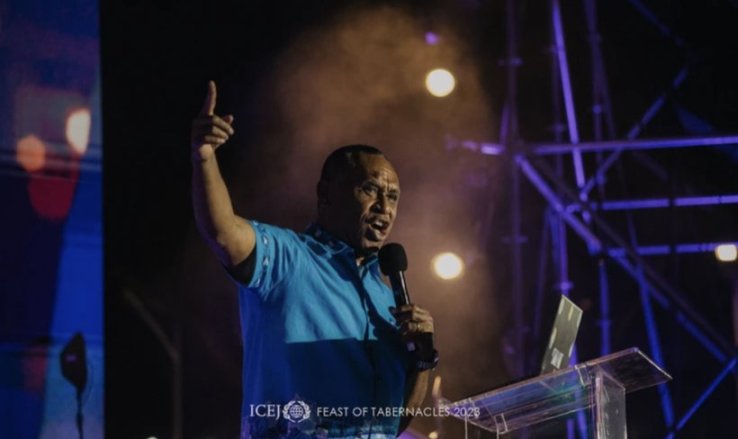
Celebrating in Israel. Inspiring address by Reverend Manasa Kolivuso from Fiji to the Christian visitors from around the world in Jerusalem.
We need to understand who our friends really are. ICEJ and many other Christian ministries exist today to be a blessing to Israel and the Jewish people, to break down barriers of the past in addition to crimes committed by “the Church” in the name of Jesus, and teach Christians about the proper role of Christians vis-à-vis Israel and the Jewish people. If we embrace all of the Tanach, the Old Testament, we must affirm that the Temple, for which we pray to be rebuilt daily, is and will be a house of prayer for all nations, not a Jewish synagogue.
From Israel with Love. Christians from all over the world, celebrating the Feast of the Tabernacle in Jerusalem.
While the Temple does not exist for now, the celebration of one of the three Biblical pilgrimage festivals by Christian gentiles from around the world should be celebrated. This brings us closer to the redemption that we – Jews and Christians – both pray and wait for. In fact, it’s a direct realization of the prophecy of our prophet, Zachariah, 14:16. Not coincidentally, Zachariah 14:16 is a cornerstone for ICEJ’s inspiration to organize the Feast decades ago.
Building bridges between Jews and Christians has its potholes. It’s not always easy. Sometimes it’s a theological version of a contact sport. But it’s not good enough for Jews, whether they are involved in or support such activities or not, to paint all Christians and all history of relations between Jews and Christians with a broad brush. People need to know what they’re talking about. Nuance matters. Not only was ICEJ one of the original and longest standing Christian organizations to set up shop in Jerusalem to be a blessing to Israel, specifically for and during the Feast, they proactively tell Christian participants that missionary activity is not appropriate or appreciated. Does that mean that each of the thousands of participants understand that completely or honor it? No, not necessarily. But ICEJ as an organization draws a line in the sand that they tell participants not to cross.
Sights and Sounds of Solidarity. The Feastof the Tabernacle is a huge statement of solidarity with Israel and the participants should be treated with respect and not subject to protest and spitting as took place on Tuesday when Orthodox Jews spat on and shouted at a group of Christian pilgrims who were walking in Jerusalem’s Old City .
In a recent Jerusalem Post Op Ed (26 September), David Parsons, Vice President and Senior Spokesman for ICEJ, recognized that Jews who object to the Christian presence and activities in Israel do so for many reasons, none of which are applicable to ICEJ:
“The protesters and those who back them have expressed doubts about our friendship. They are afraid it is a cover for missionary activity. Others question our motives for standing with Israel, saying we are just here out of guilt for past Christian antisemitism, or we want to bring back Jesus, or – worst of all – we are out to force the Apocalypse.”
Parsons assures onbehalf of the tens of millions of Evangelicals worldwidethat:
“…the International Christian Embassy Jerusalem has been refuting these claims for decades, both through our words and our benevolent deeds in the land.”
As unpleasant as it is to be the target of protests, he acknowledged that “it is not easy to turn attitudes around so quickly after centuries of Christian hostility and violence towards Jews. We realize the Jewish people went through a long, hard journey of exile among the nations over many centuries, and this involved much suffering. Regrettably, many of these travails were inflicted by Christians.”
Celebrating the Tabernacle. Christians from around the world come to Jerusalem every fall as they have been doing for the past three decades to celebrate the Feast of Tabernacles, sponsored by the International Christian Embassy in Jerusalem.
Sukkot is arguably the Jewish holiday with the widest roots among gentiles. It’s long known that when the Temple stood during Sukkot, Jews would bring 70 offerings on behalf of the 70 nations of the world.
In a recent conversation on the “Inspiration from Zion” podcast, Rabbi David Stav of the Orthodox Jewish organization Tzohar, noted that Christian support for Israel is a sign of redemption. Rabbi Stav specifically related to King Solomon building the Temple in Jerusalem, referring to it as a house of prayer for all nations, with gentiles bringing offerings to the Temple. Rabbi Stav also highlighted that this is part of Jewish prayer daily. Therefore it’s something that Jews need to understand and affirm as well, not just in meaningless prayer.
Commenting on recent Jewish protests and violent acts toward Christians, Rabbi Stav noted that Israel’s first Chief Rabbi, Rabbi Kook, said that to be Jewish is to love all humanity, to be a blessing and a light unto the nations. Judaism needs to care about the all people who, as we know, are created in the image of God.
The ICEJ is no longer the only embassy in Jerusalem, although for decades it was, serving as the face of international Chrisitan support for Israel. We celebrate each time a new country establishes an embassy in Jerusalem, and we pray today that more will. For decades the world did not recognize Israeli sovereignty to or Jewish history in any part of Jerusalem. We must gratefully acknowledge the role of the ICEJ in vigorously countering the hurtful prejudice against the Jewish state and celebrate together the Feast of Tabernacles.
About the writer:
Jonathan Feldstein - President of the US based non-profit Genesis123 Foundation whose mission is to build bridges between Jews and Christians – is a freelance writer whose articles appear in The Jerusalem Post, Times of Israel, Townhall, NorthJersey.com, Algemeiner Jornal, The Jewish Press, major Christian websites and more.
While the mission of Lay of the Land (LotL) is to provide a wide and diverse perspective of affairs in Israel, the Middle East and the Jewish world, the opinions, beliefs and viewpoints expressed by its various writers are not necessarily ones of the owners and management of LOTL but of the writers themselves. LotL endeavours to the best of its ability to credit the use of all known photographs to the photographer and/or owner of such photographs (0&EO).
During the past two decades, virtually every country in Europe, and many in the Western Hemisphere, have adopted a Holocaust memorial day, many inspired by the decision of the United Nations to do so in 2005. Quite a few have chosen to follow the example of the UN by commemorating the date of the liberation of Auschwitz death camp on January 27, 1945, but others chose dates that mark significant events in the history of the Shoah in their respective countries. In some cases, the choice is a reflection of the significance of specific Holocaust events for their societies, or the desire, or lack thereof, to emphasize the complicity of local Nazi collaborators.
Thus, for example, France chose July 16, the anniversary of the mass arrest in Paris in 1942 of 13,152 French Jews, who were deported to their deaths in Auschwitz by the local police. Similarly, Hungary chose April 16, the date of the initial orders for the ghettoization of Hungarian Jewry, the prelude to the deportation of 437,000 of them to Auschwitz in spring of 1944. Bulgaria, by contrast, chose March 10, the date on which the government revoked its original plan to deport the country’s entire Jewish population to Treblinka.
Murdered by Neighbors. Lithuanian militiamen in Kovno, Lithuania round up Jewish women in June-July 1941.
Other countries’ choices of the memorial day are a reflection of their attempts to distance themselves from Holocaust crimes. Thus, Estonia, which to date has done little to deal with its Holocaust past, and the complicity of its locals with the Nazis, chose January 27, which has no connection to Estonian history, since none of the local Jewish community was deported to Auschwitz. A more striking example of a desire to deflect attention from the highly significant and very extensive participation in the murder of their Jewish citizens by local collaborators is Lithuania’s choice of September 23, the date of the evacuation of the Vilna Ghetto, which was carried out by the Nazis. If the Lithuanians really wanted a date that expressed their self-reflection about their role in the Holocaust, they would choose October 28, when, in 1941, Lithuanians murdered approximately 10,000 Lithuanian Jews in the Ninth Fort in Kovno.
Those of us who are acquainted with the phenomenon of Holocaust distortion and are trying to combat it are well aware of the false Holocaust narrative created and promoted by successive Lithuanian governments. They have repeatedly attributed the mass murder of 212,000 Lithuanian Jews, as well as thousands of foreign Jews killed in Lithuania by local Nazi collaborators, almost exclusively to the German and Austrian Nazis.
A major reason these lies have persisted for decades has been the refusal of Israel to protest these falsehoods, a policy crafted by Prime Minister Benjamin Netanyahu to try to enlist the support of the new democracies of post-Communist Eastern Europe. Instead of objecting to the Lithuanians’ false narrative of the Holocaust, Netanyahu even praised their efforts to commemorate the Shoah during a state visit to Lithuania in 2018. No Israeli official has ever publicly criticized the Lithuanians’ refusal to admit the extensive participation of Lithuanians in the implementation of the Final Solution, not only in Lithuania, but even in neighboring Belarus, where a Lithuanian unit murdered at least 20,000 Belarussian Jews.
Heard Loud and Clear.No escaping their past, the representatives of the Lithuanian people heard in their parliament from an Israeli that almost the entire Jewish community was cruelly annihilated during the Holocaust by the Germans “and to a significant extent, by the local population.”
This policy apparently came to an abrupt and surprising end last week, when Dani Dayan, the chairman of Yad Vashem, addressed the Seimas, the Lithuanian Parliament, as part of the events of this year’s Holocaust memorial day on September 23. He began his highly emotional speech by mourning the destruction of the incredibly vibrant prewar Jewish life and culture that had earned Vilna the title of “Yerushalayim de-Lita,” – the Jerusalem of Lithuania.
He then continued by describing the scope and nature of the tragedy:
“Hundreds of thousands of Lithuanian Jews were murdered in this country by the Germans and their Lithuanian collaborators. Almost the entire Jewish community became extinct. The totality of the destruction of such a…remarkably vibrant Jewish community, almost like none other, annihilated so cruelly, so systematically during the Holocaust – and to a significant extent, by the local population.
Insane, poisonous antisemitic hatred eradicated an entire civilization – my civilization – here in your homeland…
We are encouraged by gradual but substantial progress made over the years in Lithuania… but, unfortunately, I must say that not yet enough progress has been made… a great deal remains to be accomplished. Our task will not be completed until this understanding… trickles down to the very last member of the Lithuanian civil society.”
Daring Dayan. It takes courage to stand up in a foreign country’s parliament and accuse their revered national heroes of being murderers but that is exactly whatDani Dayan, the chairman of Yad Vashem did when he addressed the Lithuania’s parliament, the Seimas. He specifically called out the names of those “heroes” who had a roll in the murder Jews during the Holocaust.
Dayan then broached one of the most sensitive issues in Lithuania regarding local Holocaust perpetrators, one that had never been broached by any Israeli official:
“An antisemite, especially a murderer of Jews, cannot be considered an ‘otherwise good person.’…For sure, he cannot be considered a hero. In addition to refraining from attributing public honor to such butchers, Lithuania must consistently acknowledge that many of the Lithuanian Jews massacred in the Holocaust died at the hands of their Lithuanian co-nationals, and that Lithuanians also took part in the extermination of Jews in neighboring countries.
Such recognition is obviously owed to the Jewish victims, but also, and probably even more, to the present and future generations of Lithuanians.”
Dayan then mentioned three specific cases of Lithuanian Holocaust perpetrators who have been glorified, and elevated to the status of national heroes, despite their role in the murder of Jews. “Such names as Noreika, Skirpa, and Krikstaponis do not add to the honor of your nation.”
He concluded his historic speech with the “El Malei Rachimim” prayer for the souls of the deceased, and received a loud ovation.
Shift in Attitude. Prime Minister Ingrida Šimonytė (center) seen here with Dani Dayan (2nd left), affirmed that the Government of Lithuania will continue to uphold zero tolerance towards any manifestations of anti-Semitism, Holocaust denial or disrespect for the victims of the Holocaust, and to adhere to the principles of restoring historical justice.
The question now remains whether Dayan’s bold and extremely moving speech will lead to a serious change in the government’s policy regarding the official historical narrative of the Shoah in Lithuania. It took France 50 years to accept responsibility for the crimes of the Vichy regime. Hopefully, Lithuania will not take that long. Without Israeli pressure, however, I am afraid nothing will change. That said, who knows? Perhaps one day Lithuania will commemorate the Shoah on October 28, instead of September 23.
Testimony of the Dead. The speech that needed to be made and the people that needed to hear it. Yad Vashem Chairman Dayan Address to Lithuania’s Seimas, 21 September 2023
About the writer:
Dr. Efraim Zuroff is the chief Nazi hunter of the Simon Wiesenthal Center and the director of the Center’s Israel Office and Eastern European Affairs.
While the mission of Lay of the Land (LotL) is to provide a wide and diverse perspective of affairs in Israel, the Middle East and the Jewish world, the opinions, beliefs and viewpoints expressed by its various writers are not necessarily ones of the owners and management of LOTL but of the writers themselves. LotL endeavours to the best of its ability to credit the use of all known photographs to the photographer and/or owner of such photographs (0&EO).
By Raymond Wacks Emeritus Professor of Law and Legal Theory
I am driving along a well-remembered highway in Randburg. It is 2005 – the last time I visited South Africa (where I was born and, as they say, bred). Randburg is an anonymous conurbation on the outskirts of Johannesburg. As a student, I had a holiday job here as a cashier in a supermarket.
But is this really Randburg? Formerly a whites-only area, I see only black faces. My supermarket has disappeared. The shopping mall is unrecognisable. I must have taken a wrong turn. Peering at the road sign, I am reassured. This is indeed Hendrik Verwoerd Drive.
Former Prime Minister Hendrik Verwoerd? In post-apartheid South Africa? Surely this architect of evil cannot still be celebrated 15 years after the demise of what he called ‘separate development’? While many towns and public places have been accorded new (or pre-existing) African names, several roads have been reborn to conform to the new ideology. Nelson Mandela features prominently, of course, but there are also streets dedicated to the memory of Che Guevara, Joe Slovo, and other revolutionary heroes.
Perhaps, I thought, policy had simply failed to catch up with principle. Nevertheless, it struck me as astonishing that Verwoerd should continue to be venerated. It was he who famously declared that his government’s role was ‘the preservation of the white man and his state’. Under his premiership, from 1958 until his assassination in 1966, apartheid was not only consolidated, but clothed in philosophical, cultural, and theological validation that drew on the seductive power of Afrikaner nationalism. He had, in fact, presided over the country’s break with Britain and the establishment of a republic. And, under his steely, cerebral leadership, the African National Congress was banned, and Nelson Mandela was sentenced to life imprisonment.
South Africa Out of Step. Under apartheid, blacks were separated by law from whites – including separate stairways.
WHAT IS ‘APARTHEID’?
Apartheid, it is frequently forgotten – or conveniently overlooked – was not merely racial segregation. It was an elaborate, intricate project, sustained by a doctrinaire philosophy applied by an authoritarian regime buttressed by draconian legislation. It relied on an unaccountable security force with sweeping powers, a largely enthusiastic legislature and a mostly pliant judiciary. The legal system was the creation of a white minority; the political system disenfranchised every ‘non-white’ person, and the law discriminated against them in almost every facet of social and economic life: employment, land, housing, education, sex and freedom of movement.
Deaths in detention and torture were systemic. ‘He slipped in the shower’ or ‘he jumped from the interrogation room window’ were the stock explanations offered by the security branch. Surveillance, intimidation, and police brutality were routine. Apartheid South Africa was the archetypal modern police state. The Broederbond, a secret, Calvinist, all-male society fostered Afrikaner interests. Jan Smuts described it as a ‘dangerous, cunning, political fascist organisation’.
The neo-Nazi nature of this totalitarian order was one of its fundamental components. I remember the day that Verwoerd’s successor, John Vorster, was elected. We university students greeted each other with mock Nazi salutes. He was detained in 1942 as a result of his membership of the pro-Nazi Ossewabrandwag, which supported Germany during the Second World War.
RESISTING INJUSTICE
There was, of course, a small minority of whites, including Afrikaners, who opposed the injustice of apartheid. A conspicuous example was the lawyer, Bram Fischer. Despite his impeccable Afrikaner antecedents (his father was judge president of the Orange Free State; his grandfather, a member of the cabinet) he championed the rights of the oppressed, defending Mandela in the notorious Rivonia trial of 1963-4. Enduring considerable personal suffering and sacrifice, he went underground to wage war against the iniquity of apartheid.
In 1966, he was convicted of furthering the aims of communism – a catch-all charge, since communism was defined to include ‘bringing about any political, industrial, social, or economic change… by the promotion of disturbance or disorder’ or ‘encouraging feelings of hostility between the European and the non-European races… the consequences of which are calculated to further… disorder’. The statute empowered the minister of justice to brand as a communist any person he decided fitted the description.
The writer (left) seen here with Nelson Mandela in 1991.
Fischer was sentenced to life imprisonment, during which he developed cancer. As a result of a fall, he fractured his neck and femur. He was partially paralysed and lost the ability to talk. Three months elapsed before the authorities permitted his transfer to hospital. He died soon thereafter. Ruthless inhumanity and petty vindictiveness were among the hallmarks of apartheid.
Nelson Mandela described Fischer as ‘one of the bravest and staunchest friends of the freedom struggle that I have ever known … displaying a level of courage and sacrifice that was in a class by itself’.
Issue was black and white. This area of the sea and beach was strictly reserved for South Africa’s white population.
KILLING OPPONENTS
The generosity of definition of the Suppression of Communism Act of 1950 was equalled by the Terrorism Act of 1967 which defined ‘terrorism’ as including anything that might ‘endanger the maintenance of law and order’. Life sentences in South Africa were exactly that. And the gallows were kept busy: between 1910 and 1989 more than 4,200 executions were carried out. About half of those met their end between 1978 and 1989 when the struggle against apartheid was at its peak.
The overwhelming majority of those put to death were black; many were political prisoners. At the end of July 1989, for example, a total of 283 prisoners were being held on death row at Pretoria Central Prison. Of these, 272 were black; 11 were white. In March 1988, 53 individuals were hanged for politically related crimes.
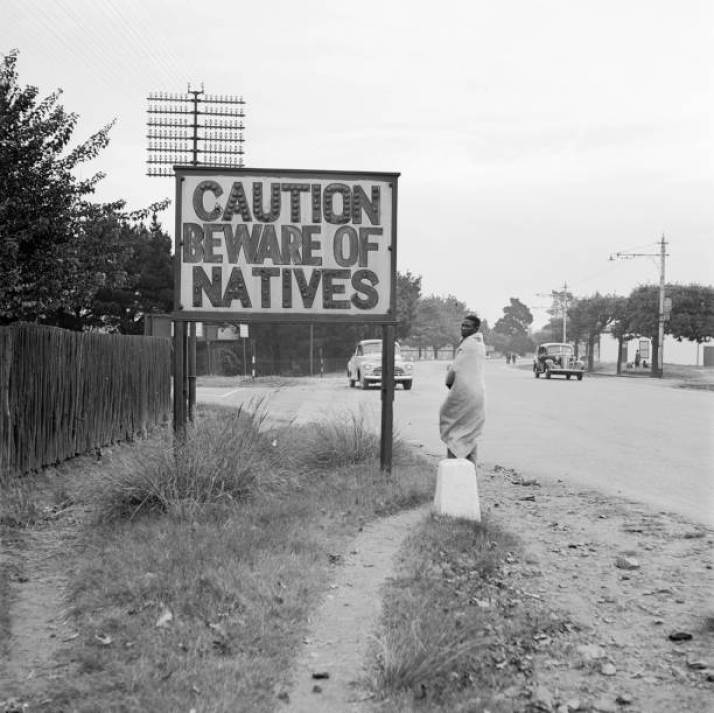
Sign of the Times. ‘Swart gevaar’ (Afrikaans for “black danger”) was an apartheid term skillfully used to sensitize the whites to fear the majority black African population as a dangerous threat.
APARTHEID STANDS ALONE
It hardly requires stating that injustice in our world is ubiquitous. But the abomination of apartheid was unique. The United Nations sought in 1973 to crystallise its essence by establishing it as a crime. According to the Apartheid Convention, the offence consists of inhuman acts committed for the purpose of maintaining domination by one racial group over any other, and systematically oppressing them.
The authors of the Convention, in pursuit of greater precision, provided a catalogue of the acts embraced by the crime, including murder, torture, inhuman treatment and arbitrary arrest of members of a racial group, legislation that discriminates in the political, social, economic and cultural fields, separate residential areas for racial groups, the prohibition of interracial marriages, and the persecution of opponents of apartheid.
The text captures the quintessential elements of apartheid as applied in South Africa – even though it drains it of much of the system’s malevolence and authoritarianism touched on above. And, despite the demise of apartheid in 1994, the offence lives on. Thus, in 1998, the Rome Statute of the International Criminal Court included apartheid, along with a catalogue of other wrongs such as murder, extermination, enslavement, and torture, as a crime against humanity.
Lawyers – and other pedants – may therefore claim that, notwithstanding the terms of the Apartheid Convention, and its explicit description of the South African situation, apartheid may exist anywhere. This folly has, of course, given rise to the preposterous contention that Israel is an ‘apartheid state’. The Jewish state is far from a paragon of virtue, but stigmatising it in this cavalier manner is itself a grotesque injustice – and an affront to those who endured the long years of torment and persecution in South Africa.
The subjectivity of suffering renders any attempt to calibrate injustice, difficult. It is specious and misconceived, however, to describe Israel as implementing apartheid – even by the standards of international law.
Where are the ‘inhumane acts… of an institutionalised regime of systematic oppression and domination’ by one race over another, as specified in the Rome Statute? Unlike blacks under apartheid, Israeli Arabs may vote, stand for election to parliament, be appointed to the judiciary. They have the freedom to attend any hospital, school, or university. They are not denied access to beaches, cinemas, theatres, libraries, sporting facilities. They may choose who to love. And it is reportedly easier for an Arab citizen of Israel to buy an apartment in Tel Aviv or Jerusalem than in Beirut, Bahrain, Kuwait, or Doha.
Signposted Society. Separate areas allocated for the different races. In this natural setting, Malays left and Europeans, meaning whites, to the right.
FINDING APARTHEID
Even Richard Goldstone, the former South African judge who headed the censorious inquiry into Israel’s ‘Cast Lead’ operation in Gaza, conceded that in Israel, ‘there is no apartheid. Nothing there comes close to the definition of apartheid under the 1998 Rome Statute…’ In an article in the New York Times in October 2011, he declared:
‘I know all too well the cruelty of South Africa’s abhorrent apartheid system, under which human beings characterised as black had no rights to vote, hold political office, use “white” toilets or beaches, marry whites, live in whites-only areas or even be there without a “pass.” Blacks critically injured in car accidents were left to bleed to death if there was no “black” ambulance to rush them to a “black” hospital. “White” hospitals were prohibited from saving their lives.’
Truth be Told. Richard Goldstone, the former South African judge who headed the censorious inquiry into Israel’s ‘Cast Lead’ operation in Gaza, conceded that in Israel, ‘there is no apartheid. Nothing there comes close to the definition of apartheid under the 1998 Rome Statute…’
The plight of those who live in Gaza and the West Bank is plainly different. Combating terrorism and maintaining security inevitably exact a high price. It cannot be denied that many Palestinians encounter hardship, privation, and indignity. But one might ask: Where is the sympathy and compassion for those who live in squalid camps in various Arab countries?
In Lebanon, for example, up to 400,000 Palestinian refugees live in dreadful social and economic conditions, many in overcrowded camps without essential utilities. They are effectively stateless. In 2001, the Lebanese parliament enacted legislation prohibiting Palestinians from owning property. The law also restricts their ability to work in several areas. While a ban on Palestinians holding most clerical and technical positions was terminated – provided they obtained temporary work permits – more than 20 high-level professions are denied to Palestinians. Moreover, Palestinians are not eligible for social security benefits. They are subject also to discrimination in respect of housing, property ownership, inheritance rights, and freedom of movement and residence.
SELECTIVE OUTRAGE
Where is the expression of outrage at these measures? Is Lebanon not an ‘apartheid state’? What about Syrian discrimination against Sunnis and Christians? Or its gulag of extermination camps in which thousands of political opponents are executed and tortured? Why is Israel singled out for censure and boycotts? Even in the case of Gaza and the West Bank it is mendacious and mischievous to describe Israeli policy as apartheid. Is the Israeli government really an ‘institutionalised regime of systematic oppression and domination by one racial group?’
Despite the political challenges, Palestinian West Bankers are carving out a future characterized by enterprise and ingenuity embodied in such projects as Rawabi (Arabic روابي meaning “The Hills”). The first planned city built by Palestinians in the West Bank, Rawabi is hailed as a “Flagship Palestinian enterprise”.
Whatever traction its advocates seek to gain from the South African archetype, the argument actually undermines the Palestinian cause. If there is injustice, let us call it by its name. Simplistic sloganeering is unhelpful. It is no less so than in the increasingly fashionable designation of ‘Holocaust’ to instances of barbarity that, while plainly heinous, fall far short of the depravity of the Third Reich. There are, of course, all too many examples of egregious attempts at genocide around the world but they are usually confined to a single nation and spring from internecine tribal or religious divisions. The ‘final solution’ – the wholesale extermination of the Jews (not merely in one country, but across all of Europe) – stands alone as a paradigm of inhumanity and iniquity. Let it be.
It is no answer to assert that these usages are merely metaphorical. Metaphor often enriches language. But it may also debase. The capricious abuse of ‘apartheid’, along with ‘massacre’, ‘genocide’, and ‘occupation’, has lamentably become commonplace.
Factual and linguistic precision is more likely to generate solutions to intractable political problems. Reckless rhetoric may appeal to the demagogue; it has no place in the quest for peace and justice.
I have just discovered – thanks to Google maps – that Hendrik Verwoerd Drive has been renamed. It is now Bram Fischer Drive.
About the writer:
Raymond Wacks, Emeritus Professor of Law and Legal Theory, graduated from Wits law school in 1969 having served on the Executive of the SRC and as President of the Law Students’ Council. He left South Africa in 1970 to pursue research at Oxford where he spent the next decade. In 1982 he returned to SA to take up the chair in public law at the University of Natal, Durban. Wacks is the author of fifteen books, several of which have been translated into more than a dozen languages on legal philosophy, privacy, and justice. He is also the co-author of five books, and editor of ten. His monograph, The Rule of Law Under Firewas published by Hart in 2021. Oxford University Press published the sixth edition of his Understanding Jurisprudence: An Introduction to Legal Theory in 2021, as well as the third edition of Law: A Very Short Introduction which appeared earlier this year.
While the mission of Lay of the Land (LotL) is to provide a wide and diverse perspective of affairs in Israel, the Middle East and the Jewish world, the opinions, beliefs and viewpoints expressed by its various writers are not necessarily ones of the owners and management of LOTL but of the writers themselves. LotL endeavours to the best of its ability to credit the use of all known photographs to the photographer and/or owner of such photographs (0&EO).
Unveiling the contours and contrasts of an ever-changing Middle East landscape Reliable reportage and insightful commentary on the Middle East by seasoned journalists from the region and beyond
Also available on YouTube@The Israel Brief – Simply click on the red subscribe button to receive alerts when a new report is posted.
What’s happening in Israel today? See from every Monday – Thursday LOTL’s The Israel Brief broadcasts and on our Facebook page and YouTube by seasoned TV & radio broadcaster, Rolene Marks familiar to Chai FM listeners in South Africaand millions of American listeners to the News/Talk/Sports radio station WINA, broadcasting out of Virginia, USA.
(1) PRAYERS AND PROTEST ON THE STREETS OF TEL-AVIV
Yom-Kippur in 1973 was a defining moment. Will Yom-Kippur 2023 prove to be another?
By David E. Kaplan
Coalition of Chaos. From an Israel of unity during the ‘73 Yom Kippur War, to one of disunity today.
As the Jewish state reaches out to former enemies striking glorious accords, within Israel today the present governing coalition sows inglorious discord. On the 50th anniversary of the Yom Kippur War, Israel finds itself again at war – with itself!
Government and the Gavel. Israel’s Supreme Court hears arguments in showdown over judicial curbs.
While seeking “to curtail the powers of the Supreme Court,” Netanyahu’s governing coalition is not only undermining the rule of law but also the country’s celebrated democratic system. In this pursuit, Israel finds itself in questionable company. “There are echoes,” asserts the writer “of the South African apartheid government’s crackdown on the judiciary,”
AN ISOLATED TEMPLE OF SUSTAINABILITY SHINES IN THE NEGEV
Experiencing a new resort that blends seamlessly into the crusty landscape and exquisite beauty of Israel’s southern desert
By Motti Verses
When people think of a relaxing and rejuvenating holiday, a desert would unlikely be the first place that comes to mind. Challenging this misguided mindset, follow travel expert Motti Verses as he indulges all his ‘senses’ in Israel’s Negevdesert at the Six Senses Shaharut – a luxury oasis providing the ultimate in relaxion in ultimate seclusion.
LOTL Cofounders David E. Kaplan (Editor), Rolene Marks and Yair Chelouche
To unsubscribe, please reply to layotland@gmail.com
While the mission of Lay of the Land (LotL) is to provide a wide and diverse perspective of affairs in Israel, the Middle East and the Jewish world, the opinions, beliefs and viewpoints expressed by its various writers are not necessarily ones of the owners and management of LOTL but of the writers themselves. LotL endeavours to the best of its ability to credit the use of all known photographs to the photographer and/or owner of such photographs (0&EO).