Look Who’s Watching

The announcement of Tel Aviv actress Shira Haas being in the running for an Emmy for best actress for her role in “Unorthodox”, reflects Israel’s impressive trajectory in the  global TV entertainment industry

By David E. Kaplan

The series about a Hasidic Jewish woman in Brooklyn, who flees to Berlin from an arranged marriage and is taken in by a group of musicians – until her past comes calling – Unorthodox has garnered eight Primetime Emmy Award nominations, including for Israel the Outstanding Lead Actress in a Limited Series.

image001 (27)
Unorthodox’s stars, Amit Rahav and Shira Haas.

Beyond the series success, the general meaning of the word  “Unorthodox” – “unconventional” or “out of the ordinary” –  may well explain Israel’s success in the entertainment industry.

The world seems to have an insatiable appetite for news on Israel. With more foreign correspondents per capita than any other country, Israel captures more media attention than China, India and all of Africa combined, yet few people know much about ordinary Israelis and their daily lives.

However, this is changing not by international news networks; but by popular Israeli TV shows that are emerging as one of the country’s hottest exports. An October 2019 Vanity Fair article headline ran:

Why Israeli TV Is Irresistible to American Producers

Already way back in 2015, Israel’s daily, Haaretz ran an article recording that “In Hollywood today, Israeli television formats are more popular than any other country’s TV show concepts.” Since then, Israel’s trajectory has soared even more. The country has exported more successful television formats  – the concept and branding of a show – than the vast majority of other foreign language countries.

Behind this success is the fascination of the complex and entertaining lives of Israelis that provides excellent material for first-rate shows.

Donna Rosenthal, an Israeli TV producer, Israel Radio reporter and Hebrew University lecturer writes that Israel offers “an intriguing mix of fervently modern and devoutly traditional Jews, Muslims, Christians and Druze. All live in colliding worlds. Some order Big Macs in the language of the Ten Commandments; others pray regularly; some only if their soccer team is losing.”

She described her street in Jerusalem, where “Israeli women wear army helmets, wigs and veils and iPhone headphones. Their heroes? Gal Gadot and digital entrepreneurs transforming the ancient land of prophets into the modern land of profits.”

This societal mix is the stuffing of Israel’s new wave of entertainment exports.

The Rise Of Raff

In the vanguard of this renaissance is acclaimed Israeli film and television director, screenwriter and writer Gideon Raff.  In 2009, the production of the Israeli television drama series Prisoners of War which he created, wrote and directed, became the country’s highest-rated drama of all time, and went on to win several Israeli television awards.

image002 - 2020-08-05T164451.631.jpg

Even before filming of Prisoners of War began, the rights to develop the American version of the series had been sold to 20th Century Fox Television based on the strength of the script alone. This resulted in the acclaimed American spy thriller series Homeland that is now onto its eighth season.

What overseas purchasers find most attractive about Israeli TV shows is not its relatively low acquisition costs but “the kind of stories they tell and the way they choose to tell them.” Raff notes that the whole first season of his Israeli show Prisoners of War cost less than a single episode of Homeland.  What followed has been a string of Raff successes that capture the mood, complexities and nuances of a Middle East embroiled in war, terrorism and religious schisms.  Raff’s deft directional touch, results in the shows being appreciated by audiences across the political and religious divide.

image003 - 2020-08-05T164608.304
Homeland’ Takes it Home. The cast and crew of Homeland, winner of the Outstanding Drama Series award at the 64th Primetime Emmy Awards in Los Angeles with Gideon Raff (left).

Preceding his 2019 The Red Sea Resort and limited miniseries of The Spy, both exciting espionage sagas imbedded in Israel’s history of existential threat and salvation, there were the two earlier mini-series successes, namely Tyrant, loosely based on the directorial Assad regime in Syria and Dig, an archaeological thriller set in Jerusalem.

While Raff’s Dig, which premiered in March 2015 with top stars Jason Isaacs and Anne Heche, the real stars were the sights of Jerusalem from the chases through the cobbled streets of the Old City to iconic restaurants in the city center. Uncovering the murder beneath the layers of religious subterfuge, it was also the beauty and eternal mysteries of Jerusalem that was unveiled to global audiences.

image004 - 2020-08-05T165053.169
Saga of Salvation. Inspired by true events, undercover agents open up a fake hotel to real tourists as a cover to help smuggle thousands of Ethiopian refugees to safety in Israel.

While Dig is fictional,  not so The Red Sea Resort and The Spy that reveal to global audiences the lengths Israelis have to go to in order to survive in a hard and unforgiving environment.

image005 - 2020-08-05T165220.551
The Spy. Sacha Baron Cohen in the Netflix drama about Israeli spy Eli Cohen, who infiltrated the Syrian government in the 1960s and was later executed.

Fauda Phenomenon

Thanks to the popularity of Netflix, original Israeli television shows  – with subtitles – are now gaining a global audience. One spectacular example in the espionage genre is the hugely successful Fauda, a show about Israeli special agents hunting West Bank terrorists in seasons 1 and 2 and in Gaza in Season 3.

The Israeli television series developed by Lior Raz and Avi Issacharoff,  draws on their experiences in the Israel Defense Forces and tells the story of Doron, a commander in a counter terrorism unit (Mista’arvim) as they pursue an  arch-terrorist known as “The Panther.”

The New York Times voted Fauda the best international show of 2017 and in 2018, the show took 11 Israeli TV Academy Awards, including best TV drama and best actor for Lior Raz. It has also been well received by the Palestinians for its brutal honesty. As William Delingpole explains in The Spectator, “Unlike most American drama series, Fauda isn’t there to make friends.”

image006 - 2020-08-05T165325.985
A Series For All Seasons. The cast in season 3 of the internationally successful “Fauda”.

He argues that the show’s popularity with Palestinians is because “it does them the service of taking them seriously…. treating them with grudging respect. Fauda takes the more respectful path of simply showing things as they are: two peoples, often so similar in appearance you cannot tell them apart, often fluent in each other’s languages, yet utterly and impossibly driven by a set of inimical values derived from a wholly different religious and cultural mind set. Sadly, this one is going to run and run.”

With no attempts to “sanitize”, “prettify” or “westernize” any of the cultures, this edge-of-the-seat entertainment with scenes of nail-biting tension, compelling character acting and location shots so atmospheric, “gives you a far clearer understanding of what’s really going on in the Middle East than anything you’ll ever see on the BBC,” concludes Delingpole.

Also in the Israeli military genre is the 2018 drama series When Heroes Fly ((Hebrew: Bishvila Giborim Afim) directed by Omri Givon. It is a 9-part dramatic thriller that centers on four friends – Israeli military veterans – who reunite for a rescue mission eleven years after having a bitter falling out. They travel to the Colombian jungle in search of Yaeli – the former lover of one man and sister of another.

image007 (85)
Flying High. Produced by Keshet International, the runaway hit won critical acclaim in Israel and went on to win the Best Series Award at the first Cannes Series Festival in April 2018.


A thriller, the series is also revealing social commentary on Israel’s ethnic tapestry. It shows how Israel’s mandatory army service is a melting pot that throws diverse groups together. This is how an Ashkenazi elite or Orthodox Jew can end up taking orders from a scrappy Mizrachi kid in a combat unit – and how these formative experiences bond them, remaining ‘brothers for life’.

In October 2018, Netflix acquired international broadcasting rights to the series which will also be adapted into an English version for the United States market.

Apart from the series shifting back and forwards in time, more significant is the new trend of venturing further afield geographically to tell a story.

This observation, writes British film critic Adrian Hennigan in Haaretz,   “is a sign of Israel’s burgeoning confidence as a producer of quality television.” While When Heroes Fly ventures to Columbia, another 2018 Israeli drama series, Miguel, also looks to South America as a location.

Created by Tom Salama and Daphna Levine, the series stars Ran Danker as a gay man that adopts a 5-year-old child, Miguel, from Guatemala. While the child finds it challenging adjusting to Israeli culture, the situation becomes far more complex when sixteen years later, father and son, return to Guatemala in search of Miguel’s biological mother.

The series has received many accolades. Recipient of a prize at the Canneseries,  The Financial Times praised the performance of Miguelito Sojuel playing the younger titular character:

Sojuel is outstanding as an orphan who stubbornly refuses to embrace the new life his adoptive father has planned out for him. Clutching a football as if his life depended on it, he dominates the screen with his defiant eyes: proud of who he is and steadfastly unmoved by gift-wrapped blandishments.”

Ordinary Israel Revealed

Shifting away from the popular genre of war and terror to more introspective facets of life in Israel; are a slew of popular satirical shows that finds resonance abroad.

Strange as it might sound, one of these hottest series is not about sex, drugs or violence but about Israel’s Haredim community.

Set in Jerusalem, Shtisel is a window into the world of ultra-Orthodoxy, examining the feelings, thoughts and everyday realities of those who have been born into a world of intense spirituality, that imposes rules and roles they are meant to dutifully abide by.

Most the drama plays out in Jerusalem’s religious, Internet-free neighbourhood of Mea Shearim, following the lives of rabbi Shulem Shtisel, the family patriarch; as well as those of the other members of his family.
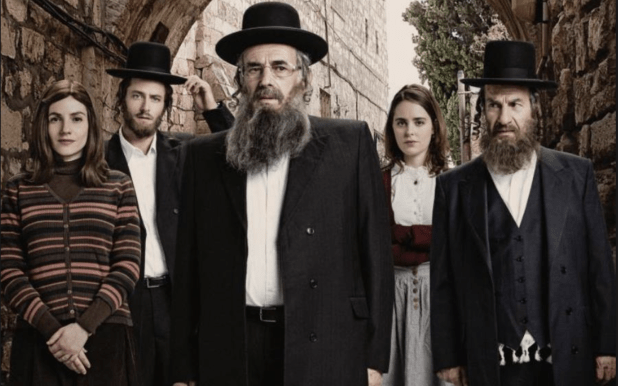
image008 (13)
Widening the Lens. Revealing the lifestyle of Israel’s Haredi community, “Shtisel,” has won millions of binge-watching Netflix viewers.

The series has been considered innovative for its treatment of the Orthodox Jews by stripping them of their political associations and depicting them as “ordinary” people as they genuinely seek love within the parameters of their ultra-religious lifestyle.

Dr Maurice Yacowar,  a retired film studies professor and author of “The Sopranos on the Couch”, has described the scripting of Shtisel as  “A TV Masterpiece from Israel”.

It is little wonder that in May 2019, it was announced that Shtisel has been renewed for a third season. One of its stars is Unorthodox Emmy nominee, Shira Haas.

image009 (57)
Class Collision. The romantic comedy “The Beauty and the Baker” with Rotem Sela and Aviv Alush ranks as one of the highest-rated scripted series ever in Israel.

Available on Netflix and Amazon Prime Video, The Baker and the Beauty ( In Hebrew Lehiyot Ita or “Being with Her”)  is an Israeli romantic-comedy series that follows the improbable love story between an international supermodel and a simple 28-year-old man working in his family’s pita bakery and who still lives with his parents. Their chance meeting and subsequent relationship faces many challenges, including the many people who’d like to see them separated. Lighthearted with impressive cinematography and talented acting, The Baker and the Beauty is an amusing watch.

Starring Rotem Sela and Avi Alush, the show comically exposes Jewish ethnic divisions in Israeli society through the attempted relationship of its two central characters  – the privileged Ashkenazi woman and her working-class Yemenite love interest.

In the United Kingdom where the series was broadcasted on Channel 4, The Daily Telegraph praised the series, writing that “aside from being a hugely entertaining, frivolous romantic comedy on the surface, the show has a grittier side which will appeal to a British audience.”

Israel has even made an indelible mark on the global teen market. Euphoria, which follows a group of high school students through their experiences of sex, drugs, friendships, love and trauma is an American teen drama television series based on the Israeli miniseries of the same name originally created by Ron Leshem, Daphna Levin, and Tmira Yardeni.  The series premiered on HBO on June 16, 2019 and in July 2019 it was renewed for a second season.

image011 (42)
Tel Aviv in Turmoil. In the world of asylum seekers in southern Tel Aviv, a young police investigator (Hani Furstenberg) tries to solve a complicated murder case.

What might further partly explain Israel’s successes in the global market are that many of its plots could so easily be taken directly from the headlines news. Two such entertaining examples are False Flag (or in Hebrew Kfulim)  believed to be loosely based on the 2010 assassination in Dubai of a senior Hamas militant Mahmoud al-Mabhough, and Asylum City  (in Hebrew “Ir Miklat”) which tackles African refugees, crime and murder in south Tel Aviv. Both expose how ordinary people get caught up in issues and principles that television audiences across the world can easily relate to.

image010 (53)
Twists & Turns. What first looks like a case of mistaken identity develops into a nerve-racking spy thriller ordinary Israelis are accused of kidnapping the Iranian Minister of Defence.

Compelling Characters

All the signs indicate that Israel’s impressive trajectory of its TV formats selling “like hotcakes” in major foreign markets will continue.

Suggesting explanations, Abigail Klein Leichman, writing in Israel 21c  notes fist and foremost that Israel’s TV shows are “character driven”. She sites Adam Berkowitz, co-head of the television department at Creative Artists Agency (CAA) in Los Angeles and president of the international TV Formats Conference, who praises the quality of Israel’s TV shows:

It’s the compelling characters that draw you.”

There is also a uniqueness about Israel television that reflects the entrepreneurial character of its citizens.

Just as Israelis in general comfortably embrace risk-taking and uncertainty,” writes Leichman, “the Israeli TV formats industry doesn’t hesitate to take a chance on innovative and unusual ideas. Once it has been proven in Israel, an out-of-the-box show format is an easier sell abroad.”

Further supporting Israel’s vanguard position are the “compelling storylines” of Israeli shows.

Walter Iuzzolino, head of British streaming service Walter Presents, told Bloomberg Business Week that Israeli TV formats are “emotionally poignant, three-dimensional, and never boring.”

How could they be boring as they reflect the daily drama of Israeli life?

The underlying themes of war, terror, religious and political conflicts – and the everyday challenge of getting along with neighbours of different cultures – provide endless enriching material for Israeli producers.

As Leichman poignantly points out, “The sometimes chaotic reality of Israeli life is reflected in the title of one of the biggest hits overseas, Fauda, which means “chaos” in Arabic. Action, humour, suspense, melodrama – our TV shows have it all.”

So while a small country, is it any wonder why Israel today is a powerhouse in global television?


While the mission of Lay of the Land (LotL) is to provide a wide and diverse perspective of affairs in Israel, the Middle East and the Jewish world, the opinions, beliefs and viewpoints expressed by its various writers are not necessarily ones of the owners and management of LOTL but of the writers themselves.  LotL endeavours to the best of its ability to credit the use of all known photographs to the photographer and/or owner of such photographs


The Arab Voice – August 2020

Arab writers from the Middle East and beyond, opine on a rapidly declining Lebanon losing the interest and sympathy of the world and on the behaviour and impact of two presidents – Donald Trump and Recep Tayyip Erdogan.


The World No Longer Trusts Lebanon

By  Farouk Youssef

Al-Arab, London, July 17

The Lebanese people look back at their bloody civil war and think of it as a walk in the park compared to the dark ages they are currently experiencing under Hezbollah’s rule. Hezbollah transformed Lebanon into a booby-trapped country that can be detonated on command in case its people refuse to comply with the group’s dictates.

The inconvenient truth is that Lebanon has lost the world’s empathy. What a tragic ending for a country that was once a tourism hotspot, a country with unparalleled natural beauty, a country of hardworking, law-abiding citizens who demonstrated nothing but tolerance and respect for each other. Even under the sectarian system and during the many years of heightened sectarian tensions, the Lebanese people managed to lead normal lives and conduct their affairs insulated from all the political turmoil. They did not have to sacrifice their civic rights. To some extent, they felt the possibility of “taming” the sectarian system and preventing it from separating them from the rest of the world. They hoped to transform that system into a distant memory. They hoped to turn sectarianism into diversity and bring an end to the discrimination in their society.

But what happened, unfortunately, is that Hezbollah took advantage of the sectarian system and made it a mantle for its malicious operations. It defrauded the Lebanese people in order to divide and conquer them. It resorted to scare tactics and intimidation to ensure a majority in parliament. It created a system of political patronage wherein all those not loyal to the movement are weakened and ousted.

image001 - 2020-08-04T103008.346
Anti-government protesters carry Lebanese flags and burn tires as they block the main highway in the north of Beirut during a protest over deteriorating living conditions. EPA

Sadly, all of this has been only a prelude to declaring hegemony over the Lebanese state so that even the Christian president of the republic became the candidate of Hezbollah alongside the Sunni prime minister, who was also chosen by Hezbollah. Given Hezbollah’s ultimate loyalty to the Islamic Republic of Iran and its supreme leader, its takeover of Lebanese politics means that Lebanon has become nothing more than a subsidiary of Iran.

The Lebanese situation has become confusing to the world in terms of how to look at it and deal with its crisis.

Is Lebanon simply a victim of its sectarian system?

Or is it a malicious actor implementing Iran’s agenda in the region? Lebanon has lost the flexibility to be a country that embraces its diversity and at the same time has lost its ability to convince the world that it is a democratic country open for global and regional dialogue.

image002 - 2020-08-04T103146.214
The International Monetary Fund (IMF) has projected that Lebanon’s economy will shrink 12% in 2020 amid the country’s worst economic and financial crisis in decades.

This is the primary reason for the world’s indifference to Lebanon’s current political and financial crises. The world no longer trusts Lebanon. Lebanon and Hezbollah have become one and the same. Thus, it can no longer claim to be a victim and beg for the mercy of world powers.

Lebanon, the country whose beauty for years managed to conceal the ugliness of Hezbollah, will have to face its ultimate dark fate alone.
– Farouk Youssef


Has The US Changed Or Just Its President?

By Muhammad Al-Sammak

Al-Etihad, UAE, July 17

Europe emerged from World War II in a deplorable state. The winter of 1947 was a tragedy unlike any other witnessed before. The continent was totally destroyed, and famine was widespread. The European economies collapsed. In France, inflation reached 49%. In Italy, it exceeded 62%. In Germany, the Allies did not leave a single city intact. Almost every major factory around the country was destroyed.

Across the ocean, the US was concerned with returning its soldiers from the battlefield in an effort to begin healing the wounds of those families that lost loved ones in the war. However, geopolitical developments soon imposed other priorities. Chief among them was rebuilding and rehabilitating Europe in an effort to curb the westward Communist advance coming from the Soviet Union.

Thus the famous Marshall Plan, named after the US secretary of state at the time, was born. Under the plan, the US provided $14.3 billion in direct aid to rebuild European economies between 1948 and 1952. The value of this amount in 2018 dollars is some $130 billion. The Soviet Union interpreted Marshall’s plan as an attempt to resurrect Germany. That is why Joseph Stalin hastened the acceleration of the Soviet takeover of Eastern Europe, including the eastern part of Germany.

The US responded with the creation of NATO. The goal of this alliance was to push the Soviet Union back east, to maintain an American presence on the continent and to ensure a continuation of the German defeat. This helped rebuild a new Europe, which evolved into today’s European Union.

Compare this experience with what we are witnessing today. Unlike the winter of 1947, US President Donald Trump, in the winter of 2017, announced a new policy based on the principle of “America First.” Under this principle, to which Trump adheres despite European and American opposition, the US has been seeking to reduce its financial commitments to NATO while imposing unprecedented taxes on European exports to America (for example, steel).

image003 - 2020-08-04T103635.737
The two presidents sowing seeds of mistrust among their allies, Trump and Erdogan (centre) at an earlier NATO gathering that descended into acrimony following Trump criticizing US allies.

Today, Trump is trying to reduce his country’s obligations to others while turning a blind eye to what is happening in Europe. But unlike his predecessors who saw the Soviet incursion into Czechoslovakia as a reason for grave concern, Trump views the Russian takeover of Crimea as a non-issue. He refuses to be drawn into any form of confrontation with the Russian Federation because that would come at the expense of America First.

In the winter of 1947, when the US approved the Marshall Plan, President Harry Truman was surrounded by legendary figures like George Marshall, George Kennan, Will Clayton and Adlai Stevenson, who were not only great advisers but also shrewd thinkers. They were academics, policymakers and seasoned diplomats.

Conversely, today’s White House is filled with staffers who have an insanely limited experience in international affairs. In order to fulfill his commitment to the Marshall Plan to restore life to Europe after the war, Truman had to pursue a policy of economic openness. As for Trump, his commitment to America First has led him to pursue a policy of isolation and seclusion, even with his closest neighbours, Mexico and Canada.

Hence, the question is: Has the US changed or is it only the president?

Muhammad Al-Sammak


The Sultan Who Trades In Religion

By Khalid Tashkndi

Al-Okaz, Saudi Arabia, July 11

Turkish President Recep Tayyip Erdogan tweeted last week that converting the Hagia Sophia Museum into a mosque is a prelude to the liberation of al-Aqsa Mosque. However, Erdogan’s tweet in Arabic dramatically differed from the one he posted in English, in which he explained that a section of the museum would be converted into a mosque, where anyone, including non-Muslim foreigners, would be welcomed. He then added: “With its new status, Hagia Sophia, the shared heritage of humanity, will continue to embrace everyone in a much more sincere and original way.”

image005 - 2020-08-04T103850.239
People, some wearing face masks, pray outside the Hagia Sophia museum in Istanbul on July 10, 2020 as they gather to celebrate after a top Turkish court revoked the sixth-century Hagia Sophia’s status as a museum, clearing the way for it to be turned back into a mosque. (AFP)

The stark difference between the contents of the two tweets is yet another reminder of Erdogan’s shameful deceit and cheap attempt to manipulate the emotions of millions of Muslims around the world. The goal of the first tweet was to draw an unsubstantiated link between Hagia Sophia and Al-Aqsa Mosque and position Turkey as the supposed “liberator” of both. The goal of the second tweet was to emphasize that the site would be open to all non-Muslims.

This paradoxical stance is nothing more than a desperate effort on behalf of Erdogan to save his continually declining popularity both at home and abroad.

To do so, he resorts to the mockery of Islam.

Khalid Tashkndi


*Translations by Asaf Zilberfarb.


While the mission of Lay of the Land (LotL) is to provide a wide and diverse perspective of affairs in Israel, the Middle East and the Jewish world, the opinions, beliefs and viewpoints expressed by its various writers are not necessarily ones of the owners and management of LOTL but of the writers themselves.  LotL endeavours to the best of its ability to credit the use of all known photographs to the photographer and/or owner of such photographs


The Crisis of Zionism

By Alex Ryvchin

When the French playwright Edmond Fleg attended Theodore Herzl’s Third Zionist Congress in Basel he marvelled at the scene. “I looked about me. What Jewish contrasts! A pale-faced Pole with high cheekbones, a German in spectacles, a Russian looking like an angel, a bearded Persian, a clean-shaven American, an Egyptian in a fez, and over there, that black phantom, towering up in his immense caftan, with his fur cap and pale curls falling from his temples.” Fleg saw the sum of Jewish exile in that room. Jews of east and west, religious and secular, wealthy and poor, radical and conservative. A people dispersed to every corner of the globe, just melting a little into their surrounds, adopting local language, custom, dress, before being rudely plucked out and sent onward by Kings and Empresses, warlords and clerics, to new lands and new privations.

image002 - 2020-08-03T130013.679
Time to Act. First Zionist Congress, held in Basel, Switzerland in 1897. Photo12/Universal Images Group via Getty Images.

The staging of a Zionist assembly in Europe, which unified Jews under the banner of a single idea, had been achieved through a combination of grandeur and old-fashioned community organising. At the First Zionist Congress, also held in Basel, in 1897, Herzl entered the Stadtcasino in black trousers, tails and a white tie, more befitting a matinee of La Traviata than a Jewish communal event. But in the days before, Herzl sat up with students addressing envelopes long into the night.

At that First Congress, the aim of Zionism was expressed as to establish a national home for the Jewish people in the Land of Israel secured under public law. Within this simple declaration stood an almighty mission. The Jews had not had a national home for two millennia. The Land of Israel had since 135 CE been known by another name, had seen multiple empires befall it, and had a meagre Jewish population of 25,000. Moreover, the mass physical return of a scattered and acculturated people to long vanquished lands was something that had never been achieved in human history.

It was this dreamy idealism that gave Zionism a magnetic quality. It animated Jewish youths to throw themselves into community activism and intellectual rumbles out of which organised Zionism grew. It led to the founding of grass-roots Zionist groups like Bilu (House of Jacob, come ye and let us go), whose members travelled from Russia to Palestine and established agricultural settlements. It compelled the likes of Chaim Weizmann to spend his student days in Germany as a member of another Zionist group, the Verein, throwing his humble stipend into sausages and beer while raucously debating Zionism, socialism, nationalism and internationalism in cafes until the wee hours.

And it prompted the writer Israel Zangwill to lambast the Jewish establishment for holding back the progress of Zionism to the detriment of the suffering Jewish masses. Zangwill thundered to the Jewish poor in London’s East End, “we are supposed to pray three times a day for the return of Jerusalem, but, as soon as we say we want to go back, we are accused of blasphemy!”

When this generation of Jewish activists encountered the pamphlets of thinkers like Leon Pinsker and Herzl their minds were instantly seared and permanently changed. How could a vigorous young Jew coming of age in a time of unsparing brutality towards Jews, be unmoved by Pinsker’s illustration of their stateless people wandering the earth as “a ghost-like apparition of a living corpse … living everywhere but nowhere in the correct place?” Or Herzl’s functional oratory that promised, “the Jews who wish for a state will have it. We shall live at last as free people on our own soil and die peacefully in our own homes.”

Not only was Zionism exciting and radical, world events conspired to make it a matter of life and death. Jews were looted, raped and slaughtered across Russia in 1881 and 1905, in Fez in 1912 and in Shiraz in 1910. This turned Zionism from a rising ideal into an urgent humanitarian mission.

image004 - 2020-08-03T130627.086
Poetic Warnings. Although Hayim Nachman Bialik’s later writings became more universal in outlook, it was his “In the City of Slaughter” written in response to the Kishinev pogrom that proved such a powerful statement of anguish at the situation of the Jews of Europe.

The Kishinev pogrom of 1903, while comparatively less bloody than some of the others of the time, was chronicled so graphically it caused deep shame in the Jewish world. The poet Hayim Nachman Bialik wrote:

in the dark corners of Kishinev, crouching husbands, bridegrooms and brothers peering through the cracks of their shelters, watching their wives, sisters, daughters writhing beneath their bestial defilers, suffocating in their own blood, their flesh portioned out as booty.”

The New York Times reported:

 “the scenes of horror were beyond description … the streets were piled with corpses and wounded.”

After Kishinev, an editorial of The American Hebrew noted that “American Zionism had come of age,” while a Christian speaker at a Zionist meeting at Cooper Union declared, “all efforts must be made to establish a Jewish commonwealth.” Zionism offered Jews an escape from Kishinev, both physically and psychologically.

image003 - 2020-08-03T130447.745
Hunting Season. Jews were the prey as seen in this photograph taken following the Kishinev pogrom in 1903, when 49 Jews were murdered following a ‘blood libel’ against the Jewish community. Here, the victims are laid out wrapped in prayer shawls prior to burial (public domain)

Any doubt about the necessity of Zionism dissipated as the Holocaust descended onto Europe. As David Ben-Gurion noted, “what Zionist propaganda could not do,” being to fully reveal Jewish self-delusion and vulnerability, “disaster has done overnight.”  The surviving Jews, absurdly warehoused in displaced persons camps in Europe several years after the defeat of Nazism, yearned to locate the ruins of their families and rebuild lives away from European antisemitism. “Palestine is definitely and pre-eminently the first choice” for resettlement, Earl Harrison, President Truman’s envoy for refugees, reported.

The creation of Israel in May 1948 did nothing to dim Jewish interest in Zionism. The establishment of the state may have been the practical fulfilment of the Basel vision, but much work remained. There was the immediate defence of the state against invasion, rescue missions for imperilled Jews, the upbuilding of a society, and the pursuit of peace with Arab neighbours once war subsided. In a sense, Zionism became more important as the Jewish world unified behind creating a society worthy of the two millennia intermission.

image001 - 2020-08-03T130155.178
Rebirth of a Nation. David Ben-Gurion declaring on the 14 May 1948 the state of Israel with the portrait of Hertzl above.

For diaspora communities, there were governments to be lobbied to achieve recognition of Israel, public opinion to shape, humanitarian aid to raise. Zionist organisations like the Jewish National Fund and Women’s International Zionist Organization and a kaleidoscope of others weren’t simply folded into the Jewish State in 1948, they redoubled their efforts.

There were trees to plant to cultivate the land, university faculties to endow, lone soldiers to support, victims of terror to assist, millions of Soviet, African and Middle Eastern Jews to rescue and absorb. All of this deepened the investment of diaspora Jews in the Zionist project. No one wanted to miss out on history in the making and if Aliyah was impracticable, membership of Zionist organisations, political activism and fundraising enabled diaspora Jews to be active players in the extraordinary story of Jewish rehabilitation and national rebirth.

For Jews who had either lapsed in their religious observance or, like the vast majority of Soviet emigres, were never religious to begin with, Zionism offered the Jewish communal pride, feelings of belonging, and opportunities for learning and debate, previously only to be found in religion.

A senior Israeli diplomat once told me that Zionism was his religion. It is the sort of comment that would instantly be misconstrued as amounting to worship of settlements or prayers at the altar of Bibi. But I immediately understood what he meant. He was immersed in the story of Zionism, believed with perfect conviction in its justness and necessity, was inspired by it, and compelled to act civically and humanely by its teachings. He wished to convey the wondrous stories of Zionism to his children – Weizmann’s experiments with acetone, Herzl’s awakening at the Dreyfus Trial, the magical moment on 29 November 1947 when Jews worldwide realised they would get their state. This diplomat wanted his children to imbibe these stories as he had, so that they too would grow up connected to their Jewishness, know who they are, remain strong in the face of aggressors, and proud in the knowledge that they belong to a people of vision and fortitude.

image006 - 2020-08-03T130317.330
French Injustice. The Dreyfus trial in 1894 known in France as “L’Affaire”, come to symbolise modern injustice and remains a prime example of a conspired miscarriage of justice and antisemitism.

Yet the price of Israel’s incredible success is that the very imperatives that drew Jews to Zionism – state-building, rescue of Jewish communities, urgent defence, are now seemingly gone, meaning there is much less to connect a young Jew of Johannesburg, Sydney or Toronto to a national project playing out on the edge of the Mediterranean Sea, currently lacking towering figures and spellbinding moments.

The solution is a deeper understanding of what Zionism means and what it truly represents. Zionism, at its core, has always been about rights. Yes, Zionism sought a national home for the Jewish people. But why? To protect the most fundamental right of all, the right to live. Zionism remains, through its support for a strong Jewish state and its ethos of Jewish self-help, the greatest bulwark against antisemitism. And it was Zionism that attained recognition that the Jews are a people and thus possess the right to self-determination. As Churchill observed, “the Jewish people should know they are in Palestine as of right and not of sufferance.”

History shows that the most basic rights extended to other peoples have to be hard won and vigilantly defended when it comes to the Jews. Zionism represents that bundle of rights that the Jews have secured and will never relinquish. The right to a place of refuge from murderous hatred. The right to a national centre for the preservation and enlargement of Jewish cultural, scholarly and scientific contributions. The right for Jews, like all other nations, to freely determine their own political status.

image005 - 2020-08-03T130834.532
The Knesset. After 2000 years of exile and persecution, the Jewish parliament stands proudly in Jerusalem as a functional symbol of Jewish nationhood.

When expressed as the embodiment of Jewish rights, Zionism soars above party politics and the acrimony of policymaking in modern Israel, and it correctly presents anti-Zionism as a campaign to strip Jews of their rights. But if Zionism loses a clear purpose, it will be swept away by more emotionally gratifying offerings, which have the capacity to deliver absolute ruin.


About the writer:

Alex-Ryvchin.jpgAlexander (Alex) Ryvchin is an Australian writer, advocate, commentator, and lawyer. A former spokesman for the Zionist Federation UK, Ryvchin’s writings on the Arab-Israeli conflict and Jewish history have been published in numerous international newspapers including The Australian, The Sydney Morning Herald, The Guardian, The National Post and The Jerusalem Post. Ryvchin is a regular columnist for The Spectator.


While the mission of Lay of the Land (LotL) is to provide a wide and diverse perspective of affairs in Israel, the Middle East and the Jewish world, the opinions, beliefs and viewpoints expressed by its various writers are not necessarily ones of the owners and management of LOTL but of the writers themselves.  LotL endeavours to the best of its ability to credit the use of all known photographs to the photographer and/or owner of such photographs


Unbreakable Bonds

The Relationship between the USA and Israel

By Lay of the Land USA correspondent

Away from the feuding in American politics – a matter for Americans themselves to determine and decide as they will in November’s upcoming election  – President Trump’s steadfast support for Israel has been reassuring and much appreciated. At a time when Israel faces existential threats and is not short of enemies committed to its destruction, it is reassuring to Israelis as well as Jewish communities around the world that the Jewish state enjoys the solid support and friendship of the United States not only in word but indeed.

There is only ONE Israel and we all know what befell the Jews when there was NO Israel!

image003 - 2020-08-02T154104.516
Unshakable Ties. During the meeting with President Reuven Rivlin, US Secretary of State, Mike Pompeo Pompeo said that he is sure that “you know that Israel has no better friend than the United States.”

Appreciation of this enduring support and friendship, was warmly evident in a recent address by leading businessman and philanthropist, Simon Falic at a gathering of Christian Zionists to honor the US Secretary of State, Mike Pompeo. The indefatigable Secretary of State has been in the forefront of  championing President Trump’s vision for peace in order to “achieve enduring security, freedom and prosperity for both sides.”

1596370110270blob
Simon Falic stressing the unbreakable bond between the US and Israel.

“Judeo Christian values are ingrained in the United States of America,” began Falic. “For many of us, one of the most significant events in the last century was the establishment of the State of Israel and the return of the Jewish people to our ancestral homeland.  I believe, as so many of you, that this historical event was decreed by the heavens. The destinies of the United States and Israel are intertwined.”

Unbreakable Bonds3.png


Stressing the familial nature of the relationship, Falic said that  “while our common enemies refer to the United States as the ‘big Satan’ and Israel as the ‘little Satan’, I think it is more like we are the big brother and Israel the little brother.” Evidence of this was  “President Truman’s recognition in 1948 of the establishment of the State of Israel, to 1973 during the Yom Kippur war, when President Nixon sent desperately needed weapons to allow Israel to defend herself and survive the Arab onslaught and then from the billions of dollars in aid over the years to President Trump’s recognition of Jerusalem as the eternal and united capital of Israel  and the recognition of Israel’s sovereignty of the Golan Heights.”

image001 - 2020-08-02T154921.875
Strong Ties. Simon Falic, Chairman of Duty Free Americas at the ceremony presenting Israeli President Shimon Peres the Congressional Gold Medal in 2014. The medal, designed and struck by the United States Mint, recognizes and honored the late President Peres for maintaining strong bilateral relations between Israel and the United States and was the first Congressional Gold Medal to be awarded to a sitting President of Israel. (Photo: Shmuel Lenchevsky/Dov Lenchevsky)

Through this all, “big brother has always been there for little brother.”

Stressing the Biblical ties to the land, Falic said, “The Jewish people returning to live in Israel after 2000 years in exile is based on something far more meaningful than any partition plan, any arbitrary division of land, or any political decision that granted Jewish survivors of World War II a place of refuge. It is essentially tied to the Bible. Without this perspective, people inevitably miss the entire story that leads to mistakes politically.

“Time and again, leaders from across the globe adopt definitive positions about what is best for Israel and how to move the peace process forward. Yet, these ideas never worked. They insisted on imposing a solution without seriously considering and ignoring the fact that Israel is surrounded by enemies who vow to destroy this sliver of Holy Land that could fit into Lake Michigan.  Israel and her people alone will have to face and deal with the consequences, as the Oslo accords have taught us.  The mindset of the Arab world is that they can lose 99 wars with Israel – but all they have to do is win the 100th.”

Warning against failure to take advantage when destiny provides a window of opportunity, Falic recounted of the telegram, President Truman’s Chief of Staff, General George Marshall wired on May 13th, 1948, to David Ben Gurion “stating that if he declared an independent state of Israel, five Arab armies would attack and within 48 hours and not one Jew in the land would be left alive.  The rest is history.”

This same warning of fearing the worst and hence counselling inaction, occurred before President Trump announced the move of the U.S. Embassy to Jerusalem. “He was also warned by his Generals that there will most likely be a violent reaction around the world to US interests.”

And once again “The rest is history”.

This pattern of warning and suggested caution was to again repeat itself with President Trump’s “recognition of Israel’s sovereignty of the Golan Heights.  We can only imagine what would be the situation today if Israel had not conquered the Golan Heights from Syria in the Six-Day War of 1967 and held in the Yom Kippur War of 1973.  Today, ISIS, the Syrian and Iranian regimes and the Russians would be overlooking the Sea of Galilee.”

Looking to Pompeo, and with a warm smile, Falic exclaimed:

“You are now being part of Israel’s History.”

Exposing European hypocrisy of singling out Israel for selective opprobrium, Falic drew attention to last year’s European Union Court of Justice, when “all 15 judges unanimously ruled, that all products made by Jews in Judea and Samaria, or what they refer to as occupied territory, must be labeled as products made in “occupied territory”.  There are close to 100 conflicts and disputes around the world regarding borders and territories, including Cyprus that is occupied by Turkey, but only Israeli products made by Jews, were singled out. Europe destroyed and eliminated century’s old Jewish communities and today they pursue Israel and the Jews in their courts and in diplomatic circles. The primary product that was part of this European’s court decision, was a wine called Psagot. Psagot is the “poster boy” of the BDS movement.


Unbreakable Bonds1
Taste Of Ancient Israel. The Psagot winery is located in the northern region of the Jerusalem mountains, an area ripe with remnants of biblical-era vineyards and wineries. 


My family and I are partners in this winery.  We invested in Psagot over 10 years ago – against the advice of other investors and wine experts. We were told that while the wine is excellent, it is in a disputed area that one day might be part of a negotiated agreement and Jewish life and business there will be eliminated.

image004 (22)
Psagot winery. During the vineyard’s construction, a coin dating back to the Great Revolt of (66–73 CE) was discovered where its front face is stamped with the words “For Freedom of Zion” and adorned with a vine leaf, while the back face reads “Year Two” (a reference to the Revolt) alongside an image of an amphora – an ancient container used for storing wine. This coin appears on the label of each bottle of Psagot wine.

Ironically, these naysayers encouraged and emboldened us, even more, to invest to help establish Jewish life and business after 2,000 years.  Next to the vineyards is a cave and press where wine was produced and stored during the time of the Second Temple. An ancient coin of Judea was found in the cave, and today a replica of that coin appears on many of our bottles.  Psagot was a small unknown boutique winery producing 40,000 bottles per year. Today, after winning many prestigious wine awards in France and London, we produce 400,000 bottles per year.

image002 - 2020-08-02T155135.095
Shared Values, Common Destinies. US Secretary of State Mike Pompeo waves as he speaks at the 2019 American Israel Public Affairs Committee (AIPAC) policy conference, at Washington Convention Center, in Washington, Monday, March 25, 2019 (AP Photo/Jose Luis Magana)

“Secretary of State Pompeo, only one week after the despicable decision of the European court, you publicly announced the State Department’s determination that the establishment of Israeli civilian settlements in the West Bank is not categorically inconsistent with International law. Your official announcement is widely referred to in Israel as the “Pompeo Doctrine”.  I don’t think you really know how loved and respected you are in Israel.”

1596370206896blob
Simon Falic (right) with Pastor John Hagee, founder and chairman of the Christian United for Israel (CUFI) organization.

Reminding his Christian Zionist audience of the strong connection the Jewish people have with the land of Israel “where Abraham, Isaac, Sara, Leah, Rivka, and Rachel, walked, lived and are buried,” Falic concluded with  “Secretary of State, Mike Pompeo, and to all our Christian Zionist friends, “May G-d bless you and protect you. May G-d make his face shine upon you and treat you with grace. May G-d lift his face toward you and grant you peace.”

In a world currently plagued not only of a virus but one of uncertainty, it is reassuring that we have certainty on this critical issue – the unbreakable bond between the USA and Israel.

1596370333561blob
Simon Falic flanked by his wife, the Honorary Life President, WIZO USA Jana Falic (left) and Nili Falic, Chairman Emeritus, Friends of the IDF (FIDF).


While the mission of Lay of the Land (LotL) is to provide a wide and diverse perspective of affairs in Israel, the Middle East and the Jewish world, the opinions, beliefs and viewpoints expressed by its various writers are not necessarily ones of the owners and management of LOTL but of the writers themselves.  LotL endeavours to the best of its ability to credit the use of all known photographs to the photographer and/or owner of such photographs